Skip to content · ⁨الانتقال إلى المحتوى⁩

Analytical techniques · ⁨التقنيات التحليلية⁩

A-Level Chemistry · ⁨A-Level الكيمياء⁩ · Topic 37 · ⁨الموضوع 37⁩

Video lesson for this topic · ⁨درس فيديو لهذا الموضوع⁩ Open the video page · ⁨افتح صفحة الفيديو⁩
8:06

التقنيات التحليلية (A2): الرنين المغناطيسي النووي (NMR)

هناك سبع جزيئات مختلفة. كل منها يحتوي على خمسة ذرات كربون، وعشرة ذرات هيدروجين وذرة أكسجين واحدة، وكلها تحتوي على مجموعة كربونيل. قم بوزنها في جهاز مطياف الكتلة…

English narration · English + 中文 subtitles burned in · ⁨سرد باللغة الإنجليزية · ترجمة مدمجة بالإنجليزية + الصينية⁩

37.1

Thin-layer chromatography · ⁨الكروماتوغرافيا الطبقي الرقيق⁩

Syllabus · ⁨المنهج⁩
English
  1. describe and understand the terms (a) stationary phase, for example aluminium oxide (on a solid support) (b) mobile phase; a polar or non-polar solvent (c) $R_{\text{f}}$ value (d) solvent front and baseline
  2. interpret $R_{\text{f}}$ values
  3. explain the differences in $R_{\text{f}}$ values in terms of interaction with the stationary phase and of relative solubility in the mobile phase
العربية
  1. وصف وفهم المصطلحات التالية: (أ) الطور الثابت، على سبيل المثال أكسيد الألمنيوم (على دعامة صلبة) (ب) الطور المتحرك: مذيب قطبي أو غير قطبي (ج) قيمة $R_{\text{f}}$ (د) مقدمة المذيب وخط الأساس
  2. تفسير قيم $R_{\text{f}}$
  3. شرح الفروق في قيم $R_{\text{f}}$ من حيث التفاعل مع الطور الثابت وقابلية الذوبان النسبية في الطور المتحرك

Source: Cambridge International syllabus · ⁨المصدر: منهج كامبريدج الدولي⁩

English

Chromatography 色谱 separates a mixture using two "phases" — one that stays still and one that moves. In thin-layer chromatography 薄层色谱 (TLC):

  • the stationary phase 固定相 stays still (for example aluminium oxide on a plate).
  • the mobile phase 流动相 moves (a polar or non-polar solvent that travels up the plate).
  • the baseline 基线 is the starting line where the spots are placed; the solvent front 溶剂前沿 is the highest level the solvent reaches.

The $R_{\text{f}}$ value compares how far a spot moves with how far the solvent moves:

$$R_{\text{f}} = \frac{\text{distance moved by the spot}}{\text{distance moved by the solvent front}}$$

It is always between 0 and 1. A substance that sticks more strongly to the stationary phase, or is less soluble in the mobile phase, moves less and has a smaller $R_{\text{f}}$.

العربية

الكروماتوغرافيا تفصل الخليط باستخدام "مرحلتين" — واحدة ثابتة وأخرى متحركة. في الكروماتوغرافيا الطبقي الرقيق (TLC):

  • الطور الثابت يبقى ساكناً (على سبيل المثال أكسيد الألومنيوم على لوحة).
  • الطور المتحرك يتحرك (مذيب قطبي أو غير قطبي يتسلق اللوحة).
  • الخط الأساسي هو نقطة البداية حيث تُوضع البقع؛ جبهة المذيب هي أعلى مستوى يصل إليه المذيب.

قيمة $R_{\text{f}}$ تقارن مدى تحرك البعة مع مدى تحرك المذيب:

$$R_{\text{f}} = \frac{\text{distance moved by the spot}}{\text{distance moved by the solvent front}}$$

دائماً ما تكون بين 0 و1. المادة التي ترتبط بشكل أقوى بالطور الثابت، أو تكون أقل ذوبانية في الطور المتحرك، تتحرك مسافة أقل ولها قيمة $R_{\text{f}}$ أصغر.

لوحة TLC بها خط أساسي، وجبهة مذيب، وبقعة تحركت جزءاً من الطريق للأعلى، مع تحديد مسافات البعة والمذيب
الكروماتوغرافيا الطبقي الرقيق: قيمة $R_\text{f}$ هي المسافة التي تحركتها البعة مقسومة على المسافة التي تحركتها جبهة المذيب

لوحة TLC مطورة تتوهج تحت ضوء الأشعة فوق البنفسجية *لوحة TLC حقيقية تحت الضوء الأشعة فوق البنفسجية: كل بقعة مضيئة هي مكون مفصول من الخليط
Explore · ⁨استكشف⁩

TLC route · ⁨مسار TLC⁩

Follow a spot up a plate and use Rf to identify substances. · ⁨تتبع بقعة لأعلى لوحة واستخدام Rf لتحديد المواد.⁩

Vocabulary · ⁨مفردات⁩ Train · ⁨تدريب⁩
English العربية
chromatography/krəʊməˈtɒɡrəfi/ الكروماتوجرافيا
thin-layer chromatography/θɪn ˈleɪə krəʊməˈtɒɡrəfi/ الكروماتوغرافيا الطبقي الرقيق (TLC)
stationary phase/ˈsteɪʃənəri feɪz/ الطور الساكن
mobile phase/ˈməʊbaɪl feɪz/ الطور المتحرك
baseline/ˈbeɪslaɪn/ الخط الأساسي
solvent front/ˈsɒlvənt frʌnt/ واجهة المذيب
gas/liquid chromatography/ɡæs ˈlɪkwɪd krəʊməˈtɒɡrəfi/ الكروماتوغرافيا الغازية/السائلة
retention time/rɪˈtenʃn taɪm/ وقت البقاء
37.2

Gas/liquid chromatography · ⁨الكروماتوغرافيا الغازية/السائلة⁩

Syllabus · ⁨المنهج⁩
English
  1. describe and understand the terms (a) stationary phase; a high boiling point non-polar liquid (on a solid support) (b) mobile phase; an unreactive gas (c) retention time
  2. interpret gas/liquid chromatograms in terms of the percentage composition of a mixture
  3. explain retention times in terms of interaction with the stationary phase
العربية
  1. وصف وفهم المصطلحات التالية: (أ) الطور الثابت: سائل غير قطبي عالي الغليان (على دعامة صلبة) (ب) الطور المتحرك: غاز غير متفاعل (ج) زمن الاحتفاظ
  2. تفسير مخططات الكروماتوغرافيا الغازية/السائلة من حيث التركيب المئوي للمخلوط
  3. شرح أوقات الاحتفاظ من حيث التفاعل مع الطور الثابت

Source: Cambridge International syllabus · ⁨المصدر: منهج كامبريدج الدولي⁩

English

In gas/liquid chromatography 气液色谱 (GLC):

  • the stationary phase is a high-boiling-point non-polar liquid on a solid support.
  • the mobile phase is an unreactive carrier gas.
  • the retention time 保留时间 is how long a component takes to pass through.

The area of each peak gives the percentage of that component in the mixture. A component that interacts more with the stationary phase has a longer retention time.

العربية

في الكروماتوغرافيا الغازية/السائلة (GLC):

  • الطور الثابت هو سائل غير قطبي عالي درجة الغليان على دعامة صلبة.
  • الطور المتحرك هو غاز حامل غير متفاعل.
  • زمن الاحتفاظ هو الوقت الذي يستغرقه المكون للمرور عبر العمود.

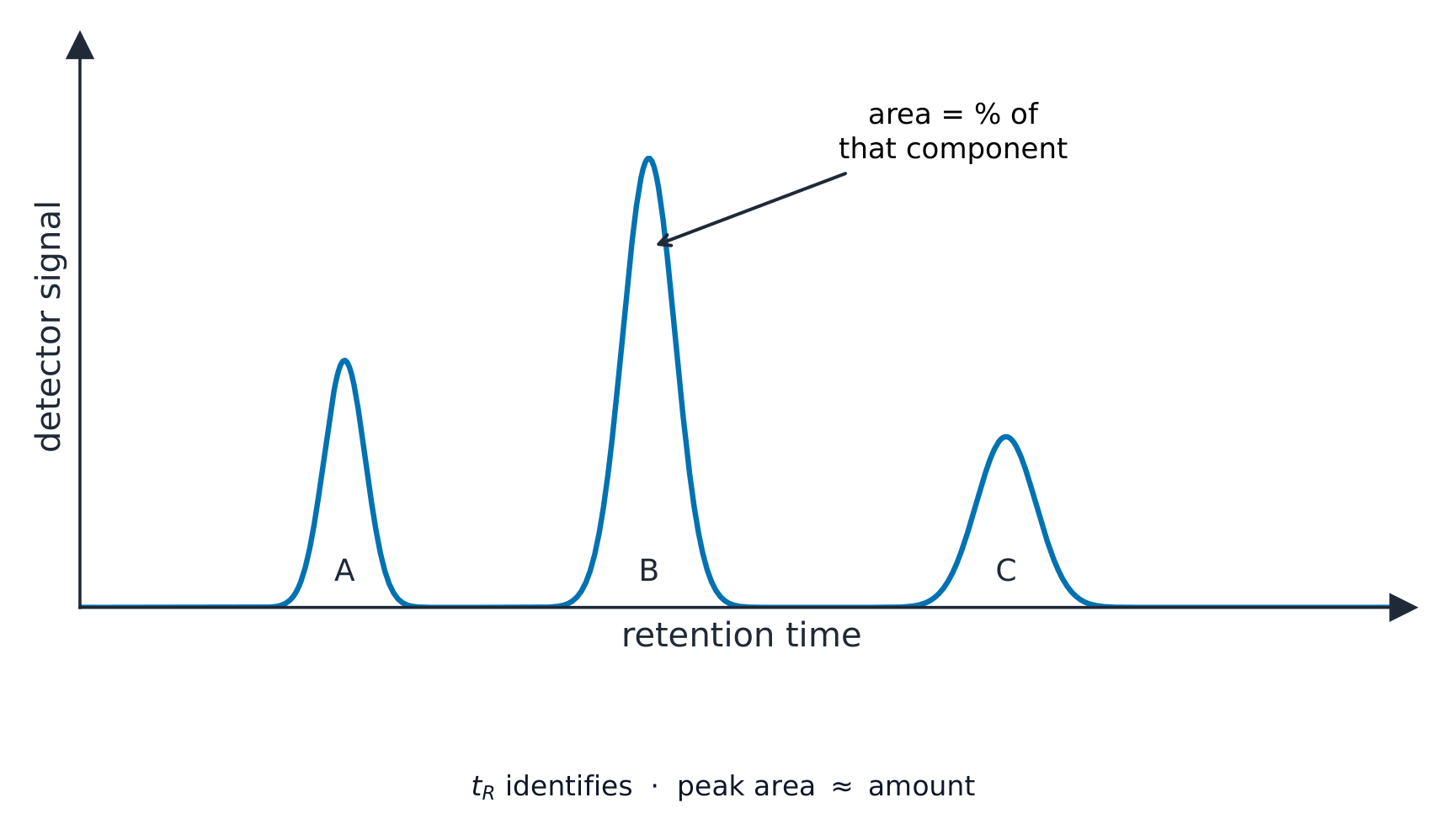
تعطي مساحة كل ذروة النسبة المئوية لذلك المكون في الخليط. المكون الذي يتفاعل أكثر مع الطور الثابت يكون له وقت احتجاز أطول.

رسم بياني كروماتوغرافي بثلاث ذروات بأوقات احتجاز مختلفة، ومساحة الذروة تعطي النسبة المئوية لكل مكون
رسم بياني للكروماتوغرافيا الغازية-السائلة: كل مكون يعطي ذروة عند وقت احتجاز خاص به، ومساحة الذروة هي نسبته المئوية في الخليط
Explore · ⁨استكشف⁩

Gas/liquid chromatography route · ⁨طريق كروماتوغرافيا الغاز/السائل⁩

Follow a volatile sample through column separation to a chromatogram. · ⁨تتبع عينة متطايرة عبر فصل العمود للحصول على مخطط كروماتوغرافي.⁩

37.3

Carbon-13 NMR spectroscopy · ⁨طيف الرنين المغناطيسي النووي للكربون-13⁩

Syllabus · ⁨المنهج⁩
English
  1. analyse and interpret a carbon-13 NMR spectrum of a simple molecule to deduce: (a) the different environments of the carbon atoms present (b) the possible structures for the molecule
  2. predict or explain the number of peaks in a carbon-13 NMR spectrum for a given molecule
العربية
  1. تحليل وتفسير طيف الرنين المغناطيسي النووي للكربون-13 لجزيء بسيط لاستنتاج: (أ) البيئات المختلفة لذرات الكربون الموجودة (ب) الهياكل المحتملة للجزيء
  2. التنبؤ أو解释 عدد القمم في طيف الرنين المغناطيسي النووي للكربون-13 لجزيء محدد

Source: Cambridge International syllabus · ⁨المصدر: منهج كامبريدج الدولي⁩

English

NMR 核磁共振 (nuclear magnetic resonance) studies how certain nuclei behave in a strong magnetic field.

In carbon-13 NMR, each different chemical environment 化学环境 of carbon gives one peak. So:

  • the number of peaks tells you how many different carbon environments there are (equivalent carbons share a peak).
  • the position of each peak (its chemical shift) suggests the type of carbon, which helps you deduce possible structures.
العربية

NMR (الرنين المغناطيسي النووي) يدرس سلوك بعض الأنوية في مجال مغناطيسي قوي.

جهاز NMR أسطواني طويل يقف في المختبر، ومُشار إليه بتحذير المجال المغناطيسي القوي
جهاز NMR: الأسطوانة الكبيرة تحتوي على مغناطيس فائق التوصيل يُنتج المجال المغناطيسي القوي جداً الذي تحتاجه التقنية

في طيف R-NMR للكربون-13، كل بيئة كيميائية مختلفة للكربون تعطي ذروة واحدة. لذا:

  • عدد الذروات يخبرك بعدد البيئات الكيميائية المختلفة للكربون (الكربونات المتساوية تشترك في ذروة).
  • موقع كل ذروة (انزياحها الكيميائي) يشير إلى نوع الكربون، مما يساعدك على استنتاج الهياكل المحتملة.
Explore · ⁨استكشف⁩

Carbon-13 NMR lab · ⁨مختبر الرنين المغناطيسي النووي للكربون-13⁩

Match carbon environments to C-13 NMR evidence. · ⁨طابق بيئات الكربون مع أدلة C-13 NMR.⁩

Vocabulary · ⁨مفردات⁩ Train · ⁨تدريب⁩
English العربية
NMR/ˌen em ˈɑː/ رنين مغناطيسي نووي
chemical environment/ˈkemɪkl enˈvaɪrənmənt/ البيئة الكيميائية
37.4

Proton (¹H) NMR spectroscopy · ⁨طيف الرنين المغناطيسي النووي للبروتون (¹H)⁩

Syllabus · ⁨المنهج⁩
English
  1. analyse and interpret a proton ($^1\text{H}$) NMR spectrum of a simple molecule to deduce: (a) the different environments of proton present using chemical shift values (b) the relative numbers of each type of proton present from relative peak areas (c) the number of equivalent protons on the carbon atom adjacent to the one to which the given proton is attached from the splitting pattern, using the $n + 1$ rule (limited to singlet, doublet, triplet, quartet and multiplet) (d) the possible structures for the molecule
  2. predict the chemical shifts and splitting patterns of the protons in a given molecule
  3. describe the use of tetramethylsilane, TMS, as the standard for chemical shift measurements
  4. state the need for deuterated solvents, e.g. $\text{CDCl}_3$, when obtaining a proton NMR spectrum
  5. describe the identification of O–H and N–H protons by proton exchange using $\text{D}_2\text{O}$
العربية
  1. تحليل وتفسير طيف الرنين المغناطيسي النووي للبروتون ($^1\text{H}$) لجزيء بسيط لاستنتاج: (أ) البيئات المختلفة للبروتونات الموجودة باستخدام قيم الإزاحة الكيميائية (ب) الأعداد النسبية لكل نوع من البروتونات الموجودة من خلال مساحات القمم النسبية (ج) عدد البروتونات المكافئة على ذرة الكربون المجاورة لذرة الكربون المرتبط بها البروتون المعطى من خلال نمط الانقسام، باستخدام قاعدة $n + 1$ (مقتصر على مفرد، مزدوج، ثلاثي، رباعي ومتعدد) (د) الهياكل المحتملة للجزيء
  2. التنبؤ بالإزاحات الكيميائية ونماط انقسام البروتونات في جزيء محدد
  3. وصف استخدام التيتراميثيل سيلان، TMS، كمعيار لقياسات الإزاحة الكيميائية
  4. بيان الحاجة إلى المذيبات المدهونة (deuterated solvents)، مثل $\text{CDCl}_3$، عند الحصول على طيف الرنين المغناطيسي النووي للبروتون
  5. وصف تحديد بروتونات O–H و N–H عن طريق تبادل البروتونات باستخدام $\text{D}_2\text{O}$

Source: Cambridge International syllabus · ⁨المصدر: منهج كامبريدج الدولي⁩

English

Proton NMR looks at the hydrogen atoms (proton 质子 nuclei). From the spectrum you read off:

  • chemical environments: protons in different environments appear at different chemical shift 化学位移 values.
  • relative numbers: the relative peak areas give the ratio of each type of proton.
  • splitting 裂分: a peak is split by the protons on the neighbouring carbon, following the $n+1$ rule — $n$ equivalent neighbours split a peak into $n+1$ lines:
Neighbours ($n$) Pattern
0 singlet 单峰
1 doublet 双峰
2 triplet 三峰
3 quartet 四峰
many multiplet 多重峰

Practical points

  • tetramethylsilane 四甲基硅烷 (TMS) is the standard, set at a chemical shift of $0$.
  • a deuterated solvent 氘代溶剂 (such as $\text{CDCl}_3$) is used so that the solvent itself gives no proton signal.
  • shaking the sample with $\text{D}_2\text{O}$ makes the O–H and N–H peaks disappear (their hydrogen is swapped for deuterium), which identifies those protons.

Worked example. A compound $\text{C}_4\text{H}_8\text{O}_2$ gives three proton NMR peaks: a triplet at $\delta\ 1.2$ (area 3), a quartet at $\delta\ 4.1$ (area 2), and a singlet at $\delta\ 2.0$ (area 3). Deduce the structure. Read the areas first, then the splitting. Areas $3:2:3$ give three proton environments holding 3, 2 and 3 hydrogens. Apply the $n+1$ rule in reverse: a triplet (area 3) is a $\text{CH}_3$ with 2 neighbours, and a quartet (area 2) is a $\text{CH}_2$ with 3 neighbours - each splitting the other, which is the classic ethyl group, $\text{CH}_3\text{CH}_2-$. That $\text{CH}_2$ lies far downfield at $\delta\ 4.1$, so it is attached to an oxygen. The remaining singlet (area 3) is a $\text{CH}_3$ with no neighbours at $\delta\ 2.0$, so it sits next to the C=O. Together: $\text{CH}_3\text{COOCH}_2\text{CH}_3$, ethyl ethanoate. A triplet-and-quartet pair is almost always an ethyl group - spot it first and the rest follows.

العربية

طيف NMR للبروتون يفحص ذرات الهيدروجين (أنوية البروتون). من الطيف تقرأ:

  • البيئات الكيميائية: البروتونات في بيئات مختلفة تظهر عند قيم انزياح كيميائي مختلفة.
  • الأعداد النسبية: مساحات الذروات النسبية تعطي نسبة كل نوع من البروتونات.
  • التشعب: يتم تشعب الذروة بواسطة البروتونات الموجودة على الكربون المجاور، وفقاً لـ قاعدة $n+1$ — $n$ جيران مكافئين يشعبون الذروة إلى $n+1$ خطوط:
مجاورون ($n$) النمط
0 فردي
1 ثنائي
2 ثلاثي
3 رباعي
العديد متعدد
أنماط ذروات NMR الأربعة: خط واحد، خطان، ثلاثة خطوط وأربعة خطوط، مُصاغة فردي، ثنائي، ثلاثي ورباعي
قاعدة $n+1$: $n$ بروتون مجاور مكافئ يقسم الذروة إلى $n+1$ خطوط (ذروة مفردة، مزدوجة، ثلاثية، رباعية)
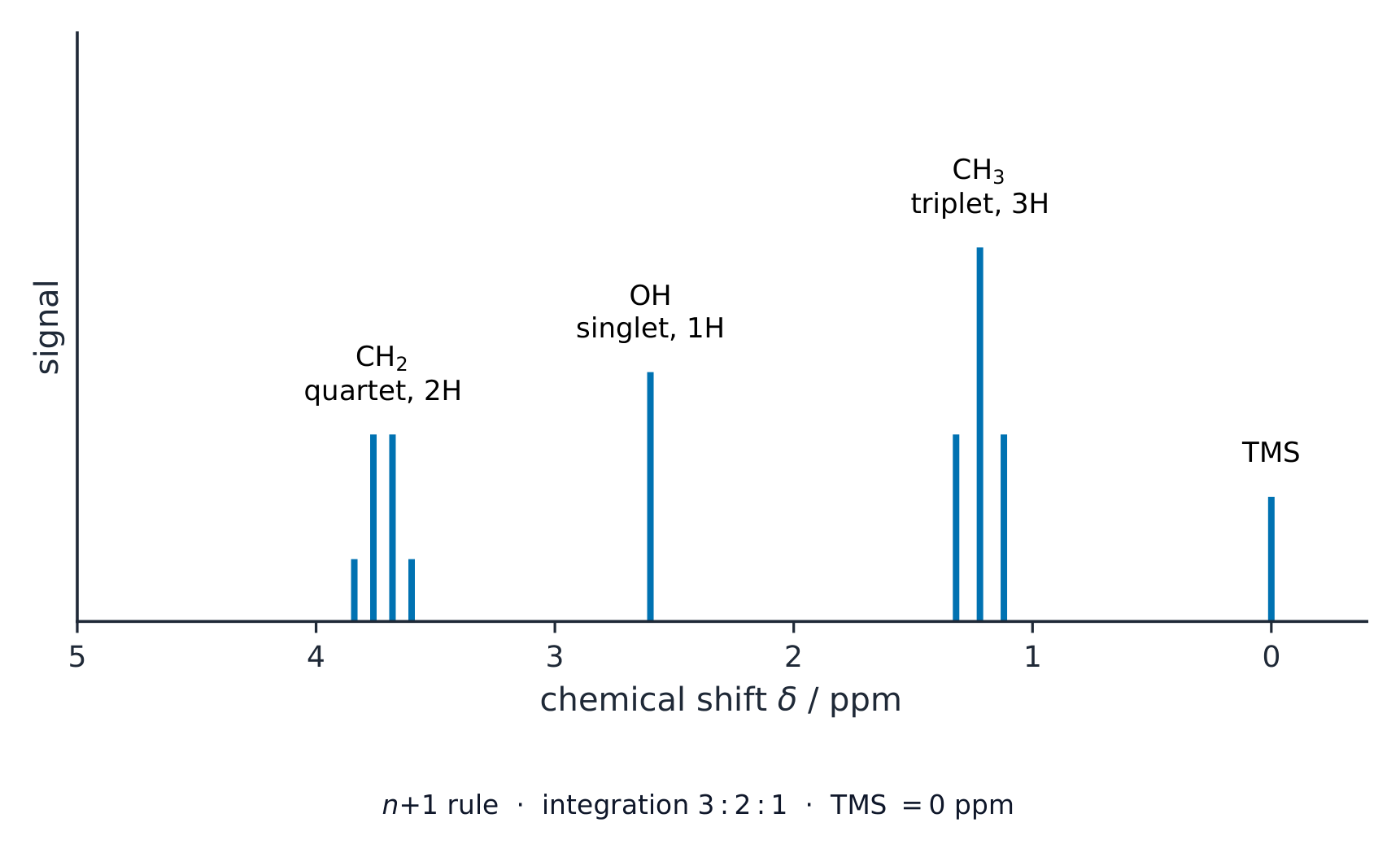
طيف الرنين المغناطيسي النووي للبروتونات للإيثانول مع ثلاث مجموعات من القمم: ثلاثية CH3، رباعية CH2، ومفردة OH، بالإضافة إلى مرجع TMS عند الصفر
الرنين المغناطيسي النووي للبروتونات للإيثانول: ثلاثة بيئات تعطي ثلاثية CH$_3$، وربعية CH$_2$، ومفردة OH، مع مساحات بنسبة $3:2:1$

نقاط عملية

  • تيتراميثيل سيلان (TMS) هو المعيار، مضبوط عند إزاحة كيميائية قدرها $0$.
  • يُستخدم مذيب متماثل نظيرياً (مثل $\text{CDCl}_3$) بحيث لا يعطي المذيب نفسه أي إشارة بروتونية.
  • هز العينة مع $\text{D}_2\text{O}$ يجعل قمم O–H و N–H تختفي (يتم استبدال هيدروجينها بالديوتيريوم)، مما يحدد تلك البروتونات.

مثال محلول. مركب $\text{C}_4\text{H}_8\text{O}_2$ يعطي ثلاثة قمم في طيف الرنين النووي المغناطيسي للبروتون: ثلاثية عند $\delta\ 1.2$ (مساحة 3)، ورباعية عند $\delta\ 4.1$ (مساحة 2)، وفردية عند $\delta\ 2.0$ (مساحة 3). استنتج البنية. اقرأ المساحات أولاً، ثم التشتت. تعطي المساحات $3:2:3$ ثلاثة بيئات بروتونية تحمل 3، 2، و3 ذرات هيدروجين. طبق قاعدة $n+1$ عكسياً: الثلاثية (مساحة 3) تمثل مجموعة $\text{CH}_3$ مع 2 جيران، والرباعية (مساحة 2) تمثل مجموعة $\text{CH}_2$ مع 3 جيران — كل منهما يشتت الآخر، وهو ما يمثل المجموعة الإيثيلية الكلاسيكية، $\text{CH}_3\text{CH}_2-$. تقع هذه المجموعة $\text{CH}_2$ بعيداً عن الحقل عند $\delta\ 4.1$، لذا فهي مرتبطة بـأكسجين. أما الـالفردية المتبقية (مساحة 3) فهي مجموعة $\text{CH}_3$ بدون جيران عند $\delta\ 2.0$، لذا فهي مجاورة لـ C=O. معاً: $\text{CH}_3\text{COOCH}_2\text{CH}_3$، إيثيل إيثانوات. الزوج الثلاثي-الرباعي هو تقريباً دائماً مجموعة إيثيلية — حددها أولاً وسيكون الباقي واضحاً.

Explore · ⁨استكشف⁩

Proton NMR lab · ⁨مختبر الرنين المغناطيسي النووي للهيدروجين (Proton)⁩

Match proton evidence to chemical environment and neighbours. · ⁨طابق أدلة الهيدروجين مع البيئة الكيميائية والجيران.⁩

Vocabulary · ⁨مفردات⁩ Train · ⁨تدريب⁩
English العربية
proton/ˈprəʊtɒn/ بروتون
chemical shift/ˈkemɪkl ʃɪft/ الإزاحة الكيميائية
splitting/ˈsplɪtɪŋ/ التشقيق
singlet/ˈsɪŋɡlɪt/ وحيدة
doublet/ˈdʌblət/ ثنائية
triplet/ˈtrɪplɪt/ ثلاثية
quartet/kwɔːˈtet/ رباعية
multiplet/ˈmʌltɪplɪt/ متعدد الخطوط
tetramethylsilane/ˈtetrəmiːθɪlsɪleɪn/ رباعي ميثيل سيليكان
deuterated solvent/ˈdjuːtəreɪtɪd ˈsɒlvənt/ مذيب مُعاد
37.4

Exam tips · ⁨نصائح للامتحان⁩

English
  • In $^{13}\text{C}$ NMR the number of peaks equals the number of carbon environments — use symmetry to count them.
  • In $^1\text{H}$ NMR use chemical shift (data booklet), integration (ratio of H's) and splitting (the $n+1$ rule): a triplet + quartet means an ethyl group.
  • TMS is the reference ($\delta = 0$); a $\text{D}_2\text{O}$ shake removes O-H and N-H peaks.
  • Combine IR, mass spectrum and NMR to deduce a structure, stating which evidence gives which feature.
العربية
  • في طيف $^{13}\text{C}$ NMR عدد القمم يساوي عدد البيئات الكربونية — استخدم التماثل لحسابها.
  • في طيف $^1\text{H}$ NMR استخدم الإزاحة الكيميائية (كتاب البيانات)، والتكامل (نسبة H)، والتشتت (قاعدة $n+1$): الثنائية + الرباعية تعني مجموعة إيثيلية.
  • TMS هو المرجع ($\delta = 0$)؛ هزة $\text{D}_2\text{O}$ تزيل قمم O-H و N-H.
  • اجمع بين الأشعة تحت الحمراء، طيف الكتلة، والرنين المغناطيسي النووي لاستنتاج بنية، موضحاً أي دليل يعطي أي ميزة.

Interactive lessons on this topic · ⁨دروس تفاعلية حول هذا الموضوع⁩

Work through it step by step, with instant-check exercises. · ⁨ا-working عليه خطوة بخطوة، مع تمارين تحقق فوري.⁩

Past Papers · ⁨أوراق الامتحانات السابقة⁩

More topics in A-Level Chemistry · ⁨A-Level الكيمياء⁩ · ⁨المزيد من المواضيع في A-Level Chemistry · ⁨A-Level الكيمياء⁩⁩

Log in or create account · ⁨تسجيل الدخول أو إنشاء حساب⁩

IGCSE, A-Level & AP