ثلاثة أشياء مختلفة تمامًا: صبغة برتقالية فاقعة، مسكن للألم، وبلاستيك قوي. الثلاثة تبدأ كسائل عديم اللون واحد — البنزين. لكن لا يوجد تفاعل واحد…
English narration · English + 中文 subtitles burned in · سرد باللغة الإنجليزية · ترجمة مدمجة بالإنجليزية + الصينية
36.1
Organic synthesis · التركيب العضوي
Syllabus · المنهج
English
for an organic molecule containing several functional groups: (a) identify organic functional groups using the reactions in the syllabus (b) predict properties and reactions
devise multi-step synthetic routes for preparing organic molecules using the reactions in the syllabus
analyse a given synthetic route in terms of type of reaction and reagents used for each step of it, and possible by-products
العربية
لجزيء عضوي يحتوي على عدة مجموعات وظيفية: (أ) حدد المجموعات الوظيفية العضوية باستخدام التفاعلات في المنهج (ب) تنبؤ الخصائص والتفاعلات
صمم مسارات تركيب متعددة الخطوات لتحضير الجزيئات العضوية باستخدام التفاعلات في المنهج
حلل مسار تركيب معطى من حيث نوع التفاعل والكواشف المستخدمة في كل خطوة له، والنواتج الثانوية المحتملة
Source: Cambridge International syllabus · المصدر: منهج كامبريدج الدولي
English
Like the AS synthesis topic, this asks you to join up known reactions to build a target molecule. Now you also have the A Level reactions of arenes, phenol, amines, amides and acyl chlorides.
Identifying functional groups
A molecule may carry several functional group 官能团 types. Use the test reactions to spot each one, then predict its behaviour. For example:
decolourises bromine water with no catalyst, giving a white precipitate → a phenol or a phenylamine (the ring is activated).
reacts violently with cold water, giving fumes of $\text{HCl}$ → an acyl chloride 酰氯.
gives a purple colour with neutral $\text{FeCl}_3$ → a phenol 苯酚.
$\text{Sn}$ / conc $\text{HCl}$, then $\text{NaOH}$ (reduction 还原)
phenylamine
phenylamine
$\text{HNO}_2$, below $10\,°\text{C}$
a diazonium salt
diazonium salt
warm water
phenol; or couple with phenol → azo dye
methylbenzene
hot $\text{KMnO}_4$ (oxidation 氧化)
benzoic acid
carboxylic acid 羧酸
$\text{SOCl}_2$ or $\text{PCl}_5$
acyl chloride
acyl chloride
alcohol / phenol
an ester 酯
acyl chloride
ammonia / amine 胺
an amide 酰胺
amide or nitrile 腈
$\text{LiAlH}_4$
an amine
halogenoalkane
$\text{KCN}$
a nitrile (adds one carbon)
Planning and analysing a route
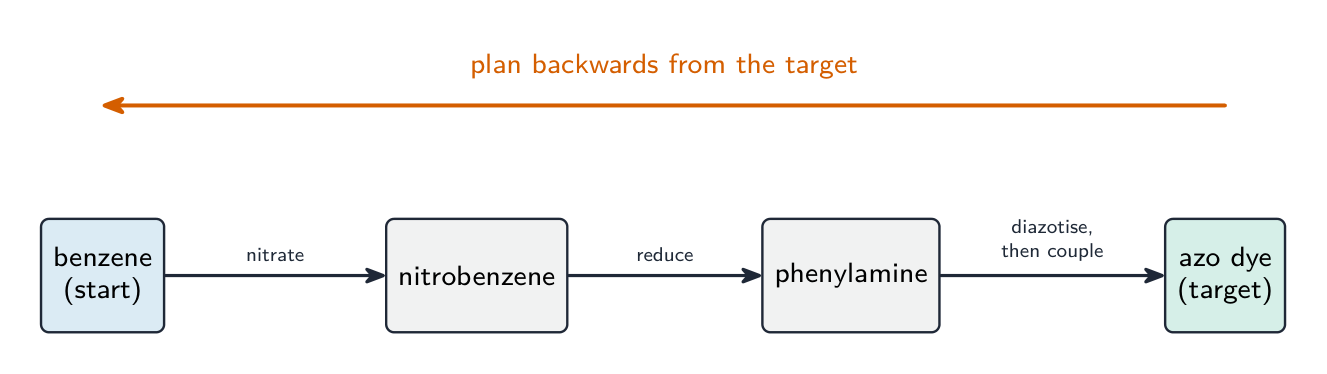
To devise a synthetic route 合成路线, work backwards from the target: which single reaction makes it, and from what? Repeat until you reach the starting material, then write each step with its reagent 试剂 and conditions.
When you analyse a route, state the type of reaction for each step (for example electrophilic substitution, addition–elimination 加成消去, oxidation or reduction) and watch for likely by-products 副产物 — for example, making an amine from a halogenoalkane also gives over-substituted amines, lowering the yield.
Worked example. Devise a route from benzene to phenylamine, $\text{C}_6\text{H}_5\text{NH}_2$. Work backwards: phenylamine comes from reducing nitrobenzene, and nitrobenzene comes from nitrating benzene - so the route is two steps. Step 1: benzene with concentrated $\text{HNO}_3$ and concentrated $\text{H}_2\text{SO}_4$ at $55\ °\text{C}$; electrophilic substitution gives nitrobenzene (keep below $55\ °\text{C}$, or further substitution follows). Step 2: reduce the nitrobenzene with tin and concentrated $\text{HCl}$, then add $\text{NaOH}$ to free the amine from its salt. There is no direct route - you cannot put an $\text{–NH}_2$ straight onto a ring, which is exactly why this nitrate-then-reduce pair is worth knowing by heart.
العربية
مثل موضوع تركيب AS، يطلب منك هذا السؤال ربط التفاعلات المعروفة لبناء جزيء هدف. الآن لديك أيضاً تفاعلات A Level للأرينات والفينول والأamines والأميدات وكلوريدات الأيل.
تحديد المجموعات الوظيفية
قد يحمل الجزيء عدة أنواع من المجموعات الوظيفية. استخدم التفاعلات الاختبارية لاكتشاف كل منها، ثم تنبأ بسلوكه. على سبيل المثال:
يُبيض ماء البروم بدون أي عامل حفاز، مكوّناً راسباً أبيض → فينول أو فينيل أمين (الحلقة مُفعّلة).
يتفاعل بعنف مع الماء البارد، مكوّناً أبخرة $\text{HCl}$ → كلوريد الأيل.
يعطي لوناً بنفسجياً مع $\text{FeCl}_3$ متعادلاً → فينول.
اختبارات التعريف المضافة في A Level: كل كاشف يعطي نتيجة مميزة تشير إلى مجموعة وظيفية
$\text{Sn}$ / concentr $\text{HCl}$، ثم $\text{NaOH}$ (اختزال)
فينيل أمين
فينيل أمين
$\text{HNO}_2$، تحت درجة حرارة $10\,°\text{C}$
ملح ديازونيوم
ملح ديازونيوم
ماء دافئ
فينول؛ أو اقترانه مع فينول → صبغة آزو
ميثيل بنزين
ساخن $\text{KMnO}_4$ (أكسدة)
حمض البنزويك
حمض كربوكسيلي
$\text{SOCl}_2$ أو $\text{PCl}_5$
كلوريد الأسيل
كلوريد الأسيل
كحول / فينول
إستر
كلوريد الأسيل
أمونيا / أمين
أميد
أميد أو سايانيد
$\text{LiAlH}_4$
أمين
هالوجينو ألكان
$\text{KCN}$
سايانيد (يضيف ذرة كربون واحدة)
خريطة تفاعلات مستوى A: السلسلة العطرية (أعلى) وسلسلة كلوريد الأسيل (أسفل)، مع مدخلاتها. اعمل عكسياً من هدفك
تخطيط وتحليل المسار
لتصميم مسار اصطناعي، اعمل عكسياً من الهدف: ما هو التفاعل الواحد الذي ينتجه، ومن ماذا؟ كرر العملية حتى تصل إلى المادة الأولية، ثم اكتب كل خطوة مع الكاشف والظروف.
خطط المسار بالعمل عكسياً من المستهدف، تفاعلاً تفاعلاً، حتى تصل إلى المادة الأولية
عندما تحلل مساراً، حدد نوع التفاعل لكل خطوة (على سبيل المثال استبدال إلكتروفيلي، إضافة-استبعاد، أكسدة أو اختزال) وانتبه للـ نواتج الثانوية المحتملة — على سبيل المثال، إنتاج أمين من هالوجينو ألكان يعطي أيضاً أمينات متعددة الاستبدال، مما يقلل المحصول.
مثال محلل. صمم مساراً من البنزين إلى فينيل أمين، $\text{C}_6\text{H}_5\text{NH}_2$. اعمل عكسياً: الفينيل أمين يأتي من اختزال نيترو بنزين، ونيترو بنزين يأتي من نترجة البنزين - لذا فإن المسار يتكون من خطوتين. الخطوة 1: البنزين مع $\text{HNO}_3$ المركز و$\text{H}_2\text{SO}_4$ المركز عند $55\ °\text{C}$؛ الاستبدال الإلكتروفيلي يعطي نيترو بنزين (احتفظ بدرجة الحرارة تحت $55\ °\text{C}$، أو سيحدث استبدال إضافي). الخطوة 2: اختزل النيترو بنزين باستخدام القصدير و$\text{HCl}$ المركز، ثم أضف $\text{NaOH}$ لتحرير الأمين من ملحه. لا يوجد مسار مباشر - لا يمكنك وضع مجموعة $\text{–NH}_2$ مباشرة على الحلقة، وهذا بالضبط سبب أهمية حفظ زوج النترجة ثم الاختزال عن ظهر قلب.
Explore · استكشف
A-Level synthesis planner · مخطط تركيب A-Level
Build a route by matching functional-group changes to reagents. · بنِ مسارًا بمطابقة تغيرات المجموعات الوظيفية مع الكواشف.
Pick one and the site follows you — notes, papers, videos and practice all open on it. · اختر واحدًا وسيتبعك الموقع — الملاحظات، الأوراق، الفيديوهات والتدريب جميعها تفتح عليه.
Type to search notes, lessons, code, vocabulary and past-paper questions across every subject. · اكتب للبحث عن ملاحظات، دروس، أكواد، مفردات وأسئلة امتحانات سابقة عبر جميع المواد.