انظر إلى ثلاثة أشياء مختلفة تمامًا. حبل نايلون. زجاجة مشروب بلاستيكية. البروتين في شعرك. يبدو أنه ليس لديهم شيء مشترك. ومع ذلك فإن الثلاثة…
English narration · English + 中文 subtitles burned in · سرد باللغة الإنجليزية · ترجمة مدمجة بالإنجليزية + الصينية
35.1
Condensation polymerisation · البلمرة بالتكاثف
Syllabus · المنهج
English
describe the formation of polyesters: (a) the reaction between a diol and a dicarboxylic acid or dioyl chloride (b) the reaction of a hydroxycarboxylic acid
describe the formation of polyamides: (a) the reaction between a diamine and a dicarboxylic acid or dioyl chloride (b) the reaction of an aminocarboxylic acid (c) the reaction between amino acids
deduce the repeat unit of a condensation polymer obtained from a given monomer or pair of monomers
identify the monomer(s) present in a given section of a condensation polymer molecule
العربية
صف تكوين بولي إستر: (أ) التفاعل بين ديول وحمض كربوكسيلي ثنائي أو كلوريد أسيل ثنائي (ب) تفاعل حمض هيدروكسي كربوكسيلي
صف تكوين بولي أميد: (أ) التفاعل بين ديامين وحمض كربوكسيلي ثنائي أو كلوريد أسيل ثنائي (ب) تفاعل حمض أمينو كربوكسيلي (ج) التفاعل بين الأحماض الأمينية
استنتج وحدة التكرار لـ بوليمر تكثيف حاصل من مونومر معين أو زوج من المونومرات
حدد المونومر(ات) الموجودة في جزء معين من جزيء بوليمر تكثيف
Source: Cambridge International syllabus · المصدر: منهج كامبريدج الدولي
English
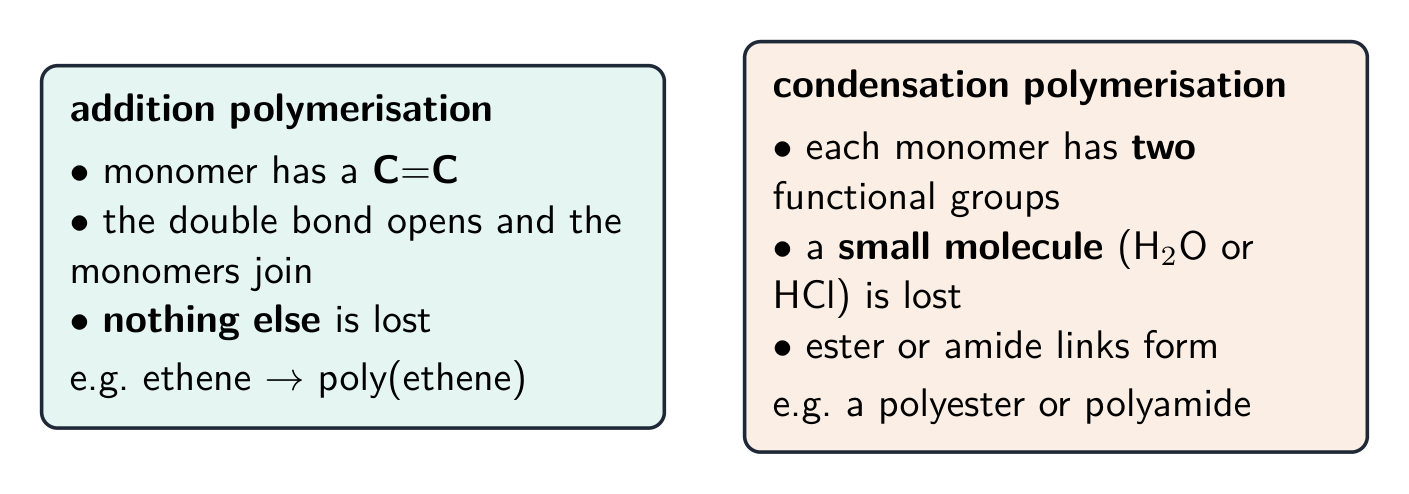
In condensation polymerisation 缩合聚合, monomers join into a long chain and a small molecule (such as water or $\text{HCl}$) is lost each time a new bond forms. Each monomer needs two reactive groups, so the chain can grow at both ends.
Polyesters
A polyester 聚酯 has many ester links along its chain. You can make one from:
a diol 二醇 (two $\text{–OH}$ groups) and a dicarboxylic acid 二羧酸 (two $\text{–COOH}$ groups), or a dioyl chloride.
a single hydroxycarboxylic acid, which has both an $\text{–OH}$ and a $\text{–COOH}$.
Polyamides
A polyamide 聚酰胺 has many amide links. You can make one from:
a diamine 二胺 (two $\text{–NH}_2$ groups) and a dicarboxylic acid or a dioyl chloride.
a single aminocarboxylic acid, or from amino acids 氨基酸 joining together (proteins are natural polyamides).
Repeat units and monomers
The repeat unit 重复单元 of a condensation polymer contains parts of both monomers, minus the atoms lost as the small molecule. To find the monomers 单体 from a section of polymer, break the chain at each ester or amide link, then add back $\text{–OH}$ and $\text{–H}$ (or $\text{–Cl}$).
Worked example. A polymer chain contains repeating $\text{–CONH–}$ links. Name the type of polymer, identify the monomers, and give the small molecule lost. A $\text{–CONH–}$ link is an amide, so this is a polyamide made by condensation polymerisation. To find the monomers, break the chain at each amide link and give the cut ends their atoms back: the carbon side takes $\text{–OH}$, making a dicarboxylic acid, and the nitrogen side takes $\text{–H}$, making a diamine. The small molecule lost at each link is water (or $\text{HCl}$, if an acyl dichloride was used in place of the acid). Each monomer must have two functional groups, or the chain could never keep growing - if the monomer you propose has only one, you have broken the chain in the wrong place.
العربية
في البلمرة بالتكاثف، ترتبط المونومرات في سلسلة طويلة و يُفقد جزيء صغير (مثل الماء أو $\text{HCl}$) في كل مرة يتشكل فيها رابط جديد. تحتاج كل مونومر إلى مجموعتين تفاعليتين، حتى يمكن للسلسلة النمو من كلا الطرفين.
روابط التكثيف: يتكون البولي إستر بروابط إستر، والبولي أميد بروابط أميد؛ تطلق كل رابطة جديدة جزيئاً صغيراً (هنا الماء)
البولي إستر
البولي إستر يحتوي على العديد من روابط الإستر في سلسلته. يمكن制备 واحد منه من:
حمض هيدروكسي كربوكيلي واحد، يحتوي على كل من $\text{–OH}$ و$\text{–COOH}$.
زجاجات مشروبات PET مصنوعة من بولي إستر — وهو بوليمر تكاثفي، تم جمعها هنا لإعادة تدويرها
البولي أميد
البولي أميد يحتوي على العديد من روابط الأميد. يمكن制备 واحد منه من:
داي أمين (مجموعتان $\text{–NH}_2$) وحمض ثنائي الكربوكسيل أو كلوريد ثنائي الأيل.
حمض أمينو كربوكيلي واحد، أو من أحماض أمينية ترتبط معاً (البروتينات هي بولي أميدات طبيعية).
"فخ النايلون": يتشكل النايلون (بولي أميد) حيث يلتقي محلولان متفاعلان، لذا يمكن سحب خيط طويل واحد (يظهر وردياً هنا بسبب إضافة مؤشر)
وحدات التكرار والمونومرات
تحتوي وحدة التكرار للبوليمر التكاثفي على أجزاء من كلا المونومرات، ناقص الذرات المفقودة كجزيء صغير. لإيجاد المونومرات من جزء من البوليمر، قم بكسر السلسلة عند كل رابطة إستر أو أميد، ثم أعد $\text{–OH}$ و$\text{–H}$ (أو $\text{–Cl}$).
لإيجاد المونومرات، قم بكسر السلسلة عند كل رابطة وأعد –OH و–H إلى الأطراف المقطعة — مما يعطي هنا الديول وحمض ثنائي الكربوكسيل
مثال محلول. تحتوي سلسلة بوليمر على روابط $\text{–CONH–}$ متكررة. اذكر نوع البوليمر، حدد المونومرات، وأعطِ الجزيء الصغير المفقود. رابطة $\text{–CONH–}$ هي أميد، لذا هذا بولي أميد يتكون عن طريق تكاثف البوليمرات. لإيجاد المونومرات، قم بكسر السلسلة عند كل رابطة أميد وأعد ذرات أطراف القطع: تأخذ طرف الكربون $\text{–OH}$، مما يُكوّن حمض ثنائي الكربوكسيل، ويأخذ طرف النيتروجين $\text{–H}$، مما يُكوّن داي أمين. الجزيء الصغير المفقود عند كل رابطة هو الماء (أو $\text{HCl}$، إذا تم استخدام كلوريد الأيل بدلاً من الحمض). يجب أن تحتوي كل مونومر على مجموعتين وظيفيتين، وإلا فلن تستمر السلسلة في النمو - إذا كان المونومر الذي تقترحه يحتوي على مجموعة واحدة فقط، فقد قمت بكسر السلسلة في المكان الخطأ.
recognise that poly(alkenes) are chemically inert and can therefore be difficult to biodegrade
recognise that some polymers can be degraded by the action of light
recognise that polyesters and polyamides are biodegradable by acidic and alkaline hydrolysis
العربية
أن تدرك أن بوليمرات الألكينات (poly(alkenes)) خاملة كيميائياً وبالتالي قد يصعب تحللها حيوياً
أن تدرك أن بعض البوليمرات يمكن تحللها بفعل الضوء
أن تدرك أن البوليستر والبولي أميد تتحلل حيوياً بواسطة التحلل المائي الحمضي والقاعدي
Source: Cambridge International syllabus · المصدر: منهج كامبريدج الدولي
English
poly(alkene)s 聚烯烃 are chemically inert — they have only strong, non-polar C–C and C–H bonds, so they are hard to biodegrade 可生物降解 and last a long time.
some polymers are made so that light can break them down (they are photodegradable).
polyesters and polyamides are biodegradable, because their ester and amide links can be broken by acidic or alkaline hydrolysis 水解.
العربية
بولي(ألكينات) خاملة كيميائياً — لديها فقط روابط قوية غير قطبية C–C وC–H، لذا يصعب تحللها حيوياً وتبقى لفترة طويلة.
بعض البوليمرات مصممة بحيث يمكن الضوء تكسيرها (هي قابلة للتحلل الضوئي).
البولي إستر والبولي أميد قابلة للتحلل الحيوي، لأن روابطها الإستر والأميد يمكن تكسيرها بواسطة التحلل المائي الحمضي أو القلوي.
Condensation polymers (polyesters, polyamides) form with loss of a small molecule ($\text{H}_2\text{O}$ or HCl) — draw the repeat unit and the lost molecule.
Identify the monomers from the polymer by breaking the ester or amide link — a common question.
Predict the type from the monomers: a $\text{C}=\text{C}$ gives addition; two functional groups give condensation.
Polyesters and polyamides are hydrolysable (more degradable); addition polymers are not.
العربية
بوليمرات التكثيف (بولي إستر، بولي أميد) تتكون مع فقدان جزيء صغير ($\text{H}_2\text{O}$ أو HCl) — ارسم وحدة التكرار والجزيء المفقود.
حدد المونومرات من البوليمر عن طريق كسر الرابطة الإستر أو الأميد — سؤال شائع.
تنبأ بالنوع من المونومرات: يعطي $\text{C}=\text{C}$ إضافة؛ المجموعتان الوظيفيتان تعطانا تكثيفاً.
Pick one and the site follows you — notes, papers, videos and practice all open on it. · اختر واحدًا وسيتبعك الموقع — الملاحظات، الأوراق، الفيديوهات والتدريب جميعها تفتح عليه.
Type to search notes, lessons, code, vocabulary and past-paper questions across every subject. · اكتب للبحث عن ملاحظات، دروس، أكواد، مفردات وأسئلة امتحانات سابقة عبر جميع المواد.