Skip to content · ⁨الانتقال إلى المحتوى⁩

Equilibria · ⁨التوازن الكيميائي⁩

A-Level Chemistry · ⁨A-Level الكيمياء⁩ · Topic 25 · ⁨الموضوع 25⁩

Video lesson for this topic · ⁨درس فيديو لهذا الموضوع⁩ Open the video page · ⁨افتح صفحة الفيديو⁩
7:56

الاتزان (A2)

يتم الحفاظ على دمك عند درجة الحموضة ٧,٤. تحركه بضع أعشار من الجانبين وأنت في المستشفى. ومع ذلك طوال اليوم، يسيل الحمض — من طعامك، ومن…

English narration · English + 中文 subtitles burned in · ⁨سرد باللغة الإنجليزية · ترجمة مدمجة بالإنجليزية + الصينية⁩

25.1

Conjugate acids and bases · ⁨الأحماض والقواعد المرافقة⁩

Syllabus · ⁨المنهج⁩
English
  1. understand and use the terms conjugate acid and conjugate base
  2. define conjugate acid–base pairs, identifying such pairs in reactions
  3. define mathematically the terms pH, $K_a$, $\text{p}K_a$ and $K_w$ and use them in calculations ($K_b$ and the equation $K_w = K_a \times K_b$ will not be tested)
  4. calculate $[\text{H}^+(\text{aq})]$ and pH values for: (a) strong acids (b) strong alkalis (c) weak acids
  5. (a) define a buffer solution (b) explain how a buffer solution can be made (c) explain how buffer solutions control pH; use chemical equations in these explanations (d) describe and explain the uses of buffer solutions, including the role of $\text{HCO}_3^-$ in controlling pH in blood
  6. calculate the pH of buffer solutions, given appropriate data
  7. understand and use the term solubility product, $K_{\text{sp}}$
  8. write an expression for $K_{\text{sp}}$
  9. calculate $K_{\text{sp}}$ from concentrations and vice versa
  10. (a) understand and use the common ion effect to explain the different solubility of a compound in a solution containing a common ion (b) perform calculations using $K_{\text{sp}}$ values and concentration of a common ion
العربية
  1. فهم واستخدام مصطلحي الحامض المرافق والقاعدة المرافقة
  2. تعريف أزواج الحمض والقاعدة المرافقة، وتحديد مثل هذه الأزواج في التفاعلات
  3. عرّف رياضياً مصطلحات الأس الهيدروجيني pH، $K_a$، $\text{p}K_a$ و$K_w$ واستخدمها في الحسابات (لن يتم اختبار $K_b$ والمعادلة $K_w = K_a \times K_b$)
  4. احسب قيم $[\text{H}^+(\text{aq})]$ والأس الهيدروجيني pH لـ: (أ) الأحماض القوية (ب) القواعد القوية (ج) الأحماض الضعيفة
  5. (أ) عرّف المحلول المنظم (ب) اشرح كيفية تحضير محلول منظم (ج) اشرح كيف تتحكم المحاليل المنظمة في الأس الهيدروجيني pH؛ استخدم المعادلات الكيميائية في هذه الشروحات (د) صف واشرح استخدامات المحاليل المنظمة، بما في ذلك دور $\text{HCO}_3^-$ في التحكم في الأس الهيدروجيني pH في الدم
  6. حساب الـpH للمحاليل المنظمة، عند توفر البيانات المناسبة
  7. افهم واستخدم مصطلح حاصل الذوبانية، $K_{\text{sp}}$
  8. اكتب تعبيراً لـ $K_{\text{sp}}$
  9. احسب $K_{\text{sp}}$ من التراكيز والعكس صحيح
  10. (أ) افهم واستخدم تأثير الأيون المشترك لتفسير الاختلاف في ذوبانية مركب في محلول يحتوي على أيون مشترك (ب) قم بالحسابات باستخدام قيم $K_{\text{sp}}$ وتركيز أيون مشترك

Source: Cambridge International syllabus · ⁨المصدر: منهج كامبريدج الدولي⁩

English
Titration curve and equivalence point

When a Brønsted acid loses an $\text{H}^+$, what is left is its conjugate base 共轭碱. When a base gains an $\text{H}^+$, it becomes its conjugate acid 共轭酸. The two species that differ by just one $\text{H}^+$ form a conjugate acid–base pair 共轭酸碱对.

For example, in $\text{CH}_3\text{COOH} \rightleftharpoons \text{CH}_3\text{COO}^- + \text{H}^+$, the pair is $\text{CH}_3\text{COOH}$ (acid) and $\text{CH}_3\text{COO}^-$ (its conjugate base).

العربية
منحنى المعايرة ونقطة التكافؤ

عندما يفقد حمض برونستد $\text{H}^+$، ما يتبقى هو قاعدته المرافقة. وعندما تكتسب قاعدة $\text{H}^+$، تصبح حمضها المرافق. النوعان اللذان differs فقط بمقدار واحد $\text{H}^+$ يشكلان زوج حمض-قاعدة مرافق.

على سبيل المثال، في $\text{CH}_3\text{COOH} \rightleftharpoons \text{CH}_3\text{COO}^- + \text{H}^+$، الزوج هو $\text{CH}_3\text{COOH}$ (حمض) و$\text{CH}_3\text{COO}^-$ (قاعدته المرافقة).

حمض الإيثانويك يفقد بروتوناً ليصبح قاعده مقترنة، والأمونيا تكتسب بروتوناً لتصبح حمضاً مقترناً، مع وضع الزوج المقترن بين أقواس
تختلف الأزواج المرافقة ببروتون واحد: يفقد الحمض H$^+$ ليعطي قاعدته المرافقة؛ تكتسب القاعدة H$^+$ لتعطي حمضها المرافق
Explore · ⁨استكشف⁩

pH and H⁺ concentration · ⁨درجة الحموضة وتركيز H⁺⁩

pH = −log[H⁺]: slide it and watch [H⁺] change tenfold per unit. A conjugate acid–base pair differ by a single proton. · ⁨pH = −log[H⁺]: حركه الشريحة ولاحظ تغير [H⁺] بعشر مرات لكل وحدة. الزوج الحمضي-القاعدي المترافق يختلفان ببروتون واحد.⁩

25.1

pH and the equilibrium constants · ⁨الأس الهيدروجيني وثوابت الاتزان⁩

English
  • pH measures acidity: $\text{pH} = -\log[\text{H}^+]$, so $[\text{H}^+] = 10^{-\text{pH}}$.
  • the acid dissociation constant 酸解离常数 of a weak acid $\text{HA}$ is $K_a = \dfrac{[\text{H}^+][\text{A}^-]}{[\text{HA}]}$, and $\text{p}K_a = -\log K_a$. A larger $K_a$ (smaller $\text{p}K_a$) means a stronger acid.
  • the ionic product of water 水的离子积 is $K_w = [\text{H}^+][\text{OH}^-] = 1.0 \times 10^{-14}$ at $298\ \text{K}$.

Calculating pH

  • strong acid 强酸: fully ionised, so $[\text{H}^+]$ equals the acid concentration; then take $-\log$.
  • strong alkali 强碱: find $[\text{OH}^-]$ from the concentration, then use $[\text{H}^+] = K_w / [\text{OH}^-]$.
  • weak acid 弱酸: only partly ionised, so use $[\text{H}^+] = \sqrt{K_a \times [\text{HA}]}$.

Worked example. Find the pH of $0.050\ \text{mol dm}^{-3}$ hydrochloric acid (a strong acid).

It is fully ionised, so $[\text{H}^+] = 0.050\ \text{mol dm}^{-3}$, giving $\text{pH} = -\log(0.050) = 1.30$.

Worked example. Find the pH of $0.10\ \text{mol dm}^{-3}$ sodium hydroxide (a strong base). ($K_w = 1.0 \times 10^{-14}$.)

$[\text{OH}^-] = 0.10$, so $[\text{H}^+] = K_w/[\text{OH}^-] = (1.0 \times 10^{-14})/0.10 = 1.0 \times 10^{-13}$, giving $\text{pH} = 13.0$.

Worked example. Find the pH of $0.10\ \text{mol dm}^{-3}$ ethanoic acid (a weak acid). ($K_a = 1.8 \times 10^{-5}$.)

$$[\text{H}^+] = \sqrt{K_a \times [\text{HA}]} = \sqrt{(1.8 \times 10^{-5})(0.10)} = 1.3 \times 10^{-3}, \qquad \text{pH} = -\log(1.3 \times 10^{-3}) = 2.87.$$
العربية
  • الأس الهيدروجيني يقيس الحموضة: $\text{pH} = -\log[\text{H}^+]$، لذا $[\text{H}^+] = 10^{-\text{pH}}$.
  • ثابت تفكك الحمض لحمض ضعيف $\text{HA}$ هو $K_a = \dfrac{[\text{H}^+][\text{A}^-]}{[\text{HA}]}$، و$\text{p}K_a = -\log K_a$. قيمة أكبر لـ $K_a$ (أصغر لـ $\text{p}K_a$) تعني حمضاً أقوى.
  • الحاصل الأيوني للماء هو $K_w = [\text{H}^+][\text{OH}^-] = 1.0 \times 10^{-14}$ عند $298\ \text{K}$.
مقياس الرقم الهيدروجيني يمتد من الحمضي إلى المتعادل ثم القلوي، حيث الرقم الهيدروجيني = -log تركيز أيونات الهيدروجين
مقياس الأس الهيدروجيني: الأس الهيدروجيني = لوغاريتم سالب لتركيز أيونات الهيدروجين
شرائط ورق الرقم الهيدروجيني بجانب مخطط ألوان
ورق الأس الهيدروجيني يقدر الأس الهيدروجيني لمحلول من اللون الذي يتحول إليه

حساب الأس الهيدروجيني

  • حمض قوي: متأين كلياً، لذا $[\text{H}^+]$ يساوي تركيز الحمض؛ ثم خذ $-\log$.
  • قاعدة قوية: أوجد $[\text{OH}^-]$ من التركيز، ثم استخدم $[\text{H}^+] = K_w / [\text{OH}^-]$.
  • حمض ضعيف: متأين جزئياً، لذا استخدم $[\text{H}^+] = \sqrt{K_a \times [\text{HA}]}$.

مثال محلول. أوجد الأس الهيدروجيني لحمض كلوريد هيدروكلوريك $0.050\ \text{mol dm}^{-3}$ (حمض قوي).

هو متأين كلياً، لذا $[\text{H}^+] = 0.050\ \text{mol dm}^{-3}$، مما يعطي $\text{pH} = -\log(0.050) = 1.30$.

مثال محلول. أوجد الأس الهيدروجيني لهيدروكسيد الصوديوم $0.10\ \text{mol dm}^{-3}$ (قاعدة قوية). ($K_w = 1.0 \times 10^{-14}$.)

$[\text{OH}^-] = 0.10$، لذا $[\text{H}^+] = K_w/[\text{OH}^-] = (1.0 \times 10^{-14})/0.10 = 1.0 \times 10^{-13}$، مما يعطي $\text{pH} = 13.0$.

مثال محلول. أوجد الأس الهيدروجيني لحمض الإيثانويك $0.10\ \text{mol dm}^{-3}$ (حمض ضعيف). ($K_a = 1.8 \times 10^{-5}$.)

$$[\text{H}^+] = \sqrt{K_a \times [\text{HA}]} = \sqrt{(1.8 \times 10^{-5})(0.10)} = 1.3 \times 10^{-3}, \qquad \text{pH} = -\log(1.3 \times 10^{-3}) = 2.87.$$
25.1

Buffer solutions · ⁨المحاليل المنظومة⁩

English

A buffer solution 缓冲溶液 resists a change in pH when a small amount of acid or alkali is added. You make one from a weak acid and its conjugate base (for example ethanoic acid and sodium ethanoate).

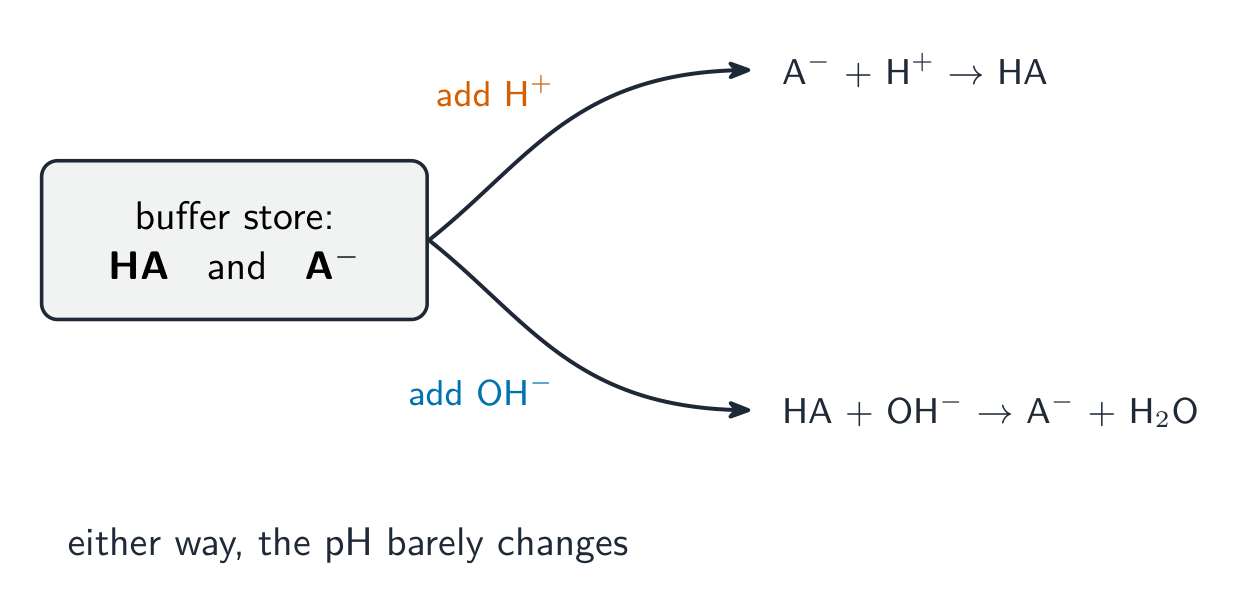
It works because the mixture holds a store of both partners:

  • added $\text{H}^+$ is removed by the conjugate base: $\text{CH}_3\text{COO}^- + \text{H}^+ \rightarrow \text{CH}_3\text{COOH}$.
  • added $\text{OH}^-$ is removed by the weak acid: $\text{CH}_3\text{COOH} + \text{OH}^- \rightarrow \text{CH}_3\text{COO}^- + \text{H}_2\text{O}$.

To find the pH, put the concentrations of the acid and its salt into the $K_a$ expression. Buffers are important in living things — for example, $\text{HCO}_3^-$ keeps the pH of blood close to $7.4$.

العربية

المحلول المنظوم يقاوم تغير الأس الهيدروجيني عند إضافة كمية صغيرة من الحمض أو القاعدة. تصنع واحداً من حمض ضعيف وقاعدته المرافقة (على سبيل المثال حمض الإيثانويك وإيثانات الصوديوم).

يعمل لأن الخليط يحتفظ بمخزون من كلا الشريكين:

  • أي هيدروجين مضاف $\text{H}^+$ يُزال بواسطة القاعدة المترافقة: $\text{CH}_3\text{COO}^- + \text{H}^+ \rightarrow \text{CH}_3\text{COOH}$.
  • أي هيدروكسيد مضاف $\text{OH}^-$ يُزال بواسطة الحمض الضعيف: $\text{CH}_3\text{COOH} + \text{OH}^- \rightarrow \text{CH}_3\text{COO}^- + \text{H}_2\text{O}$.
خزان محلول منظم يحتوي على HA و A-، حيث يتم إزالة H+ المضاف بواسطة A- وإزالة OH- المضاف بواسطة HA
يحافظ المحلول المنظوم على مخزون من حمض ضعيف وقاعدته المرافقة: يُمتص H$^+$ المضاف بواسطة A$^-$ وOH$^-$ المضاف بواسطة HA، لذا لا يتغير الأس الهيدروجيني تقريباً

لإيجاد الأس الهيدروجيني، ضع تراكيز الحمض وملحه في تعبير $K_a$. المحاليل المنظومة مهمة في الكائنات الحية — على سبيل المثال، $\text{HCO}_3^-$ يحافظ على الأس الهيدروجيني للدم قريباً من $7.4$.

Explore · ⁨استكشف⁩

Buffers and the titration curve · ⁨المحاليل المنقّحة ومنحنى المعايرة⁩

Add alkali to acid: the flat part is where a buffer resists pH change, and the steep jump is the equivalence point. · ⁨أضف القلوي إلى الحمض: الجزء المسطح هو المكان الذي يقاوم فيه المحلول المنقح تغير الـ pH، والقفز الحاد هو نقطة التكافؤ.⁩

25.1

Solubility product · ⁨حاصل الذوبانية⁩

English

For a salt that barely dissolves, the solubility product 溶度积 ($K_{\text{sp}}$) is the product of the ion concentrations in a saturated solution, each raised to the power of its number in the formula:

$$K_{\text{sp}} = [\text{Ag}^+][\text{Cl}^-] \qquad K_{\text{sp}} = [\text{Ca}^{2+}][\text{F}^-]^2$$

You can find $K_{\text{sp}}$ from the solubility, or the solubility from $K_{\text{sp}}$.

The common ion effect

The common ion effect 同离子效应 is the way a salt becomes less soluble in a solution that already contains one of its ions. The extra ion pushes the dissolving equilibrium back (Le Chatelier), so less salt dissolves. You can calculate the new solubility using $K_{\text{sp}}$ and the concentration of the common ion.

العربية

بالنسبة لمحل盐几乎不溶解的盐,** حاصل الذوبانية **($K_{\text{sp}}$) هو حاصل ضرب تراكيز الأيونات في محلول مشبع، مرفوعة لكل منها إلى قوة عددها في الصيغة:

$$K_{\text{sp}} = [\text{Ag}^+][\text{Cl}^-] \qquad K_{\text{sp}} = [\text{Ca}^{2+}][\text{F}^-]^2$$

يمكنك إيجاد $K_{\text{sp}}$ من الذوبانية، أو الذوبانية من $K_{\text{sp}}$.

تكوينات صخرية متدلية من سقف كهف
تنمو العتيبات عندما يعود كربونات الكالسيوم المذابة ببطء إلى الخارج من المحلول — هذا اتزان ذوبانية حقيقي

تأثير الأيون المشترك

تأثير الأيون المشترك هو الطريقة التي يصبح بها المحلول أقل ذوبانية في محلول يحتوي بالفعل على أحد أيونه. يدفع الأيون الإضافي اتزان الذوبان للخلف (لي شاتليه)، لذا يذوب قدر أقل من الملح. يمكنك حساب الذوبانية الجديدة باستخدام $K_{\text{sp}}$ وتركيز الأيون المشترك.

Explore · ⁨استكشف⁩

Solubility product lab · ⁨مختبر حاصل الضرب في التشبع⁩

ionic product compared with Ksp · ⁨مقارنة المنتج الأيوني مع حاصل الضرب في التشبع (Ksp)⁩

Increase ion concentration and see when precipitation becomes likely. · ⁨زيادة تركيز الأيونات وملاحظة متى تصبح عملية الترسيب محتملة.⁩

25.2

Partition coefficients · ⁨معاملات التقسيم⁩

Syllabus · ⁨المنهج⁩
English
  1. state what is meant by the term partition coefficient, $K_{\text{pc}}$
  2. calculate and use a partition coefficient for a system in which the solute is in the same physical state in the two solvents
  3. understand the factors affecting the numerical value of a partition coefficient in terms of the polarities of the solute and the solvents used
العربية
  1. بيّن ما يعنيه مصطلح ثابت التقسيم، $K_{\text{pc}}$
  2. حساب واستخدام معامل تقسيم لنظام يكون فيه المذاب في نفس الحالة الفيزيائية في المذيبين
  3. فهم العوامل المؤثرة على القيمة العددية لمعامل التقسيم من حيث قطبية المذيب والمذيبات المستخدمة

Source: Cambridge International syllabus · ⁨المصدر: منهج كامبريدج الدولي⁩

English

When a solute is shaken with two solvents that do not mix, it spreads between them. The partition coefficient 分配系数 ($K_{\text{pc}}$) is the ratio of its concentrations in the two layers (at constant temperature):

$$K_{\text{pc}} = \frac{[\text{solute in solvent 1}]}{[\text{solute in solvent 2}]}$$

This works when the solute 溶质 is in the same physical state in both solvents. The value depends on the polarity 极性 of the solute and of each solvent 溶剂: a non-polar solute dissolves more in the non-polar solvent, while a polar solute prefers the polar solvent.

العربية

عند رج مذاب مع مذابين لا يختلطان، ينتشر بينهما. معامل التقسيم ($K_{\text{pc}}$) هو نسبة تراكيزه في الطبقتين (عند درجة حرارة ثابتة):

$$K_{\text{pc}} = \frac{[\text{solute in solvent 1}]}{[\text{solute in solvent 2}]}$$

هذا يعمل عندما يكون المذاب في نفس الحالة الفيزيائية في كلا المذيبين. تعتمد القيمة على قطبية المذاب وكل مذيب: يذوب المذاب غير القطبي أكثر في المذيب غير القطبي، بينما يفضل المذاب القطبي المذيب القطبي.

طبقتان من المذيب غير قابلتين للامتزاج مع مذاب منتشر بينهما، أكثر في الطبقة العلوية غير القطبية منه في الماء بالأسفل
ينتشر المذاب المختلط مع مذابين لا يختلطان بينهما؛ معامل التقسيم هو نسبة تراكيزه في الطبقتين
Explore · ⁨استكشف⁩

Partition coefficient lab · ⁨مختبر ثابت التقسيم⁩

Kpc = concentration organic / concentration aqueous · ⁨Kpc = التركيز العضوي / التركيز المائي⁩

Change organic-layer concentration and see the partition ratio. · ⁨غيّر تركيز الطبقة العضوية ولاحظ نسبة التقسيم.⁩

Vocabulary · ⁨مفردات⁩ Train · ⁨تدريب⁩
English العربية
conjugate base/ˈkɒndʒuːɡeɪt beɪs/ قاعدته المرافقة
conjugate acid/ˈkɒndʒuːɡeɪt ˈæsɪd/ حمض مرافق
conjugate acid–base pair/ˈkɒndʒuːɡeɪt ˈæsɪd beɪs peə/ زوج حمض-قاعدة مترافق
acid dissociation constant/ˈæsɪd dɪˌsəʊsɪˈeɪʃn ˈkɒnstənt/ ثابت تفكك الحمض
ionic product of water/aɪˈɒnɪk ˈprɒdʌkt ɒv ˈwɔːtə/ المنتج الأيوني للماء
strong acid/strɒŋ ˈæsɪd/ حمض قوي
strong alkali/strɒŋ ˈælkəlaɪ/ قاعدة قوية
weak acid/wiːk ˈæsɪd/ القاعدة المرافقة
buffer solution/ˈbʌfə səˈluːʃn/ محلول منظم
solubility product/ˌsɒljuːˈbɪlɪti ˈprɒdʌkt/ ثابت حاصل الذوبانية
common ion effect/ˈkɒmən ˈaɪɒn ɪˈfekt/ تأثير الأيون المشترك
partition coefficient/pɑːˈtɪʃn ˌkəʊɪˈfɪʃənt/ معامل التقسيم
solute/ˈsɒljuːt/ المذاب
polarity/pəʊˈlærɪti/ القطبية
solvent/ˈsɒlvənt/ المذيب
25.2

Exam tips · ⁨نصائح للامتحان⁩

English
  • $\text{pH} = -\log[\text{H}^+]$; for a strong acid $[\text{H}^+]$ = concentration, for a weak acid use $[\text{H}^+] = \sqrt{K_a[\text{HA}]}$.
  • For a base, get $[\text{H}^+]$ from $K_w = [\text{H}^+][\text{OH}^-] = 1.0 \times 10^{-14}$.
  • For a buffer use $[\text{H}^+] = K_a \times [\text{acid}]/[\text{salt}]$ and explain how it removes added $\text{H}^+$/$\text{OH}^-$.
  • Write the $K_{sp}$ expression with the correct powers; the number of decimal places in a pH equals the significant figures of $[\text{H}^+]$.
العربية
  • $\text{pH} = -\log[\text{H}^+]$؛ بالنسبة لـ حمض قوي $[\text{H}^+]$ = التركيز، بالنسبة لـ حمض ضعيف استخدم $[\text{H}^+] = \sqrt{K_a[\text{HA}]}$.
  • بالنسبة لقاعدة، أوجد $[\text{H}^+]$ من $K_w = [\text{H}^+][\text{OH}^-] = 1.0 \times 10^{-14}$.
  • بالنسبة لـ محلول منظوم استخدم $[\text{H}^+] = K_a \times [\text{acid}]/[\text{salt}]$ واشرح كيف يزيل $\text{H}^+$/$\text{OH}^-$ المضافة.
  • اكتب تعبير $K_{sp}$ بأسlights الصحيحة؛ عدد الخانات العشرية في الأس الهيدروجيني يساوي الأرقام المعنوية لـ $[\text{H}^+]$.

Interactive lessons on this topic · ⁨دروس تفاعلية حول هذا الموضوع⁩

Work through it step by step, with instant-check exercises. · ⁨ا-working عليه خطوة بخطوة، مع تمارين تحقق فوري.⁩

Past Papers · ⁨أوراق الامتحانات السابقة⁩

More topics in A-Level Chemistry · ⁨A-Level الكيمياء⁩ · ⁨المزيد من المواضيع في A-Level Chemistry · ⁨A-Level الكيمياء⁩⁩

Log in or create account · ⁨تسجيل الدخول أو إنشاء حساب⁩

IGCSE, A-Level & AP