لقد صنعت للتو مركبة جديدة. هي سائل شفاف في دورق، بدون ملصق، ولا يمكنك رؤية جزيء واحد. كيف تثبت ماهيته؟ تسأل…
English narration · English + 中文 subtitles burned in · سرد باللغة الإنجليزية · ترجمة مدمجة بالإنجليزية + الصينية
22.1
Infrared spectroscopy · مطيافية الأشعة تحت الحمراء
Syllabus · المنهج
English
analyse an infrared spectrum of a simple molecule to identify functional groups (see the Data section for the functional groups required)
العربية
حلل طيف الأشعة تحت الحمراء لجزيء بسيط لتحديد المجموعات الوظيفية (راجع قسم البيانات للمجموعات الوظيفية المطلوبة)
Source: Cambridge International syllabus · المصدر: منهج كامبريدج الدولي
English
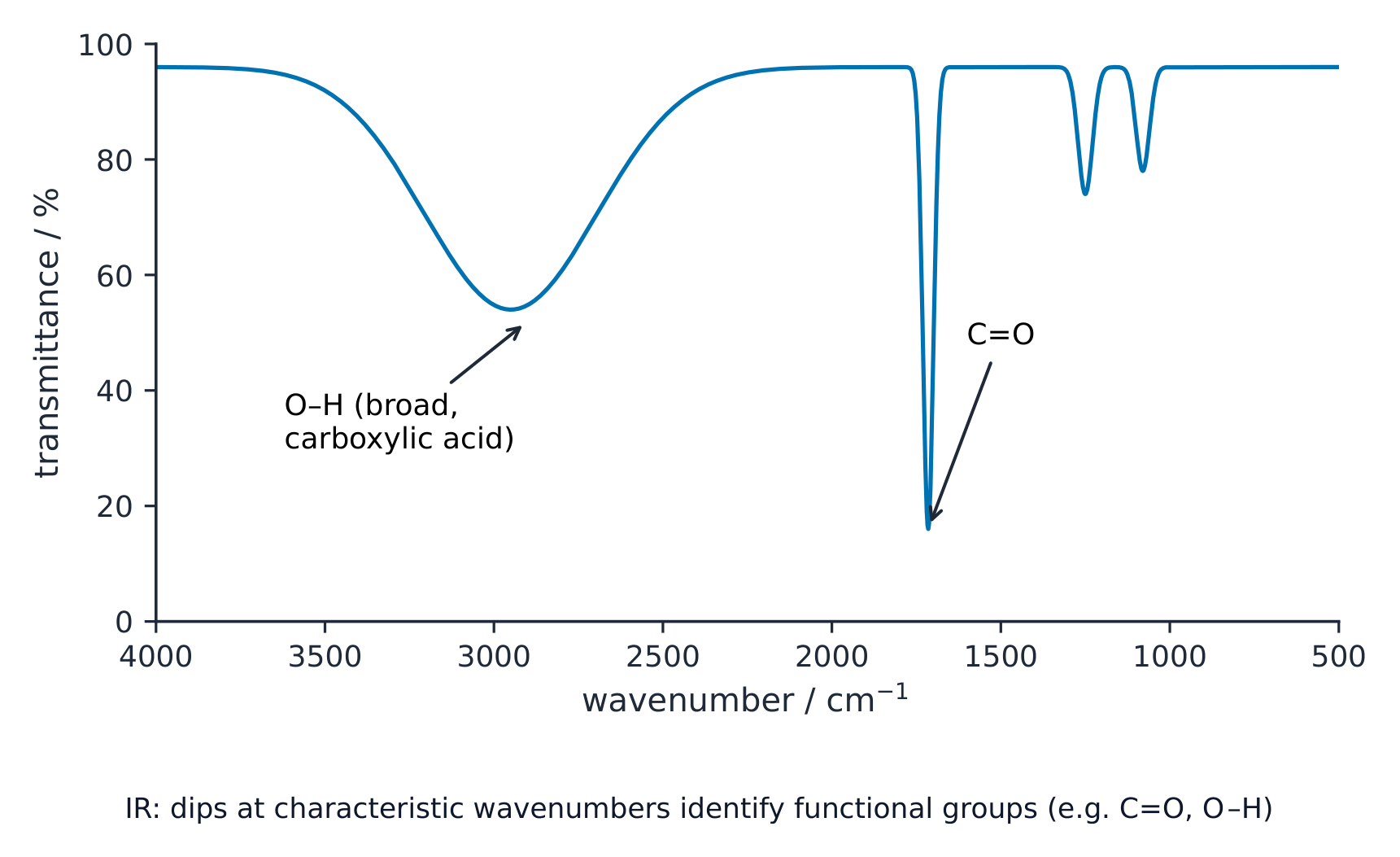
Infrared spectroscopy 红外光谱 helps you find the functional group 官能团 in a molecule. Each kind of bond soaks up (absorbs) infrared radiation at its own range of frequencies. Where the bond shows strong absorption 吸收, the spectrum has a dip.
The position is measured in wavenumber 波数 (in $\text{cm}^{-1}$). You are given a data table, so you do not memorise the numbers. You just match the dips to bonds:
a broad dip around $3200$–$3650\ \text{cm}^{-1}$ → an O–H bond in an alcohol.
a dip around $1700\ \text{cm}^{-1}$ → a C=O bond (aldehyde, ketone, acid or ester).
a broad dip $2500$–$3000\ \text{cm}^{-1}$ together with a C=O dip → a carboxylic acid.
This is useful for checking a reaction. For example, if propene has been turned into propan-2-ol, the C=C dip should be gone and an O–H dip should appear.
العربية
مطيافية الأشعة تحت الحمراء تساعدك في إيجاد المجموعة الوظيفية في الجزيء. كل نوع من الروابط يمتص (يستهلك) إشعاع الأشعة تحت الحمراء عند نطاق ترددي خاص به. حيث يظهر الرابطة امتصاصاً قوياً، يكون الطيف به انخفاض (ذروة سلبية).
يعمل جهاز مطياف الأشعة تحت الحمراء بإشعال الأشعة عبر عينة ويسجل أي الأرقام الموجية تمتصها روابطه
يُقاس الموقع بـ الرقم الموجي (في $\text{cm}^{-1}$). معطى لك جدول بيانات، لذا لا تحفظ الأرقام. فقط طابق الانخفاضات مع الروابط:
انخفاض واسع حول $3200$–$3650\ \text{cm}^{-1}$ → رابطة O–H في كحول.
انخفاض حول $1700\ \text{cm}^{-1}$ → رابطة C=O (ألدهيد، كيتون، حمض أو إستر).
انحدار عريض $2500$–$3000\ \text{cm}^{-1}$ جنبًا إلى جنب مع انحدار C=O → حمض كربوكسيلي.
هذا مفيد للتحقق من التفاعل. على سبيل المثال، إذا تم تحويل البروبين إلى بروبان-2-ول، يجب أن يختفي انخفاض C=C ويظهر انخفاض O–H.
طيف الأشعة تحت الحمراء: كل رابطة تعطي انخفاضاً عند رقم موجي خاص بها. انخفاض O–H واسع مع انخفاض C=O يحدد الحمض الكربوكسيلي
Explore · استكشف
IR spectroscopy lab · مختبر مطيافية الأشعة تحت الحمراء
Match an absorption to the bond or functional group it reveals. · طابق الامتصاص مع الرابطة أو المجموعة الوظيفية التي تكشف عنها.
استنتج الكتلة الجزيئية لجزيء عضوي من قمة أيون الجزيء في طيف كتلته
اقترح هوية الجزيئات المتكونة عن طريق التفتت البسيط في طيف كتلة معطى
استنتج عدد ذرات الكربون، $n$، في مركب باستخدام $[M + 1]^+$ القمة والصيغة
$$n = \frac{100 \times \text{abundance of } [M + 1]^+ \text{ ion}}{1.1 \times \text{abundance of } M^+ \text{ ion}}$$
استنتج وجود ذرات البروم والكلور في مركب باستخدام $[M + 2]^+$ القمة
Source: Cambridge International syllabus · المصدر: منهج كامبريدج الدولي
English
In mass spectrometry 质谱, a molecule is turned into ions and sorted by its mass-to-charge ratio 质荷比 ($m/e$). The spectrum is a set of peaks at different $m/e$ values.
Relative atomic mass from isotopes
An element's isotope 同位素 mixture gives several peaks. From the isotopic abundance 同位素丰度 (how common each isotope is) you can find the relative atomic mass 相对原子质量 — a weighted average:
For example, chlorine is 75% $^{35}\text{Cl}$ and 25% $^{37}\text{Cl}$, giving $A_r = \dfrac{35 \times 75 + 37 \times 25}{100} = 35.5$.
The molecular ion and fragmentation
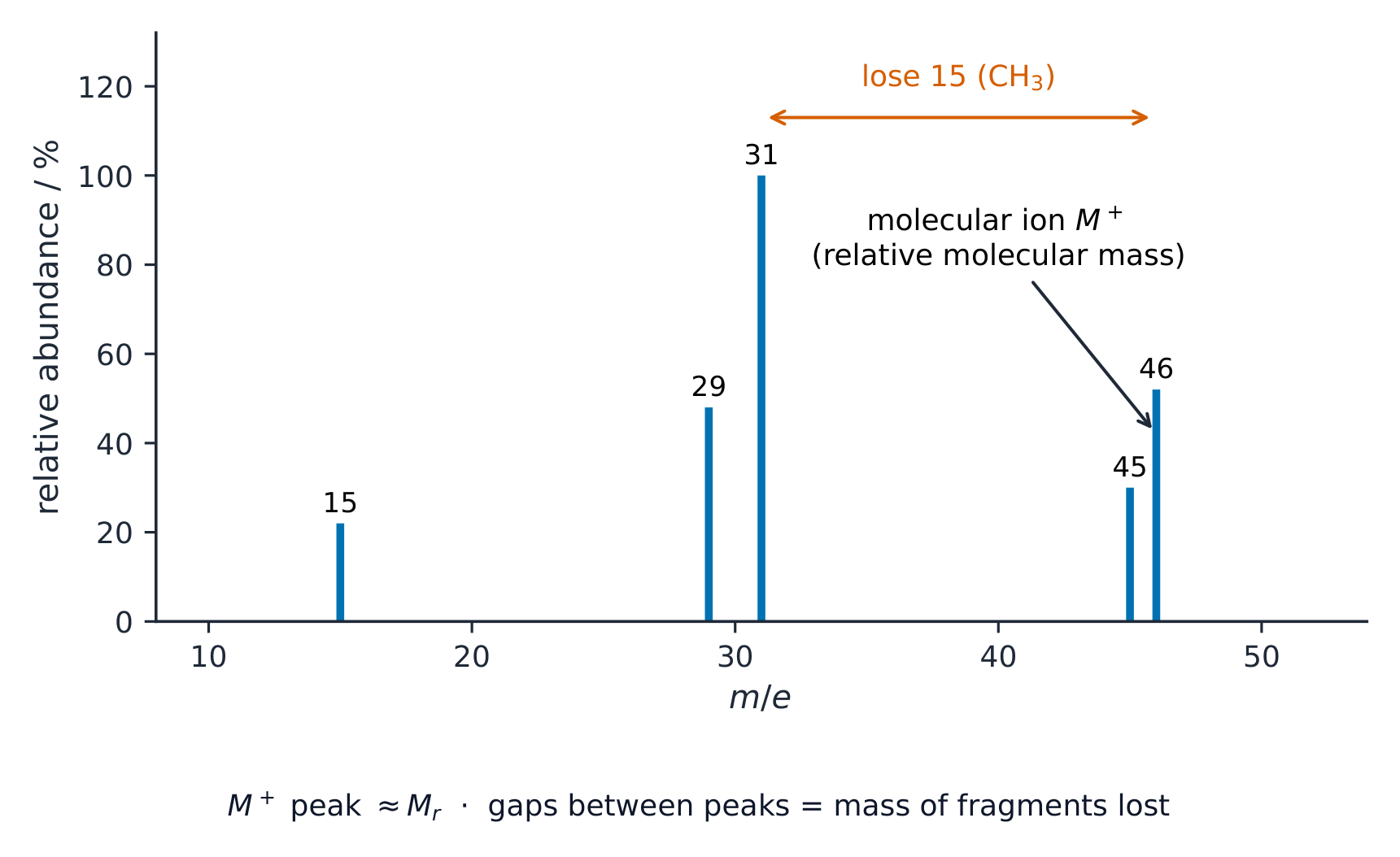
The peak at the highest $m/e$ (the molecular ion 分子离子 peak, or molecular ion peak 分子离子峰, $M^+$) gives the relative molecular mass of the whole molecule.
The molecule also breaks into smaller pieces — this is fragmentation 碎裂. The gap between two peaks tells you the mass of the lost piece, so you can suggest each fragment 碎片. For example, a loss of 15 means a $\text{CH}_3$ group was lost, and a loss of 29 means $\text{CHO}$ or $\text{C}_2\text{H}_5$.
The [M + 1] and [M + 2] peaks
a small [M + 1] peak comes from the $^{13}\text{C}$ isotope. The number of carbon atoms $n$ is:
$$n = \frac{100 \times \text{abundance of } [M + 1]^+}{1.1 \times \text{abundance of } M^+}$$
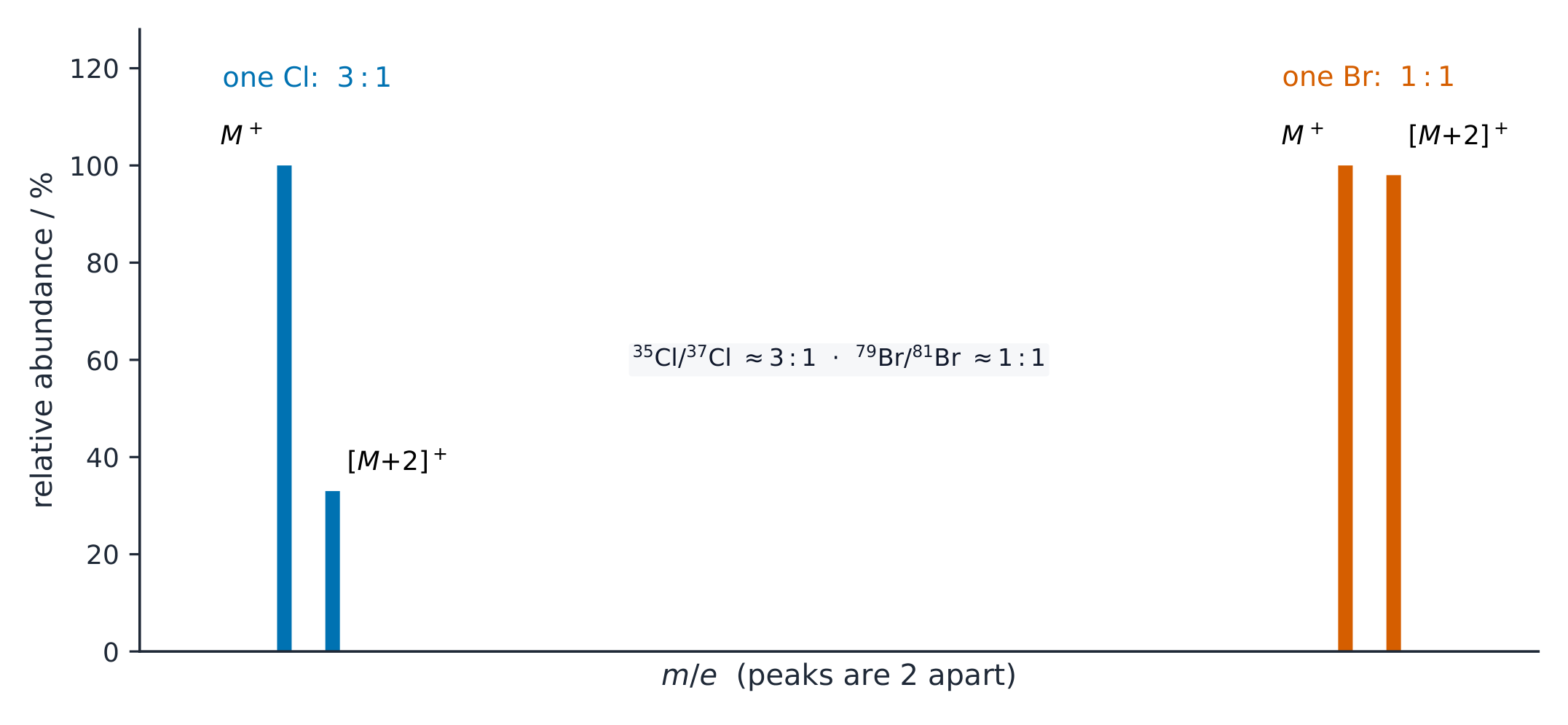
an [M + 2] peak shows chlorine or bromine. One chlorine gives an $[M + 2]$ peak about one third the height of $M^+$ (from $^{37}\text{Cl}$); one bromine gives an $[M + 2]$ peak about the same height as $M^+$ (from $^{81}\text{Br}$).
Worked example. A compound shows a molecular ion at $m/e = 108$ and a peak of almost equal height at $m/e = 110$. Its infrared spectrum shows no broad absorption near $3300\ \text{cm}^{-1}$. Deduce its identity. Two peaks two units apart with roughly equal heights are the $1:1$ signature of one bromine atom (from $^{79}\text{Br}$ and $^{81}\text{Br}$); one chlorine would have given a $3:1$ ratio instead. Take the bromine away from the molecular ion: $108 - 79 = 29$, which fits a $\text{C}_2\text{H}_5$ fragment. The absence of a broad peak near $3300\ \text{cm}^{-1}$ rules out an $\text{O-H}$, so there is no alcohol group. The compound is bromoethane, $\text{C}_2\text{H}_5\text{Br}$. Read the $[M+2]$ratio rather than merely noting the peak: $1:1$ means bromine, $3:1$ means chlorine.
العربية
في مطيافية الكتلة، يُحوّل الجزيء إلى أيونات ويُصنّف حسب نسبة الكتلة إلى الشحنة ($m/e$). الطيف عبارة عن مجموعة من القمم عند قيم $m/e$ مختلفة.
جهاز مطياف كتلة حديث: تُحمّل العينة من الأمام، ثم تقوم الآلة بتأيينها وتصنيف الأيونات حسب نسبتها للكتلة إلى الشحنة لإعطاء الطيف
الكتلة الذرية النسبية من النظائر
خليط نظائر العنصر يعطي عدة قمم. من التوافر النظيري (مدى شيوع كل نظير) يمكنك إيجاد الكتلة الذرية النسبية — وهي متوسط مرجح:
على سبيل المثال، الكلور هو 75% $^{35}\text{Cl}$ و 25% $^{37}\text{Cl}$، مما يعطي $A_r = \dfrac{35 \times 75 + 37 \times 25}{100} = 35.5$.
أيون الجزيء والتجزؤ
القمة عند أعلى $m/e$ (قمة أيون الجزيء، أو قمة أيون الجزيء، $M^+$) تعطي الكتلة الجزيئية النسبية للجزيء بأكمله.
الجزيء ينقسم أيضاً إلى أجزاء أصغر — هذا هو التجزؤ. الفارق بين قمتين يخبرك بكتلة الجزء المفقود، لذا يمكنك اقتراح كل جزء متجزئ. على سبيل المثال، فقدان 15 يعني فقدان مجموعة $\text{CH}_3$، وفقدان 29 يعني $\text{CHO}$ أو $\text{C}_2\text{H}_5$.
طيف كتلة: قمة أعلى $m/e$ هي أيون الجزيء ($M^+$، الـ $M_r$)؛ الفوارق بين القمم تعطي كتل الجزئات المفقودة
قمم [M + 1] و[M + 2]
قمة [M + 1] صغيرة تأتي من نظير $^{13}\text{C}$. عدد ذرات الكربون $n$ هو:
$$n = \frac{100 \times \text{abundance of } [M + 1]^+}{1.1 \times \text{abundance of } M^+}$$
قمة [M + 2] تشير إلى الكلور أو البروم. كلور واحد يعطي قمة $[M + 2]$ ارتفاعها حوالي ثلث ارتفاع $M^+$ (من $^{37}\text{Cl}$)؛ بروم واحد يعطي قمة $[M + 2]$ ارتفاعها تقريباً نفس ارتفاع $M^+$ (من $^{81}\text{Br}$).
قمة $[M+2]$ على بُعد وحدة كتلية واحدة فوق $M^+$ تظهر هالوجين: كلور واحد يعطي نسبة $3:1$، بروم واحد نسبة $1:1$
مثال محلول. يُظهر مركب أيون جزيئي عند $m/e = 108$ وقمة بنفس الارتفاع تقريبًا عند $m/e = 110$. يظهر طيفه تحت الأحمر عدم وجود امتصاص عريض قرب $3300\ \text{cm}^{-1}$. استنتج هويته. قمتان تباعدهما وحدتان وارتفاعاهما متساويان تقريبًا هما $1:1$ لـ ذرة برومين واحدة (من $^{79}\text{Br}$ و$^{81}\text{Br}$)؛ كان الكلور سينتج نسبة $3:1$ بدلاً من ذلك. أزل البرومين من الأيون الجزيئي: $108 - 79 = 29$، وهو ما يتوافق مع片段$\text{C}_2\text{H}_5$. يستبعد غياب القمة العريضة قرب $3300\ \text{cm}^{-1}$ وجود $\text{O-H}$، لذا لا يوجد مجموعة كحول. المركب هو بروموإيثان، $\text{C}_2\text{H}_5\text{Br}$. اقرأ $[M+2]$النسبة بدلاً من مجرد ملاحظة القمم: $1:1$ يعني برومين، و$3:1$ يعني كلور.
Explore · استكشف
Mass spectrometry route · مسار مطيافية الكتلة
Follow a molecule through ionisation, separation and detection. · تابع جزيءًا خلال التأين، والفصل، والكشف.
Pick one and the site follows you — notes, papers, videos and practice all open on it. · اختر واحدًا وسيتبعك الموقع — الملاحظات، الأوراق، الفيديوهات والتدريب جميعها تفتح عليه.
Type to search notes, lessons, code, vocabulary and past-paper questions across every subject. · اكتب للبحث عن ملاحظات، دروس، أكواد، مفردات وأسئلة امتحانات سابقة عبر جميع المواد.