English
- recall the reactions (reagents and conditions) by which halogenoalkanes can be produced: (a) the free-radical substitution of alkanes by $\text{Cl}_2$ or $\text{Br}_2$ in the presence of ultraviolet light, as exemplified by the reactions of ethane (b) electrophilic addition of an alkene with a halogen, $\text{X}_2$, or hydrogen halide, $\text{HX(g)}$, at room temperature (c) substitution of an alcohol, e.g. by reaction with $\text{HX(g)}$; or with $\text{KCl}$ and concentrated $\text{H}_2\text{SO}_4$ or concentrated $\text{H}_3\text{PO}_4$; or with $\text{PCl}_3$ and heat; or with $\text{PCl}_5$; or with $\text{SOCl}_2$
- classify halogenoalkanes into primary, secondary and tertiary
- describe the following nucleophilic substitution reactions: (a) the reaction with $\text{NaOH(aq)}$ and heat to produce an alcohol (b) the reaction with $\text{KCN}$ in ethanol and heat to produce a nitrile (c) the reaction with $\text{NH}_3$ in ethanol heated under pressure to produce an amine (d) the reaction with aqueous silver nitrate in ethanol as a method of identifying the halogen present as exemplified by bromoethane
- describe the elimination reaction with $\text{NaOH}$ in ethanol and heat to produce an alkene as exemplified by bromoethane
- describe the $\text{S}_\text{N}1$ and $\text{S}_\text{N}2$ mechanisms of nucleophilic substitution in halogenoalkanes including the inductive effects of alkyl groups
- recall that primary halogenoalkanes tend to react via the $\text{S}_\text{N}2$ mechanism; tertiary halogenoalkanes via the $\text{S}_\text{N}1$ mechanism; and secondary halogenoalkanes by a mixture of the two, depending on structure
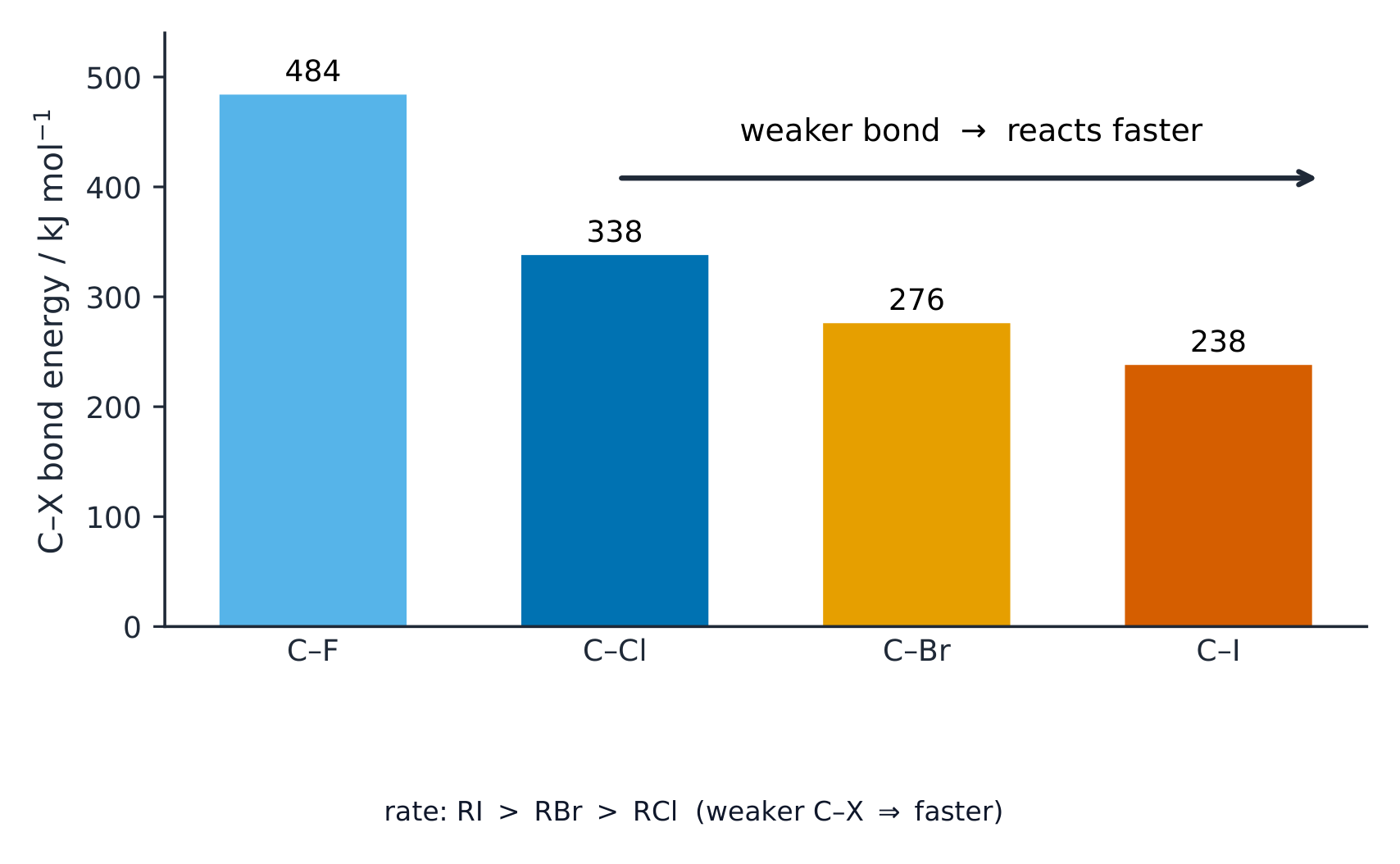
- describe and explain the different reactivities of halogenoalkanes (with particular reference to the relative strengths of the C–X bonds as exemplified by the reactions of halogenoalkanes with aqueous silver nitrates)
العربية
- استذكر التفاعلات (الكواشف والشروط) التي يمكن من خلالها إنتاج هالوجينوألكانات: (أ) الاستبدال الجذري الحر للألكانات بواسطة $\text{Cl}_2$ أو $\text{Br}_2$ في وجود الضوء فوق البنفسجي، كما هو موضح بتفاعلات الإيثان (ب) الإضافة الكهربية لألكين مع هالوجين، $\text{X}_2$، أو هاليد الهيدروجين، $\text{HX(g)}$، عند درجة حرارة الغرفة (ج) استبدال كحول، على سبيل المثال عن طريق تفاعله مع $\text{HX(g)}$؛ أو مع $\text{KCl}$ وحمض concentré $\text{H}_2\text{SO}_4$ أو حمض concentré $\text{H}_3\text{PO}_4$؛ أو مع $\text{PCl}_3$ وحرارة؛ أو مع $\text{PCl}_5$؛ أو مع $\text{SOCl}_2$
- صنف هالوجينوألكانات إلى أولية، ثانوية وثلاثية
- صف التفاعلات التالية لـالاستبدال النوكليوفيلي: (أ) التفاعل مع $\text{NaOH(aq)}$ والحرارة لإنتاج كحول (ب) التفاعل مع $\text{KCN}$ في الإيثانول والحرارة لإنتاج نتريل (ج) التفاعل مع $\text{NH}_3$ في الإيثانول المُسخّن تحت الضغط لإنتاج أمين (د) التفاعل مع نترات الفضة المائية في الإيثانول كطريقة لتحديد نوع الهالوجين الموجود كمثال على ذلك بروموإيثان
- صف تفاعل الإزالة مع $\text{NaOH}$ في الإيثانول والحرارة لإنتاج ألكين كمثال على ذلك بروموإيثان
- صف آليات $\text{S}_\text{N}1$ و$\text{S}_\text{N}2$ للاستبدال النوكليوفيلي في هالوجينوألكانات بما في ذلك التأثيرات التحريضية للمجموعات الألكيلية
- استذكر أن هالوجينوألكانات أولية تميل للتفاعل عبر آلية $\text{S}_\text{N}2$؛ وهالوجينوألكانات ثلاثية عبر آلية $\text{S}_\text{N}1$؛ وهالوجينوألكانات ثانوية عبر مزيج من الاثنين، اعتماداً على البنية
- صف واشرح الاختلافات في النشاط الكيميائي لهالوجينوألكانات (مع الإشارة بشكل خاص إلى قوة الروابط C–X النسبية كما هو موضح بتفاعلات هالوجينوألكانات مع نترات الفضة المائية)