跳到主要内容

副词修饰形容词

HSK 5 · 知识点 16

本主题的视频课程 打开视频页面
2:33

HSK 5 语法 16:形容词前加副词

格外 + 形容词或动词。“格外”在增强程度的同时没有“非常”那么沉重。英语母语者易错点:“格外”隐含与常态的比较,而不仅仅是强调强度。见……

英文讲解与普通话例句 · 字幕与原声同步

点击任意汉字可查看拼音和释义。
English

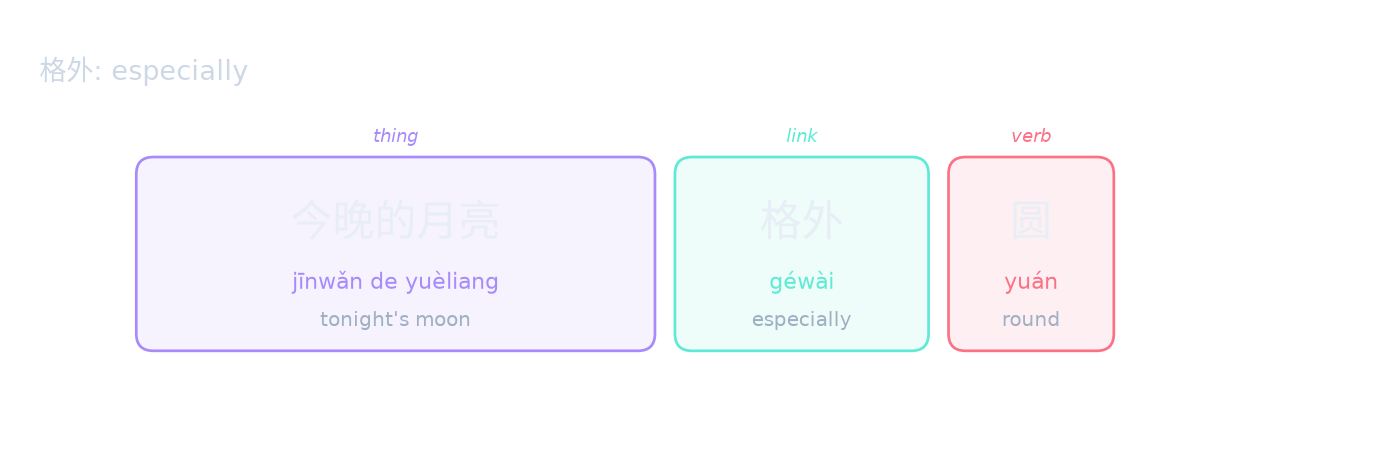
especially; unusually格外gé wài means "especially, unusually": it says something is more than usual in this situation. It goes before an adjective: today今天jīn tiān(modifier / structural particle)的demoon月亮yuè liàngespecially; unusually格外gé wàiround; circle圆yuán. It is more formal than especially / special特别tè bié.

16.1

格外 + 形容词 / 动词

English

Form: especially; unusually格外gé wài + adjective / feeling verb

  • tonight今晚jīn wǎn(modifier / structural particle)的demoon月亮yuè liàngespecially; unusually格外gé wàiround; circle圆yuán,especially; unusually格外gé wàibright亮liàng。 Jīnwǎn de yuèliang géwài yuán, géwài liàng. – Tonight the moon is especially round and bright.
  • the first time第一次dì yī cìto depart离开lí kāihome / family / (measure: shops)家jiā,he / him他tāespecially; unusually格外gé wàito miss想念xiǎng niànmum; mother妈妈mā mā。 Dì-yī cì líkāi jiā, tā géwài xiǎngniàn māma. – Away from home for the first time, he especially missed his mum.
  • to snow下雪xià xuě(completed / change)了le,to drive a car开车kāi chēwant / will / need要yàoespecially; unusually格外gé wàito be careful小心xiǎo xīn。 Xià xuě le, kāichē yào géwài xiǎoxīn. – It's snowing, so drive extra carefully.
  • rain雨yǔafter / back后hòu(modifier / structural particle)的deair空气kōng qìespecially; unusually格外gé wàifresh and clean清新qīng xīn。 Yǔ hòu de kōngqì géwài qīngxīn. – The air after rain is especially fresh.
  • holiday节日jié rìinside; in里lǐ,on the street街上jiē shàngto appear; to seem显得xiǎn deespecially; unusually格外gé wàilively; busy (place)热闹rè nào。 Jiérì li, jiē shang xiǎnde géwài rènao. – During the festival, the streets look especially lively.
  • to hear听到tīng dàothis这个zhè ge好消息hǎo xiāo xī,everyone大家dà jiāespecially; unusually格外gé wàihappy; glad高兴gāo xìng。 Tīngdào zhège hǎo xiāoxi, dàjiā géwài gāoxìng. – Hearing the good news, everyone was especially happy.

How it works. especially; unusually格外gé wài géwài means "especially, unusually, more than usual". It always carries a comparison, even when it is not said: compared with other nights (tonight今晚jīn wǎn(modifier / structural particle)的demoon月亮yuè liàngespecially; unusually格外gé wàiround; circle圆yuán), with normal times (holiday节日jié rìinside; in里lǐespecially; unusually格外gé wàilively; busy (place)热闹rè nào), or because of the situation (to snow下雪xià xuě(completed / change)了le → especially; unusually格外gé wàito be careful小心xiǎo xīn). The first clause often gives that reason or time.

especially; unusually格外gé wài is an adverb, so it goes right before an adjective or a feeling verb (to miss想念xiǎng niàn, to like喜欢xǐ huan, to treasure; to value珍惜zhēn xī). It is a little more written and descriptive than especially / special特别tè bié, which is why it is common in stories and diaries. to appear; to seem显得xiǎn deespecially; unusually格外gé wài ("looks especially …") is a frequent chunk.

degree / adjective linker很hěn / very非常fēi cháng especially / special特别tè bié especially; unusually格外gé wài
very; no comparison needed especially / very; everyday more than usual; a comparison is implied
weather天气tiān qìdegree / adjective linker很hěngood好hǎo。 today今天jīn tiānespecially / special特别tè biécold冷lěng。 雪后xuě hòu(modifier / structural particle)的deearly morning早晨zǎo chénespecially; unusually格外gé wàiquiet安静ān jìng。

Watch out

  • Do not stack degree words: wrong: especially; unusually格外gé wàidegree / adjective linker很hěnhappy; glad高兴gāo xìng → especially; unusually格外gé wàihappy; glad高兴gāo xìng.
  • especially; unusually格外gé wài is an adverb only, never an adjective before a noun: wrong: he / him他tāto be / is是shìespecially; unusually格外gé wài(modifier / structural particle)的deperson人rén → he / him他tāto be / is是shì一个yí gèdegree / adjective linker很hěnespecially / special特别tè bié(modifier / structural particle)的deperson人rén.
  • Without any reason or contrast it sounds odd: wrong: I / me我wǒespecially; unusually格外gé wàito be / is是shìstudent学生xué shēng. Use it to describe a quality that stands out at a particular time.

In a passage

今年春节jīn nián chūn jié,I / me我wǒto return to回到huí dào(completed / change)了leto depart离开lí kāi三年sān nián(modifier / structural particle)的dehometown家乡jiā xiāng。village村子cūn ziinside; in里lǐespecially; unusually格外gé wàilively; busy (place)热闹rè nào,each and every family…家家户户jiā jiā hù hùall / both都dōuto hang挂guàto rise / (start to)起qǐ(completed / change)了le红灯笼hóng dēng lóng。to see见到jiàn dàograndma奶奶nǎi nǎi(modifier / structural particle)的de那一刻nà yī kè,I / me我wǒin one's heart / mind心里xīn liespecially; unusually格外gé wàiemotional; worked up激动jī dòng。that day那天nà tiānevening晚上wǎn shàng(modifier / structural particle)的dedumpling饺子jiǎo zi,I / me我wǒto feel / think觉得jué deespecially; unusually格外gé wàitasty好吃hǎo chī。

Read and notice. Find the three especially; unusually格外gé wài phrases. Why does each feeling stand out more than usual?

格外: especially
词汇 训练
汉字 拼音 English
格外 gé wài especially; unusually
想念 xiǎng niàn to miss
显得 xiǎn de to appear; to seem
珍惜 zhēn xī to treasure; to value
家乡 jiā xiāng hometown
16.2

练习

English

Cover the teaching pages before you answer. The answers are at the end.

1. Complete: “After the rain the air is especially fresh.” rain雨yǔafter / back后hòu(modifier / structural particle)的deair空气kōng qì…………fresh and clean清新qīng xīn。

2. Which sentence is correct?

  • A. today今天jīn tiāncold冷lěngespecially; unusually格外gé wài。
  • B. today今天jīn tiānespecially; unusually格外gé wàicold冷lěng。
  • C. especially; unusually格外gé wàitoday今天jīn tiāndegree / adjective linker很hěncold冷lěng。
  • D. today今天jīn tiānespecially; unusually格外gé wàidegree / adjective linker很hěncold冷lěng。

3. Build: “It's snowing; drive extra carefully.”

Put in order: ,to drive a car开车kāi chē / want / will / need要yàoespecially; unusually格外gé wài / to be careful小心xiǎo xīn。 / to snow下雪xià xuě(completed / change)了le

4. True or false? especially; unusually格外gé wài is close in meaning to especially / special特别tè bié. If false, correct it.

5. At the Mid-Autumn Festival you look up and the moon is brighter than you've ever seen. Use especially; unusually格外gé wài. Write your answer in Chinese, then say it aloud.

16.3

混合练习

English

These questions mix the patterns and use new situations.

6. Find and fix the problem. A note says today今天jīn tiānespecially; unusually格外gé wàiquiet安静ān jìng. A classmate thinks the place is always the quietest anywhere. Correct it.

7. Use it yourself. Explain why the park is especially quiet today.

16.4

答案与解析

English

Mark your work, then correct each mistake in your own words.

1. especially; unusually格外gé wài

especially; unusually格外gé wài + Adj = more than usual.

2. B. today今天jīn tiānespecially; unusually格外gé wàicold冷lěng。

today今天jīn tiānespecially; unusually格外gé wàicold冷lěng is right: especially; unusually格外gé wài ("especially") is a degree adverb, so it replaces degree / adjective linker很hěn and goes before a bare adjective.

3. to snow下雪xià xuě(completed / change)了le,to drive a car开车kāi chēwant / will / need要yàoespecially; unusually格外gé wàito be careful小心xiǎo xīn。

want / will / need要yào + especially; unusually格外gé wài + Adj.

4. True.

Both stress “more than usual”.

5. Model answer: tonight今晚jīn wǎn(modifier / structural particle)的demoon月亮yuè liàngespecially; unusually格外gé wàiround; circle圆yuán,especially; unusually格外gé wàibright亮liàng。

Check your answer:

  • Do not add degree / adjective linker很hěn or very非常fēi cháng: especially; unusually格外gé wàihappy; glad高兴gāo xìng, not especially; unusually格外gé wàidegree / adjective linker很hěnhappy; glad高兴gāo xìng.
  • especially; unusually格外gé wài implies "more than usual"; it sounds odd when nothing is being compared.

Mixed practice

6. especially; unusually格外gé wài compares with usual: today it is especially quiet, more than normal for this place.

7. Model answer. today今天jīn tiānto rain下雨xià yǔ,park公园gōng yuáninside; in里lǐespecially; unusually格外gé wàiquiet安静ān jìng。

Review later. Tomorrow, describe one thing that is especially; unusually格外gé wài different today.

该知识点的互动课程

逐步完成,配合即时检查练习。

更多 HSK 5 知识点

登录或创建账户

IGCSE, A-Level & AP