Small words that place events in time, count things and tell the time, and three particles that change what a sentence means ((ongoing -ing)着, (completed / change)了 and (and …? / softener)呢). Most mistakes here are about order: the time word comes before the verb, and before以前 / after / from now on以后 come after the event they mark.
助词、名词 & 数字
HSK 3 · 知识点 5
4:48
HSK 3 语法 5:助词、名词与数词
半数、大数与模糊量。“半”顺应英语语序;“万”以四位分组;降调疑问词表若干。规则虽简,其…
英文讲解与普通话例句 · 字幕与原声同步
5.1
一目了然
Before, after and when
- 1. Time / Verb + before以前 – before …: to sleep睡觉before以前although (you'd think) / don't look别看mobile phone手机。
- 2. before以前,… – in the past, …: before以前here这儿not have / haven't没有road路,now现在to have / there is有很多car车(completed / change)了。
- 3. just now刚才 – a moment ago: just now刚才someone有人to / for / give给you你to make a telephone call打电话(completed / change)了。
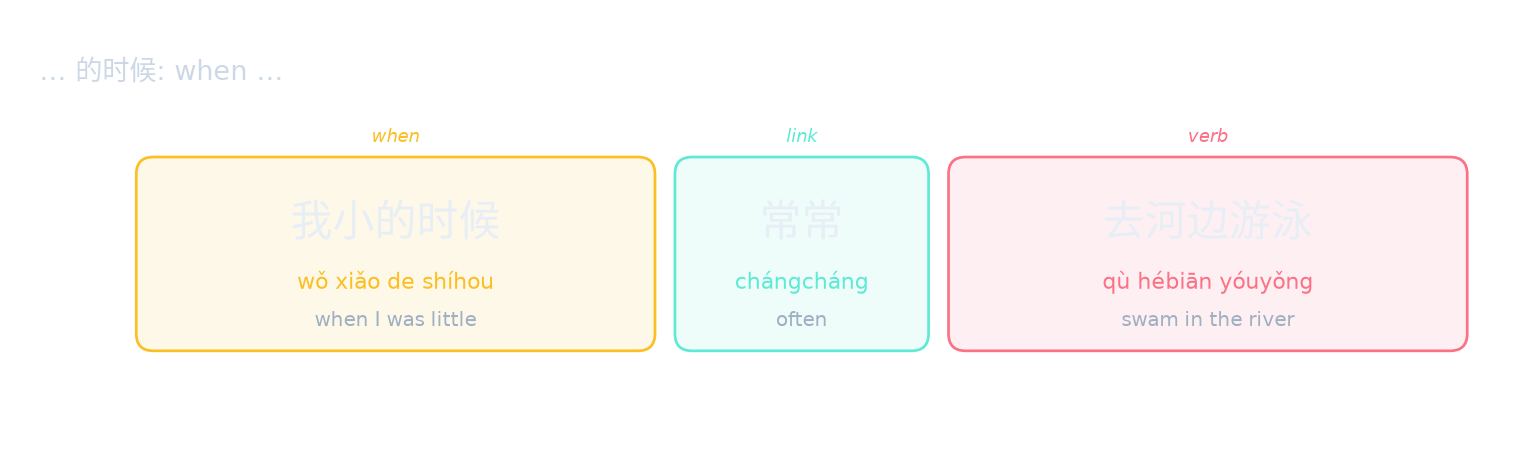
- 4. Time / Verb + time / when时 – when …: I / me我small小(modifier / structural particle)的time; when时候often常常to go去river bank河边to swim游泳。
- 5. after / from now on以后 – after / in the future: 大学毕业after / from now on以后,I / me我want / think / miss想to go去abroad国外to work; job工作。
- 6. … ,later; afterwards后来 … – afterwards / later – past: he / him他to go去(completed / change)了Shenzhen subprovincial city…深圳,later; afterwards后来at / in在there那儿to open; to drive开(completed / change)了one (family / company)一家company公司。
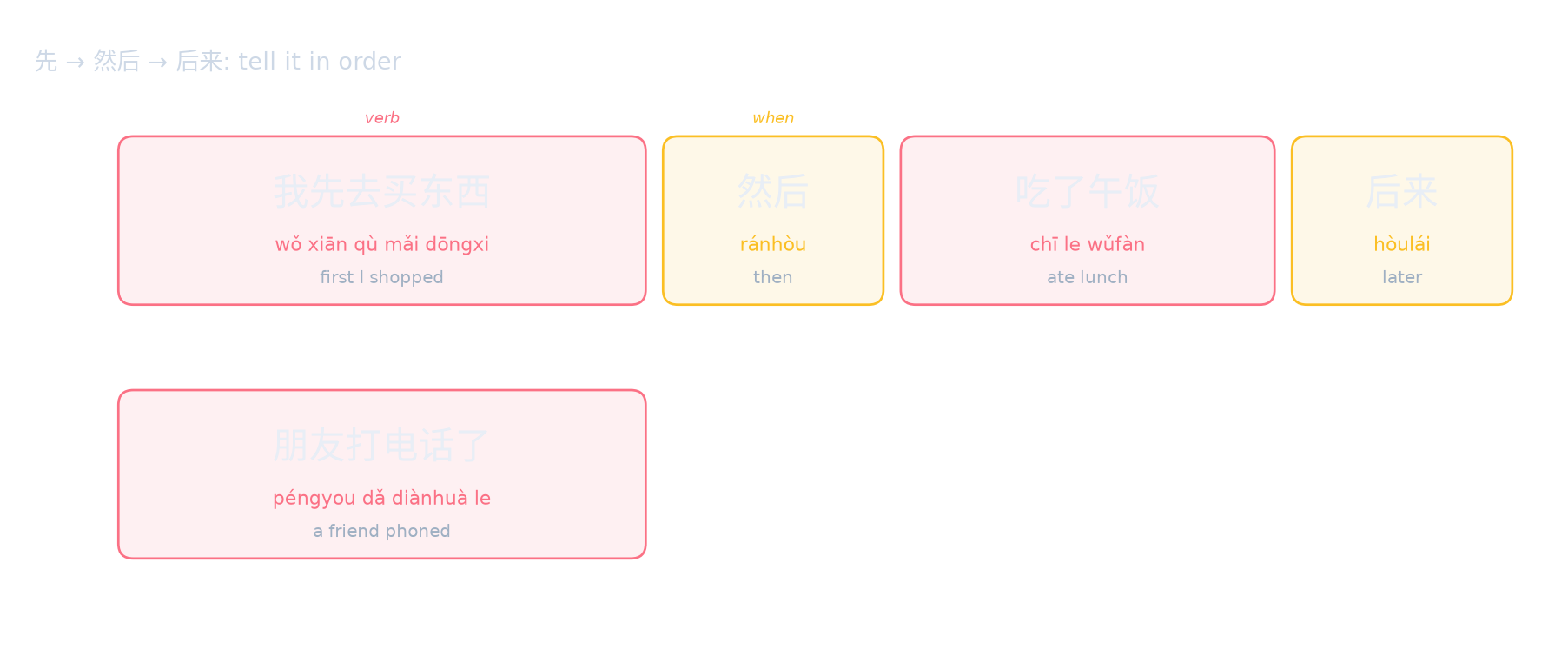
- 7. after / from now on以后 vs then / after然后 vs later; afterwards后来 – then / after: I / me我first先to go去to buy买thing; stuff东西,then / after然后to eat吃(completed / change)了lunch午饭。
Numbers and the clock
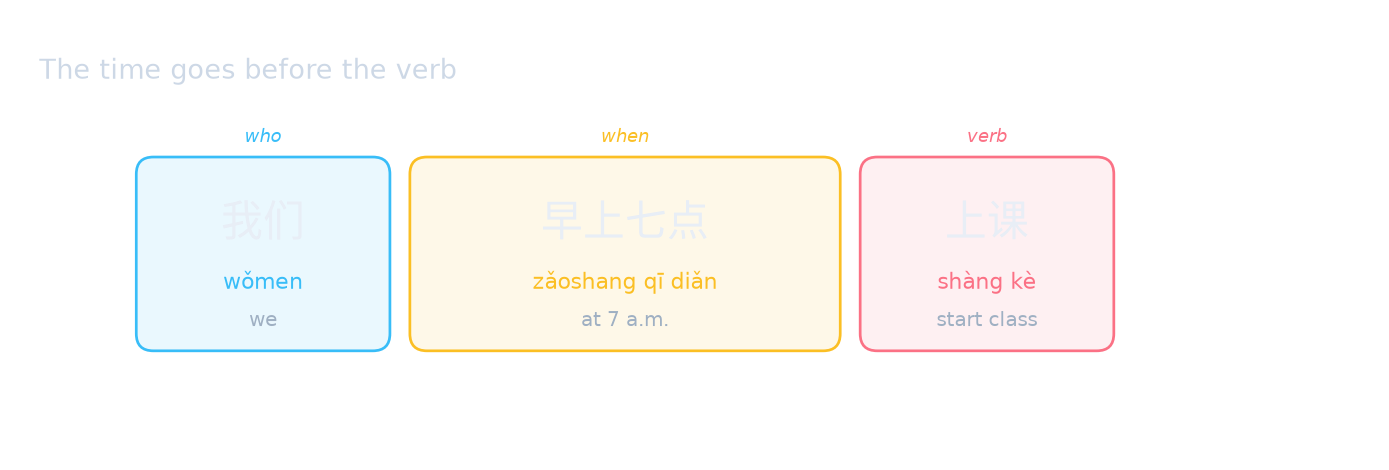
- 8. Telling the hour – Number + o'clock; a little点: we / us我们early morning早上七点to go to class上课。
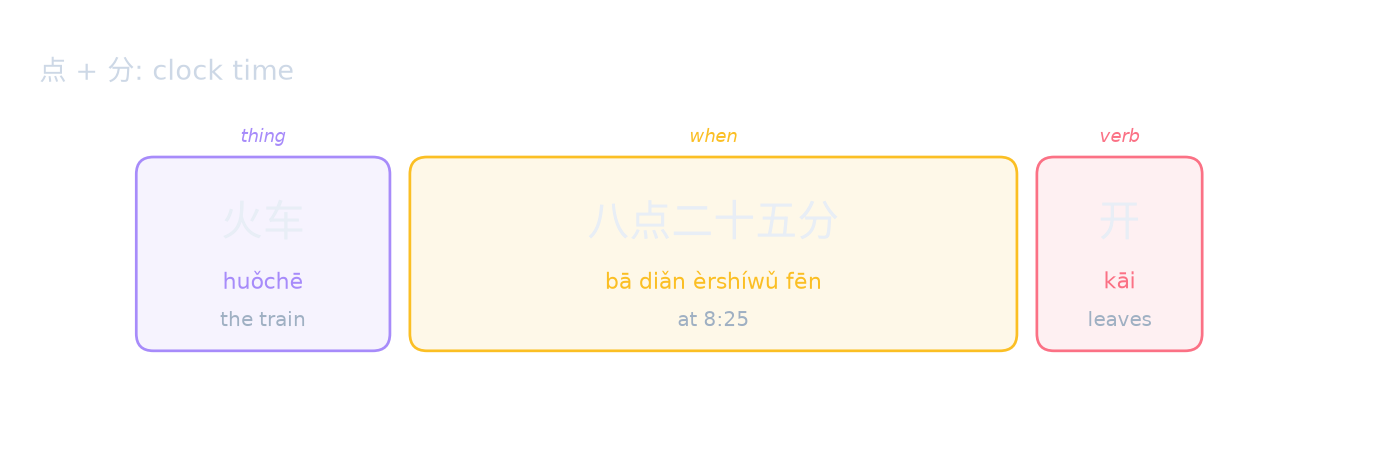
- 9. Times to the minute – o'clock; a little点 … minute / point / to divide分: train火车八点二十五to separate分开。
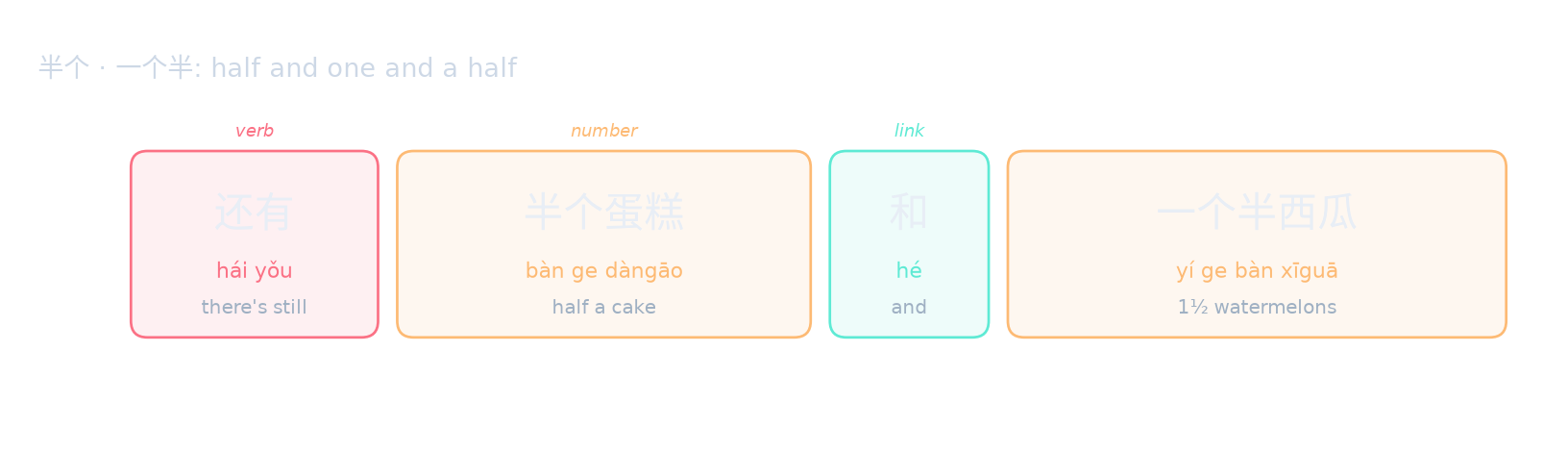
- 10. half半 – half / and a half: also / there is still还有half of sth半个cake蛋糕and / with和one and a half一个半watermelon西瓜。
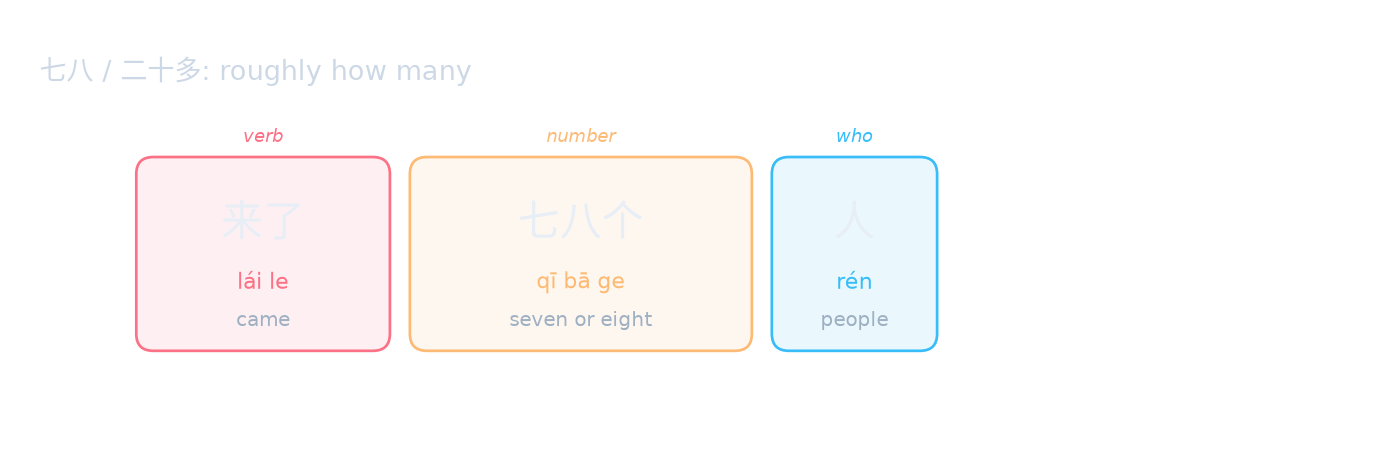
- 11. Approximating with sequential numbers: to come来(completed / change)了七八个person人。
- 12. Big numbers – ten thousand万 / 100 million亿: Chongqing city (Chungking)…重庆to have / there is有三千多万person人。
Particles
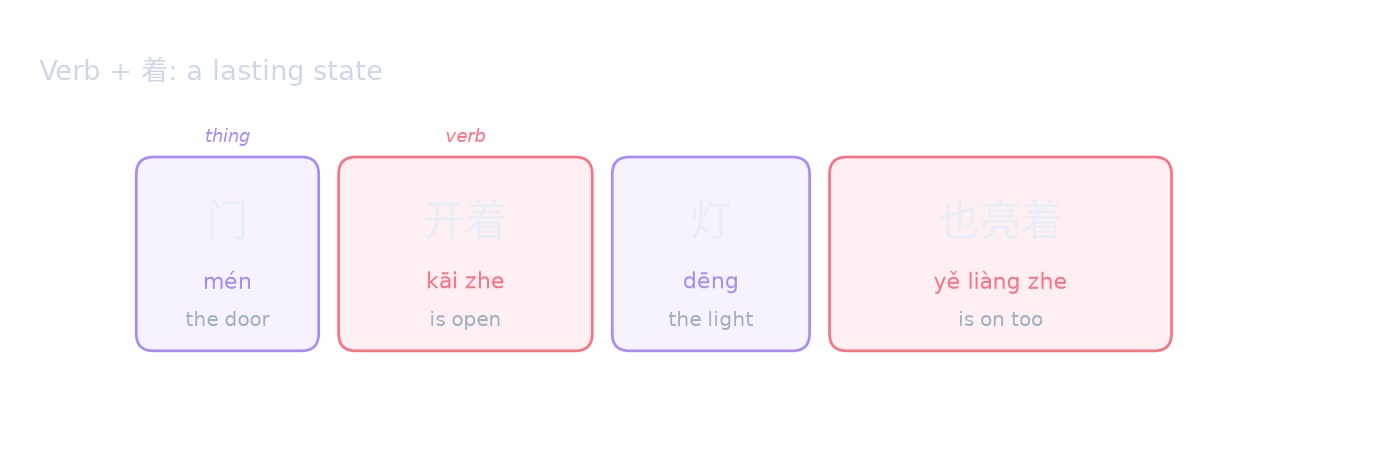
- 13. Verb + (ongoing -ing)着 – ongoing state: 门开(ongoing -ing)着,lamp灯also也bright亮(ongoing -ing)着。
- 14. Sentence-final (completed / change)了 – change of state: he / him他to be / is是teacher老师。
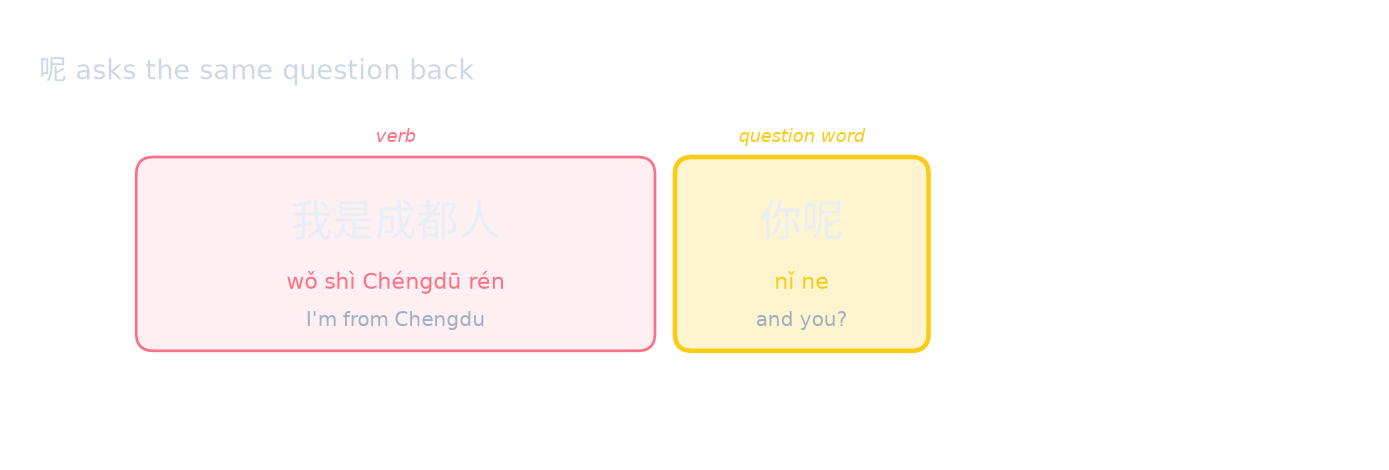
- 15. Questions with (and …? / softener)呢 – and you? / where?: I / me我to be / is是Chengdu subprovincial city…成都person人,you你(and …? / softener)呢?
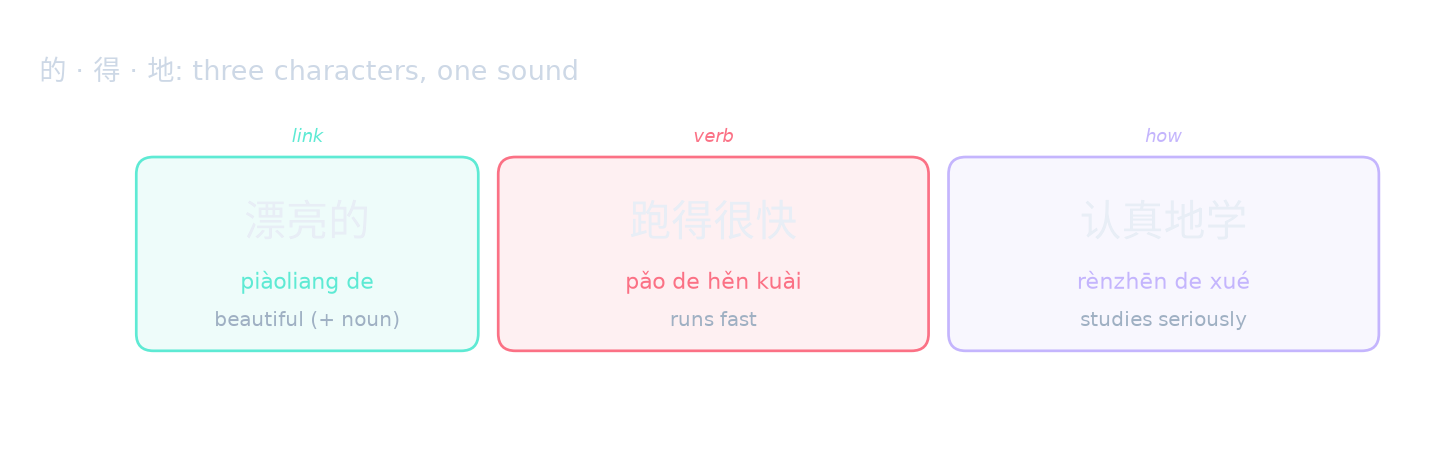
- 16. (modifier / structural particle)的 / (degree marker)得 / (adverb -ly)地 – the three “de”: he / him他to run跑(modifier / structural particle)的很快。
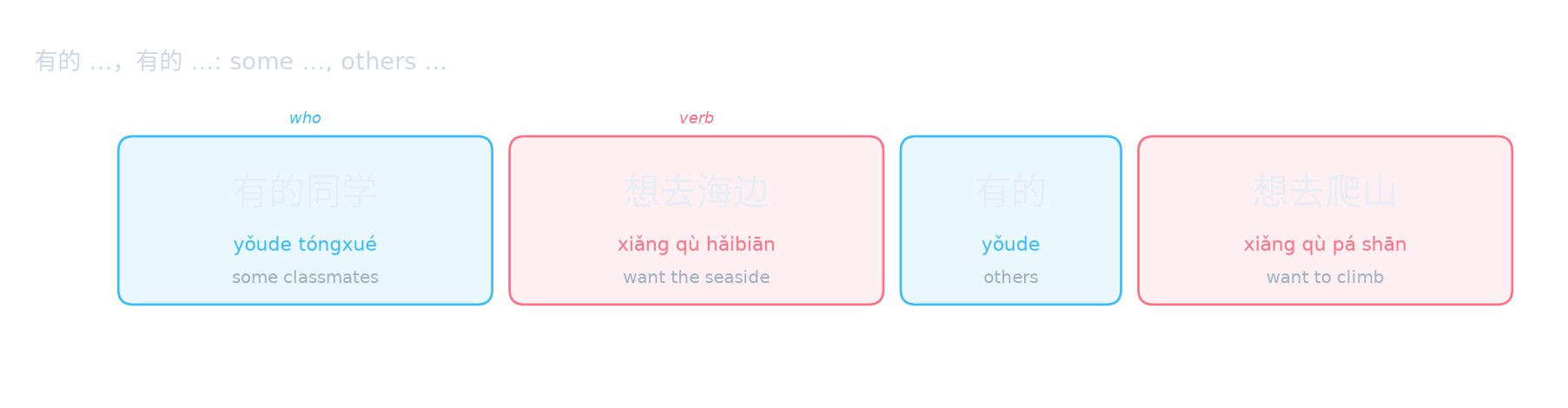
- 17. to have / there is有(modifier / structural particle)的 – some / some…, others…: to have / there is有(modifier / structural particle)的classmate同学want / think / miss想to go去coast海边,to have / there is有(modifier / structural particle)的want / think / miss想to go去to climb a mountain爬山。
5.2
1. 时间 / 动词 + 以前(在……之前)
Form: time / action + before以前 + main verb
- to sleep睡觉before以前although (you'd think) / don't look别看mobile phone手机。 Shuìjiào yǐqián bié kàn shǒujī. – Don't look at your phone before bed.
- Friday星期五before以前要交school assignment作业。 Xīngqīwǔ yǐqián yào jiāo zuòyè. – The homework must be handed in before Friday.
- to have a meal吃饭before以前want / will / need要to wash one's hands洗手。 – Wash your hands before you eat.
- 三天before以前 / 三天front / before前 – three days ago
How it works. Unlike English "before", before以前 yǐqián comes after the time or action it refers to: 八点before以前, to go to class上课before以前. The whole phrase goes before the main verb: you你八点before以前to come来(suggestion)吧.
In short fixed phrases, front / before前 alone does the same job: 饭前, 睡前, 三天front / before前.
Watch out
- wrong: before以前to go to class上课 → to go to class上课before以前. before以前 at the front means "in the past" (next section).
- wrong: I / me我to return home回家十点before以前 → I / me我十点before以前to return home回家.

| 汉字 | 拼音 | English |
|---|---|---|
| 以前 | yǐ qián | before |
| 作业 | zuò yè | school assignment |
5.3
2. 以前,……(过去,……)
Form: before以前 (+ subject) …,now现在 … · subject + before以前 + verb
- before以前here这儿not have / haven't没有road路,now现在to have / there is有很多car车(completed / change)了。 Yǐqián zhèr méiyǒu lù, xiànzài yǒu hěn duō chē le. – There used to be no road here; now there are lots of cars.
- I / me我before以前to live (somewhere)住at / in在Shanghai municipality…上海。 Wǒ yǐqián zhù zài Shànghǎi. – I used to live in Shanghai.
- he / him他before以前not不to like喜欢to eat吃spicy辣(modifier / structural particle)的,now现在degree / adjective linker很to like喜欢。 – He didn't use to like spicy food; now he loves it.
How it works. On its own at the start, or after the subject, before以前 means "in the past, used to". It describes a past habit or state, often in contrast with now现在. A past habit usually needs no (completed / change)了.
Which before以前? Look at what comes before it.
| before以前 alone | after a time or action |
|---|---|
| "in the past" | "before" |
| before以前I / me我not不喝咖啡。 | 喝咖啡before以前,I / me我first先to eat吃breakfast早饭。 |
past过去 is a slightly more formal "in the past". originally / so it turns out原来 means "originally", stressing that things later changed: he / him他originally / so it turns out原来to be / is是teacher老师,later; afterwards后来to work as当(completed / change)了author作家.

| 汉字 | 拼音 | English |
|---|---|---|
| 先 | xiān | first |
| 过去 | guò qù | past |
5.4
3. 刚才(不久以前)
Form: just now刚才 + subject + … · subject + just now刚才 + …
- just now刚才someone有人to / for / give给you你to make a telephone call打电话(completed / change)了。 Gāngcái yǒu rén gěi nǐ dǎ diànhuà le. – Someone called you a moment ago.
- you你just now刚才to go去where哪儿(completed / change)了? Nǐ gāngcái qù nǎr le? – Where did you go just now?
- just now刚才at / in在to rain下雨,now现在to stop停(completed / change)了。 – It was raining a moment ago; now it's stopped.
- just now刚才I / me我not / haven't没to hear听见。 – I didn't hear just now.
How it works. just now刚才 gāngcái is a time word for "a moment ago", in the same situation. Like yesterday昨天 or today今天, it goes before or after the subject. It works with actions, states (just now刚才degree / adjective linker很quiet安静) and negatives (just now刚才I / me我not / haven't没to hear听见).
| just now刚才 | just now刚 | recently最近 |
|---|---|---|
| minutes ago | "just", before the verb | recently, over days |
| he / him他just now刚才to walk / to leave走(completed / change)了 | he / him他just now刚to walk / to leave走 | I / me我recently最近to move house搬家(completed / change)了 |
Watch out
- just now刚 cannot start a sentence: wrong: just now刚he / him他to come来(completed / change)了 → just now刚才他来(completed / change)了.
- For "I moved house recently", use recently最近, not just now刚才.

| 汉字 | 拼音 | English |
|---|---|---|
| 刚才 | gāng cái | just now |
| 安静 | ān jìng | quiet |
| 最近 | zuì jìn | recently |
5.5
4. 时间或动词 + 时(表示某事发生的时候)
Form: clause + (modifier / structural particle)的time; when时候 (spoken) / time / when时 (written),main clause
- I / me我small小(modifier / structural particle)的time; when时候often常常to go去river bank河边to swim游泳。 Wǒ xiǎo de shíhou chángcháng qù hébiān yóuyǒng. – When I was little, I often went swimming by the river.
- I / me我to / arrive / (result: get)到home / family / (measure: shops)家(modifier / structural particle)的time; when时候,he / him他already已经to sleep睡(completed / change)了。 Wǒ dào jiā de shíhou, tā yǐjīng shuì le. – When I got home, he was already asleep.
- you你to have time (to do sth)有空(modifier / structural particle)的time; when时候to / for / give给I / me我to make a telephone call打电话。 – Call me when you have time.
- 上课时,请关mobile phone手机。 – Please turn off your phone in class.
How it works. Like before以前 and after / from now on以后, "when" comes after what it refers to. Use (modifier / structural particle)的time; when时候 in conversation. time / when时 is shorter and suits signs, writing and fixed phrases: to eat a meal用餐time / when时No smoking请勿吸烟 (no smoking while dining).
Watch out
- wrong: time; when时候to rain下雨 → to rain下雨(modifier / structural particle)的time; when时候.
- what什么time; when时候 asks "when?"; it does not make a "when" clause: wrong: I / me我what什么time; when时候to get home到家,he / him他already已经to sleep睡(completed / change)了 → I / me我to / arrive / (result: get)到home / family / (measure: shops)家(modifier / structural particle)的time; when时候…….

| 汉字 | 拼音 | English |
|---|---|---|
| 以后 | yǐ hòu | after |
5.6
5. 以后
Form: time / action + after / from now on以后 + main clause · after / from now on以后 (from now on) + clause
- 大学毕业after / from now on以后,I / me我want / think / miss想to go去abroad国外to work; job工作。 Dàxué bìyè yǐhòu, wǒ xiǎng qù guówài gōngzuò. – After I graduate, I want to work abroad.
- you你to / arrive / (result: get)到(completed / change)了after / from now on以后to / for / give给I / me我to make a telephone call打电话。 Nǐ dàole yǐhòu gěi wǒ dǎ diànhuà. – Call me after you arrive.
- after / from now on以后I / me我not不to arrive late迟到(completed / change)了。 – From now on, I won't be late.
- after / from now on以后我会早点儿to sleep睡。 – From now on I'll go to bed earlier.
How it works. After an event, after / from now on以后 yǐhòu means "after": to finish class下课after / from now on以后, 吃了饭after / from now on以后, 三天after / from now on以后. Alone at the start, it means "in the future, from now on". after / back后 is the short form in fixed phrases: 饭后, to graduate毕业after / back后.
| after / from now on以后 | later; afterwards后来 | then / after然后 |
|---|---|---|
| after X; from now on | later, in a past story | next step, past or future |
| to graduate毕业after / from now on以后 | later; afterwards后来他开(completed / change)了one (family / company)一家company公司 | first先to wash one's hands洗手,then / after然后to have a meal吃饭 |
Watch out
- wrong: after / from now on以后to have a meal吃饭 means "eat in the future". "After eating" is to have a meal吃饭after / from now on以后.

| 汉字 | 拼音 | English |
|---|---|---|
| 迟到 | chí dào | to arrive late |
| 然后 | rán hòu | then |
5.7
6. … ,后来 …(表示过去某个时间之后)
Form: past event,later; afterwards后来 + what happened next
- he / him他to go去(completed / change)了Shenzhen subprovincial city…深圳,later; afterwards后来at / in在there那儿to open; to drive开(completed / change)了one (family / company)一家company公司。 Tā qùle Shēnzhèn, hòulái zài nàr kāile yì jiā gōngsī. – He went to Shenzhen and later started a company there.
- to start开始I / me我not不to like喜欢he / him他,later; afterwards后来we / us我们to become / into成(completed / change)了friend朋友。 – At first I didn't like him, but later we became friends.
- he / him他in one's childhood小时候很瘦,later; afterwards后来长胖(completed / change)了。 – He was thin as a child, but later he put on weight.
- later; afterwards后来(and …? / softener)呢? / later; afterwards后来how about怎么样(completed / change)了? – And then? / How did it turn out?
How it works. later; afterwards后来 hòulái jumps forward in a past story, often over a gap of time. It starts the second clause, after a comma. later; afterwards后来(and …? / softener)呢? keeps a story going.
| later; afterwards后来 | then / after然后 |
|---|---|
| past stories only | past or future |
| a jump forward in time | the next step, close behind |
| later; afterwards后来长胖(completed / change)了 | we / us我们first先to have a meal吃饭,then / after然后to go去to buy买thing; stuff东西 |
Watch out
- For a plan, use after / from now on以后 or then / after然后: wrong: we / us我们later; afterwards后来talk later / besides再说 → we / us我们after / from now on以后talk later / besides再说.
- later; afterwards后来 is never added after an event: wrong: to graduate毕业later; afterwards后来 → to graduate毕业after / from now on以后.

5.8
7. 以后、然后与后来(表示之后)
Form: event + after / from now on以后 · first先……,then / after然后…… · past story,later; afterwards后来……
- I / me我first先to go去to buy买thing; stuff东西,then / after然后to eat吃(completed / change)了lunch午饭。later; afterwards后来,I / me我(modifier / structural particle)的old friend老朋友to / for / give给I / me我to make a telephone call打电话(completed / change)了。 – First I went shopping, then I had lunch. Later on, an old friend phoned me.
- we / us我们first先to have a meal吃饭,then / after然后to go去to look at; to watch; to read看film; movie电影。 – Let's eat first, then see a film.
- we / us我们to be / is是university大学classmate同学,later; afterwards后来to marry结婚(completed / change)了。 – We were classmates at university, and later we got married.
- I / me我to / arrive / (result: get)到(completed / change)了after / from now on以后to / for / give给you你to make a telephone call打电话。 – I'll call you after I arrive.
How it works. Three words for "after", each with its own job.
| Word | Job | Past or future |
|---|---|---|
| after / from now on以后 | after an event (to finish class下课after / from now on以后); alone: from now on | both |
| then / after然后 | the next step, close behind | both |
| later; afterwards后来 | a jump forward in a story | past only |
then / after然后 starts the next clause; it cannot follow an event the way after / from now on以后 does: I / me我to / arrive / (result: get)到(completed / change)了after / from now on以后…… or I / me我to / arrive / (result: get)到(completed / change)了,then / after然后…….
Watch out
- wrong: we / us我们later; afterwards后来goodbye再见 → we / us我们after / from now on以后goodbye再见.
- wrong: to finish class下课later; afterwards后来 → to finish class下课after / from now on以后.

| 汉字 | 拼音 | English |
|---|---|---|
| 结婚 | jié hūn | to marry |
5.9
8. 表示整点(数字 + 点)
Form: (part of day +) number + o'clock; a little点 + verb · what time?几点?
- we / us我们early morning早上七点to go to class上课。 Wǒmen zǎoshang qī diǎn shàngkè. – We start class at seven in the morning.
- now现在what time?几点? Xiànzài jǐ diǎn? – What time is it?
- you你what time?几点to finish work下班?——I / me我六点to finish work下班。 – What time do you finish work? – At six.
- I / me我evening晚上九点to sleep睡觉。 – I go to bed at nine in the evening.
How it works. Number + o'clock; a little点 diǎn = o'clock. Ask with what time?几点. The part of the day comes first (early morning早上, noon中午, afternoon下午, evening晚上), then the hour, then the verb.
| o'clock; a little点 | hour小时 |
|---|---|
| a point on the clock | a length of time |
| 三点 (3 o'clock) | 三个hour小时 (three hours) |
I / me我三点to start开始,学了三个hour小时: I started at three and studied for three hours.
Watch out
- 2 o'clock is wrong: 二点 → 两点.
- wrong: I / me我to finish work下班六点 → I / me我六点to finish work下班.

5.10
9. 精确到分钟的时间(点 … 分)
Form: (part of day +) number + o'clock; a little点 + number + minute / point / to divide分 + verb
- train火车八点二十五to separate分开。 Huǒchē bā diǎn èrshíwǔ fēn kāi. – The train leaves at 8.25.
- I / me我early morning早上六点一刻to get up起床。 Wǒ zǎoshang liù diǎn yí kè qǐchuáng. – I get up at a quarter past six.
- afternoon下午两点半见。 – See you at 2.30 p.m.
How it works. The larger unit always comes first: part of the day, then the hour, then the minutes. After ten minutes, minute / point / to divide分 is often dropped in speech (八点二十五).
| Time | Chinese |
|---|---|
| 8.05 | 八点零五(minute / point / to divide分) |
| 7.30 | 七点half半 |
| 9.15 | 九点一刻 |
| 9.45 | 九点三刻 |
| 9.55 | poor差五分十点 (five to ten) |
| 8.50 | poor差very十分九点 |
Watch out
- For 1–9 minutes, add zero零: wrong: 八点五分 → 八点零五分.
- The time goes before the verb: wrong: I / me我to get up起床七点 → I / me我七点to get up起床.
- 2.00 is 两点, never wrong: 二点.

| 汉字 | 拼音 | English |
|---|---|---|
| 分 | fēn | minute |
| 半 | bàn | half |
| 差 | chà | poor |
5.11
10. 半(一半 / 又半)
Form: half半 + measure word (half a) · number + measure word + half半 (and a half) · half一半 (half of it)
- also / there is still还有half of sth半个cake蛋糕and / with和one and a half一个半watermelon西瓜。 Hái yǒu bàn ge dàngāo hé yí ge bàn xīguā. – There's half a cake and one and a half watermelons left.
- film; movie电影to have / there is有两个half hour半小时。 – The film is two and a half hours long.
- half一半(modifier / structural particle)的student学生to be / is是schoolgirl女生。 – Half of the students are girls.
- I / me我only只to eat吃(completed / change)了half一半。 – I only ate half.
How it works. Where half半 goes changes the meaning.
| Pattern | Meaning | Example |
|---|---|---|
| half半 + measure word | half a … | half of sth半个hour小时, 半杯water水, half a year半年 |
| number + measure word + half半 | … and a half | one and a half一个半hour小时, 一年half半 |
| half一半 | half (of a whole) | I / me我only只to eat吃(completed / change)了half一半 |
| hour + half半 | half past | 三点half半 |
Watch out
- No one / a一 before half半 in "half a": wrong: half一半(measure word)个 → half of sth半个.
- wrong: 一个hour小时half半 → one and a half一个半hour小时.

| 汉字 | 拼音 | English |
|---|---|---|
| 蛋糕 | dàn gāo | cake |
| 只 | zhǐ | only |
5.12
11. 用相邻数字表示约数
Form: two neighbouring numbers + measure word · more than ten十几 / 几十 · number + many; much多 · number + about; left and right左右
- to come来(completed / change)了七八个person人。 Láile qī-bā ge rén. – Seven or eight people came.
- 班里to have / there is有十几个student学生。 Bān li yǒu shíjǐ ge xuésheng. – There are a dozen or so students in the class.
- he / him他三十岁about; left and right左右。 – He's around thirty.
- I / me我to wait; and so on等(completed / change)了三个many; much多hour小时。 – I waited over three hours.
How it works. Chinese has several ways to give a rough number.
| Pattern | Meaning | Example |
|---|---|---|
| two neighbouring numbers, smaller first | about | 三四个, 五六天 |
| more than ten十几 | eleven to nineteen | 十几个 |
| 几十 | dozens | 几十个 |
| round ten + many; much多 + measure word | -odd, over | 二十多个person人, 一百多块 |
| number under ten + measure word + many; much多 | a bit over | 三个many; much多hour小时 |
| number + about; left and right左右 | around | 三十岁about; left and right左右 |
| almost / about the same差不多 + number | nearly | almost / about the same差不多五十个person人 |
Watch out
- The measure word comes after both numbers: wrong: 三个四个person人 → 三四个person人.
- wrong: 二十个many; much多 → 二十多个.

5.13
12. 大数:万 / 亿
Form: ten thousand万 (10,000) · 100 million亿 (100,000,000)
- Chongqing city (Chungking)…重庆to have / there is有三千多万person人。 Chóngqìng yǒu sānqiān duō wàn rén. – Chongqing has over thirty million people.
- China中国to have / there is有fourteen十四亿人。 Zhōngguó yǒu shísì yì rén. – China has 1.4 billion people.
- 这辆car车两万五千yuan (spoken); piece块。 – This car costs 25,000 yuan.
How it works. English groups big numbers in threes (thousand, million); Chinese groups them in fours, with ten thousand万 and 100 million亿.
| Number | Chinese | Think of it as |
|---|---|---|
| 10,000 | 一万 | 1 | 0000 |
| 100,000 | hundred thousand十万 | 10 | 0000 |
| 1,000,000 | 一百万 | 100 | 0000 |
| 10,000,000 | 一千万 | 1000 | 0000 |
| 100,000,000 | 一亿 | 1 | 0000 | 0000 |
| 1,000,000,000 | one billion十亿 | 10 | 0000 | 0000 |
Converting. Mark off four digits from the right for ten thousand万, eight for 100 million亿: 2,000,000 → 200|0000 → 两百万.
Watch out
- wrong: one / a一百千 → hundred thousand十万 (there is no "hundred thousand" unit).
- wrong: 一万万 → 一百万 for a million.

| 汉字 | 拼音 | English |
|---|---|---|
| 万 | wàn | ten thousand |
5.14
13. 动词 + 着(持续状态)
Form: verb + (ongoing -ing)着 (state) · verb₁ + (ongoing -ing)着 + verb₂ · not / haven't没 + verb + (ongoing -ing)着
- 门开(ongoing -ing)着,lamp灯also也bright亮(ongoing -ing)着。 Mén kāizhe, dēng yě liàngzhe. – The door is open, and the lights are on.
- he / him他attire穿着一件白衬衫。 Tā chuānzhe yí jiàn bái chènshān. – He's wearing a white shirt.
- he / him他to laugh笑(ongoing -ing)着to speak说:"it doesn't matter没关系。" – He said with a smile, "It doesn't matter."
- we / us我们to sit / to take (a bus …)坐(ongoing -ing)着to chat聊天。 – We sat and chatted.
How it works. (ongoing -ing)着 zhe after a verb describes a state that lasts: open, on, wearing, sitting. As verb₁ + (ongoing -ing)着 + verb₂, the first state continues while the second action happens.
| at / in在 + verb | verb + (ongoing -ing)着 |
|---|---|
| in the middle of the action | the state that results |
| he / him他at / in在to open a door (lit. and…开门 (he is opening the door) | 门开(ongoing -ing)着 (the door is open) |
| he / him他at / in在穿衣服 (he is getting dressed) | he / him他attire穿着白衬衫 (he is wearing a white shirt) |
Watch out
- The negative uses not / haven't没: wrong: 门不开(ongoing -ing)着 → door门not / haven't没to open; to drive开(ongoing -ing)着.

| 汉字 | 拼音 | English |
|---|---|---|
| 灯 | dēng | lamp |
5.15
14. 句末的了(状态变化)
Form: sentence + (completed / change)了 (a new situation) · not不 + verb + (completed / change)了 (no longer)
- to rain下雨(completed / change)了! Xià yǔ le! – It's raining (now)!
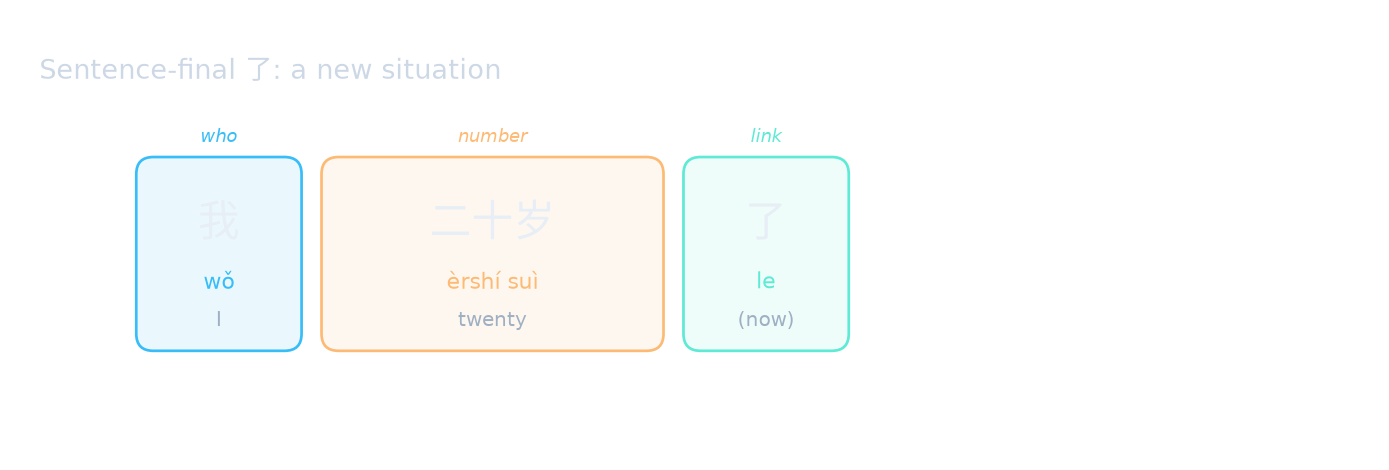
- I / me我二十岁(completed / change)了。 Wǒ èrshí suì le. – I'm twenty now.
- I / me我not不喝咖啡(completed / change)了。 Wǒ bù hē kāfēi le. – I've stopped drinking coffee.
- we / us我们快到(completed / change)了。 – We're almost there.
How it works. (completed / change)了 at the end of a sentence announces that the situation has changed: it's cold (weather)天冷(completed / change)了 (it's turned cold), he / him他not不to come来(completed / change)了 (he's not coming any more), green light (traffic signal)绿灯(completed / change)了 (it's green now). It is not a past tense.
| Verb + (completed / change)了 | Sentence + (completed / change)了 |
|---|---|
| a completed action | a change of situation |
| I / me我to eat吃(completed / change)了一个apple苹果。 | I / me我not不hungry饿(completed / change)了。 |
| I ate an apple. | I'm not hungry any more. |
Some sentences have both.
Watch out
- A past habit with no change takes no (completed / change)了: wrong: I / me我before以前often常常to go去(completed / change)了 → I / me我before以前often常常to go去.
- I / me我not不to smoke抽烟(completed / change)了 means "I've quit smoking", not "I didn't smoke".

| 汉字 | 拼音 | English |
|---|---|---|
| 饿 | è | hungry |
5.16
15. 用呢提问(你呢?或在哪里?)
Form: noun + (and …? / softener)呢? · question word … (and …? / softener)呢? · at / in在 + verb … (and …? / softener)呢。
- I / me我to be / is是Chengdu subprovincial city…成都person人,you你(and …? / softener)呢? Wǒ shì Chéngdū rén, nǐ ne? – I'm from Chengdu. And you?
- I / me我(modifier / structural particle)的key钥匙(and …? / softener)呢? Wǒ de yàoshi ne? – Where are my keys?
- you你at / in在what are you doing?干什么(and …? / softener)呢? – What are you up to?
- he / him他at / in在to sleep睡觉(and …? / softener)呢。 Tā zài shuìjiào ne. – He's asleep right now.
How it works. (and …? / softener)呢 ne has three common jobs.
| Use | Example | Meaning |
|---|---|---|
| asks the same question back | I / me我degree / adjective linker很good好,you你(and …? / softener)呢? | And you? |
| alone, with no context | I / me我(modifier / structural particle)的mobile phone手机(and …? / softener)呢? | Where's my phone? |
| softens a question-word question | you你to go去where哪儿(and …? / softener)呢? | Where are you off to? |
| marks something still going on | outside外面下着雨(and …? / softener)呢。 | It's raining out. |
Watch out
- A yes-no question takes (yes/no ?)吗, not (and …? / softener)呢: wrong: you你to be / is是teacher老师(and …? / softener)呢? → you你to be / is是teacher老师(yes/no ?)吗?
- (yes/no ?)吗 changes a question word's meaning: you你to go去where哪儿(yes/no ?)吗? asks "Are you going anywhere?"

5.17
16. 的 / 得 / 地(三个“de”)
Form: (modifier / structural particle)的 + noun · (adverb -ly)地 + verb · verb + (degree marker)得 + comment
- I / me我to like喜欢to eat吃mum; mother妈妈to do; to make做(modifier / structural particle)的dish (of food); vegetable菜。 Wǒ xǐhuan chī māma zuò de cài. – I love the food Mum makes.
- I / me我(modifier / structural particle)的friend朋友slowly慢慢(adverb -ly)地to walk / to leave走to come over过来。 Wǒ de péngyou mànmàn de zǒu guòlai. – My friend walks slowly over.
- he / him他to run跑(degree marker)得很快。 Tā pǎo de hěn kuài. – He runs fast.
- he / him他happy; glad高兴地说,he / him他考得degree / adjective linker很good好。 – He said happily that he had done well in the exam.
How it works. All three are read de. Choose by what is next to them.
| Character | Look at | Example |
|---|---|---|
| (modifier / structural particle)的 | a noun follows (or is left out) | pretty漂亮(modifier / structural particle)的clothes衣服, yesterday昨天to buy买(modifier / structural particle)的thing; stuff东西 |
| (adverb -ly)地 | a verb follows | conscientious认真(adverb -ly)地to work; job工作, slowly慢慢(adverb -ly)地to walk / to leave走 |
| (degree marker)得 | a verb comes before; a comment on the result follows | to write写(degree marker)得degree / adjective linker很good好, tired累(degree marker)得not want to不想(of sth) to move动 |
The quick test. In to run跑(degree marker)得很快, the verb to run跑 comes before the particle, so it must be (degree marker)得.
Watch out
- wrong: to run跑(modifier / structural particle)的很快 → to run跑(degree marker)得很快; wrong: conscientious认真(modifier / structural particle)的to study; to learn学习 → conscientious认真(adverb -ly)地to study; to learn学习.

| 汉字 | 拼音 | English |
|---|---|---|
| 地 | de | adverbial particle |
| 认真 | rèn zhēn | conscientious |
5.18
17. 有的(一些;有的……有的……)
Form: to have / there is有(modifier / structural particle)的 + noun …,to have / there is有(modifier / structural particle)的 … · to have / there is有((modifier / structural particle)的)time; when时候
- to have / there is有(modifier / structural particle)的classmate同学want / think / miss想to go去coast海边,to have / there is有(modifier / structural particle)的want / think / miss想to go去to climb a mountain爬山。 Yǒude tóngxué xiǎng qù hǎibiān, yǒude xiǎng qù pá shān. – Some classmates want to go to the beach; others want to go hiking.
- these这些书有(modifier / structural particle)的degree / adjective linker很interesting有意思,to have / there is有(modifier / structural particle)的degree / adjective linker很boring; bored无聊。 – Some of these books are interesting; some are boring.
- I / me我sometimes有时候to walk走路to go to work上班。 Wǒ yǒu shíhou zǒulù shàngbān. – Sometimes I walk to work.
How it works. to have / there is有(modifier / structural particle)的 yǒude picks out part of a group: "some (of them)". It stands in the subject position, and is often repeated for contrast: to have / there is有(modifier / structural particle)的expensive贵,to have / there is有(modifier / structural particle)的cheap便宜. With a known group, put the group first as the topic: these这些dish (of food); vegetable菜,to have / there is有(modifier / structural particle)的I / me我没吃过.
| to have / there is有(modifier / structural particle)的 | some一些 |
|---|---|
| part of a group, usually the subject | "some, a few", also as the object |
| to have / there is有(modifier / structural particle)的person人not不to like喜欢 | I / me我to buy买(completed / change)了some一些apple苹果 |
Watch out
- wrong: I / me我not不to like喜欢to have / there is有(modifier / structural particle)的person人 for "some people don't like it" → to have / there is有(modifier / structural particle)的person人not不to like喜欢.

| 汉字 | 拼音 | English |
|---|---|---|
| 爬山 | pá shān | to climb a mountain |
5.19
练习
Cover the teaching pages before you answer. The answers are at the end.
1. Time / Verb + before以前 (before …)
1. Complete: “Please come back before ten.” please; to invite请十点…………to return回来。
2. Build: “The homework must be handed in before Friday.”
Put in order: before以前 / Friday星期五 / school assignment作业。 / 要交
3. Match each sentence to its meaning.
-
(1) to finish class下课after / from now on以后,I / me我to go去to play ball打球。
-
(2) before以前I / me我won't / can't不会to swim游泳。
-
(3) after / from now on以后I / me我want / think / miss想to go去China中国to work; job工作。
-
(4) to have a meal吃饭before以前want / will / need要to wash one's hands洗手。
-
A. In the future I want to work in China.
-
B. I couldn't swim in the past.
-
C. After class, I go and play ball.
-
D. Wash your hands before eating.
4. Which says “Turn off the light before you leave.”?
- A. to walk / to leave走before以前关灯。
- B. to walk / to leave走关灯before以前。
- C. before以前to walk / to leave走关灯。
- D. 关灯to walk / to leave走before以前。
5. True or false? 三天front / before前 and 三天before以前 both mean “three days ago”. If false, correct it.
6. Your doctor gives you advice about a good night's sleep. Use Time / Verb + before以前. Write your answer in Chinese, then say it aloud.
2. before以前,… (in the past, …)
7. Complete: “I used to be very shy.” I / me我…………degree / adjective linker很shy害羞。
8. Match each sentence to its meaning.
-
(1) before以前I / me我not不喝咖啡。
-
(2) 喝咖啡before以前,I / me我first先to eat吃breakfast早饭。
-
A. Before drinking coffee I eat breakfast.
-
B. I didn't use to drink coffee.
9. Build: “He didn't use to like spicy food.”
Put in order: not不to like喜欢 / to eat吃spicy辣(modifier / structural particle)的。 / he / him他 / before以前
10. True or false? originally / so it turns out原来 stresses that the situation later changed. If false, correct it.
11. True or false? In the model, I / me我before以前degree / adjective linker很to be afraid怕to speak说Chinese language汉语 means the writer is still afraid of speaking Chinese. If false, correct it.
12. Your grandmother looks at old photos of her village with dirt roads and no cars. Use before以前,…. Write your answer in Chinese, then say it aloud.
3. just now刚才 (a moment ago)
13. Complete: “It was raining just now; now it has stopped.” …………at / in在to rain下雨,now现在to stop停(completed / change)了。
14. Which sentence is correct?
- A. just now刚才he / him他degree / adjective linker很busy忙。
- B. he / him他degree / adjective linker很刚忙。
- C. he / him他busy忙just now刚才degree / adjective linker很。
- D. just now刚he / him他degree / adjective linker很busy忙。
15. Build: “Where did you go just now?”
Put in order: to go去where哪儿 / (completed / change)了? / just now刚才 / you你
16. True or false? just now刚才 is a good choice for “I moved house recently.” If false, correct it.
17. Build: “I had only just left home when it started to rain.”
Put in order: then / just就to rain下雨 / (completed / change)了。 / day天 / 我刚to go out出门,
18. “He only started working here two weeks ago.” Which is correct?
- A. he / him他just now刚to come来here这儿to work; job工作两个week星期。
- B. he / him他just now刚才at / in在here这儿to work; job工作两个week星期。
- C. he / him他just now刚才两个week星期to come来here这儿to work; job工作。
- D. he / him他两个week星期just now刚才to come来here这儿to work; job工作。
19. You come back from the shower and see your roommate pointing at your phone. Use just now刚才. Write your answer in Chinese, then say it aloud.
4. Time / Verb + time / when时 (when …)
20. Complete: “When I got home, he was already asleep.” I / me我to / arrive / (result: get)到home / family / (measure: shops)家…………,he / him他already已经to sleep睡(completed / change)了。
21. Which says “Call me when you have time.”?
- A. you你what什么time; when时候to have time (to do sth)有空to / for / give给I / me我to make a telephone call打电话。
- B. you你to have time (to do sth)有空(modifier / structural particle)的time; when时候to / for / give给I / me我to make a telephone call打电话。
- C. you你to / for / give给I / me我to make a telephone call打电话to have time (to do sth)有空(modifier / structural particle)的time; when时候。
- D. time; when时候you你to have time (to do sth)有空to / for / give给I / me我to make a telephone call打电话。
22. Build: “In class, please turn off your phone.”
Put in order: 请关 / mobile phone手机。 / , / 上课时
23. True or false? time / when时 is more common than (modifier / structural particle)的time; when时候 in everyday conversation. If false, correct it.
24. In the story, what does that那time; when时候 refer to?
- A. The time when the writer was a child.
- B. The time when they moved to the city.
- C. The time of the exam.
- D. Right now.
25. You are telling a friend a story from your childhood about learning to swim. Use Time / Verb + time / when时. Write your answer in Chinese, then say it aloud.
5. after / from now on以后 (after / in the future)
26. Complete: “Call me after you arrive.” you你to / arrive / (result: get)到(completed / change)了…………to / for / give给I / me我to make a telephone call打电话。
27. What does after / from now on以后我会早点儿to sleep睡 mean?
- A. I used to go to bed early.
- B. I went to bed early afterwards.
- C. From now on I'll go to bed earlier.
- D. I went to bed after eating.
28. Build: “After I graduate from university, I want to work abroad.”
Put in order: 大学毕业 / to go去abroad国外to work; job工作。 / ,I / me我want / think / miss想 / after / from now on以后
29. True or false? after / from now on以后to have a meal吃饭 means “after eating”. If false, correct it.
30. Pick the word for each gap.
-
(1) first先坐地铁,____to exchange换bus公共汽车。
-
(2) he / him他last year去年to go去(completed / change)了abroad国外,____we / us我们then / just就(not) any more再也not / haven't没见过面。
-
(3) 吃完饭____,we / us我们to go去to go for a walk散步(suggestion)吧。
-
A. later; afterwards后来
-
B. after / from now on以后
-
C. then / after然后
31. A friend in her final year asks what you plan to do once you finish university. Use after / from now on以后. Write your answer in Chinese, then say it aloud.
6. … ,later; afterwards后来 … (afterwards / later – past)
32. Complete the story: “At first I didn't like him, but later we became friends.” to start开始I / me我not不to like喜欢he / him他,…………we / us我们to become / into成(completed / change)了friend朋友。
33. Which fits a plan? “Let's eat first, then go shopping.”
- A. we / us我们later; afterwards后来to have a meal吃饭,first先to go去to buy买thing; stuff东西。
- B. we / us我们first先to have a meal吃饭,then / after然后to go去to buy买thing; stuff东西。
- C. we / us我们first先to have a meal吃饭,later; afterwards后来to go去to buy买thing; stuff东西。
- D. we / us我们to have a meal吃饭later; afterwards后来,to go去to buy买thing; stuff东西。
34. Ask to continue a story: “And how did it turn out?”
Put in order: how about怎么样 / later; afterwards后来 / (completed / change)了?
35. True or false? he / him他in one's childhood小时候很瘦,later; afterwards后来长胖(completed / change)了 describes a change with a gap of time. If false, correct it.
36. Put the story in order.
Put in order: first先with / and跟teacher老师to learn学,then / after然后oneself自己to practice练习。 / before以前I / me我won't / can't不会to swim游泳。 / finally; last最后I / me我finally终于to learn学会(completed / change)了! / later; afterwards后来I / me我to participate参加(completed / change)了一个to swim游泳class班。
37. You are telling a friend about a classmate who moved to Shenzhen two years ago. Use … ,later; afterwards后来 …. Write your answer in Chinese, then say it aloud.
7. after / from now on以后 vs then / after然后 vs later; afterwards后来 (then / after)
38. A recipe: “Wash the vegetables, then cut them.” first先洗菜,…………切菜。
39. Which says “See you again some time” (in the future)?
- A. we / us我们goodbye再见later; afterwards后来。
- B. we / us我们later; afterwards后来goodbye再见。
- C. we / us我们then / after然后to see / meet见after / from now on以后。
- D. we / us我们after / from now on以后goodbye再见。
40. Match each word to its use.
-
(1) after / from now on以后
-
(2) then / after然后
-
(3) later; afterwards后来
-
A. the next step
-
B. later on in a past story
-
C. after an event / in the future
41. Build: “I'll call you after I arrive.”
Put in order: to / arrive / (result: get)到(completed / change)了after / from now on以后 / to make a telephone call打电话。 / to / for / give给you你 / I / me我
42. You describe last Saturday: shopping, then lunch, and much later a surprise phone call. Use after / from now on以后 or then / after然后 or later; afterwards后来. Write your answer in Chinese, then say it aloud.
8. Telling the hour (Number + o'clock; a little点)
43. Ask: “What time is it now?” now现在…………o'clock; a little点?
44. How do you say “2 o'clock in the afternoon”?
- A. afternoon下午两点
- B. afternoon下午二点
- C. afternoon下午两个hour小时
- D. 两点afternoon下午
45. Build: “I go to bed at nine in the evening.”
Put in order: 九点 / evening晚上 / I / me我 / to sleep睡觉。
46. True or false? 三点 and 三个hour小时 mean the same. If false, correct it.
47. Your new school timetable starts much earlier than you are used to. Write your answer in Chinese, then say it aloud.
9. Times to the minute (o'clock; a little点 … minute / point / to divide分)
48. Write 10:30 with half半: 十点…………
49. What time is poor差very十分九点?
- A. 10:09
- B. 8:50
- C. 9:10
- D. 9:50
50. Build: “I get up at a quarter past six.”
Put in order: early morning早上 / 六点一刻 / I / me我 / to get up起床。
51. True or false? 8:05 is said 八点五分 with no zero零. If false, correct it.
52. You are buying a train ticket and the clerk tells you the departure time. Write your answer in Chinese, then say it aloud.
10. half半 (half / and a half)
53. Complete: “The film is two and a half hours long.” film; movie电影to have / there is有两个…………hour小时。
54. Which says “half an hour”?
- A. hour小时half半
- B. 一个hour小时half半
- C. half一半(measure word)个hour小时
- D. half of sth半个hour小时
55. Match each phrase to its meaning.
-
(1) half a year半年
-
(2) 一年half半
-
(3) half一半
-
(4) 三点half半
-
A. half past three
-
B. half a year
-
C. half (of it)
-
D. a year and a half
56. True or false? 一个hour小时half半 is the usual way to say “an hour and a half”. If false, correct it.
57. After the party, your mum looks at the table and counts what is left. Use half半. Write your answer in Chinese, then say it aloud.
11. Approximating with sequential numbers
58. Complete: “There are a dozen or so students in the class.” 班里to have / there is有…………(measure word)个student学生。
59. Which says “five or six days”?
- A. 五个六天
- B. six六五天
- C. 五天六天
- D. 五六天
60. Match each phrase to its meaning.
-
(1) 二十多个
-
(2) 几十个
-
(3) 三十岁about; left and right左右
-
(4) 七八个
-
A. seven or eight
-
B. twenty-odd
-
C. around thirty years old
-
D. dozens
61. Build: “Seven or eight people came.”
Put in order: person人。 / to come来(completed / change)了 / (measure word)个 / 七八
62. Your teacher asks how many people came to the club meeting. You did not count exactly. Write your answer in Chinese, then say it aloud.
12. Big numbers: ten thousand万 / 100 million亿
63. Write 50,000 in Chinese: …………
64. How do you say 100,000?
- A. 一万
- B. 一百万
- C. hundred thousand十万
- D. one / a一百千
65. Match the numbers.
-
(1) 一万
-
(2) 一百万
-
(3) 一亿
-
(4) one billion十亿
-
A. 1,000,000,000
-
B. 1,000,000
-
C. 10,000
-
D. 100,000,000
66. True or false? 一千万 means ten million. If false, correct it.
67. You read that the city of Chongqing has about thirty million people and wonder how to say it. Use Big numbers: ten thousand万 / 100 million亿. Write your answer in Chinese, then say it aloud.
13. Verb + (ongoing -ing)着 (ongoing state)
68. “The window is open.” window窗户to open; to drive开…………。
69. “The TV isn't on.”
- A. television电视not / haven't没to open; to drive开(ongoing -ing)着。
- B. television电视not不to open; to drive开(ongoing -ing)着。
- C. television电视(ongoing -ing)着not / haven't没to open; to drive开。
- D. television电视开不着。
70. Match each phrase to the picture description.
-
(1) 戴着hat帽子
-
(2) to take拿(ongoing -ing)着one / a一本书
-
(3) to stand站(ongoing -ing)着
-
(4) attire穿着白衬衫
-
A. holding a book
-
B. wearing a white shirt
-
C. standing
-
D. wearing a hat
71. Build: “He said with a smile …”
Put in order: to laugh笑(ongoing -ing)着 / to speak说…… / he / him他
72. Which sentence means “She is putting on her coat (right now)”?
- A. she / her她to wear穿overcoat大衣(ongoing -ing)着。
- B. she / her她attire穿着overcoat大衣。
- C. she / her她at / in在to wear穿overcoat大衣。
- D. she / her她not / haven't没attire穿着overcoat大衣。
73. True or false? 灯不亮(ongoing -ing)着 is the correct way to say “The light isn't on.” If false, correct it.
74. Look around the room you are in, or at a photo. Describe two people or things in Chinese with Verb + (ongoing -ing)着 (attire穿着, 戴着, to take拿(ongoing -ing)着, to sit / to take (a bus …)坐(ongoing -ing)着, 开着). Then compare with the model. Write your answer in Chinese, then say it aloud.
14. Sentence-final (completed / change)了 (change of state)
75. The light turns green: “It's green now, let's go.” green light (traffic signal)绿灯…………,to walk / to leave走(suggestion)吧。
76. Match each sentence to its meaning.
-
(1) he / him他to be / is是doctor医生。
-
(2) he / him他to be / is是doctor医生(completed / change)了。
-
(3) I / me我not不to drink tea喝茶。
-
(4) I / me我not不to drink tea喝茶(completed / change)了。
-
A. I don't drink tea.
-
B. I've stopped drinking tea.
-
C. He's a doctor.
-
D. He's become a doctor.
77. What does I / me我not不to smoke抽烟(completed / change)了 mean?
- A. I've quit smoking.
- B. I don't want to smoke.
- C. I'm smoking now.
- D. I didn't smoke.
78. Build: “We're almost there.”
Put in order: to / arrive / (result: get)到 / fast; soon快 / we / us我们 / (completed / change)了。
79. Your friend asks you你to have a meal吃饭(completed / change)了(yes/no ?)吗? You haven't eaten yet. What do you say?
- A. I / me我not / haven't没to eat吃(completed / change)了。
- B. I / me我still / also / even还not / haven't没to eat吃。
- C. I / me我不吃(completed / change)了。
- D. I / me我to eat吃(completed / change)了not / haven't没。
80. Which sentence says you are still learning Chinese after three years?
- A. I / me我三年to learn学Chinese language汉语。
- B. 我学(completed / change)了三年Chinese language汉语(completed / change)了。
- C. 我学三年(completed / change)了Chinese language汉语。
- D. 我学(completed / change)了三年Chinese language汉语。
81. True or false? I / me我before以前often常常to go去(completed / change)了 is correct for a past habit. If false, correct it.
82. You were about to go out, but you look out of the window and see rain. Use Sentence-final (completed / change)了. Write your answer in Chinese, then say it aloud.
15. Questions with (and …? / softener)呢 (and you? / where?)
83. Complete: “I like tea. What about you?” I / me我to like喜欢to drink tea喝茶,you你…………?
84. Which question is correct?
- A. you你(yes/no ?)吗to be / is是student学生?
- B. you你to be / is是student学生(and …? / softener)呢?
- C. you你to be / is是student学生(yes/no ?)吗(and …? / softener)呢?
- D. you你to be / is是student学生(yes/no ?)吗?
85. True or false? Said while searching your bag, I / me我(modifier / structural particle)的mobile phone手机(and …? / softener)呢? means “Where's my phone?” If false, correct it.
86. Build: “He's sleeping right now.”
Put in order: (and …? / softener)呢。 / at / in在 / he / him他 / to sleep睡觉
87. A new classmate tells you she comes from Chengdu, then waits for you to say where you are from. Use Questions with (and …? / softener)呢. Write your answer in Chinese, then say it aloud.
16. (modifier / structural particle)的 / (degree marker)得 / (adverb -ly)地 (the three “de”)
88. Match each phrase to its particle.
-
(1) pretty漂亮__clothes衣服
-
(2) conscientious认真__to work; job工作
-
(3) to write写__degree / adjective linker很good好
-
A. (degree marker)得
-
B. (adverb -ly)地
-
C. (modifier / structural particle)的
89. True or false? In mum; mother妈妈to do; to make做(modifier / structural particle)的dish (of food); vegetable菜, (modifier / structural particle)的 is correct because dish (of food); vegetable菜 is a noun. If false, correct it.
90. Fill the gaps: I / me我__friend朋友slowly慢慢__to walk / to leave走to come over过来。
- A. (adverb -ly)地 … (degree marker)得
- B. (degree marker)得 … (modifier / structural particle)的
- C. (modifier / structural particle)的 … (adverb -ly)地
- D. (modifier / structural particle)的 … (degree marker)得
91. Complete: “She sings very well.” she / her她to sing唱…………degree / adjective linker很good好。
92. Which says “He writes characters well”?
- A. he / him他to write写(degree marker)得Chinese character字degree / adjective linker很good好。
- B. he / him他degree / adjective linker很good好(adverb -ly)地to write characters写字(degree marker)得。
- C. he / him他to write characters写字to write写(degree marker)得degree / adjective linker很good好。
- D. he / him他to write characters写字(degree marker)得degree / adjective linker很good好。
93. Build: “My brother doesn't swim fast.”
Put in order: to swim / to travel游 / I / me我younger brother弟弟 / (degree marker)得 / unhappy不快。
94. Fix the message: he / him他conscientious认真__做作业,to do; to make做__很快。
- A. (adverb -ly)地 … (modifier / structural particle)的
- B. (modifier / structural particle)的 … (modifier / structural particle)的
- C. (adverb -ly)地 … (degree marker)得
- D. (degree marker)得 … (adverb -ly)地
95. A friend texts you about a classmate who runs fast, but writes the wrong "de" and the sentence looks odd. Use (modifier / structural particle)的 / (degree marker)得 / (adverb -ly)地. Write your answer in Chinese, then say it aloud.
17. to have / there is有(modifier / structural particle)的 (some / some…, others…)
96. Complete: “Some students live at school.” …………student学生to live (somewhere)住at / in在school学校。
97. Which says “I bought some apples.”?
- A. I / me我to have / there is有(modifier / structural particle)的to buy买(completed / change)了apple苹果。
- B. I / me我to buy买(completed / change)了some一些apple苹果。
- C. to have / there is有(modifier / structural particle)的I / me我to buy买(completed / change)了apple苹果。
- D. I / me我to buy买(completed / change)了to have / there is有(modifier / structural particle)的apple苹果。
98. Build: “Some of these books are interesting; some are boring.”
Put in order: to have / there is有(modifier / structural particle)的degree / adjective linker很interesting有意思 / to have / there is有(modifier / structural particle)的degree / adjective linker很boring; bored无聊。 / these这些book书 / ,
99. True or false? sometimes有时候 means “sometimes”. If false, correct it.
100. Your class votes on a trip. Some want the beach, others want the mountains. Use to have / there is有(modifier / structural particle)的. Write your answer in Chinese, then say it aloud.
5.20
混合练习
These questions mix the patterns and use new situations.
101. Choose then / after然后 or later; afterwards后来: I / me我first先to go去to buy买thing; stuff东西,…………to eat吃lunch午饭。 / he / him他to go去(completed / change)了Shenzhen subprovincial city…深圳,…………at / in在there那儿to open; to drive开(completed / change)了one (family / company)一家company公司。
102. Which sentence says "before you go to sleep"?
- A. before以前to sleep睡觉
- B. to sleep睡觉before以前
- C. before以前(modifier / structural particle)的to sleep睡觉
103. Choose (modifier / structural particle)的, (degree marker)得 or (adverb -ly)地: he / him他to run跑…………很快。 / he / him他conscientious认真…………to study; to learn学习。 / he / him他to be / is是conscientious认真…………student学生。
104. Write the time 8:25.
105. Find and fix the problem. A classmate writes he / him他conscientious认真(degree marker)得to study; to learn学习 for "he studies carefully". Correct the sentence and give a second way to say it.
106. Use it yourself. Write a message saying you will be home at ten past two and will phone after you get home.
5.21
答案与解析
Mark your work, then correct each mistake in your own words.
1. Time / Verb + before以前 (before …)
1. before以前
Time + before以前 = before that time.
2. Friday星期五before以前要交school assignment作业。
Time + before以前 + verb phrase.
3. (1) C: to finish class下课after / from now on以后,I / me我to go去to play ball打球。 = After class, I go and play ball.; (2) B: before以前I / me我won't / can't不会to swim游泳。 = I couldn't swim in the past.; (3) A: after / from now on以后I / me我want / think / miss想to go去China中国to work; job工作。 = In the future I want to work in China.; (4) D: to have a meal吃饭before以前want / will / need要to wash one's hands洗手。 = Wash your hands before eating.
After an action, before以前 / after / from now on以后 = before / after it; on their own, they mean in the past / in the future.
4. A. to walk / to leave走before以前关灯。
Action + before以前, then the main verb.
5. True.
front / before前 is a shorter form of before以前 after a time.
6. Model answer: to sleep睡觉before以前although (you'd think) / don't look别看mobile phone手机。
Check your answer:
- Put before以前 after what it refers to: to go to class上课before以前, not before以前to go to class上课 (which means "in the past, I attended class").
- The before以前 phrase goes before the main verb, not at the end: I / me我十点before以前to return home回家, not I / me我to return home回家十点before以前.
2. before以前,… (in the past, …)
7. before以前
Subject + before以前 + description = used to be.
8. (1) B: before以前I / me我not不喝咖啡。 = I didn't use to drink coffee.; (2) A: 喝咖啡before以前,I / me我first先to eat吃breakfast早饭。 = Before drinking coffee I eat breakfast.
Alone, before以前 means “in the past”; after an action it means “before”.
9. he / him他before以前not不to like喜欢to eat吃spicy辣(modifier / structural particle)的。
Subject + before以前 + verb phrase.
10. True.
originally / so it turns out原来 = originally (and then it changed).
11. False.
before以前 = in the past; the next sentence with now现在 shows that things have changed.
12. Model answer: before以前here这儿not have / haven't没有road路,now现在to have / there is有很多car车(completed / change)了。
Check your answer:
- Alone at the front or after the subject, before以前 = "in the past": before以前I / me我won't / can't不会to prepare a meal做饭.
- After a time or action, it = "before": to go to class上课before以前 – "before class". Check what comes before it.
3. just now刚才 (a moment ago)
13. just now刚才
just now刚才 is a time word that can start the sentence.
14. A. just now刚才he / him他degree / adjective linker很busy忙。
just now刚才 can describe a state a moment ago; just now刚 is not used for a past state like degree / adjective linker很busy忙.
15. you你just now刚才to go去where哪儿(completed / change)了?
Subject + just now刚才 + verb phrase.
16. False.
just now刚才 is only a moment ago; recently is recently最近 (or just now刚to move house搬家).
17. 我刚to go out出门,day天then / just就to rain下雨(completed / change)了。
just now刚 A,(subject) then / just就 B: B happens right after A.
18. A. he / him他just now刚to come来here这儿to work; job工作两个week星期。
just now刚 + verb + time span = only that long since; just now刚才 means minutes ago.
19. Model answer: just now刚才someone有人to / for / give给you你to make a telephone call打电话(completed / change)了。
Check your answer:
- Use just now刚才 for a moment ago in the same situation; for "recently" over days, use recently最近 or just now刚.
- just now刚才 can go first in the sentence; just now刚 cannot: just now刚才他来(completed / change)了 ✓, just now刚he / him他to come来(completed / change)了 ✗.
4. Time / Verb + time / when时 (when …)
20. (modifier / structural particle)的time; when时候
Clause + (modifier / structural particle)的time; when时候 = when.
21. B. you你to have time (to do sth)有空(modifier / structural particle)的time; when时候to / for / give给I / me我to make a telephone call打电话。
The (modifier / structural particle)的time; when时候 clause comes first; what什么time; when时候 asks “when?”.
22. 上课时,请关mobile phone手机。
Clause + time / when时, then the request.
23. False.
(modifier / structural particle)的time; when时候 is the usual spoken form; time / when时 is more written.
24. A. The time when the writer was a child.
that那time; when时候 points back to the time just mentioned: in one's childhood小时候.
25. Model answer: I / me我small小(modifier / structural particle)的time; when时候often常常to go去river bank河边to swim游泳。
Check your answer:
- time / when时 / (modifier / structural particle)的time; when时候 goes after the clause: to rain下雨(modifier / structural particle)的time; when时候, not time; when时候to rain下雨.
- In a "when" clause, do not use what什么time; when时候 (that asks "when?"): I / me我to / arrive / (result: get)到home / family / (measure: shops)家(modifier / structural particle)的time; when时候, not I / me我what什么time; when时候to get home到家.
5. after / from now on以后 (after / in the future)
26. after / from now on以后
Event + after / from now on以后 = after that event.
27. C. From now on I'll go to bed earlier.
after / from now on以后 alone at the start refers to the future.
28. 大学毕业after / from now on以后,I / me我want / think / miss想to go去abroad国外to work; job工作。
Event + after / from now on以后, then the main clause.
29. False.
After eating is to have a meal吃饭after / from now on以后; after / from now on以后to have a meal吃饭 means “eat in the future”.
30. (1) C: first先坐地铁,____to exchange换bus公共汽车。 = then / after然后; (2) A: he / him他last year去年to go去(completed / change)了abroad国外,we / us我们then / just就(not) any more再也not / haven't没见过面。 = later; afterwards后来; (3) B: 吃完饭,we / us我们to go去to go for a walk散步(suggestion)吧。 = after / from now on以后
then / after然后 = the next step; later; afterwards后来 = later, in a past story; X after / from now on以后 = after X.
31. Model answer: 大学毕业after / from now on以后,I / me我want / think / miss想to go去abroad国外to work; job工作。
Check your answer:
- Put after / from now on以后 after the event: to have a meal吃饭after / from now on以后, not after / from now on以后to have a meal吃饭 (which would mean "eat in the future").
- For the next step in a past story, prefer later; afterwards后来 or then / after然后, not a bare after / from now on以后: I / me我first先to go去(completed / change)了bank银行,then / after然后to go去(completed / change)了supermarket超市.
6. … ,later; afterwards后来 … (afterwards / later – past)
32. later; afterwards后来
later; afterwards后来 introduces what happened later in a past story.
33. B. we / us我们first先to have a meal吃饭,then / after然后to go去to buy买thing; stuff东西。
later; afterwards后来 is only for past stories; a plan uses then / after然后.
34. later; afterwards后来how about怎么样(completed / change)了?
later; afterwards后来how about怎么样(completed / change)了?
35. True.
later; afterwards后来 jumps forward in a past story.
36. before以前I / me我won't / can't不会to swim游泳。later; afterwards后来I / me我to participate参加(completed / change)了一个to swim游泳class班。first先with / and跟teacher老师to learn学,then / after然后oneself自己to practice练习。finally; last最后I / me我finally终于to learn学会(completed / change)了!
before以前 → later; afterwards后来 → first先 … then / after然后 → finally终于: how it was, what changed, the steps, the result.
37. Model answer: he / him他to go去(completed / change)了Shenzhen subprovincial city…深圳,later; afterwards后来at / in在there那儿to open; to drive开(completed / change)了one (family / company)一家company公司。
Check your answer:
- later; afterwards后来 is only for the past. For "later" in a plan, use after / from now on以后 or then / after然后: we / us我们after / from now on以后talk later / besides再说.
- It stands alone as a time word; it is not added after an event: to graduate毕业after / from now on以后, not to graduate毕业later; afterwards后来.
7. after / from now on以后 vs then / after然后 vs later; afterwards后来 (then / after)
38. then / after然后
then / after然后 links the next step.
39. D. we / us我们after / from now on以后goodbye再见。
later; afterwards后来 is only for past stories; after / from now on以后 can refer to the future.
40. (1) C: after / from now on以后 = after an event / in the future; (2) A: then / after然后 = the next step; (3) B: later; afterwards后来 = later on in a past story
Each “after” word has its own job.
41. I / me我to / arrive / (result: get)到(completed / change)了after / from now on以后to / for / give给you你to make a telephone call打电话。
Clause + after / from now on以后 + main clause.
42. Model answer: I / me我first先to go去to buy买thing; stuff东西,then / after然后to eat吃(completed / change)了lunch午饭。later; afterwards后来,I / me我(modifier / structural particle)的old friend老朋友to / for / give给I / me我to make a telephone call打电话(completed / change)了。
Check your answer:
- later; afterwards后来 is never for the future: we / us我们after / from now on以后goodbye再见, not we / us我们later; afterwards后来goodbye再见.
- later; afterwards后来 is never added after an event: to finish class下课after / from now on以后, not to finish class下课later; afterwards后来.
8. Telling the hour (Number + o'clock; a little点)
43. how many / a few几
what time?几点 asks the hour.
44. A. afternoon下午两点
Part of the day first, and 2:00 is 两点.
45. I / me我evening晚上九点to sleep睡觉。
Subject + part of the day + time + verb.
46. False.
三点 is 3 o'clock; 三个hour小时 is three hours.
47. Model answer: we / us我们early morning早上七点to go to class上课。
Check your answer:
- The time goes before the verb: I / me我六点to finish work下班, not I / me我to finish work下班六点.
- Use 两点 for 2 o'clock, not 二点.
9. Times to the minute (o'clock; a little点 … minute / point / to divide分)
48. half半
half半 after o'clock; a little点 = half past.
49. B. 8:50
poor差very十分九点 = ten minutes to nine.
50. I / me我early morning早上六点一刻to get up起床。
Subject + part of the day + time + verb.
51. False.
For 1–9 minutes add zero零: 八点零五分.
52. Model answer: train火车八点二十五to separate分开。
Check your answer:
- Put the clock time before the verb: I / me我七点to get up起床, not I / me我to get up起床七点.
- Say 两点 for 2:00, not 二点.
10. half半 (half / and a half)
53. half半
Number + MW + half半 + noun = two and a half hours.
54. D. half of sth半个hour小时
half半 + MW + noun.
55. (1) B: half a year半年 = half a year; (2) D: 一年half半 = a year and a half; (3) C: half一半 = half (of it); (4) A: 三点half半 = half past three
half半 before the MW is “half a”; after it, “and a half”; half一半 is the noun.
56. False.
Say one and a half一个半hour小时.
57. Model answer: also / there is still还有half of sth半个cake蛋糕and / with和one and a half一个半watermelon西瓜。
Check your answer:
- Half a … : half半 before the measure word (half of sth半个hour小时). … and a half: half半 after it (one and a half一个半hour小时).
- Do not say half一半(measure word)个 or 一个hour小时half半: say half of sth半个 and one and a half一个半hour小时.
11. Approximating with sequential numbers
58. more than ten十几
more than ten十几 = between eleven and nineteen.
59. D. 五六天
Two neighbouring numbers, smaller first, then the measure word or noun.
60. (1) B: 二十多个 = twenty-odd; (2) D: 几十个 = dozens; (3) C: 三十岁about; left and right左右 = around thirty years old; (4) A: 七八个 = seven or eight
many; much多, how many / a few几, about; left and right左右 and neighbouring numbers all give approximate amounts.
61. to come来(completed / change)了七八个person人。
Neighbouring numbers + measure word + noun.
62. Model answer: to come来(completed / change)了七八个person人。
Check your answer:
- The measure word comes after both numbers: 三四个person人, not 三个四个person人.
- With many; much多 and round tens, many; much多 goes before the measure word: 二十多个, not 二十个many; much多 (for amounts under ten, many; much多 follows the measure word: 三个many; much多hour小时).
12. Big numbers: ten thousand万 / 100 million亿
63. 五万
50,000 = 5 × 10,000 = 五万.
64. C. hundred thousand十万
100,000 = 10 × 10,000 = hundred thousand十万.
65. (1) C: 一万 = 10,000; (2) B: 一百万 = 1,000,000; (3) D: 一亿 = 100,000,000; (4) A: one billion十亿 = 1,000,000,000
Chinese groups large numbers in fours.
66. True.
1,000 × 10,000 = 10,000,000.
67. Model answer: Chongqing city (Chungking)…重庆to have / there is有三千多万person人。
Check your answer:
- 100,000 is hundred thousand十万, not one / a一百千: Chinese has no "hundred thousand" unit, so regroup by fours.
- A million is 一百万, not 一万万; 一万万 is an old word for 一亿.
13. Verb + (ongoing -ing)着 (ongoing state)
68. (ongoing -ing)着
Verb + (ongoing -ing)着 = a lasting state.
69. A. television电视not / haven't没to open; to drive开(ongoing -ing)着。
Negate (ongoing -ing)着 with not / haven't没.
70. (1) D: 戴着hat帽子 = wearing a hat; (2) A: to take拿(ongoing -ing)着one / a一本书 = holding a book; (3) C: to stand站(ongoing -ing)着 = standing; (4) B: attire穿着白衬衫 = wearing a white shirt
to put on or wear戴 is for glasses and hats; to wear穿 for clothes; to take拿 for holding.
71. he / him他to laugh笑(ongoing -ing)着to speak说……
V1 (ongoing -ing)着 + V2 = do V2 in the manner of V1.
72. C. she / her她at / in在to wear穿overcoat大衣。
An action in progress → at / in在 + verb. she / her她attire穿着overcoat大衣 = she is wearing a coat (the state).
73. False.
(ongoing -ing)着 takes not / haven't没: lamp灯not / haven't没bright亮(ongoing -ing)着。
74. Model answer: I / me我younger sister妹妹to sit / to take (a bus …)坐(ongoing -ing)着看电视,she / her她in hand手里to take拿(ongoing -ing)着一个apple苹果。window窗户开着。
Check your answer:
- Each sentence describes a state that lasts, not a single quick action.
- I used to put on or wear戴 for glasses or hats and to wear穿 for clothes.
- Any negative uses not / haven't没, not not不.
- I tried one V1 (ongoing -ing)着 + V2 sentence, such as to sit / to take (a bus …)坐(ongoing -ing)着to read看书.
14. Sentence-final (completed / change)了 (change of state)
75. (completed / change)了
Final (completed / change)了 announces the change.
76. (1) C: he / him他to be / is是doctor医生。 = He's a doctor.; (2) D: he / him他to be / is是doctor医生(completed / change)了。 = He's become a doctor.; (3) A: I / me我not不to drink tea喝茶。 = I don't drink tea.; (4) B: I / me我not不to drink tea喝茶(completed / change)了。 = I've stopped drinking tea.
(completed / change)了 at the end adds "this is new".
77. A. I've quit smoking.
not不…(completed / change)了 = no longer.
78. we / us我们快到(completed / change)了。
fast; soon快 + verb + (completed / change)了 = about to.
79. B. I / me我still / also / even还not / haven't没to eat吃。
Not yet = still / also / even还not / haven't没 + verb, with no (completed / change)了. I / me我不吃(completed / change)了 would mean "I won't eat any more".
80. B. 我学(completed / change)了三年Chinese language汉语(completed / change)了。
Verb (completed / change)了 + duration + final (completed / change)了 = so far, and still going.
81. False.
A past habit with no change takes no (completed / change)了: I / me我before以前often常常to go去。
82. Model answer: to rain下雨(completed / change)了!
Check your answer:
- My final (completed / change)了 marks something new or changed, not just "the past".
- With still / also / even还not / haven't没 I used no (completed / change)了: still / also / even还not / haven't没to eat吃, not not / haven't没to eat吃(completed / change)了.
15. Questions with (and …? / softener)呢 (and you? / where?)
83. (and …? / softener)呢
X + (and …? / softener)呢 repeats the question about X.
84. D. you你to be / is是student学生(yes/no ?)吗?
Yes-no questions take (yes/no ?)吗; (and …? / softener)呢 does not make a yes-no question.
85. True.
With no earlier question, Noun + (and …? / softener)呢 asks where something is.
86. he / him他at / in在to sleep睡觉(and …? / softener)呢。
at / in在 + verb + (and …? / softener)呢 marks an action in progress.
87. Model answer: I / me我to be / is是Chengdu subprovincial city…成都person人,you你(and …? / softener)呢?
Check your answer:
- Do not put (and …? / softener)呢 on a yes-no question: you你to be / is是teacher老师(yes/no ?)吗?, not you你to be / is是teacher老师(and …? / softener)呢?
- To ask “where?”, use you你to go去where哪儿? or you你to go去where哪儿(and …? / softener)呢?. With (yes/no ?)吗 the question word changes meaning: you你to go去where哪儿(yes/no ?)吗? asks “Are you going anywhere?”
16. (modifier / structural particle)的 / (degree marker)得 / (adverb -ly)地 (the three “de”)
88. (1) C: pretty漂亮__clothes衣服 = (modifier / structural particle)的; (2) B: conscientious认真__to work; job工作 = (adverb -ly)地; (3) A: to write写__degree / adjective linker很good好 = (degree marker)得
Before a noun → (modifier / structural particle)的; before a verb → (adverb -ly)地; after a verb → (degree marker)得.
89. True.
mum; mother妈妈to do; to make做 describes the noun dish (of food); vegetable菜, so (modifier / structural particle)的.
90. C. (modifier / structural particle)的 … (adverb -ly)地
I / me我(modifier / structural particle)的friend朋友 (before a noun) and slowly慢慢(adverb -ly)地to walk / to leave走 (before a verb).
91. (degree marker)得
After a verb, (degree marker)得 introduces how well.
92. C. he / him他to write characters写字to write写(degree marker)得degree / adjective linker很good好。
With an object, say the verb twice: to write characters写字 + to write写(degree marker)得degree / adjective linker很good好. (he / him他Chinese character字to write写(degree marker)得degree / adjective linker很good好 is also right.)
93. I / me我younger brother弟弟游得unhappy不快。
not不 goes after (degree marker)得: 游得unhappy不快.
94. C. (adverb -ly)地 … (degree marker)得
conscientious认真(adverb -ly)地 + verb to do; to make做; then after the verb to do; to make做 comes (degree marker)得 + how fast.
95. Model answer: he / him他to run跑(degree marker)得很快。
Check your answer:
- After a verb and before degree / adjective linker很 I wrote (degree marker)得: to run跑(degree marker)得很快, not to run跑(modifier / structural particle)的很快.
- If my verb had an object, I said the verb twice: to speak说Chinese language汉语to speak说(degree marker)得degree / adjective linker很good好.
17. to have / there is有(modifier / structural particle)的 (some / some…, others…)
96. to have / there is有(modifier / structural particle)的
to have / there is有(modifier / structural particle)的 + noun in subject position.
97. B. I / me我to buy买(completed / change)了some一些apple苹果。
In object position, “some” is some一些.
98. these这些书有(modifier / structural particle)的degree / adjective linker很interesting有意思,to have / there is有(modifier / structural particle)的degree / adjective linker很boring; bored无聊。
Topic, then to have / there is有(modifier / structural particle)的…,to have / there is有(modifier / structural particle)的….
99. True.
to have / there is有((modifier / structural particle)的)time; when时候 = sometimes.
100. Model answer: to have / there is有(modifier / structural particle)的classmate同学want / think / miss想to go去coast海边,to have / there is有(modifier / structural particle)的want / think / miss想to go去to climb a mountain爬山。
Check your answer:
- Put to have / there is有(modifier / structural particle)的 in subject position: to have / there is有(modifier / structural particle)的person人not不to like喜欢, not I / me我not不to like喜欢to have / there is有(modifier / structural particle)的person人 for "some people don't like it".
- With an object you know, put the topic first: these这些dish (of food); vegetable菜,to have / there is有(modifier / structural particle)的I / me我没吃过 – "Some of these dishes I haven't tried."
Mixed practice
101. I / me我first先to go去to buy买thing; stuff东西,then / after然后to eat吃lunch午饭。he / him他to go去(completed / change)了Shenzhen subprovincial city…深圳,later; afterwards后来at / in在there那儿to open; to drive开(completed / change)了one (family / company)一家company公司。then / after然后 is the next step in a sequence; later; afterwards后来 is "later on" in a past story.
102. B. before以前 comes after the event it marks.
103. he / him他to run跑(degree marker)得很快。he / him他conscientious认真(adverb -ly)地to study; to learn学习。he / him他to be / is是conscientious认真(modifier / structural particle)的student学生。(degree marker)得 after a verb, (adverb -ly)地 before a verb, (modifier / structural particle)的 before a noun.
104. 八点二十五(minute / point / to divide分)。The hour comes first with o'clock; a little点, then the minutes.
105. Write he / him他conscientious认真(adverb -ly)地to study; to learn学习: (adverb -ly)地 comes before a verb. Or put the comment after the verb with (degree marker)得: 他学得degree / adjective linker很conscientious认真. (modifier / structural particle)的 comes before a noun: conscientious认真(modifier / structural particle)的student学生.
106. Model answer. I / me我afternoon下午两点very十分to get home到家,to get home到家after / from now on以后to / for / give给you你to make a telephone call打电话。after / from now on以后 comes after the event it follows: to get home到家after / from now on以后.
Review later. Tomorrow, write three phrases, one each with (modifier / structural particle)的, (degree marker)得 and (adverb -ly)地.
该知识点的互动课程
逐步完成,配合即时检查练习。
- Time / Verb + 以前 (before …)
- 以前,⋯⋯
- 刚才
- Time / Verb + 时 (when …)
- 以后,⋯⋯
- ⋯⋯,后来⋯⋯
- Approximating with sequential numbers
- Big numbers: 万 / 亿
- Times to the minute (点 … 分)
- Telling the hour (Number + 点)
- Verb + 着 (ongoing state)
- Sentence-final 了 (change of state)
- ⋯⋯呢?
- 的 / 得 / 地
- 有的 (some / some…, others…)
- 半 (half / and a half)
- 以后 vs 然后 vs 后来