Comparing two things. than / compared to比 says one is more than the other; not have / haven't没有 says one is less; with / and跟……the same一样 says they are the same; to have / there is有 says one is as … as the other. Add more更 or still / also / even还 for "even more" and many; much多(completed / change)了 for "much more". Always keep the same feature in both halves and check which thing comes first.
比较级
HSK 3 · 知识点 4
4:19
HSK 3语法 4:比较
比较工具集。“比”表多于,“没有”表不如,“跟…比”表参照标准,“更”或“还”表甚至更多,“多了”表差距大。五种工具,一个禁词。该词…
英文讲解与普通话例句 · 字幕与原声同步
4.1
一目了然
Same or different
- 1. A with / and跟 / and / with和 B the same一样 – the same as: older brother哥哥with / and跟younger brother弟弟the same一样tall; high高。
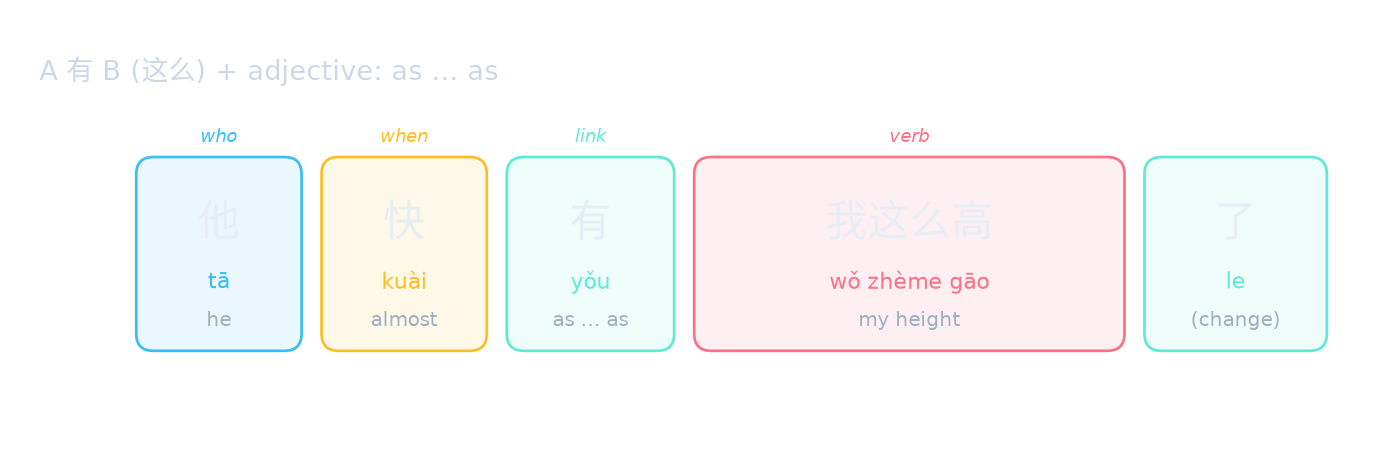
- 2. N1 + to have / there is有 + N2 + Adj – as … as: he / him他fast; soon快to have / there is有I / me我so much这么tall; high高(completed / change)了!
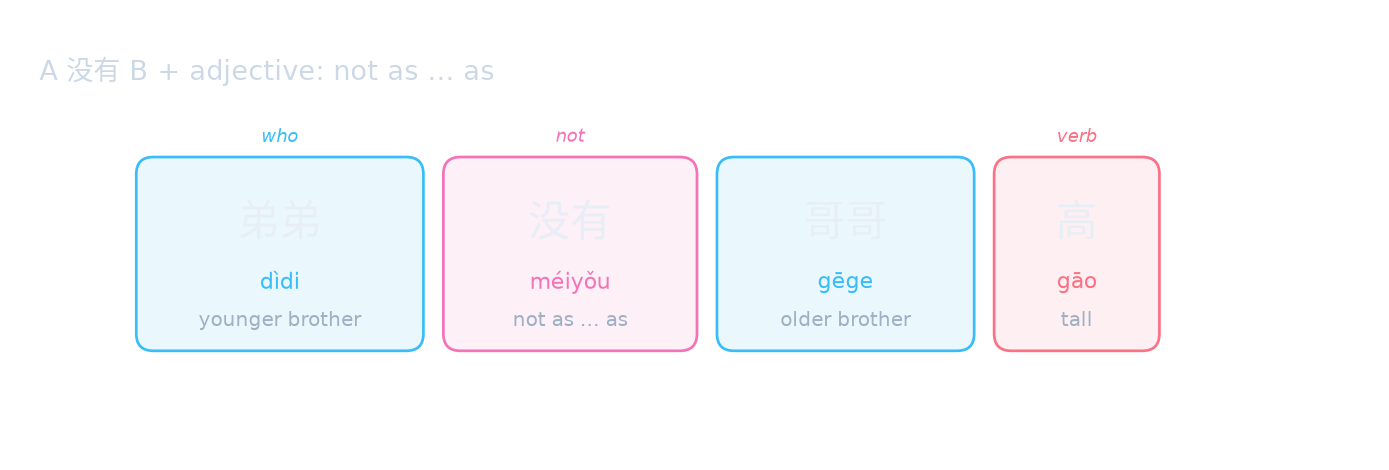
- 3. not / haven't没(to have / there is有) comparisons – not as … as: younger brother弟弟not have / haven't没有older brother哥哥tall; high高。
- 4. with / and跟 … than / compared to比(get up / (start, become)起来) – compared with …: with / and跟Shanghai municipality…上海than / compared to比,here这儿quiet安静many; much多(completed / change)了。
How big is the difference?
- 5. than / compared to比 … more更 / still / also / even还 – even more than: she / her她degree / adjective linker很tall; high高,she / her她younger sister妹妹than / compared to比she / her她still / also / even还tall; high高。
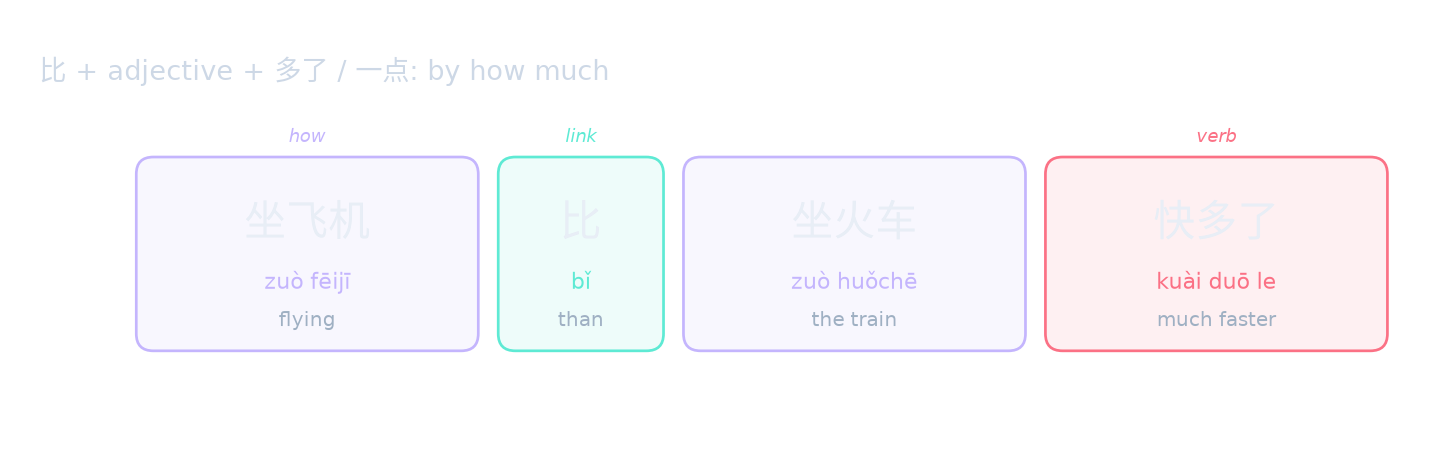
- 6. than / compared to比 … Adj + many; much多(completed / change)了 – much more than: 坐飞机than / compared to比坐火车fast; soon快many; much多(completed / change)了。
4.2
1. A 跟 / 和 B 一样(相同)
Form: A + with / and跟 / and / with和 + B + (not不)the same一样 (+ adjective)
- older brother哥哥with / and跟younger brother弟弟the same一样tall; high高。 Gēge gēn dìdi yíyàng gāo. – The older brother is as tall as the younger one.
- today今天with / and跟yesterday昨天the same一样cold冷。 Jīntiān gēn zuótiān yíyàng lěng. – Today is as cold as yesterday.
- I / me我(modifier / structural particle)的way of thinking想法with / and跟you你(modifier / structural particle)的not不the same一样。 – My idea is different from yours.
- we / us我们to buy买(completed / change)了the same一样(modifier / structural particle)的clothes衣服。 – We bought the same clothes.
How it works. A with / and跟 B the same一样 says A and B are the same. Add an adjective to say in what way: the same一样tall; high高, the same一样busy忙, the same一样expensive贵. with / and跟 and and / with和 both work; with / and跟 is more common in speech. Before a noun, the same一样(modifier / structural particle)的 means "the same": the same一样(modifier / structural particle)的clothes衣服.
Negatives and questions. not不 goes before the same一样: with / and跟he / him他not不the same一样 (different from him). Ask with (yes/no ?)吗 or the same一样not不the same一样: Beijing北京(modifier / structural particle)的winter冬天with / and跟Shanghai municipality…上海(modifier / structural particle)的the same一样cold冷(yes/no ?)吗?
| A with / and跟 B the same一样 + adjective | A than / compared to比 B + adjective |
|---|---|
| equal | one is more |
| older brother哥哥with / and跟younger brother弟弟the same一样tall; high高 | older brother哥哥than / compared to比younger brother弟弟tall; high高 |
Watch out
- wrong: not不with / and跟he / him他the same一样 → with / and跟he / him他not不the same一样.
- wrong: the same一样degree / adjective linker很tall; high高 → the same一样tall; high高.

| 汉字 | 拼音 | English |
|---|---|---|
| 跟 | gēn | with |
| 一样 | yī yàng | like |
4.3
2. 名词1 + 有 + 名词2 + 形容词(和……一样)
Form: A + to have / there is有 + B + (so much这么 / like that那么) + adjective
- he / him他fast; soon快to have / there is有I / me我so much这么tall; high高(completed / change)了! Tā kuài yǒu wǒ zhème gāo le! – He's almost as tall as me!
- this这个watermelon西瓜to have / there is有basketball篮球like that那么big大。 Zhège xīguā yǒu lánqiú nàme dà. – This watermelon is as big as a basketball.
- you你(modifier / structural particle)的hometown家乡to have / there is有Harbin, subprovincial city…哈尔滨like that那么cold冷(yes/no ?)吗? – Is your hometown as cold as Harbin?
- I / me我(modifier / structural particle)的Chinese language中文already已经to have / there is有he / him他like that那么good好(completed / change)了。 – My Chinese is already as good as his.
How it works. A to have / there is有 B + adjective says A reaches B's level. It is common in questions and with fast; soon快 or already已经. The negative is the familiar not have / haven't没有: he / him他not have / haven't没有I / me我tall; high高.
| A with / and跟 B the same一样 + adjective | A to have / there is有 B like that那么 + adjective |
|---|---|
| the two are equal | A reaches B's level |
| he / him他with / and跟I / me我the same一样tall; high高 | he / him他to have / there is有I / me我so much这么tall; high高(yes/no ?)吗? |
Watch out
- The adjective stays bare: wrong: to have / there is有he / him他degree / adjective linker很tall; high高 → to have / there is有he / him他like that那么tall; high高.

4.4
3. 用没(有)进行比较(不如……)
Form: A + not / haven't没(to have / there is有) + B + (like that那么 / so much这么) + adjective
- younger brother弟弟not have / haven't没有older brother哥哥tall; high高。 Dìdi méiyǒu gēge gāo. – The younger brother isn't as tall as the older one.
- I / me我(modifier / structural particle)的Chinese language中文not have / haven't没有you你like that那么good好。 Wǒ de Zhōngwén méiyǒu nǐ nàme hǎo. – My Chinese isn't as good as yours.
- underground railway地铁not have / haven't没有high speed rail高铁fast; soon快。 – The subway isn't as fast as the high-speed train.
How it works. A not have / haven't没有 B + adjective means "A is not as … as B". It is the usual negative of a than / compared to比 comparison. like that那么 or so much这么 before the adjective adds force.
| Positive | Negative |
|---|---|
| older brother哥哥than / compared to比younger brother弟弟tall; high高。 | younger brother弟弟not have / haven't没有older brother哥哥tall; high高。 |
| The older brother is taller. | The younger brother isn't as tall. |
Swap A and B, use not have / haven't没有, and keep the same adjective.
Watch out
- The adjective stays bare: wrong: not have / haven't没有he / him他degree / adjective linker很tall; high高 → not have / haven't没有he / him他tall; high高.
- not … than / unlike不比 is a different idea ("not more … than", used to argue). The plain negative of than / compared to比 is not have / haven't没有.

| 汉字 | 拼音 | English |
|---|---|---|
| 地铁 | dì tiě | underground railway |
4.5
4. 跟 … 比(起来)(与……相比)
Form: with / and跟 / and / with和 + B + than / compared to比(get up / (start, become)起来),A + adjective (+ many; much多(completed / change)了 / a bit一点)
- with / and跟Shanghai municipality…上海than / compared to比,here这儿quiet安静many; much多(completed / change)了。 Gēn Shànghǎi bǐ, zhèr ānjìng duō le. – Compared with Shanghai, it's much quieter here.
- with / and跟last year去年than / compared to比,this year今年(modifier / structural particle)的summer夏天热多(completed / change)了。 – Compared with last year, this summer is much hotter.
- and / with和Beijing北京than / compared to比,Guangzhou subprovincial…广州warm暖和(degree marker)得many; much多。 – Compared with Beijing, Guangzhou is much warmer.
- I / me我with / and跟I / me我older brother哥哥than / compared to比get up / (start, become)起来,or / still还是fairly / to compare比较short in height矮。 – Compared with my brother, I'm still rather short.
How it works. with / and跟 B than / compared to比(get up / (start, become)起来) sets the comparison first, usually at the start of the sentence with a comma; the comment on A follows with a bare adjective and an amount (many; much多(completed / change)了, a bit一点). It can also follow the subject.
| A than / compared to比 B + adjective | with / and跟 B than / compared to比,A + adjective |
|---|---|
| one tight sentence | sets the scene first |
| here这儿than / compared to比Shanghai municipality…上海quiet安静。 | with / and跟Shanghai municipality…上海than / compared to比,here这儿quiet安静many; much多(completed / change)了。 |
Watch out
- Don't use than / compared to比 twice: wrong: than / compared to比quiet安静many; much多(completed / change)了 → quiet安静many; much多(completed / change)了.
- wrong: than / compared to比with / and跟Shanghai municipality…上海 → with / and跟Shanghai municipality…上海than / compared to比.

| 汉字 | 拼音 | English |
|---|---|---|
| 安静 | ān jìng | quiet |
| 还是 | hái shi | still |
| 比较 | bǐ jiào | to compare |
| 矮 | ǎi | short in height |
4.6
5. 比……更 / 还
Form: A + than / compared to比 + B + more更 / still / also / even还 + adjective
- she / her她degree / adjective linker很tall; high高,she / her她younger sister妹妹than / compared to比she / her她still / also / even还tall; high高。 Tā hěn gāo, tā mèimei bǐ tā hái gāo. – She's tall, and her sister is even taller.
- this这个than / compared to比that那个more更cheap便宜。 Zhège bǐ nàge gèng piányi. – This one is even cheaper than that one.
- this这个dish (of food); vegetable菜than / compared to比that那个still / also / even还spicy辣! – This dish is even spicier than that one!
- I / me我to like喜欢tea茶,but但I / me我more更to like喜欢coffee咖啡。 – I like tea, but I like coffee even more.
How it works. more更 or still / also / even还 means "even more": B is already like this, and A goes further. The order is than / compared to比 + B, then more更 / still / also / even还, then the bare adjective.
| more更 gèng | still / also / even还 hái |
|---|---|
| neutral, common in writing | surprised or emphatic, in speech |
| also works without than / compared to比: I / me我more更to like喜欢coffee咖啡 | needs the than / compared to比 phrase |
Watch out
- No degree / adjective linker很 or very非常 in a than / compared to比 sentence: wrong: than / compared to比he / him他degree / adjective linker很tall; high高 → than / compared to比he / him他more更tall; high高.
- wrong: more更than / compared to比I / me我busy忙 → than / compared to比I / me我more更busy忙.

| 汉字 | 拼音 | English |
|---|---|---|
| 更 | gèng | more |
4.7
6. 比 … 形容词 + 多了(程度高得多)
Form: A + than / compared to比 + B + adjective + many; much多(completed / change)了 / (degree marker)得many; much多 / a bit一点 / exact amount
- 坐飞机than / compared to比坐火车fast; soon快many; much多(completed / change)了。 Zuò fēijī bǐ zuò huǒchē kuài duō le. – Flying is much faster than taking the train.
- today今天than / compared to比yesterday昨天hot热a bit一点。 Jīntiān bǐ zuótiān rè yìdiǎn. – Today is a bit hotter than yesterday.
- he / him他than / compared to比I / me我big大三岁。 Tā bǐ wǒ dà sān suì. – He's three years older than me.
- younger sister妹妹than / compared to比I / me我small小两岁。 – My sister is two years younger than me.
How it works. In a than / compared to比 sentence, how much more always comes after the adjective.
| After the adjective | Meaning |
|---|---|
| many; much多(completed / change)了 / (degree marker)得many; much多 | much more (many; much多(completed / change)了 is more spoken) |
| a bit一点 / some一些 | a little more |
| 三岁, 十块 | by an exact amount |
many; much多(completed / change)了 also works without than / compared to比 to report a change: I / me我(modifier / structural particle)的illness / ill病many好多(completed / change)了 (I'm much better now).
Watch out
- wrong: 多快(completed / change)了 or wrong: 很快many; much多(completed / change)了 → fast; soon快many; much多(completed / change)了.
- wrong: he / him他than / compared to比I / me我三岁big大 → he / him他than / compared to比I / me我big大三岁.

4.8
练习
Cover the teaching pages before you answer. The answers are at the end.
1. A with / and跟 / and / with和 B the same一样 (the same as)
1. Complete: “This bag costs the same as that one.” this这个bag / to wrap包with / and跟that那个bag / to wrap包…………expensive贵。
2. Build: “Today is as cold as yesterday.”
Put in order: the same一样 / today今天 / cold冷。 / with / and跟yesterday昨天
3. Build: “My sister likes music as much as I do.”
Put in order: younger sister妹妹 / the same一样 / to like喜欢music音乐。 / with / and跟I / me我
4. “The child sleeps like a little cat.” child孩子睡得…………kitten小猫the same一样。
5. Which says “My answer is different from yours.”?
- A. I / me我(modifier / structural particle)的answer答案with / and跟you你(modifier / structural particle)的not / haven't没the same一样。
- B. I / me我(modifier / structural particle)的answer答案with / and跟not不you你(modifier / structural particle)的the same一样。
- C. I / me我(modifier / structural particle)的answer答案with / and跟you你(modifier / structural particle)的the same一样not不。
- D. I / me我(modifier / structural particle)的answer答案with / and跟you你(modifier / structural particle)的not不the same一样。
6. True or false? older brother哥哥with / and跟younger brother弟弟the same一样tall; high高 means the older brother is taller. If false, correct it.
7. Two classmates are exactly the same height, and a new teacher keeps mixing them up. Use A with / and跟 / and / with和 B the same一样. Write your answer in Chinese, then say it aloud.
2. N1 + to have / there is有 + N2 + Adj (as … as)
8. Ask: “Is your hometown as cold as Harbin?” you你(modifier / structural particle)的hometown家乡…………Harbin, subprovincial city…哈尔滨like that那么cold冷(yes/no ?)吗?
9. Build: “This watermelon is as big as a basketball.”
Put in order: like that那么big大。 / this这个watermelon西瓜 / to have / there is有 / basketball篮球
10. Build: “How heavy is your suitcase?”
Put in order: you你(modifier / structural particle)的suitcase箱子 / heavy / important重? / to have / there is有 / many; much多
11. Which sentence is correct?
- A. he / him他so much这么to have / there is有I / me我tall; high高。
- B. he / him他to have / there is有tall; high高I / me我so much这么。
- C. he / him他to have / there is有I / me我degree / adjective linker很tall; high高。
- D. he / him他to have / there is有I / me我so much这么tall; high高。
12. True or false? The negative of he / him他to have / there is有I / me我tall; high高 is he / him他not have / haven't没有I / me我tall; high高. If false, correct it.
13. Your nephew was tiny last year; now he reaches your shoulder. Use N1 + to have / there is有 + N2 + Adj. Write your answer in Chinese, then say it aloud.
3. not / haven't没(to have / there is有) comparisons (not as … as)
14. Complete: “The subway isn't as fast as the high-speed train.” underground railway地铁…………high speed rail高铁fast; soon快。
15. Which sentence is correct?
- A. I / me我not have / haven't没有busy忙he / him他。
- B. I / me我not have / haven't没有he / him他degree / adjective linker很busy忙。
- C. I / me我not have / haven't没有he / him他like that那么busy忙。
- D. I / me我not不to have / there is有he / him他busy忙。
16. Build: “My Chinese isn't as good as yours.”
Put in order: you你 / like that那么good好。 / I / me我(modifier / structural particle)的Chinese language中文 / not have / haven't没有
17. True or false? older brother哥哥than / compared to比younger brother弟弟tall; high高 and younger brother弟弟not have / haven't没有older brother哥哥tall; high高 describe the same situation. If false, correct it.
18. In the model, which sentence says the hometown has fewer people than Beijing?
- A. air空气than / compared to比Beijing北京good好。
- B. winter冬天with / and跟Beijing北京the same一样cold冷。
- C. person人also也not have / haven't没有Beijing北京like that那么many; much多。
- D. I / me我(modifier / structural particle)的hometown家乡than / compared to比Beijing北京small小。
19. Two brothers stand back to back. The younger one is shorter, and he does not like it. Use not / haven't没. Write your answer in Chinese, then say it aloud.
4. with / and跟 … than / compared to比(get up / (start, become)起来) (compared with …)
20. Complete: “Compared with last month, I'm much busier.” …………last month上个月than / compared to比,I / me我busy忙many; much多(completed / change)了。
21. Build: “Compared with Beijing, Guangzhou is much warmer.”
Put in order: warm暖和(degree marker)得many; much多。 / , / Guangzhou subprovincial…广州 / and / with和Beijing北京than / compared to比
22. “Compared with last month, I am a little busier.” Which is correct?
- A. with / and跟last month上个月than / compared to比,I / me我比忙a little一点儿。
- B. with / and跟last month上个月than / compared to比,我忙a little一点儿。
- C. with / and跟last month上个月than / compared to比,I / me我degree / adjective linker很busy忙a little一点儿。
- D. with / and跟last month上个月than / compared to比,I / me我a little一点儿busy忙。
23. Which sentence is correct?
- A. with / and跟Beijing北京than / compared to比,Shanghai municipality…上海hot热a bit一点。
- B. than / compared to比with / and跟Beijing北京,Shanghai municipality…上海hot热a bit一点。
- C. with / and跟Beijing北京than / compared to比,Shanghai municipality…上海specific heat比热a bit一点。
- D. with / and跟Beijing北京,Shanghai municipality…上海specific heat比热a bit一点。
24. True or false? with / and跟Shanghai municipality…上海than / compared to比,here这儿quiet安静many; much多(completed / change)了 and here这儿than / compared to比Shanghai municipality…上海quiet安静many; much多(completed / change)了 compare the same two places. If false, correct it.
25. A friend from Shanghai is visiting your small town and finds everything slower and quieter. Use with / and跟 … than / compared to比. Write your answer in Chinese, then say it aloud.
5. than / compared to比 … more更 / still / also / even还 (even more than)
26. Complete: “This one is even cheaper than that one.” this这个than / compared to比that那个…………cheap便宜。
27. True or false? she / her她younger sister妹妹than / compared to比she / her她still / also / even还tall; high高 implies that she is already quite tall. If false, correct it.
28. “Of the three, this one is the cheapest.” this这三个inside; in里,this这个…………cheap便宜。
29. Which sentence is correct?
- A. he / him他than / compared to比I / me我very非常intelligent聪明。
- B. he / him他than / compared to比I / me我degree / adjective linker很intelligent聪明。
- C. he / him他than / compared to比I / me我more更intelligent聪明。
- D. he / him他more更than / compared to比I / me我intelligent聪明。
30. Build: “I like tea, but I like coffee even more.”
Put in order: ,but但I / me我 / I / me我to like喜欢tea茶 / more更to like喜欢 / coffee咖啡。
31. Your friend is already tall, but her younger sister, only fourteen, is taller still. Use than / compared to比 … more更 / still / also / even还. Write your answer in Chinese, then say it aloud.
6. than / compared to比 … Adj + many; much多(completed / change)了 (much more than)
32. Complete: “This room is much bigger than that one.” this这个room房间than / compared to比that那个big大…………。
33. Build: “Today is a bit hotter than yesterday.”
Put in order: than / compared to比yesterday昨天 / today今天 / hot热 / a bit一点。
34. Build: “How much heavier is this bag than that one?”
Put in order: this这个bag / to wrap包 / than / compared to比that那个 / how many / how much多少? / heavy / important重
35. Which says “My sister is two years younger than me.”?
- A. younger sister妹妹两岁than / compared to比I / me我small小。
- B. younger sister妹妹than / compared to比I / me我small小两岁。
- C. younger sister妹妹than / compared to比I / me我两岁small小。
- D. younger sister妹妹than / compared to比I / me我很小两岁。
36. True or false? I / me我(modifier / structural particle)的illness / ill病many好多(completed / change)了 needs than / compared to比 to be correct. If false, correct it.
37. You are choosing how to get from Beijing to Guangzhou. The train takes eight hours, the plane three. Use than / compared to比 … Adj + many; much多(completed / change)了. Write your answer in Chinese, then say it aloud.
4.9
混合练习
These questions mix the patterns and use new situations.
38. Xiao Wang is 1.80 m, Xiao Li 1.70 m. Which sentence is true?
- A. 小王not have / haven't没有small小李高。
- B. 小李not have / haven't没有小王tall; high高。
- C. small小李比小王tall; high高。
39. Choose more更 or degree / adjective linker很: she / her她degree / adjective linker很tall; high高,she / her她younger sister妹妹than / compared to比she / her她…………tall; high高。
40. Say "Flying is much faster than taking the train."
41. Say "My brother is as tall as me."
42. Find and fix the problem. A is taller than B. A classmate writes Anot have / haven't没有Btall; high高. What does that sentence really say?
43. Use it yourself. Say this room is much quieter than that one, then say the same fact with not have / haven't没有.
4.10
答案与解析
Mark your work, then correct each mistake in your own words.
1. A with / and跟 / and / with和 B the same一样 (the same as)
1. the same一样
A with / and跟 B the same一样 + Adj. the same一样expensive贵 = “equally expensive”.
2. today今天with / and跟yesterday昨天the same一样cold冷。
A + with / and跟 B + the same一样 + Adj.
3. younger sister妹妹with / and跟I / me我the same一样to like喜欢music音乐。
A with / and跟 B the same一样 + verb: the same一样to like喜欢 = like just as much.
4. to resemble像
to resemble像 + B + the same一样 = like B.
5. D. I / me我(modifier / structural particle)的answer答案with / and跟you你(modifier / structural particle)的not不the same一样。
not不 is placed right before the same一样.
6. False.
the same一样tall; high高 means the same height. “Taller” needs than / compared to比: older brother哥哥than / compared to比younger brother弟弟tall; high高.
7. Model answer: older brother哥哥with / and跟younger brother弟弟the same一样tall; high高。
Check your answer:
- not不 goes before the same一样: with / and跟he / him他not不the same一样, not not不with / and跟he / him他the same一样 for "different from him".
- No degree / adjective linker很 before the adjective after the same一样: the same一样tall; high高, not the same一样degree / adjective linker很tall; high高.
2. N1 + to have / there is有 + N2 + Adj (as … as)
8. to have / there is有
A to have / there is有 B like that那么 + Adj asks whether A reaches B's level.
9. this这个watermelon西瓜to have / there is有basketball篮球like that那么big大。
A + to have / there is有 + B + like that那么 + Adj.
10. you你(modifier / structural particle)的suitcase箱子to have / there is有multi- (faceted, cultural…多重?
to have / there is有 + many; much多 + adjective asks for the amount.
11. D. he / him他to have / there is有I / me我so much这么tall; high高。
he / him他to have / there is有I / me我so much这么tall; high高 is right: A to have / there is有 B (so much这么) + bare adjective, "as tall as me". degree / adjective linker很 is not used in a comparison, and so much这么 comes before the adjective.
12. True.
not have / haven't没有 is the negative of the to have / there is有 comparison.
13. Model answer: he / him他fast; soon快to have / there is有I / me我so much这么tall; high高(completed / change)了!
Check your answer:
- No degree / adjective linker很: to have / there is有he / him他like that那么tall; high高, not to have / there is有he / him他degree / adjective linker很tall; high高.
- The negative is not have / haven't没有, which you know already: he / him他not have / haven't没有I / me我tall; high高 – "He isn't as tall as me."
3. not / haven't没(to have / there is有) comparisons (not as … as)
14. not have / haven't没有
A not have / haven't没有 B + Adj = A is not as Adj as B.
15. C. I / me我not have / haven't没有he / him他like that那么busy忙。
I / me我not have / haven't没有he / him他like that那么busy忙 is right: A not have / haven't没有 B (like that那么) + bare adjective. degree / adjective linker很 cannot go before the adjective in a comparison, 不有 is never used, and the adjective must follow B.
16. I / me我(modifier / structural particle)的Chinese language中文not have / haven't没有you你like that那么good好。
A + not have / haven't没有 + B + like that那么 + Adj.
17. True.
Both say the older brother is taller.
18. C. person人also也not have / haven't没有Beijing北京like that那么many; much多。
A not have / haven't没有 B like that那么many; much多 = A does not have as many as B.
19. Model answer: younger brother弟弟not have / haven't没有older brother哥哥tall; high高。
Check your answer:
- No degree / adjective linker很 or very非常 before the adjective: not have / haven't没有he / him他tall; high高, not not have / haven't没有he / him他degree / adjective linker很tall; high高.
- not … than / unlike不比 is a different idea ("not more … than", often in an argument); the plain negative of than / compared to比 is not have / haven't没有.
4. with / and跟 … than / compared to比(get up / (start, become)起来) (compared with …)
20. with / and跟
with / and跟 / and / with和 + B + than / compared to比 sets up the comparison.
21. and / with和Beijing北京than / compared to比,Guangzhou subprovincial…广州warm暖和(degree marker)得many; much多。
and / with和 B than / compared to比, then A + Adj + (degree marker)得many; much多.
22. B. with / and跟last month上个月than / compared to比,我忙a little一点儿。
a little一点儿 comes after the adjective, with no degree / adjective linker很 and no second than / compared to比.
23. A. with / and跟Beijing北京than / compared to比,Shanghai municipality…上海hot热a bit一点。
After with / and跟 B than / compared to比, the comment is a plain adjective, with no second than / compared to比.
24. True.
Both say this place is much quieter than Shanghai.
25. Model answer: with / and跟Shanghai municipality…上海than / compared to比,here这儿quiet安静many; much多(completed / change)了。
Check your answer:
- After with / and跟 B than / compared to比, the comment uses a plain adjective (+ many; much多(completed / change)了 / a bit一点): quiet安静many; much多(completed / change)了, not than / compared to比quiet安静many; much多(completed / change)了.
- Keep with / and跟 before B: with / and跟Shanghai municipality…上海than / compared to比, not than / compared to比with / and跟Shanghai municipality…上海.
5. than / compared to比 … more更 / still / also / even还 (even more than)
26. more更
than / compared to比 B + more更 / still / also / even还 + Adj.
27. True.
still / also / even还 / more更 = even more, so the person compared with is already tall.
28. most最
most最 + adjective = the most; no than / compared to比 is needed.
29. C. he / him他than / compared to比I / me我more更intelligent聪明。
more更 follows the than / compared to比 phrase; degree / adjective linker很 and very非常 do not go in a than / compared to比 sentence.
30. I / me我to like喜欢tea茶,but但I / me我more更to like喜欢coffee咖啡。
more更 can work without than / compared to比 when the comparison is clear.
31. Model answer: she / her她degree / adjective linker很tall; high高,she / her她younger sister妹妹than / compared to比she / her她still / also / even还tall; high高。
Check your answer:
- Use more更 or still / also / even还 for "even more", never degree / adjective linker很 or very非常: than / compared to比he / him他more更tall; high高, not than / compared to比he / him他degree / adjective linker很tall; high高.
- more更 / still / also / even还 go after the than / compared to比 phrase, before the adjective: than / compared to比I / me我more更busy忙, not more更than / compared to比I / me我busy忙.
6. than / compared to比 … Adj + many; much多(completed / change)了 (much more than)
32. many; much多(completed / change)了
Adj + many; much多(completed / change)了 / (degree marker)得many; much多 = much more.
33. today今天than / compared to比yesterday昨天hot热a bit一点。
A than / compared to比 B + Adj + a bit一点.
34. this这个包比that那个heavy / important重how many / how much多少?
A than / compared to比 B + adjective + how many / how much多少? asks for the amount.
35. B. younger sister妹妹than / compared to比I / me我small小两岁。
The exact difference follows the adjective.
36. False.
many; much多(completed / change)了 can describe a change on its own: “much better now”.
37. Model answer: 坐飞机than / compared to比坐火车fast; soon快many; much多(completed / change)了。
Check your answer:
- Say fast; soon快many; much多(completed / change)了, not 多快(completed / change)了 or 很快many; much多(completed / change)了: the degree follows the adjective.
- Put an exact difference after the adjective: big大三岁, not 三岁big大 in a than / compared to比 sentence.
Mixed practice
38. B. A not have / haven't没有 B + adjective says A is less than B.
39. she / her她younger sister妹妹than / compared to比she / her她more更tall; high高 (or still / also / even还tall; high高). degree / adjective linker很 never follows than / compared to比 in a comparison.
40. 坐飞机than / compared to比坐火车fast; soon快many; much多(completed / change)了。many; much多(completed / change)了 after the adjective means "much more".
41. older brother哥哥with / and跟I / me我the same一样tall; high高。with / and跟……the same一样 + adjective says the two are the same.
42. It says A is not as tall as B, the opposite. Write Athan / compared to比Btall; high高, or Bnot have / haven't没有Atall; high高.
43. Model answer. this这个room房间than / compared to比that那个room房间quiet安静many; much多(completed / change)了。that那个room房间not have / haven't没有this这个room房间quiet安静。Note that not have / haven't没有 does not say how big the difference is.
Review later. Tomorrow, compare two classmates' heights in three ways: than / compared to比, not have / haven't没有 and with / and跟……the same一样.
该知识点的互动课程
逐步完成,配合即时检查练习。