跳到主要内容

描述 & 程度

HSK 3 · 知识点 1

本主题的视频课程 打开视频页面
4:59

HSK 3 语法 1:描述与程度

中文描摹事物的方式。程度至极“极了”,温暖双叠,“地”式副词,“所/那/这”等程度代词,感官框架,以及“一样”比较。六类描摹手段,六条简洁规则。…

英文讲解与普通话例句 · 字幕与原声同步

点击任意汉字可查看拼音和释义。
English

Ways to describe people and things, and to say how much. Some patterns make an adjective stronger (extremely极了jí le, many; much多duō……(exclamation)啊a, so much这么zhè me), some soften it (fairly / to compare比较bǐ jiào) or make it vivid (doubled adjectives), some join two qualities (again又yòu……again又yòu……) and two show change (more and more越来越yuè lái yuè, (越…越) the more / to cross越yuè……(越…越) the more / to cross越yuè……). The particles (modifier / structural particle)的de and (adverb -ly)地de attach descriptions to nouns and verbs.

1.1

一目了然

English

How much? Degree

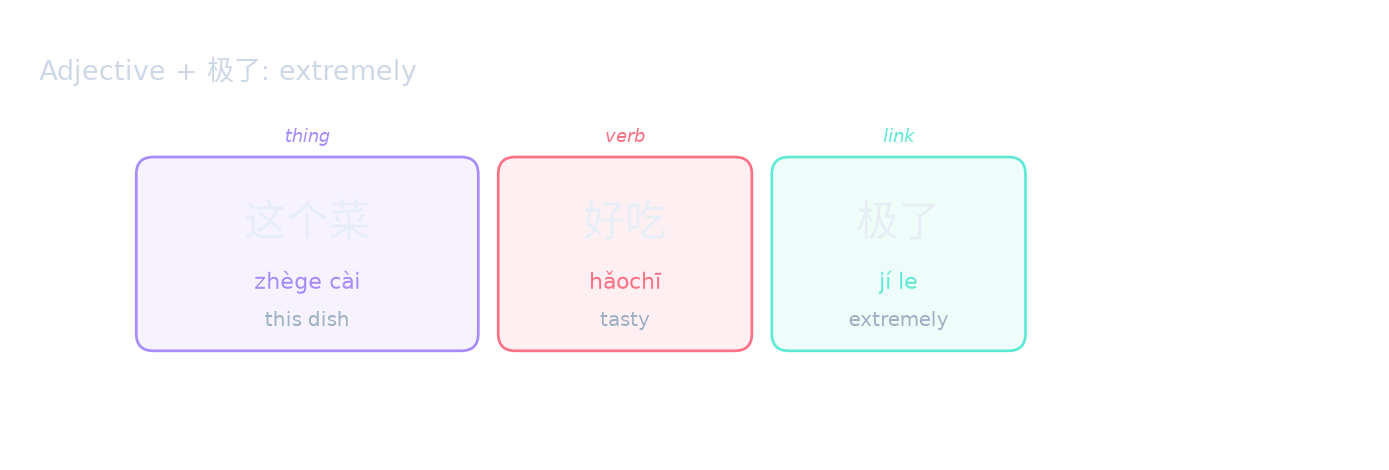
  • 1. Adjective + extremely极了jí le – extremely: this这个zhè gedish (of food); vegetable菜càitasty好吃hǎo chīextremely极了jí le!
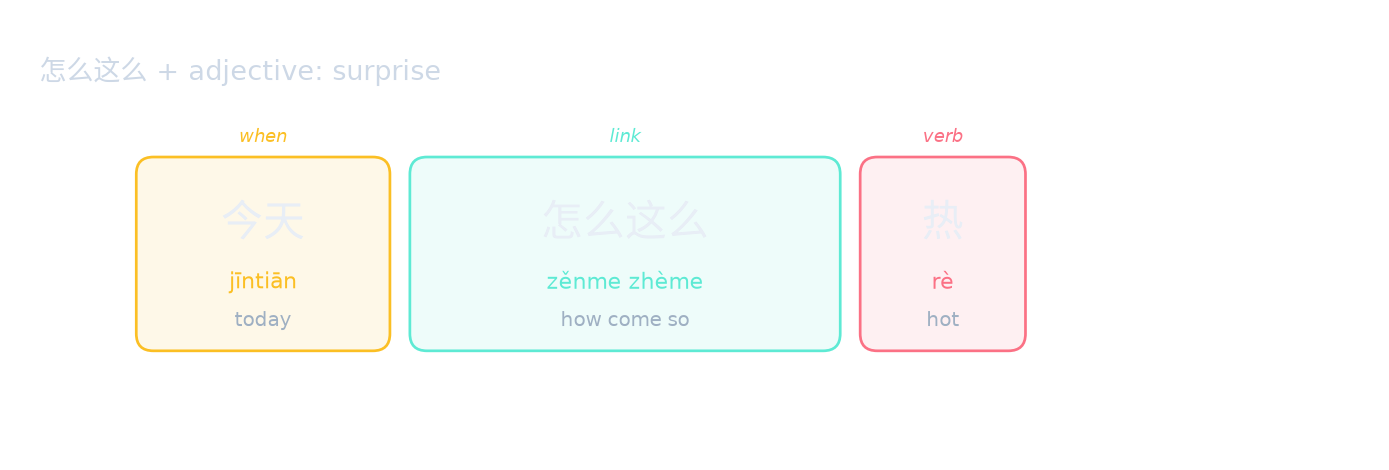
  • 2. so much这么zhè me / like that那么nà me + Adjective – so …: today今天jīn tiānhow / why怎么zěn meso much这么zhè mehot热rè!
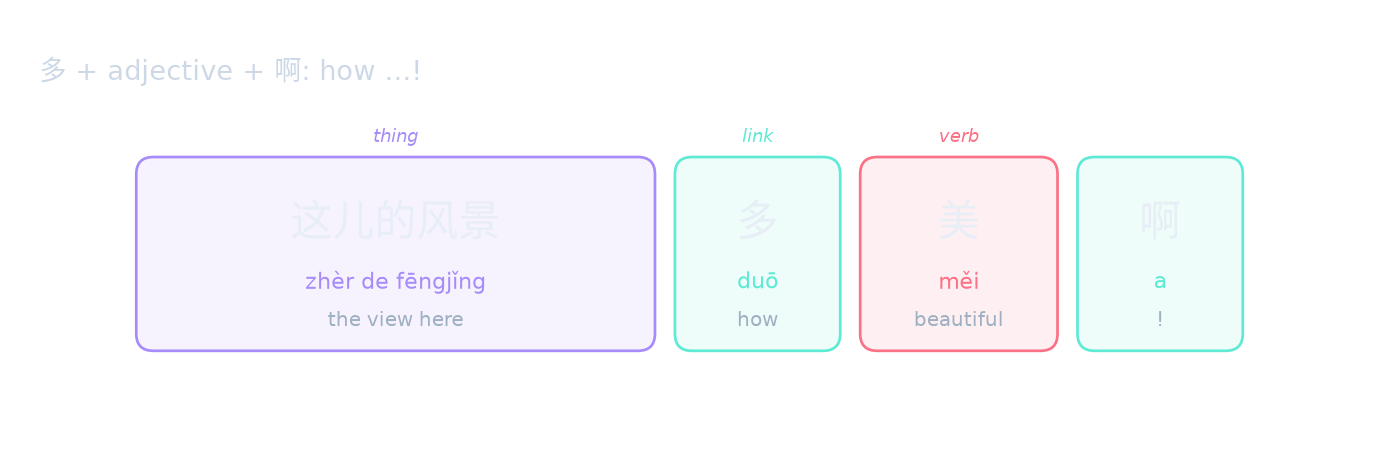
  • 3. many; much多duō + Adjective + (exclamation)啊a! – how …!: here这儿zhè ér(modifier / structural particle)的descenery风景fēng jǐngmany; much多duōbeautiful美měi(exclamation)啊a!
  • 4. Subject + fairly / to compare比较bǐ jiào + Adjective – fairly, rather: to work; job工作gōng zuò比较忙bǐ jiào máng,but不过bú guòcolleague同事tóng shìall / both都dōudegree / adjective linker很hěngood好hǎo。

Describing nouns and actions

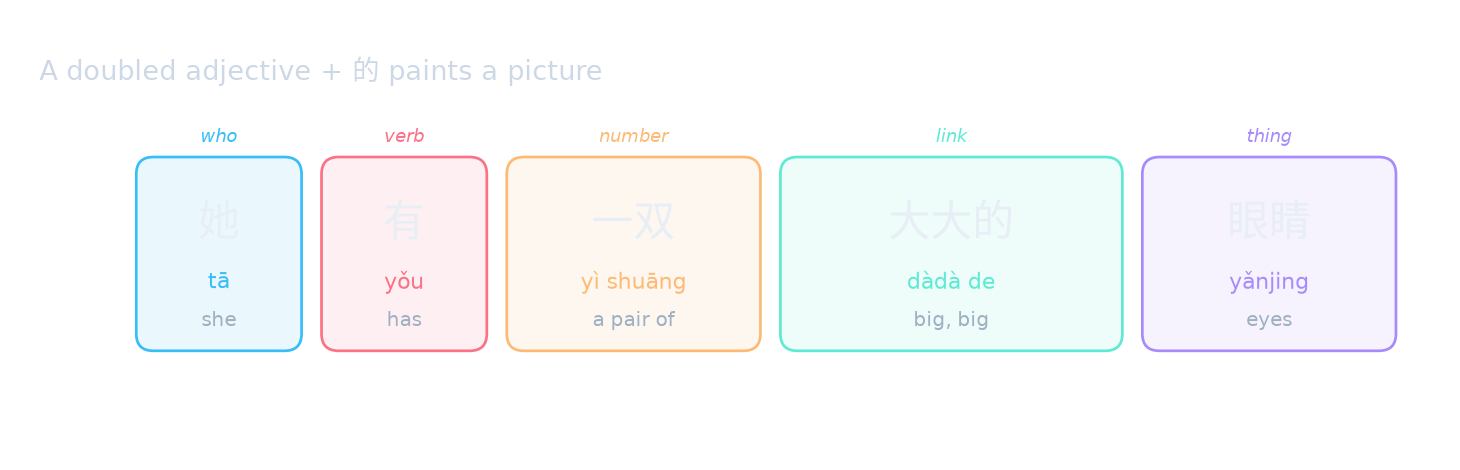
  • 5. Doubling adjectives – AA / AABB: she / her她tāto have / there is有yǒu一双yī shuāng大大的dà dà deeye眼睛yǎn jīng。
  • 6. Adjective + (modifier / structural particle)的de + Noun – describing a noun: I / me我wǒ(modifier / structural particle)的deto be / is是shìthat那个nà gered (color)红色hóng sè(modifier / structural particle)的de大包dà bāo。
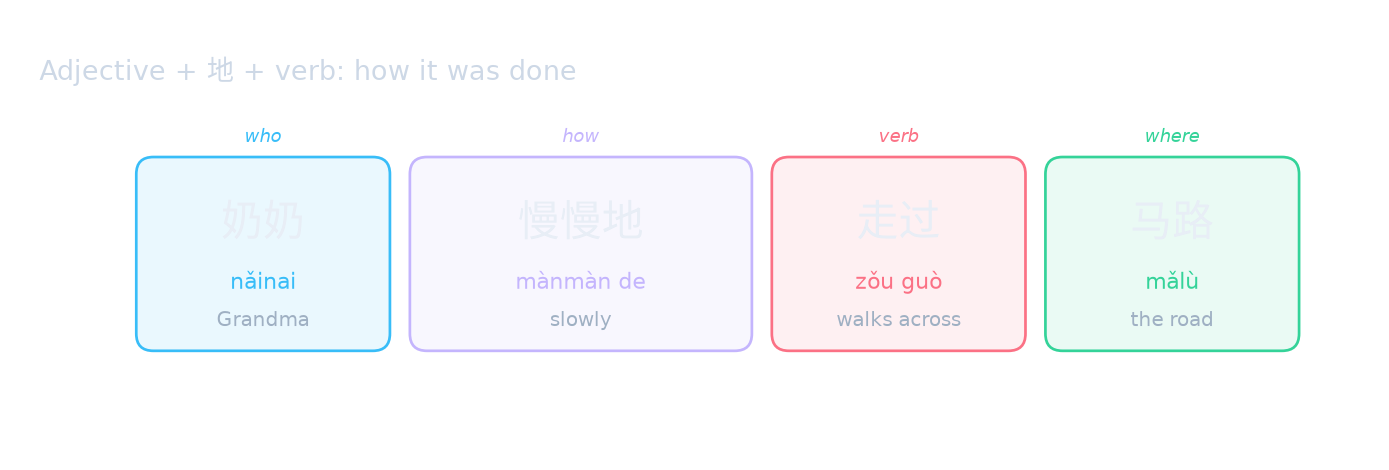
  • 7. Adjective + (adverb -ly)地de + Verb – making an adverb: grandma奶奶nǎi nǎislowly慢慢màn màn(adverb -ly)地deto walk past走过zǒu guòstreet马路mǎ lù。

Two qualities and change

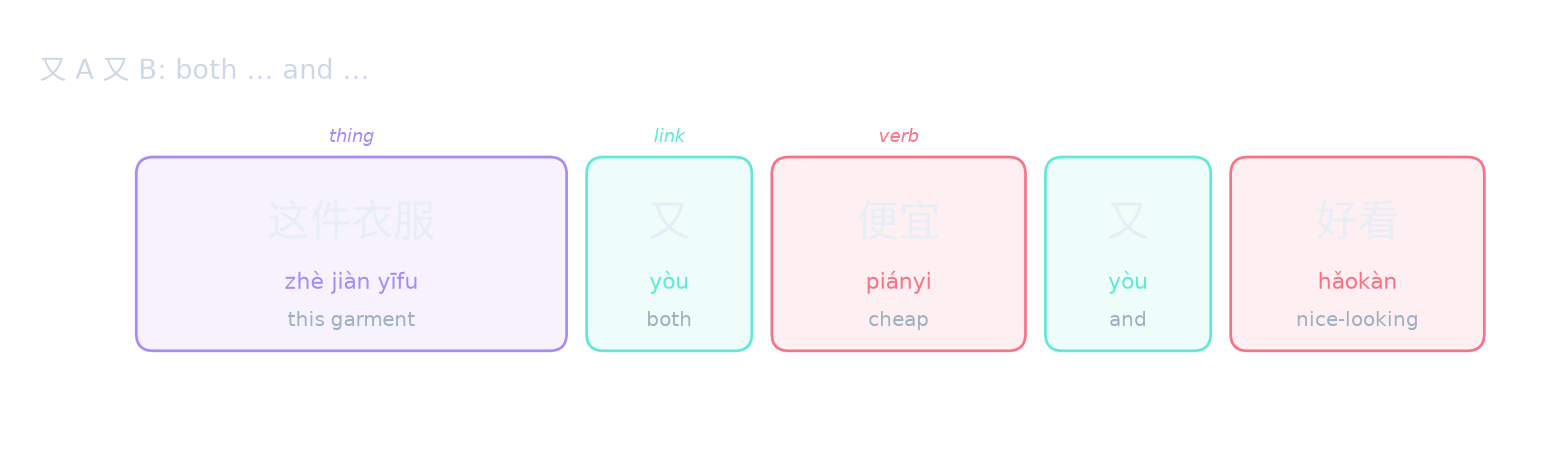
  • 8. again又yòu … again又yòu … – both … and …: 这件zhè jiànclothes衣服yī fúagain又yòucheap便宜pián yiagain又yòugood-looking好看hǎo kàn。
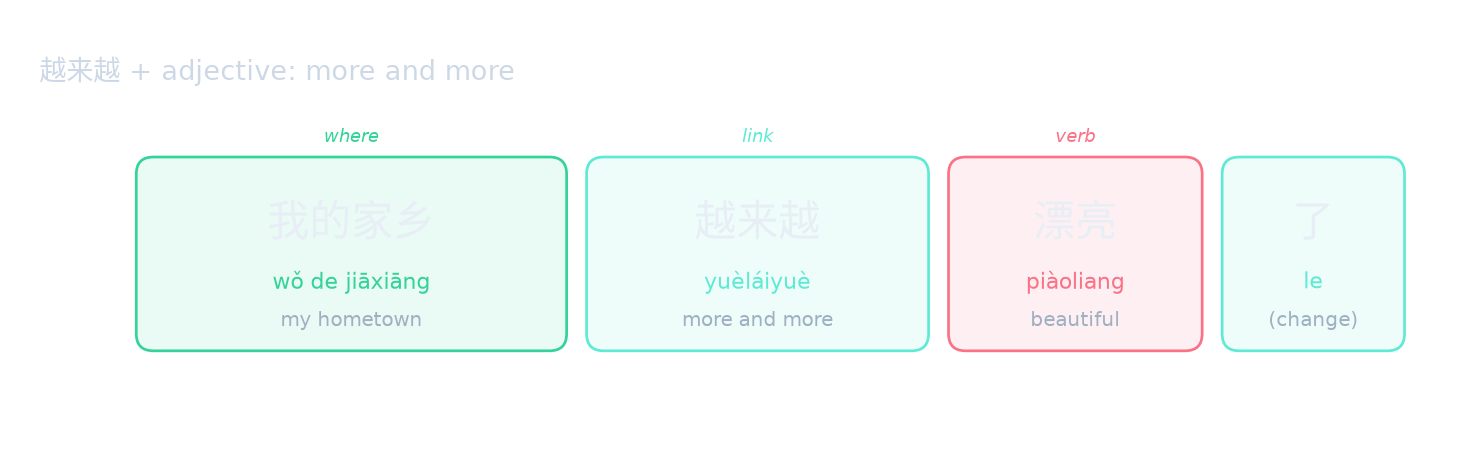
  • 9. more and more越来越yuè lái yuè – more and more: I / me我wǒ(modifier / structural particle)的dehometown家乡jiā xiāngmore and more越来越yuè lái yuèpretty漂亮piào liàng(completed / change)了le。
  • 10. (越…越) the more / to cross越yuè … (越…越) the more / to cross越yuè … – the more …, the more …: 雨越yǔ yuèdown / next; to fall (rain), get off下xià(越…越) the more / to cross越yuèbig大dà。
1.2

1. 形容词 + 极了(表示程度极高)

English

Form: subject + adjective + extremely极了jí le

  • this这个zhè gedish (of food); vegetable菜càitasty好吃hǎo chīextremely极了jí le! Zhège cài hǎochī jí le! – This dish is absolutely delicious!
  • to hear听到tīng dàothis这个zhè genews; message消息xiāo xī,I / me我wǒhappy; glad高兴gāo xìngextremely极了jí le。 Tīngdào zhège xiāoxi, wǒ gāoxìng jí le. – I was overjoyed to hear the news.
  • I / me我wǒto like喜欢xǐ huanextremely极了jí le。 Wǒ xǐhuan jí le. – I absolutely love it.
  • A: outside外面wài miàncold冷lěng(yes/no ?)吗ma? B: cold冷lěngextremely极了jí le! – "Is it cold outside?" "Freezing!"

How it works. extremely极了jí le jí le pushes an adjective to its top degree: "extremely", "absolutely". It closes the clause, after the adjective. It works with feelings (happy; glad高兴gāo xìng, tired累lèi) and a few feeling verbs (to like喜欢xǐ huan).

degree / adjective linker很hěn + adjective very非常fēi cháng + adjective adjective + extremely极了jí le
neutral description strong; speech and writing spoken, exclamatory reaction
weather天气tiān qìdegree / adjective linker很hěngood好hǎo weather天气tiān qìvery非常fēi chánggood好hǎo weather天气tiān qì好极了hǎo jí le!

Watch out

  • extremely极了jí le already gives the degree, so no degree / adjective linker很hěn or very非常fēi cháng: wrong: degree / adjective linker很hěn好极了hǎo jí le → 好极了hǎo jí le.
  • It goes after the adjective: wrong: extremely极了jí lecold冷lěng → cold冷lěngextremely极了jí le.
Adjective + 极了: extremely
1.3

2. 这么 / 那么 + 形容词(如此……)

English

Form: so much这么zhè me / like that那么nà me + adjective

  • today今天jīn tiānhow / why怎么zěn meso much这么zhè mehot热rè! Jīntiān zěnme zhème rè! – How come it's so hot today!
  • 这双鞋zhè shuāng xiéso much这么zhè mecheap便宜pián yi! Zhè shuāng xié zhème piányi! – These shoes are so cheap!
  • there那儿nà ér(modifier / structural particle)的dewinter冬天dōng tiānlike that那么nà mecold冷lěng,you你nǐhow / why怎么zěn meto put up with受得了shòu dé le? – The winters there are so cold; how do you stand it?
  • I / me我wǒnot have / haven't没有méi yǒuhe / him他tālike that那么nà metall; high高gāo。 Wǒ méiyǒu tā nàme gāo. – I'm not as tall as him.

How it works. Both mean "so …" and stand directly before the adjective, in the place of degree / adjective linker很hěn.

so much这么zhè me zhème like that那么nà me nàme
here and now, what you can see or feel over there, earlier, or already mentioned
you你nǐ(modifier / structural particle)的desuitcase箱子xiāng zihow / why怎么zěn meso much这么zhè meheavy / important重zhòng? there那儿nà ér(modifier / structural particle)的demountain山shānlike that那么nà mepretty漂亮piào liàng

They often come with how / why怎么zěn me (surprise: how / why怎么zěn meso much这么zhè meexpensive贵guì) and with not have / haven't没有méi yǒu comparisons (I / me我wǒnot have / haven't没有méi yǒuhe / him他tālike that那么nà metall; high高gāo).

Watch out

  • One degree word only: wrong: so much这么zhè medegree / adjective linker很hěnhot热rè → so much这么zhè mehot热rè.
  • Before the adjective: wrong: far远yuǎnlike that那么nà me → like that那么nà mefar远yuǎn.
怎么这么 + adjective: surprise
1.4

3. 多 + 形容词 + 啊!(表示感叹)

English

Form: many; much多duō + adjective + (exclamation)啊a!

  • here这儿zhè ér(modifier / structural particle)的descenery风景fēng jǐngmany; much多duōbeautiful美měi(exclamation)啊a! Zhèr de fēngjǐng duō měi a! – How beautiful the view is here!
  • you你nǐ(modifier / structural particle)的deChinese language中文zhōng wénto speak说shuō(degree marker)得demany; much多duōgood好hǎo(exclamation)啊a! Nǐ de Zhōngwén shuō de duō hǎo a! – How well you speak Chinese!
  • today今天jīn tiān多热duō rè(exclamation)啊a! – How hot it is today!

How it works. many; much多duō……(exclamation)啊a! is an exclamation, "How … !". many; much多duō goes before a bare adjective and (exclamation)啊a closes the sentence. It sounds warm and admiring.

many; much多duō + adjective + (exclamation)啊a! too太tài + adjective + (completed / change)了le! many; much多duō + adjective?
admiring exclamation strong reaction, often "too" a question about amount
many; much多duōbeautiful美měi(exclamation)啊a! 太贵tài guì(completed / change)了le! 多远duō yuǎn? How far?

Watch out

  • No degree / adjective linker很hěn inside: wrong: many; much多duō很漂亮hěn piào liàng(exclamation)啊a → many; much多duōpretty漂亮piào liàng(exclamation)啊a.
  • Keep (exclamation)啊a and "!". Without them, this这个zhè gepark公园gōng yuánhow old?多大duō dà? asks "How big is the park?"
多 + adjective + 啊: how …!
词汇 训练
汉字 拼音 English
啊 a exclamation particle
公园 gōng yuán park
1.5

4. 主语 + 比较 + 形容词(表示程度较高)

English

Form: subject + fairly / to compare比较bǐ jiào + adjective · fairly / to compare比较bǐ jiào + verb + object (compare)

  • to work; job工作gōng zuò比较忙bǐ jiào máng,but不过bú guòcolleague同事tóng shìall / both都dōudegree / adjective linker很hěngood好hǎo。 Gōngzuò bǐjiào máng, búguò tóngshì dōu hěn hǎo. – Work is fairly busy, but my colleagues are nice.
  • fairly / to compare比较bǐ jiàofar远yuǎn,we / us我们wǒ mento take a taxi (in town)打车dǎ chē(suggestion)吧ba。 Bǐjiào yuǎn, wǒmen dǎ chē ba. – It's rather far; let's take a taxi.
  • I / me我wǒfairly / to compare比较bǐ jiàoto like喜欢xǐ huanto drink tea喝茶hē chá。 – I prefer tea.
  • we / us我们wǒ menfairly / to compare比较bǐ jiào(used after a verb) give it…一下yī xiàthis这zhè两个liǎng gèmobile phone手机shǒu jī。 – Let's compare these two phones.

How it works. Before an adjective, fairly / to compare比较bǐ jiào bǐjiào means "fairly, rather". It takes the place of degree / adjective linker很hěn and gives a moderate, polite answer; nothing else is being compared. Before to like喜欢xǐ huan it means "prefer".

With an object, fairly / to compare比较bǐ jiào is the verb "to compare". Tell the two apart by position.

Watch out

  • fairly / to compare比较bǐ jiào never goes inside an A than / compared to比bǐ B comparison: wrong: he / him他tāthan / compared to比bǐI / me我wǒfairly / to compare比较bǐ jiàotall; high高gāo → he / him他tāthan / compared to比bǐI / me我wǒtall; high高gāo.
  • Do not stack degree words: wrong: degree / adjective linker很hěn比较忙bǐ jiào máng → 比较忙bǐ jiào máng.
比较 softens; 不过 adds a turn
词汇 训练
汉字 拼音 English
比较 bǐ jiào to compare
同事 tóng shì colleague
1.6

5. 形容词重叠(AA / AABB)

English

Form: AA((modifier / structural particle)的de) · AABB((modifier / structural particle)的de / (adverb -ly)地de)

  • she / her她tāto have / there is有yǒu一双yī shuāng大大的dà dà deeye眼睛yǎn jīng。 Tā yǒu yì shuāng dàdà de yǎnjing. – She has big, big eyes.
  • room房间fáng jiān干干净净gān gān jìng jìng(modifier / structural particle)的de。 Fángjiān gāngānjìngjìng de. – The room is spotless.
  • child孩子hái zi(plural)们mencheerful and optimistic高高兴兴gāo gāo xìng xìng(adverb -ly)地deto return home回家huí jiā(completed / change)了le。 – The children went home happily.

How it works. Doubling an adjective makes a description vivid, and adds degree.

Adjective Doubled Example
big大dà, red红hóng, slow慢màn (one syllable) AA 大大的dà dà deeye眼睛yǎn jīng, 红红的hóng hóng deapple苹果píng guǒ, slowly慢慢màn màn(adverb -ly)地deto walk / to leave走zǒu
clean干净gān jìng, happy; glad高兴gāo xìng, distinct清楚qīng chǔ (AB) AABB 干干净净gān gān jìng jìng, cheerful and optimistic高高兴兴gāo gāo xìng xìng, 清清楚楚qīng qīng chǔ chǔ

Before a noun add (modifier / structural particle)的de; before a verb add (adverb -ly)地de. In AA forms, the second syllable is often said lightly.

Watch out

  • Doubling already adds degree, so no degree / adjective linker很hěn: wrong: degree / adjective linker很hěn大大的dà dà deeye眼睛yǎn jīng → 大大的dà dà deeye眼睛yǎn jīng.
  • A two-syllable adjective doubles each syllable: wrong: clean干净gān jìngclean干净gān jìng → 干干净净gān gān jìng jìng.
  • Doubled forms describe; they are not negated: wrong: not不bù干干净净gān gān jìng jìng → not不bùclean干净gān jìng.
A doubled adjective + 的 paints a picture
词汇 训练
汉字 拼音 English
地 de adverbial particle
干净 gān jìng clean
清楚 qīng chu distinct
1.7

6. 形容词 + 的 + 名词(描述名词)

English

Form: adjective + (modifier / structural particle)的de + noun · adjective + (modifier / structural particle)的de (the … one)

  • I / me我wǒ(modifier / structural particle)的deto be / is是shìthat那个nà gered (color)红色hóng sè(modifier / structural particle)的de大包dà bāo。 Wǒ de shì nàge hóngsè de dà bāo. – Mine is that big red bag.
  • he / him他tāto be / is是shìI / me我wǒdegree / adjective linker很hěngood好hǎo(modifier / structural particle)的defriend朋友péng yǒu。 Tā shì wǒ hěn hǎo de péngyou. – He is a very good friend of mine.
  • 这是zhè shì一本yī běndegree / adjective linker很hěninteresting有意思yǒu yì si(modifier / structural particle)的debook书shū。 – This is a very interesting book.
  • big大dà(modifier / structural particle)的deor / still还是hái shìsmall小xiǎo(modifier / structural particle)的de?——我要wǒ yàored红hóng(modifier / structural particle)的de。 – The big one or the small one? – I want the red one.

How it works. In Chinese the description always comes before the noun, and (modifier / structural particle)的de links them.

Needs (modifier / structural particle)的de Usually no (modifier / structural particle)的de
degree / adjective linker很hěn + adjective: degree / adjective linker很hěngood好hǎo(modifier / structural particle)的defriend朋友péng yǒu common one-syllable pairs: good person好人hǎo rén, 新车xīn chē
two syllables: clean干净gān jìng(modifier / structural particle)的deroom房间fáng jiān major city大城市dà chéng shì, black tea红茶hóng chá

When the noun is clear, adjective + (modifier / structural particle)的de stands alone: 我要wǒ yàonew新xīn(modifier / structural particle)的de,don't不要bú yàoold (of things)旧jiù(modifier / structural particle)的de.

Watch out

  • Keep (modifier / structural particle)的de after degree / adjective linker很hěn + adjective: wrong: degree / adjective linker很hěngood好hǎofriend朋友péng yǒu → degree / adjective linker很hěngood好hǎo(modifier / structural particle)的defriend朋友péng yǒu.
  • wrong: clothes衣服yī fúpretty漂亮piào liàng(modifier / structural particle)的de → pretty漂亮piào liàng(modifier / structural particle)的declothes衣服yī fú (the description goes first).
Describer + 的 can stand for the thing
词汇 训练
汉字 拼音 English
还是 hái shi still
旧 jiù old (of things)
1.8

7. 形容词 + 地 + 动词(构成状语)

English

Form: subject + adjective + (adverb -ly)地de + verb

  • grandma奶奶nǎi nǎislowly慢慢màn màn(adverb -ly)地deto walk past走过zǒu guòstreet马路mǎ lù。 Nǎinai mànmàn de zǒuguò mǎlù. – Grandma walks slowly across the road.
  • she / her她tāquiet安静ān jìng(adverb -ly)地deto read看书kàn shū。 Tā ānjìng de kàn shū. – She reads quietly.
  • he / him他tāto be careful小心xiǎo xīn(adverb -ly)地deto open打开dǎ kāibox盒子hé zi。 – He opened the box carefully.

How it works. (adverb -ly)地de de turns a description into the way an action is done, like English "-ly". The description comes before the verb. Doubled adjectives (cheerful and optimistic高高兴兴gāo gāo xìng xìng(adverb -ly)地de) and short phrases (很快hěn kuài(adverb -ly)地de, very非常fēi chángconscientious认真rèn zhēn(adverb -ly)地de) work too.

Three particles called de.

(modifier / structural particle)的de (adverb -ly)地de (degree marker)得de
before a noun before a verb after a verb
conscientious认真rèn zhēn(modifier / structural particle)的destudent学生xué shēng conscientious认真rèn zhēn(adverb -ly)地deto study; to learn学习xué xí 学得xué dédegree / adjective linker很hěnconscientious认真rèn zhēn
a serious student studies seriously studies seriously (comment)

Watch out

  • wrong: he / him他tāto study; to learn学习xué xíconscientious认真rèn zhēn(adverb -ly)地de → he / him他tāconscientious认真rèn zhēn(adverb -ly)地deto study; to learn学习xué xí or 他学得tā xué dédegree / adjective linker很hěnconscientious认真rèn zhēn.
  • Write (adverb -ly)地de before a verb, not (modifier / structural particle)的de: wrong: happy; glad高兴gāo xìng(modifier / structural particle)的deto speak说shuō → happy; glad高兴gāo xìng地说dì shuō.
Adjective + 地 + verb: how it was done
词汇 训练
汉字 拼音 English
奶奶 nǎi nai grandma
安静 ān jìng quiet
小心 xiǎo xīn to be careful
认真 rèn zhēn conscientious
1.9

8. 又……又……

English

Form: subject + again又yòu + A + again又yòu + B

  • 这件zhè jiànclothes衣服yī fúagain又yòucheap便宜pián yiagain又yòugood-looking好看hǎo kàn。 Zhè jiàn yīfu yòu piányi yòu hǎokàn. – This jacket is both cheap and good-looking.
  • she / her她tā(modifier / structural particle)的deroom房间fáng jiānagain又yòubig大dàagain又yòuclean干净gān jìng。 Tā de fángjiān yòu dà yòu gānjìng. – Her room is big and clean.
  • child孩子hái zi(plural)们menagain又yòuto sing唱chàngagain又yòuto jump跳tiào。 Háizimen yòu chàng yòu tiào. – The children sang and danced.
  • I / me我wǒagain又yòutired累lèiagain又yòuhungry饿è。 – I'm tired and hungry.

How it works. again又yòu……again又yòu…… says two qualities or actions are true at the same time. Each again又yòu goes straight before its own adjective or verb. The two point the same way: both good (又快又好yòu kuài yòu hǎo) or both bad (again又yòutired累lèiagain又yòuhungry饿è).

Compare. degree / adjective linker很hěncheap便宜pián yi,also也yědegree / adjective linker很hěngood-looking好看hǎo kàn lists two facts one after the other; again又yòucheap便宜pián yiagain又yòugood-looking好看hǎo kàn presents them together as one picture.

Watch out

  • and / with和hé cannot join two adjectives after the subject: wrong: cheap便宜pián yiand / with和hégood-looking好看hǎo kàn → again又yòucheap便宜pián yiagain又yòugood-looking好看hǎo kàn.
  • No degree / adjective linker很hěn inside the pattern: wrong: again又yòudegree / adjective linker很hěntall; high高gāoagain又yòu很大hěn dà → 又高又大yòu gāo yòu dà.
  • again又yòucheap便宜pián yiagain又yòubad-looking; ugly难看nán kàn sounds odd unless you are joking: the qualities clash.
又 A 又 B: both … and …
词汇 训练
汉字 拼音 English
又 yòu again
饿 è hungry
1.10

9. 越来越(程度逐渐加深)

English

Form: subject + more and more越来越yuè lái yuè + adjective / feeling verb (+ (completed / change)了le)

  • I / me我wǒ(modifier / structural particle)的dehometown家乡jiā xiāngmore and more越来越yuè lái yuèpretty漂亮piào liàng(completed / change)了le。 Wǒ de jiāxiāng yuèláiyuè piàoliang le. – My hometown is getting more and more beautiful.
  • weather天气tiān qìmore and more越来越yuè lái yuècold冷lěng(completed / change)了le。 Tiānqì yuèláiyuè lěng le. – It's getting colder and colder.
  • I / me我wǒmore and more越来越yuè lái yuèto like喜欢xǐ huanthis这个zhè gecity城市chéng shì(completed / change)了le。 – I like this city more and more.
  • he / him他tāmore and more越来越yuè lái yuècan / will会huìto prepare a meal做饭zuò fàn(completed / change)了le。 – He's getting better and better at cooking.

How it works. more and more越来越yuè lái yuè yuèláiyuè says a quality keeps growing over time. It goes after the subject, before a bare adjective or a feeling verb (to like喜欢xǐ huan, want / think / miss想xiǎng) or ability verb (can / will会huì). The final (completed / change)了le is common because the sentence reports a change.

Watch out

  • No degree word after it: wrong: more and more越来越yuè lái yuèdegree / adjective linker很hěngood好hǎo → more and more越来越yuè lái yuègood好hǎo.
  • The subject comes first: wrong: more and more越来越yuè lái yuèhe / him他tātall; high高gāo → he / him他tāmore and more越来越yuè lái yuètall; high高gāo.
  • more and more越来越yuè lái yuè is change over time. To link two things ("the more A, the more B"), use (越…越) the more / to cross越yuè A (越…越) the more / to cross越yuè B.
越来越 + adjective: more and more
词汇 训练
汉字 拼音 English
城市 chéng shì city
越 yuè to exceed
1.11

10. 越 … 越 …(程度随另一程度增加而增加)

English

Form: (越…越) the more / to cross越yuè + A + (越…越) the more / to cross越yuè + B · subject₁ (越…越) the more / to cross越yuè A,subject₂ (越…越) the more / to cross越yuè B

  • 雨越yǔ yuèdown / next; to fall (rain), get off下xià(越…越) the more / to cross越yuèbig大dà。 Yǔ yuè xià yuè dà. – The rain is getting heavier and heavier.
  • you你nǐ(越…越) the more / to cross越yuèto practice练习liàn xí,to speak说shuō(degree marker)得de(越…越) the more / to cross越yuègood好hǎo。 Nǐ yuè liànxí, shuō de yuè hǎo. – The more you practise, the better you speak.
  • 天越tiān yuècold冷lěng,人越rén yuèfew; little少shǎo。 Tiān yuè lěng, rén yuè shǎo. – The colder it gets, the fewer people there are.
  • I / me我wǒ(越…越) the more / to cross越yuèwant / think / miss想xiǎng(越…越) the more / to cross越yuèto get angry生气shēng qì。 – The more I think about it, the angrier I get.

How it works. (越…越) the more / to cross越yuè A (越…越) the more / to cross越yuè B means "the more A, the more B": B grows as A increases. Each (越…越) the more / to cross越yuè goes before a verb or adjective. With one subject the pattern is short (he / him他tā(越…越) the more / to cross越yuèto speak说shuō(越…越) the more / to cross越yuèfast; soon快kuài); with two, each subject comes before its own (越…越) the more / to cross越yuè.

more and more越来越yuè lái yuè (越…越) the more / to cross越yuè A (越…越) the more / to cross越yuè B
growth over time alone growth tied to something else
weather天气tiān qìmore and more越来越yuè lái yuècold冷lěng 越想yuè xiǎng(越…越) the more / to cross越yuèto get angry生气shēng qì

Watch out

  • No degree / adjective linker很hěn after (越…越) the more / to cross越yuè: wrong: (越…越) the more / to cross越yuèto speak说shuō(越…越) the more / to cross越yuè很快hěn kuài → (越…越) the more / to cross越yuèto speak说shuō(越…越) the more / to cross越yuèfast; soon快kuài.
  • wrong: 越天yuè tiāncold冷lěng,越人少yuè rén shǎo → 天越tiān yuècold冷lěng,人越rén yuèfew; little少shǎo.
越 A 越 B: the more A, the more B
词汇 训练
汉字 拼音 English
练习 liàn xí to practice
生气 shēng qì to get angry
1.12

练习

English

Cover the teaching pages before you answer. The answers are at the end.

1. Adjective + extremely极了jí le (extremely)

1. Complete the reaction to a great film: this这个zhè gefilm; movie电影diàn yǐnggood-looking好看hǎo kàn…………!

2. Which sentence is correct?

  • A. weather天气tiān qìdegree / adjective linker很hěn好极了hǎo jí le。
  • B. weather天气tiān qìvery非常fēi cháng好极了hǎo jí le。
  • C. weather天气tiān qìextremely极了jí legood好hǎo。
  • D. weather天气tiān qì好极了hǎo jí le。

3. True or false? A friend asks outside外面wài miàncold冷lěng(yes/no ?)吗ma? Replying cold冷lěngextremely极了jí le! is natural spoken Chinese. If false, correct it.

4. Build: “I was overjoyed when I heard the news.”

Put in order: extremely极了jí le。 / to hear听到tīng dàothis这个zhè genews; message消息xiāo xī, / I / me我wǒ / happy; glad高兴gāo xìng

5. The shop has a huge sale and you are delighted with the prices. Which reaction fits best?

  • A. too太tàicheap便宜pián yi(completed / change)了le,I / me我wǒnot不bùto buy买mǎi。
  • B. here这里zhè lǐ(modifier / structural particle)的dething; stuff东西dōng xīdegree / adjective linker很hěncheap便宜pián yiextremely极了jí le。
  • C. here这里zhè lǐ(modifier / structural particle)的dething; stuff东西dōng xīcheap便宜pián yiextremely极了jí le!
  • D. here这里zhè lǐ(modifier / structural particle)的dething; stuff东西dōng xīa little有点yǒu diǎncheap便宜pián yi。

6. Your friend has cooked for you, and the food is far better than "quite good". Use Adjective + extremely极了jí le. Write your answer in Chinese, then say it aloud.

2. so much这么zhè me / like that那么nà me + Adjective (so …)

7. You are holding a heavy suitcase: you你nǐ(modifier / structural particle)的desuitcase箱子xiāng zihow / why怎么zěn me…………heavy / important重zhòng?

8. A friend describes her hometown far away. Which fits best? “The mountains there are so beautiful.”

  • A. there那儿nà ér(modifier / structural particle)的demountain山shānso much这么zhè me很漂亮hěn piào liàng。
  • B. there那儿nà ér(modifier / structural particle)的demountain山shāndegree / adjective linker很hěnlike that那么nà mepretty漂亮piào liàng。
  • C. there那儿nà ér(modifier / structural particle)的demountain山shānpretty漂亮piào liànglike that那么nà me。
  • D. there那儿nà ér(modifier / structural particle)的demountain山shānlike that那么nà mepretty漂亮piào liàng。

9. Match each sentence to its meaning.

  • (1) this这个zhè geChinese character字zìshould应该yīng gāiso much这么zhè meto write写xiě。

  • (2) 你别nǐ biélike that那么nà meto speak说shuō!

  • (3) so much这么zhè me多人duō rén!

  • A. Don't say it like that!

  • B. This character should be written like this.

  • C. So many people!

10. True or false? so much这么zhè medegree / adjective linker很hěnhot热rè is correct because so much这么zhè me and degree / adjective linker很hěn both mean “very”. If false, correct it.

11. Build: “I am not as tall as him.”

Put in order: I / me我wǒ / he / him他tā / not have / haven't没有méi yǒu / like that那么nà me / tall; high高gāo。

12. You step outside in July and it is much hotter than you expected. Use so much这么zhè me / like that那么nà me + Adjective. Write your answer in Chinese, then say it aloud.

3. many; much多duō + Adjective + (exclamation)啊a! (how …!)

13. Exclaim: “How nice the weather is!” weather天气tiān qì…………good好hǎo(exclamation)啊a!

14. Which one asks a question instead of exclaiming?

  • A. this这个zhè gepark公园gōng yuánhow old?多大duō dà?
  • B. this这个zhè gepark公园gōng yuánmany; much多duōpretty漂亮piào liàng(exclamation)啊a!
  • C. this这个zhè gepark公园gōng yuánhow old?多大duō dà(exclamation)啊a!
  • D. here这儿zhè érmany; much多duōquiet安静ān jìng(exclamation)啊a!

15. Build: “How well you speak Chinese!”

Put in order: you你nǐ(modifier / structural particle)的deChinese language中文zhōng wén / to speak说shuō(degree marker)得de / (exclamation)啊a! / 多好duō hǎo

16. True or false? many; much多duō很漂亮hěn piào liàng(exclamation)啊a! is correct. If false, correct it.

17. Match each sentence to its meaning.

  • (1) this这个zhè gesuitcase箱子xiāng zimulti- (faceted, cultural…多重duō zhòng?

  • (2) this这个zhè gesuitcase箱子xiāng zimulti- (faceted, cultural…多重duō zhòng(exclamation)啊a!

  • (3) 你家nǐ jiāaway from离líschool学校xué xiào多远duō yuǎn?

  • A. How far is your home from school?

  • B. How heavy is this suitcase?

  • C. This suitcase is so heavy!

18. You reach the top of a mountain and the whole city lies below you. Use many; much多duō + Adjective + (exclamation)啊a!. Write your answer in Chinese, then say it aloud.

4. Subject + fairly / to compare比较bǐ jiào + Adjective (fairly, rather)

19. A moderate answer: “Today is fairly cold.” today今天jīn tiān…………cold冷lěng。

20. Build: “It is rather far; let's take a taxi.”

Put in order: to take a taxi (in town)打车dǎ chē(suggestion)吧ba。 / fairly / to compare比较bǐ jiàofar远yuǎn / , / we / us我们wǒ men

21. Build: “The room is fairly small, but it is very clean.”

Put in order: room房间fáng jiān / but不过bú guò / fairly / to compare比较bǐ jiàosmall小xiǎo, / degree / adjective linker很hěnclean干净gān jìng。

22. Which sentence says “He is taller than me.”?

  • A. he / him他tāthan / compared to比bǐI / me我wǒtall; high高gāo。
  • B. he / him他tāthan / compared to比bǐI / me我wǒfairly / to compare比较bǐ jiàotall; high高gāo。
  • C. he / him他tādegree / adjective linker很hěnthan / compared to比bǐI / me我wǒtall; high高gāo。
  • D. he / him他tāfairly / to compare比较bǐ jiàoI / me我wǒtall; high高gāo。

23. Match each sentence to its meaning.

  • (1) 这家zhè jiārestaurant饭馆fàn guǎnfairly / to compare比较bǐ jiàoexpensive贵guì。

  • (2) we / us我们wǒ menfairly / to compare比较bǐ jiào(used after a verb) give it…一下yī xiàprice价格jià gé。

  • (3) I / me我wǒfairly / to compare比较bǐ jiàoto like喜欢xǐ huansummer夏天xià tiān。

  • A. Let's compare the prices.

  • B. I prefer summer.

  • C. This restaurant is rather expensive.

24. A friend asks how your new job is. It is fine, but you would not call it amazing. Use Subject + fairly / to compare比较bǐ jiào + Adjective. Write your answer in Chinese, then say it aloud.

5. Doubling adjectives (AA / AABB)

25. Match each adjective to its doubled form.

  • (1) happy; glad高兴gāo xìng

  • (2) clean干净gān jìng

  • (3) slow慢màn

  • (4) pretty漂亮piào liàng

  • A. 漂漂亮亮piāo piāo liàng liàng

  • B. 干干净净gān gān jìng jìng

  • C. slowly慢慢màn màn

  • D. cheerful and optimistic高高兴兴gāo gāo xìng xìng

26. True or false? clean干净gān jìng can be doubled as clean干净gān jìngclean干净gān jìng to describe a room. If false, correct it.

27. Double distinct清楚qīng chǔ (clear): teacher老师lǎo shī(把: marks the object)把bǎquestion / problem问题wèn títo speak说shuō(degree marker)得de…………(modifier / structural particle)的de。

28. “The little boy's hands are all dirty.” Which is correct?

  • A. she / her她tā(modifier / structural particle)的dehand手shǒu冷冷的lěng lěng de。
  • B. she / her她tā(modifier / structural particle)的dehand手shǒu冷冷地lěng lěng dì。
  • C. she / her她tā(modifier / structural particle)的dehand手shǒudegree / adjective linker很hěn冷冷的lěng lěng de。
  • D. she / her她tā(modifier / structural particle)的dehand手shǒucoldly冷冷lěng lěng。

29. Build: “Please speak slowly.”

Put in order: slowly慢慢màn màn / please; to invite请qǐng / to speak说shuō。

30. Which means “Let's go out and have some fun”?

  • A. we / us我们wǒ mento go out出去chū qùcheerful and optimistic高高兴兴gāo gāo xìng xìng(suggestion)吧ba!
  • B. we / us我们wǒ mento go out出去chū qùdegree / adjective linker很hěnhappy; glad高兴gāo xìng(suggestion)吧ba!
  • C. we / us我们wǒ mento go out出去chū qùhappy; glad高兴gāo xìngfeeling or desire to do sth兴xīng(suggestion)吧ba!
  • D. we / us我们wǒ mento go out出去chū qùhappy; glad高兴gāo xìnghappy; glad高兴gāo xìng(suggestion)吧ba!

31. Which phrase is correct?

  • A. 红红的hóng hóng deapple苹果píng guǒ
  • B. not不bù红红的hóng hóng deapple苹果píng guǒ
  • C. degree / adjective linker很hěn红红的hóng hóng deapple苹果píng guǒ
  • D. red红hóng红红的hóng hóng deapple苹果píng guǒ

32. You are describing a child's drawing: big eyes, a round face, a very tidy room. Write your answer in Chinese, then say it aloud.

6. Adjective + (modifier / structural particle)的de + Noun (describing a noun)

33. Complete: “He is a very good friend.” he / him他tāto be / is是shìI / me我wǒdegree / adjective linker很hěngood好hǎo…………friend朋友péng yǒu。

34. Build: “This is a very interesting book.”

Put in order: degree / adjective linker很hěninteresting有意思yǒu yì si(modifier / structural particle)的de / book书shū。 / 一本yī běn / 这是zhè shì

35. Build: “This is the food Mum made.”

Put in order: to do; to make做zuò(modifier / structural particle)的de / 这是zhè shì / mum; mother妈妈mā mā / dish (of food); vegetable菜cài。

36. Which phrase is correct?

  • A. clothes衣服yī fúpretty漂亮piào liàng(modifier / structural particle)的de
  • B. pretty漂亮piào liàngdegree / adjective linker很hěn(modifier / structural particle)的declothes衣服yī fú
  • C. 很漂亮hěn piào liàng(modifier / structural particle)的declothes衣服yī fú
  • D. degree / adjective linker很hěn漂亮衣服piào liàng yī fú

37. True or false? In a shop, 我要wǒ yàored红hóng(modifier / structural particle)的de can mean “I want the red one.” If false, correct it.

38. At the station a lost-property officer asks which bag is yours. You need more than "a bag". Use Adjective + (modifier / structural particle)的de + Noun. Write your answer in Chinese, then say it aloud.

7. Adjective + (adverb -ly)地de + Verb (making an adverb)

39. Fill in the particle: she / her她tāquiet安静ān jìng…………to read看书kàn shū。

40. Build: “Grandma walks slowly across the road.”

Put in order: to walk past走过zǒu guò / grandma奶奶nǎi nǎi / street马路mǎ lù / 。 / slowly慢慢màn màn(adverb -ly)地de

41. “He opened the door quietly.” Which is correct?

  • A. he / him他tā轻地qīng dì开了门kāi le mén。
  • B. he / him他tā开了门kāi le mén轻轻地qīng qīng dì。
  • C. he / him他tālightly轻轻qīng qīng(modifier / structural particle)的de开了门kāi le mén(adverb -ly)地de。
  • D. he / him他tā轻轻地qīng qīng dì开了门kāi le mén。

42. True or false? he / him他tāto study; to learn学习xué xíconscientious认真rèn zhēn(adverb -ly)地de。 is a correct way to say “He studies seriously.” If false, correct it.

43. Choose the particle for both blanks: he / him他tāhappy; glad高兴gāo xìng__to speak说shuō: “I / me我wǒ考得kǎo dé__degree / adjective linker很hěngood好hǎo!”

  • A. (adverb -ly)地de … (adverb -ly)地de
  • B. (modifier / structural particle)的de … (modifier / structural particle)的de
  • C. (degree marker)得de … (adverb -ly)地de
  • D. (adverb -ly)地de … (degree marker)得de

44. Your grandmother crosses the busy road carefully; your little brother does his homework seriously for once. Use Adjective + (adverb -ly)地de + Verb. Write your answer in Chinese, then say it aloud.

8. again又yòu … again又yòu … (both … and …)

45. Complete: “The noodles here are both tasty and cheap.” here这儿zhè ér(modifier / structural particle)的denoodles面条miàn tiáo…………tasty好吃hǎo chī…………cheap便宜pián yi。 (write the word that fills both blanks)

46. Build: “Her room is both big and clean.”

Put in order: again又yòubig大dà / again又yòuclean干净gān jìng / she / her她tā(modifier / structural particle)的deroom房间fáng jiān / 。

47. Which sentence keeps both halves pointing the same way?

  • A. this这个zhè gemobile phone手机shǒu jīagain又yòucheap便宜pián yiagain又yòugood好hǎoto use / with用yòng。
  • B. this这个zhè gemobile phone手机shǒu jīagain又yòuexpensive贵guìagain又yòugood好hǎoto use / with用yòng。
  • C. this这个zhè gemobile phone手机shǒu jīagain又yòucheap便宜pián yiagain又yòuno good不好bù hǎoto use / with用yòng。
  • D. this这个zhè gemobile phone手机shǒu jīagain又yòudegree / adjective linker很hěncheap便宜pián yiagain又yòudegree / adjective linker很hěngood好hǎoto use / with用yòng。

48. Which sentence is natural?

  • A. he / him他tāagain又yòutall; high高gāoagain又yòuhandsome帅shuài。
  • B. he / him他tā高和帅gāo hé shuài。
  • C. he / him他tāagain又yòudegree / adjective linker很hěntall; high高gāoagain又yòu很帅hěn shuài。
  • D. he / him他tāagain又yòu高帅gāo shuài。

49. True or false? 这件zhè jiànclothes衣服yī fúcheap便宜pián yiand / with和hégood-looking好看hǎo kàn is a correct way to say “This item of clothing is cheap and good-looking.” If false, correct it.

50. You found a jacket that looks great and costs very little, and you want to say both at once. Use again又yòu … again又yòu …. Write your answer in Chinese, then say it aloud.

9. more and more越来越yuè lái yuè (more and more)

51. Complete: “Your Chinese is getting better and better.” you你nǐ(modifier / structural particle)的deChinese language中文zhōng wén…………good好hǎo(completed / change)了le。

52. Build: “I like this city more and more.”

Put in order: this这个zhè gecity城市chéng shì(completed / change)了le。 / more and more越来越yuè lái yuè / I / me我wǒ / to like喜欢xǐ huan

53. “More and more people are learning to swim.” Which is correct?

  • A. person人rénmore and more越来越yuè lái yuè很多hěn duōto learn学xuéto swim游泳yóu yǒng。
  • B. more and more越来越yuè lái yuèmany; much多duō(modifier / structural particle)的de人学rén xuéto swim游泳yóu yǒng。
  • C. more and more越来越yuè lái yuè人多学rén duō xuéto swim游泳yóu yǒng。
  • D. degree / adjective linker很hěnmore and more越来越yuè lái yuèmany; much多duō(modifier / structural particle)的de人学rén xuéto swim游泳yóu yǒng。

54. Build: “I like this game less and less.”

Put in order: not不bùto like喜欢xǐ huan / I / me我wǒ / this这个zhè gegame游戏yóu xì(completed / change)了le。 / more and more越来越yuè lái yuè

55. Which sentence is correct?

  • A. thing; stuff东西dōng xīdegree / adjective linker很hěnmore and more越来越yuè lái yuèexpensive贵guì(completed / change)了le。
  • B. thing; stuff东西dōng xīmore and more越来越yuè lái yuèexpensive贵guì(completed / change)了le。
  • C. more and more越来越yuè lái yuèthing; stuff东西dōng xīexpensive贵guì(completed / change)了le。
  • D. thing; stuff东西dōng xīmore and more越来越yuè lái yuèdegree / adjective linker很hěnexpensive贵guì(completed / change)了le。

56. True or false? more and more越来越yuè lái yuè links two different things, as in “the more you practise, the better you get.” If false, correct it.

57. You go back to your hometown after five years: more cars, more tall buildings, more people. Use more and more越来越yuè lái yuè. Write your answer in Chinese, then say it aloud.

10. (越…越) the more / to cross越yuè … (越…越) the more / to cross越yuè … (the more …, the more …)

58. Complete: “The more he eats, the fatter he gets.” he / him他tā(越…越) the more / to cross越yuèto eat吃chī…………fat胖pàng。

59. Which sentence is correct?

  • A. 越天yuè tiānhot热rè,越人yuè rénmany; much多duō。
  • B. 天热越tiān rè yuè,人多越rén duō yuè。
  • C. 天越tiān yuèhot热rè,人越rén yuèmany; much多duō。
  • D. 天越tiān yuèhot热rè,人越rén yuè很多hěn duō。

60. Build: “The more you practise, the better you speak.”

Put in order: to speak说shuō(degree marker)得de / , / you你nǐ(越…越) the more / to cross越yuèto practice练习liàn xí / (越…越) the more / to cross越yuègood好hǎo。

61. True or false? 越想yuè xiǎng(越…越) the more / to cross越yuèto get angry生气shēng qì means “the more I think about it, the angrier I get.” If false, correct it.

62. You are waiting for the rain to stop, but it only gets heavier. Use (越…越) the more / to cross越yuè … (越…越) the more / to cross越yuè …. Write your answer in Chinese, then say it aloud.

1.13

混合练习

English

These questions mix the patterns and use new situations.

63. Which sentence is correct?

  • A. this这个zhè gedish (of food); vegetable菜càidegree / adjective linker很hěntasty好吃hǎo chīextremely极了jí le!
  • B. this这个zhè gedish (of food); vegetable菜càitasty好吃hǎo chīextremely极了jí le!
  • C. this这个zhè gedish (of food); vegetable菜càiextremely极了jí letasty好吃hǎo chī!

64. Choose more and more越来越yuè lái yuè or (越…越) the more / to cross越yuè……(越…越) the more / to cross越yuè……: weather天气tiān qì…………hot热rè(completed / change)了le。 / rain雨yǔ…………down / next; to fall (rain), get off下xià…………big大dà。

65. Choose (modifier / structural particle)的de or (adverb -ly)地de: grandma奶奶nǎi nǎislowly慢慢màn màn…………to walk past走过zǒu guòstreet马路mǎ lù。 / 我要wǒ yàothat那个nà gered (color)红色hóng sè…………bag / to wrap包bāo。

66. Describe a jacket that is both cheap and good-looking.

67. Find and fix the problem. A friend loves the meal and says this这个zhè gedish (of food); vegetable菜càidegree / adjective linker很hěntasty好吃hǎo chīextremely极了jí le. Correct the sentence.

68. Use it yourself. Say that a room is getting quieter and quieter, and that a friend is both kind and patient.

1.14

答案与解析

English

Mark your work, then correct each mistake in your own words.

1. Adjective + extremely极了jí le (extremely)

1. extremely极了jí le

good-looking好看hǎo kànextremely极了jí le = “absolutely brilliant”. extremely极了jí le follows the adjective directly.

2. D. weather天气tiān qì好极了hǎo jí le。

extremely极了jí le follows a bare adjective. degree / adjective linker很hěn and very非常fēi cháng would add a second degree word, and extremely极了jí le never comes first.

3. True.

Adj + extremely极了jí le is typical of spoken reactions. In a formal report very非常fēi chángcold冷lěng would be more usual.

4. to hear听到tīng dàothis这个zhè genews; message消息xiāo xī,I / me我wǒhappy; glad高兴gāo xìngextremely极了jí le。

Time clause first, then Subject + Adjective + extremely极了jí le: to hear听到tīng dàothis这个zhè genews; message消息xiāo xī,I / me我wǒhappy; glad高兴gāo xìngextremely极了jí le。

5. C. here这里zhè lǐ(modifier / structural particle)的dething; stuff东西dōng xīcheap便宜pián yiextremely极了jí le!

extremely极了jí le = extremely, a happy reaction. a little有点yǒu diǎn sounds like a complaint, and degree / adjective linker很hěn cannot stand before extremely极了jí le.

6. Model answer: this这个zhè gedish (of food); vegetable菜càitasty好吃hǎo chīextremely极了jí le!

Check your answer:

  • No degree / adjective linker很hěn or very非常fēi cháng in front: say 好极了hǎo jí le, not degree / adjective linker很hěn好极了hǎo jí le, because extremely极了jí le already carries the degree.
  • extremely极了jí le never comes before the adjective: cold冷lěngextremely极了jí le, not extremely极了jí lecold冷lěng.

2. so much这么zhè me / like that那么nà me + Adjective (so …)

7. so much这么zhè me

The suitcase is right here, so so much这么zhè me + heavy / important重zhòng = “so heavy”.

8. D. there那儿nà ér(modifier / structural particle)的demountain山shānlike that那么nà mepretty漂亮piào liàng。

like that那么nà me + Adj, with no extra degree / adjective linker很hěn; like that那么nà me suits a distant place.

9. (1) B: this这个zhè geChinese character字zìshould应该yīng gāiso much这么zhè meto write写xiě。 = This character should be written like this.; (2) A: 你别nǐ biélike that那么nà meto speak说shuō! = Don't say it like that!; (3) C: so much这么zhè me多人duō rén! = So many people!

so much这么zhè me / like that那么nà me before a verb = this way / that way; so much这么zhè memany; much多duō = so many.

10. False.

so much这么zhè me already supplies the degree, so degree / adjective linker很hěn is left out: so much这么zhè mehot热rè.

11. I / me我wǒnot have / haven't没有méi yǒuhe / him他tālike that那么nà metall; high高gāo。

A + not have / haven't没有méi yǒu + B + like that那么nà me + Adj.

12. Model answer: today今天jīn tiānhow / why怎么zěn meso much这么zhè mehot热rè!

Check your answer:

  • Do not add degree / adjective linker很hěn as well: so much这么zhè mehot热rè, not so much这么zhè medegree / adjective linker很hěnhot热rè, since so much这么zhè me already gives the degree.
  • Place so much这么zhè me or like that那么nà me before the adjective, not after it: like that那么nà mefar远yuǎn, not far远yuǎnlike that那么nà me.

3. many; much多duō + Adjective + (exclamation)啊a! (how …!)

13. many; much多duō

many; much多duō + Adj + (exclamation)啊a = “How … !”

14. A. this这个zhè gepark公园gōng yuánhow old?多大duō dà?

Without (exclamation)啊a and the exclamation mark, how old?多大duō dà? asks “How big is it?”

15. you你nǐ(modifier / structural particle)的deChinese language中文zhōng wénto speak说shuō(degree marker)得demany; much多duōgood好hǎo(exclamation)啊a!

Verb + (degree marker)得de + many; much多duō + Adj + (exclamation)啊a.

16. False.

many; much多duō already gives the degree, so the adjective stays bare: many; much多duōpretty漂亮piào liàng(exclamation)啊a!

17. (1) B: this这个zhè gesuitcase箱子xiāng zimulti- (faceted, cultural…多重duō zhòng? = How heavy is this suitcase?; (2) C: this这个zhè gesuitcase箱子xiāng zimulti- (faceted, cultural…多重duō zhòng(exclamation)啊a! = This suitcase is so heavy!; (3) A: 你家nǐ jiāaway from离líschool学校xué xiào多远duō yuǎn? = How far is your home from school?

With (exclamation)啊a and ! it is an exclamation; with ? it asks how much.

18. Model answer: here这儿zhè ér(modifier / structural particle)的descenery风景fēng jǐngmany; much多duōbeautiful美měi(exclamation)啊a!

Check your answer:

  • No degree / adjective linker很hěn inside: many; much多duōbeautiful美měi(exclamation)啊a, not many; much多duōdegree / adjective linker很hěnbeautiful美měi(exclamation)啊a; many; much多duō already carries the degree.
  • Keep (exclamation)啊a and the exclamation mark. Without them, many; much多duō + Adj often becomes a question: 多远duō yuǎn? – "How far is it?"

4. Subject + fairly / to compare比较bǐ jiào + Adjective (fairly, rather)

19. fairly / to compare比较bǐ jiào

fairly / to compare比较bǐ jiào + Adj = fairly cold.

20. fairly / to compare比较bǐ jiàofar远yuǎn,we / us我们wǒ mento take a taxi (in town)打车dǎ chē(suggestion)吧ba。

fairly / to compare比较bǐ jiào + Adj, then the suggestion.

21. room房间fáng jiānfairly / to compare比较bǐ jiàosmall小xiǎo,but不过bú guòdegree / adjective linker很hěnclean干净gān jìng。

fairly / to compare比较bǐ jiào + a plain fact, then but不过bú guò + the good side.

22. A. he / him他tāthan / compared to比bǐI / me我wǒtall; high高gāo。

A than / compared to比bǐ B + Adj. The adverb fairly / to compare比较bǐ jiào does not go inside a than / compared to比bǐ comparison.

23. (1) C: 这家zhè jiārestaurant饭馆fàn guǎnfairly / to compare比较bǐ jiàoexpensive贵guì。 = This restaurant is rather expensive.; (2) A: we / us我们wǒ menfairly / to compare比较bǐ jiào(used after a verb) give it…一下yī xiàprice价格jià gé。 = Let's compare the prices.; (3) B: I / me我wǒfairly / to compare比较bǐ jiàoto like喜欢xǐ huansummer夏天xià tiān。 = I prefer summer.

Before an adjective or a liking verb, fairly / to compare比较bǐ jiào means “rather”; with an object such as price价格jià gé it is the verb “compare”.

24. Model answer: to work; job工作gōng zuò比较忙bǐ jiào máng,but不过bú guòcolleague同事tóng shìall / both都dōudegree / adjective linker很hěngood好hǎo。

Check your answer:

  • In a than / compared to比bǐ comparison, fairly / to compare比较bǐ jiào cannot appear before the adjective: he / him他tāthan / compared to比bǐI / me我wǒtall; high高gāo, not he / him他tāthan / compared to比bǐI / me我wǒfairly / to compare比较bǐ jiàotall; high高gāo.
  • Do not stack it with degree / adjective linker很hěn: 比较忙bǐ jiào máng, not degree / adjective linker很hěn比较忙bǐ jiào máng or fairly / to compare比较bǐ jiàodegree / adjective linker很hěnbusy忙máng.

5. Doubling adjectives (AA / AABB)

25. (1) D: happy; glad高兴gāo xìng = cheerful and optimistic高高兴兴gāo gāo xìng xìng; (2) B: clean干净gān jìng = 干干净净gān gān jìng jìng; (3) C: slow慢màn = slowly慢慢màn màn; (4) A: pretty漂亮piào liàng = 漂漂亮亮piāo piāo liàng liàng

One syllable gives AA; two syllables give AABB.

26. False.

Adjectives double as AABB: 干干净净gān gān jìng jìng. ABAB is for verbs (to rest休息xiū xīto rest休息xiū xī).

27. 清清楚楚qīng qīng chǔ chǔ

A two-syllable adjective AB doubles as AABB, so distinct清楚qīng chǔ becomes 清清楚楚qīng qīng chǔ chǔ.

28. A. she / her她tā(modifier / structural particle)的dehand手shǒu冷冷的lěng lěng de。

At the end of the sentence a doubled adjective takes (modifier / structural particle)的de: 冷冷的lěng lěng de.

29. please; to invite请qǐng慢慢说màn màn shuō。

slowly慢慢màn màn + verb, a friendly request.

30. D. we / us我们wǒ mento go out出去chū qùhappy; glad高兴gāo xìnghappy; glad高兴gāo xìng(suggestion)吧ba!

Used as a verb ("do it a bit"), happy; glad高兴gāo xìng doubles as ABAB: happy; glad高兴gāo xìnghappy; glad高兴gāo xìng.

31. A. 红红的hóng hóng deapple苹果píng guǒ

AA + (modifier / structural particle)的de + noun. Doubling already means "very", so no degree / adjective linker很hěn, and no not不bù.

32. Model answer: she / her她tāto have / there is有yǒu一双yī shuāng大大的dà dà deeye眼睛yǎn jīng。

Check your answer:

  • I can explain what doubling adds, rather than only naming it.
  • No degree / adjective linker很hěn or not不bù in front of a doubled adjective.
  • A doubled adjective before a noun or at the end has (modifier / structural particle)的de: 大大的dà dà deeye眼睛yǎn jīng, face脸liǎn红红的hóng hóng de.

6. Adjective + (modifier / structural particle)的de + Noun (describing a noun)

33. (modifier / structural particle)的de

degree / adjective linker很hěn + Adj needs (modifier / structural particle)的de before the noun.

34. 这是zhè shì一本yī běndegree / adjective linker很hěninteresting有意思yǒu yì si(modifier / structural particle)的debook书shū。

Number + measure word + description + (modifier / structural particle)的de + noun.

35. 这是zhè shìmum; mother妈妈mā māto do; to make做zuò(modifier / structural particle)的dedish (of food); vegetable菜cài。

The whole description (mum; mother妈妈mā māto do; to make做zuò) comes before (modifier / structural particle)的de + noun.

36. C. 很漂亮hěn piào liàng(modifier / structural particle)的declothes衣服yī fú

Description + (modifier / structural particle)的de + noun, and degree / adjective linker很hěn + Adj keeps (modifier / structural particle)的de.

37. True.

When the noun is clear from context, Adj + (modifier / structural particle)的de stands for “the … one”.

38. Model answer: I / me我wǒ(modifier / structural particle)的deto be / is是shìthat那个nà gered (color)红色hóng sè(modifier / structural particle)的de大包dà bāo。

Check your answer:

  • Keep (modifier / structural particle)的de after degree / adjective linker很hěn + Adj: degree / adjective linker很hěngood好hǎo(modifier / structural particle)的defriend朋友péng yǒu, not degree / adjective linker很hěngood好hǎofriend朋友péng yǒu.
  • The description goes before the noun, never after: pretty漂亮piào liàng(modifier / structural particle)的declothes衣服yī fú, not clothes衣服yī fúpretty漂亮piào liàng(modifier / structural particle)的de (that is a separate sentence pattern).

7. Adjective + (adverb -ly)地de + Verb (making an adverb)

39. (adverb -ly)地de

Adjective + (adverb -ly)地de + Verb. quiet安静ān jìng(adverb -ly)地deto read看书kàn shū = “read quietly”.

40. grandma奶奶nǎi nǎislowly慢慢màn màn(adverb -ly)地deto walk past走过zǒu guòstreet马路mǎ lù。

Subject + Adjective + (adverb -ly)地de + Verb + Object.

41. D. he / him他tā轻轻地qīng qīng dì开了门kāi le mén。

A one-syllable adjective is doubled before (adverb -ly)地de: 轻轻地qīng qīng dì.

42. False.

(adverb -ly)地de + description must come before the verb (he / him他tāconscientious认真rèn zhēn(adverb -ly)地deto study; to learn学习xué xí), or use (degree marker)得de after it (他学得tā xué dédegree / adjective linker很hěnconscientious认真rèn zhēn).

43. D. (adverb -ly)地de … (degree marker)得de

happy; glad高兴gāo xìng地说dì shuō ((adverb -ly)地de before the verb) and 考得kǎo dédegree / adjective linker很hěngood好hǎo ((degree marker)得de after the verb).

44. Model answer: grandma奶奶nǎi nǎislowly慢慢màn màn(adverb -ly)地deto walk past走过zǒu guòstreet马路mǎ lù。

Check your answer:

  • (adverb -ly)地de comes before the verb: conscientious认真rèn zhēn(adverb -ly)地deto study; to learn学习xué xí. After the verb you need (degree marker)得de: 他学得tā xué dédegree / adjective linker很hěnconscientious认真rèn zhēn.
  • Write (adverb -ly)地de, not (modifier / structural particle)的de, between the description and the verb; both are read de.

8. again又yòu … again又yòu … (both … and …)

45. again又yòu

again又yòutasty好吃hǎo chīagain又yòucheap便宜pián yi – again又yòu before each quality.

46. she / her她tā(modifier / structural particle)的deroom房间fáng jiānagain又yòubig大dàagain又yòuclean干净gān jìng。

Subject + again又yòu A + again又yòu B.

47. A. this这个zhè gemobile phone手机shǒu jīagain又yòucheap便宜pián yiagain又yòugood好hǎoto use / with用yòng。

Cheap and easy to use are both good points, and there is no degree / adjective linker很hěn inside the pattern.

48. A. he / him他tāagain又yòutall; high高gāoagain又yòuhandsome帅shuài。

again又yòu + Adj + again又yòu + Adj with no degree / adjective linker很hěn. and / with和hé does not join two adjectives in the predicate.

49. False.

and / with和hé joins nouns, not two adjectives used as the predicate. Use again又yòucheap便宜pián yiagain又yòugood-looking好看hǎo kàn.

50. Model answer: 这件zhè jiànclothes衣服yī fúagain又yòucheap便宜pián yiagain又yòugood-looking好看hǎo kàn。

Check your answer:

  • Use two qualities with the same direction: again又yòucheap便宜pián yiagain又yòugood-looking好看hǎo kàn is natural; again又yòucheap便宜pián yiagain又yòubad-looking; ugly难看nán kàn sounds odd unless you are joking.
  • No degree / adjective linker很hěn inside the pattern: 又高又大yòu gāo yòu dà, not again又yòudegree / adjective linker很hěntall; high高gāoagain又yòu很大hěn dà.

9. more and more越来越yuè lái yuè (more and more)

51. more and more越来越yuè lái yuè

more and more越来越yuè lái yuè + Adj + (completed / change)了le reports a growing change.

52. I / me我wǒmore and more越来越yuè lái yuèto like喜欢xǐ huanthis这个zhè gecity城市chéng shì(completed / change)了le。

Subject + more and more越来越yuè lái yuè + feeling verb + object + (completed / change)了le.

53. B. more and more越来越yuè lái yuèmany; much多duō(modifier / structural particle)的de人学rén xuéto swim游泳yóu yǒng。

more and more越来越yuè lái yuèmany; much多duō comes before the noun, usually with (modifier / structural particle)的de: more and more越来越yuè lái yuèmany; much多duō(modifier / structural particle)的deperson人rén. No degree / adjective linker很hěn before more and more越来越yuè lái yuè.

54. I / me我wǒmore and more越来越yuè lái yuènot不bùto like喜欢xǐ huanthis这个zhè gegame游戏yóu xì(completed / change)了le。

not不bù goes after more and more越来越yuè lái yuè: more and more越来越yuè lái yuènot不bùto like喜欢xǐ huan.

55. B. thing; stuff东西dōng xīmore and more越来越yuè lái yuèexpensive贵guì(completed / change)了le。

thing; stuff东西dōng xīmore and more越来越yuè lái yuèexpensive贵guì(completed / change)了le is right: more and more越来越yuè lái yuè goes after the subject and takes a bare adjective. Adding degree / adjective linker很hěn (more and more越来越yuè lái yuèdegree / adjective linker很hěnexpensive贵guì, degree / adjective linker很hěnmore and more越来越yuè lái yuèexpensive贵guì) is wrong, and more and more越来越yuè lái yuè cannot come before the subject.

56. False.

That is (越…越) the more / to cross越yuè A (越…越) the more / to cross越yuè B. more and more越来越yuè lái yuè has one quality that grows over time.

57. Model answer: I / me我wǒ(modifier / structural particle)的dehometown家乡jiā xiāngmore and more越来越yuè lái yuèpretty漂亮piào liàng(completed / change)了le。

Check your answer:

  • No degree / adjective linker很hěn or very非常fēi cháng after more and more越来越yuè lái yuè: more and more越来越yuè lái yuègood好hǎo, not more and more越来越yuè lái yuèdegree / adjective linker很hěngood好hǎo.
  • more and more越来越yuè lái yuè comes after the subject and before the adjective: he / him他tāmore and more越来越yuè lái yuètall; high高gāo, not more and more越来越yuè lái yuèhe / him他tātall; high高gāo.

10. (越…越) the more / to cross越yuè … (越…越) the more / to cross越yuè … (the more …, the more …)

58. (越…越) the more / to cross越yuè

(越…越) the more / to cross越yuè A (越…越) the more / to cross越yuè B.

59. C. 天越tiān yuèhot热rè,人越rén yuèmany; much多duō。

天越tiān yuèhot热rè,人越rén yuèmany; much多duō is right: each (越…越) the more / to cross越yuè comes after its own subject (day天tiān, person人rén) and before a bare adjective. Do not put (越…越) the more / to cross越yuè before the subject, or add degree / adjective linker很hěn.

60. you你nǐ(越…越) the more / to cross越yuèto practice练习liàn xí,to speak说shuō(degree marker)得de(越…越) the more / to cross越yuègood好hǎo。

Subject + (越…越) the more / to cross越yuè + verb, then (越…越) the more / to cross越yuè + result.

61. True.

(越…越) the more / to cross越yuè A (越…越) the more / to cross越yuè B links growth in B to A.

62. Model answer: 雨越yǔ yuèdown / next; to fall (rain), get off下xià(越…越) the more / to cross越yuèbig大dà。

Check your answer:

  • No degree / adjective linker很hěn after (越…越) the more / to cross越yuè: more and more越来越yuè lái yuègood好hǎo and (越…越) the more / to cross越yuèto speak说shuō(越…越) the more / to cross越yuèfast; soon快kuài, not (越…越) the more / to cross越yuèto speak说shuō(越…越) the more / to cross越yuè很快hěn kuài.
  • Each (越…越) the more / to cross越yuè sits after its own subject: 天越tiān yuècold冷lěng,人越rén yuèfew; little少shǎo, not 越天yuè tiāncold冷lěng,越人少yuè rén shǎo.

Mixed practice

63. B. extremely极了jí le follows the adjective and already means "extremely", so degree / adjective linker很hěn is not used.

64. weather天气tiān qìmore and more越来越yuè lái yuèhot热rè(completed / change)了le。雨越yǔ yuèdown / next; to fall (rain), get off下xià(越…越) the more / to cross越yuèbig大dà。more and more越来越yuè lái yuè + adjective shows change over time; (越…越) the more / to cross越yuè A (越…越) the more / to cross越yuè B links two things that change together.

65. grandma奶奶nǎi nǎislowly慢慢màn màn(adverb -ly)地deto walk past走过zǒu guòstreet马路mǎ lù ((adverb -ly)地de before a verb)。我要wǒ yàothat那个nà gered (color)红色hóng sè(modifier / structural particle)的debag / to wrap包bāo ((modifier / structural particle)的de before a noun).

66. 这件zhè jiànclothes衣服yī fúagain又yòucheap便宜pián yiagain又yòugood-looking好看hǎo kàn。again又yòu A again又yòu B joins two qualities of the same thing.

67. Say this这个zhè gedish (of food); vegetable菜càitasty好吃hǎo chīextremely极了jí le!extremely极了jí le already means "extremely", so it cannot be used with degree / adjective linker很hěn. this这个zhè gedish (of food); vegetable菜càidegree / adjective linker很hěntasty好吃hǎo chī is also correct, but weaker.

68. Model answer. room房间fáng jiānmore and more越来越yuè lái yuèquiet安静ān jìng(completed / change)了le。she / her她tāagain又yòucordial热情rè qíngagain又yòupatient; patience耐心nài xīn。more and more越来越yuè lái yuè shows change over time; again又yòu……again又yòu…… joins two qualities.

Review later. Tomorrow, use a new adjective with extremely极了jí le, with more and more越来越yuè lái yuè and with again又yòu……again又yòu…….

该知识点的互动课程

逐步完成,配合即时检查练习。

更多 HSK 3 知识点

登录或创建账户

IGCSE, A-Level & AP