Verb + 着 (ongoing state)
引入您的已保存位置保留在此浏览器中。恢复操作不会完成课程或回答其中的问题。
The door is open
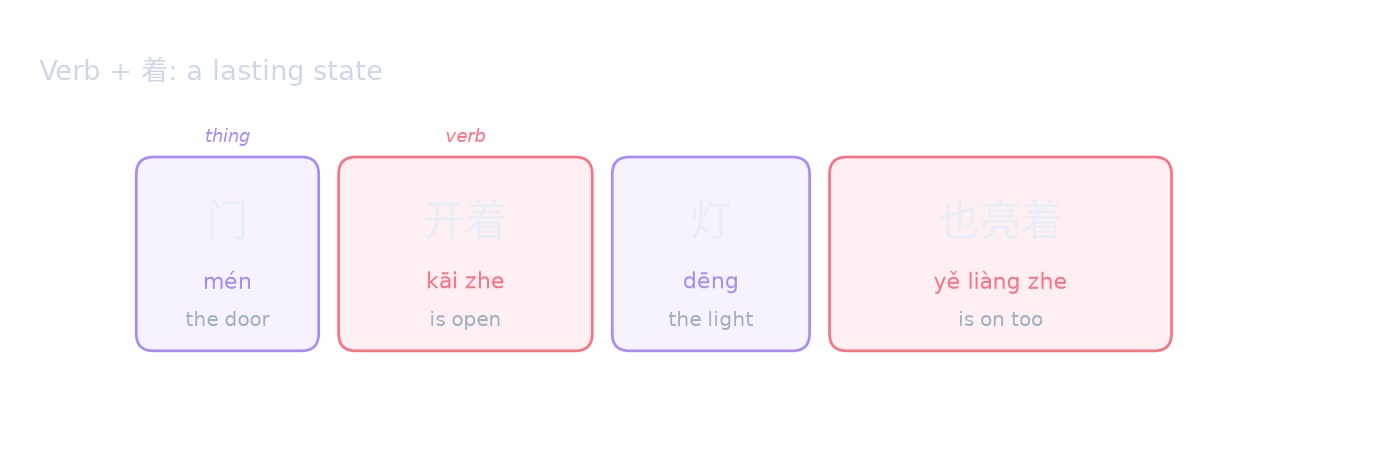
- You come home and notice the door open and the lights on.
- 门开(ongoing)着,lamp灯also也bright亮(ongoing)着。 — "The door is open, and the lights are on too." (ongoing)着 describes a state that continues.
Verb + (ongoing)着 = an ongoing state
- Verb + (ongoing)着 describes a state that lasts: to open; to drive开(ongoing)着 (is open), attire穿着 (is wearing), to sit坐(ongoing)着 (is sitting).
- Negate with not / haven't没: door门not / haven't没to open; to drive开(ongoing)着 — "The door isn't open."
she她wear穿(ongoing)着a一(measure word)件red红top衣服。
Complete: “The window is open.” 窗户开____。
难度 1/5 · 今日首次完成可获 100 金币及少量额外奖励
Verb + 着 describes the continuing state.
Doing one thing while in a state
- Verb1 + (ongoing)着 + Verb2: the first state goes on while the second action happens: he他smile笑(ongoing)着say说:"it doesn't matter没关系。" — "He said with a smile, 'It doesn't matter.'"
- we / us我们to sit坐(ongoing)着to chat聊天。 — "We sat and chatted."
he他smile笑(while)着say说:it doesn't matter没关系。
Build: “He said with a smile...”
难度 3/5 · 今日首次完成可获 200 金币及少量额外奖励
V1 + 着 + V2.
State, not progress
- (ongoing)着 describes a state; for an action in progress, use (in progress)在: he他(in progress)在to open a door (lit. and…开门 (he is opening the door) vs 门开(ongoing)着 (the door is open).
- Negate with not / haven't没, not not不: lamp灯not / haven't没bright亮(ongoing)着.
Which says “He is opening the door” (the action in progress)?
难度 1/5 · 今日首次完成可获 100 金币及少量额外奖励
An action in progress takes 在 + Verb; 门开着 is the state.
The negative of 门开着 is 门不开着.
难度 1/5 · 今日首次完成可获 100 金币及少量额外奖励
着 is negated with 没: 门没开着.
(ongoing)着 versus (in progress)在
- (in progress)在 + Verb = in the middle of doing: he他(in progress)在wear穿top衣服 — "He's getting dressed."
- Verb + (ongoing)着 = the resulting state: he他attire穿着a一(measure word)件白衬衫 — "He's wearing a white shirt."
he他(in progress)在put on穿clothes衣服。
Recap
- Verb + (ongoing)着 = an ongoing state (门开(ongoing)着); V1(ongoing)着 + V2 = do V2 while in state V1.
- (in progress)在 + Verb = action in progress. Negate (ongoing)着 with not / haven't没.
Read the full reference: HSK 3 grammar — Particles.
You come home and notice the door open and the lights on. Close the examples. Say a Mandarin response, then write it in Chinese. Explain briefly in English what the lesson’s pattern adds. Compare with the model, then change one detail and try again.
This is supported productive practice. Compare meaning and structure; your answer need not copy the model. A partner or teacher must hear the spoken response to comment on pronunciation.