Sentence-final 了 (change of state)
引入您的已保存位置保留在此浏览器中。恢复操作不会完成课程或回答其中的问题。
It's started raining
- You were about to go out, but you look out of the window and see rain.
- to rain下雨(completed / change)了! Xià yǔ le! — "It's raining (now)!" A moment ago it was dry; now it isn't.
- Goal: use (completed / change)了 at the end of a sentence to say something has changed, and keep it apart from a simple past tense.
1 · With and without (completed / change)了
- Final (completed / change)了 tells the listener: this is new. Compare each pair:
| Without (completed / change)了: a fact | With (completed / change)了: a change |
|---|---|
| the weather天degree / adjective linker很cold冷。 — It's cold. | it's cold (weather)天冷(completed / change)了。 Tiān lěng le. — It's got cold. |
| he他to be / is是teacher老师。 — He's a teacher. | he他to be / is是teacher老师(completed / change)了。 — He's become a teacher. |
| I我not不喝咖啡。 — I don't drink coffee. | I我not不喝咖啡(completed / change)了。 — I've stopped drinking coffee. |
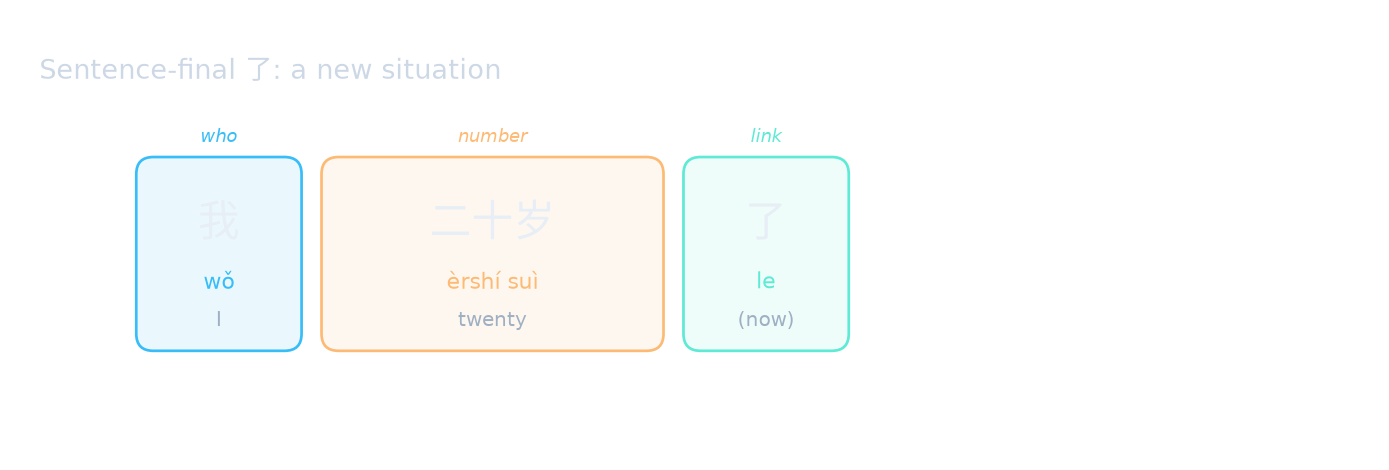
| I我十岁。 — I'm ten. | I我十岁(completed / change)了。 — I'm ten now. |
the weather天cold冷了。
The light turns green: “It's green now, let's go.” 绿灯____,走吧。
难度 1/5 · 今日首次完成可获 100 金币及少量额外奖励
Final 了 announces the change.
Match each sentence to its meaning.
难度 2/5 · 今日首次完成可获 140 金币及少量额外奖励
了 at the end adds "this is new".
2 · Four everyday uses
- A new state: I我hungry饿(completed / change)了。 Wǒ è le. — "I'm hungry (now)." he他illness / ill病(completed / change)了。 — "He's ill."
- No longer — not不 … (completed / change)了: he他not不come来(completed / change)了。 Tā bù lái le. — "He's not coming any more" (he was going to).
- About to — fast; soon快 / want / will / need要 … (completed / change)了: 快到(completed / change)了。 Kuài dào le. — "We're almost there." want / will / need要to rain下雨(completed / change)了。 — "It's going to rain."
- Strong feeling — too太 … (completed / change)了: very good太好了! Tài hǎo le! — "That's great!"
he他not不come来了。
What does 我不抽烟了 mean?
难度 1/5 · 今日首次完成可获 100 金币及少量额外奖励
不…了 = no longer.
Build: “We're almost there.”
难度 3/5 · 今日首次完成可获 200 金币及少量额外奖励
快 + verb + 了 = about to.
3 · Questions and "not yet"
- Ask about a change: you你eat吃饭(completed / change)了吗? Nǐ chī fàn le ma? — "Have you eaten?"
- Yes: eat吃(completed / change)了。 — No: still / also / even还not / haven't没eat吃。 Hái méi chī. — "Not yet." The not / haven't没 answer takes no (completed / change)了.
you你eat吃饭了吗?
Your friend asks 你吃饭了吗? You haven't eaten yet. What do you say?
难度 1/5 · 今日首次完成可获 100 金币及少量额外奖励
Not yet = 还没 + verb, with no 了. 我不吃了 would mean "I won't eat any more".
4 · Final (completed / change)了 or verb (completed / change)了?
- Verb + (completed / change)了 (before the object) = an action was completed: I我eat吃(completed / change)了an一个apple苹果。 — "I ate an apple."
- Final (completed / change)了 = a change in the situation: I我not不hungry饿(completed / change)了。 — "I'm not hungry any more."
- Both together = so far, and it is still going on: I我learn学(completed / change)了two years两年Chinese汉语(completed / change)了。 Wǒ xué le liǎng nián Hànyǔ le. — "I've been learning Chinese for two years (and still am)." Without the last (completed / change)了 (I我learn学(completed / change)了two years两年Chinese汉语) it is finished: "I studied Chinese for two years."
I我learn学了two years两年Chinese汉语了。
Which sentence says you are still learning Chinese after three years?
难度 1/5 · 今日首次完成可获 100 金币及少量额外奖励
Verb 了 + duration + final 了 = so far, and still going.
Common mistakes
- (completed / change)了 as a past tense: a past habit with no change takes no (completed / change)了. ✗ I我before以前often常常to go去(completed / change)了 ✓ I我before以前often常常to go去。 — "I often used to go."
- (completed / change)了 with not / haven't没: ✗ I我not / haven't没eat吃(completed / change)了 ✓ I我still / also / even还not / haven't没eat吃。 — "I haven't eaten yet."
- not不 … (completed / change)了 is not "didn't": I我not不喝咖啡(completed / change)了 = I've stopped. "I didn't drink coffee" = I我not / haven't没喝咖啡.
我以前常常去了 is correct for a past habit.
难度 1/5 · 今日首次完成可获 100 金币及少量额外奖励
A past habit with no change takes no 了: 我以前常常去。
Recap
- Sentence + (completed / change)了 = a new situation: to rain下雨(completed / change)了, I我hungry饿(completed / change)了, he他to be / is是teacher老师(completed / change)了.
- not不 … (completed / change)了 = no longer · fast; soon快 / want / will / need要 … (completed / change)了 = soon · too太 … (completed / change)了 = so …! · still / also / even还not / haven't没 + verb = not yet (no (completed / change)了).
- Verb (completed / change)了 = completed action; both (completed / change)了 = so far and still going.
Read the full reference: HSK 3 grammar — Particles.
You were about to go out, but you look out of the window and see rain. Close the examples. Say a Mandarin response, then write it in Chinese. Explain briefly in English what the lesson’s pattern adds. Compare with the model, then change one detail and try again.
This is supported productive practice. Compare meaning and structure; your answer need not copy the model. A partner or teacher must hear the spoken response to comment on pronunciation.