Time / Verb + 时 (when …)
引入您的已保存位置保留在此浏览器中。恢复操作不会完成课程或回答其中的问题。
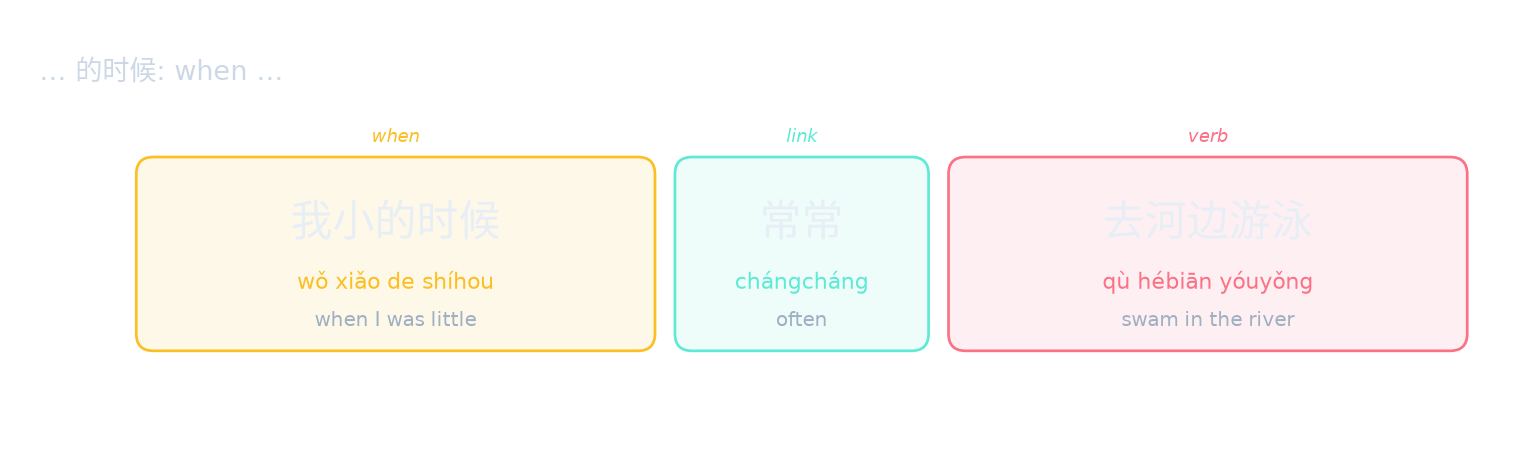
When I was little
- You are telling a friend a story from your childhood about learning to swim.
- I我small小(modifier / structural particle)的time; when时候often常常to go去river bank河边to swim游泳。 — "When I was little, I often went swimming by the river."
Time / Verb phrase + when时 ((modifier / structural particle)的time; when时候)
- X + (modifier / structural particle)的time; when时候 = "when X". The spoken form is (modifier / structural particle)的time; when时候; the shorter when时 is more written: in class上课when时, to rain下雨when时.
- Like before以前, when时 comes after what it refers to.
in class上课when时,please请turn off关your phone手机。
Build: “In class, please turn off your phone.”
难度 3/5 · 今日首次完成可获 200 金币及少量额外奖励
Clause + 时, then the request.
Spoken (modifier / structural particle)的time; when时候
- I我arrive到home家(modifier / structural particle)的time; when时候,he他already已经sleep睡(completed / change)了。 — "When I got home, he was already asleep."
- you你to have time (to do sth)有空(modifier / structural particle)的time; when时候to / for / give给I我to make a telephone call打电话。 — "Call me when you have time."
I我arrive到home家when的时候,he他already已经sleep睡了。
Complete: “When I got home, he was already asleep.” 我到家____,他已经睡了。
难度 1/5 · 今日首次完成可获 100 金币及少量额外奖励
Clause + 的时候 = when.
Order and the right word
- when时 / (modifier / structural particle)的time; when时候 goes after the clause: to rain下雨(modifier / structural particle)的time; when时候, not time; when时候to rain下雨.
- In a "when" clause, do not use what什么time; when时候 (that asks "when?"): I我arrive到home家(modifier / structural particle)的time; when时候, not I我what什么time; when时候perfect到家.
Which says “Call me when you have time.”?
难度 1/5 · 今日首次完成可获 100 金币及少量额外奖励
The 的时候 clause comes first; 什么时候 asks “when?”.
when时 versus (modifier / structural particle)的time; when时候
- Use (modifier / structural particle)的time; when时候 in conversation: eat吃饭(modifier / structural particle)的time; when时候don't别talk说话.
- when时 suits signs, writing and short fixed phrases: to eat a meal用餐when时No smoking请勿吸烟 — "No smoking while dining."
eat吃饭when的时候don't别talk说话。
时 is more common than 的时候 in everyday conversation.
难度 1/5 · 今日首次完成可获 100 金币及少量额外奖励
的时候 is the usual spoken form; 时 is more written.
Recap
- X + (modifier / structural particle)的time; when时候 / when时 = when X; it follows the clause it belongs to.
- (modifier / structural particle)的time; when时候 is spoken, when时 is more written. what什么time; when时候 asks a question; it is not "when" in a statement.
Read the full reference: HSK 3 grammar — Nouns.
You are telling a friend a story from your childhood about learning to swim. Close the examples. Say a Mandarin response, then write it in Chinese. Explain briefly in English what the lesson’s pattern adds. Compare with the model, then change one detail and try again.
This is supported productive practice. Compare meaning and structure; your answer need not copy the model. A partner or teacher must hear the spoken response to comment on pronunciation.