Start with a cross-border decision and its evidence
Bright Kettle is an invented appliance maker. It wants to sell in a new overseas market.
Its managers must choose an entry method, price and delivery plan.
These examples are practice data, not current exchange rates, tariffs or company accounts.
A real-company research task needs real evidence. The final section shows how to begin that investigation.
Globalisation 全球化 links markets, production, finance and information across borders.
International business includes goods, services and investment across national borders.
A firm may seek new customers, lower costs, skills or reliable resources.
Explain which reason matters in the actual case. Going abroad does not guarantee any of these benefits.
Effects differ across groups. Customers may gain choice, while some workers face job changes.
Suppliers may gain orders but become more dependent on one buyer.
Owners may gain a market but face unfamiliar rules, costs and competition.
Describe a mechanism and evidence, rather than calling every effect good or bad.
A country's total gain does not mean every household or place gains equally.
Compare entry methods against the firm's position
Exporting 出口 supplies customers abroad from another country.
Direct exporting and using a distributor can involve different commitments and customer contact.
It can avoid owning a foreign factory, but transport, after-sales service and compliance still cost money.
Licensing 许可经营 allows another business to use agreed rights, such as technology, under a contract.
Franchising 特许经营 usually includes an agreed business format and brand, with continuing obligations.
These arrangements can use a partner's resources. They also need quality checks and protection of the agreed rights.
A joint venture 合资企业 involves shared ownership of a venture.
A wholly owned subsidiary 全资子公司 is fully owned by the parent company.
A subsidiary does not always mean full ownership; the phrase "wholly owned" makes that assumption explicit.
More ownership can provide more control, but contracts, staff, law and customers still affect actual control.
Method
Possible advantage for Bright Kettle
Cost or risk to check
Export through a distributor
Test demand without owning a local factory
Delivery, distributor service and less direct customer contact
Licence a partner
Use local production resources
Quality, contract enforcement and technology protection
Joint venture
Share local knowledge, resources and investment
Disagreement over decisions and sharing returns
Wholly owned subsidiary
Direct ownership of the local activity
Larger commitment, management demands and unfamiliar rules
Suppose Bright Kettle has limited funds and no evidence of repeat overseas demand.
A bounded export trial may fit better than building a subsidiary immediately.
The distributor must be checked for service, reporting and contract terms.
If demand becomes established, compare the next options again. One method is not always cheapest or best.
State the exchange-rate quote before calculating
An exchange rate 汇率 tells you how much of one currency buys another.
Always state the direction of the quote. Percentages for opposite quotes are not identical.
Use fictional home currency H. Initially one euro buys 10 H; later one euro buys 11 H.
The H-per-euro quote rises by 10%. The value of one H in euros falls from 0.10 to about 0.09091.
That is a fall of about 9.09%, not 10%.
$$\text{H per euro increase}=\frac{11-10}{10}\times100=10\%$$
$$\text{euro per H decrease}=\frac{0.10-1/11}{0.10}\times100\approx9.09\%$$
If Bright Kettle keeps its home-currency price at 1,000 H:
$$\text{euro price}=\frac{\text{home price in H}}{\text{H per euro}}$$
$$\text{old euro price}=1\,000\div10=100\text{ euros}$$
$$\text{new euro price}=1\,000\div11\approx90.91\text{ euros}$$
This may help price competitiveness. It does not prove demand rises.
Competitors, customer preferences and the final retail price also matter.
The seller or distributor may change its price instead of passing on the full exchange-rate change.
An imported component priced at 40 euros costs 400 H initially, then 440 H.
Imported costs may offset some benefit from overseas sales.
Contracts, invoice currency and payment dates change how quickly the effect appears.
Compare two pricing choices and their margins
Assume each kettle uses the 40-euro imported component plus 500 H of other variable costs.
Ignore delivery, fixed costs, tax and all other charges in this calculation.
Contribution 边际贡献 is sales revenue minus variable cost. It is not final profit.
Before the exchange-rate change, a 100-euro sale brings 1,000 H.
The component costs 400 H, leaving contribution of 100 H.
$$\text{old contribution}=1\,000-400-500=100\text{ H per kettle}$$
Choice A keeps the euro invoice at 100. It now brings 1,100 H, with component cost 440 H.
$$\text{A contribution}=1\,100-440-500=160\text{ H per kettle}$$
Choice B keeps the home price at 1,000 H. Its euro price falls to about 90.91.
$$\text{B contribution}=1\,000-440-500=60\text{ H per kettle}$$
A has higher contribution per kettle in this simplified model. B gives the buyer a lower euro price.
Total contribution also depends on quantity sold. Compare demand evidence before choosing.
A currency change does not mechanically make the buyer's price fall or the seller's profit rise.
Analyse trade barriers and other external influences
A tariff 关税 is a tax on imported goods.
A quota 配额 limits an import quantity or value under specified rules.
Their effects depend on the product, policy, market and who absorbs the extra cost.
Domestic producers may face less import competition; consumers may pay more or have fewer choices.
Firms using imported inputs may face higher costs too.
For a fictional 10% tariff on a stated customs value of 120 euros:
$$\text{value plus tariff}=120+12=132\text{ euros}$$
This excludes freight and any other taxes or charges. It is not a real country's import calculation.
A quota allowing 500 units would constrain a 600-unit import plan under those assumptions.
Check how rights to import are allocated; a market-wide quota is not every firm's personal allowance.
A free-trade area 自由贸易区 removes agreed barriers between members for qualifying trade.
Members can keep different external tariffs. A customs union 关税同盟 has a common external tariff arrangement.
Do not assume every trade agreement removes every barrier or uses identical rules against outsiders.
The product, origin rules and actual agreement must be checked in a real case.
For this exercise, define the goods trade balance as goods exports minus goods imports.
State the definition, currency and period when comparing data. Exports of 80 and imports of 95 give a deficit of 15.
That economy-wide figure is not Bright Kettle's own profit or evidence that every exporter is losing money.
Other external influences include political decisions, law, technology, income and social expectations.
Political risk 政治风险 concerns government action or instability affecting the business.
Intellectual property 知识产权 includes protected rights such as patents and trademarks.
Check the relevant jurisdiction's current official rules for a real product or contract.
Do not copy one country's requirements into another market.
Corporate social responsibility 企业社会责任 concerns a firm's responsibilities and effects on society.
Legal compliance and ethical judgement answer different questions.
A supplier policy is evidence of a stated policy, not proof that every supplier follows it.
Use records and checks to examine working conditions, product safety or waste claims.
Connect internal organisation to overseas delivery
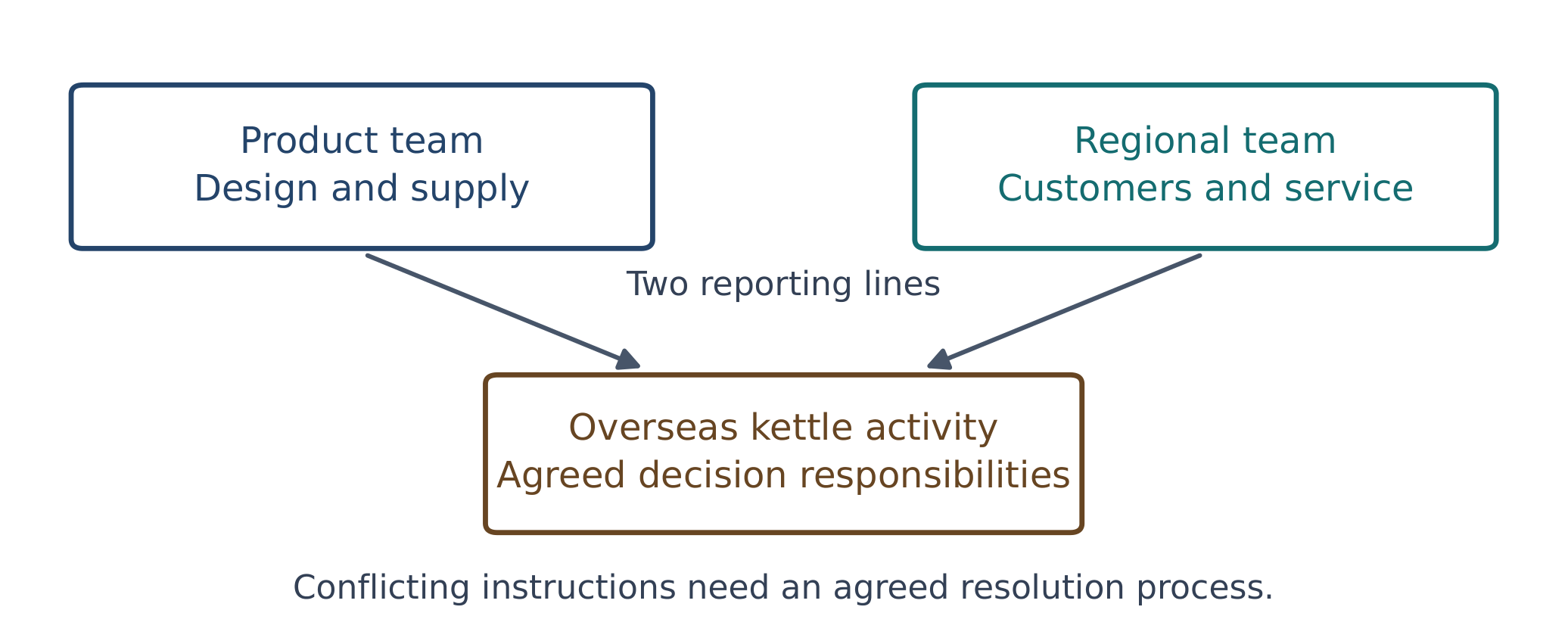
Bright Kettle must decide who has authority over price, design, supply and local service.
A product team understands the kettle; a regional team understands local customers and distribution.
A matrix structure 矩阵式结构 can combine these reporting lines, but conflicting instructions need a resolution process.
Choose a structure by its coordination needs, rather than assuming a label guarantees success.
Agree how decisions will be resolved when the two teams disagree.
Sending experienced home-country managers can help transfer routines.
Hiring local managers can improve language skills and knowledge of customers and operating rules.
A mixed team needs clear responsibilities, training and ways to resolve disagreements.
Avoid assuming nationality alone determines competence or values.
Standardisation 标准化 keeps agreed features consistent across markets.
Adaptation 本地化 changes features for a particular market.
Bright Kettle could keep a tested core design while checking local safety, power, instructions and service needs.
Adaptation can add cost; it does not automatically improve sales.
Standardisation can reduce some costs; it does not guarantee the product fits every market.
A supply plan must consider lead times, quality, stock, transport and alternative sources.
For example, two weeks of stock with a four-week replacement lead time may leave a gap after disruption.
An alternative supplier must be checked, not merely named. Its quality, capacity and delivery may differ.
Long and short supply chains both have costs and risks; length alone does not establish reliability.
Build an international marketing proposal without stereotypes
Define a reachable customer group and research its actual needs.
Do not treat every person in a country as having the same taste or income.
Translate and test names, instructions and promotions with suitable readers.
Check meaning, clarity and legal requirements rather than guessing from a colour or number.
Marketing choice
Proposal for the fictional kettle trial
Evidence needed
Product
Tested core with suitable instructions and local requirements checked
Customer use, safety and service needs
Price
Compare invoice currency, costs and competing offers
Suitable alternatives and willingness to pay
Place
A checked distributor with service arrangements
Coverage, delivery and after-sales records
Promotion
Clear claims in language customers understand
Comprehension, actual response and claim support
Run a permitted limited trial and measure paid orders, returns, complaints and contribution.
A favourable survey is not the same as repeat purchases.
Compare actual results with assumptions before expanding.
Keep any real-country compliance decision separate from this fictional teaching proposal.
Investigate a real company and communicate a supported judgement
Choose a narrow research question, a real firm, a period and relevant markets.
For example: how do overseas production arrangements affect a firm's control and supply risk?
Keep a source log with author, document, date, section and the claim it supports.
Separate reported facts, your analysis and untested assumptions.
Apple's Form 10-K for the year ended 27 September 2025 is one dated primary source.
Its Item 1 describes five geographic reporting segments, with similar offers managed separately for regional markets.
Its Item 1A discusses dependence on manufacturing and logistics partners outside the United States.
The firm identifies a tradeoff between lower operating costs and less direct control of production and distribution.
These are reported arrangements and risk statements, not proof that a particular disruption happened.
A supported interpretation is that partner arrangements need coordination and monitoring.
That inference follows the disclosed control issue. It does not establish which entry method is best in a new market.
Find additional evidence before recommending a change. An annual report alone does not prove every marketing or supplier claim.
Check definitions: a geographic reporting segment is not necessarily one country or one production site.
Use an appropriate business report: purpose, method, findings, analysis, recommendation, limitations and sources.
In a presentation, use readable evidence, clear units and concise explanations linked to the decision.
An evidence-based recommendation names a tradeoff, supporting facts, remaining uncertainty and a review condition.
Use the actual centre brief for required formats and assessed depth.
Practice and explained answers
Give two possible reasons for Bright Kettle to enter a foreign market. Explain a risk for each.
Choose an initial entry method for the limited-funds, untested-demand case. Give one condition and one drawback.
Calculate the new euro price of a 1,000-H kettle when the quote changes from 10 to 11 H per euro.
Explain why a 10% rise in H per euro is not a 10% fall in euros per H.
Calculate the imported component cost at both rates and the contribution for pricing choices A and B.
Why does choice A's higher contribution per kettle not prove higher total contribution?
Calculate the fictional tariff. Explain two groups that could be affected differently.
Distinguish a free-trade area from a customs union without assuming all trade is unrestricted.
Explain how regional and product teams could resolve a disagreement over an adaptation.
Identify a supply risk in the stock/lead-time example and a checked response.
Explain one conclusion supported by Apple's dated risk disclosure and one conclusion it does not prove.
Outline a real-company research report and a recommendation that names its evidence limits.
Explained answers
Answer 1. New customers may increase sales, but demand and competition remain uncertain.
A new source may reduce input costs, but quality or delivery may differ. Explain conditions, not guarantees.
Answer 2. A limited export trial can test demand with less ownership commitment than a new subsidiary.
Check the distributor and terms first. A drawback is less direct control of service and customer information.
The best method depends on actual costs, resources and objectives.
Answer 3. The new price is 1,000 divided by 11, or about 90.91 euros.
The home price is fixed in this calculation, and other charges are ignored.
Answer 4. Opposite quotes use different starting values.
The euro value of H falls from 0.10 to 1/11, giving a fall of about 9.09%.
Answer 5. The component rises from 400 H to 440 H.
A gives 1,100 minus 440 minus 500, or 160 H contribution.
B gives 1,000 minus 440 minus 500, or 60 H contribution.
These exclude the stated other costs and are not final profit.
Answer 6. Total contribution equals contribution per unit times quantity.
A higher price to the buyer could reduce orders. Use demand evidence rather than assume equal volumes.
Answer 7. The tariff is 12 euros; value plus tariff is 132 before other charges.
Domestic producers may face less import competition, while buyers or firms using imported inputs may pay more.
Who absorbs the charge affects the result.
Answer 8. A free-trade area's members can have different external tariffs.
A customs union has a common external tariff arrangement. Actual product coverage and origin rules still matter.
Answer 9. Specify which team decides safety, design and market matters, with an agreed escalation process.
Compare customer evidence, costs and applicable requirements before choosing. A matrix label alone does not resolve conflict.
Answer 10. Two weeks of stock may run out before a four-week replacement arrives.
Check an alternative source or a justified stock change, including cost, quality and capacity.
Do not assume an untested alternative can supply immediately.
Answer 11. The disclosure supports investigating coordination and partner-control risk.
It does not prove that a particular disruption occurred or that a subsidiary is the best response.
Keep the reported fact separate from your interpretation and recommendation.
Answer 12. State purpose, firm, period, sources and method. Present findings before analysis and recommendation.
Name source limits, conflicting evidence and missing information. Recommend a bounded next step with a review condition.