GAC012是Level II商业模块,也是大学选修学分中最常开设的 微积分之后。七个单元带你从什么是企业开始,到影响企业的经济学原理 它涉及外部规划、管理、劳动关系和营销。
考核采用书面与应用任务:课堂测验、调查真实企业的商业研究任务、展示研究发现的报告或演示文稿,以及课程作业。
- 格式是评分的一部分。 报告有章节和标题;而文章没有。使用 即使分析合理,选错也会扣分。
- ⚠ 关于真实企业的每一项声明都需要来源。"阿里巴巴盈利"是 断言;“阿里巴巴在其2024年度报告中报告净利润为X”是证据。
GAC 商科包含三个模块。GAC012 介绍企业做什么、外部经济力量如何作用于企业,以及计划、管理实践、雇佣关系与市场营销。GAC034 把同样的思路转向你自己的资金与创业,从预算、信贷一直到完整的商业计划书。GAC022 则把视野扩大到全球化、国际经济学与跨文化营销。
每个模块都以一项研究任务收尾。调研一家真实企业、用商务格式呈现结论并为其辩护,是明确列出的学习目标,因此很大一部分分数来自报告而非记忆。
格式本身就是分数的一部分。报告、备忘录与商业计划书各有模块期待的结构,即使分析本身站得住脚,用错体例也会失分。
GAC012 被许多大学认可学分,这也是它在必修核心之外最常被选择的原因之一。
本站的案例与报告任务均为原创,依据模块学习目标以及 GAC 教学中心常见的任务类型编写。
GAC012是Level II商业模块,也是大学选修学分中最常开设的 微积分之后。七个单元带你从什么是企业开始,到影响企业的经济学原理 它涉及外部规划、管理、劳动关系和营销。
考核采用书面与应用任务:课堂测验、调查真实企业的商业研究任务、展示研究发现的报告或演示文稿,以及课程作业。
**GAC012 商业 II:商业研究(二级)**课程第7个单元中的第1个单元。该模块教学时长约为40学时,另加20小时自主学习,由教学中心进行评估并由ACT进行质量 moderation(外部审核/校准)——无外部考试。
模块目标: 完成本模块后,学生应能够展示对当代商业的理论、流程和实践的理解,以及对其支持和辅助功能与服务的认识。
本单元旨在实现的模块成果:
学习目标 GAC012.1: 展示对重要商业概念的理解。
来源:Cambridge International 教学大纲
企业 结合资源生产人们愿意付费的商品或服务。
例题。 一家咖啡馆将工资提高15%。
员工的收益增加。所有者的利润下降。顾客可能面临更高的价格。供应商是 不受影响。利益相关者问题需明确标注谁,并说明对其重要程度 他们*,而不是列出你能记住的每个人。
这是 GAC012 商业 II:商科研究(Level II)7个单元中的第2单元。该模块教学时长约为40课时,外加20课时的自主学习时间,考核由教学中心进行并由ACT进行 moderation(质量监控/审核)——无外部考试。
本单元旨在实现的模块成果:
学习目标 GAC012.1: 展示对重要商业概念的理解。
学习目标 GAC012.6: 展示用于商业研究任务的调查与分析技能。
来源:Cambridge International 教学大纲
| English | 中文 | 拼音 |
|---|---|---|
| equilibrium/ˌiːkwɪˈlɪbrɪəm/ | 均衡 | jūn héng |
| Elasticity/ɪlæˈstɪsɪti/ | 弹性 | tán xìng |
| inelastic/ɪnɪˈlæstɪk/ | 缺乏弹性 | quē fá tán xìng |
| Competition/ˌkɒmpəˈtɪʃn/ | 竞争 | jìng zhēng |
| monopoly/məˈnɒpəli/ | 垄断 | lǒng duàn |
| business plan/ˈbɪznəs plæn/ | 商业计划书 | shāng yè jì huà shū |
| Objectives/ɒbˈdʒektɪvz/ | 目标 | mù biāo |
| cash flow forecast/kæʃ fləʊ ˈfɔːkæst/ | 现金流预测 | xiàn jīn liú yù cè |
GAC012 商业 II:商业研究(二级) 7个单元中的第3单元。该模块教学时长约为40课时,另需20小时自主学习,由教学中心进行考核并由ACT审核——无外部考试。
本单元旨在达成的模块成果:
学习目标 GAC012.2: 识别、评估并应用有效管理的流程与理论。
学习目标 GAC012.5: 展示对金融和会计在商业环境中的应用的理解。
来源:Cambridge International 教学大纲
| English | 中文 | 拼音 |
|---|---|---|
| in-class test/ɪn klæs test/ | 课堂测验 | kè táng cè yàn |
| business research task/ˈbɪznəs rɪˈsɜːtʃ tæsk/ | 商业研究任务 | shāng yè yán jiū rèn wù |
| report/rɪˈpɔːt/ | 报告 | bào gào |
| coursework/ˈkɔːsjuːɜːk/ | 平时作业 | píng shí zuò yè |
| business/ˈbɪznəs/ | 企业 | qǐ yè |
| Factors of production/ˈfæktəz ɒv prəˈdʌkʃn/ | 生产要素 | shēng chǎn yào sù |
| primary sector/ˈpraɪməri ˈsektə/ | 第一产业 | dì yī chǎn yè |
| secondary sector/ˈsekəndəri ˈsektə/ | 第二产业 | dì èr chǎn yè |
| tertiary sector/ˈtɜːʃjəri ˈsektə/ | 第三产业 | dì sān chǎn yè |
| sole trader/səʊl ˈtreɪdə/ | 个体经营 | gè tǐ jīng yíng |
| partnership/ˈpɑːtnəʃɪp/ | 合伙企业 | hé huǒ qǐ yè |
| limited company/ˈlɪmɪtɪd ˈkʌmpəni/ | 有限公司 | yǒu xiàn gōng sī |
| Stakeholders/ˈsteɪkhəʊldəz/ | 利益相关者 | lì yì xiāng guān zhě |
| PEST analysis/pest əˈnæləsɪs/ | PEST 分析 | PEST fēn xī |
| SWOT analysis/swɒt əˈnæləsɪs/ | SWOT 分析 | SWOT fēn xī |
| Demand/dɪˈmænd/ | 需求 | xū qiú |
| supply/səˈplaɪ/ | 供给 | gōng jǐ |
GAC012 商业 II:商业研究(二级)课程中的第 4 单元(共 7 个单元)。 本模块的教学时长约为 40 课时,外加 20 课时的自主学习时间。该模块在培训中心进行考核,并由 ACT 进行 moderation(审核/校准)——无外部考试。
本单元旨在达成的模块成果:
学习目标 GAC012.2: 识别、评估并应用有效管理的过程与理论。
学习目标 GAC012.7: 使用适合商业用途的格式传达信息。
来源:Cambridge International 教学大纲
例题。 固定成本为每年 60,000 元。每单位售价为 25,生产成本为 10 make.
在 4,000 单位以上,企业实现盈利。分母中的减法运算表示 每单位的边际贡献,命名它是展示你理解公式的关键 rather than having memorised it.
| English | 中文 | 拼音 |
|---|---|---|
| Break-even/breɪk ˈiːvən/ | 盈亏平衡 | yíng kuī píng héng |
| contribution/ˌkɒntrɪˈbjuːʃn/ | 边际贡献 | biān jì gòng xiàn |
**GAC012 商业 II:商业研究(Level II)**课程第7个单元中的第5个单元。该模块教学时长约为40课时,外加20小时自主学习,由教学中心进行评估并由ACT进行校准——无外部考试。
本单元旨在实现的模块成果:
学习目标 GAC012.2: 识别、评估并应用有效管理的过程与理论。
学习目标 GAC012.5: 展示对金融与会计在商业环境中的应用的理解。
来源:Cambridge International 教学大纲
| English | 中文 | 拼音 |
|---|---|---|
| Management/ˈmænɪdʒmənt/ | 管理 | guǎn lǐ |
| Motivation/ˌməʊtɪˈveɪʃn/ | 激励 | jī lì |
| Delegation/ˌdelɪˈɡeɪʃn/ | 授权 | shòu quán |
| organisational structure/ˌɔːɡənaɪˈzeɪʃənl ˈstrʌktʃə/ | 组织结构 | zǔ zhī jié gòu |
| flat/flæt/ | 扁平 | biǎn píng |
| tall/tɔːl/ | 层级多 | céng jí duō |
| contract of employment/ˈkɒntrækt ɒv emˈplɔɪmənt/ | 劳动合同 | láo dòng hé tóng |
GAC012 商业 II:商业研究(二级) 第 7 单元中的第 6 单元。该模块授课时长约为 40 学时,另需 20 学时自主学习,由教学中心进行评估并由 ACT 进行 moderation——无外部考试。
本单元旨在达成的模块成果:
学习目标 GAC012.3: 展示并应用对商业环境中法律、人力资源管理和劳资关系的理解与运用。
来源:Cambridge International 教学大纲
| English | 中文 | 拼音 |
|---|---|---|
| Recruitment/rɪˈkruːtmənt/ | 招聘 | zhāo pìn |
| training/ˈtreɪnɪŋ/ | 培训 | péi xùn |
| appraisal/əˈpreɪzl/ | 绩效评估 | jì xiào píng gū |
| Industrial relations/ɪnˈdʌstrɪəl rɪˈleɪʃnz/ | 劳资关系 | láo zī guān xì |
| Employment law/emˈplɔɪmənt lɔː/ | 劳动法 | láo dòng fǎ |
| Marketing/ˈmɑːkɪtɪŋ/ | 市场营销 | shì chǎng yíng xiāo |
| marketing mix/ˈmɑːkɪtɪŋ mɪks/ | 营销组合 | yíng xiāo zǔ hé |
| Market segmentation/ˈmɑːkɪt ˌseɡmənˈteɪʃn/ | 市场细分 | shì chǎng xì fēn |
| Market research/ˈmɑːkɪt rɪˈsɜːtʃ/ | 市场调研 | shì chǎng diào yán |
| primary/ˈpraɪməri/ | 一手 | yī shǒu |
| secondary/ˈsekəndəri/ | 二手 | èr shǒu |
本单元旨在达成的模块成果:
学习目标 GAC012.4: 展示并应用对营销策略的理解。
学习目标 GAC012.7: 使用适合商业用途的格式传递信息。
来源:Cambridge International 教学大纲
词汇卡片释义
商业研究任务:一项指定作业,要求学生调查一家真实公司或市场。 PEST分析:扫描企业周围的政治、经济、社会和技术力量。 SWOT分析:内部优势与劣势,以及外部机会与威胁的矩阵。 盈亏平衡点:总收入等于总成本的销售额水平。 扁平型:管理层级较少的组织结构图。 高耸型:具有多层管理者的组织结构图。 雇佣合同:规定薪资、职责和工作时间的法律协议。 绩效考核:对员工工作表现的正式评估。 劳资关系:雇主与其雇员之间的互动。 劳动立法:确立职场权利与义务的法律条文。 市场细分:将具有共同需求或特征的买家划分为不同群体。 一手资料:为本次研究直接收集的原始信息。 二手资料:他人已发表的信息。
River Café is an invented business used throughout these notes. It sells lunches near a college. Its owner wants shorter queues, enough cash to pay bills and customers who return. All figures are practice data. They are not claims about a real company.
A business combines land, labour, capital and enterprise. The café uses premises, staff, equipment and organising decisions. Its service depends on goods from farming and manufacturing businesses. The sectors are linked: a supplier's crop loss can affect café costs and menus.
Stakeholders 利益相关者 may want different things from the same decision. Staff want fair pay and manageable shifts. Customers want value and quick service. Owners need a sustainable return. Suppliers need payment when agreed. The community may care about waste, noise and jobs.
If wages rise, profit does not have to fall by the full increase. Better service or lower staff turnover might partly offset the extra cost. Suppliers may also be affected if orders or payment timing change. Explain a likely effect and the condition behind it; do not assume everyone is unaffected or guaranteed to benefit.
Ownership affects control, finance and risk. Compare one-owner control with shared decisions and outside investment. Do not treat every partnership as legally identical. Legal forms and owner liability depend on the jurisdiction and form. For a real research task, identify the firm's actual registered form from an appropriate source.
Suppose a competing café opens nearby. Some customers may choose it instead. That can reduce River's demand at each price, rather than simply move buyers along one unchanged demand curve. A change in River's own price causes a movement along its demand curve, other things equal. New customer preferences or a substitute's price can shift the curve itself.
Price elasticity of demand 需求价格弹性 compares percentage changes in quantity demanded and price. Use the starting values consistently in this simple practice calculation. Other methods, such as using midpoint values, can give a different result. Follow the method required by your brief.
River raises price from 25 to 27.50 yuan. Quantity demanded falls from 500 to 480 lunches. We want the size of the quantity response compared with the price change.
Its absolute value, 0.4, is below one: this example has inelastic demand over that change. Do not label every essential product inelastic without evidence. Alternatives, time and the buyer's budget matter.
Revenue is price times quantity, not profit.
Revenue rises by 700 yuan. We still need cost data to calculate the profit change. The observed response does not prove the price rise caused all the change if other conditions also changed.
Use PEST to organise external evidence. For River, consider food rules, customer budgets, lunch habits and ordering technology. Use SWOT to connect that evidence to internal facts. Trained staff are a strength; slow ordering is a weakness. A new nearby college building could be an opportunity. A new competitor could be a threat. Each point needs evidence and an implication for a choice, not just a label.
An income statement 利润表 summarises revenue and expenses for a period. A balance sheet 资产负债表 describes resources, obligations and owner funding at a particular date. A cash flow forecast predicts receipts and payments. These documents answer different questions.
In one practice month River sells 500 lunches at 25 yuan each. Ingredients used cost 10 yuan per lunch. Wages are 4,000 yuan and rent is 2,000 yuan. For this simplified calculation, ignore tax, interest, depreciation and changes in ingredient stocks.
| Income item | Yuan |
|---|---|
| Sales revenue | 12,500 |
| Ingredients used | 5,000 |
| Gross profit | 7,500 |
| Wages and rent | 6,000 |
| Operating profit | 1,500 |
Gross profit 毛利润 subtracts the cost of goods sold from revenue. Here, ingredients used are the stated simplified cost of goods sold. Operating profit 营业利润 subtracts operating expenses as well.
Now consider cash timing for that same month. Some lunches are sold to an event organiser on agreed later payment. Only 8,000 yuan of current sales is received immediately. River also receives 2,000 yuan owed from earlier sales. It pays all ingredients, wages and rent this month. It buys equipment for 3,000 yuan. Opening cash is 1,000 yuan.
| Cash forecast item | Yuan |
|---|---|
| Current sales received | 8,000 |
| Earlier sales received | 2,000 |
| Total receipts | 10,000 |
| Ingredients, wages and rent paid | 11,000 |
| Equipment paid | 3,000 |
| Total payments | 14,000 |
The forecast shows a 3,000-yuan funding shortfall, despite operating profit of 1,500 yuan. The negative forecast is a warning to arrange funding or change timing; it is not money River already holds. Uncollected current sales total 4,500 yuan. Earlier collections are not this month's new sales revenue. Equipment is a payment now but not fully an operating expense in this simplified profit calculation.
An asset 资产 is a business resource; a liability 负债 is an obligation. Equity 所有者权益 is the owner's remaining interest after liabilities. Use this separate financial-position snapshot, not the month-end cash forecast above:
| Position at a stated date | Yuan |
|---|---|
| Cash and customer amounts owed | 7,000 |
| Stock and equipment | 13,000 |
| Total assets | 20,000 |
| Supplier amounts owed and loan | 8,000 |
| Equity | 12,000 |
Equipment value does not mean the café has that amount of cash available. A loan receipt increases cash and a liability; it is not sales revenue or profit.
A useful objective is: reduce the measured median lunch wait from eight minutes to five within six weeks. State who measures it, when and how. Also check service quality and staff workload. One faster service measure alone does not establish a better business.
River's monthly fixed operating costs are 6,000 yuan. Price is 25 and variable cost per lunch is 10. Break-even asks how many lunches cover fixed costs through contribution.
At 500 lunches, the amount above break-even is 100 lunches. This is the margin of safety 安全边际, measured here in units. The calculation assumes constant price, variable cost per unit and fixed cost over the relevant output range. If contribution is zero or negative, selling more cannot cover positive fixed costs under those assumptions.
Compare a pre-order trial with a new machine. The trial may cost less but require staff training. The machine may improve capacity but worsen the short-term cash forecast. Check cost, demand evidence, staffing, risks and how you would review the result. Do not choose an option solely because one predicted number is higher.
Managers plan the trial, organise people and resources, lead the team and control results against objectives. Delegation 授权 gives a team member authority for a task; the manager still reviews its completion. Name the decision boundary, resources, deadline and reporting arrangement.
An autocratic style 专制型管理 makes decisions with little staff input. It can be useful for a clear urgent action, but may overlook staff knowledge. A democratic style 民主型管理 invites staff input. It may improve ideas and commitment but take longer. River could discuss a new ordering routine with staff, then use clear instructions during the busy trial. Evaluate the fit to the situation rather than calling one style always best.
Herzberg's two-factor theory 双因素理论 separates sources of dissatisfaction from motivating features of work. Pay and working conditions can reduce dissatisfaction; achievement, recognition and responsibility can support satisfaction. It is a theory to test against context, not a guarantee about every employee. River should check unsafe or unclear shifts before assuming that a certificate will solve low morale. It could then combine a fair routine with training, recognition and meaningful responsibility.
Human resources work includes recruitment, selection, induction, training and review. For a new café worker, specify the actual tasks and needed skills, then assess applicants against the same criteria. Induction 入职培训 introduces procedures, people and safe working routines. Training develops skills; appraisal checks progress and identifies support needs.
Law sets requirements; contracts record agreed terms; employee relations handle cooperation and disagreement. For a real case, identify the applicable jurisdiction and check current official rules. Do not copy a country's pay or hours rule into another country's case. If shifts cause a dispute, gather the records, hear both sides and use the agreed process. A written policy alone does not prove that staff were treated fairly or that the business complies with the law.
Choose a target group before the four Ps. River targets nearby students needing a quick weekday lunch. Its product could be a simple pre-order lunch; price must fit the intended budget and cover relevant costs. Place includes convenient collection. Promotion should explain collection times and the actual offer. These choices need to work together: advertising speed is misleading if the collection queue stays slow.
Research should ask a decision question: would a pre-order trial solve the queue problem for this group? Collect useful observations and a short neutral survey with appropriate permission. Ask 'Which collection time would you use?' rather than 'Would you like our excellent fast service?' The second wording encourages praise and weakens the evidence.
In an invented survey, 18 of 30 lunch-queue volunteers say they would consider pre-ordering.
This is 60% of those volunteers, not 60% of all college students or guaranteed paying customers. People absent from the queue may have different needs. Stated interest may differ from actual use. Combine survey responses with queue observations, existing sales records and a limited trial. Check dates, definitions and purpose when using someone else's market figures.
A business report needs a title, purpose, method, findings, analysis, recommendation and limitations. Record sources and dates for real-company evidence. Separate observed facts from your interpretation. Do not label invented practice figures as company accounts.
For River, the recommendation might be a two-week pre-order trial with a cost limit and staff training. Check median wait, orders served, complaints and the trial's cash effect. The volunteer survey suggests interest but cannot establish demand across the whole college. The owner should review the measured trial result before expanding.
A presentation shows the decision, key evidence and reasoning in readable slides. A detailed report preserves methods, calculations and sources for checking. Choose the required format from the actual brief; do not assume every task requires the same headings.
Answer 1. Staff may gain income if paid hours remain similar. Owners face higher wage cost, but service or retention may improve.
Answer 2. Trained staff are an internal strength. A new competitor is an external threat if it attracts River's customers.
Answer 3. A substitute's price can shift River's demand. River's own price changes quantity demanded along its curve, other things equal.
Answer 4. Profit also requires costs. Calculate revenue from price and quantity:
Answer 5. Sales include amounts not yet collected, while equipment requires payment now. Profit and cash use different timing and classifications.
Answer 6. Delaying equipment reduces payments by 3,000 yuan. Calculate the revised closing cash:
There is no cash buffer for an unexpected bill; the equipment need also remains.
Answer 7. Subtract liabilities from assets. Assets include non-cash resources:
Answer 8. The new variable cost reduces each lunch's contribution. Divide fixed cost by the revised contribution:
Answer 9. Staff discussion can reveal ordering problems and improve commitment. A democratic approach may take longer before a decision.
Answer 10. Improve the shift conditions that cause dissatisfaction, then consider recognition and useful responsibility. Needs differ across staff, so theory and pay changes do not guarantee motivation.
Answer 11. Eighteen of the thirty volunteers expressed interest. Queue volunteers may not represent all students; interest is not a purchase.
Answer 12. Trial pre-ordering for two weeks within a stated cost limit. Measure wait, orders, complaints and cash. Review actual use and staff workload before expanding; the small volunteer survey alone is insufficient.
GAC034将商业理念引导至您的个人资金与创业项目中:包括预算编制、支出管理, 信用,然后是从营销计划到财务计划的初创企业。
考核以实际应用任务为主,通常包括一份留学用途的个人预算、一份初创企业的商业计划,以及测验和课程作业。
GAC034 个人理财与创业(二级) 第1单元,共6个单元。本模块教学时长约40课时,另加20小时自主学习,由教学中心进行评估并由ACT进行 moderation(质量审核)——无外部考试。
模块目标: 完成本模块后,学生应能初步了解企业运作方式,并学习营销、商业和财务的基础知识。此外,通过制定留学预算等练习,学生将学会长期分析成本和支出,从而掌握如何做到财务负责。
本单元旨在实现的模块成果:
学习目标 GAC034.1: 制定个人预算,以应对大学期间的 living cost(生活费)。
来源:Cambridge International 教学大纲
例题。一年的海外学习。
学费和租金是固定的且容易计算。食物、交通和电话费是可变的。然后是保险, 签证和机票,书籍,以及10%的应急储备。
缺少最后四项的预算大约少五分之一——这是可行计划与三月时打电话回家之间的差距。 有效,并于三月进行了家访。
| English | 中文 | 拼音 |
|---|---|---|
| personal budget/ˈpɜːsənl ˈbʌdʒɪt/ | 个人预算 | gè rén yù suàn |
| budget/ˈbʌdʒɪt/ | 预算 | yù suàn |
| Fixed costs/fɪkst kɒsts/ | 固定成本 | gù dìng chéng běn |
| variable costs/ˈveərɪəbl kɒsts/ | 可变成本 | kě biàn chéng běn |
| insurance/ɪnˈʃʊərəns/ | 保险 | bǎo xiǎn |
| visa and travel/ˈviːzə ænd ˈtrævl/ | 签证与差旅 | qiān zhèng yǔ chà lǚ |
| textbooks and equipment/ˈtekstbʊks ænd ɪˈkwɪpmənt/ | 教材与设备 | jiào cái yǔ shè bèi |
| contingency/kənˈtɪndʒənsi/ | 应急储备 | yìng jí chǔ bèi |
这是 GAC034 个人理财与创业(二级)课程 6 个单元中的第 2 个单元。该模块的教学时长约为 40 学时,另需 20 学时自主学习,评估由教学中心进行并由 ACT 审核——无外部考试。
本单元旨在达成的模块成果:
学习目的 GAC034.2: 应用决策模型在购买商品和服务时最大化消费者满意度。
学习目的 GAC034.3: 分析影响信贷选择、信贷成本以及使用信贷法律方面的因素。
来源:Cambridge International 教学大纲
| English | 中文 | 拼音 |
|---|---|---|
| decision-making model/dɪˈsɪʒn ˈmeɪkɪŋ ˈmɒdl/ | 决策模型 | jué cè mó xíng |
| Opportunity cost/ɒpəˈtjuːnɪti kɒst/ | 机会成本 | jī huì chéng běn |
| Credit/ˈkredɪt/ | 信贷 | xìn dài |
| Investing/ɪnˈvestɪŋ/ | 投资 | tóu zī |
| risk/rɪsk/ | 风险 | fēng xiǎn |
GAC034 个人理财与创业(二级) 6个单元中的第3单元。该模块教学时长约为40课时,外加20小时自主学习,在教学中心进行评估并由ACT进行 moderation —— 无外部考试。
本单元旨在实现的模块成果:
学习目标 GAC034.6: 为初创企业制定商业计划书。
来源:Cambridge International 教学大纲
| English | 中文 | 拼音 |
|---|---|---|
| entrepreneur/ˌɒntrɪprəˈnjʊə/ | 创业者 | chuàng yè zhě |
| business model/ˈbɪznəs ˈmɒdl/ | 商业模式 | shāng yè mó shì |
| value proposition/ˈvæljuː ˌprɒpəˈzɪʃn/ | 价值主张 | jià zhí zhǔ zhāng |
本单元致力于实现以下模块成果:
学习目标 GAC034.4: 展示并应用对营销策略的理解。
来源:Cambridge International 教学大纲
| English | 中文 | 拼音 |
|---|---|---|
| target market/ˈtɑːɡɪt ˈmɑːkɪt/ | 目标市场 | mù biāo shì chǎng |
| Pricing/ˈpraɪsɪŋ/ | 定价 | dìng jià |
GAC034个人理财与创业(二级) 第6单元中的第5单元。该模块授课时长约40课时,外加20小时自学,由教学中心进行评估并由ACT进行质量监控——无外部考试。
本单元旨在实现以下模块成果:
学习目标 GAC034.5: 展示对应用于商业环境的财务和会计知识的理解。
学习目标 GAC034.6: 为初创企业制定商业计划书。
来源:Cambridge International 教学大纲
| English | 中文 | 拼音 |
|---|---|---|
| Operations/ˌɒpəˈreɪʃnz/ | 运营 | yùn yíng |
| Personnel/ˌpɜːsəˈnel/ | 人员 | rén yuán |
| Suppliers/səˈplaɪəz/ | 供应商 | gōng yìng shāng |
GAC034个人理财与创业(二级) 第6单元,共6个单元。本模块教学时长约40课时,另需20小时自主学习,在教学中心进行评估并由ACT进行 moderation —— 无外部考试。
本单元致力于实现以下模块成果:
学习目标 GAC034.1: 制定个人预算,以应对大学期间的 living cost(生活成本)。
学习目标 GAC034.5: 展示对金融与会计在商业环境中的应用的理解。
来源:Cambridge International 教学大纲
例题。学生咖啡车。
咖啡车和设备的启动成本为12,000。租金、供应品和保险的月度运营成本为3,000。 一杯咖啡售价15,制作成本为5。
工作日每天售出15杯即可覆盖运营成本——此时尚未偿还那12,000的启动成本。 区分这两个问题是财务计划的全部要点。
词汇卡片释义
个人预算:对个人收入与支出的规划。 保险:在发生指定损失时提供赔付的合同。 签证与差旅:入境许可及前往目的地的费用。 教材与设备:课程要求学生必备的书本和工具。 应急储备:用于支付原计划外费用的备用金。 决策模型:从多个选项中做出选择的步骤集合。 投资:投入资产以期增值的行为。 商业模式:企业创造价值并获取收益的方式。 定价:决定向客户收取的金额。 运营:生产和销售产品以及交付服务的日常工作。 人员管理:公司雇佣的员工及其管理工作。 启动成本:新公司在开始交易前所需的支出。 运营成本:公司在持续经营期间产生的持续支出。 损益表:某一时期内收入减去成本的报表。
| English | 中文 | 拼音 |
|---|---|---|
| Start-up costs/stɑːt ʌp kɒsts/ | 启动成本 | qǐ dòng chéng běn |
| running costs/ˈrʌnɪŋ kɒsts/ | 运营成本 | yùn yíng chéng běn |
| profit and loss/ˈprɒfɪt ænd lɒs/ | 损益 | sǔn yì |
| balance sheet/ˈbæləns ʃiːt/ | 资产负债表 | zī chǎn fù zhài biǎo |
Lin is planning a year at university. These figures are invented practice data, in yuan. They are not a price guide for any country. For a real plan, check dated university and official information.
A budget needs a period, currency, expected costs and realistic funding. Separate money available now from money promised later. Record when each large bill must be paid. Use net income received after deductions. Do not count uncertain work or an unconfirmed scholarship as guaranteed funding.
Lin's monthly living costs are rent 3,500, food 1,800, transport 400 and phone 300.
| Expected spending | Yuan |
|---|---|
| Tuition for the year | 120,000 |
| Living costs for 12 months | 72,000 |
| Insurance | 3,000 |
| Visa and travel | 6,000 |
| Books and equipment | 4,000 |
| Total expected spending | 205,000 |
Lin adds a reserve of 10% of expected spending for this exercise. Ten percent is an assumption, not a universal rule. Risks and available support affect a suitable reserve. The accommodation also requires an 8,000-yuan refundable deposit, returned after this planning year. A refundable deposit 可退还押金 ties up cash even when it is not a final expense.
Expected spending remains 205,000. The reserve is not an extra purchase that must occur. The deposit is cash unavailable during this year. Do not subtract its later refund before it arrives. With 200,000 yuan of total confirmed funds for the year, Lin has a 33,500-yuan planning gap. An annual total also needs a monthly payment schedule: enough annual funding can still arrive after tuition is due. If a cost is quoted in another currency, state the conversion assumption and test a less favourable rate.
In a separate monthly example, Lin receives 7,000 net, spends 6,000 and plans to save 500. Setting aside another 300 for unexpected needs leaves 200 unallocated. Saving can be planned, but it must fit the budget. If income falls, revise the plan instead of pretending the gap disappears. Compare actual spending with the budget each month and explain the difference before revising future amounts.
Lin needs a laptop that runs the course software and lasts through classes without charging. Set required features, a maximum total cost and service needs before comparing advertisements. The total cost of ownership 总拥有成本 includes necessary extras, maintenance and relevant running costs.
| Fictional offer | Device | Needed extras | Total |
|---|---|---|---|
| A | 4,800 | Software 600; delivery 200 | 5,600 |
| B | 5,200 | Required software and delivery included | 5,200 |
Both meet the required software and battery criteria in this exercise. B costs 400 less overall, despite its higher device price. If B did not run the required software, its lower total alone would not make it suitable. Check warranty, support, return terms and seller information when applying the model to a real purchase.
Follow five steps: define the need, set criteria, compare suitable options, decide, then review the result. An opportunity cost is the best alternative use of the money you give up. Buying the laptop may reduce money available for travel or a reserve. It is not every possible alternative added together. The review asks whether the chosen product meets the need, not only whether the advertisement looked attractive.
The principal 本金 is the amount borrowed. A repayment schedule 还款计划 states when payments are due. Compare the same amount borrowed, the full term, fees and repayment conditions. A lower monthly payment can mean a longer term and a higher total cost.
Two invented offers each provide 6,000 yuan, with these complete stated payments and fees:
| Offer | Monthly payment | Months | Separate fee |
|---|---|---|---|
| A | 550 | 12 | 120 |
| B | 290 | 24 | 0 |
The fee is paid separately and is not included again in the monthly payments.
A costs 240 less, but requires a larger monthly payment. If only 400 remains after essential monthly spending, A does not fit that stated monthly budget. B's smaller payment does not prove it is affordable throughout two years or that borrowing is necessary. Compare postponing the purchase, reducing its cost or changing the funding plan too.
Annual percentage rate 年利率 expresses credit cost on an annual basis under the applicable calculation rules. It is not simply total fees divided by principal for any repayment pattern. Read the disclosed rate together with total repayment, term, included charges and other possible fees. We calculate neither offer's APR here; the timing of all relevant cash flows would be needed.
For an introductory simple interest 单利 example, assume 6,000 is borrowed for one year at 8%, without fees. The whole principal stays outstanding until the end. This is a different example from the instalment offers above.
Legal aspects include who can enter the agreement, required information, duties and consequences of missed payments. Check the applicable jurisdiction's official rules and the actual agreement in a real case. Identify due dates, changing rates, charges, early repayment terms and whether security or a guarantor is required. A guarantor 担保人 can take on obligations under the agreement; it is not just a friendly reference. Do not assume rights, cancellation periods or age rules are identical across countries. The US consumer regulator is a source for US examples, not a substitute for another country's rules.
Consider the goal, time before the money is needed, access needs, fees and risk of loss. Money needed for next month's rent has a different purpose from a long-term investment. Liquidity 流动性 concerns how readily money or an asset can be accessed or converted for use. An advertised return is not evidence that money can be withdrawn safely whenever needed.
Diversification 分散投资 spreads exposure across investments. It can reduce some risks, but does not prevent all losses. Taking more risk does not guarantee a higher realised return. Unnecessary risk need not be rewarded. Check who provides the product, its terms and official warnings rather than relying on a promised high return.
For a mathematical compound interest 复利 example, start with 3,000 and assume a fixed 4% annual growth for two years. Assume interest stays in the account and ignore fees and tax. This is not a current product offer.
The second year grows from 3,120, not the original 3,000. If returns are uncertain, the final amount is a scenario rather than a guaranteed balance.
Bean Cart is an invented student coffee venture. Its proposed customers need drinks near morning classes. A value proposition 价值主张 names the intended customer, problem and reason to choose the offer. For Bean Cart: a clearly priced coffee collected near morning classes, with a short planned collection time. The claim about short waits needs testing; it is not true merely because the plan says it.
The business model identifies who pays for each cup, the price, key costs and how delivery works. Research who would actually use the location, how often and what alternatives already exist. Use neutral questions, observations and a small trial with appropriate permission. Interest in a conversation is not an order. A small convenient sample does not represent every student.
The plan should connect market evidence, the offer and four Ps to operations and finance. List the assumptions behind demand, prices, staff costs and supplier reliability. State what evidence would make you change or stop the plan. Include a purpose, market case, marketing plan, operations/personnel, financial forecasts, risks and review measures. Follow the centre's required format for the assessed submission.
Assume one worker can serve a cup every three minutes during two service hours each day. There are 20 working days a month. Ignore interruptions only for this initial capacity calculation.
A 900-cup forecast exceeds this stated capacity. A 600-cup forecast fits the arithmetic but still needs demand evidence. Cleaning, setup, breaks and equipment faults may reduce actual capacity. Map the process: order, payment, preparation, collection and cleanup. Name the bottleneck and explain what would change if demand doubled.
Personnel planning names who does each task, training, working time, cost and cover for absence. Owner labour also uses time; it is not unlimited because no wage is initially entered. Identify supplier lead times, stock needs and a checked alternative supplier. Location permission, food safety and relevant operating rules must be checked before any real trial. A classroom plan is not permission to trade.
For this new case, assume a 15,000-yuan owner investment and no loan. Before trading, cart and equipment cost 12,000. Opening trading cash is therefore 3,000. The initial assets are equipment 12,000 plus cash 3,000, funded by equity 15,000. Buying equipment changes the form of the assets; it is not 12,000 of sales or an immediate full operating expense.
Price is 15 yuan and ingredients cost 5 per cup. Assume monthly fixed operating cost of 3,000, excluding those per-cup ingredients. This explicit classification avoids counting supplies twice. Ignore tax, depreciation and owner wages in this simplified model.
At 600 cups, revenue is 9,000 and ingredients cost 3,000.
Assume all customers pay immediately, ingredients are bought and used in the same month, and fixed costs are paid monthly. No further equipment, loans or owner withdrawals occur in the following forecast.
| Trading month | Cups | Receipts | Payments | Closing cash |
|---|---|---|---|---|
| 1 | 600 | 9,000 | 6,000 | 6,000 |
| 2 | 300 | 4,500 | 4,500 | 6,000 |
| 3 | 800 | 12,000 | 7,000 | 11,000 |
Each month's closing cash becomes the next month's opening cash. Do not restart every month at 3,000. Month 2 is at operating break-even. Month 3 uses the initial maximum capacity, leaving no allowance for interruptions. These forecasts are scenarios, not guaranteed sales. Test a lower-demand month and delayed receipts before accepting the plan.
Operating break-even does not mean the original equipment investment has been recovered. If a 3,000-yuan cash surplus repeated each month without other uses, recovering 12,000 would take four months. That simple scenario changes if sales, costs, withdrawals or further investment change. Explain the difference between one-time funding, a period's profit, a cash balance and recovery of the initial outlay.
Answer 1. Expected spending is 205,000. Planned funds needed are 233,500 because reserve and deposit need available cash. The reserve may stay unused; the deposit is tied up until after this year.
Answer 2. The planning gap equals required funds minus confirmed funds.
Check whether funds arrive before tuition, travel and deposit payments are due.
Answer 3. The annual increase is the monthly increase times twelve.
Recalculate the chosen reserve too; the question's figure excludes reserve and deposit.
Answer 4. A totals 5,600 and B totals 5,200, so B saves 400. Required software compatibility still matters.
Answer 5. A costs 720 and B costs 960 beyond the principal. B's payment of 290 fits the stated 400 surplus. A's payment of 550 does not. This does not establish long-term affordability or a need to borrow.
Answer 6. The loans have different durations and repayments reduce the amount outstanding. APR uses annualised timing and applicable charge rules, rather than only one total-cost ratio.
Answer 7. Simple interest is 480 on the stated one-year principal. The separate two-year compound example ends at 3,244.80, with interest retained and no fees or tax.
Answer 8. Daily capacity is 40 and monthly capacity is 800, so 900 exceeds the assumptions. Interruptions may reduce capacity further; a higher forecast needs a justified operational change.
Answer 9. Contribution is 10 per cup, break-even is 300 cups and operating profit at 600 is 3,000. These are operating results under the stated exclusions, not recovery of all startup investment.
Answer 10. Month 2 opens with month 1's closing cash of 6,000. Revenue at 200 cups is 3,000. Ingredients cost 1,000 and fixed costs remain 3,000, so total payments are 4,000.
Answer 11. Capacity does not prove customers will buy. Survey interest may not become paid orders. Competitors, location access and timetable changes may also affect actual demand.
Answer 12. Link a checked customer need and marketing offer to feasible staffing, supply and finance. State the sales and cost assumptions; test low demand and worker absence. Review a permitted small trial's actual sales, service time and cash before expanding or revising the plan.
GAC022是三级商业模块。它基于GAC012关于一个国家中一家企业的结论, 并提出当企业跨越国界时会发生什么变化。
评估方式与GAC012相似——一项测试,一项关于国际商业的研究任务 (research task), 一份报告或演示文稿,以及课程作业——但对分析的标准期望更高。 三级报告的评判依据是证据是否支持判断,而不是章节是否存在。 存在部分。
| English | 中文 | 拼音 |
|---|---|---|
| research task/rɪˈsɜːtʃ tæsk/ | 研究任务 | yán jiū rèn wù |
| tariff/ˈtærɪf/ | 关税 | guān shuì |
| exchange rate/eksˈtʃeɪndʒ reɪt/ | 汇率 | huì lǜ |
| venture/ˈventʃə/ | 合资企业 | hé zī qǐ yè |
*这是 GAC022 商务III:国际商务研究(Level III)5个单元中的第1个单元。该模块教学时长约为40课时,外加20小时自主学习,由教学中心进行评估并由ACT进行 moderation(质量审核)——无外部考试。
模块目标: 完成本模块后,学生应能够展示对国际商务及全球化影响的理解。
本单元旨在实现的模块成果:
学习目标 GAC022.1: 描述并分析围绕全球化的关键概念。
来源:Cambridge International 教学大纲
国际商务 (international business) 是跨越国界的商业活动, 全球化 (globalisation) 是使其变得平常的过程。
例题。一家中国家电制造商希望在德国销售。
出口意味着成本最低且控制最少。合资企业购买当地知识和 分销网络,并分享利润。子公司保留所有利润并承担所有 风险,包括该企业不熟悉的法律体系。
得分在于选择一个并针对企业的实际立场为其辩护——而不是 列出所有三项。
| English | 中文 | 拼音 |
|---|---|---|
| International business/ˌɪntəˈnæʃənl ˈbɪznəs/ | 国际商务 | guó jì shāng wù |
| globalisation/ˌɡləʊbəlaɪˈzeɪʃn/ | 全球化 | quán qiú huà |
| markets/ˈmɑːkɪts/ | 市场 | shì chǎng |
| costs/kɒsts/ | 成本 | chéng běn |
| resources/rɪˈzɔːsɪz/ | 资源 | zī yuán |
| Exporting/ekˈspɔːtɪŋ/ | 出口 | chū kǒu |
| licensing/ˈlaɪsənsɪŋ/ | 许可经营 | xǔ kě jīng yíng |
| franchising/ˈfræntʃaɪzɪŋ/ | 特许经营 | tè xǔ jīng yíng |
| subsidiary/sʌbˈsɪdjəri/ | 子公司 | zi gōng sī |
GAC022 商业 III:国际商务研究(三级) 5个单元中的第2单元。该模块教学时长约为40课时,另加20小时自主学习时间,由教学中心进行考核并由ACT(ACT考试局)进行 moderation — 无外部考试。
本单元旨在实现的模块成果:
学习目标 GAC022.2: 展示并应用对外部影响国际商务发展的因素的理解。
来源:Cambridge International 教学大纲
例题。本国货币对欧元贬值10%。
出口商的商品现在对德国买家来说便宜了10%,因此需求上升。但进口零部件 成本增加了10%,因此利润率收窄。企业是否获利取决于其投入中有多少是进口的——而这种依赖关系正是题目想要的分析。 它引入了——这种依赖关系正是题目所要求的分析。
| English | 中文 | 拼音 |
|---|---|---|
| quota/ˈkwəʊtə/ | 配额 | pèi é |
| trade bloc/treɪd blɒk/ | 贸易集团 | mào yì jí tuán |
| balance of trade/ˈbæləns ɒv treɪd/ | 贸易差额 | mào yì chā é |
这是 GAC022 商业III:国际商务研究(Level III)5个单元中的第3单元。该模块的教学时长约为40课时,外加20课时的自主学习时间,考核在教学中心进行并由ACT负责 moderation —— 没有外部考试。
本单元旨在实现以下模块成果:
学习目标 GAC022.2: 展示并应用对影响国际商务发展的外部因素的理解。
学习目标 GAC022.5: 展示用于商业研究任务的调查与分析技能。
来源:Cambridge International 教学大纲
| English | 中文 | 拼音 |
|---|---|---|
| Political risk/pəˈlɪtɪkl rɪsk/ | 政治风险 | zhèng zhì fēng xiǎn |
| Legal systems/ˈliːɡl ˈsɪstəmz/ | 法律体系 | fǎ lǜ tǐ xì |
| intellectual property/ˌɪntəˈlektʃuːəl ˈprɒpəti/ | 知识产权 | zhī shí chǎn quán |
| Ethics/ˈeθɪks/ | 商业伦理 | shāng yè lún lǐ |
| Corporate social responsibility/ˈkɔːpərət ˈsəʊʃl rɪˌspɒnsəˈbɪlɪti/ | 企业社会责任 | qǐ yè shè huì zé rèn |
本单元旨在实现的模块成果:
学习目标 GAC022.3: 展示、评估并应用对促成成功国际商务互动的内部因素的理解。
来源:Cambridge International 教学大纲
| English | 中文 | 拼音 |
|---|---|---|
| Staffing/ˈstæfɪŋ/ | 人员配置 | rén yuán pèi zhì |
| Standardisation/ˌstændədaɪˈzeɪʃn/ | 标准化 | biāo zhǔn huà |
| adaptation/ˌædæpˈteɪʃn/ | 本地化 | běn dì huà |
| Supply chain/səˈplaɪ tʃeɪn/ | 供应链 | gōng yìng liàn |
本单元旨在达成的模块成果:
学习目标 GAC022.4: 将营销策略知识应用于国际商业环境。
学习目标 GAC022.6: 使用适合商业用途的格式和语言传达信息。
来源:Cambridge International 教学大纲
例题。一个零食品牌进入其旗舰口味不为人知的市场。
标准化:一种产品,一个工厂,最低成本——但销售缓慢。
适应:一种当地口味,适合当地零售的小包装,通过人们实际使用的平台进行宣传——成本较高,但拥有一个市场。 实际使用——成本更高,且存在市场。
大多数企业两者都做:标准化的核心与适应的边缘。说明哪些部分应标准化, 哪些应适应,并为每一部分提供理由,这是三级答案。
词汇卡片释义
研究任务:要求学生调查某个问题的作业。 企业:一个新的商业项目,可能只有一名所有者。其对应的中文术语指由两方或多方共同经营的类型。 国际商务:跨越国界的贸易和经营活动。 子公司:受较大母公司控制的公司。 贸易集团:成员国之间简化贸易往来的国家集团。 贸易差额:出口值与进口值之间的差额。 政治风险:政府行为可能对商业造成损害的可能性。 法律体系:各国之间不同的法律规范集合。 伦理学:超越法律条文要求的关于正确行为的判断。 企业社会责任:企业在追求利润之外,对社会和环境应承担的责任。 人员配置:寻找并安排公司所需的人员。 供应链:将产品从原材料运送到买家的各个关联环节。
| English | 中文 | 拼音 |
|---|---|---|
| Brand/brænd/ | 品牌 | pǐn pái |
Bright Kettle is an invented appliance maker. It wants to sell in a new overseas market. Its managers must choose an entry method, price and delivery plan. These examples are practice data, not current exchange rates, tariffs or company accounts. A real-company research task needs real evidence. The final section shows how to begin that investigation.
Globalisation 全球化 links markets, production, finance and information across borders. International business includes goods, services and investment across national borders. A firm may seek new customers, lower costs, skills or reliable resources. Explain which reason matters in the actual case. Going abroad does not guarantee any of these benefits.
Effects differ across groups. Customers may gain choice, while some workers face job changes. Suppliers may gain orders but become more dependent on one buyer. Owners may gain a market but face unfamiliar rules, costs and competition. Describe a mechanism and evidence, rather than calling every effect good or bad. A country's total gain does not mean every household or place gains equally.
Exporting 出口 supplies customers abroad from another country. Direct exporting and using a distributor can involve different commitments and customer contact. It can avoid owning a foreign factory, but transport, after-sales service and compliance still cost money.
Licensing 许可经营 allows another business to use agreed rights, such as technology, under a contract. Franchising 特许经营 usually includes an agreed business format and brand, with continuing obligations. These arrangements can use a partner's resources. They also need quality checks and protection of the agreed rights.
A joint venture 合资企业 involves shared ownership of a venture. A wholly owned subsidiary 全资子公司 is fully owned by the parent company. A subsidiary does not always mean full ownership; the phrase "wholly owned" makes that assumption explicit. More ownership can provide more control, but contracts, staff, law and customers still affect actual control.
| Method | Possible advantage for Bright Kettle | Cost or risk to check |
|---|---|---|
| Export through a distributor | Test demand without owning a local factory | Delivery, distributor service and less direct customer contact |
| Licence a partner | Use local production resources | Quality, contract enforcement and technology protection |
| Joint venture | Share local knowledge, resources and investment | Disagreement over decisions and sharing returns |
| Wholly owned subsidiary | Direct ownership of the local activity | Larger commitment, management demands and unfamiliar rules |
Suppose Bright Kettle has limited funds and no evidence of repeat overseas demand. A bounded export trial may fit better than building a subsidiary immediately. The distributor must be checked for service, reporting and contract terms. If demand becomes established, compare the next options again. One method is not always cheapest or best.
An exchange rate 汇率 tells you how much of one currency buys another. Always state the direction of the quote. Percentages for opposite quotes are not identical.
Use fictional home currency H. Initially one euro buys 10 H; later one euro buys 11 H. The H-per-euro quote rises by 10%. The value of one H in euros falls from 0.10 to about 0.09091. That is a fall of about 9.09%, not 10%.
If Bright Kettle keeps its home-currency price at 1,000 H:
This may help price competitiveness. It does not prove demand rises. Competitors, customer preferences and the final retail price also matter. The seller or distributor may change its price instead of passing on the full exchange-rate change.
An imported component priced at 40 euros costs 400 H initially, then 440 H. Imported costs may offset some benefit from overseas sales. Contracts, invoice currency and payment dates change how quickly the effect appears.
Assume each kettle uses the 40-euro imported component plus 500 H of other variable costs. Ignore delivery, fixed costs, tax and all other charges in this calculation. Contribution 边际贡献 is sales revenue minus variable cost. It is not final profit.
Before the exchange-rate change, a 100-euro sale brings 1,000 H. The component costs 400 H, leaving contribution of 100 H.
Choice A keeps the euro invoice at 100. It now brings 1,100 H, with component cost 440 H.
Choice B keeps the home price at 1,000 H. Its euro price falls to about 90.91.
A has higher contribution per kettle in this simplified model. B gives the buyer a lower euro price. Total contribution also depends on quantity sold. Compare demand evidence before choosing. A currency change does not mechanically make the buyer's price fall or the seller's profit rise.
A tariff 关税 is a tax on imported goods. A quota 配额 limits an import quantity or value under specified rules. Their effects depend on the product, policy, market and who absorbs the extra cost. Domestic producers may face less import competition; consumers may pay more or have fewer choices. Firms using imported inputs may face higher costs too.
For a fictional 10% tariff on a stated customs value of 120 euros:
This excludes freight and any other taxes or charges. It is not a real country's import calculation. A quota allowing 500 units would constrain a 600-unit import plan under those assumptions. Check how rights to import are allocated; a market-wide quota is not every firm's personal allowance.
A free-trade area 自由贸易区 removes agreed barriers between members for qualifying trade. Members can keep different external tariffs. A customs union 关税同盟 has a common external tariff arrangement. Do not assume every trade agreement removes every barrier or uses identical rules against outsiders. The product, origin rules and actual agreement must be checked in a real case.
For this exercise, define the goods trade balance as goods exports minus goods imports. State the definition, currency and period when comparing data. Exports of 80 and imports of 95 give a deficit of 15. That economy-wide figure is not Bright Kettle's own profit or evidence that every exporter is losing money.
Other external influences include political decisions, law, technology, income and social expectations. Political risk 政治风险 concerns government action or instability affecting the business. Intellectual property 知识产权 includes protected rights such as patents and trademarks. Check the relevant jurisdiction's current official rules for a real product or contract. Do not copy one country's requirements into another market.
Corporate social responsibility 企业社会责任 concerns a firm's responsibilities and effects on society. Legal compliance and ethical judgement answer different questions. A supplier policy is evidence of a stated policy, not proof that every supplier follows it. Use records and checks to examine working conditions, product safety or waste claims.
Bright Kettle must decide who has authority over price, design, supply and local service. A product team understands the kettle; a regional team understands local customers and distribution. A matrix structure 矩阵式结构 can combine these reporting lines, but conflicting instructions need a resolution process. Choose a structure by its coordination needs, rather than assuming a label guarantees success.
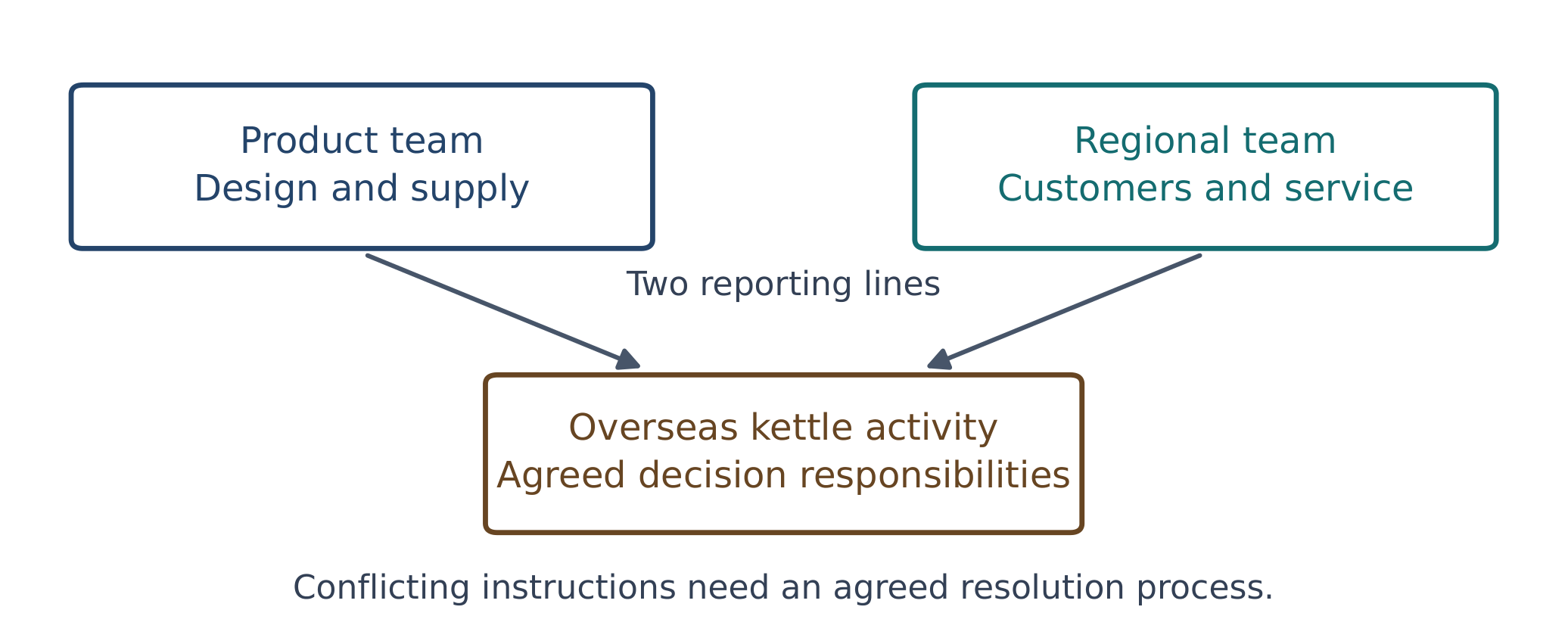
Sending experienced home-country managers can help transfer routines. Hiring local managers can improve language skills and knowledge of customers and operating rules. A mixed team needs clear responsibilities, training and ways to resolve disagreements. Avoid assuming nationality alone determines competence or values.
Standardisation 标准化 keeps agreed features consistent across markets. Adaptation 本地化 changes features for a particular market. Bright Kettle could keep a tested core design while checking local safety, power, instructions and service needs. Adaptation can add cost; it does not automatically improve sales. Standardisation can reduce some costs; it does not guarantee the product fits every market.
A supply plan must consider lead times, quality, stock, transport and alternative sources. For example, two weeks of stock with a four-week replacement lead time may leave a gap after disruption. An alternative supplier must be checked, not merely named. Its quality, capacity and delivery may differ. Long and short supply chains both have costs and risks; length alone does not establish reliability.
Define a reachable customer group and research its actual needs. Do not treat every person in a country as having the same taste or income. Translate and test names, instructions and promotions with suitable readers. Check meaning, clarity and legal requirements rather than guessing from a colour or number.
| Marketing choice | Proposal for the fictional kettle trial | Evidence needed |
|---|---|---|
| Product | Tested core with suitable instructions and local requirements checked | Customer use, safety and service needs |
| Price | Compare invoice currency, costs and competing offers | Suitable alternatives and willingness to pay |
| Place | A checked distributor with service arrangements | Coverage, delivery and after-sales records |
| Promotion | Clear claims in language customers understand | Comprehension, actual response and claim support |
Run a permitted limited trial and measure paid orders, returns, complaints and contribution. A favourable survey is not the same as repeat purchases. Compare actual results with assumptions before expanding. Keep any real-country compliance decision separate from this fictional teaching proposal.
Choose a narrow research question, a real firm, a period and relevant markets. For example: how do overseas production arrangements affect a firm's control and supply risk? Keep a source log with author, document, date, section and the claim it supports. Separate reported facts, your analysis and untested assumptions.
Apple's Form 10-K for the year ended 27 September 2025 is one dated primary source. Its Item 1 describes five geographic reporting segments, with similar offers managed separately for regional markets. Its Item 1A discusses dependence on manufacturing and logistics partners outside the United States. The firm identifies a tradeoff between lower operating costs and less direct control of production and distribution. These are reported arrangements and risk statements, not proof that a particular disruption happened.
A supported interpretation is that partner arrangements need coordination and monitoring. That inference follows the disclosed control issue. It does not establish which entry method is best in a new market. Find additional evidence before recommending a change. An annual report alone does not prove every marketing or supplier claim. Check definitions: a geographic reporting segment is not necessarily one country or one production site.
Use an appropriate business report: purpose, method, findings, analysis, recommendation, limitations and sources. In a presentation, use readable evidence, clear units and concise explanations linked to the decision. An evidence-based recommendation names a tradeoff, supporting facts, remaining uncertainty and a review condition. Use the actual centre brief for required formats and assessed depth.
Answer 1. New customers may increase sales, but demand and competition remain uncertain. A new source may reduce input costs, but quality or delivery may differ. Explain conditions, not guarantees.
Answer 2. A limited export trial can test demand with less ownership commitment than a new subsidiary. Check the distributor and terms first. A drawback is less direct control of service and customer information. The best method depends on actual costs, resources and objectives.
Answer 3. The new price is 1,000 divided by 11, or about 90.91 euros. The home price is fixed in this calculation, and other charges are ignored.
Answer 4. Opposite quotes use different starting values. The euro value of H falls from 0.10 to 1/11, giving a fall of about 9.09%.
Answer 5. The component rises from 400 H to 440 H. A gives 1,100 minus 440 minus 500, or 160 H contribution. B gives 1,000 minus 440 minus 500, or 60 H contribution. These exclude the stated other costs and are not final profit.
Answer 6. Total contribution equals contribution per unit times quantity. A higher price to the buyer could reduce orders. Use demand evidence rather than assume equal volumes.
Answer 7. The tariff is 12 euros; value plus tariff is 132 before other charges. Domestic producers may face less import competition, while buyers or firms using imported inputs may pay more. Who absorbs the charge affects the result.
Answer 8. A free-trade area's members can have different external tariffs. A customs union has a common external tariff arrangement. Actual product coverage and origin rules still matter.
Answer 9. Specify which team decides safety, design and market matters, with an agreed escalation process. Compare customer evidence, costs and applicable requirements before choosing. A matrix label alone does not resolve conflict.
Answer 10. Two weeks of stock may run out before a four-week replacement arrives. Check an alternative source or a justified stock change, including cost, quality and capacity. Do not assume an untested alternative can supply immediately.
Answer 11. The disclosure supports investigating coordination and partner-control risk. It does not prove that a particular disruption occurred or that a subsidiary is the best response. Keep the reported fact separate from your interpretation and recommendation.
Answer 12. State purpose, firm, period, sources and method. Present findings before analysis and recommendation. Name source limits, conflicting evidence and missing information. Recommend a bounded next step with a review condition.
正在加载学科…