持久理解(VAR-1): 鉴于变异可能是随机的,也可能不是随机的,因此结论具有不确定性。
学习目标 VAR-1.F: 识别数据模式中暗示的问题。[技能 1.A]
- VAR-1.F.1 数据中的模式并不一定意味着变异是非随机的。
AP 统计学 · 知识点 4
 8:39
概率、随机变量与概率分布
一名篮球运动员连续投中五球。观众确信她今晚手感火热。但看看纯粹运气能做什么。抛一枚公平硬币二十次。其中…
英语旁白 · 英中内嵌字幕

持久理解(VAR-1): 鉴于变异可能是随机的,也可能不是随机的,因此结论具有不确定性。
学习目标 VAR-1.F: 识别数据模式中暗示的问题。[技能 1.A]
来源:College Board AP 课程与考试说明
Something is random 随机 if individual outcomes 结果 are uncertain but a regular pattern emerges over many repetitions 重复. Short-run results look erratic; long-run relative frequencies 相对频率 settle down. This long-run stability is what makes probability useful.
概率位于从 0(不可能)到 1(必然)的刻度上。
| English | 中文 | 拼音 |
|---|---|---|
| random/ˈrændəm/ | 随机 | suí jī |
| outcomes/ˈaʊtkʌmz/ | 结果 | jié guǒ |
| repetitions | 重复 | chóng fù |
| relative frequencies/ˈrelətɪv ˈfriːkwənsiz/ | 相对频率 | xiāng duì pín lǜ |

持久理解 (UNC-2): 模拟使我们能够预测数据中的模式。
学习目标 UNC-2.A: 使用模拟估计概率。[技能 3.A]
来源:College Board AP 课程与考试说明
A simulation 模拟 imitates a chance process 随机过程 using random digits 随机数字 or technology. Steps: state the model, assign digits to outcomes, run many trials 试验, and record the proportion of trials meeting the condition. The resulting proportion estimates the probability – more trials give a better estimate.
| English | 中文 | 拼音 |
|---|---|---|
| simulation/ˌsɪmjʊˈleɪʃn/ | 模拟 | mó nǐ |
| chance process | 随机过程 | suí jī guò chéng |
| random digits | 随机数字 | suí jī shù zì |
| trials | 试验 | shì yàn |

持久性理解(VAR-4): 随机事件的发生可能性可以被量化。
学习目标 VAR-4.A: 计算事件及其补集的概率。[技能 3.A]
学习目标 VAR-4.B: 解释事件的概率。[技能 4.B]
来源:College Board AP 课程与考试说明
The probability 概率 of an event 事件 is a number from $0$ to $1$ giving its long-run relative frequency. The sample space 样本空间 is the set of all outcomes. For an event $A$, the complement 补 rule: $P(A^c)=1-P(A)$. Probabilities of all outcomes sum to $1$.
概率是结果长期发生的频率。多次掷骰子,观察实验比例如何趋向理论值。
| English | 中文 | 拼音 |
|---|---|---|
| probability/ˌprɒbəˈbɪlɪti/ | 概率 | gài lǜ |
| event/ɪˈvent/ | 事件 | shì jiàn |
| sample space/ˈsæmpl speɪs/ | 样本空间 | yàng běn kōng jiān |
| complement/ˈkɒmplɪmənt/ | 补 | bǔ |
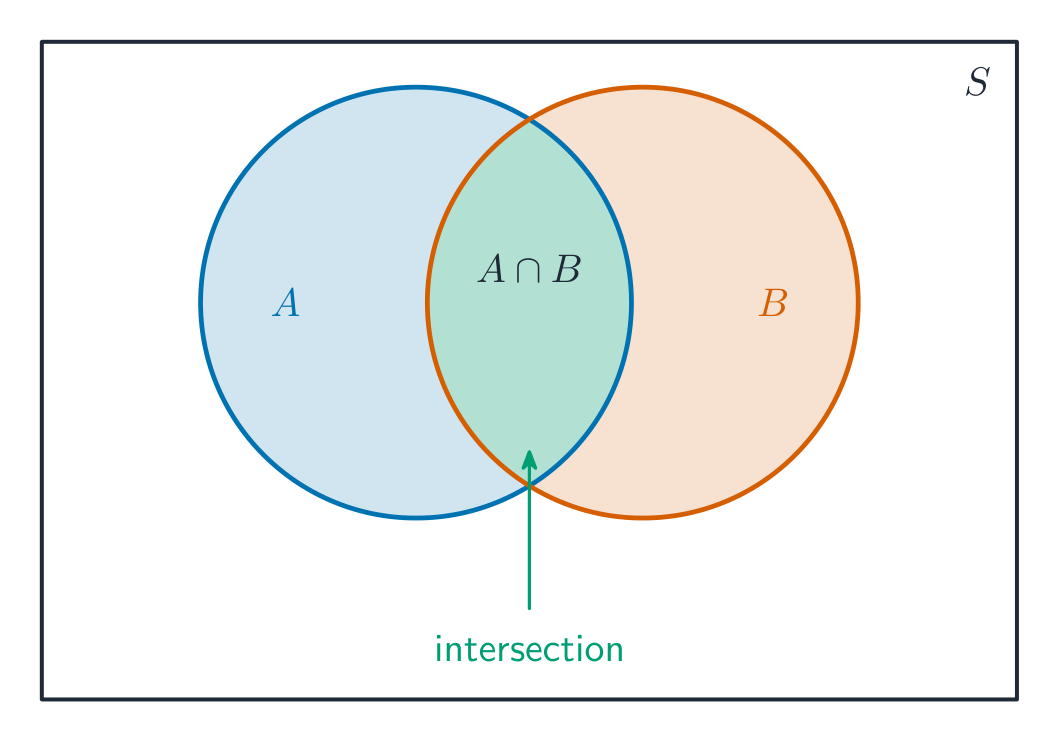
持久理解 (VAR-4): 随机事件发生的可能性可以被量化。
学习目标 VAR-4.C: 解释两个事件为何是(或不是)互斥的。[技能 4.B]
来源:College Board AP 课程与考试说明
Two events are mutually exclusive 互斥 (disjoint 不相交) if they cannot both happen. Then the addition rule 加法法则 simplifies:
并集是 A 或 B 中的一切;重叠只减一次。
| English | 中文 | 拼音 |
|---|---|---|
| mutually exclusive/ˈmjuːtʃuːəli eksˈkluːsɪv/ | 互斥 | hù chì |
| disjoint/dɪsˈdʒɔɪnt/ | 不相交 | bù xiāng jiāo |
| addition rule/əˈdɪʃn ruːl/ | 加法法则 | jiā fǎ fǎ zé |
| overlap/ˌəʊvəˈlæp/ | 重叠部分 | chóng dié bù fèn |
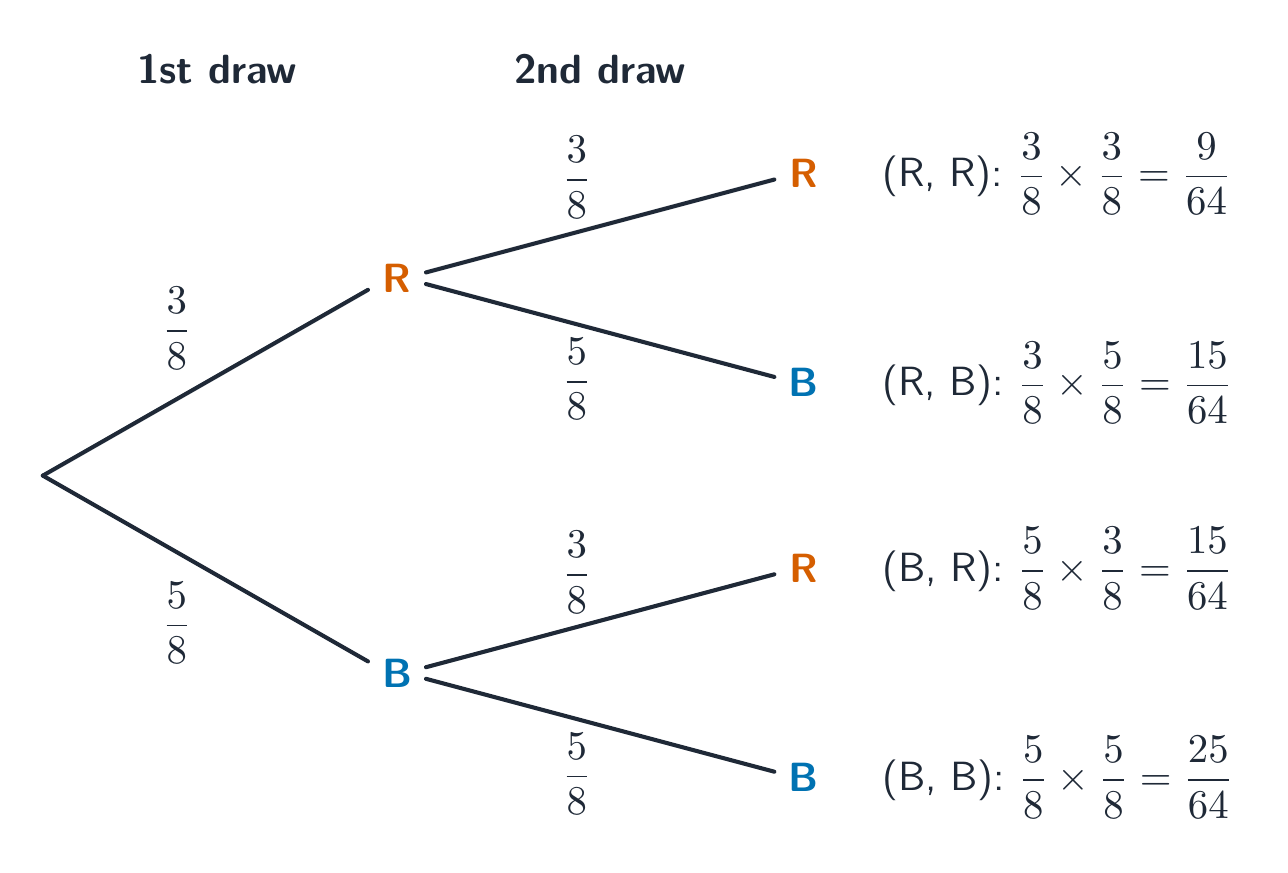
持久理解 (VAR-4): 随机事件发生的可能性可以被量化。
学习目标 VAR-4.D: 计算条件概率。[技能 3.A]
来源:College Board AP 课程与考试说明
The conditional probability 条件概率 of $A$ given $B$ is
Worked example: tree diagram. $2\%$ of people have a disease. A test is positive for $95\%$ of people who have it, and (a false positive 假阳性) for $10\%$ of people who do not. A person tests positive. What is the probability that they have the disease?
Only about $16\%$ of positive results come from people with the disease: so few people have it that the false positives outnumber the true ones. Do not confuse $P(\text{positive}\mid\text{disease})=0.95$ with $P(\text{disease}\mid\text{positive})$.
条件概率 $P(B\mid A)$ 是在已知 $B$ 发生的情况下, $A$ 的概率。改变分支概率,观察条件如何重塑结果。
| English | 中文 | 拼音 |
|---|---|---|
| conditional probability/kənˈdɪʃənl ˌprɒbəˈbɪlɪti/ | 条件概率 | tiáo jiàn gài lǜ |
| Two-way tables | 双向表 | shuāng xiàng biǎo |
| false positive | 假阳性 | jiǎ yáng xìng |
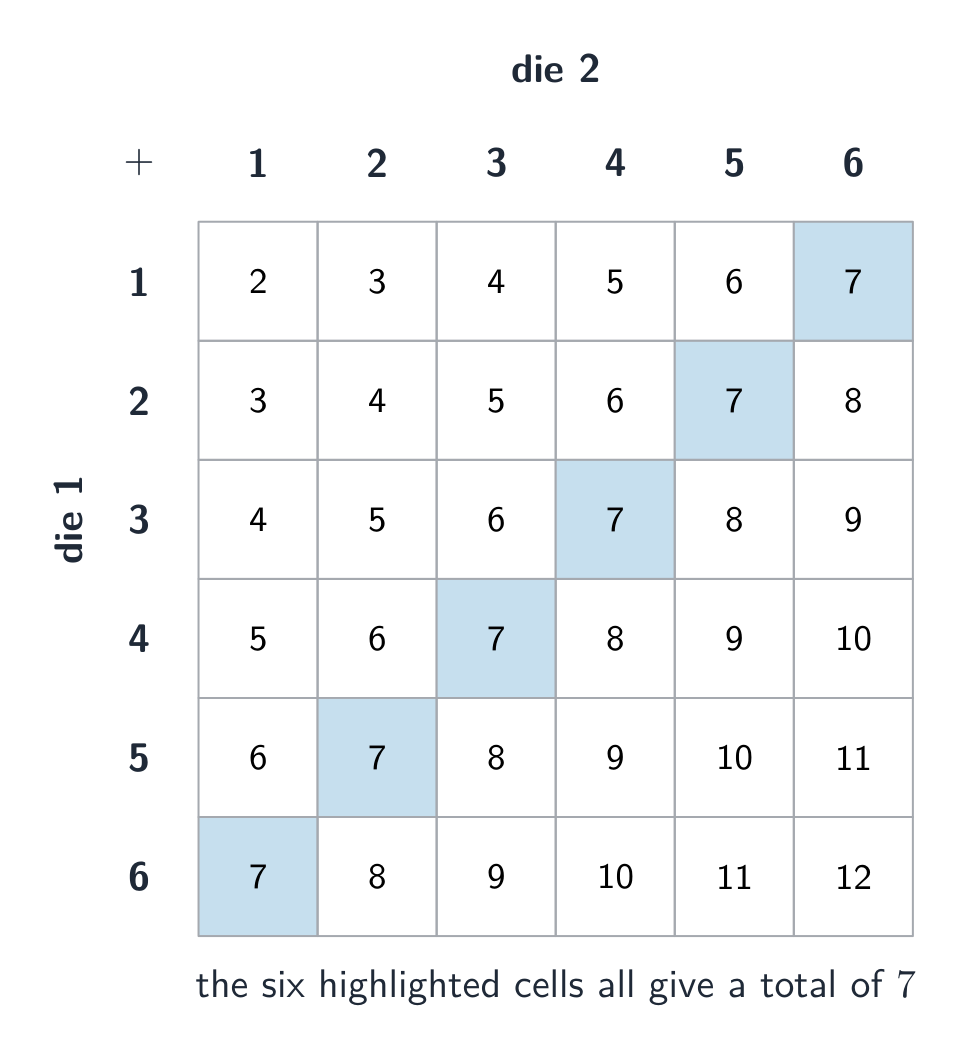
持久理解 (VAR-4): 随机事件发生的可能性可以被量化。
学习目标 VAR-4.E: 计算独立事件及两个事件并集的概率。[技能 3.A]
来源:College Board AP 课程与考试说明
Events are independent 独立 if knowing one does not change the other's probability: $P(A\mid B)=P(A)$. Then the multiplication rule 乘法法则 simplifies:
对于并集 $P(A\cup B)=P(A)+P(B)-P(A\cap B)$ ——你减去重叠部分以避免重复计数。切换运算以查看每个区域亮起。
| English | 中文 | 拼音 |
|---|---|---|
| independent/ˌɪndɪˈpendənt/ | 独立 | dú lì |
| multiplication rule/ˌmʌltɪplɪˈkeɪʃn ruːl/ | 乘法法则 | chéng fǎ fǎ zé |
| dependent/dɪˈpendənt/ | 不独立 | bù dú lì |

持久理解 (VAR-5): 概率分布可用于模拟总体中的变异性。
学习目标 VAR-5.A: 表示离散型随机变量的概率分布。[技能 2.B]
学习目标 VAR-5.B: 解释概率分布。[技能 4.B]
来源:College Board AP 课程与考试说明
A random variable 随机变量 assigns a number to each outcome of a chance process. A probability distribution 概率分布 lists each possible value with its probability (they sum to $1$). A distribution can be discrete 离散 (a table of values) or continuous 连续 (an area-under-a-curve model like the normal).
每根条是 P(x);各条之和为 1。
| English | 中文 | 拼音 |
|---|---|---|
| random variable/ˈrændəm ˈveərɪəbl/ | 随机变量 | suí jī biàn liàng |
| probability distribution/ˌprɒbəˈbɪlɪti ˌdɪstrɪˈbjuːʃn/ | 概率分布 | gài lǜ fēn bù |
| discrete/dɪˈskriːt/ | 离散 | lí sàn |
| continuous/kənˈtɪnjuːəs/ | 连续 | lián xù |
持久理解 (VAR-5): 概率分布可用于对总体中的变异进行建模。
学习目标 VAR-5.C: 计算离散型随机变量的参数。[技能 3.B]
学习目标 VAR-5.D: 解释离散型随机变量的参数。[技能 4.B]
来源:College Board AP 课程与考试说明
The mean (expected value) 期望值 of a discrete random variable is the probability-weighted average 概率加权平均:
Worked example. A game pays $\$5$ with probability $0.2$ and costs you $\$1$ (a $-1$ outcome) with probability $0.8$. The expected value is
| English | 中文 | 拼音 |
|---|---|---|
| mean (expected value)/miːn/ | 期望值 | qī wàng zhí |
| probability-weighted average | 概率加权平均 | gài lǜ jiā quán píng jūn |
| standard deviation/ˈstændəd ˌdiːvɪˈeɪʃn/ | 标准差 | biāo zhǔn chà |

持久理解 (VAR-5): 概率分布可用于模拟总体中的变异。
学习目标 VAR-5.E: 计算随机变量线性组合的参数。[技能 3.B]
学习目标 VAR-5.F: 描述随机变量参数线性变换的影响。[技能 3.C]
来源:College Board AP 课程与考试说明
When you add or subtract random variables, means add 均值相加: $\mu_{X\pm Y}=\mu_X\pm\mu_Y$. If $X$ and $Y$ are independent, variances add 方差相加 (even when subtracting):
Worked example. Task A takes $X$ minutes with $\mu_X=20$, $\sigma_X=3$; task B takes $Y$ minutes with $\mu_Y=15$, $\sigma_Y=4$; the times are independent.
Two common errors: adding the standard deviations ($3+4=7$), and subtracting them for a difference ($4-3=1$). Add the variances, then take the square root.
A third error: treating $3X$ like $X_1+X_2+X_3$. Tripling one value triples the spread, $\sigma_{3X}=3\sigma_X$; adding three independent values gives $\sigma=\sqrt{3}\,\sigma_X$, because the variances add.
独立正态变量的和/差本身也是正态的。
| English | 中文 | 拼音 |
|---|---|---|
| means add | 均值相加 | jūn zhí xiāng jiā |
| variances add | 方差相加 | fāng chà xiāng jiā |
持久理解(UNC-3): 概率推理使我们能够预测数据中的规律。
学习目标 UNC-3.A: 利用模拟产生的数据估计二项随机变量的概率。[技能 3.A]
学习目标 UNC-3.B: 计算二项分布的概率。[技能 3.A]
来源:College Board AP 课程与考试说明
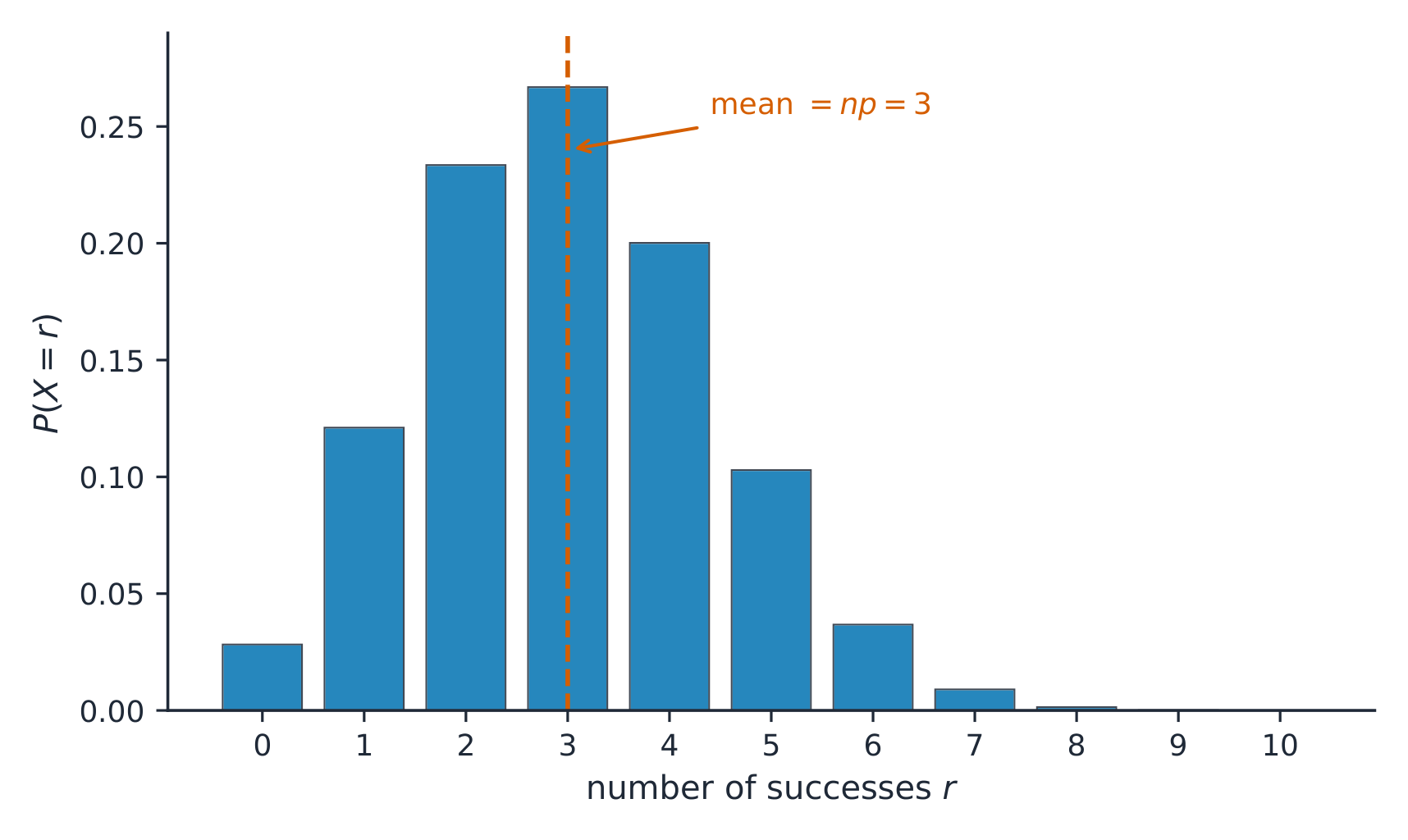
A binomial 二项 setting (BINS): a fixed number $n$ of Independent trials, each with two outcomes (success 成功/failure 失败) and the same success probability $p$. The random variable $X=$ number of successes. Its probability:
二项分布统计 $n$ 次独立试验中的成功次数,每次试验的概率为 $p$。更改 $n$ 和 $p$,观察条形图如何移动和扩散。
| English | 中文 | 拼音 |
|---|---|---|
| binomial/baɪˈnəʊmɪəl/ | 二项 | èr xiàng |
| success | 成功 | chéng gōng |
| failure | 失败 | shī bài |
持久理解 (UNC-3): 概率推理使我们能够预测数据中的模式。
学习目标 UNC-3.C: 计算二项分布的参数。[技能 3.B]
学习目标 UNC-3.D: 解释二项分布的概率和参数。[技能 4.B]
来源:College Board AP 课程与考试说明
For a binomial $X$ with $n$ trials and success probability $p$:
Worked example. A player makes $70\%$ of free throws. In $n=10$ shots, the probability of exactly $8$ makes is
Worked example: “at least”. For the same player ($n=10$, $p=0.7$), the probability of at least $8$ makes adds the top three values:
By the complement, the probability of at most $7$ makes is $P(X\le7)=1-0.3828=0.6172$.
Common mistakes. Writing $P(X\ge 8)=1-P(X\le 8)$: the complement of “at least $8$” is “at most $7$”, so $P(X\ge 8)=1-P(X\le 7)$. Using a binomial model when $n$ is not fixed, or when the trials are not independent (drawing without replacement from a small group).

持久理解 (UNC-3): 概率推理使我们能够预测数据中的模式。
学习目标 UNC-3.E: 计算几何随机变量的概率。[技能 3.A]
学习目标 UNC-3.F: 计算几何分布的参数。[技能 3.B]
学习目标 UNC-3.G: 解释几何分布的概率和参数。[技能 4.B]
来源:College Board AP 课程与考试说明
A geometric 几何 setting is the same as binomial but with no fixed $n$: you keep trying until the first success. The random variable $Y=$ the trial of the first success:
Worked example. A player makes $30\%$ of shots, independently. The probability that the first make is on the third shot needs two misses, then a make:
The probability of a make within the first three shots uses the complement (three misses in a row): $P(Y\le 3)=1-0.7^3=0.657$. On average the first make comes on shot $\mu_Y=\tfrac{1}{0.3}\approx 3.33$.
一直掷到目标出现——这就是一个几何计数。
| English | 中文 | 拼音 |
|---|---|---|
| geometric/ˌdʒiːəʊˈmetrɪk/ | 几何 | jǐ hé |
Answer each before reading the answers below.
逐步完成,配合即时检查练习。
正在加载学科…