跳到主要内容

电磁感应

AP 物理 C:电磁学 · 第 13 主题

训练
讲义 词汇表
13.1

磁通量

大纲
Learning ObjectiveEssential Knowledge

13.1.A
Describe the magnetic flux through an arbitrary area or geometric shape.

  • 13.1.A.1 For a magnetic field $\vec{B}$ that is constant across an area $\vec{A}$, the magnetic flux through the area is defined as $\Phi_B = \vec{B} \cdot \vec{A}$ .
    • 13.1.A.1.i The area vector is defined as perpendicular to the plane of the surface and outward from a closed surface.
    • 13.1.A.1.ii The sign of flux is given by the dot product of the magnetic field vector and the area vector.
  • 13.1.A.2 The total magnetic flux passing through a surface is defined by the surface integral of the magnetic field over the surface area.
    • Equation: $\Phi_B = \displaystyle\int \vec{B} \cdot d\vec{A}$

来源:美国大学理事会 AP 课程与考试说明

磁通量(magnetic flux)测量多少磁场通过一个表面。对于一个通过一个平坦环的均匀场它是点积 $\Phi_B=\vec{B}\cdot\vec{A}=BA\cos\theta$;一般地它是面积分(surface integral)

$$\Phi_B=\int \vec{B}\cdot d\vec{A}.$$

面积矢量(area vector)垂直于表面(从一个闭合的向外),而通量的符号来自点积。若 $B$ 变化、面积变化,或环转动,通量就变化——把所有三条路径记在心里,因为每一条都是一个考试问题。

词汇表 训练
英文 中文 拼音
Magnetic flux 磁通量 cí tōng liàng
surface integral 面积分 miàn jī fēn
area vector 面积矢量 miàn jī shǐ liàng
13.2

电磁感应

大纲
Learning ObjectiveEssential Knowledge

13.2.A
Describe the induced electric potential difference resulting from a change in magnetic flux.

  • 13.2.A.1 Faraday's law describes the relationship between changing magnetic flux and the resulting induced emf in a system.
    • Equation: $\mathcal{E} = -\dfrac{d\Phi_B}{dt} = -\dfrac{d\left(\vec{B} \cdot \vec{A}\right)}{dt}$
    • 13.2.A.1.i When the area of the surface being considered is constant, the induced emf is equal to the area multiplied by the rate of change in the component of the magnetic field perpendicular to the surface.
    • 13.2.A.1.ii When the magnetic field is constant, the induced emf is equal to the magnetic field multiplied by the rate of change in area perpendicular to the magnetic field.
    • 13.2.A.1.iii When an emf is induced in a long solenoid, the total induced emf is equal to the induced emf in a single loop multiplied by the number of loops in the solenoid.
      • Equation: $\left|\mathcal{E}_{\text{sol}}\right| = N\left|\dfrac{d\Phi_B}{dt}\right|$
  • 13.2.A.2 Lenz's law is used to determine the direction of an induced emf resulting from a changing magnetic flux.
    • 13.2.A.2.i An induced emf generates a current that creates a magnetic field that opposes the change in magnetic flux.
    • 13.2.A.2.ii The right-hand rule is used to determine the relationships between current, emf, and magnetic flux.
  • 13.2.A.3 Maxwell's equations are the collection of equations that fully describe electromagnetism. Maxwell's third equation is Faraday's law of induction, which describes the relationship between a changing magnetic flux and an induced electric field.
    • Equation: $\mathcal{E} = \oint \vec{E} \cdot d\vec{\ell} = -\dfrac{d\Phi_B}{dt}$
  • 13.2.A.4 Maxwell's equations can be used to show that electric and magnetic fields obey wave equations and that electromagnetic waves travel at a constant speed in free space.
    • Equation (derived): $c = \dfrac{1}{\sqrt{\varepsilon_0 \mu_0}}$

Boundary statement: AP Physics C: Electricity & Magnetism does not expect students to mathematically derive the speed of light in free space from Maxwell's equations. This relationship is included above solely as an indication of the further applications, implications, and connections to physical phenomena that students may study in more advanced physics courses.

来源:美国大学理事会 AP 课程与考试说明

电磁感应

一个变化的通量感应一个 电动势(emf)——法拉第定律(Faraday's law):

$$\varepsilon=-\frac{d\Phi_B}{dt}.$$

以恒定面积,$\varepsilon=-A\,\dfrac{dB_\perp}{dt}$;以恒定场,$\varepsilon=-B\,\dfrac{dA_\perp}{dt}$。一个 $N$ 匝的线圈使单环 emf 成倍:$|\varepsilon_{\text{sol}}|=N\left|\dfrac{d\Phi_B}{dt}\right|$

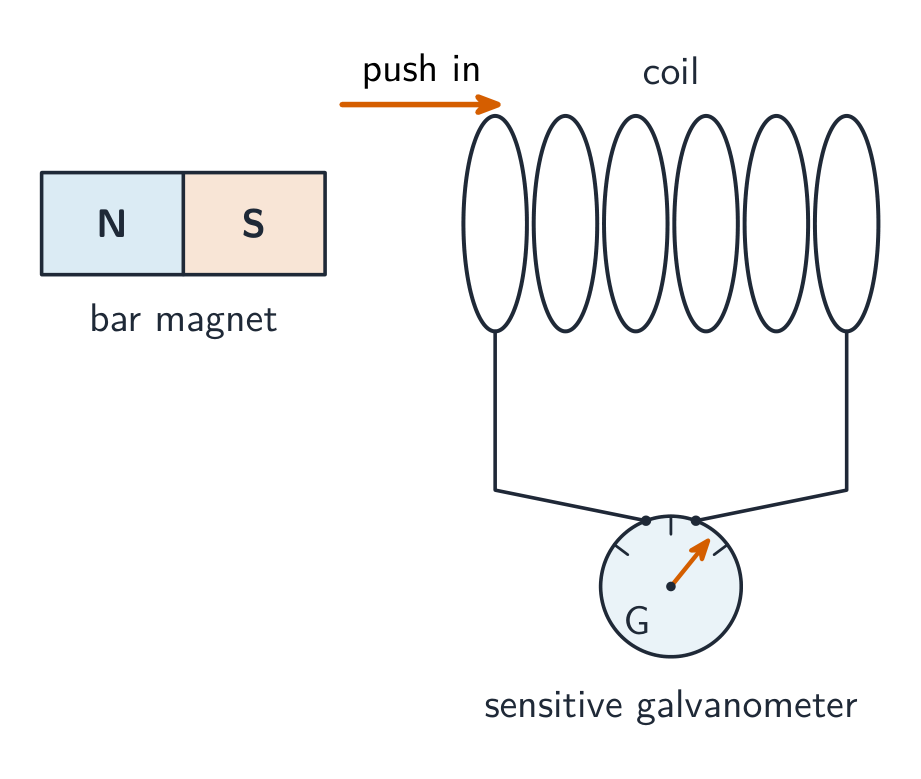
楞次定律(Lenz's law)是负号:感应电流(induced current)流动以使它自己的磁场反对造成它的通量的变化。把一个磁体推向一个环,环推回;把它拉开,环把它拉进来。用右手定则(right-hand rule)把"反对变化"变成一个电流方向。

把一个磁体移进一个线圈感应一个驱动一个电流的 emf

一根长度 $L$ 的杆以速率 $v$ 横穿一个场滑动是值得记住的特殊情况——动生电动势(motional emf)$\varepsilon=BLv$

Worked example. 一根 $0.20\ \text{m}$ 的杆以 $3.0\ \text{m/s}$ 横穿一个 $0.50\ \text{T}$ 的场滑动:$\varepsilon=BLv=0.50(0.20)(3.0)=0.30\ \text{V}$。等价地,若一个单一环的通量在 $0.030\ \text{s}$ 里从 $0.020\ \text{Wb}$ 降到 $0.008\ \text{Wb}$,平均 emf 是 $\varepsilon=\dfrac{0.012}{0.030}=0.40\ \text{V}$

法拉第定律也是麦克斯韦方程组(Maxwell's equations)的第三个,以一个更深的形式:一个变化的磁通量创造一个环流的电场,$\oint\vec{E}\cdot d\vec{l}=-\dfrac{d\Phi_B}{dt}$ ——那个场是把电荷绕环推的东西。麦克斯韦方程组一起预测以 $c=1/\sqrt{\varepsilon_0\mu_0}$ 行进的电磁波(electromagnetic waves)(你应当知道这个联系,但 AP 不会要求你推导它)。
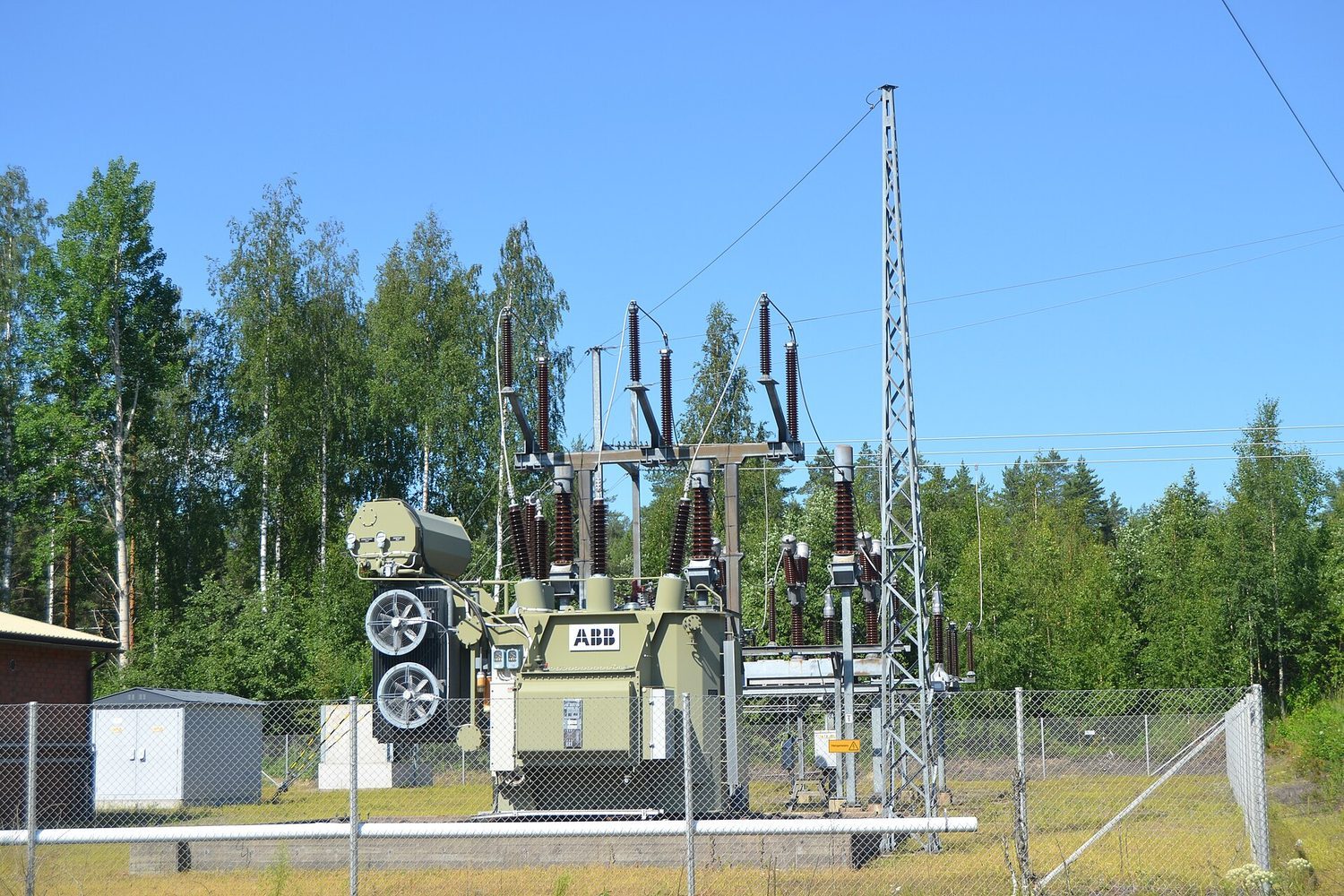
A substation transformer: changing magnetic flux in coils induces the voltages that power the grid
探索

Induce a current by moving a magnet

A changing magnetic flux through a coil induces an EMF (Faraday's law); its direction opposes the change (Lenz's law). Move the magnet faster for a bigger EMF.

词汇表 训练
英文 中文 拼音
emf 电动势 diàn dòng shì
Faraday's law 法拉第定律 fǎ lā dì dìng lǜ
Lenz's law 楞次定律 léng cì dìng lǜ
induced current 感应电流 gǎn yìng diàn liú
right-hand rule 右手定则 yòu shǒu dìng zé
motional emf 动生电动势 dòng shēng diàn dòng shì
Maxwell's equations 麦克斯韦方程组 mài kè sī wéi fāng chéng zǔ
electromagnetic waves 电磁波 diàn cí bō
练习卷
13.3

感应电流与磁力

大纲
Learning ObjectiveEssential Knowledge

13.3.A
Describe the force exerted on a conductor due to the interaction between an external magnetic field and an induced current within that conductor.

  • 13.3.A.1 When an induced current is created in a conductive loop, the already-present magnetic field will exert a magnetic force on the moving charge carriers within the loop.
    • Equation: $\vec{F}_B = \displaystyle\int I\left(d\vec{\ell} \times \vec{B}\right)$
  • 13.3.A.2 When current is induced in a conducting loop, magnetic forces are only exerted on the segments of the loop that are within the external magnetic field. These magnetic forces may cause translational or rotational acceleration.
  • 13.3.A.3 The force on a conducting loop is proportional to the induced current in the loop, which depends on the rate of change of magnetic flux, the resistance of the loop, and the velocity of the loop.
  • 13.3.A.4 Newton's second law can be applied to a conducting loop moving in a magnetic field as it experiences an induced emf.

来源:美国大学理事会 AP 课程与考试说明

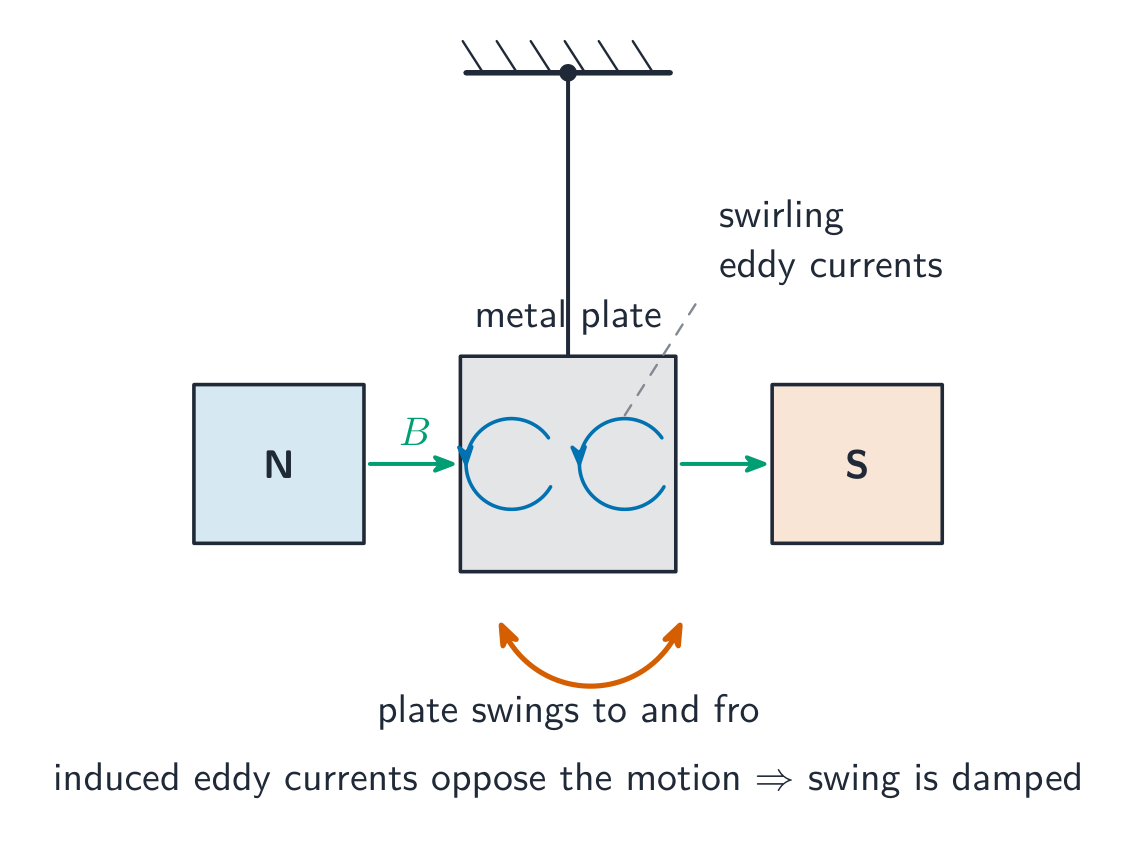
一旦一个感应电流流动,外部场对它施加力($\vec{F}=\int I\,d\vec{l}\times\vec{B}$)——而由楞次定律那些力总是抵抗造成感应的运动。只有实际在场里面的环的段感受一个力,它能使一个环加速、旋转,或制动。这是涡电流(eddy currents)制动的起源,而你能对一个移动的环或杆像任何其他力学问题一样应用牛顿第二定律。

感应涡电流反对运动,快速地衰减一个在场里摆动的金属板

经典的设置是一根在由一个电阻连接的导电轨道上滑动的杆:

一根在轨道上滑动的杆:感应电流感受一个反对运动的力

Worked example (the full chain). 相距 $L=0.20\ \text{m}$、电阻 $R=0.60\ \Omega$ 的轨道坐在一个指入页面的 $0.50\ \text{T}$ 的场里。杆被以恒定的 $3.0\ \text{m/s}$ 推。那么:$\varepsilon=BLv=0.30\ \text{V}$;$I=\varepsilon/R=0.50\ \text{A}$;场以 $F=BIL=0.50(0.50)(0.20)=0.050\ \text{N}$ 推回杆。推力以 $P=Fv=0.15\ \text{W}$ 做功——恰好是电阻里耗散的 $P=I^2R=0.15\ \text{W}$。机械功变成电能:那是一个发电机(generator),而能量守恒。没有推力被释放,杆指数地减慢:$ma=-\dfrac{B^2L^2}{R}v$

Exam skill. FRQ 走这个确切的链条:通量 $\to$ emf $\to$ 电流 $\to$$\to$ 牛顿第二定律。分别写每个环节并在最后用楞次定律检查方向。

词汇表 训练
英文 中文 拼音
eddy currents 涡电流 wō diàn liú
generator 发电机 fā diàn jī
13.4

电感

大纲
Learning ObjectiveEssential Knowledge

13.4.A
Describe the physical and electrical properties of an inductor.

  • 13.4.A.1 Inductance is the tendency of a conductor to oppose a change in electrical current.
    • 13.4.A.1.i Inductance of a conductor depends on the physical properties of the conductor. Straight wires are typically modeled as having zero inductance.
    • 13.4.A.1.ii An inductor, such as a solenoid, is a circuit element that has significant inductance.
    • 13.4.A.1.iii The inductance of a solenoid is dependent on the total number of turns, the length of the solenoid, the cross-sectional area of the solenoid, and magnetic permeability of the solenoid's core.
      • Equation: $L_{\text{sol}} = \dfrac{\mu_{\text{core}} N^2 A}{\ell}$
  • 13.4.A.2 Inductors store energy in the magnetic field that is generated by current in the inductor.
    • Equation: $U_L = \dfrac{1}{2} L I^2$
    • 13.4.A.2.i The energy stored in the magnetic field generated by an inductor in which current is flowing can be dissipated through a resistor or used to charge a capacitor.
    • 13.4.A.2.ii The transfer of energy generated in an inductor to other forms of energy obeys conservation laws.
  • 13.4.A.3 By applying Faraday's law to an inductor and using the definition of inductance, induced emf can be related to inductance and the rate of change of current.
    • Equation: $\mathcal{E}_i = -L\dfrac{dI}{dt}$

来源:美国大学理事会 AP 课程与考试说明

电感(inductance)是一个导体反对它自己电流变化的倾向:变化的电流改变它自己的通量,它自感一个 emf。由法拉第定律,

$$\varepsilon=-L\frac{dI}{dt}.$$

一个电感器(inductor)是一个被建来有大电感的电路元件——通常是一个螺线管(solenoid),那里几何给出

$$L_{\text{sol}}=\frac{\mu_{\text{core}}N^2A}{\ell},$$

$N$ 是总匝数、$A$ 是面积、$\ell$ 是长度,而 $\mu_{\text{core}}$ 是芯的磁导率(magnetic permeability)。(直导线被建模为有零电感。)一个携带电流 $I$ 的电感器在它的磁场里储存能量:

$$U_L=\tfrac{1}{2}LI^2,$$

它后来能在一个电阻里耗散或移进一个电容器——能量守恒像往常一样适用。

词汇表 训练
英文 中文 拼音
inductance 电感 diàn gǎn
inductor 电感器 diàn gǎn qì
solenoid 螺线管 luó xiàn guǎn
magnetic permeability 磁导率 cí dǎo lǜ
13.5

含电阻与电感的电路(LR 电路)

大纲
Learning ObjectiveEssential Knowledge

13.5.A
Describe the physical and electrical properties of a circuit containing a combination of resistors and a single inductor.

  • 13.5.A.1 A resistor will dissipate energy that was stored in an inductor as the current changes.
  • 13.5.A.2 Kirchhoff's loop rule can be applied to a series LR circuit with a battery of emf $\mathcal{E}$, resulting in a differential equation that describes the current in the loop.
    • Equation (derived): $\mathcal{E} = IR + L\dfrac{dI}{dt}$
  • 13.5.A.3 The time constant is a significant feature of the behavior of an LR circuit.
    • 13.5.A.3.i The time constant of a circuit is a measure of how quickly an LR circuit will reach a steady state and is described with the equation $\tau = \dfrac{L}{R_{\text{eq}}}$ .
    • 13.5.A.3.ii The time constant represents the time an LR circuit would take to reach a steady state if the system continued to change at the initial rate of change.
    • 13.5.A.3.iii For an inductor that has zero initial current, the time constant represents the time required for the current in the inductor to reach approximately 63 percent of its final asymptotic value.
    • 13.5.A.3.iv For an inductor with an initial current, the time constant represents the time required for the current in the inductor to reach approximately 37 percent of its initial value.
  • 13.5.A.4 The electric properties of inductors change during the time interval in which the current in the inductor changes, but will exhibit steady state behavior after a long time interval.
    • 13.5.A.4.i When a switch is initially closed or opened in a circuit containing an inductor, the induced emf will be equal in magnitude and opposite in direction to the applied potential difference across the branch containing the inductor.
    • 13.5.A.4.ii The potential difference across an inductor, the current in the inductor, and the energy stored in the inductor are exponential with respect to time and have asymptotes that are determined by the initial conditions of the circuit.
    • 13.5.A.4.iii After a time much greater than the time constant of the circuit, an inductor will behave as a conducting wire with zero resistance.

来源:美国大学理事会 AP 课程与考试说明

在一个 RL电路(RL circuit)里,一个电池 $\varepsilon$、电阻 $R$ 和电感器 $L$ 串联的基尔霍夫回路定则给出一个微分方程(differential equation):

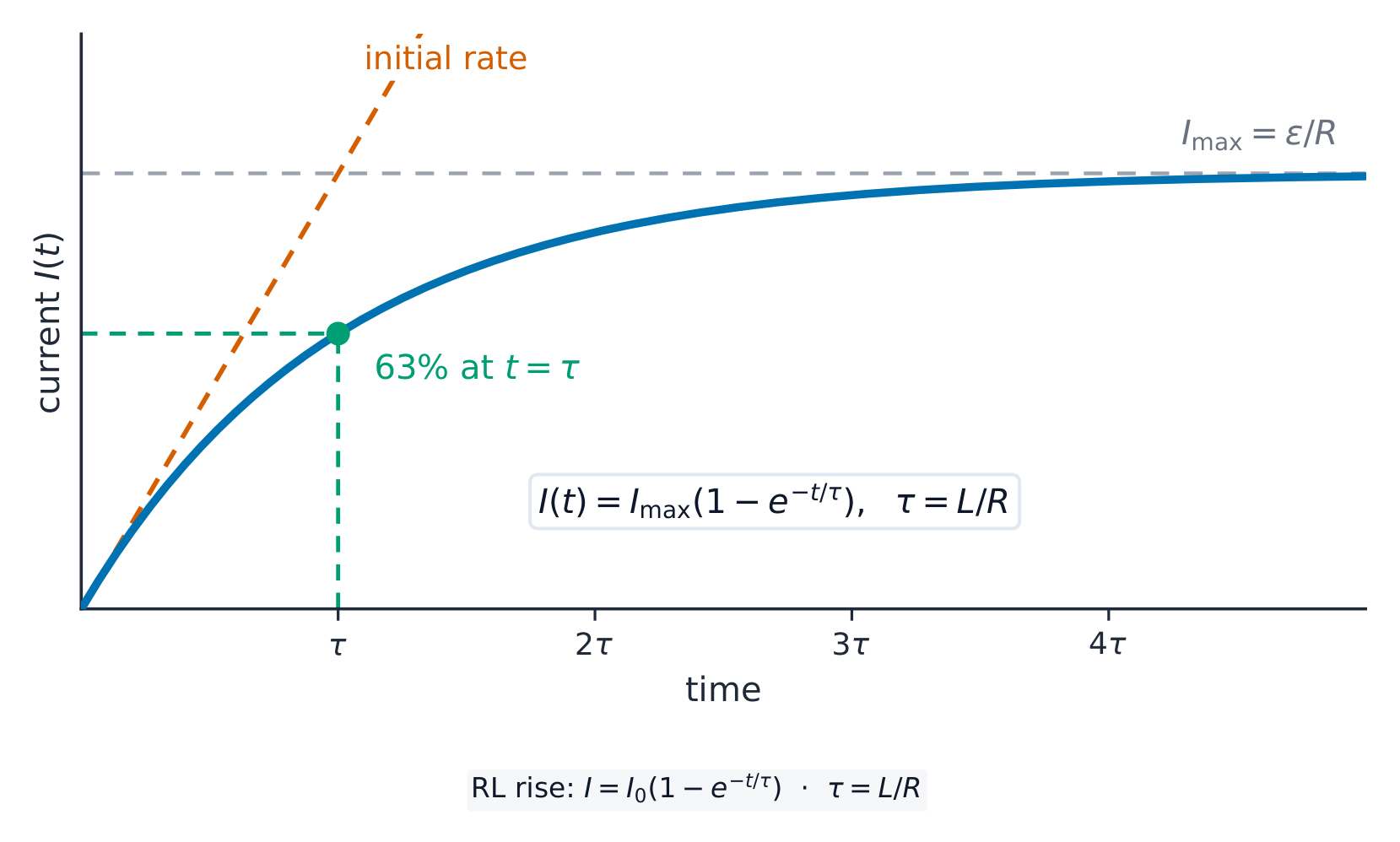
$$\varepsilon=IR+L\frac{dI}{dt}\quad\Rightarrow\quad I(t)=\frac{\varepsilon}{R}\big(1-e^{-t/\tau}\big),\qquad \tau=\frac{L}{R}.$$

时间常数(time constant)$\tau$ 设定节奏:一个 $\tau$ 后一个上升的电流达到约它最终值的 $63\%$(一个衰减的落到 $37\%$);它也是这个变化以初始速率取的时间。学两个极限——它们回答大多数概念问题:

  • 开关刚闭合后($t=0$):电流不能跳跃,所以电感器暂时阻挡它,自感一个与施加的电势差大小相等、方向相反的 emf。
  • 很久之后($t\gg\tau$):电流稳定,$dI/dt=0$,而电感器表现为一根普通的导线——与一个电容器恰好相反。
一个 RL 电路里的电流指数地上升,在一个时间常数达到 63%

Worked example. $\varepsilon=12\ \text{V}$$R=6.0\ \Omega$$L=3.0\ \text{H}$:最终电流 $\varepsilon/R=2.0\ \text{A}$$\tau=L/R=0.50\ \text{s}$。在 $t=0.50\ \text{s}$ 电流是 $2.0(1-e^{-1})\approx1.3\ \text{A}$。在 $t=0$ 电感器的电势差是完整的 $12\ \text{V}$;随着 $t\to\infty$ 它落到零。电流、电感器电压和储存的能量都在时间上是指数的。

词汇表 训练
英文 中文 拼音
RL circuit RL电路 RL diàn lù
differential equation 微分方程 wēi fēn fāng chéng
time constant 时间常数 shí jiān cháng shù
13.6

含电容与电感的电路(LC 电路)

大纲
Learning ObjectiveEssential Knowledge

13.6.A
Describe the physical and electrical properties of a circuit containing a combination of capacitors and a single inductor.

  • 13.6.A.1 In circuits containing only a charged capacitor and an inductor (LC circuits), the maximum current in the inductor can be determined using conservation of energy within the circuit.
  • 13.6.A.2 In LC circuits, the time dependence of the charge stored in the capacitor can be modeled as simple harmonic motion.
    • Equation (derived): $\dfrac{d^2 q}{dt^2} = -\dfrac{1}{LC} q$
  • 13.6.A.3 The angular frequency of an oscillating LC circuit can be derived from the differential equation that describes an LC circuit.
    • Equation (derived): $\omega = \dfrac{1}{\sqrt{LC}}$

来源:美国大学理事会 AP 课程与考试说明

LC 电路:能量像弹簧一样来回振荡

一个 LC电路(LC circuit)没有电阻,所以什么都不耗散能量:它振荡(oscillates),在电容器的电场和电感器的磁场之间晃动能量。回路定则给出

$$\frac{d^2q}{dt^2}=-\frac{1}{LC}\,q,$$

与一个弹簧上的质量相同的方程——简谐运动(simple harmonic motion),电荷扮演位移的角色而

$$\omega=\frac{1}{\sqrt{LC}}.$$

总能量 $\dfrac{q^2}{2C}+\tfrac12LI^2$ 保持恒定:在最大电荷时全在电容器里,在最大电流时全在电感器里。

Worked example. $L=2.0\ \text{H}$$C=8.0\ \mu\text{F}$:$\omega=\dfrac{1}{\sqrt{2.0(8.0\times10^{-6})}}=250\ \text{rad/s}$,周期 $T=2\pi/\omega\approx0.025\ \text{s}$。若电容器开始充电到 $12\ \text{V}$,那么 $U=\tfrac12CV^2=5.8\times10^{-4}\ \text{J}$,而最大电流由 $\tfrac12LI_{\max}^2=U$ 得出:$I_{\max}=\sqrt{2U/L}=0.024\ \text{A}$ —— 能量守恒(conservation of energy),不需要微积分。

词汇表 训练
英文 中文 拼音
LC circuit LC电路 LC diàn lù
oscillates 振荡 zhèn dàng
simple harmonic motion 简谐运动 jiǎn xié yùn dòng
conservation of energy 能量守恒 néng liàng shǒu héng
13.6

考试技巧

  • 计算通量 $\Phi_B=\int \vec B\cdot d\vec A$ 并从法拉第定律 $\varepsilon=-\tfrac{d\Phi_B}{dt}$ 得到感应 EMF。
  • 楞次定律(负号)固定方向:感应电流反对通量的变化。
  • 通量以三种方式变化——变化的 $B$、变化的面积,或变化的角度——辨别哪种并求导。
  • 对于一根长度 $L$ 以速率 $v$ 移动的杆,动生 EMF 是 $BLv$
  • 一个电感器储存能量 $\tfrac12 LI^2$ 并抵抗电流的变化(RL 时间常数 $\tau=L/R$)。

本主题的互动课程

逐步学习,并即时检测练习。

AP 物理 C:电磁学历年真题

AP 物理 C:电磁学的更多主题

登录或创建账号

IGCSE, A-Level & AP