- understand that a magnetic field is an example of a field of force produced either by moving charges or by permanent magnets
- represent a magnetic field by field lines
磁场
A-Level 物理 · 第 20 主题
 13:21
13:21
Magnetic Fields
High above the poles, the sky comes alive — sheets of green light, rippling in the dark. This is the aurora. Its cause? Our planet is a giant magnet. Streams…
英文讲解 · 内嵌中英文字幕
20.1
磁场的概念

大纲
来源:剑桥国际大纲
磁场(magnetic field)是一个运动电荷(或一个电流(current))会感受到力(force)的区域。它由下列产生:
- 运动的电荷(通常是导线中的电流),或
- 永磁体(permanent magnets,其中它来自微小的原子电流)。
"说明磁场是什么意思。" 运动电荷、载流导体或磁性材料在其中受到力的区域。 评分方案要看到力这个词以及那三种对象之一;单单"磁铁周围的区域"不得分。
场线
- 在磁铁外部场线(field lines)从 N 指向 S,在内部从 S 到 N(所以它们构成闭合回路)。
- 场线决不相交;场线越密表示场越强。


要知道的图样:
- 条形磁铁(bar magnet)——外部从 N 到 S 的弯曲的线,在两极附近最强。
- 长直导线——绕导线的圆;方向由右手定则(right-hand grip rule,拇指沿电流,手指卷向场所指的方向)得出。
- 平的圆形线圈——穿过中心的场垂直于线圈;线圈的作用像一个小条形磁铁。
- 长螺线管(solenoid)——内部的场沿轴线近似匀强,像一块拉长的条形磁铁;外部它衰减得很快。


画导线的场。 绕直导线"画四条场线"按三点评分:场线是以导线为圆心的同心圆;它们的间距随距离增大(场随离导线的距离而减弱);每条线都带一个箭头,方向由右手定则给出(电流射入纸面:顺时针;电流射出纸面:逆时针)。要画成圆,不要徒手画成椭圆。
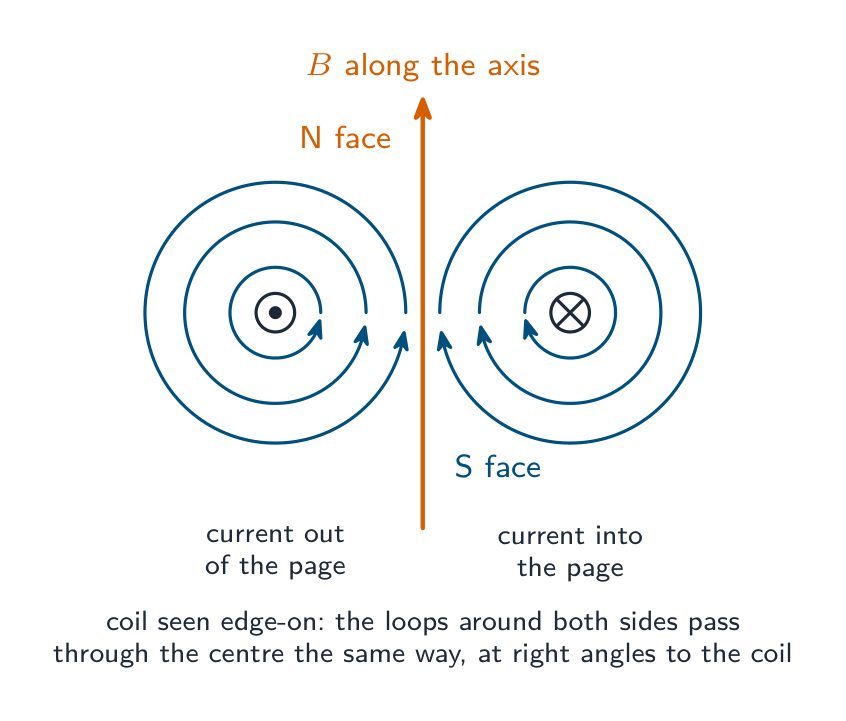
对平面圆形线圈,绕线圈两侧的环在中心处相互加强,所以那里的场垂直于线圈平面,在中心最强;从一个面看线圈是北极(场从它离开),从另一面看是南极。长螺线管是一排这样的线圈:内部的场匀强且平行于轴,场线从一端(它的 N 端)出来,在外部回到另一端。
螺线管内的铁芯(iron core)大大增强场,因为铁的原子磁体排齐并叠加到它上面。这就是为什么电磁铁(electromagnets)和变压器(transformers)有铁芯。
教学大纲把它叫做含铁的(ferrous)芯:铁、钢或另一种磁性材料。被问到为什么铁芯增强场时,要说铁芯被螺线管的场磁化(magnetised),而它自己的场加到电流的场上。
探索
Magnetic field lab
Move between magnetic arrangements and see how field patterns change.
探索
Current field rule lab
Connect current direction to the circular magnetic field around a wire.
词汇表
训练
| 英文 | 中文 | 拼音 |
|---|---|---|
| magnetic field/mæɡˈnetɪk fiːld/ | 磁场 | cí chǎng |
| bar magnet/bɑː ˈmæɡnɪt/ | 条形磁铁 | tiáo xíng cí tiě |
| field lines/fiːld laɪnz/ | 场线 | chǎng xiàn |
| field line/fiːld laɪn/ | 场线 | chǎng xiàn |
| current/ˈkʌrənt/ | 电流 | diàn liú |
| force/fɔːs/ | 力 | lì |
| permanent magnet/ˈpɜːmənənt ˈmæɡnɪt/ | 永磁体 | yǒng cí tǐ |
| right-hand grip rule/raɪt hænd ɡrɪp ruːl/ | 右手定则 | yòu shǒu dìng zé |
| coil/kɔɪl/ | 线圈 | xiàn quān |
| long solenoid/lɒŋ ˈsəʊlənɔɪd/ | 螺线管 | luó xiàn guǎn |
| solenoid/ˈsəʊlənɔɪd/ | 螺线管 | luó xiàn guǎn |
| iron core/ˈaɪən kɔː/ | 铁芯 | tiě xīn |
| electromagnet/ɪˌlektrəʊˈmæɡnɪt/ | 电磁铁 | diàn cí tiě |
| transformer/trænsˈfɔːmə/ | 变压器 | biàn yā qì |
| ferrous/ˈferəs/ | 含铁的 | hán tiě de |
| magnetised/ˈmæɡnɪtaɪzd/ | 被磁化 | bèi cí huà |
20.2
载流导体受到的力
大纲
- understand that a force might act on a current-carrying conductor placed in a magnetic field
- recall and use the equation $F = BIL \sin \theta$, with directions as interpreted by Fleming's left-hand rule
- define magnetic flux density as the force acting per unit current per unit length on a wire placed at right-angles to the magnetic field
来源:剑桥国际大纲
一根长度为 $L$、载电流 $I$ 的导线在磁通密度为 $B$ 的磁场中感受到一个力
$$F = B I L \sin\theta,$$
其中 $\theta$ 是导线与场之间的夹角。当导线垂直于场时力最大($F = BIL$),当导线沿场时为零。
例题。 一根长 $0.20\ \text{m}$ 的导线载 $3.0\ \text{A}$ 的电流,垂直于磁通密度为 $0.50\ \text{T}$ 的磁场。求它所受的力。
$$F = BIL = 0.50 \times 3.0 \times 0.20 = 0.30\ \text{N}.$$
受力的两个条件。 磁场中的铜导线只有当 (1) 它载有电流,并且 (2) 电流不平行于场(导线有一部分垂直于 $B$)时才受力。没有电流的导线,或沿场线放置的导线,什么也感受不到:$\sin\theta = 0$。
例题(电流天平)。 一根长 $5.0\ \text{cm}$ 的水平导线垂直于放在电子天平上的磁铁两极之间的场。无电流时天平读数为 $102.30\ \text{g}$;电流为 $2.5\ \text{A}$ 时读数为 $102.86\ \text{g}$。求磁通密度。
由牛顿第三定律,导线所受的力对应着磁铁所受的一个等大反向的力,所以天平读数的变化就是磁力:$F = \Delta m\, g = (0.56 \times 10^{-3})(9.81) = 5.5 \times 10^{-3}\ \text{N}$。于是 $B = F/(IL) = 5.5 \times 10^{-3}/(2.5 \times 0.050) = 4.4 \times 10^{-2}\ \text{T}$($44\ \text{mT}$)。读数增大了,所以磁铁受的力向下,导线受的力向上;把电流反向会使读数减小同样的量。
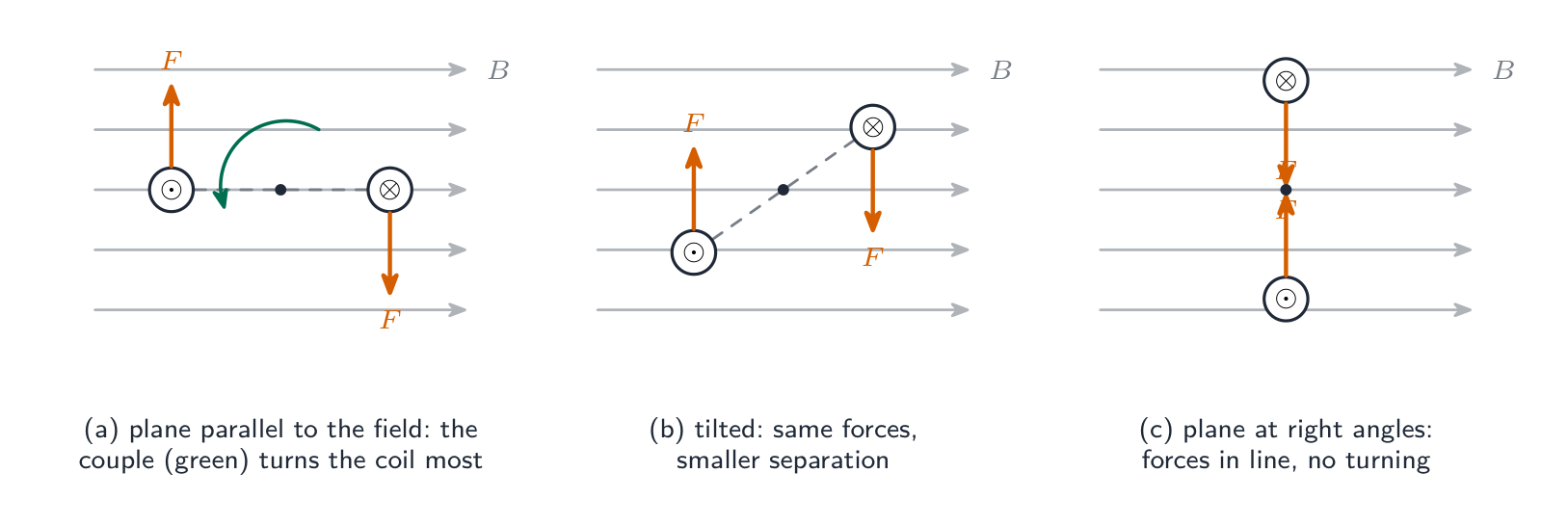
例题(线圈上的力)。 矩形线圈 PQRS 的边 PS 和 QR 长 $8.0\ \text{cm}$,载 $1.2\ \text{A}$ 电流,处于 $0.30\ \text{T}$ 的水平场中,线圈平面平行于场。描述线圈所受的力。
边 PS 和 QR 垂直于场,所以每边受力 $F = BIL = 0.30 \times 1.2 \times 0.080 = 2.9 \times 10^{-2}\ \text{N}$;它们中的电流方向相反,所以由弗莱明定则两力等大反向,一个向上一个向下。边 PQ 和 SR 平行于场,不受力。这两个力形成一个力偶(couple),使线圈绕轴转动;随着线圈转动,力的大小不变但它们的垂直距离缩小,所以当线圈平面垂直于场时转动效果降为零。这是电动机和动圈式电表的原理。
磁通密度
这个方程也定义了磁通密度(magnetic flux density)$B$:
$$B = \frac{F}{IL} \quad\text{(wire at right angles to the field).}$$
所以 $B$ 是垂直于场的导线上每单位电流每单位长度所受的力。单位:特斯拉(tesla),$\text{T} = \text{N A}^{-1}\ \text{m}^{-1}$。
两分定义。 磁通密度是放在垂直于场的(直)导体上每单位电流每单位长度所受的力。 "每单位电流"和"每单位长度"都需要,"垂直"(或"成直角")也需要:没有它定义就是错的,因为力还取决于角度。特斯拉是使载 1 安培电流、垂直于场的 1 米导体受到 1 牛顿力的磁通密度:$1\ \text{T} = 1\ \text{N A}^{-1}\ \text{m}^{-1}$。
方向——弗莱明左手定则
用左手(弗莱明左手定则(Fleming's left-hand rule)):食指 = 磁场(Field),中指 = 电流(Current),拇指 = 力(推力)。把三者摆成直角。

探索
Feel the force on the wire
A current in a magnetic field feels a force F = BIL at right angles to both — reverse the current or flip the magnet and the force jumps the other way.
词汇表
训练
| 英文 | 中文 | 拼音 |
|---|---|---|
| couple/ˈkʌpl/ | 力偶 | lì ǒu |
| magnetic flux density/mæɡˈnetɪk flʌks ˈdensɪti/ | 磁通密度 | cí tōng mì dù |
| magnetic flux/mæɡˈnetɪk flʌks/ | 磁通量 | cí tōng liàng |
| tesla/ˈteslə/ | 特斯拉 | tè sī lā |
| Fleming's left-hand rule/ˈflemɪŋz left hænd ruːl/ | 弗莱明左手定则 | fú lái míng zuǒ shǒu dìng zé |
20.3
运动电荷受到的力

大纲
- determine the direction of the force on a charge moving in a magnetic field
- recall and use $F = BQv \sin \theta$
- understand the origin of the Hall voltage and derive and use the expression $V_{\text{H}} = BI / (ntq)$, where $t = \text{thickness}$
- understand the use of a Hall probe to measure magnetic flux density
- describe the motion of a charged particle moving in a uniform magnetic field perpendicular to the direction of motion of the particle
- explain how electric and magnetic fields can be used in velocity selection
来源:剑桥国际大纲
一个以速度(velocity)$v$ 穿过场运动的电荷 $Q$ 感受到
$$F = B Q v \sin\theta,$$
其中 $\theta$ 是 $v$ 与 $B$ 之间的夹角。同样的左手定则(中指是一个正电荷的运动方向——负电荷时反过来)。当 $v$ 垂直于 $B$ 时力最大,当 $v$ 沿 $B$ 时为零。
不受力的两种情况。 磁场中的带电粒子在静止(没有 $v$)或平行或反平行于场运动($\sin\theta = 0$)时不受力。对比电场,它对静止电荷的推力一样大:这个差别正是下面速度选择器的全部要点。
匀强场中的圆周运动
一个垂直于匀强场(uniform field)运动的电荷感受到一个同时垂直于 $v$ 和 $B$ 的力。这个力不做功(总是垂直于运动),所以动能(kinetic energy)和速率保持恒定——粒子做圆周运动。令磁力等于向心力(centripetal force):
$$B Q v = \frac{m v^{2}}{r}, \qquad r = \frac{m v}{B Q}.$$
例题。 一个质子(质量 $1.7 \times 10^{-27}\ \text{kg}$,电荷 $1.6 \times 10^{-19}\ \text{C}$)以 $2.0 \times 10^{6}\ \text{m s}^{-1}$ 垂直于一个 $0.50\ \text{T}$ 的场运动。求它圆形路径的半径。
$$r = \frac{mv}{BQ} = \frac{(1.7 \times 10^{-27})(2.0 \times 10^{6})}{(0.50)(1.6 \times 10^{-19})} \approx 0.043\ \text{m}.$$
所以半径取决于动量(momentum)$mv$。周期是
$$T = \frac{2\pi m}{B Q},$$
它不取决于速率——更快的粒子走更大的圆,但每圈用相同的时间。如果 $v$ 还有一部分沿 $B$,那部分不变,路径是一条螺旋(helix)。
"解释为什么路径是圆的。" 磁力总是垂直于速度,所以它改变运动方向而不改变速率,而且它的大小 $BQv$ 是恒定的,因为 $B$、$Q$ 和 $v$ 恒定。一个大小恒定、始终垂直于速度的力正是向心力(centripetal force),所以路径是圆。三个要点都要给出:垂直、大小恒定、速率不变。
例题。 以 $1.7 \times 10^{7}\ \text{m s}^{-1}$ 运动的电子垂直进入磁通密度为 $4.8\ \text{mT}$ 的匀强场。求它们路径的半径。然后把电子换成沿同一初始直线以 $3.4 \times 10^{7}\ \text{m s}^{-1}$ 运动的正电子(positrons,质量相同,电荷 $+e$):描述路径如何变化。
$$r = \frac{mv}{BQ} = \frac{(9.11 \times 10^{-31})(1.7 \times 10^{7})}{(4.8 \times 10^{-3})(1.60 \times 10^{-19})} = 2.0 \times 10^{-2}\ \text{m}.$$
正电子向相反方向偏转(正电荷,所以弗莱明定则中指沿运动方向时给出相反方向的力),而由于 $r \propto v$,它们的半径是两倍,$4.0\ \text{cm}$。它们的周期相同($T = 2\pi m/BQ$ 中没有 $v$):它们以两倍的速率绕更大的圆。
霍尔效应
一块载电流 $I$ 的导体板,在垂直于电流的场 $B$ 中,在它的两个面之间产生一个电压——霍尔电压(Hall voltage)$V_{\text{H}}$(霍尔效应(Hall effect))。
运动的电荷感受到一个磁力 $BQv_{\text{d}}$($v_{\text{d}}$ 是漂移速度(drift velocity)),所以它们在一个面上积累,产生一个阻止更多积累的电场(electric field)$E$。在稳态时 $eE = Bev_{\text{d}}$,所以 $E = B v_{\text{d}}$。用 $V_{\text{H}} = E w$ 和 $I = n e v_{\text{d}} w t$:
$$V_{\text{H}} = \frac{B I}{n t q},$$
其中 $q$ 是载流子电荷。霍尔探头(Hall probe)用这个来测量 $B$:让一个已知电流通过一块薄的半导体(semiconductor)板并读出 $V_{\text{H}}$(当板垂直于 $B$ 时最大)。

推导 $V_{\text{H}} = BI/(ntq)$(考试要求完整推导)。取一片宽为 $d$(霍尔电压出现在这个宽度两侧)、沿 $B$ 方向厚为 $t$ 的薄片,所以电流通过的横截面为 $A = dt$。(1) 稳态时载流子所受的电力与磁力平衡:$qE = Bqv$,所以 $E = Bv$。(2) 霍尔电场在宽度上均匀,所以 $V_{\text{H}} = Ed = Bvd$。(3) 电流为 $I = nAvq = n\,dt\,vq$,所以 $v = I/(n\,dt\,q)$。代入:$V_{\text{H}} = Bd \cdot I/(n\,dt\,q) = BI/(ntq)$。要注意两点:电压出现在垂直于磁力的两个面之间,而不是电流进入的两端之间;而且它对半导体更大,因为半导体的数密度 $n$ 比金属小几百万倍,这就是探头用半导体薄片的原因。
使用霍尔探头。 读数与 $B$ 成正比,但也取决于取向:薄片平面垂直于场时读数最大,场在薄片平面内时读数为零。所以 (1) 转动探头直到读数最大,并且 (2) 在已知场中校准(calibrate)它,因为固定电流下 $V_{\text{H}} \propto B$。
例题。 一个霍尔探头在 $32\ \text{mT}$ 的匀强场中给出最大读数 $24\ \text{mV}$。在第二个场中,探头再次转到最大读数,读数为 $15\ \text{mV}$。求第二个磁通密度。
$V_{\text{H}} \propto B$(同一探头,同一电流):$B = 32 \times 15/24 = 20\ \text{mT}$。若探头留在其他角度,读数会更小,$B$ 就会被低估,这就是"转到最大"是方法一部分的原因。
速度选择器
速度选择器(velocity selector)用正交的电场和磁场只让一个速率通过。在电力 $qE$ 和磁力 $qvB$ 被设为相互对抗的情况下,只有当满足下式时净力为零
$$qE = qvB \quad\Rightarrow\quad v = \frac{E}{B}.$$
速率为 $E/B$ 的粒子笔直通过;较快或较慢的被偏转。

推导并解释选择器。 正离子穿过正交场时所受的磁力为 $BQv$,垂直于它的运动;所加电场使电力 $QE$ 方向相反(板的布置必须使场逆着磁力方向)。要让离子笔直通过,$QE = BQv$,所以 $v = E/B$,与电荷和质量无关。更快的离子受更大的磁力,向磁力一侧弯曲;更慢的离子被不变的电力推向另一侧。被问到"解释如何用电场使粒子到达 Z"时,要说电力必须朝哪个方向、大小必须等于磁力,并给出 $E = Bv$。这就是速度选择(velocity selection)。
探索
Force on a moving charge
F = BQv
The magnetic force on a charge is proportional to its speed (for a fixed field and charge).
词汇表
训练
| 英文 | 中文 | 拼音 |
|---|---|---|
| uniform field/ˈjuːnɪfɔːm fiːld/ | 匀强场 | yún qiáng chǎng |
| velocity/vəˈlɒsɪti/ | 速度 | sù dù |
| electric field/ɪˈlektrɪk fiːld/ | 电场 | diàn chǎng |
| velocity selector/vəˈlɒsɪti sɪˈlektə/ | 速度选择器 | sù dù xuǎn zé qì |
| kinetic energy/kɪˈnetɪk ˈenədʒi/ | 动能 | dòng néng |
| centripetal force/senˈtrɪpɪtl fɔːs/ | 向心力 | xiàng xīn lì |
| momentum/məʊˈmentəm/ | 动量 | dòng liàng |
| helix/ˈhiːlɪks/ | 螺旋 | luó xuán |
| positrons/ˈpɒzɪtrɒnz/ | 正电子 | zhèng diàn zi |
| Hall effect/hɔːl ɪˈfekt/ | 霍尔效应 | huò ěr xiào yìng |
| Hall voltage/hɔːl ˈvəʊltɪdʒ/ | 霍尔电压 | huò ěr diàn yā |
| drift velocity/drɪft vəˈlɒsɪti/ | 漂移速度 | piāo yí sù dù |
| Hall probe/hɔːl prəʊb/ | 霍尔探头 | huò ěr tàn tóu |
| semiconductor/ˌsemɪkənˈdʌktə/ | 半导体 | bàn dǎo tǐ |
| calibrate/ˈkælɪbreɪt/ | 校准 | jiào zhǔn |
| velocity selection/vəˈlɒsɪti sɪˈlekʃn/ | 速度选择 | sù dù xuǎn zé |
20.4
电流产生的磁场
大纲
- sketch magnetic field patterns due to the currents in a long straight wire, a flat circular coil and a long solenoid
- understand that the magnetic field due to the current in a solenoid is increased by a ferrous core
- explain the origin of the forces between current-carrying conductors and determine the direction of the forces
来源:剑桥国际大纲
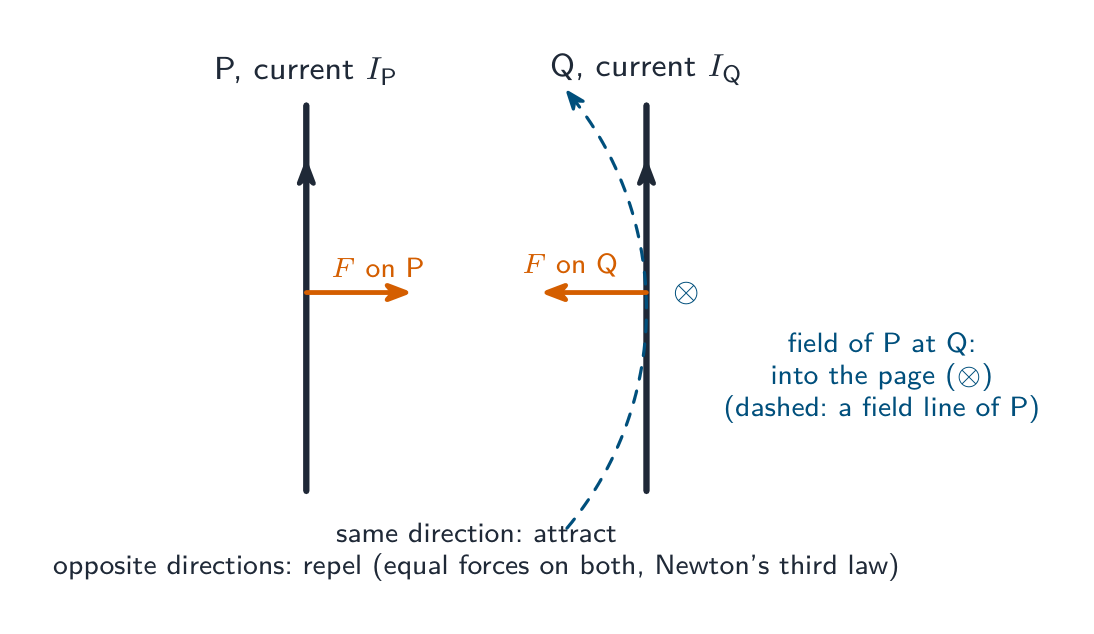
两根长的平行导线各自位于对方的磁场中。用弗莱明左手定则:平行电流(同方向)相吸;反平行电流(相反方向)相斥。这是安培的 SI 定义的基础。
解释这个力(标准三分题)。 (1) P 中的电流在它周围产生磁场(以 P 为圆心的圆)。(2) 在 Q 处这个场垂直于 Q 中的电流,所以 Q 作为磁场中的载流导体受力 $BIL$。(3) 弗莱明左手定则给出方向:电流同向时指向 P,反向时背离。由牛顿第三定律,P 受的力等大反向,所以两根导线以相同的力相吸(或相斥)。把一根导线中的电流加倍会使两根导线所受的力都加倍:Q 受的力增大是因为 $I_{\text{Q}}$ 加倍了,P 受的力增大是因为它所处的场加倍了。
20.5
电磁感应
大纲
- define magnetic flux as the product of the magnetic flux density and the cross-sectional area perpendicular to the direction of the magnetic flux density
- recall and use $\Phi = BA$
- understand and use the concept of magnetic flux linkage
- understand and explain experiments that demonstrate: • that a changing magnetic flux can induce an e.m.f. in a circuit • that the induced e.m.f. is in such a direction as to oppose the change producing it • the factors affecting the magnitude of the induced e.m.f.
- recall and use Faraday's and Lenz's laws of electromagnetic induction
来源:剑桥国际大纲
磁通量
垂直于 $B$ 的一个平面积 $A$ 中的磁通量(magnetic flux)$\Phi$ 是
$$\Phi = B A.$$
如果面积的法线与 $B$ 成 $\theta$ 角,用 $\Phi = B A \cos\theta$。单位:韦伯(weber),$\text{Wb} = \text{T m}^{2}$。对于一个 $N$ 匝的线圈(coil),磁链(flux linkage)是 $N\Phi = N B A$。
两分定义。 磁通量是磁通密度与垂直于场的(电路)面积的乘积。 磁链是磁通量与线圈匝数的乘积,$N\Phi$,单位为韦伯·匝。要说"垂直"(或"与场垂直"):$\Phi = BA$ 只对垂直于 $B$ 的面积分量成立。
例题。 一个 64 匝、横截面积 $0.71\ \text{cm}^{2}$ 的小线圈放在长螺线管内部的轴上,那里的磁通密度为 $2.5\ \text{mT}$。求线圈的磁链。
穿过线圈的磁通用线圈自己的面积,而不是螺线管的:$\Phi = BA = (2.5 \times 10^{-3})(0.71 \times 10^{-4}) = 1.8 \times 10^{-7}\ \text{Wb}$,所以磁链是 $N\Phi = 64 \times 1.8 \times 10^{-7} = 1.1 \times 10^{-5}\ \text{Wb}$。当螺线管的电流变化时,小线圈中感应的电动势就是这个磁链的变化率。
法拉第定律和楞次定律
当穿过一个电路的磁链变化时,就感应出一个电动势(electromotive force,e.m.f.)——这就是电磁感应(electromagnetic induction)。
法拉第定律(Faraday's law):感应电动势等于磁链的变化率:
$$|\varepsilon| = N\frac{d\Phi}{dt}.$$
例题。 一个 $200$ 匝、面积 $0.010\ \text{m}^{2}$ 的线圈,其平面垂直于一个 $0.50\ \text{T}$ 的场。场在 $0.20\ \text{s}$ 内稳定地降到零。求平均感应电动势。
磁链从 $N\Phi = NBA = 200 \times 0.50 \times 0.010 = 1.0\ \text{Wb}$ 变到零,所以
$$|\varepsilon| = \frac{\Delta(N\Phi)}{\Delta t} = \frac{1.0}{0.20} = 5.0\ \text{V}.$$
楞次定律(Lenz's law):感应电动势的作用是阻止产生它的那个变化。这是能量守恒(conservation of energy)——如果它助长变化,能量就会凭空而来。合起来:
$$\varepsilon = -\frac{d(N\Phi)}{dt}.$$
什么改变磁通?
- 改变 $B$(把一块磁铁移近线圈),
- 改变面积 $A$(一根杆沿轨道滑动),
- 改变方向(一个线圈在场中转动——交流发电机,下一个主题)。
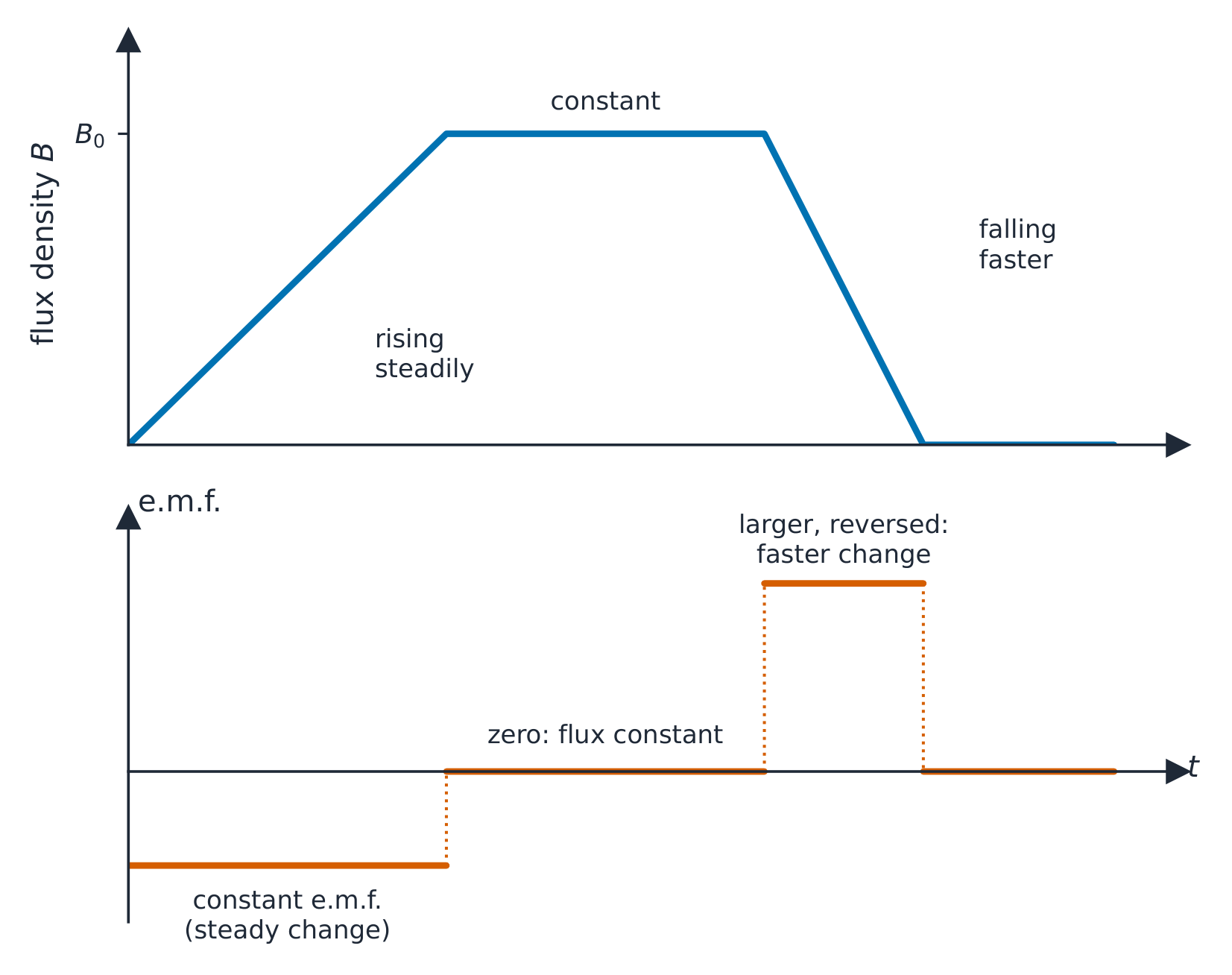
从磁通图读出电动势。 感应电动势是磁链图的斜率(带一个表示楞次定律的负号)。稳定上升的磁通给出恒定的电动势;恒定的磁通给出零电动势,不论磁通多大;更快的下降给出更大、符号相反的电动势。"画出电动势随时间的变化"就是逐段用眼睛对磁通图求导。
例题。 上面的 64 匝线圈处于一个螺线管中,螺线管的磁通密度在 $40\ \text{ms}$ 内从 $0$ 均匀升到 $2.5\ \text{mT}$,然后保持稳定。求上升期间线圈中感应的电动势,以及之后的电动势。
上升期间磁链稳定增长到 $1.1 \times 10^{-5}\ \text{Wb}$:$\varepsilon = \Delta(N\Phi)/\Delta t = 1.1 \times 10^{-5}/0.040 = 2.8 \times 10^{-4}\ \text{V}$($0.28\ \text{mV}$),在上升持续期间恒定。之后磁链恒定,所以电动势为零,即使线圈仍处于强场中:是变化在感应。
例题(切割磁通)。 一架翼展(wingspan)$60\ \text{m}$ 的飞机在地磁场竖直分量为 $45\ \mu\text{T}$ 的地方以 $250\ \text{m s}^{-1}$ 水平飞行。求两翼尖之间的电动势。
在时间 $\Delta t$ 内机翼扫过面积 $L v \Delta t$,切割磁通 $B L v \Delta t$,所以 $\varepsilon = BLv = (45 \times 10^{-6})(60)(250) = 0.68\ \text{V}$。只有垂直于扫过面积的 $B$ 分量才算数(这里是竖直分量)。两翼尖之间有电势差但没有电流,因为没有完整的电路;弗莱明定则给出哪个翼尖为正。
演示
- 把一块条形磁铁移入线圈使检流计(galvanometer)偏转;把磁铁拔出时偏转反向(楞次定律),运动越快偏转越大(法拉第定律)。

- 一个摆入场中的铜盘很快被减速——感应出阻止运动的涡流(eddy currents)。

用楞次定律解释电磁制动。 车辆的铝盘在电磁铁两极之间转动。铝盘切割场线,所以其中感应出电动势;铝盘是导体,所以涡流流动;由楞次定律这些电流产生的力阻碍铝盘的运动,使车辆减速。动能转化为铝盘中的热能。高速时制动更强(切割磁通的速率更大,电流更大),随着车辆减速而减弱;它不能让静止的车辆保持不动,因为没有运动就没有感应电流。
在线圈中振荡的磁铁。 弹簧上的条形磁铁在接有电阻的线圈中进出振荡。变化的磁链感应出电动势;电路闭合时有电流流动,由楞次定律线圈的场阻碍磁铁的运动,所以振荡被阻尼:能量以电阻中的热的形式离开振荡,振幅衰减。断开开关后仍有感应电动势但没有电流,所以线圈不再阻尼这个运动。
什么使感应电动势更大
由 $\varepsilon = N\,d\Phi/dt$ 且 $\Phi = BA$:更多的匝数 $N$、更强的 $B$、更大的面积 $A$,或更快的变化——每一个都给出更大的感应电动势。
用楞次定律判断方向。 把磁铁的 N 极推向线圈,感应电流使线圈的近端面成为北极,以排斥靠近的磁铁;把它拉开,近端面就成为南极,以吸引它。两种情况下移动磁铁的人都要克服那个力做功,而那个功就是电能的来源:楞次定律是伪装起来的能量守恒。要记住的两句话:感应电动势的方向使其产生的效果阻碍产生它的变化(楞次),以及感应电动势与磁链的变化率成正比(法拉第)。
探索
Electromagnetic induction
Move the magnet through the coil — a current is induced only while the field is changing. Faster gives more current; flip the magnet to reverse it.
词汇表
训练
| 英文 | 中文 | 拼音 |
|---|---|---|
| electromagnetic induction/ɪˌlektrəʊməɡˈnetɪk ɪnˈdʌkʃn/ | 电磁感应 | diàn cí gǎn yìng |
| weber/ˈveɪbə/ | 韦伯 | wéi bó |
| flux linkage/flʌks ˈlɪŋkɪdʒ/ | 磁链 | cí liàn |
| Lenz's law/ˈlentsɪz lɔː/ | 楞次定律 | léng cì dìng lǜ |
| electromotive force/ɪˌlektrəʊˈməʊtɪv fɔːs/ | 电动势 | diàn dòng shì |
| Faraday's law/ˈfærədeɪz lɔː/ | 法拉第定律 | fǎ lā dì dìng lǜ |
| conservation of energy/ˌkɒnsəˈveɪʃn ɒv ˈenədʒi/ | 能量守恒 | néng liàng shǒu héng |
| wingspan/ˈwɪŋspæn/ | 翼展 | yì zhǎn |
| galvanometer/ˌɡælvəˈnɒmɪtə/ | 检流计 | jiǎn liú jì |
| eddy currents/ˈedi ˈkʌrənts/ | 涡流 | wō liú |
20.5
考官认可的定义
定义题按固定措辞评分。准确学会这些,只给一个答案。
| 术语 | 定义 |
|---|---|
| 磁场 | 运动电荷、载流导体或磁性材料在其中受到力的区域 |
| 磁通密度 | 放在垂直于场的直导体上每单位电流每单位长度所受的力 |
| 特斯拉 | 使载 1 A 电流、垂直于场的 1 m 导体受到 1 N 力的磁通密度 |
| 磁通量 | 磁通密度与垂直于场的面积的乘积,$\Phi = BA$ |
| 磁链 | 穿过线圈的磁通量与它的匝数的乘积,$N\Phi$ |
| 韦伯 | 一特斯拉·平方米 |
| 法拉第定律 | 感应电动势与磁链的变化率成正比 |
| 楞次定律 | 感应电动势的方向使其产生的效果阻碍产生它的变化 |
| 霍尔电压 | 磁场中载流薄片两侧产生的电势差,$V_{\text{H}} = BI/(ntq)$ |
20.5
考试技巧
- 电流所受的力 $F = BIL\sin\theta$;运动电荷所受的力 $F = BQv\sin\theta$;方向用弗莱明左手定则,中指沿传统电流方向(对电子要反过来)。
- 垂直于 $B$ 运动的电荷做圆周运动:$BQv = mv^{2}/r$,所以 $r = mv/(BQ)$,$T = 2\pi m/(BQ)$,与速率无关。$v$ 沿 $B$ 的分量不变:螺旋线。
- 正交场:$v = E/B$ 的粒子不偏转地通过。霍尔探头:$V_{\text{H}} = BI/(ntq)$,薄片垂直于 $B$ 时最大;用半导体是因为 $n$ 小。
- 感应:电动势 $=$ 磁链 $N\Phi$ 的变化率(法拉第);它的方向阻碍变化(楞次)。在磁通–时间图上电动势是斜率:恒定的变化给出恒定的电动势,没有变化给出零。
- 切割磁通:长 $L$ 的导体以 $v$ 垂直于 $B$ 运动时 $\varepsilon = BLv$(每秒扫过的面积乘以 $B$)。
- 定义带着"每单位电流每单位长度"、"垂直"、"垂直于场的面积"和"磁链的变化率"这些词:每个都是一分。
常见错误
- 在磁通密度的定义中漏掉"垂直于场",或定义特斯拉时没有 1 N、1 m、1 A。
- 对电流所受的力用右手(应是左手定则),或把中指沿电子的运动方向而不是传统电流方向。
- 说静止电荷受到磁力,或说沿场线运动的电荷受到磁力。
- 解释圆周运动时不说力垂直于速度且大小恒定;或声称磁力改变速率。
- 求小线圈的磁链时用螺线管的面积而不是小线圈的面积。
- 说"大的磁通感应出电动势":只有变化的磁链才行。静止在稳恒场中的线圈没有电动势。
- 把楞次定律说成"电流阻碍磁铁"而没有"产生它的变化",或说法拉第定律时没有"变化率"或没有"磁链"。
- 把直导线的场线画成等间距的圆或不带箭头;把螺线管内部的场线画成相交。
- 忘记把两根平行导线之一的电流加倍会使两根导线所受的力都加倍(牛顿第三定律)。
本主题的互动课程
逐步学习,并即时检测练习。