Magnetic fields due to currents
Introduced| English | Meaning |
|---|---|
| iron core/ˈaɪən kɔː/ | A piece of iron placed inside a coil or magnetic device to guide and strengthen its magnetic field. |
| right-hand grip rule/raɪt hænd ɡrɪp ruːl/ | A right-hand rule linking current and magnetic field: around a straight wire the thumb follows current and the curled fingers follow the magnetic field. |
| bar magnet/bɑː ˈmæɡnɪt/ | bar magnet |
| solenoid/ˈsəʊlənɔɪd/ | A coil of wire that produces a magnetic field when an electric current flows through it. |
A magnet with an off switch
- A scrapyard crane picks up a tonne of steel, swings it across the yard, and drops it by flicking a switch.
- No permanent magnet can do that. What the crane carries is a coil of wire around an iron core, and its magnetism exists only while the current flows.
- Every field in this lesson comes from a current, which means every one of them can be switched, reversed or made stronger at will.
- This lesson is the field patterns that currents produce, and the forces between two currents.
The field around a straight wire
- The field forms concentric circles around the wire, in the plane perpendicular to it.
- Their spacing widens with distance, because the field weakens as you move away.
- The direction comes from the right-hand grip rule 右手定则: grip the wire with your right hand, thumb along the current, and your fingers curl the way the field points.
- For a current into the page, that gives a clockwise field.
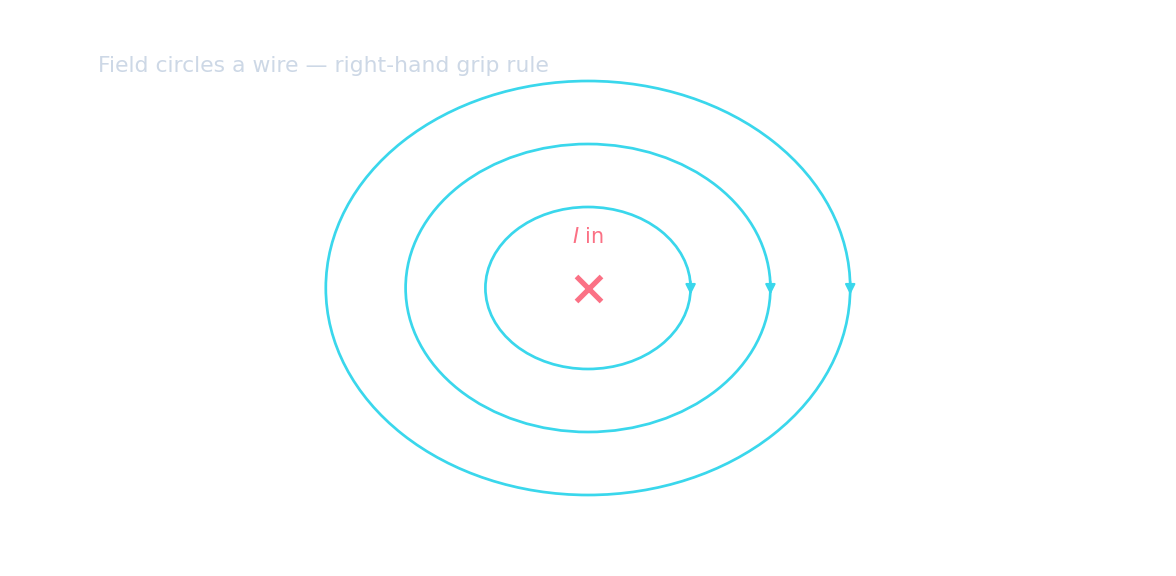
Circles, widening, each with an arrow
Current field rule lab
Connect current direction to the circular magnetic field around a wire.
The magnetic field around a long straight wire forms:
Difficulty 1/5 · 100 coins + a small bonus on first completion today
Concentric circles, with the direction given by the right-hand grip rule.
The right-hand grip rule gives the direction of the field around a current-carrying wire.
Difficulty 1/5 · 100 coins + a small bonus on first completion today
Thumb along the current, curled fingers show the way the circular field points.
The flat circular coil
- Bend the wire into a loop and the circular fields around each side reinforce through the centre.
- So the field at the centre is at right angles to the plane of the coil, and strongest there.
- Seen from one face the coil behaves as a north pole, since the field leaves it there; from the other face, a south pole. A single loop is already a small bar magnet 条形磁铁.
What is the direction of the magnetic field at the centre of a flat circular coil?
Difficulty 1/5 · 100 coins + a small bonus on first completion today
The circular fields around the two sides reinforce through the centre, so the coil acts as a small bar magnet, north from one face and south from the other.
The solenoid
- A solenoid 螺线管 is many such loops in a row. Their fields add along the axis, so inside the field is nearly uniform and parallel to the axis, exactly like a stretched bar magnet.
- Outside it spreads out and falls off fast, and the ends behave as N and S poles.
- Three things strengthen it: more turns per unit length, a larger current, and an iron core 铁芯.

Uniform down the axis, and poles at the ends
Inside a long solenoid the magnetic field is nearly ____.
Difficulty 1/5 · 100 coins + a small bonus on first completion today
Like a stretched bar magnet — the field inside is uniform and parallel to the axis.
Adding an iron core greatly increases a solenoid's magnetic field.
Difficulty 1/5 · 100 coins + a small bonus on first completion today
The iron's atomic magnets line up and add to the field — used in electromagnets and transformers.
Which changes increase the magnetic field inside a solenoid? Select all that apply.
Difficulty 2/5 · 140 coins + a small bonus on first completion today
Turns per unit length, current and a ferrous core. A thicker wire lowers the resistance but does not itself change the field for a given current.
Worked example: why the core helps
- Explain why inserting an iron core greatly increases the magnetic field of a solenoid.
- The core is a ferrous material, so the solenoid's field magnetises it: its atomic magnets line up with the field.
- The magnetised core then produces its own magnetic field, which adds to the field of the current.
- The two together are far stronger than the current's field alone. Both steps, magnetised and adds its own field, are needed for the marks. "It concentrates the field lines" is not the marked answer.
Put the explanation of why an iron core strengthens a solenoid in order.
Difficulty 3/5 · 200 coins + a small bonus on first completion today
Both middle steps are needed for the marks: magnetised, and adding its own field. "It concentrates the field" is not the marked wording.
Two parallel currents
- Each wire sits in the field of the other, so each experiences a motor-effect force $F = BIL$.
- Apply the left-hand rule to each wire in turn, using the field the other one makes. The result is symmetric, as Newton's third law requires.
- Currents in the same direction attract. Currents in opposite directions repel.
- This force is the basis of the historical definition of the ampere.
Two parallel wires carrying currents in the same direction:
Difficulty 1/5 · 100 coins + a small bonus on first completion today
Same-direction currents attract; opposite-direction currents repel. This is the basis of the ampere.
Match each task to the rule you use.
Difficulty 2/5 · 140 coins + a small bonus on first completion today
A parallel-wires question needs both: the right hand for the field one wire makes, then the left hand for the force it exerts on the other.
Worked example: predicting the direction
- Two long parallel wires carry currents in the same direction. Show that they attract.
- Use the right-hand grip rule on the left wire: in the region of the right wire, its field points into the page, say.
- Now use the left-hand rule on the right wire: field into the page, current up the page, so the force on it is towards the left wire.
- Repeat for the other wire and the force is towards the first. They attract. Note that like currents attract, which is the opposite of what like charges do.
Marks that slip away
- Right hand for the field a current makes; left hand for the force on a current in a field. Both appear in a parallel-wires question and they are not interchangeable.
- The field around a wire is circles, not lines along the wire, and their spacing widens.
- The iron core is magnetised and adds its own field. Say both parts.
- Currents in the same direction attract, unlike charges of the same sign.
You've got it
- a straight wire's field is concentric circles with widening spacing, direction from the right-hand grip rule
- a flat coil gives a field at right angles through its centre and acts as a small bar magnet; a solenoid is nearly uniform inside and has poles at its ends
- more turns per unit length, a larger current and an iron core all strengthen a solenoid, the core because it is magnetised and adds its own field
- parallel currents attract when in the same direction and repel when opposite, found by using the right-hand rule for the field and the left-hand rule for the force