- understand that internal energy is determined by the state of the system and that it can be expressed as the sum of a random distribution of kinetic and potential energies associated with the molecules of a system
- relate a rise in temperature of an object to an increase in its internal energy
热力学
A-Level 物理 · 第 16 主题
 15:27
15:27
Internal Energy
Pump up a bicycle tyre, quickly and hard, and something surprising happens: the pump gets hot. Warm enough to feel. You did not heat it with a flame. So where…
英文讲解 · 内嵌中英文字幕
16.1
内能

大纲
来源:剑桥国际大纲
一个系统的内能(internal energy)$U$ 是下列各项之和:
- 它的分子(molecules)的随机动能(random kinetic energies)——它们在空间中飞行(平动(translational)运动),除非它们是单原子,否则还会旋转(转动(rotational))和摇动(振动(vibrational)),以及
- 分子间的力产生的势能(potential energies)。
对于一个真实的固体、液体或气体,两部分都重要。在理想气体(ideal-gas)模型中,分子间(intermolecular)力被忽略,所以分子势能为零,内能纯粹是动能。
两分的定义。 系统的内能是其分子(或原子)的动能与势能的随机分布之和。 两分都需要"动能与势能之和"以及"随机"(或"分子的")——漏掉"随机"描述的是运动物体的能量,不是它的内能。对理想气体,"结合动能和势能"来说:内能只是分子的总动能,因为没有分子间力,因而没有势能。
两个关键点:
- $U$ 只取决于系统的状态(它的温度(temperature)、压强(pressure)、体积(volume)、物质的量(amount of substance))——而不取决于到达那里所走的路径。
- $U$ 是对分子求和,而不是整个物体运动的动能。一列运动的气体有整体动能,但那与 $U$ 无关——$U$ 是随机分子运动的能量。
温度和内能
升高一个物体的温度会升高它的分子的随机动能,因而升高它的内能。
对于理想气体,每个分子有平均平动动能 $\tfrac{3}{2} k T$(主题 15)。在分子间势能为零的情况下,总内能是
$$U = \tfrac{3}{2} N k T = \tfrac{3}{2} n R T.$$
所以理想气体的内能与热力学温度(thermodynamic temperature)成正比。$T$ 翻倍使 $U$ 翻倍。这只对理想气体才精确。
在一个真实物质的相变(phase change,熔化或沸腾)过程中,$U$ 上升是因为分子势能上升(键在断裂),尽管温度保持不变。
描述内能的变化——总要把两种能量都点名。 三分的"结合分子动能和势能描述并解释"的答案要说出每一种发生了什么:
- 气体在恒容下被加热: 分子的动能增加,因为温度是它们平均动能的量度;势能不变(不做功,分子间距不变);所以内能增加。
- 导线在恒温下于弹性限度内被拉伸: 原子的动能不变(温度相同);势能增加,因为原子克服原子间力被拉得更开;所以内能增加。
- 冰在 $0\ ^{\circ}\text{C}$ 熔化: 动能不变(恒温);势能增加,因为分子间的键被打破、间距增大;所以内能增加,增量为供给的潜热。
例题。 一固定质量的理想气体在恒压下被加热。画出其内能 $U$ 随体积 $V$ 的变化。
恒压下 $V \propto T$(查理定律),而理想气体 $U \propto T$,所以 $U \propto V$:过原点的直线。原点在线上,因为在绝对零度 $V$(外推)和 $U$ 都为零。
探索
The spread of molecular energies
Internal energy is the total random kinetic + potential energy of the molecules. Heat the gas and the whole speed distribution shifts to higher energy.
词汇表
训练
| 英文 | 中文 | 拼音 |
|---|---|---|
| internal energy/ɪnˈtɜːnl ˈenədʒi/ | 内能 | nèi néng |
| kinetic energy/kɪˈnetɪk ˈenədʒi/ | 动能 | dòng néng |
| molecules/ˈmɒlɪkjuːlz/ | 分子 | fèn zǐ |
| molecule/ˈmɒlɪkjuːl/ | 分子 | fèn zǐ |
| translational/trænˈsleɪʃənl/ | 平动 | píng dòng |
| rotational/rəʊˈteɪʃənl/ | 转动 | zhuǎn dòng |
| vibrational/vaɪˈbreɪʃənl/ | 振动 | zhèn dòng |
| ideal-gas/aɪˈdɪəl ɡæs/ | 理想气体 | lǐ xiǎng qì tǐ |
| intermolecular/ˌɪntəməˈlekjʊlə/ | 分子间 | fèn zǐ jiān |
| ideal gas/aɪˈdɪəl ɡæs/ | 理想气体 | lǐ xiǎng qì tǐ |
| temperature/ˈtemprɪtʃə/ | 温度 | wēn dù |
| pressure/ˈpreʃə/ | 压强 | yā qiáng |
| volume/ˈvɒljuːm/ | 体积 | tǐ jī |
| amount of substance/əˈmaʊnt ɒv ˈsʌbstəns/ | 物质的量 | wù zhì dì liàng |
| thermodynamic temperature/ˌθɜːməʊdaɪˈnæmɪk ˈtemprɪtʃə/ | 热力学温度 | rè lì xué wēn dù |
| phase change/feɪz tʃeɪndʒ/ | 相变 | xiāng biàn |
16.2
热力学第一定律

大纲
- recall and use $W = p\Delta V$ for the work done when the volume of a gas changes at constant pressure and understand the difference between the work done by the gas and the work done on the gas
- recall and use the first law of thermodynamics $\Delta U = q + W$ expressed in terms of the increase in internal energy, the heating of the system (energy transferred to the system by heating) and the work done on the system
来源:剑桥国际大纲
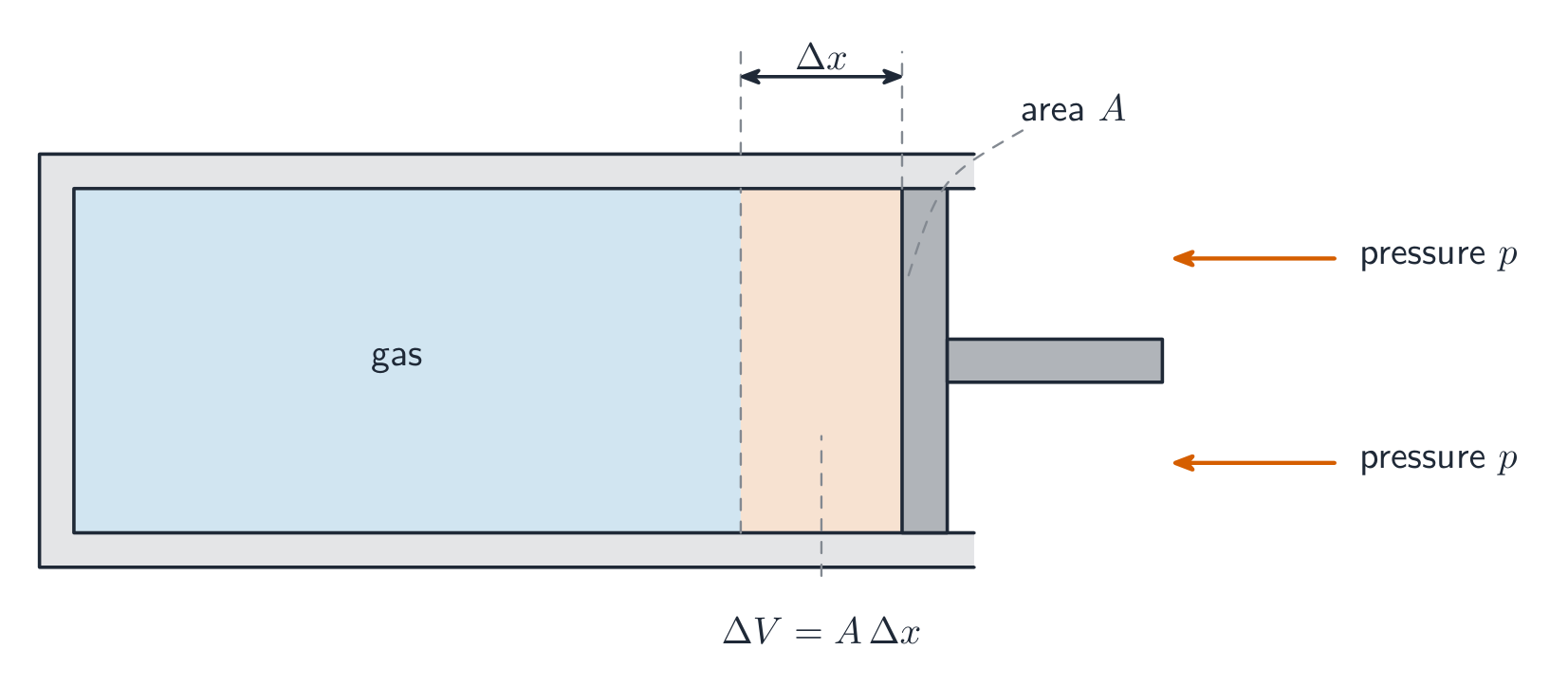
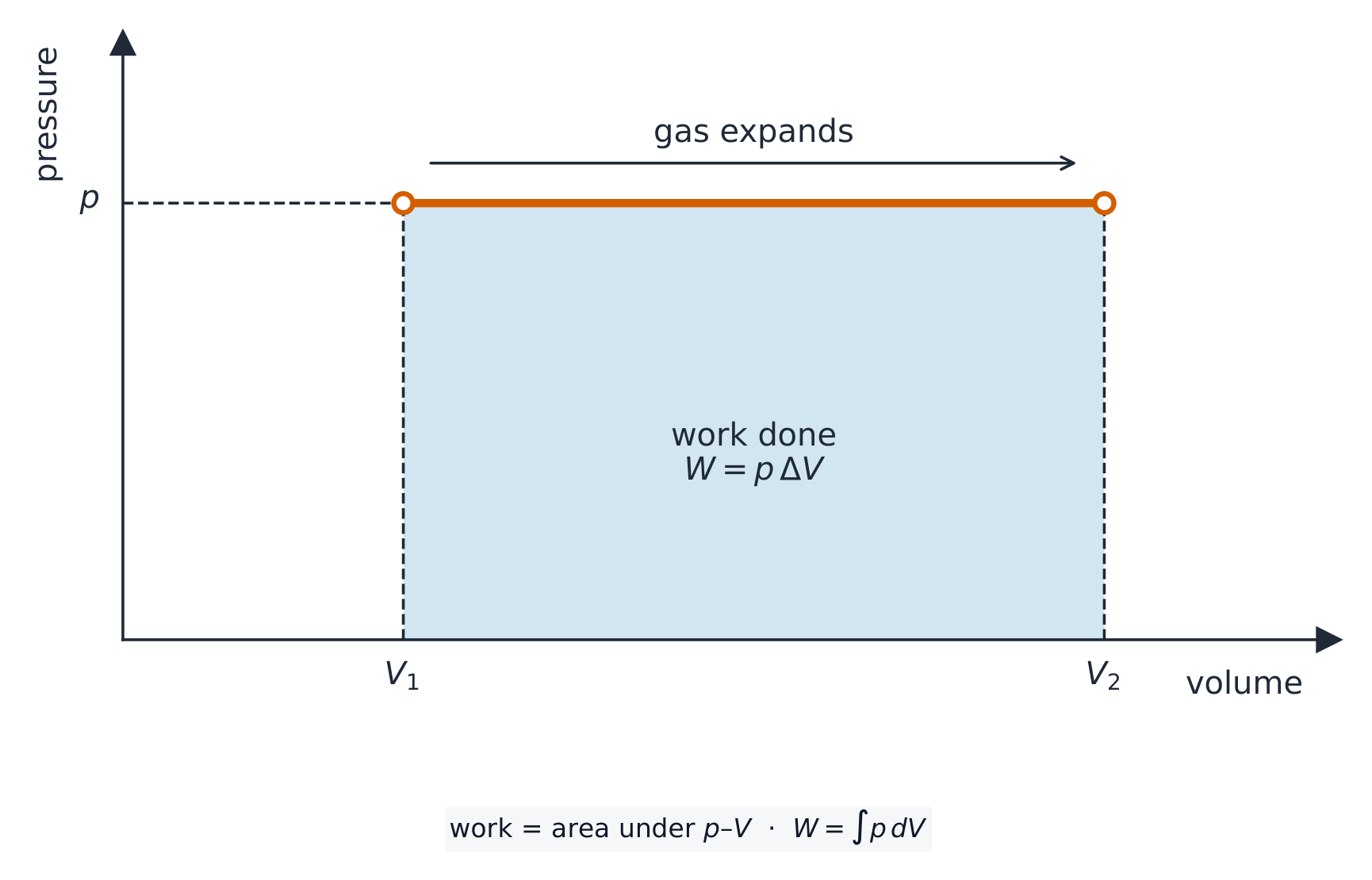
当一个气体克服外部压强改变体积时,就做了机械功。在恒压 $p$ 下体积有小的变化 $\Delta V$ 时,功的大小是
$$W = p \Delta V.$$
例题。 一个气体在 $1.0 \times 10^{5}\ \text{Pa}$ 的恒压下从 $2.0 \times 10^{-3}\ \text{m}^{3}$ 膨胀到 $5.0 \times 10^{-3}\ \text{m}^{3}$。求气体所做的功。
$$W = p\,\Delta V = (1.0 \times 10^{5})(5.0 \times 10^{-3} - 2.0 \times 10^{-3}) = 300\ \text{J}.$$
例题。 质量 $0.35\ \text{kg}$ 的理想气体在 $2.0 \times 10^{5}\ \text{Pa}$ 的恒压下被加热;它的内能增加 $7600\ \text{J}$,体积增加 $1.2 \times 10^{-2}\ \text{m}^{3}$。求气体所做的功和供给的热能。然后该气体在恒容下被加热,直到内能同样增加 $7600\ \text{J}$;解释为什么需要的热能更少。
气体所做的功 $= p\Delta V = 2.0 \times 10^{5} \times 1.2 \times 10^{-2} = 2400\ \text{J}$,所以对它所做的功 $W = -2400\ \text{J}$。第一定律:$q = \Delta U - W = 7600 - (-2400) = 1.0 \times 10^{4}\ \text{J}$。恒容下不做功($\Delta V = 0$,$W = 0$),所以全部热能都进入内能:$q = \Delta U = 7600\ \text{J}$。恒压下多出的 $2400\ \text{J}$ 是气体膨胀时推开周围环境所做的功。
例题。 体积 $3.612 \times 10^{-3}\ \text{m}^{3}$ 的铝块从 $0\ ^{\circ}\text{C}$ 加热到 $40\ ^{\circ}\text{C}$;它的体积在大气压($1.0 \times 10^{5}\ \text{Pa}$)下增加 $1.0 \times 10^{-5}\ \text{m}^{3}$。比较它对大气做的功与它吸收的热能($m = 9.75\ \text{kg}$,$c = 900\ \text{J kg}^{-1}\ \text{K}^{-1}$)。
铝块所做的功 $= p\Delta V = 1.0 \times 10^{5} \times 1.0 \times 10^{-5} = 1.0\ \text{J}$;热能 $q = mc\Delta T = 9.75 \times 900 \times 40 = 3.5 \times 10^{5}\ \text{J}$。功约是热能的 $3 \times 10^{-6}$,所以对固体 $\Delta U \approx q$:固体和液体几乎不膨胀,$p\Delta V$ 只对气体重要。
本大纲中的正负号约定
本大纲把第一定律写成 $\Delta U = q + W$,其中 $W$ 是对气体所做的功,$q$ 是通过加热注入的能量。

- 当气体被压缩时,$\Delta V$ 为负,对气体所做的功为正——气体获得能量。
- 当气体膨胀时,$\Delta V$ 为正,对气体所做的功为负——气体失去能量(它对周围做功)。
注意一道题要哪种形式:
- "对气体所做的功"——压缩时为正。
- "气体所做的功"——相反的正负号,膨胀时为正。
在恒容时($\Delta V = 0$),不做功。
16.2
热力学第一定律

热力学第一定律(first law of thermodynamics)说,当热和功在一个系统与其周围之间传递时,能量守恒:
$$\Delta U = q + W,$$
其中 $\Delta U$ 是内能的增加,$q$ 是通过加热添加的能量(注入为正,放出为负),$W$ 是对气体所做的功(压缩时为正)。这是气体的能量守恒(conservation of energy)。
按考试的问法。 "陈述热力学第一定律,说明所用符号"(2 分):系统内能的增加量 $\Delta U$ 等于通过加热传给系统的热能 $q$ 与对系统所做的功 $W$ 之和:$\Delta U = q + W$。每个符号都必须连同方向定义——"传给系统"和"对系统"正是让正负号有意义的地方。"说出第一定律描述的改变系统内能的两种方式":加热(热能传入或传出系统)和做功(对系统做功或系统做功)。

例题。 一个气体在膨胀时吸收 $500\ \text{J}$ 的热并对周围做 $200\ \text{J}$ 的功。求它内能的变化。
气体做功,所以对它所做的功是 $W = -200\ \text{J}$:
$$\Delta U = q + W = 500 + (-200) = 300\ \text{J}.$$
用第一定律解释。 三分的"用第一定律解释"答案分三步:说出 $q$ 是什么(及其符号),说出 $W$ 是什么(及其符号),然后把它们合成 $\Delta U$——如果题目问到,再说内能变化对分子意味着什么。
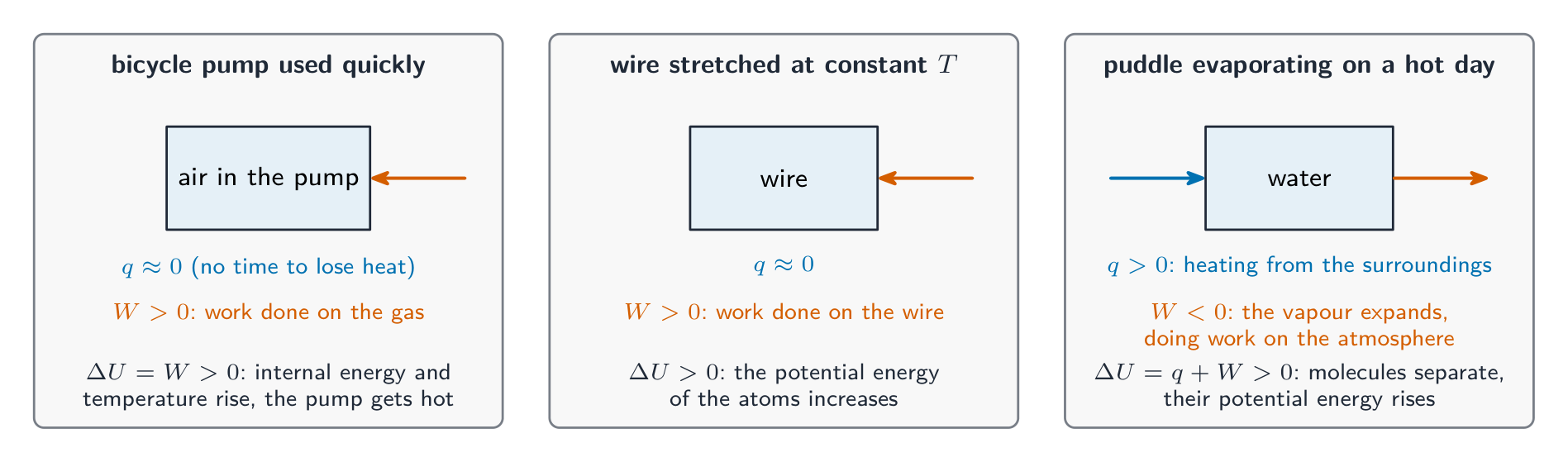
- 为什么快速打气时打气筒会发热: 空气被压缩,所以对它做功($W > 0$);压缩很快,热能来不及散失($q \approx 0$);因此 $\Delta U = W > 0$——空气的内能、从而温度升高,打气筒变热。
- 在恒温下于弹性限度内拉伸的弹簧: 拉力对弹簧做功($W > 0$);没有热能传递($q = 0$);所以内能增加——以原子被拉得更开的弹性势能形式储存。
- 热天从水洼蒸发的水: 热能从周围传给水($q > 0$);形成的蒸气体积远大于液体,所以系统对大气做功($W < 0$);内能仍然增加($q$ 大于所做的功),增加的是势能——分子克服彼此间的吸引力被分开。
解读方程
$\Delta U$ 由状态的变化确定(对理想气体,由温度的变化确定)。相同的 $\Delta U$ 可以来自 $q$ 和 $W$ 的不同搭配:
- 全是热、没有功:$\Delta U = q$(恒容加热)。
- 全是功、没有热:$\Delta U = W$(绝热压缩或膨胀)。
标准过程
对于理想气体,$\Delta U = \tfrac{3}{2} n R \Delta T$——它只取决于 $\Delta T$。
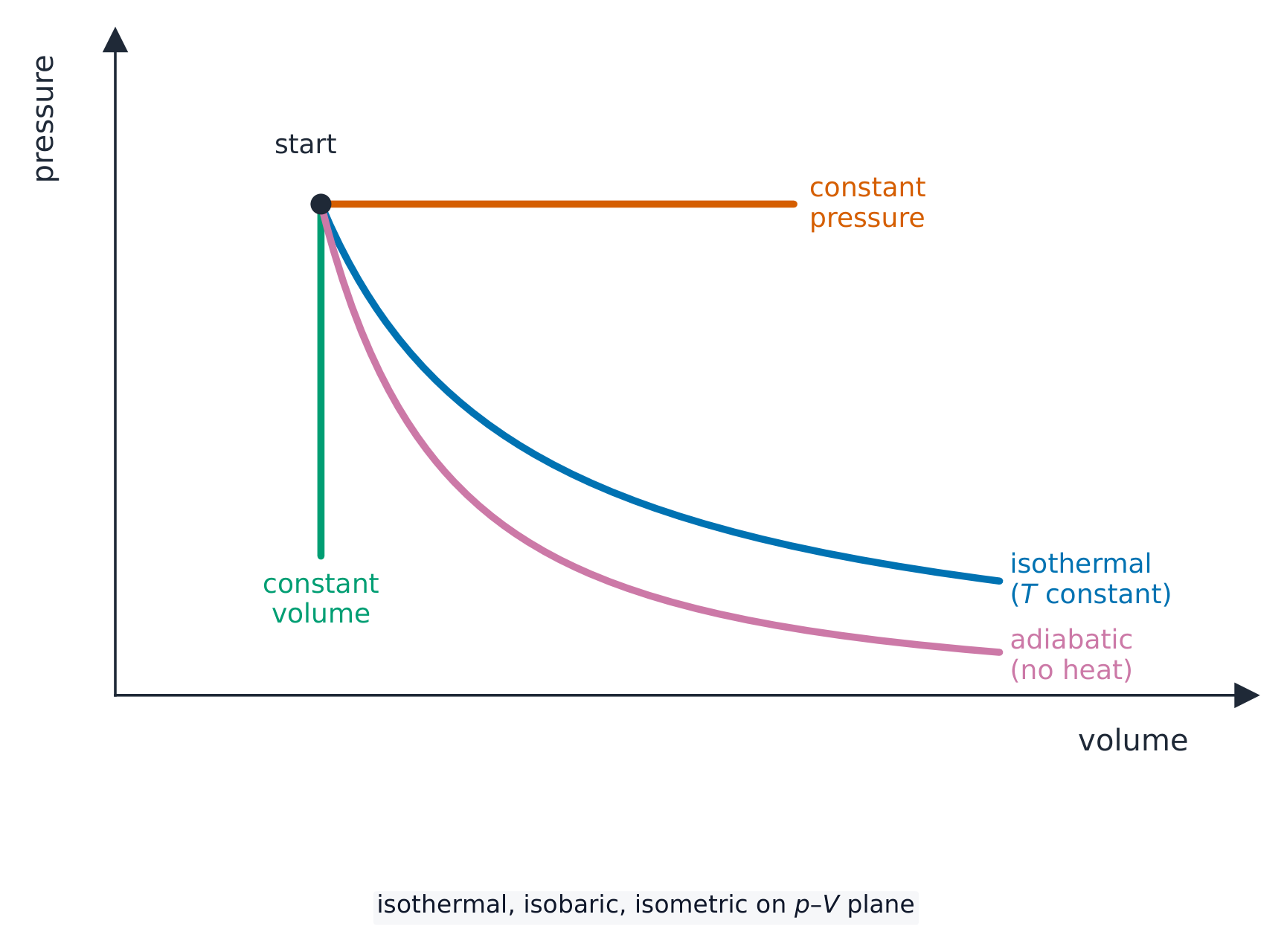
| 过程 | 保持不变的量 | $\Delta U$ | $W$(对气体) | $q$ |
|---|---|---|---|---|
| 等温 | $T$ | $0$ | $W$ | $-W$ |
| 恒容 | $V$ | $\tfrac{3}{2}n R \Delta T$ | $0$ | $\Delta U$ |
| 恒压 | $p$ | $\tfrac{3}{2}n R \Delta T$ | $-p \Delta V$ | $\Delta U - W$ |
| 绝热 | (无热) | 变化 | $W$ | $0$ |
用第一定律 $\Delta U = q + W$ 解读每一行:
- 等温(isothermal,恒定 $T$):$\Delta T = 0$,所以 $\Delta U = 0$。于是 $q = -W$——任何进入的热立刻作为功出来。
- 绝热(adiabatic,无热流):$q = 0$,所以 $\Delta U = W$。气体升温只是因为对它做了功。
- 恒容(密封的刚性容器):不做功($\Delta V = 0$),所以所有的热都进入内能:$q = \Delta U$。
- 恒压(气体推一个活塞(piston)):气体膨胀时做功,所以你供给的热做两件事——升高内能并且做膨胀功。
所以对于同样的内能增量,恒压加热比恒容加热需要更多的热能,多出的恰好是气体膨胀时所做的功 $p\Delta V$——恒容的气体留住了每一焦耳;恒压的气体把一部分还给了周围环境。
例题:两步过程
一份温度为 $T$、内能为 $U$ 的理想气体经历:
- 压缩到温度 $3T$;对气体做功 $W$。
- 恒容冷却到温度 $2T$。
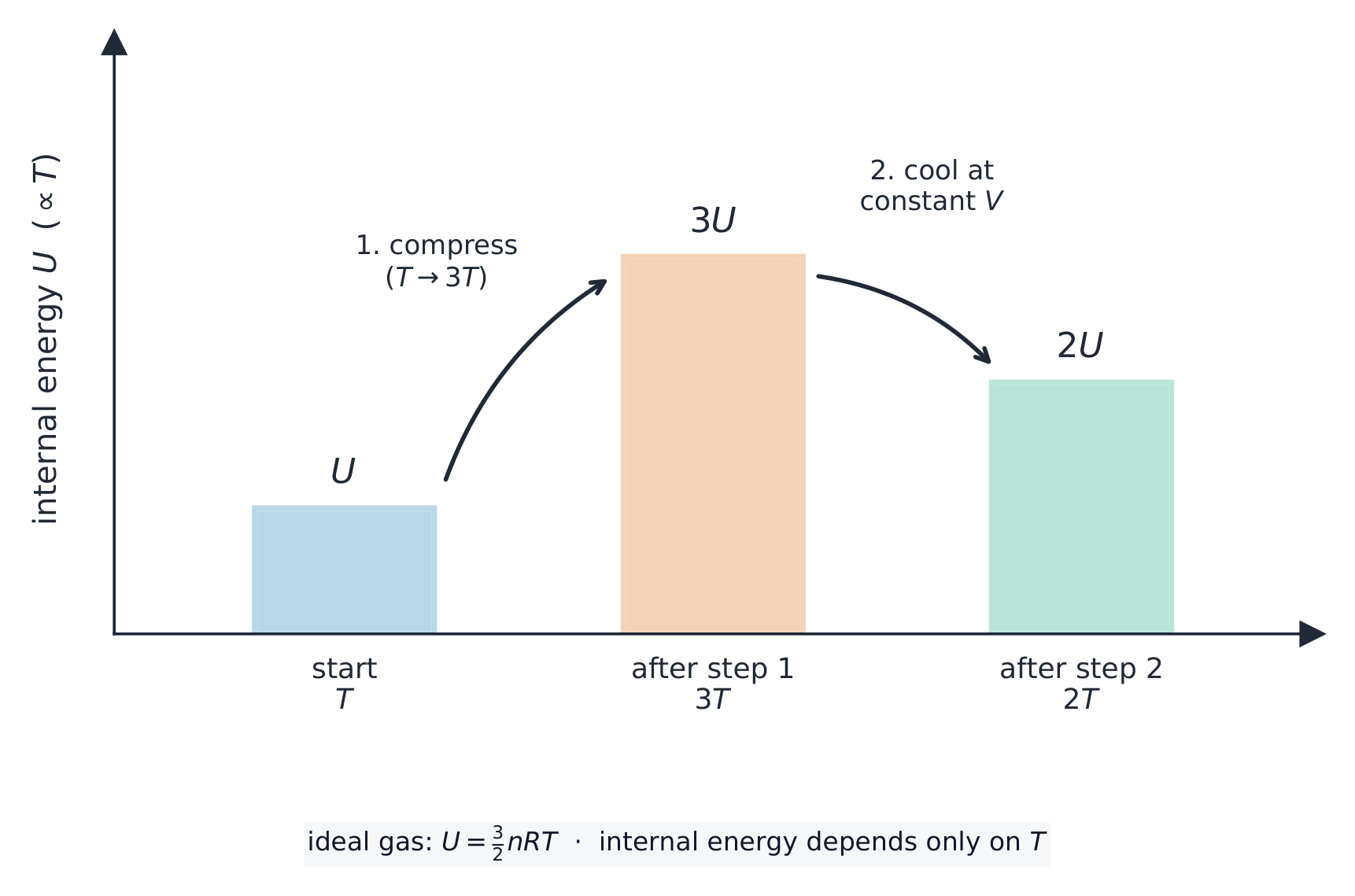
第 1 步($T \to 3T$):$U = \tfrac{3}{2}nRT$,所以 $U \to 3U$,得 $\Delta U_{1} = 2U$。$W_{1} = +W$。所以 $q_{1} = \Delta U_{1} - W_{1} = 2U - W$。
第 2 步($3T \to 2T$,恒容):$\Delta U_{2} = -U$。$W_{2} = 0$。所以 $q_{2} = -U$(热流出)。
检验:总 $\Delta U = 2U - U = U$,把气体从 $T$ 带到 $2T$($U \to 2U$)——一致。
例题:$p$–$V$ 图上的循环
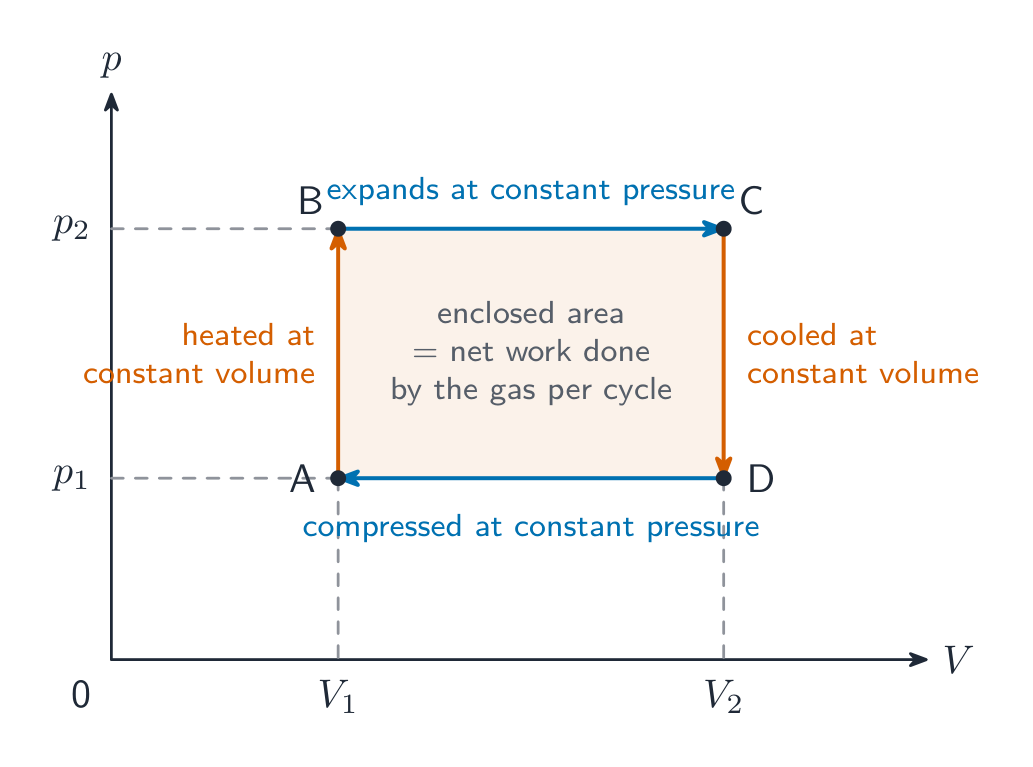
一固定质量的理想气体经历循环 ABCDA:A 到 B 恒容 $V_{1}$(压强 $p_{1} \to p_{2}$),B 到 C 恒压 $p_{2}$(体积 $V_{1} \to V_{2}$),C 到 D 恒容,D 到 A 恒压 $p_{1}$。补全每段 $q$、$W$ 和 $\Delta U$ 的正负号表,并解释 B 到 C 的内能变化。
| 段 | 过程 | $W$(对气体) | $\Delta U$ | $q$ |
|---|---|---|---|---|
| A → B | 恒容,压强升高 | $0$(体积不变) | $+$(温度升高,$pV$ 更大) | $+$($q = \Delta U$) |
| B → C | 恒压,膨胀 | $-$(气体做功 $p_{2}(V_{2} - V_{1})$) | $+$(恒压下 $T \propto V$) | $+$(且大于 $\Delta U$) |
| C → D | 恒容,压强降低 | $0$ | $-$ | $-$(热能流出) |
| D → A | 恒压,被压缩 | $+$(对气体做功 $p_{1}(V_{2} - V_{1})$) | $-$ | $-$(大小超过 $\Delta U$) |
从 B 到 C 气体在恒压下膨胀,所以温度升高($V/T$ 恒定)、内能增加;它对周围做功($W$ 为负),所以供给的热能必须同时支付两者:$q = \Delta U - W$,大于内能的增量。整个循环 $\Delta U = 0$(气体回到初态),所以净输入的热能等于气体所做的净功——矩形围成的面积 $(p_{2} - p_{1})(V_{2} - V_{1})$。
恒容热容
对于理想气体的恒容加热,$q = \Delta U = \tfrac{3}{2} n R \Delta T$。所以单原子(monatomic)理想气体的恒容摩尔热容(heat capacity)是 $\tfrac{3}{2} R$。(你不需要用符号 $C_V$,但恒容加热的结论 $q = \tfrac{3}{2} n R \Delta T$ 是要考的。)

温度不变的加热
如果在恒压下的相变过程中供给热(例如煮水),温度保持不变但内能仍上升(潜热(latent heat)把分子分开),并且气体做膨胀功。第一定律仍成立:$\Delta U = q + W$。
探索
Work done on a gas
Push the piston in and you do work on the gas (W = pΔV); the first law says that work plus the heat added equals the rise in internal energy.
词汇表
训练
| 英文 | 中文 | 拼音 |
|---|---|---|
| latent heat/ˈleɪtənt hiːt/ | 潜热 | qián rè |
| piston/ˈpɪstn/ | 活塞 | huó sāi |
| first law of thermodynamics/fɜːst lɔː ɒv ˌθɜːməʊdaɪˈnæmɪks/ | 热力学第一定律 | rè lì xué dì yí dìng lǜ |
| conservation of energy/ˌkɒnsəˈveɪʃn ɒv ˈenədʒi/ | 能量守恒 | néng liàng shǒu héng |
| isothermal/ˌaɪsəˈθɜːml/ | 等温 | děng wēn |
| adiabatic/ˌædiəˈbætɪk/ | 绝热 | jué rè |
| heat capacity/hiːt kəˈpæsɪti/ | 热容 | rè róng |
| monatomic/ˌmɒnəˈtɒmɪk/ | 单原子 | dān yuán zi |
16.2
考官认可的定义
定义题按固定措辞给分。把这些记准,并且只给一个答案。
| 术语 | 定义 |
|---|---|
| 内能 | 系统分子的动能与势能的随机分布之和 |
| 理想气体的内能 | 其分子的总随机动能,因为没有分子间力就没有势能 |
| 热力学第一定律 | 系统内能的增加量等于通过加热传给系统的热能加上对系统所做的功:$\Delta U = q + W$ |
| 恒压下对气体所做的功 | 大小为 $W = p\Delta V$;气体被压缩时为正,膨胀时为负(此时气体对周围做功) |
| 热能传递(加热) | 因温度差而传入或传出系统的能量;$q$ 传入时为正 |
| 等温变化 | 恒温下的变化,所以对理想气体 $\Delta U = 0$,$q = -W$ |
| 绝热变化 | 没有热能传递的变化,$q = 0$,所以 $\Delta U = W$ |
16.2
考试技巧
- 第一定律:$\Delta U = q + W$——每个符号都连同方向定义:$q$ 是通过加热传给系统的能量,$W$ 是对系统所做的功。
- 对理想气体,内能只取决于温度($\Delta U \propto \Delta T$)且只有动能;对固体或液体,势能也会变化。
- 恒压下气体所做的功 $= p\Delta V$;从膨胀(所做)或压缩(对其)读出正负号,并记住恒容时 $W = 0$。
- "描述并解释"的答案要点名动能和势能并说出各自的变化;"用第一定律解释"的答案要给出 $q$、$W$、再 $\Delta U$,各带符号。
- 整个循环 $\Delta U = 0$,所以净加热等于气体所做的净功——$p$–$V$ 图上围成的面积。
常见错误
- 把内能定义成"分子的总能量",或漏掉"随机"或"势能"。标准答案要的是随机动能与势能之和。
- $W = p\Delta V$ 的正负号用错。气体膨胀时对它所做的功为负。
- 说理想气体等温压缩时内能升高。恒温下 $\Delta U = 0$:对它做的功又以热的形式离开。
- 因为温度不变就把相变当成 $\Delta U = 0$。势能升高;$\Delta U$ 是潜热减去任何膨胀功。
- 忘了恒压加热的气体要做功,所以同样的 $\Delta U$ 需要比恒容更多的加热。
- 把 $\Delta U = \tfrac{3}{2}nR\Delta T$ 用于真实气体、液体或固体。它只是理想气体的结论。
本主题的互动课程
逐步学习,并即时检测练习。