- understand that (thermal) energy is transferred from a region of higher temperature to a region of lower temperature
- understand that regions of equal temperature are in thermal equilibrium
温度
A-Level 物理 · 第 14 主题
 11:46
11:46
Thermal Physics
Touch a metal spoon, then a wooden table, in the same room. The metal feels much colder. So it must be colder — right? Wrong. Bring a thermometer, and both…
英文讲解 · 内嵌中英文字幕
14.1
热平衡

大纲
来源:剑桥国际大纲
热量(heat,热能)从较高温度流向较低温度。当两个物体接触时,能量移动直到它们的温度相等——它们达到热平衡(thermal equilibrium)。在平衡时没有净的能量流动。
两个处于相同温度(temperature)的区域彼此处于热平衡——没有净能量流动,尽管粒子仍在交换能量。
温度决定热流的方向。它不是一个物体持有多少热能(thermal energy)的量度。一小杯沸水(100 °C)持有的能量远少于一个 25 °C 的游泳池,但放进杯里的一块金属会获得能量,而放进池里的会失去能量。
考官的措辞。 当两个物体之间没有热能的净转移时,它们处于热平衡;这发生在它们温度相同时。被问"为什么温度相同的两个物体处于热平衡"时,那一分是:它们之间没有热能的净流动——能量仍在双向传递,但相等。热能是因为温度差而转移的能量;温度决定方向。
例题。 两个金属长方体 P 和 Q 热接触且处于热平衡。说明这意味着什么,并描述把一个更热的长方体贴上去时会发生什么。
P 和 Q 之间没有净热能传递,因为它们温度相同。更热的长方体把热能传给它们(从高温到低温),直到三者达到一个共同温度;那时,也只有那时,整个组合才处于热平衡。
探索
Thermal equilibrium route
Watch energy transfer until two objects reach the same temperature.
词汇表
训练
| 英文 | 中文 | 拼音 |
|---|---|---|
| thermal equilibrium/ˈθɜːml ˌiːkwɪˈlɪbrɪəm/ | 热平衡 | rè píng héng |
| heat/hiːt/ | 热量 | rè liàng |
| thermal energy/ˈθɜːml ˈenədʒi/ | 热能 | rè néng |
| energy/ˈenədʒi/ | 能量 | néng liàng |
| temperature/ˈtemprɪtʃə/ | 温度 | wēn dù |
14.2
温标

大纲
- understand that a physical property that varies with temperature may be used for the measurement of temperature and state examples of such properties, including the density of a liquid, volume of a gas at constant pressure, resistance of a metal, e.m.f. of a thermocouple
- understand that the scale of thermodynamic temperature does not depend on the property of any particular substance
- convert temperatures between kelvin and degrees Celsius and recall that $T/\text{K} = \theta/\text{ }^{\circ}\text{C} + 273.15$
- understand that the lowest possible temperature is zero kelvin on the thermodynamic temperature scale and that this is known as absolute zero
来源:剑桥国际大纲
任何随温度可重复地变化的物理性质都能做一个温度计(thermometer)。例子:
- 液体的体积——液体玻璃温度计(水银或酒精)。温度上升时,液体膨胀并沿一根狭窄的毛细管(capillary)上升。
- 恒压下气体的体积——气体温度计。气体体积与绝对温度同步上升。
- 金属的电阻——电阻温度计。金属的电阻(resistance)在很宽的范围内几乎与温度同步上升。
- 热电偶的电动势——热电偶(thermocouple)是在两点相连的两种不同金属;它产生的电动势(electromotive force)取决于两个连接点之间的温差。
如果性质不是沿直线变化,不同的温度计读数可能略有不同;它们只在校准(calibration)点处一致。
固定点与校准。 温度计在两个容易复现的固定点(fixed points)校准——冰点($0\ ^{\circ}\text{C}$,纯净的熔化中的冰)和汽点($100\ ^{\circ}\text{C}$,标准压强下沸水上方的蒸汽)。在每个固定点测量该性质的值,两者之间的刻度假设性质随温度线性变化画出。这个假设就是弱点:水银的膨胀、金属的电阻、热电偶的电动势在两固定点之间的变化方式略有不同,所以在 $0$ 和 $100\ ^{\circ}\text{C}$ 一致的两支温度计在 $50\ ^{\circ}\text{C}$ 可能不一致。
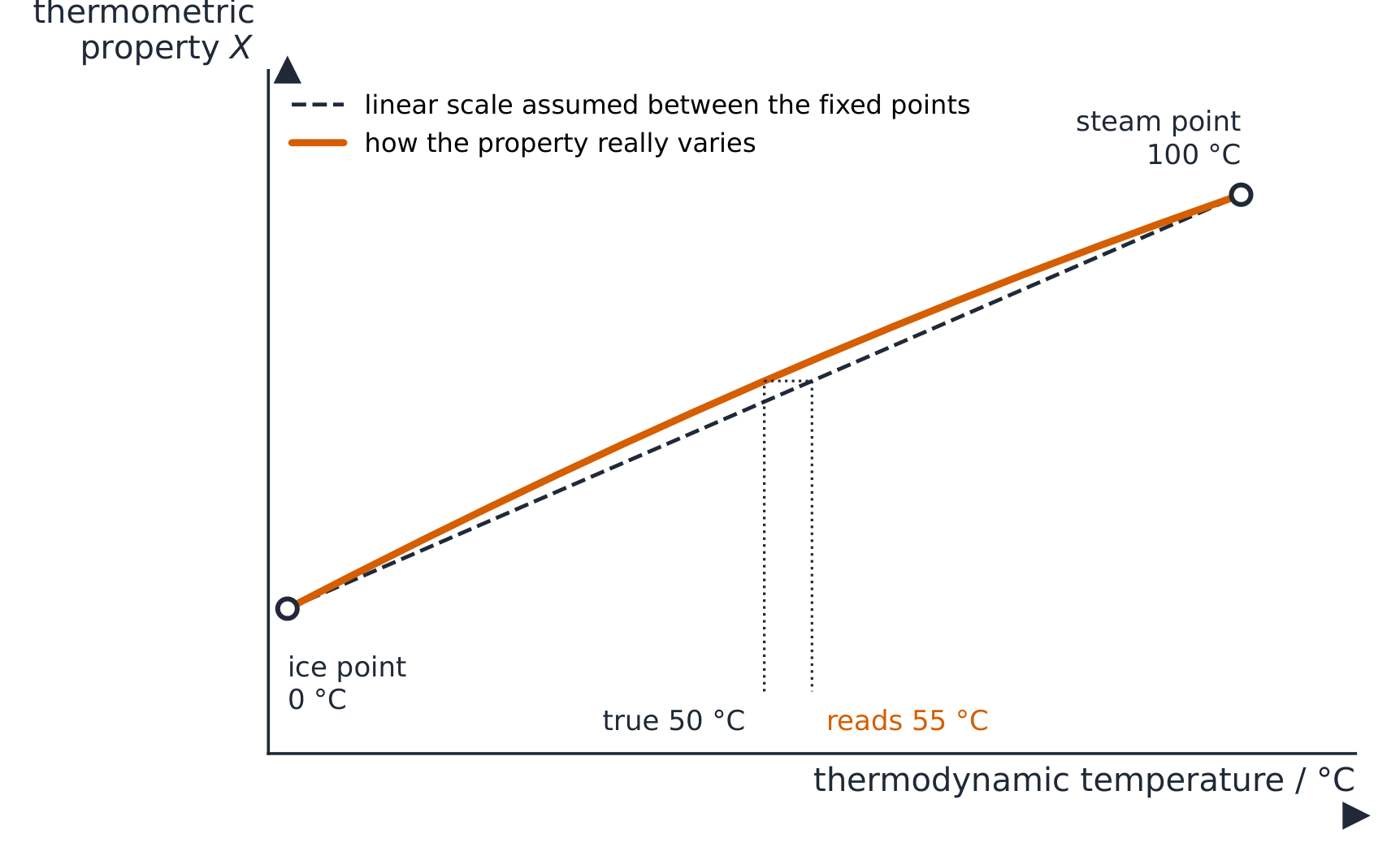
为什么液体玻璃温度计测的不是热力学温度(一分的理由):它的读数取决于特定物质的性质——水银或酒精的膨胀——以及这种膨胀在固定点之间是线性的假设。热力学标度不依赖任何物质。
为什么水不适合做测温液体。 它的密度不随温度单调变化:在 $4\ ^{\circ}\text{C}$ 密度最大,所以在 $0$ 到 $8\ ^{\circ}\text{C}$ 之间两个不同温度给出相同的密度,读数有歧义;而且每度的变化很小,温度计不灵敏。水银的密度在整个范围内稳定地、近乎线性地下降,这就是选它的原因。
例题。 铂电阻温度计是玻璃管中的一个铂丝线圈,接在测量其电阻的电路上。解释它如何测温,并给出它相对于热电偶的一个缺点。
铂的电阻随温度以已知的、近乎线性的方式增大;在冰点和汽点测量电阻,其他任何温度由测得的电阻落在两者之间线性刻度上的位置读出(或由校准曲线读出)。缺点:线圈、玻璃管及其周围的流体热容很大,所以温度计响应慢,跟不上快速变化的温度;它还笨重,并且需要电路来读数。(优点:准确、稳定,可用范围极宽。)

例题。 在定容气体温度计中,球泡置于熔化中的冰里时气体压强为 $1.05 \times 10^{5}\ \text{Pa}$,置于温暖的房间里时为 $1.19 \times 10^{5}\ \text{Pa}$。求房间的热力学温度,并解释为什么这种温度计与液体玻璃温度计不同,能直接给出热力学温度。
定容下固定质量的气体,压强与热力学温度成正比,所以 $\dfrac{T}{273.15} = \dfrac{1.19 \times 10^{5}}{1.05 \times 10^{5}}$,得 $T = 310\ \text{K}$($36\ ^{\circ}\text{C}$)。(近似)理想气体的压强只取决于它的温度,与是哪种气体无关,所以读数不依赖特定物质的性质——这正是热力学标度的定义性特征。

探索
Temperature scale lab
Kelvin index = Celsius index + 2.73
Slide Celsius temperature and see the Kelvin scale shift by 273.
词汇表
训练
| 英文 | 中文 | 拼音 |
|---|---|---|
| thermometer/θɜːˈmɒmɪtə/ | 温度计 | wēn dù jì |
| capillary/kəˈpɪləri/ | 毛细管 | máo xì guǎn |
| resistance/rɪˈzɪstəns/ | 电阻 | diàn zǔ |
| thermocouple/ˈθɜːməkʌpl/ | 热电偶 | rè diàn ǒu |
| electromotive force/ɪˌlektrəʊˈməʊtɪv fɔːs/ | 电动势 | diàn dòng shì |
| calibration/ˌkælɪˈbreɪʃn/ | 校准 | jiào zhǔn |
| fixed points/fɪkst pɔɪnts/ | 固定点 | gù dìng diǎn |
14.2
热力学温标

热力学温度(thermodynamic temperature,或绝对温度(absolute temperature))标度不取决于任何一种物质——只取决于热力学定律。它的单位是开尔文(kelvin,K)。
绝对零度
可能的最低温度是零开尔文($0\ \text{K}$),叫作绝对零度(absolute zero)。在那里系统有它可能的最小内能(internal energy)——粒子几乎没有随机运动。没有东西能被冷却到它以下。
按考试的问法。 "说出热力学标度上绝对零度的大小和单位":$0\ \text{K}$(单位是开尔文)。"说出摄氏标度上绝对零度的温度":$-273.15\ ^{\circ}\text{C}$(接受 $-273\ ^{\circ}\text{C}$)。"什么是绝对零度?":系统具有最小内能的温度——粒子具有可能的最小动能和势能——不可能低于它。热力学标度由绝对零度和水的三相点(triple point,定义为 $273.16\ \text{K}$)确定;它不依赖任何特定物质的性质。
摄氏标度
摄氏度(Celsius)标度 $\theta$ 与热力学标度相差一个固定的量:
$$T / \text{K} = \theta / {}^{\circ}\text{C} + 273.15.$$
所以 $0\ ^{\circ}\text{C} = 273.15\ \text{K}$,$100\ ^{\circ}\text{C} = 373.15\ \text{K}$。一开尔文和一摄氏度大小相同,所以 $1\ \text{K}$ 的温度差等于 $1\ ^{\circ}\text{C}$——但绝对值相差 $273.15$。
在气体定律计算中你必须始终用以开尔文为单位的绝对温度。用 °C 会给出错误答案。
词汇表
训练
| 英文 | 中文 | 拼音 |
|---|---|---|
| absolute temperature/ˈæbsəluːt ˈtemprɪtʃə/ | 绝对温度 | jué duì wēn dù |
| thermodynamic temperature/ˌθɜːməʊdaɪˈnæmɪk ˈtemprɪtʃə/ | 热力学温度 | rè lì xué wēn dù |
| kelvin/ˈkelvɪn/ | 开尔文 | kāi ěr wén |
| absolute zero/ˈæbsəluːt ˈzɪərəʊ/ | 绝对零度 | jué duì líng dù |
| internal energy/ɪnˈtɜːnl ˈenədʒi/ | 内能 | nèi néng |
| Celsius/ˈselsɪəs/ | 摄氏度 | shè shì dù |
| triple point/ˈtrɪpl pɔɪnt/ | 三相点 | sān xiāng diǎn |
14.3
比热容与比潜热

大纲
- define and use specific heat capacity
- define and use specific latent heat and distinguish between specific latent heat of fusion and specific latent heat of vaporisation
来源:剑桥国际大纲
一种物质的比热容(specific heat capacity)$c$ 是使单位质量升高一开尔文所需的能量(energy):
$$c = \frac{Q}{m \Delta T} \qquad\Longleftrightarrow\qquad Q = m c \Delta T.$$
单位:$\text{J kg}^{-1}\ \text{K}^{-1}$。
两分的定义: 比热容是使单位质量的物质温度升高一开尔文(或一度)所需的能量。 "单位质量"和"单位温升"都要有;"使 1 kg 升温 1 K 所需的能量"得分,"加热该物质所需的能量"不得分。
例子:
- 水:$c \approx 4200\ \text{J kg}^{-1}\ \text{K}^{-1}$(高——这就是为什么水是一种好的冷却剂,也是为什么海洋能稳定气候)。
- 铝:$c \approx 900\ \text{J kg}^{-1}\ \text{K}^{-1}$。
- 铜:$c \approx 385\ \text{J kg}^{-1}\ \text{K}^{-1}$。
用实验求未知的 $c$:用电的方式供给已知能量 $Q$($Q = VIt$,由功率(power)得),然后测量已知质量(mass)$m$ 的温升 $\Delta T$。则 $c = Q/(m\Delta T)$。用隔热(insulation)减少热损失,用约 10 K 的温升(大到便于测量,小到能限制损失)。
例题。 把 $0.50\ \text{kg}$ 的水从 $20\ ^{\circ}\text{C}$ 加热到 $100\ ^{\circ}\text{C}$ 需要多少能量?(水的比热容 $c = 4200\ \text{J kg}^{-1}\ \text{K}^{-1}$。)
温度差在 K 和 °C 中相同,所以 $\Delta T = 80$:
$$Q = mc\Delta T = 0.50 \times 4200 \times 80 = 1.68 \times 10^{5}\ \text{J}\ (= 168\ \text{kJ}).$$
当两个物体达到热平衡且没有热量损失到周围时,较冷者获得的能量等于较热者失去的能量:
$$m_{1} c_{1} (T_{\text{eq}} - T_{1}) = m_{2} c_{2} (T_{2} - T_{\text{eq}}).$$
例题。 把 $0.20\ \text{kg}$、$80\ ^{\circ}\text{C}$ 的水与 $0.30\ \text{kg}$、$20\ ^{\circ}\text{C}$ 的水混合,没有热量损失。求最终温度。
热水失去的热量等于冷水获得的热量(水的 $c$ 约去):
$$0.20\,(80 - T_{\text{eq}}) = 0.30\,(T_{\text{eq}} - 20) \quad\Rightarrow\quad T_{\text{eq}} = 44\ ^{\circ}\text{C}.$$
例题。 一个质量 $42\ \text{g}$、比热容 $840\ \text{J kg}^{-1}\ \text{K}^{-1}$ 的烧杯装有 $120\ \text{g}$ 某液体。加热器以 $810\ \text{W}$ 供能,烧杯和液体的温度在 $15\ \text{s}$ 内从 $19\ ^{\circ}\text{C}$ 升到 $47\ ^{\circ}\text{C}$。求液体的比热容。然后用水代替该液体重做实验;说明并解释温升有何不同。
供给的能量 $Q = Pt = 810 \times 15 = 1.22 \times 10^{4}\ \text{J}$,$\Delta T = 28\ \text{K}$。它同时加热烧杯和液体:$Q = m_{\text{b}}c_{\text{b}}\Delta T + m_{\text{l}}c_{\text{l}}\Delta T$,所以 $1.215 \times 10^{4} = 0.042 \times 840 \times 28 + 0.120 \times c_{\text{l}} \times 28$,即 $1.215 \times 10^{4} = 988 + 3.36c_{\text{l}}$,得 $c_{\text{l}} = 3.3 \times 10^{3}\ \text{J kg}^{-1}\ \text{K}^{-1}$。忘记烧杯是常丢的那一分。换成水($c = 4200$,更高)后,相同时间内相同的能量产生更小的温升,因为 $\Delta T = Q/(mc)$ 而 $mc$ 更大。如果有能量损失到周围,实际吸收的 $Q$ 小于 $Pt$,所以这样求得的 $c$ 偏大。
例题。 两个金属块 X 和 Y 接触放置并与周围绝热。X(质量 $0.50\ \text{kg}$,初温 $80\ ^{\circ}\text{C}$,$c = 390\ \text{J kg}^{-1}\ \text{K}^{-1}$)和 Y(质量 $0.50\ \text{kg}$,初温 $20\ ^{\circ}\text{C}$,$c = 900\ \text{J kg}^{-1}\ \text{K}^{-1}$)达到共同的末温。从能量角度解释为什么末温更接近 Y 的初温,并求出它。
热能从 X(较热)流向 Y,直到它们达到热平衡;X 失去的能量等于 Y 获得的能量。因为 Y 的比热容更大,一定量的能量使它的温度变化比 X 的小,所以 Y 升温的度数少于 X 降温的度数,末温更靠近 $20\ ^{\circ}\text{C}$。数值上:$0.50 \times 390 \times (80 - T) = 0.50 \times 900 \times (T - 20)$,所以 $390(80 - T) = 900(T - 20)$,$31200 + 18000 = 1290T$,$T = 38\ ^{\circ}\text{C}$。
例题。 一个铝块体积 $3.612 \times 10^{-3}\ \text{m}^{3}$,密度 $2.70 \times 10^{3}\ \text{kg m}^{-3}$。求使其温度升高 $40\ \text{K}$ 所需的能量($c = 900\ \text{J kg}^{-1}\ \text{K}^{-1}$)。
质量 $= \rho V = 2.70 \times 10^{3} \times 3.612 \times 10^{-3} = 9.75\ \text{kg}$,所以 $Q = mc\Delta T = 9.75 \times 900 \times 40 = 3.5 \times 10^{5}\ \text{J}$。藏在密度和体积后面的质量是常见的第一步。
探索
Energy to heat it: E = mcΔT
Pick a material, set the mass and the temperature rise, and read the energy. Water needs far more energy than the metals.
探索
Specific heat capacity
Q = mcΔT
The heat needed is proportional to the temperature rise — the gradient depends on mass and the material's specific heat capacity.
词汇表
训练
| 英文 | 中文 | 拼音 |
|---|---|---|
| mass/mæs/ | 质量 | zhì liàng |
| specific heat capacity/spəˈsɪfɪk hiːt kəˈpæsɪti/ | 比热容 | bǐ rè róng |
| power/ˈpaʊə/ | 功率 | gōng lǜ |
| insulation/ˌɪnsjuːˈleɪʃn/ | 隔热 | gé rè |
14.3
比潜热
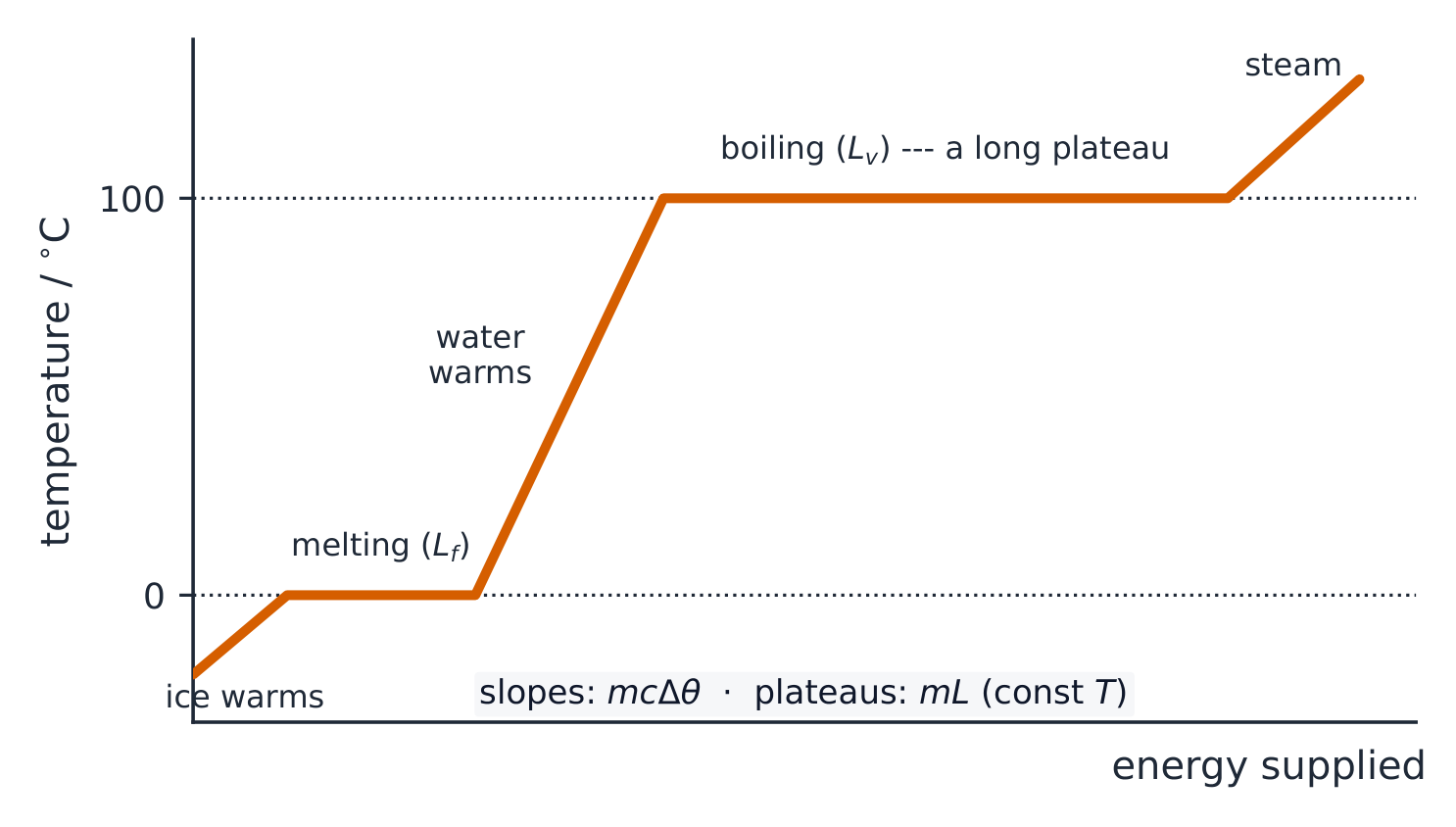
当一种物质在恒温下改变状态(固 ↔ 液,或液 ↔ 气)时,必须供给(或移走)能量而温度不变化。这个能量是潜热(latent heat)。
比潜热(specific latent heat)$L$ 是在恒温下改变单位质量状态的能量:
$$L = \frac{Q}{m} \qquad\Longleftrightarrow\qquad Q = m L.$$
单位:$\text{J kg}^{-1}$。
两分的定义: 比潜热是使单位质量的物质在温度不变的情况下改变状态所需的能量。"温度不变"(或"在恒温下")是第二分,也是最常漏掉的。问到具体某一种时,熔化加"从固态到液态",汽化加"从液态到气态"。
两种:
- 熔化(fusion)比潜热 $L_{\text{f}}$——用于熔化或凝固(固 ↔ 液)。
- 汽化(vaporisation)比潜热 $L_{\text{v}}$——用于沸腾或冷凝(液 ↔ 气)。
对于大气压下的水:$L_{\text{f}} \approx 3.34 \times 10^{5}\ \text{J kg}^{-1}$(在 $0\ ^{\circ}\text{C}$);$L_{\text{v}} \approx 2.26 \times 10^{6}\ \text{J kg}^{-1}$(在 $100\ ^{\circ}\text{C}$)。所以 $L_{\text{v}}$ 约为 $L_{\text{f}}$ 的 7 倍。
例题。 一个 $2.0\ \text{kW}$ 的加热器煮已经在 $100\ ^{\circ}\text{C}$ 的水。把 $0.10\ \text{kg}$ 这样的水变成水蒸气需要多长时间?($L_{\text{v}} = 2.26 \times 10^{6}\ \text{J kg}^{-1}$,没有热量损失。)
所需能量是 $Q = mL_{\text{v}} = 0.10 \times 2.26 \times 10^{6} = 2.26 \times 10^{5}\ \text{J}$。由 $Q = Pt$,
$$t = \frac{Q}{P} = \frac{2.26 \times 10^{5}}{2000} \approx 110\ \text{s}.$$
例题。 水壶里的水沸腾时保持在 $100\ ^{\circ}\text{C}$,尽管电热元件一直在加热。从分子能量的角度解释(3 分)。
温度是分子平均动能的量度。沸腾期间供给的能量被用来把分子分开——克服分子间的吸引力做功,以及蒸气膨胀时对大气做功——所以它增加的是分子的势能,而不是动能。平均动能不变,温度就保持恒定,直到全部的水都变成蒸汽。
为什么 $L_{\text{v}} > L_{\text{f}}$
两个原因,都来自物质的粒子图像:
- 键:在熔化时,只有一部分分子间(intermolecular)键断裂;粒子作为液体仍靠得近。在沸腾时,所有的键都必须断裂,粒子才能分开。断裂全部的键需要更多能量。
- 对大气做功:当液体变成气体时它极大地膨胀(蒸气约为液体体积(volume)的 $10^{3}$ 倍),所以它推开周围的大气压强(atmospheric pressure)做功。那功来自供给的能量。
两个理由都要写,并说出能量的名称:得分点是键被打破(势能增加)——熔化时打破一部分,沸腾时全部打破,以及在大幅膨胀中对大气做功。"沸腾需要更多能量"只是重复题目。
例题。 一个盘子盛有 $7.2 \times 10^{-5}\ \text{m}^{3}$ 的液体,密度 $710\ \text{kg m}^{-3}$,汽化比潜热 $3.6 \times 10^{5}\ \text{J kg}^{-1}$。它完全蒸发。求吸收的能量,并给出理由推测该物质的熔化比潜热可能比这个值小还是大。
质量 $= \rho V = 710 \times 7.2 \times 10^{-5} = 5.1 \times 10^{-2}\ \text{kg}$,所以吸收的能量 $Q = mL_{\text{v}} = 5.1 \times 10^{-2} \times 3.6 \times 10^{5} = 1.8 \times 10^{4}\ \text{J}$。它的 $L_{\text{f}}$ 可能更小:熔化只打破部分分子间键,体积几乎不变;而汽化把键全部打破并对大气做功——对水来说 $L_{\text{f}}$ 约是 $L_{\text{v}}$ 的七分之一。
多步问题
如果一道题混合了温度变化和一个相变(phase change)(例如 $-5\ ^{\circ}\text{C}$ 的冰升温到 $30\ ^{\circ}\text{C}$ 的水):
- 把固体从 $-5\ ^{\circ}\text{C}$ 加热到 $0\ ^{\circ}\text{C}$:$Q_{1} = m c_{\text{ice}} \times 5$。
- 在 $0\ ^{\circ}\text{C}$ 熔化:$Q_{2} = m L_{\text{f}}$。
- 把水从 $0\ ^{\circ}\text{C}$ 加热到 $30\ ^{\circ}\text{C}$:$Q_{3} = m c_{\text{water}} \times 30$。
总计:$Q_{1} + Q_{2} + Q_{3}$。相变在恒温下,所以那里用 $mL$,而不是 $mc\Delta T$。

当一道题给出加热器功率 $P$ 并问时间时,用 $Q = Pt$(假设没有热量损失)。给容器隔热(包保温层)并用小质量是改进实验的常用方法。
例题。 一块质量 $37.0\ \text{g}$、温度 $0.0\ ^{\circ}\text{C}$ 的冰投入绝热烧杯中 $26.4\ ^{\circ}\text{C}$ 的 $208\ \text{g}$ 水里。求冰全部熔化后的末温。($c_{\text{water}} = 4.20\ \text{kJ kg}^{-1}\ \text{K}^{-1}$,$L_{\text{f}} = 334\ \text{kJ kg}^{-1}$。)
冰两次获得能量——先熔化,再从 $0$ 升温到 $T$——而水从 $26.4$ 降温到 $T$ 失去能量。用克和千焦计算:$37.0 \times 0.334 + 37.0 \times 4.20 \times 10^{-3}\,T = 208 \times 4.20 \times 10^{-3}\,(26.4 - T)$,即 $12.4 + 0.155T = 23.1 - 0.874T$,所以 $1.03T = 10.7$,$T = 10\ ^{\circ}\text{C}$。三个能量项,一个方程;最常见的错误是忘了熔化后的冰水也要升温。
词汇表
训练
| 英文 | 中文 | 拼音 |
|---|---|---|
| volume/ˈvɒljuːm/ | 体积 | tǐ jī |
| specific latent heat/spəˈsɪfɪk ˈleɪtənt hiːt/ | 比潜热 | bǐ qián rè |
| latent heat/ˈleɪtənt hiːt/ | 潜热 | qián rè |
| fusion/ˈfjuːʒn/ | 熔化 | róng huà |
| vaporisation/ˌveɪpəraɪˈzeɪʃn/ | 汽化 | qì huà |
| specific latent heat of fusion/spəˈsɪfɪk ˈleɪtənt hiːt ɒv ˈfjuːʒn/ | 熔化 | róng huà |
| specific latent heat of vaporisation/spəˈsɪfɪk ˈleɪtənt hiːt ɒv ˌveɪpəraɪˈzeɪʃn/ | 汽化 | qì huà |
| atmospheric pressure/ˌætməsˈferɪk ˈpreʃə/ | 大气压强 | dà qì yā qiáng |
| phase change/feɪz tʃeɪndʒ/ | 相变 | xiāng biàn |
| intermolecular/ˌɪntəməˈlekjʊlə/ | 分子间 | fèn zǐ jiān |
14.3
考官认可的定义
定义题按固定措辞给分。把这些记准,并且只给一个答案。
| 术语 | 定义 |
|---|---|
| 热平衡 | 两个物体之间没有热能净转移的状态;它们温度相同 |
| 热能 | 因温度差而从一个物体转移到另一个物体的能量 |
| 热力学温标 | 不依赖任何特定物质性质的温标,由绝对零度和水的三相点确定 |
| 绝对零度 | 可能的最低温度,$0\ \text{K}$($-273.15\ ^{\circ}\text{C}$),此时系统具有最小内能 |
| 开尔文与摄氏度 | $T/\text{K} = \theta/^{\circ}\text{C} + 273.15$;温度差在两种标度中数值相同 |
| 比热容 | 使单位质量的物质温度升高一开尔文所需的能量 |
| 比潜热 | 使单位质量的物质在温度不变的情况下改变状态所需的能量 |
| 熔化比潜热 | 从固态变为液态的比潜热 |
| 汽化比潜热 | 从液态变为气态的比潜热 |
14.3
考试技巧
- 热平衡意味着没有热能的净流动(温度相等);热力学标度不依赖任何特定物质,由绝对零度和三相点确定。
- 用 $T/\text{K} = \theta/^\circ\text{C} + 273.15$ 换算温度,并在能量和气体方程中用开尔文;温度差在 K 和 °C 中相同。
- 加热用 $Q = mc\Delta T$,变态(温度不变)用 $Q = mL$——决不混用;混合问题写一个方程:失去的能量 $=$ 获得的能量,每一项都写上。
- 与液体一起被加热的容器也分走能量:要加上 $m_{\text{beaker}}c_{\text{beaker}}\Delta T$。
- 关于潜热的"为什么",要说出能量的名称:分子势能增加(键被打破、对大气做功),动能和温度不变。
常见错误
- 定义比热容时缺"单位质量"或缺"每开尔文"。两者都要有;单位 $\text{J kg}^{-1}\ \text{K}^{-1}$ 就是提醒。
- 潜热定义漏掉"温度不变"。正是这句话把潜热与加热区分开。
- 在变态过程中用 $mc\Delta T$,或对温升用 $mL$。
- 在能量方程中忘记烧杯、量热器,或熔化后冰水自身的升温。
- 说热力学标度的定义性特征是"用开尔文"。特征是它不依赖任何特定物质。
- 给温度差加 $273.15$。差值在两种标度中相同。
本主题的互动课程
逐步学习,并即时检测练习。