- infer from the results of the $\alpha$-particle scattering experiment the existence and small size of the nucleus
- describe a simple model for the nuclear atom to include protons, neutrons and orbital electrons
- distinguish between nucleon number and proton number
- understand that isotopes are forms of the same element with different numbers of neutrons in their nuclei
- understand and use the notation $_Z^A\text{X}$ for the representation of nuclides
- understand that nucleon number and charge are conserved in nuclear processes
- describe the composition, mass and charge of $\alpha$-, $\beta$- and $\gamma$-radiations (both $\beta^-$ (electrons) and $\beta^+$ (positrons) are included)
- understand that an antiparticle has the same mass but opposite charge to the corresponding particle, and that a positron is the antiparticle of an electron
- state that (electron) antineutrinos are produced during $\beta^-$ decay and (electron) neutrinos are produced during $\beta^+$ decay
- understand that $\alpha$-particles have discrete energies but that $\beta$-particles have a continuous range of energies because (anti)neutrinos are emitted in $\beta$-decay
- represent $\alpha$- and $\beta$-decay by a radioactive decay equation of the form $^{238}_{92}\text{U} \rightarrow ^{234}_{90}\text{Th} + ^4_2\alpha$
- use the unified atomic mass unit (u) as a unit of mass
粒子物理
A-Level 物理 · 第 11 主题
 19:01
19:01
The Nuclear Atom
Over a hundred years ago, physicists fired tiny alpha particles at a sheet of gold foil, thinner than paper. They expected the particles to sail straight…
英文讲解 · 内嵌中英文字幕
11.1
原子、原子核与辐射

大纲
来源:剑桥国际大纲
盖革-马斯登 α 粒子散射
射向一片薄金箔的 α 粒子(alpha particles)被观察到:
- 大多笔直穿过,几乎没有偏转(deflection),
- 有时以小角度偏转,
- 极少(约 $8000$ 个中有 $1$ 个)以大于 $90°$ 的角度偏转。
由此卢瑟福推断出:
- 原子大部分是空的(大多数 α 粒子笔直穿过),
- 中心有一个极小、致密、带正电的原子核(nucleus)(极少的大角度偏转需要一个集中的电荷把 α 推开),
- 原子几乎所有的质量都在这个原子核中。
数量级:原子直径 $\sim 10^{-10}\ \text{m}$,原子核直径 $\sim 10^{-15}\ \text{m}$——原子核比原子小约 $10^{5}$ 倍。
三个结果与各自证明的结论——标准答案就是这样配对的:
| 观察 | 结论 |
|---|---|
| 绝大多数笔直穿过,几乎或完全没有偏转 | 原子的大部分是空的 |
| 少数以小角度偏转 | 存在一个集中的正电荷(原子核),排斥带正电的 α 粒子 |
| 极少数(约 8000 个中 1 个)偏转超过 90°,有的原路返回 | 原子核与原子相比非常小,并且几乎包含原子的全部质量 |
实验的三个细节也会被问到:金箔很薄,使每个 α 粒子最多遇到一个原子核(而且不被吸收);腔室是真空,使 α 粒子不被空气阻止或散射;用金是因为它能被打成极薄的片,并且原子核重、电荷多。
例题。 解释为什么极少数 α 粒子被散射超过 90°。
只有几乎正对原子核接近的 α 粒子才会被折回。原子核和 α 粒子都带正电,所以在很小的间距上静电(electrostatic)排斥力非常大,而原子核比 α 粒子重得多,所以被折回的是 α 粒子。因为原子核极小,能接近到那么近的 α 粒子非常少——所以只是极少数。α 粒子接近时,它的动能转化为电势能;在最近点它瞬时静止,全部动能都变成了势能。
偏转取决于路径离原子核多近:距离越小,角度越大,而且路径关于通过原子核的直线对称。

简单核模型
一个原子有:
- 一个中心原子核,由质子(protons,带正电,电荷 $+e$)和中子(neutrons,不带电)构成,
- 原子核周围的电子(electrons,电荷 $-e$)。
质子和中子质量几乎相同($\approx 1\ \text{u}$);电子约为质子质量的 $\tfrac{1}{1836}$。

例题。 描述铀-238 原子 $^{238}_{92}\text{U}$ 的结构。
一个含 92 个质子和 $238 - 92 = 146$ 个中子的原子核,周围有 92 个电子绕行。"轨道电子"是大纲用语——电子在原子核之外,中性原子的电子数与质子数相同。
符号与关键数字
对于一个写成 $^{A}_{Z}\text{X}$ 的核素(nuclide):

- 质子数(proton number)$Z$(也叫原子序数):质子的数目。它确定元素。
- 核子数(nucleon number)$A$(也叫质量数):核子(nucleons,质子 + 中子)的总数。
- 中子数 $N = A - Z$。
一个中性原子的电子数与质子数相同。
同位素
同位素(isotopes)是同一元素(相同 $Z$)、中子数不同(不同 $A$)的原子。它们化学性质相同,但核内不同。例子:$^{12}_{6}\text{C}$ 和 $^{14}_{6}\text{C}$ 是碳的同位素。
考官的措辞:同位素是质子数相同但中子数不同的原子核(或原子)——等价地说,质子数 $Z$ 相同而核子数 $A$ 不同。氢有三种:
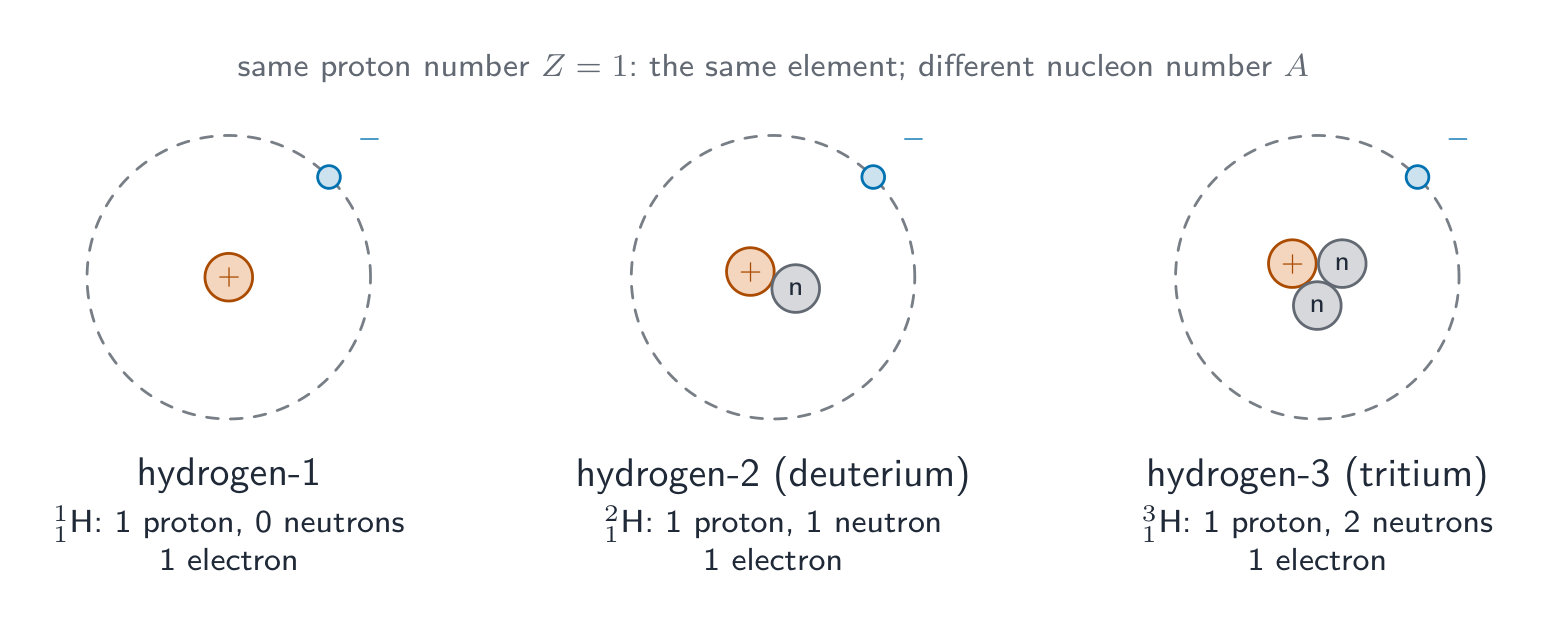
例题。 氚 $^{3}_{1}\text{H}$ 是氢的一种同位素。说出中性氚原子中质子、中子和电子的数目,并给出其原子核的夸克组成。
$Z = 1$ 个质子;$A - Z = 3 - 1 = 2$ 个中子;1 个电子(中性,所以电子数 $=$ 质子数)。原子核是一个质子(uud)和两个中子(udd、udd):4 个上夸克和 5 个下夸克。电荷检验:$4 \times \tfrac{2}{3} - 5 \times \tfrac{1}{3} = +1$,即质子数。原子的"带标注的图"就是原子核(1 个 p、2 个 n)外面有一个电子绕行。
核过程中的守恒定律
在任何核过程中:
- 核子数 $A$ 守恒(前后的总 $A$ 相等),
- 电荷守恒(这是电荷守恒(conservation of charge))。
这两条规则让你能配平衰变和反应方程。
统一原子质量单位
统一原子质量单位(unified atomic mass unit),符号 $\text{u}$,规定为使一个 $^{12}_{6}\text{C}$ 原子的质量恰好是 $12\ \text{u}$。数值上,
$$1\ \text{u} = 1.661 \times 10^{-27}\ \text{kg}.$$
质子质量 $\approx 1.007\ \text{u}$;中子 $\approx 1.009\ \text{u}$;电子 $\approx 5.5 \times 10^{-4}\ \text{u}$。
例题。 原子核 X 有 14 个核子和 $p$ 个质子。它的荷质比是 $4.1 \times 10^{7}\ \text{C kg}^{-1}$。求 $p$ 并指出 X 是什么。
电荷 $= pe$;质量 $\approx 14\ \text{u}$。所以 $\dfrac{pe}{14\text{u}} = 4.1 \times 10^{7}$,得 $p = \dfrac{4.1 \times 10^{7} \times 14 \times 1.66 \times 10^{-27}}{1.60 \times 10^{-19}} = 5.96 \approx 6$。六个质子、14 个核子:X 是碳-14,$^{14}_{6}\text{C}$。保留所有位数算到最后,再四舍五入到整数个质子。
探索
Nuclear atom evidence lab
Connect observations to the nuclear model of the atom.
探索
Radioactive decay
A = A₀·bᵗ
Activity decays exponentially — set the base b below 1.
词汇表
训练
| 英文 | 中文 | 拼音 |
|---|---|---|
| alpha particles/ˈælfə ˈpɑːtɪklz/ | α粒子 | α lì zi |
| alpha particle/ˈælfə ˈpɑːtɪkl/ | α粒子 | α lì zi |
| deflection/dɪˈflekʃn/ | 偏转 | piān zhuǎn |
| nucleus/ˈnjuːklɪəs/ | 原子核 | yuán zǐ hé |
| electrostatic/ɪˌlektrəʊˈstætɪk/ | 静电 | jìng diàn |
| proton/ˈprəʊtɒn/ | 质子 | zhì zi |
| neutron/ˈnjuːtrɒn/ | 中子 | zhōng zǐ |
| electron/ɪˈlektrɒn/ | 电子 | diàn zi |
| nuclide/ˈnjuːklaɪd/ | 核素 | hé sù |
| nucleon number/ˈnjuːklɪən ˈnʌmbə/ | 核子数 | hé zǐ shù |
| nucleon/ˈnjuːklɪən/ | 核子 | hé zǐ |
| proton number/ˈprəʊtɒn ˈnʌmbə/ | 质子数 | zhì zǐ shù |
| isotopes/ˈaɪsətəʊps/ | 同位素 | tóng wèi sù |
| isotope/ˈaɪsətəʊp/ | 同位素 | tóng wèi sù |
| conservation of charge/ˌkɒnsəˈveɪʃn ɒv tʃɑːdʒ/ | 电荷守恒 | diàn hè shǒu héng |
| unified atomic mass unit/ˈjuːnɪfaɪd əˈtɒmɪk mæs ˈjuːnɪt/ | 统一原子质量单位 | tǒng yī yuán zi zhì liàng dān wèi |
11.1
放射性射线

一个不稳定的原子核重新排列自己,并放出三种辐射(radiation)之一。这就是放射性(radioactive)衰变。每一种都有自己的性质。
α 辐射
- 组成:一个氦-4 原子核,$^{4}_{2}\alpha$(两个质子 + 两个中子)。
- 质量:$\approx 4\ \text{u}$。
- 电荷:$+2e$。
- 在空气中的射程:几厘米。被一张纸挡住。
- 电离能力:强——它擅长电离(ionising)。
- 能谱:分立的(discrete,一次衰变给出一个或几个尖锐能量的 α 粒子)。
云室(cloud chamber)使径迹可见:每个 α 粒子在电离空气时留下一条短的、直的、粗的小液滴轨迹。相等的短长度表明 α 粒子都携带大约相同的能量。
β 辐射
两种 β 粒子(beta particle):
- $\beta^{-}$:一个快速电子,当一个中子变成一个质子时放出。
- $\beta^{+}$:一个正电子(positron,电子的反粒子),当一个富质子原子核中的质子变成一个中子时放出。
性质(两种都是):
- 质量:$\approx 1/1836\ \text{u}$(比 α 小得多)。
- 电荷:$\beta^{-}$ 为 $-e$,$\beta^{+}$ 为 $+e$。
- 在空气中的射程:约 $1\ \text{m}$。被几毫米的铝挡住。
- 能谱:直到一个最大值为止是连续的(continuous,见下文)。
γ 辐射
- 组成:一个高能光子(photon)——电磁波谱(electromagnetic spectrum)的一部分。
- 质量:零(静止质量)。
- 电荷:零。
- 在空气中的射程:大(遵守平方反比律)。被几厘米厚的铅或约一米厚的混凝土强烈衰减(attenuated)。
- 电离能力:最弱。
- 能谱:分立的(当原子核在两个核能级之间跃迁时放出一个 γ 射线(gamma ray))。
在一次 α 或 β 衰变使子核(daughter nucleus)处于激发态(excited state)之后,原子核常常放出一个 γ 光子作为一个"收尾"步骤。

质量与电荷并列——表格题正是要这些,以 $\text{u}$ 和 $e$ 为单位:
| 粒子 | 质量 | 电荷 |
|---|---|---|
| 质子 | $1\ \text{u}$(1.007 u) | $+e$ |
| 中子 | $1\ \text{u}$(1.009 u) | $0$ |
| 电子、$\beta^{-}$ | $\tfrac{1}{1836}\ \text{u}$($5.5 \times 10^{-4}\ \text{u}$) | $-e$ |
| 正电子、$\beta^{+}$ | $\tfrac{1}{1836}\ \text{u}$ | $+e$ |
| α 粒子 | $4\ \text{u}$ | $+2e$ |
| γ 光子 | $0$ | $0$ |
| 中微子、反中微子 | 几乎为零 | $0$ |
例题。 从质量和电荷两方面比较 α 粒子与 $\beta^{+}$ 粒子(3 分)。
两者都带正电,但 α 粒子的电荷($+2e$)是 $\beta^{+}$($+e$)的两倍。α 粒子的质量($4\ \text{u}$)约是 $\beta^{+}$($5.5 \times 10^{-4}\ \text{u}$)的 $7300$ 倍。要给出比值,不要只说"更重":电荷两倍和质量约 7000 倍才是得分点。
因为带电,α 和 β 粒子会被电场和磁场偏转——电荷符号相反则方向相反,轻的 β 偏转远大于重的 α——而不带电的 γ 射线径直穿过。
反粒子、中微子和反中微子
每个粒子都有一个反粒子(antiparticle),质量相同但电荷相反。正电子是电子的反粒子。
在 β 衰变中,总是还会放出第三个粒子:
- $\beta^{-}$ 衰变:一个反中微子(antineutrino)$\bar{\nu}_{\text{e}}$。
- $\beta^{+}$ 衰变:一个中微子(neutrino)$\nu_{\text{e}}$。
中微子和反中微子电荷为零、质量极小、几乎不相互作用——它们很难探测,但为了在 β 衰变中平衡能量、动量(momentum)和其他守恒量,它们必须存在。
为什么 β 有连续谱(而 α 没有)
在 α 衰变中,释放的能量(energy)只在两个粒子(子核和 α)之间分配。动量和能量守恒于是把 α 的能量固定为一个值(分立)。
在 β 衰变中,能量在三个粒子(子核、β,以及(反)中微子)之间分配。β 可以取从零到一个最大值的任何份额,所以它的能谱是连续的。
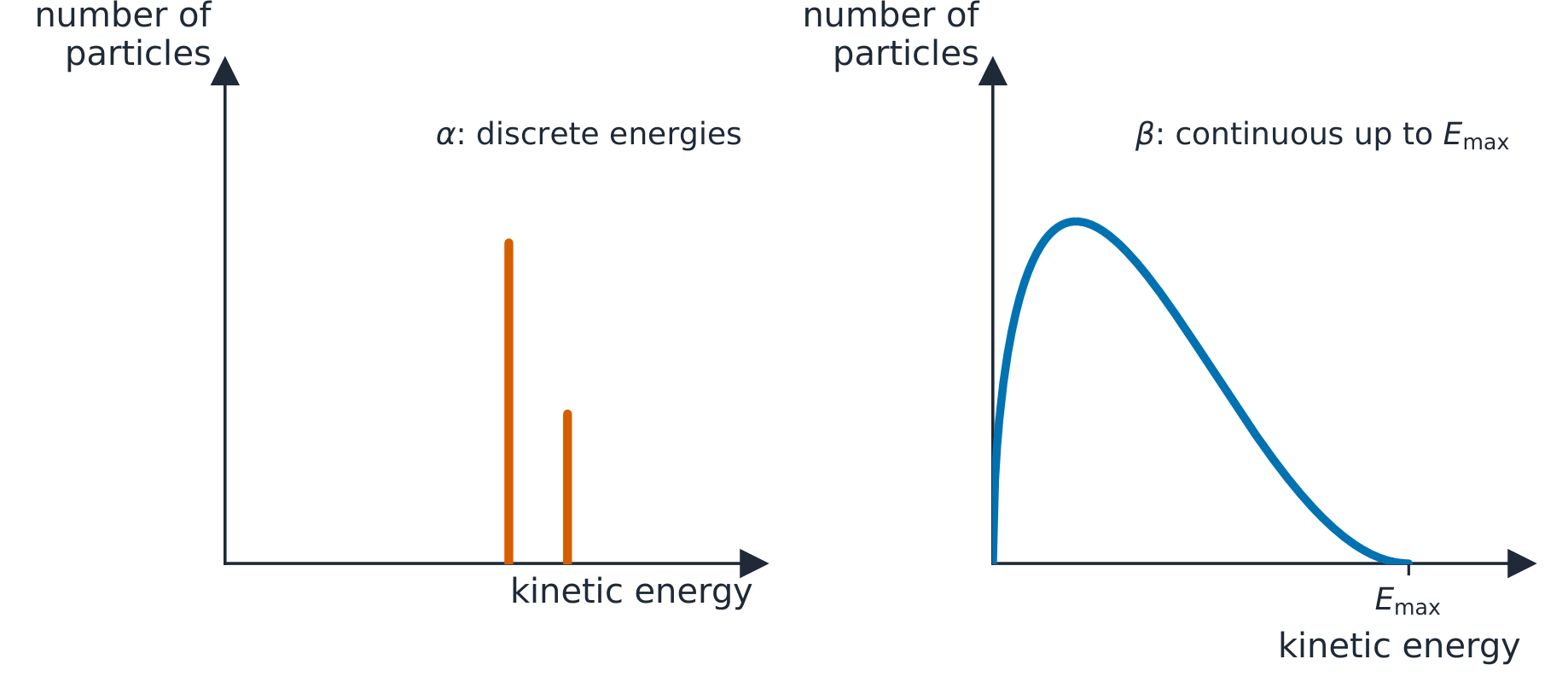
例题。 某放射源发出的 $\beta^{-}$ 粒子能谱是连续的,从零到一个最大值。解释原因(3 分)。
每次衰变释放固定的能量。这些能量在 $\beta^{-}$ 粒子、反中微子和反冲的子核之间分配。反中微子可以分到任意份额,所以 $\beta^{-}$ 粒子得到从零到最大值之间的任意能量——最大值出现在反中微子几乎没带走能量时。(α 粒子只涉及两个物体,动量守恒确定了分配,所以能量是分立的。)
书写衰变方程
一个一般的 α 衰变:
$$^{A}_{Z}\text{X} \to {}^{A-4}_{Z-2}\text{Y} + {}^{4}_{2}\alpha$$
(检验:$A = (A-4) + 4$,$Z = (Z-2) + 2$。)
一个一般的 $\beta^{-}$ 衰变:
$$^{A}_{Z}\text{X} \to {}^{A}_{Z+1}\text{Y} + {}^{0}_{-1}\beta + \bar{\nu}_{\text{e}}.$$
一个一般的 $\beta^{+}$ 衰变:
$$^{A}_{Z}\text{X} \to {}^{A}_{Z-1}\text{Y} + {}^{0}_{+1}\beta + \nu_{\text{e}}.$$
例题。 铀-238,$^{238}_{92}\text{U}$,通过 α 发射衰变;碳-14,$^{14}_{6}\text{C}$,通过 $\beta^{-}$ 发射衰变。求各自的子核素。
α 衰变使 $A$ 降 4、$Z$ 降 2;$\beta^{-}$ 衰变使 $A$ 不变、$Z$ 升 1:
$$^{238}_{92}\text{U} \to {}^{234}_{90}\text{Th} + {}^{4}_{2}\alpha, \qquad {}^{14}_{6}\text{C} \to {}^{14}_{7}\text{N} + {}^{0}_{-1}\beta + \bar{\nu}_{\text{e}}.$$
定量确定变化。 α 发射:$A$ 减 4,$Z$ 减 2。$\beta^{-}$ 发射:$A$ 不变,$Z$ 加 1。$\beta^{+}$ 发射:$A$ 不变,$Z$ 减 1。γ 发射:两者都不变。终止于已知核素的衰变链由此求解:α 衰变的次数是 $(A_{\text{start}} - A_{\text{end}})/4$,然后由 $\beta^{-}$ 衰变的次数把 $Z$ 凑对。
例题。 钍-230($^{230}_{90}\text{Th}$)经过多级 α 和 $\beta^{-}$ 发射衰变为铅-206($^{206}_{82}\text{Pb}$)。求每种衰变的次数。
α 衰变:$(230 - 206)/4 = 6$。仅六次 α 衰变会使 $Z$ 降 12 到 78;最终 $Z$ 是 82,所以有 $82 - 78 = 4$ 次 $\beta^{-}$ 衰变。
静止的原子核会反冲。 静止的原子核发射 α 粒子时动量守恒:子核与 α 粒子沿相反方向运动,动量大小相等。由于 $p = mv$,较轻的 α 粒子快得多;由于 $E_{\text{k}} = p^{2}/2m$,它也拿走大部分动能——份额与质量成反比。
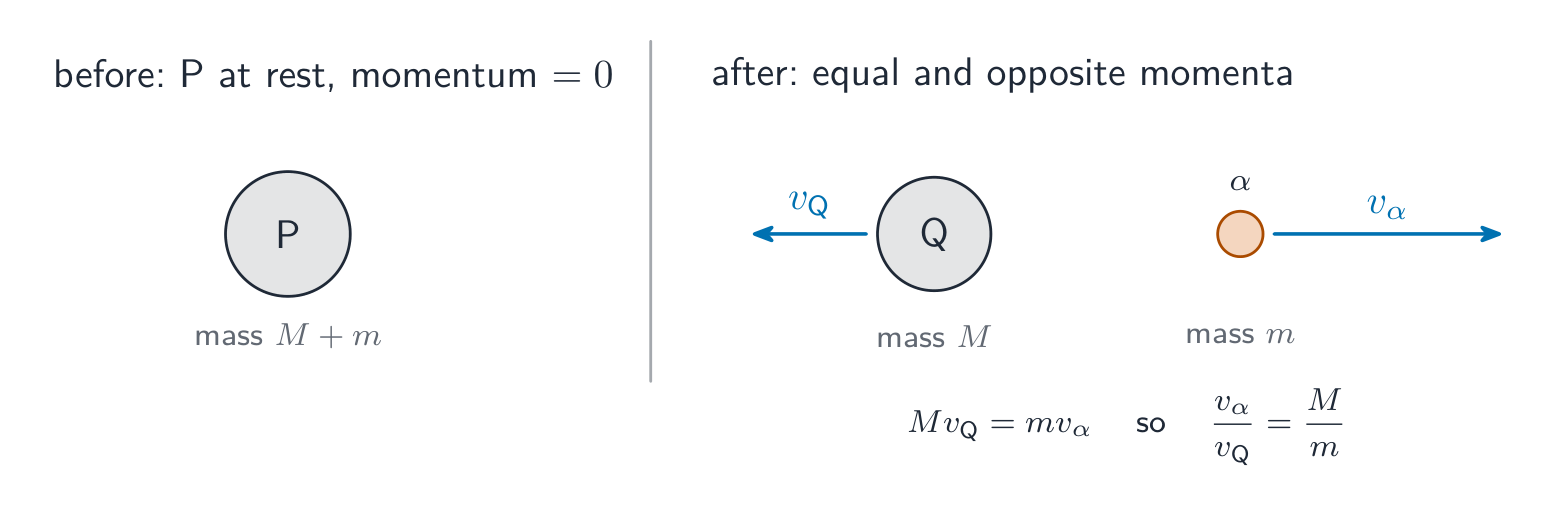
例题。 一个质量 $243\ \text{u}$ 的静止原子核 P 以 $1.5 \times 10^{7}\ \text{m s}^{-1}$ 发射一个质量 $4\ \text{u}$ 的 α 粒子。求子核 Q 的速度,以及 α 粒子与 Q 的动能之比。
Q 的质量为 $243 - 4 = 239\ \text{u}$。动量:$239 v_{\text{Q}} = 4 \times 1.5 \times 10^{7}$,所以 $v_{\text{Q}} = 2.5 \times 10^{5}\ \text{m s}^{-1}$,方向与 α 粒子相反。动能:$\dfrac{E_{\alpha}}{E_{\text{Q}}} = \dfrac{p^{2}/2m_{\alpha}}{p^{2}/2m_{\text{Q}}} = \dfrac{m_{\text{Q}}}{m_{\alpha}} = \dfrac{239}{4} \approx 60$。α 粒子拿走释放能量的约 98%。
词汇表
训练
| 英文 | 中文 | 拼音 |
|---|---|---|
| energy/ˈenədʒi/ | 能量 | néng liàng |
| radioactive/ˌreɪdɪəʊˈæktɪv/ | 放射性 | fàng shè xìng |
| radiation/ˌreɪdɪˈeɪʃn/ | 辐射 | fú shè |
| ionising/ˈaɪənaɪzɪŋ/ | 电离 | diàn lí |
| discrete/dɪˈskriːt/ | 分立 | fēn lì |
| cloud chamber/klaʊd ˈtʃeɪmbə/ | 云室 | yún shì |
| beta particle/ˈbiːtə ˈpɑːtɪkl/ | β粒子 | β lì zi |
| positron/ˈpɒzɪtrɒn/ | 正电子 | zhèng diàn zi |
| antiparticle/ˌæntɪˈpɑːtɪkl/ | 反粒子 | fǎn lì zi |
| continuous/kənˈtɪnjuːəs/ | 连续 | lián xù |
| photon/ˈfəʊtɒn/ | 光子 | guāng zi |
| electromagnetic spectrum/ɪˌlektrəʊməɡˈnetɪk ˈspektrəm/ | 电磁波谱 | diàn cí bō pǔ |
| attenuated/əˈtenjuːeɪtɪd/ | 衰减 | shuāi jiǎn |
| gamma ray/ˈɡæmə reɪ/ | γ射线 | γ shè xiàn |
| daughter nucleus/ˈdɔːtə ˈnjuːklɪəs/ | 子核 | zi hé |
| excited state/ekˈsaɪtɪd steɪt/ | 激发态 | jī fā tài |
| neutrino/njuːˈtriːnəʊ/ | 中微子 | zhōng wēi zǐ |
| antineutrino/ˌæntɪnjuːˈtriːnəʊ/ | 反中微子 | fǎn zhōng wēi zǐ |
| momentum/məʊˈmentəm/ | 动量 | dòng liàng |
11.2
基本粒子

大纲
- understand that a quark is a fundamental particle and that there are six flavours (types) of quark: up, down, strange, charm, top and bottom
- recall and use the charge of each flavour of quark and understand that its respective antiquark has the opposite charge (no knowledge of any other properties of quarks is required)
- recall that protons and neutrons are not fundamental particles and describe protons and neutrons in terms of their quark composition
- understand that a hadron may be either a baryon (consisting of three quarks) or a meson (consisting of one quark and one antiquark)
- describe the changes to quark composition that take place during $\beta^-$ and $\beta^+$ decay
- recall that electrons and neutrinos are fundamental particles called leptons
来源:剑桥国际大纲
有些粒子是基本粒子(fundamental particles,点状的,就我们所知没有更小的组成部分);另一些由基本粒子构成。
一分的定义:基本粒子是不能再分解成更小粒子的粒子(没有内部结构)。电子、中微子和夸克是基本粒子;质子和中子不是。
夸克
夸克(quark)是一种基本粒子。有六种味(flavours):
- 上(u),电荷 $+\tfrac{2}{3}e$,
- 下(d),电荷 $-\tfrac{1}{3}e$,
- 粲(c),电荷 $+\tfrac{2}{3}e$,
- 奇(s),电荷 $-\tfrac{1}{3}e$,
- 顶(t),电荷 $+\tfrac{2}{3}e$,
- 底(b),电荷 $-\tfrac{1}{3}e$。
每个夸克都有一个反夸克(antiquark),电荷大小相同但符号相反:$\bar{u}$(电荷 $-\tfrac{2}{3}e$),$\bar{d}$(电荷 $+\tfrac{1}{3}e$)。不考核夸克的其他性质。

写成题目要你填的表:
| 夸克 | 电荷 | 反夸克 | 电荷 |
|---|---|---|---|
| 上(u)、粲(c)、顶(t) | $+\tfrac{2}{3}e$ | $\bar{\text{u}}$、$\bar{\text{c}}$、$\bar{\text{t}}$ | $-\tfrac{2}{3}e$ |
| 下(d)、奇(s)、底(b) | $-\tfrac{1}{3}e$ | $\bar{\text{d}}$、$\bar{\text{s}}$、$\bar{\text{b}}$ | $+\tfrac{1}{3}e$ |
例题。 根据夸克组成,证明质子的电荷是 $+1.6 \times 10^{-19}\ \text{C}$。
质子是 uud:电荷 $= \tfrac{2}{3}e + \tfrac{2}{3}e - \tfrac{1}{3}e = +e = +1.6 \times 10^{-19}\ \text{C}$。写出三个分数和它们的和——分数给的是算式,不是答案。
强子:重子和介子
由夸克构成的粒子是强子(hadrons)。两种:
- 重子(baryons)——三个夸克。例子:质子(u u d)、中子(u d d)。电荷检验:质子 $\tfrac{2}{3} + \tfrac{2}{3} - \tfrac{1}{3} = +1$;中子 $\tfrac{2}{3} - \tfrac{1}{3} - \tfrac{1}{3} = 0$。
- 介子(mesons)——一个夸克和一个反夸克(例如 $\pi^{+}$ 是 u$\bar{\text{d}}$)。
质子和中子不是基本粒子——它们是由夸克构成的重子。
"从组成粒子的角度比较重子和介子"(2 分):两者都是由夸克构成的强子;重子是三个夸克(反重子则是三个反夸克),介子是一个夸克加一个反夸克。给定的任何电荷都必须从夸克电荷算出来:
例题。 (a) 一个介子电荷为 $-1e$。给出一种可能的夸克组成。(b) 介子 Q 电荷为 0。给出一种可能的组成。(c) 一个重子由 u、d、s 三种不同味的夸克组成。求它的电荷。(d) 给出反中子的夸克组成及其电荷。
(a) d$\bar{\text{u}}$:$-\tfrac{1}{3} - \tfrac{2}{3} = -1$(s$\bar{\text{u}}$ 也行)。(b) u$\bar{\text{u}}$:$+\tfrac{2}{3} - \tfrac{2}{3} = 0$(或 d$\bar{\text{d}}$)。(c) uds:$\tfrac{2}{3} - \tfrac{1}{3} - \tfrac{1}{3} = 0$。(d) 反中子是 udd 的反粒子,所以是 $\bar{\text{u}}\bar{\text{d}}\bar{\text{d}}$:$-\tfrac{2}{3} + \tfrac{1}{3} + \tfrac{1}{3} = 0$——与中子质量相同、电荷相同,因为两者电荷都为零。
β 衰变中的夸克变化
在 $\beta^{-}$ 衰变中一个中子变成一个质子;用夸克来说,一个下夸克变成一个上夸克:
$$\text{d} \to \text{u} + \beta^{-} + \bar{\nu}_{\text{e}}.$$
在 $\beta^{+}$ 衰变中一个质子变成一个中子;一个上夸克变成一个下夸克:
$$\text{u} \to \text{d} + \beta^{+} + \nu_{\text{e}}.$$

"从所涉及的基本粒子描述 $\beta^{+}$ 衰变"(2 分):质子中的一个上夸克变成下夸克,所以质子变成中子,同时发射一个正电子和一个电子中微子——$\text{u} \to \text{d} + \beta^{+} + \nu_{\text{e}}$。$\beta^{-}$ 衰变则角色互换:一个下夸克变成上夸克,发射一个电子和一个电子反中微子。要写出(反)中微子的名字:它就是题目问的"另一个轻子",也是 β 能量连续的原因。
轻子
轻子(leptons)是不由夸克构成的基本粒子。你需要的轻子是电子和电子中微子,以及它们的反粒子正电子和电子反中微子。(更重的轻子——μ 子和 τ 子——存在,但不考。)被问到"两种不同的轻子"时,答电子和中微子。
粒子的分类
要回答"哪些是基本粒子?":夸克和轻子(电子、正电子、中微子、反中微子)是基本粒子;质子、中子、重子、介子和强子不是——它们由夸克构成。

例题。 在下列粒子中——反中微子、$\beta^{+}$ 粒子、中子、正电子、质子——划出强子。
中子和质子(各由三个夸克组成)。反中微子和正电子是轻子;$\beta^{+}$ 粒子就是正电子。同一份清单若问"哪些不是基本粒子",答案相同:中子和质子。
反物质。 每个粒子都有质量相同、电荷相反的反粒子;正电子与电子质量相同(电荷大小也相同),不同在电荷的符号。一个反氢原子是一个反质子(电荷 $-e$,由 $\bar{\text{u}}\bar{\text{u}}\bar{\text{d}}$ 组成)加一个绕行的正电子。
探索
Fundamental particle lab
Sort particles by the family or interaction that defines them.
词汇表
训练
| 英文 | 中文 | 拼音 |
|---|---|---|
| quark/kwɑːk/ | 夸克 | kuā kè |
| fundamental particles/ˌfʌndəˈmentl ˈpɑːtɪklz/ | 基本粒子 | jī běn lì zi |
| fundamental/ˌfʌndəˈmentl/ | 基本粒子 | jī běn lì zi |
| flavours/ˈfleɪvəz/ | 味 | wèi |
| antiquark/ˈæntɪkwɑːk/ | 反夸克 | fǎn kuā kè |
| hadrons/ˈhædrɒnz/ | 强子 | qiáng zǐ |
| baryons/ˈbæriɒnz/ | 重子 | zhòng zǐ |
| mesons/ˈmiːzɒnz/ | 介子 | jiè zi |
| leptons/ˈleptɒnz/ | 轻子 | qīng zi |
11.2
考官认可的定义
定义题按固定措辞给分。把这些记准,并且只给一个答案。
| 术语 | 定义 |
|---|---|
| 质子数 $Z$ | 原子核中质子的数目 |
| 核子数 $A$ | 原子核中质子和中子的总数 |
| 同位素 | 同一元素(质子数相同)、中子数不同的原子核 |
| 核素 | 具有特定质子数和特定中子数的原子核 |
| 统一原子质量单位 | 碳-12 原子质量的十二分之一 |
| 反粒子 | 与对应粒子质量相同但电荷相反的粒子 |
| 基本粒子 | 不能再分解成更小粒子的粒子 |
| 强子 | 由夸克构成的粒子:重子(三个夸克)或介子(一个夸克加一个反夸克) |
| 轻子 | 不由夸克构成的基本粒子,如电子或中微子 |
| α 粒子 | 氦-4 原子核:两个质子和两个中子,电荷 $+2e$,质量 $4\ \text{u}$ |
| $\beta^{-}$ / $\beta^{+}$ 粒子 | 中子变成质子 / 质子变成中子时从原子核发射出的电子 / 正电子 |
11.2
考试技巧
- 用 α 散射的证据描述核式原子(一个小、致密、带正电的原子核)——把每个观察与它的结论配对。
- 用电荷、质量、电离能力和穿透力比较 $\alpha$、$\beta$ 和 $\gamma$;被要求比较两种粒子时给出比值("电荷两倍"、"质量约 7000 倍")。
- 用夸克组成(质子 $uud$,中子 $udd$)并检查你写的每个方程中电荷和核子数是否平衡。
- 在 $\beta^-$ 衰变中一个中子变成一个质子、一个电子和一个反中微子;在 $\beta^{+}$ 衰变中一个质子变成一个中子、一个正电子和一个中微子。每次都写出(反)中微子的名字。
- 静止的原子核衰变时,两个产物获得大小相等、方向相反的动量,所以较轻的更快,并带走大部分动能。
- 对衰变链,先由 $A$ 的变化数出 α 衰变次数,再用 β 衰变把 $Z$ 凑对。
常见错误
- 从笔直穿过的结果得出"原子核带正电"。那个结果说明的是空的空间;大角度偏转才说明集中的正电荷。
- 只用"质量不同"定义同位素。得分需要质子数相同,中子数不同。
- 在 $\beta^{+}$ 衰变中写 $^{0}_{-1}\beta$。正电子是 $^{0}_{+1}\beta$,而且 $Z$ 减 1。
- 在 β 衰变方程中漏掉(反)中微子,或把中微子配给 $\beta^{-}$。$\beta^{-}$ 配反中微子,$\beta^{+}$ 配中微子。
- 说质子或中子是基本粒子。只有夸克和轻子才是。
- 把介子说成"两个夸克"。它是一个夸克加一个反夸克。
- 把反夸克的电荷符号当成与夸克相同。$\bar{\text{u}}$ 是 $-\tfrac{2}{3}e$,$\bar{\text{d}}$ 是 $+\tfrac{1}{3}e$。
本主题的互动课程
逐步学习,并即时检测练习。