- describe and understand the terms (a) stationary phase, for example aluminium oxide (on a solid support) (b) mobile phase; a polar or non-polar solvent (c) $R_{\text{f}}$ value (d) solvent front and baseline
- interpret $R_{\text{f}}$ values
- explain the differences in $R_{\text{f}}$ values in terms of interaction with the stationary phase and of relative solubility in the mobile phase
分析技术
A-Level 化学 · 第 37 主题
 8:06
8:06
Analytical techniques (A2): NMR
Here are seven different molecules. Every one has five carbons, ten hydrogens and one oxygen, and every one contains a carbonyl group. Weigh them in a mass…
英文讲解 · 内嵌中英文字幕
37.1
薄层色谱

大纲
来源:剑桥国际大纲
色谱(chromatography)用两个"相"分离一个混合物——一个保持不动、一个移动。在薄层色谱(thin-layer chromatography,TLC)中:
- 固定相(stationary phase)保持不动(例如板上的氧化铝)。
- 流动相(mobile phase)移动(一种沿板向上移动的极性或非极性溶剂)。
- 基线(baseline)是放置斑点的起始线;溶剂前沿(solvent front)是溶剂到达的最高水平。
$R_{\text{f}}$ 值把一个斑点移动的距离与溶剂移动的距离作比较:
$$R_{\text{f}} = \frac{\text{distance moved by the spot}}{\text{distance moved by the solvent front}}$$
它总是在 0 和 1 之间。一种更强烈地黏附于固定相、或在流动相中更不可溶的物质移动得更少,有一个更小的 $R_{\text{f}}$。

探索
TLC route
Follow a spot up a plate and use Rf to identify substances.
词汇表
训练
| 英文 | 中文 | 拼音 |
|---|---|---|
| chromatography/krəʊməˈtɒɡrəfi/ | 色谱 | sè pǔ |
| thin-layer chromatography/θɪn ˈleɪə krəʊməˈtɒɡrəfi/ | 薄层色谱 | báo céng sè pǔ |
| stationary phase/ˈsteɪʃənəri feɪz/ | 固定相 | gù dìng xiāng |
| mobile phase/ˈməʊbaɪl feɪz/ | 流动相 | liú dòng xiāng |
| baseline/ˈbeɪslaɪn/ | 基线 | jī xiàn |
| solvent front/ˈsɒlvənt frʌnt/ | 溶剂前沿 | róng jì qián yán |
37.2
气相/液相色谱
大纲
- describe and understand the terms (a) stationary phase; a high boiling point non-polar liquid (on a solid support) (b) mobile phase; an unreactive gas (c) retention time
- interpret gas/liquid chromatograms in terms of the percentage composition of a mixture
- explain retention times in terms of interaction with the stationary phase
来源:剑桥国际大纲
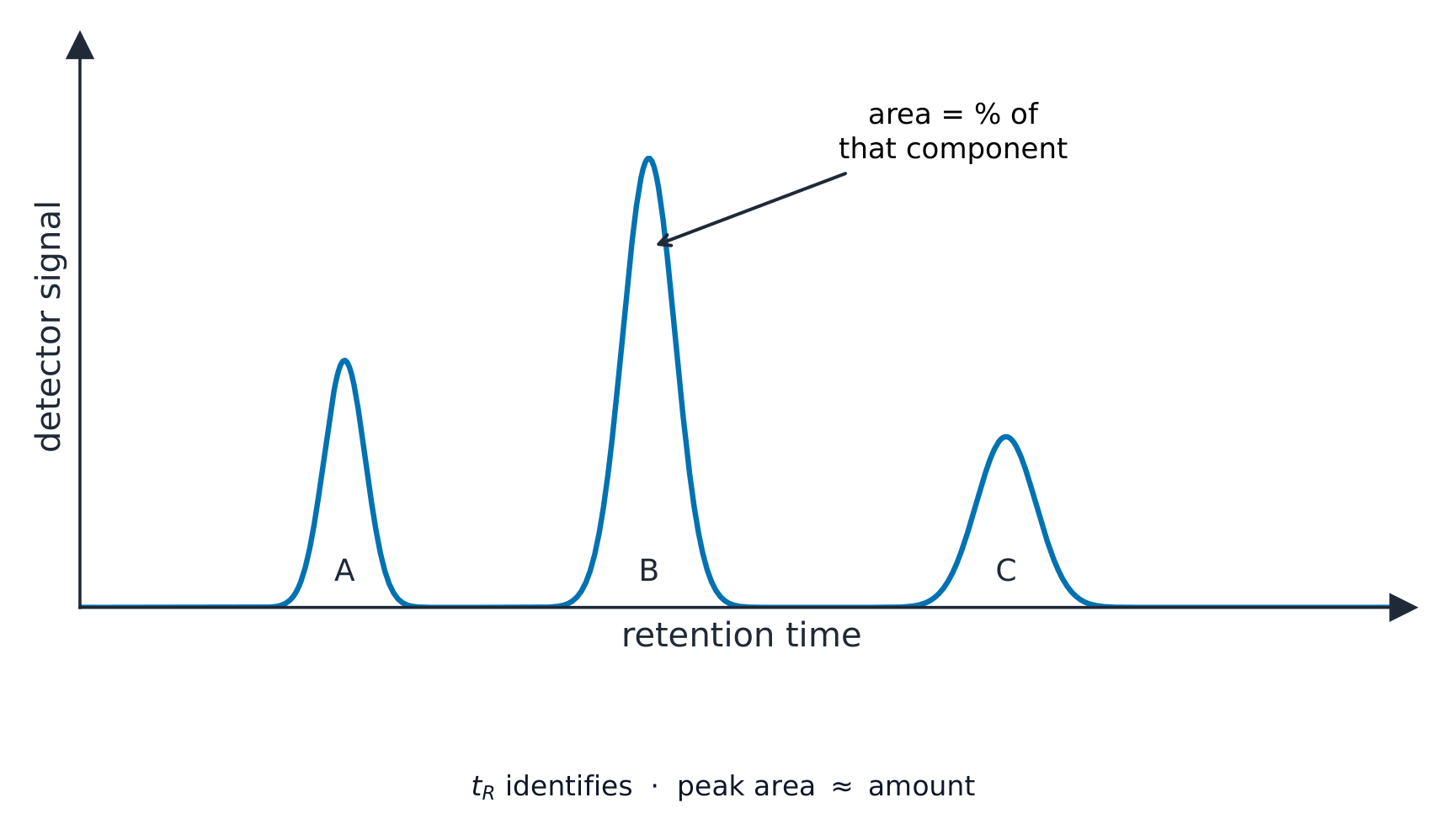
在气液色谱(gas/liquid chromatography,GLC)中:
- 固定相是一种在固体支持物上的高沸点非极性液体。
- 流动相是一种不反应的载气。
- 保留时间(retention time)是一个组分穿过所用的时间。
每个峰的面积给出那个组分在混合物中的百分比。一个与固定相相互作用更多的组分有更长的保留时间。
探索
Gas/liquid chromatography route
Follow a volatile sample through column separation to a chromatogram.
词汇表
训练
| 英文 | 中文 | 拼音 |
|---|---|---|
| gas/liquid chromatography/ɡæs ˈlɪkwɪd krəʊməˈtɒɡrəfi/ | 气液色谱 | qì yè sè pǔ |
| retention time/rɪˈtenʃn taɪm/ | 保留时间 | bǎo liú shí jiān |
37.3
碳-13 核磁共振谱

大纲
- analyse and interpret a carbon-13 NMR spectrum of a simple molecule to deduce: (a) the different environments of the carbon atoms present (b) the possible structures for the molecule
- predict or explain the number of peaks in a carbon-13 NMR spectrum for a given molecule
来源:剑桥国际大纲
核磁共振(NMR,nuclear magnetic resonance)研究某些原子核在一个强磁场中如何行为。
在碳-13 NMR 中,碳的每个不同的化学环境(chemical environment)给出一个峰。所以:
- 峰的数目告诉你有多少个不同的碳环境(等价的碳共享一个峰)。
- 每个峰的位置(它的化学位移)提示碳的类型,这帮助你推出可能的结构。
探索
Carbon-13 NMR lab
Match carbon environments to C-13 NMR evidence.
词汇表
训练
| 英文 | 中文 | 拼音 |
|---|---|---|
| NMR/ˌen em ˈɑː/ | 核磁共振 | hé cí gòng zhèn |
| chemical environment/ˈkemɪkl enˈvaɪrənmənt/ | 化学环境 | huà xué huán jìng |
37.4
质子(¹H)核磁共振谱

大纲
- analyse and interpret a proton ($^1\text{H}$) NMR spectrum of a simple molecule to deduce: (a) the different environments of proton present using chemical shift values (b) the relative numbers of each type of proton present from relative peak areas (c) the number of equivalent protons on the carbon atom adjacent to the one to which the given proton is attached from the splitting pattern, using the $n + 1$ rule (limited to singlet, doublet, triplet, quartet and multiplet) (d) the possible structures for the molecule
- predict the chemical shifts and splitting patterns of the protons in a given molecule
- describe the use of tetramethylsilane, TMS, as the standard for chemical shift measurements
- state the need for deuterated solvents, e.g. $\text{CDCl}_3$, when obtaining a proton NMR spectrum
- describe the identification of O–H and N–H protons by proton exchange using $\text{D}_2\text{O}$
来源:剑桥国际大纲
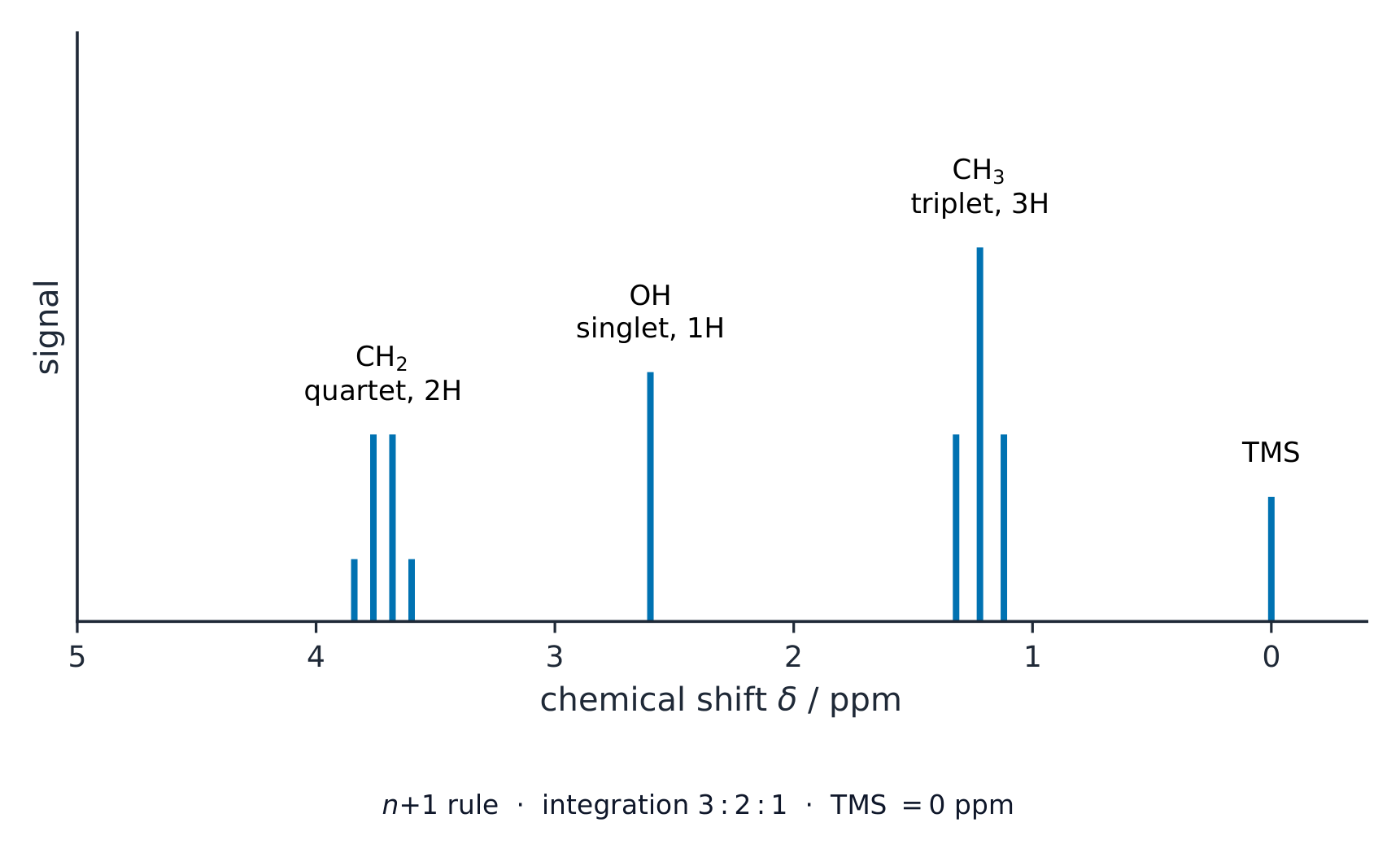
质子 NMR 看氢原子(质子(proton)核)。从谱你读出:
- 化学环境:不同环境中的质子出现在不同的化学位移(chemical shift)值。
- 相对数目:相对峰面积给出每种质子的比。
- 裂分(splitting):一个峰被相邻碳上的质子裂分,遵循 $n+1$ 规则——$n$ 个等价的相邻质子把一个峰裂分成 $n+1$ 条线:
| 相邻质子数($n$) | 图样 |
|---|---|
| 0 | 单峰(singlet) |
| 1 | 双峰(doublet) |
| 2 | 三峰(triplet) |
| 3 | 四峰(quartet) |
| 许多 | 多重峰(multiplet) |
实用要点
- 四甲基硅烷(tetramethylsilane,TMS)是标准,设在化学位移 $0$ 处。
- 用一种氘代溶剂(deuterated solvent,如 $\text{CDCl}_3$)使溶剂本身不给出质子信号。
- 把样品与 $\text{D}_2\text{O}$ 一起摇动使 O–H 和 N–H 峰消失(它们的氢被换成氘),这辨认出那些质子。
例题。 某化合物 $\text{C}_4\text{H}_8\text{O}_2$ 的质子 NMR 给出三个峰:$\delta\ 1.2$ 处的三重峰(面积 3)、$\delta\ 4.1$ 处的四重峰(面积 2),以及 $\delta\ 2.0$ 处的单峰(面积 3)。推断其结构。先读面积,再读裂分。面积 $3:2:3$ 给出三种质子环境,分别含 3、2、3 个氢。反过来用 $n+1$ 规则:三重峰(面积 3)是一个有 2 个邻位氢的 $\text{CH}_3$,四重峰(面积 2)是一个有 3 个邻位氢的 $\text{CH}_2$ - 它们彼此裂分,这是典型的乙基 $\text{CH}_3\text{CH}_2-$。那个 $\text{CH}_2$ 位于很低场的 $\delta\ 4.1$,所以它连着一个氧。剩下的单峰(面积 3)是一个在 $\delta\ 2.0$ 处、没有邻位氢的 $\text{CH}_3$,所以它挨着 C=O。合起来就是:$\text{CH}_3\text{COOCH}_2\text{CH}_3$,乙酸乙酯。三重峰加四重峰这一对几乎总是乙基 - 先认出它,其余的就顺理成章了。
探索
Proton NMR lab
Match proton evidence to chemical environment and neighbours.
词汇表
训练
| 英文 | 中文 | 拼音 |
|---|---|---|
| proton/ˈprəʊtɒn/ | 质子 | zhì zi |
| chemical shift/ˈkemɪkl ʃɪft/ | 化学位移 | huà xué wèi yí |
| splitting/ˈsplɪtɪŋ/ | 裂分 | liè fēn |
| singlet/ˈsɪŋɡlɪt/ | 单峰 | dān fēng |
| doublet/ˈdʌblət/ | 双峰 | shuāng fēng |
| triplet/ˈtrɪplɪt/ | 三峰 | sān fēng |
| quartet/kwɔːˈtet/ | 四峰 | sì fēng |
| multiplet/ˈmʌltɪplɪt/ | 多重峰 | duō zhòng fēng |
| tetramethylsilane/ˈtetrəmiːθɪlsɪleɪn/ | 四甲基硅烷 | sì jiǎ jī guī wán |
| deuterated solvent/ˈdjuːtəreɪtɪd ˈsɒlvənt/ | 氘代溶剂 | dāo dài róng jì |
37.4
考试技巧
- 在 $^{13}\text{C}$ NMR 中峰的数目等于碳环境的数目——用对称性来数它们。
- 在 $^1\text{H}$ NMR 中用化学位移(数据手册)、积分(H 的比)和裂分($n+1$ 规则):一个三峰 + 四峰意味着一个乙基。
- TMS 是参考($\delta = 0$);一次 $\text{D}_2\text{O}$ 摇动去除 O-H 和 N-H 峰。
- 结合红外、质谱和 NMR 来推出一个结构,说明哪个证据给出哪个特征。
本主题的互动课程
逐步学习,并即时检测练习。