Proton NMR · 质子 NMR
| English | 中文 | Pinyin · 拼音 |
|---|---|---|
| chemical shift/ˈkemɪkl ʃɪft/ | 化学位移 | huà xué wèi yí |
| splitting/ˈsplɪtɪŋ/ | 裂分 | liè fēn |
| deuterated/ˈdjuːtəreɪtɪd/ | 氘代 | dāo dài |
| integration/ˌɪntɪˈɡreɪʃn/ | 积分 | jī fēn |
Proton (¹H) NMR
- Proton NMR looks at the hydrogen atoms in a molecule.
- The spectrum gives three kinds of information.
- A few practical tricks make it readable.
质子(¹H)NMR
- 质子 NMR 看一个分子中的氢原子。
- 谱给出三种信息。
- 几个实用技巧使它可读。
Proton NMR lab · 质子 NMR 实验室
Match proton evidence to chemical environment and neighbours. · 把质子证据匹配到化学环境和邻居。
In proton NMR, the area under each peak is proportional to the number of ______ in that environment. · 在质子 NMR 中,每个峰下的面积与那个环境中 ______ 的数量成正比。
Integration gives the ratio of protons. · 积分给出质子的比例。
What you read off
- chemical environments: protons in different environments appear at different chemical shifts 化学位移 (number of peak groups = number of environments).
- relative numbers: the peak areas give the ratio of each type of proton.
- splitting 裂分: a peak is split by the protons on the neighbouring carbon — the $n+1$ rule.
| Neighbours ($n$) | Pattern |
|---|---|
| 0 | singlet |
| 1 | doublet |
| 2 | triplet |
| 3 | quartet |
A proton NMR spectrum of ethanol
你读出什么
- 化学环境:不同环境中的质子出现在不同的化学位移(峰组的数量 = 环境的数量)。
- 相对数量:峰面积给出每种质子的比例。
- 分裂:一个峰被邻近碳上的质子分裂——$n+1$ 规则。
| 邻居($n$) | 模式 |
|---|---|
| 0 | 单峰 |
| 1 | 双峰 |
| 2 | 三峰 |
| 3 | 四峰 |
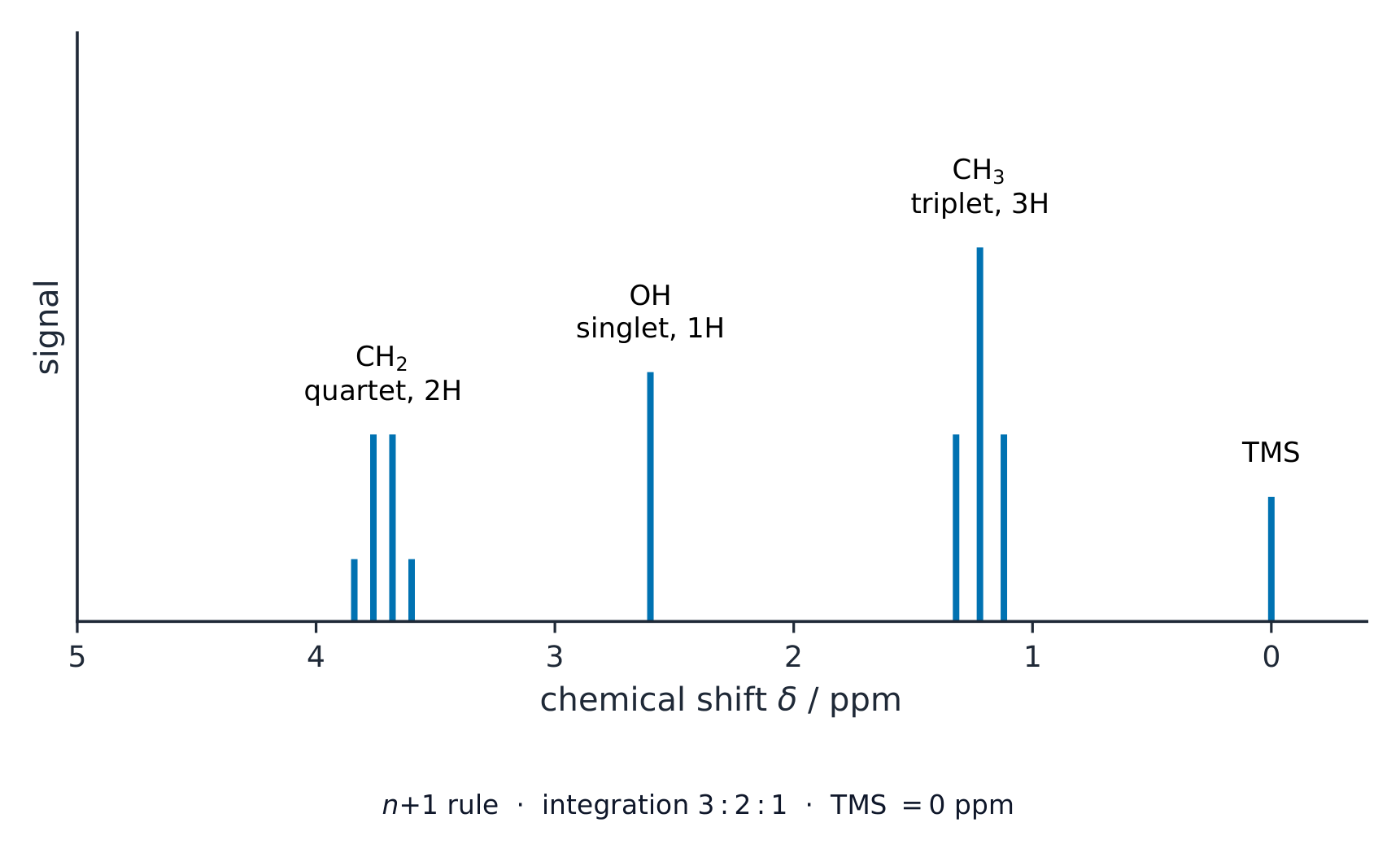
乙醇的一个质子 NMR 谱
In proton NMR, the number of groups of peaks tells you: · 在质子 NMR 中,峰组的数量告诉你:
Protons in different environments give peaks at different chemical shifts. · 不同环境中的质子在不同的化学位移给出峰。
The relative areas of the peaks give: · 峰的相对面积给出:
Peak area is proportional to how many protons of that type there are (e.g. 3:2:1 for ethanol). · 峰面积与那种质子有多少成正比(例如乙醇的 3:2:1)。
By the n+1 rule, a CH₃ group next to a CH₂ group appears as a: · 根据 n+1 规则,一个挨着 CH₂ 基团的 CH₃ 基团显示为一个:
The CH₃ has 2 neighbouring protons (on the CH₂), so n+1 = 3 lines — a triplet. · CH₃ 有 2 个邻近的质子(在 CH₂ 上),所以 n+1 = 3 条线——一个三峰。
Match each term to its meaning. · 匹配每个术语和它的含义。
Each item links the term to its correct meaning. · 每一项把术语链接到它正确的含义。
Practical points
- TMS (tetramethylsilane) is the standard, set at chemical shift 0.
- a deuterated 氘代 solvent (e.g. $\text{CDCl}_3$) gives no proton signal of its own.
- shaking with D₂O makes O–H and N–H peaks disappear (their H is swapped for D), identifying those protons.
实用要点
- TMS(四甲基硅烷)是标准,设在化学位移 0。
- 一个氘代溶剂(例如 $\text{CDCl}_3$)不给出它自己的质子信号。
- 与 D₂O 摇晃使 O–H 和 N–H 峰消失(它们的 H 被换成 D),识别那些质子。
Shaking a sample with D₂O makes which peaks disappear? · 与 D₂O 摇晃一个样品使哪些峰消失?
The exchangeable O–H and N–H hydrogens swap for deuterium, so their peaks vanish — identifying them. · 可交换的 O–H 和 N–H 氢被换成氘,所以它们的峰消失——识别它们。
What proton NMR tells you
- The number of peaks = different hydrogen environments; integration 积分 = ratio of protons.
- Splitting (n+1 rule) shows how many hydrogens are on neighbouring carbons.
质子 NMR 告诉你什么
- 峰的数量 = 不同的氢环境;积分 = 质子的比例。
- 分裂(n+1 规则)显示邻近碳上有多少氢。
You've got it
- ¹H NMR: number of peak groups = proton environments; areas = ratio of protons
- splitting: the $n+1$ rule ($n$ neighbours → $n+1$ lines): 0→singlet, 1→doublet, 2→triplet, 3→quartet
- TMS = reference (shift 0); a deuterated solvent is silent; D₂O removes O–H/N–H peaks
你掌握了
- ¹H NMR:峰组的数量 = 质子环境;面积 = 质子的比例
- 分裂:$n+1$ 规则($n$ 个邻居 → $n+1$ 条线):0→单峰,1→双峰,2→三峰,3→四峰
- TMS = 参考(位移 0);一个氘代溶剂是沉默的;D₂O 移除 O–H/N–H 峰