- 对于含有多个官能团的有机分子:(a) 利用教学大纲中的反应识别有机官能团;(b) 预测性质和反应
- 利用教学大纲中的反应,设计制备有机分子的多步合成路线
- 分析给定合成路线中每一步的反应类型、所用试剂以及可能的副产物
有机合成
A-Level 化学 · 知识点 36
 7:52
有机合成(A2)
三件截然不同的东西:一种亮橙色染料、一种止痛药和一种坚韧的塑料。三者均以同一种无色液体——苯——为起点。但单一反应无法……
英语旁白 · 英中内嵌字幕
36.1
有机合成

教学大纲
来源:Cambridge International 教学大纲
English
Like the AS synthesis topic, this asks you to join up known reactions to build a target molecule. Now you also have the A Level reactions of arenes, phenol, amines, amides and acyl chlorides.
Identifying functional groups
A molecule may carry several functional group 官能团 types. Use the test reactions to spot each one, then predict its behaviour. For example:
- decolourises bromine water with no catalyst, giving a white precipitate → a phenol or a phenylamine (the ring is activated).
- reacts violently with cold water, giving fumes of $\text{HCl}$ → an acyl chloride 酰氯.
- gives a purple colour with neutral $\text{FeCl}_3$ → a phenol 苯酚.
A map of the A Level reactions
| Start | Reagent and conditions | Product |
|---|---|---|
| benzene (an arene 芳烃) | $\text{HNO}_3$ / $\text{H}_2\text{SO}_4$ (electrophilic substitution 亲电取代) | nitrobenzene |
| nitrobenzene | $\text{Sn}$ / conc $\text{HCl}$, then $\text{NaOH}$ (reduction 还原) | phenylamine |
| phenylamine | $\text{HNO}_2$, below $10\,°\text{C}$ | a diazonium salt |
| diazonium salt | warm water | phenol; or couple with phenol → azo dye |
| methylbenzene | hot $\text{KMnO}_4$ (oxidation 氧化) | benzoic acid |
| carboxylic acid 羧酸 | $\text{SOCl}_2$ or $\text{PCl}_5$ | acyl chloride |
| acyl chloride | alcohol / phenol | an ester 酯 |
| acyl chloride | ammonia / amine 胺 | an amide 酰胺 |
| amide or nitrile 腈 | $\text{LiAlH}_4$ | an amine |
| halogenoalkane | $\text{KCN}$ | a nitrile (adds one carbon) |

Planning and analysing a route
To devise a synthetic route 合成路线, work backwards from the target: which single reaction makes it, and from what? Repeat until you reach the starting material, then write each step with its reagent 试剂 and conditions.
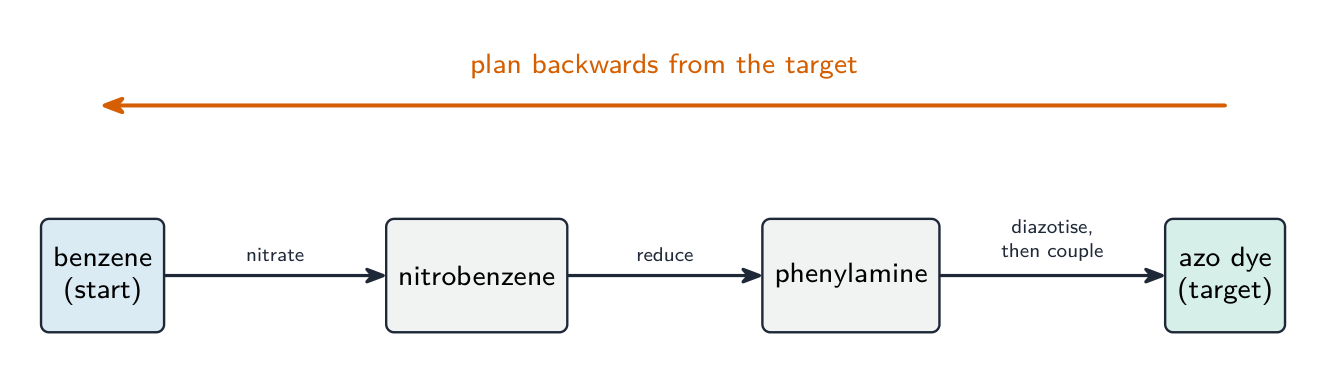
When you analyse a route, state the type of reaction for each step (for example electrophilic substitution, addition–elimination 加成消去, oxidation or reduction) and watch for likely by-products 副产物 — for example, making an amine from a halogenoalkane also gives over-substituted amines, lowering the yield.
Worked example. Devise a route from benzene to phenylamine, $\text{C}_6\text{H}_5\text{NH}_2$. Work backwards: phenylamine comes from reducing nitrobenzene, and nitrobenzene comes from nitrating benzene - so the route is two steps. Step 1: benzene with concentrated $\text{HNO}_3$ and concentrated $\text{H}_2\text{SO}_4$ at $55\ °\text{C}$; electrophilic substitution gives nitrobenzene (keep below $55\ °\text{C}$, or further substitution follows). Step 2: reduce the nitrobenzene with tin and concentrated $\text{HCl}$, then add $\text{NaOH}$ to free the amine from its salt. There is no direct route - you cannot put an $\text{–NH}_2$ straight onto a ring, which is exactly why this nitrate-then-reduce pair is worth knowing by heart.
Common mistakes.
- Writing "add $\text{KMnO}_4$" with no conditions. Every step needs its reagent and conditions: hot, acidified or alkaline $\text{KMnO}_4$, under reflux, for methylbenzene → benzoic acid.
- Forgetting the $\text{NaOH}$ after the $\text{Sn}$/$\text{HCl}$ reduction. In acid the product is the phenylammonium salt; the base frees the amine.
- Using $\text{NaBH}_4$ to reduce an amide or a nitrile. $\text{NaBH}_4$ is too weak; use $\text{LiAlH}_4$ (or $\text{H}_2$/Ni for a nitrile).
- Losing count of carbons. $\text{KCN}$ adds one carbon to the chain; most other steps keep the count the same, so check it at every step.
- Warming the diazonium salt before the coupling step. Above $10\,°\text{C}$ it gives phenol and $\text{N}_2$ instead of the azo dye.
- Reaching for $\text{AlCl}_3$ to brominate a phenol or phenylamine. These rings are activated, so bromine water alone works, and gives substitution at all three of the 2-, 4- and 6-positions.
探索
A-Level 合成规划器
通过把官能团变化匹配到试剂来构建一条路线。
词汇
训练
| English | 中文 | 拼音 |
|---|---|---|
| functional group/ˈfʌŋkʃənl ɡruːp/ | 官能团 | guān néng tuán |
| acyl chloride/əˈkɪl ˈklɔːraɪd/ | 酰氯 | xiān lǜ |
| phenol/ˈfenɒl/ | 苯酚 | běn fēn |
| arene/ˈæren/ | 芳烃 | fāng tīng |
| electrophilic substitution/ɪˌlektrəʊˈfɪlɪk ˌsʌbstɪˈtjuːʃn/ | 亲电取代 | qīn diàn qǔ dài |
| reduction/rɪˈdʌkʃn/ | 还原 | huán yuán |
| oxidation/ˌɒksɪˈdeɪʃn/ | 氧化 | yǎng huà |
| carboxylic acid/ˌkɑːbəkˈsɪlɪk ˈæsɪd/ | 羧酸 | suō suān |
| ester/ˈestə/ | 酯 | zhǐ |
| amine/ˈæmaɪn/ | 胺 | àn |
| amide/əˈmaɪd/ | 酰胺 | xiān àn |
| nitrile/ˈnaɪtraɪl/ | 腈 | jīng |
| synthetic route/sɪnˈθetɪk ruːt/ | 合成路线 | hé chéng lù xiàn |
| reagent/rɪˈeɪdʒənt/ | 试剂 | shì jì |
| addition–elimination/əˈdɪʃn ɪˌlɪmɪˈneɪʃn/ | 加成消去 | jiā chéng xiāo qù |
| by-product/baɪ ˈprɒdʌkt/ | 副产物 | fù chǎn wù |
36.1
考试技巧
English
- Combine AS and A-level steps and watch for benzene-ring reactions and carbon-count changes.
- State every reagent and condition, and note when a step produces a racemic mixture.
- Choose the shortest route that reaches the target functional group.
该知识点的互动课程
逐步完成,配合即时检查练习。