- describe the formation of polyesters: (a) the reaction between a diol and a dicarboxylic acid or dioyl chloride (b) the reaction of a hydroxycarboxylic acid
- describe the formation of polyamides: (a) the reaction between a diamine and a dicarboxylic acid or dioyl chloride (b) the reaction of an aminocarboxylic acid (c) the reaction between amino acids
- deduce the repeat unit of a condensation polymer obtained from a given monomer or pair of monomers
- identify the monomer(s) present in a given section of a condensation polymer molecule
聚合
A-Level 化学 · 第 35 主题
 7:58
7:58
Polymerisation (A2)
Look at three very different things. A nylon rope. A plastic drinks bottle. The protein in your own hair. They seem to have nothing in common. Yet all three…
英文讲解 · 内嵌中英文字幕
35.1
缩合聚合

大纲
来源:剑桥国际大纲
在缩合聚合(condensation polymerisation)中,单体连成一条长链,并且每当一个新键形成时失去一个小分子(如水或 $\text{HCl}$)。每个单体需要两个活泼基团,所以链能在两端生长。
聚酯
一个聚酯(polyester)沿它的链有许多酯连接。你可以由下列制成一个:
- 一个二醇(diol,两个 $\text{–OH}$ 基团)和一个二羧酸(dicarboxylic acid,两个 $\text{–COOH}$ 基团),或一个二酰氯。
- 一个单一的羟基羧酸,它既有一个 $\text{–OH}$ 又有一个 $\text{–COOH}$。

聚酰胺
一个聚酰胺(polyamide)有许多酰胺连接。你可以由下列制成一个:
- 一个二胺(diamine,两个 $\text{–NH}_2$ 基团)和一个二羧酸或一个二酰氯。
- 一个单一的氨基羧酸,或由氨基酸(amino acids)连接在一起(蛋白质是天然的聚酰胺)。

重复单元和单体
一个缩合聚合物的重复单元(repeat unit)含有两种单体的部分,减去作为小分子失去的原子。要从一段聚合物找出单体(monomers),在每个酯或酰胺连接处断开链,然后加回 $\text{–OH}$ 和 $\text{–H}$(或 $\text{–Cl}$)。

例题。 某聚合物链中含有重复的 $\text{–CONH–}$ 连接。说出这种聚合物的类型,指出单体,并给出失去的小分子。$\text{–CONH–}$ 连接是酰胺键,所以这是通过缩聚制成的聚酰胺。要找出单体,就在每一个酰胺键处把链断开,并把断口两端的原子还回去:碳的一侧接上 $\text{–OH}$,形成二元羧酸;氮的一侧接上 $\text{–H}$,形成二元胺。每个连接处失去的小分子是水(如果用的是二酰氯而不是酸,则是 $\text{HCl}$)。每个单体必须有两个官能团,否则链就无法不断增长 - 如果你给出的单体只有一个官能团,那就是断错了地方。
探索
Condensation polymer route
Watch monomers join while a small molecule leaves each time.
词汇表
训练
| 英文 | 中文 | 拼音 |
|---|---|---|
| condensation polymerisation/kɒndenˈseɪʃn ˌpɒlɪməraɪˈzeɪʃn/ | 缩合聚合 | suō hé jù hé |
| polyester/ˌpɒlɪˈestə/ | 聚酯 | jù zhǐ |
| diol/dɪˈɒl/ | 二醇 | èr chún |
| dicarboxylic acid/ˌdɪkɑːbəkˈsɪlɪk ˈæsɪd/ | 二羧酸 | èr suō suān |
| polyamide/ˌpɒlɪˈeɪmaɪd/ | 聚酰胺 | jù xiān àn |
| diamine/ˈdaɪəmaɪn/ | 二胺 | èr àn |
| amino acid/əˈmiːnəʊ ˈæsɪd/ | 氨基酸 | ān jī suān |
| repeat unit/rɪˈpiːt ˈjuːnɪt/ | 重复单元 | chóng fù dān yuán |
| monomer/ˈmɒnəʊmə/ | 单体 | dān tǐ |
| poly(alkene)/ˈpɒlɪ/ | 聚烯烃 | jù xī tīng |
| biodegradable/ˌbaɪəʊdɪˈɡreɪdəbl/ | 可生物降解 | kě shēng wù jiàng jiě |
35.2
预测聚合类型
大纲
- predict the type of polymerisation reaction for a given monomer or pair of monomers
- deduce the type of polymerisation reaction which produces a given section of a polymer molecule
来源:剑桥国际大纲
| 线索 | 类型 |
|---|---|
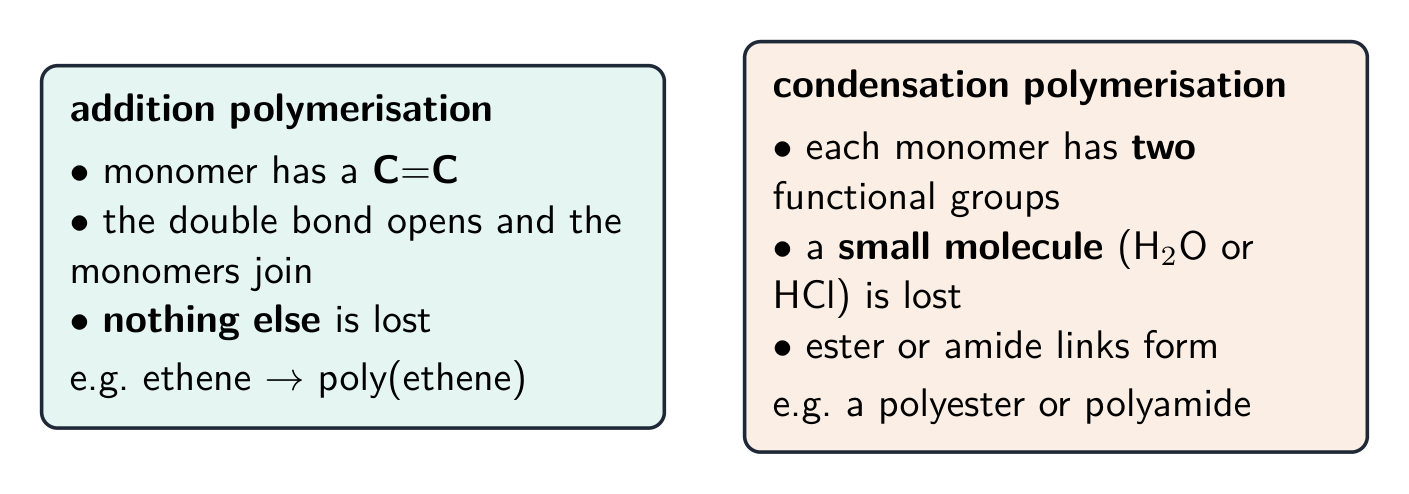
| 单体有一个 C=C 双键,并且没有其他东西失去 | 加成聚合(addition polymerisation) |
| 每个单体有两个官能团,并且失去一个小分子;链有酯或酰胺连接 | 缩合聚合 |
探索
Polymerisation type lab
Classify monomers by whether they form addition or condensation polymers.
词汇表
训练
| 英文 | 中文 | 拼音 |
|---|---|---|
| addition polymerisation/əˈdɪʃn ˌpɒlɪməraɪˈzeɪʃn/ | 加成聚合 | jiā chéng jù hé |
35.3
可降解聚合物
大纲
- recognise that poly(alkenes) are chemically inert and can therefore be difficult to biodegrade
- recognise that some polymers can be degraded by the action of light
- recognise that polyesters and polyamides are biodegradable by acidic and alkaline hydrolysis
来源:剑桥国际大纲
- 聚烯烃(poly(alkene)s)化学惰性——它们只有强的、非极性的 C–C 和 C–H 键,所以它们难以可生物降解(biodegrade),长久留存。
- 有些聚合物被制成使光能分解它们(它们是可光降解的)。
- 聚酯和聚酰胺是可生物降解的,因为它们的酯和酰胺连接能被酸性或碱性水解(hydrolysis)断裂。
探索
Degradable polymer route
Follow how polymer structure controls breakdown.
词汇表
训练
| 英文 | 中文 | 拼音 |
|---|---|---|
| hydrolysis/haɪˈdrɒləsɪs/ | 水解 | shuǐ jiě |
35.3
考试技巧
- 缩合聚合物(聚酯、聚酰胺)在失去一个小分子($\text{H}_2\text{O}$ 或 HCl)时形成——画出重复单元和失去的分子。
- 通过断开酯或酰胺连接从聚合物辨认单体——一个常见的题目。
- 从单体预测类型:一个 $\text{C}=\text{C}$ 给出加成;两个官能团给出缩合。
- 聚酯和聚酰胺是可水解的(更可降解);加成聚合物不是。
本主题的互动课程
逐步学习,并即时检测练习。