- explain and use the terms rate equation, order of reaction, overall order of reaction, rate constant, half-life, rate-determining step and intermediate
- (a) understand and use rate equations of the form $\text{rate} = k [\text{A}]^m[\text{B}]^n$ (for which $m$ and $n$ are 0, 1 or 2) (b) deduce the order of a reaction from concentration–time graphs or from experimental data relating to the initial rates method and half-life method (c) interpret experimental data in graphical form, including concentration–time and rate–concentration graphs (d) calculate an initial rate using concentration data (e) construct a rate equation
- (a) show understanding that the half-life of a first-order reaction is independent of concentration (b) use the half-life of a first-order reaction in calculations
- calculate the numerical value of a rate constant, for example by: (a) using the initial rates and the rate equation (b) using the half-life, $t_{\frac{1}{2}}$, and the equation $k = 0.693/t_{\frac{1}{2}}$
- for a multi-step reaction: (a) suggest a reaction mechanism that is consistent with the rate equation and the equation for the overall reaction (b) predict the order that would result from a given reaction mechanism and rate-determining step (c) deduce a rate equation using a given reaction mechanism and rate-determining step for a given reaction (d) identify an intermediate or catalyst from a given reaction mechanism (e) identify the rate determining step from a rate equation and a given reaction mechanism
- describe qualitatively the effect of temperature change on the rate constant and hence the rate of a reaction
反应动力学
A-Level 化学 · 第 26 主题
 8:01
8:01
Reaction kinetics (A2)
Here is a real reaction: hydrogen peroxide reacting with iodide ions in acid. Look at the balanced equation. It uses two iodide ions and two hydrogen ions…
英文讲解 · 内嵌中英文字幕
26.1
简单速率方程、反应级数与速率常数

大纲
来源:剑桥国际大纲
一个速率方程(rate equation)显示速率如何取决于反应物的浓度:
$$\text{rate} = k\,[\text{A}]^m[\text{B}]^n$$
- $m$ 是关于 A 的反应级数(order of reaction),$n$ 是关于 B 的级数。每个是 $0$、$1$ 或 $2$。
- 总反应级数(overall order of reaction)是 $m + n$。
- $k$ 是速率常数(rate constant)。速率方程只能由实验求得,不能从配平方程得出。
求级数
- 初速率法:一次改变一个浓度,看起始速率如何变化。如果 $[\text{A}]$ 翻倍使速率翻倍,关于 A 的级数是 1;如果它使速率变为四倍,级数是 2;如果速率不变,级数是 0。
例题。 在关于 $\text{A} + \text{B} \rightarrow$ 产物的实验中,$[\text{A}]$ 翻倍(固定 $[\text{B}]$)使速率翻倍,$[\text{B}]$ 翻倍(固定 $[\text{A}]$)使速率变为四倍。写出速率方程并给出总级数。
$[\text{A}]$ 翻倍使速率翻倍,所以关于 A 是一级。$[\text{B}]$ 翻倍使速率变为四倍($2^2$),所以关于 B 是二级。因此
$$\text{rate} = k[\text{A}][\text{B}]^2, \qquad \text{overall order} = 1 + 2 = 3.$$
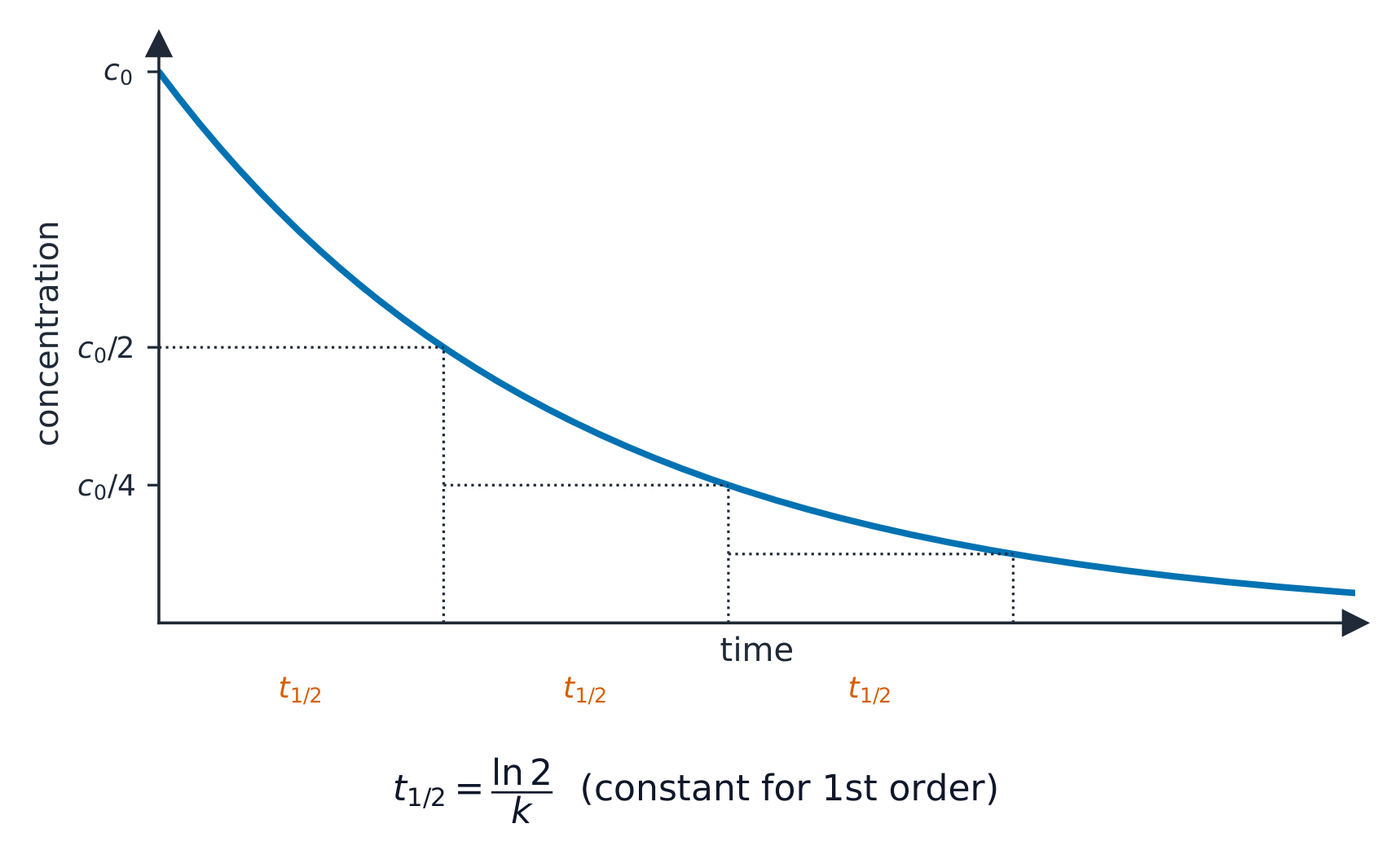
- 图:一级反应的浓度-时间图有一个恒定的半衰期(half-life,浓度减半的时间)。速率-浓度图对一级是过原点的直线,对二级是一条曲线。

半衰期和速率常数
对于一个一级反应,半衰期是恒定的——它不取决于浓度。你可以从它求速率常数:
$$k = \frac{0.693}{t_{\frac{1}{2}}}$$
例题。 一个一级反应有 $120\ \text{s}$ 的半衰期。求它的速率常数。
$$k = \frac{0.693}{t_{1/2}} = \frac{0.693}{120} = 5.8 \times 10^{-3}\ \text{s}^{-1}.$$
你也可以把初速率数据代入速率方程求 $k$。
探索
Rate equations & orders
[A] = [A]₀·bᵗ
A first-order reaction decays exponentially — equal half-lives.
词汇表
训练
| 英文 | 中文 | 拼音 |
|---|---|---|
| rate equation/reɪt ɪˈkweɪʒn/ | 速率方程 | sù lǜ fāng chéng |
| order of reaction/ˈɔːdə ɒv rɪˈækʃn/ | 反应级数 | fǎn yìng jí shù |
| overall order of reaction/ˌəʊvəˈrɔːl ˈɔːdə ɒv rɪˈækʃn/ | 总反应级数 | zǒng fǎn yìng jí shù |
| rate constant/reɪt ˈkɒnstənt/ | 速率常数 | sù lǜ cháng shù |
| half-life/hɑːf laɪf/ | 半衰期 | bàn shuāi qī |
26.1
反应机理
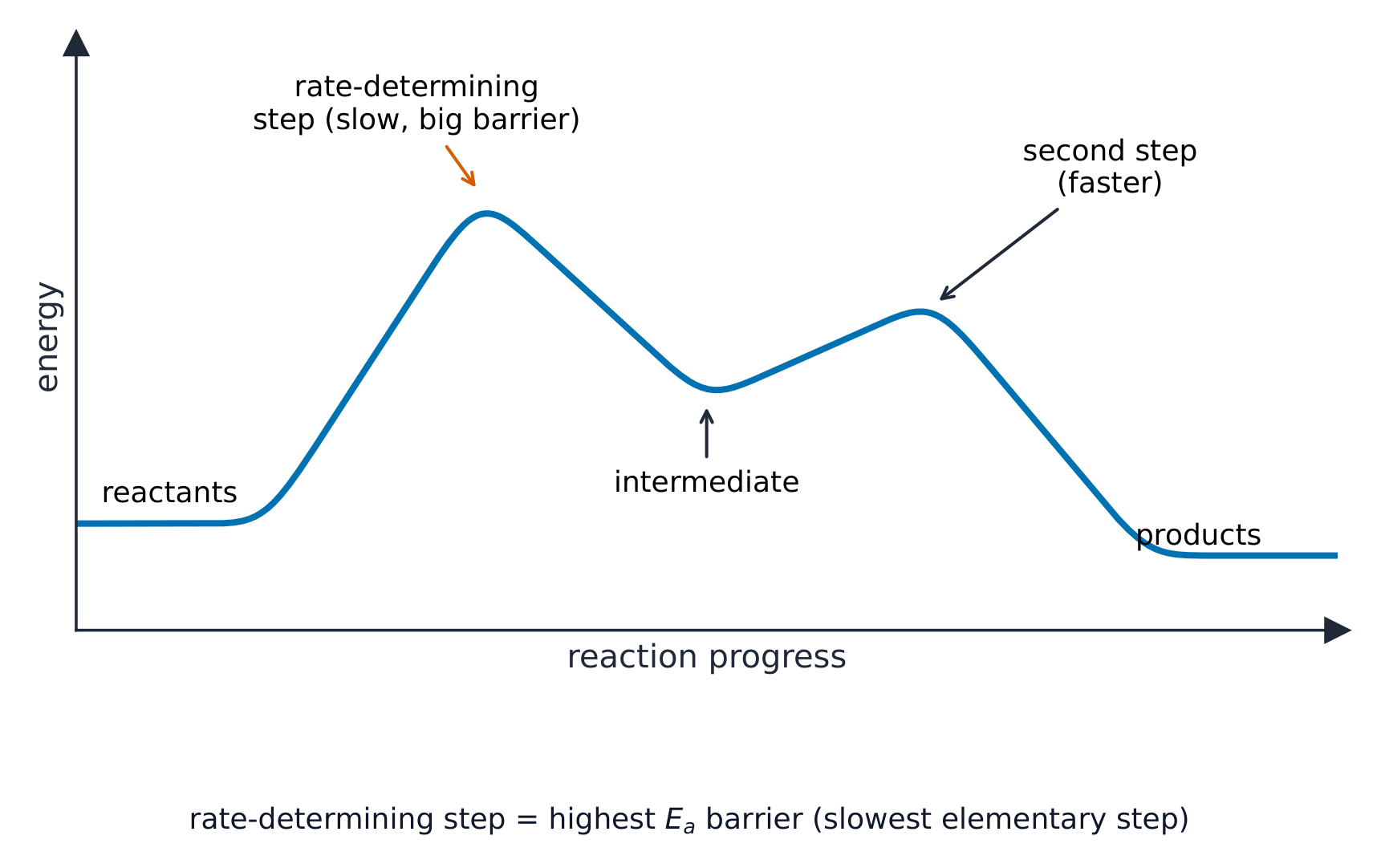
大多数反应分几步发生。最慢的步骤是决速步骤(rate-determining step),它控制总速率。只有直到并包括这一步所涉及的物种才出现在速率方程中。
- 一个中间体(intermediate)是一个在一步中生成、然后在较晚一步中用完的物种。它不在总方程中。
- 你可以提出一个既符合速率方程又符合总方程的机理,从一个给定机理预测级数,或找出决速步骤。
如果你比较不同混合物的初始速率(initial rate),你可以推出速率方程,并由此推出机理。
温度的影响
升高温度使速率常数 $k$ 增大(更多的分子越过活化能),所以速率上升。
探索
Organic mechanism route
Trace electron-pair movement from reagent to product.
词汇表
训练
| 英文 | 中文 | 拼音 |
|---|---|---|
| rate-determining step/reɪt dɪˈtɜːmɪnɪŋ step/ | 决速步骤 | jué sù bù zhòu |
| intermediate/ˌɪntəˈmiːdɪət/ | 中间体 | zhōng jiān tǐ |
| initial rate/ɪˈnɪʃl reɪt/ | 初始速率 | chū shǐ sù lǜ |
26.2
均相与多相催化剂

大纲
- explain that catalysts can be homogeneous or heterogeneous
- describe the mode of action of a heterogeneous catalyst to include adsorption of reactants, bond weakening and desorption of products, for example: (a) iron in the Haber process (b) palladium, platinum and rhodium in the catalytic removal of oxides of nitrogen from the exhaust gases of car engines
- describe the mode of action of a homogeneous catalyst by being used in one step and reformed in a later step, for example: (a) atmospheric oxides of nitrogen in the oxidation of atmospheric sulfur dioxide (b) $\text{Fe}^{2+}$ or $\text{Fe}^{3+}$ in the $\text{I}^- / \text{S}_2\text{O}_8^{2-}$ reaction
来源:剑桥国际大纲
催化剂(catalysts)可以是均相的或多相的。
多相催化剂
一个多相催化剂(heterogeneous catalyst)与反应物处于不同的物理状态(通常是固体配气体)。它分三阶段起作用:
- 吸附(adsorption):反应物分子附着到催化剂表面。
- 反应物中的键被削弱,所以它们更容易反应。
- 脱附(desorption):产物分子离开表面。

例子有哈伯法中的铁,以及催化转化器中的铂、钯和铑。
均相催化剂
一个均相催化剂(homogeneous catalyst)与反应物处于相同的物理状态。它在一步中被用完,然后在较晚一步中重新生成,所以它原封不动地回来。例子有帮助氧化大气中二氧化硫的氮的氧化物,以及加速 $\text{I}^-$ 和 $\text{S}_2\text{O}_8^{2-}$ 之间反应的 $\text{Fe}^{2+}$ 或 $\text{Fe}^{3+}$。
探索
How a catalyst speeds a reaction
Turn the catalyst on and watch the rate jump — it gives more successful collisions per second by offering a lower-energy path.
词汇表
训练
| 英文 | 中文 | 拼音 |
|---|---|---|
| catalyst/ˈkætəlɪst/ | 催化剂 | cuī huà jì |
| heterogeneous catalyst/ˌhetrəˈdʒiːnɪəs ˈkætəlɪst/ | 多相催化剂 | duō xiāng cuī huà jì |
| adsorption/ədˈsɔːpʃn/ | 吸附 | xī fù |
| desorption/dɪˈsɔːpʃn/ | 脱附 | tuō fù |
| homogeneous catalyst/həˈməʊdʒnɪəs ˈkætəlɪst/ | 均相催化剂 | jūn xiāng cuī huà jì |
26.2
考试技巧
- 从初速率数据求级数:一个浓度翻倍使速率翻倍是一级,变为四倍是二级,无变化是零级。
- 写 $\text{rate} = k[\text{A}]^m[\text{B}]^n$ 并由它算出 $k$ 的单位。
- 决速步骤含有速率方程中的物种(和级数)——用这个检验一个机理。
- 一个恒定的半衰期意味着一级。
本主题的互动课程
逐步学习,并即时检测练习。