- understand and use the terms conjugate acid and conjugate base
- define conjugate acid–base pairs, identifying such pairs in reactions
- define mathematically the terms pH, $K_a$, $\text{p}K_a$ and $K_w$ and use them in calculations ($K_b$ and the equation $K_w = K_a \times K_b$ will not be tested)
- calculate $[\text{H}^+(\text{aq})]$ and pH values for: (a) strong acids (b) strong alkalis (c) weak acids
- (a) define a buffer solution (b) explain how a buffer solution can be made (c) explain how buffer solutions control pH; use chemical equations in these explanations (d) describe and explain the uses of buffer solutions, including the role of $\text{HCO}_3^-$ in controlling pH in blood
- calculate the pH of buffer solutions, given appropriate data
- understand and use the term solubility product, $K_{\text{sp}}$
- write an expression for $K_{\text{sp}}$
- calculate $K_{\text{sp}}$ from concentrations and vice versa
- (a) understand and use the common ion effect to explain the different solubility of a compound in a solution containing a common ion (b) perform calculations using $K_{\text{sp}}$ values and concentration of a common ion
平衡
A-Level 化学 · 第 25 主题
 7:56
7:56
Equilibria (A2)
Your blood is held at pH seven point four. Move it a few tenths either way and you are in hospital. Yet all day, acid pours in — from your food, and from your…
英文讲解 · 内嵌中英文字幕
25.1
酸与碱

大纲
来源:剑桥国际大纲
当一个布朗斯特酸失去一个 $\text{H}^+$ 时,剩下的是它的共轭碱(conjugate base)。当一个碱获得一个 $\text{H}^+$ 时,它变成它的共轭酸(conjugate acid)。仅相差一个 $\text{H}^+$ 的两个物种构成一个共轭酸碱对(conjugate acid–base pair)。
例如,在 $\text{CH}_3\text{COOH} \rightleftharpoons \text{CH}_3\text{COO}^- + \text{H}^+$ 中,这一对是 $\text{CH}_3\text{COOH}$(酸)和 $\text{CH}_3\text{COO}^-$(它的共轭碱)。
探索
pH and H⁺ concentration
pH = −log[H⁺]: slide it and watch [H⁺] change tenfold per unit. A conjugate acid–base pair differ by a single proton.
词汇表
训练
| 英文 | 中文 | 拼音 |
|---|---|---|
| conjugate base/ˈkɒndʒuːɡeɪt beɪs/ | 共轭碱 | gòng è jiǎn |
| conjugate acid/ˈkɒndʒuːɡeɪt ˈæsɪd/ | 共轭酸 | gòng è suān |
| conjugate acid–base pair/ˈkɒndʒuːɡeɪt ˈæsɪd beɪs peə/ | 共轭酸碱对 | gòng è suān jiǎn duì |
25.1
pH 与平衡常数

- pH 衡量酸度:$\text{pH} = -\log[\text{H}^+]$,所以 $[\text{H}^+] = 10^{-\text{pH}}$。
- 一个弱酸 $\text{HA}$ 的酸解离常数(acid dissociation constant)是 $K_a = \dfrac{[\text{H}^+][\text{A}^-]}{[\text{HA}]}$,且 $\text{p}K_a = -\log K_a$。较大的 $K_a$(较小的 $\text{p}K_a$)意味着较强的酸。
- 水的离子积(ionic product of water)在 $298\ \text{K}$ 时是 $K_w = [\text{H}^+][\text{OH}^-] = 1.0 \times 10^{-14}$。

计算 pH
- 强酸(strong acid):完全电离,所以 $[\text{H}^+]$ 等于酸的浓度;然后取 $-\log$。
- 强碱(strong alkali):从浓度求 $[\text{OH}^-]$,然后用 $[\text{H}^+] = K_w / [\text{OH}^-]$。
- 弱酸(weak acid):只部分电离,所以用 $[\text{H}^+] = \sqrt{K_a \times [\text{HA}]}$。
例题。 求 $0.050\ \text{mol dm}^{-3}$ 盐酸(一种强酸)的 pH。
它完全电离,所以 $[\text{H}^+] = 0.050\ \text{mol dm}^{-3}$,给出 $\text{pH} = -\log(0.050) = 1.30$。
例题。 求 $0.10\ \text{mol dm}^{-3}$ 氢氧化钠(一种强碱)的 pH。($K_w = 1.0 \times 10^{-14}$。)
$[\text{OH}^-] = 0.10$,所以 $[\text{H}^+] = K_w/[\text{OH}^-] = (1.0 \times 10^{-14})/0.10 = 1.0 \times 10^{-13}$,给出 $\text{pH} = 13.0$。
例题。 求 $0.10\ \text{mol dm}^{-3}$ 乙酸(一种弱酸)的 pH。($K_a = 1.8 \times 10^{-5}$。)
$$[\text{H}^+] = \sqrt{K_a \times [\text{HA}]} = \sqrt{(1.8 \times 10^{-5})(0.10)} = 1.3 \times 10^{-3}, \qquad \text{pH} = -\log(1.3 \times 10^{-3}) = 2.87.$$
词汇表
训练
| 英文 | 中文 | 拼音 |
|---|---|---|
| acid dissociation constant/ˈæsɪd dɪˌsəʊsɪˈeɪʃn ˈkɒnstənt/ | 酸解离常数 | suān jiě lí cháng shù |
| ionic product of water/aɪˈɒnɪk ˈprɒdʌkt ɒv ˈwɔːtə/ | 水的离子积 | shuǐ de lí zi jī |
| strong acid/strɒŋ ˈæsɪd/ | 强酸 | qiáng suān |
| strong alkali/strɒŋ ˈælkəlaɪ/ | 强碱 | qiáng jiǎn |
| weak acid/wiːk ˈæsɪd/ | 弱酸 | ruò suān |
25.1
缓冲溶液
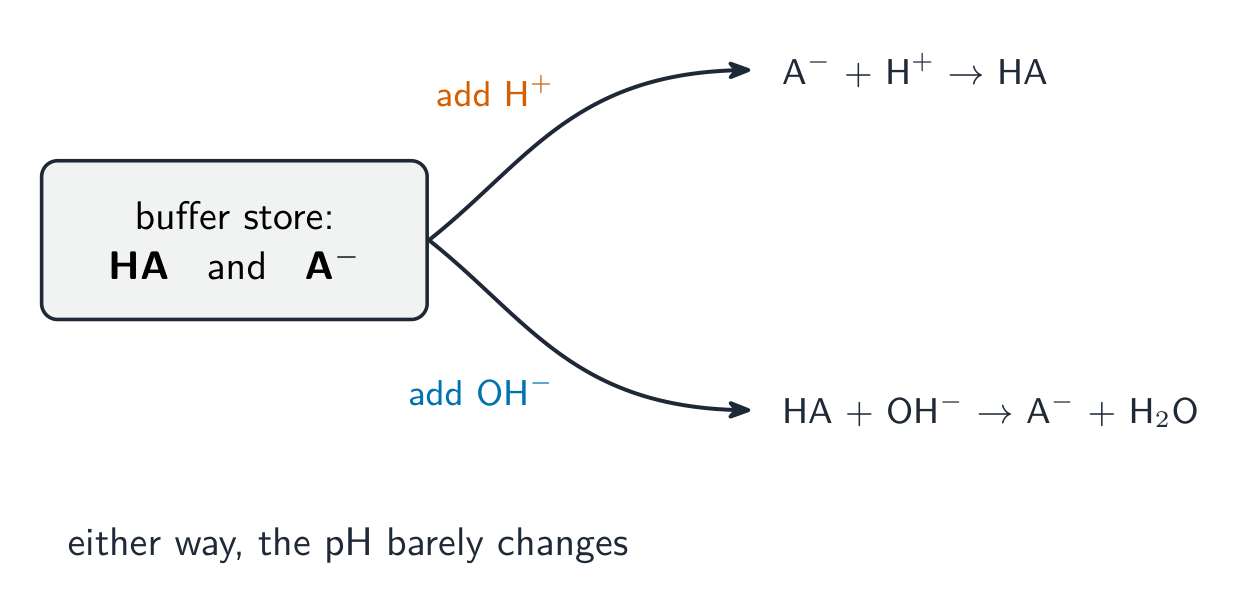
一个缓冲溶液(buffer solution)在加入少量酸或碱时抵抗 pH 的变化。你用一个弱酸和它的共轭碱(例如乙酸和乙酸钠)制成一个。
它起作用是因为混合物持有两个搭档的储备:
- 加入的 $\text{H}^+$ 被共轭碱去除:$\text{CH}_3\text{COO}^- + \text{H}^+ \rightarrow \text{CH}_3\text{COOH}$。
- 加入的 $\text{OH}^-$ 被弱酸去除:$\text{CH}_3\text{COOH} + \text{OH}^- \rightarrow \text{CH}_3\text{COO}^- + \text{H}_2\text{O}$。
要求 pH,把酸和它的盐的浓度代入 $K_a$ 表达式。缓冲液在生物中很重要——例如,$\text{HCO}_3^-$ 使血液的 pH 保持接近 $7.4$。
探索
Buffers and the titration curve
Add alkali to acid: the flat part is where a buffer resists pH change, and the steep jump is the equivalence point.
词汇表
训练
| 英文 | 中文 | 拼音 |
|---|---|---|
| buffer solution/ˈbʌfə səˈluːʃn/ | 缓冲溶液 | huǎn chōng róng yè |
25.1
溶度积

对于一个几乎不溶的盐,溶度积(solubility product,$K_{\text{sp}}$)是一个饱和溶液中各离子浓度的乘积,每个都升到它在式子中的数目次方:
$$K_{\text{sp}} = [\text{Ag}^+][\text{Cl}^-] \qquad K_{\text{sp}} = [\text{Ca}^{2+}][\text{F}^-]^2$$
你可以从溶解度求 $K_{\text{sp}}$,或从 $K_{\text{sp}}$ 求溶解度。
同离子效应
同离子效应(common ion effect)是一个盐在一个已经含有它一种离子的溶液中变得不那么可溶的方式。多出的离子把溶解平衡推回(勒夏特列),所以溶解的盐更少。你可以用 $K_{\text{sp}}$ 和同离子的浓度计算新的溶解度。
探索
Solubility product lab
ionic product compared with Ksp
Increase ion concentration and see when precipitation becomes likely.
词汇表
训练
| 英文 | 中文 | 拼音 |
|---|---|---|
| solubility product/ˌsɒljuːˈbɪlɪti ˈprɒdʌkt/ | 溶度积 | róng dù jī |
| common ion effect/ˈkɒmən ˈaɪɒn ɪˈfekt/ | 同离子效应 | tóng lí zi xiào yìng |
25.2
分配系数

大纲
- state what is meant by the term partition coefficient, $K_{\text{pc}}$
- calculate and use a partition coefficient for a system in which the solute is in the same physical state in the two solvents
- understand the factors affecting the numerical value of a partition coefficient in terms of the polarities of the solute and the solvents used
来源:剑桥国际大纲
当一个溶质与两种不混合的溶剂一起摇动时,它在它们之间分布。分配系数(partition coefficient,$K_{\text{pc}}$)是它在两层中浓度的比(在恒温下):
$$K_{\text{pc}} = \frac{[\text{solute in solvent 1}]}{[\text{solute in solvent 2}]}$$
这在溶质(solute)在两种溶剂中处于相同物理状态时成立。这个值取决于溶质和每种溶剂(solvent)的极性(polarity):一个非极性溶质在非极性溶剂中溶得更多,而一个极性溶质偏爱极性溶剂。
探索
Partition coefficient lab
Kpc = concentration organic / concentration aqueous
Change organic-layer concentration and see the partition ratio.
词汇表
训练
| 英文 | 中文 | 拼音 |
|---|---|---|
| partition coefficient/pɑːˈtɪʃn ˌkəʊɪˈfɪʃənt/ | 分配系数 | fēn pèi xì shù |
| solute/ˈsɒljuːt/ | 溶质 | róng zhì |
| polarity/pəʊˈlærɪti/ | 极性 | jí xìng |
| solvent/ˈsɒlvənt/ | 溶剂 | róng jì |
25.2
考试技巧
- $\text{pH} = -\log[\text{H}^+]$;对于强酸 $[\text{H}^+]$ = 浓度,对于弱酸用 $[\text{H}^+] = \sqrt{K_a[\text{HA}]}$。
- 对于一个碱,从 $K_w = [\text{H}^+][\text{OH}^-] = 1.0 \times 10^{-14}$ 求 $[\text{H}^+]$。
- 对于一个缓冲液用 $[\text{H}^+] = K_a \times [\text{acid}]/[\text{salt}]$ 并解释它如何去除加入的 $\text{H}^+$/$\text{OH}^-$。
- 用正确的幂写出 $K_{sp}$ 表达式;一个 pH 中的小数位数等于 $[\text{H}^+]$ 的有效数字。
本主题的互动课程
逐步学习,并即时检测练习。