Reaction mechanisms · 反应机理
| English | 中文 | Pinyin · 拼音 |
|---|---|---|
| mechanism/ˈmekənɪzəm/ | 机理 | jī lǐ |
| rate-determining step/reɪt dɪˈtɜːmɪnɪŋ step/ | 决速步骤 | jué sù bù zhòu |
| intermediate/ˌɪntəˈmiːdɪət/ | 中间体 | zhōng jiān tǐ |
| activation energy/ˌæktɪˈveɪʃn ˈenədʒi/ | 活化能 | huó huà néng |
The slowest step rules
- Most reactions happen in several steps.
- The slowest step controls the overall rate.
- The rate equation reveals the mechanism 机理.
最慢的步骤主宰
- 大多数反应分几个步骤发生。
- 最慢的步骤控制总速率。
- 速率方程揭示机理。
Organic mechanism route · 有机机理途径
Trace electron-pair movement from reagent to product. · 从试剂到产物追踪电子对的移动。
The slowest step of a reaction mechanism is the rate-______ step. · 一个反应机理的最慢步骤是速率______步骤。
Only species up to and including it appear in the rate equation. · 只有直到并包括它的物种出现在速率方程中。
The rate-determining step 决速步骤
- The slowest step is the rate-determining step (RDS) — it controls the overall rate.
- Only the species involved up to and including the RDS appear in the rate equation.
- An intermediate 中间体 is made in one step and used up in a later one — it is not in the overall equation.
The rate-determining step is the slowest step in a multi-step reaction
速率决定步骤
- 最慢的步骤是速率决定步骤(RDS)(rate-determining step)——它控制总速率。
- 只有直到并包括 RDS 涉及的物种出现在速率方程中。
- 一个中间体(intermediate)在一个步骤中制造并在一个之后的步骤中被用掉——它不在总方程中。
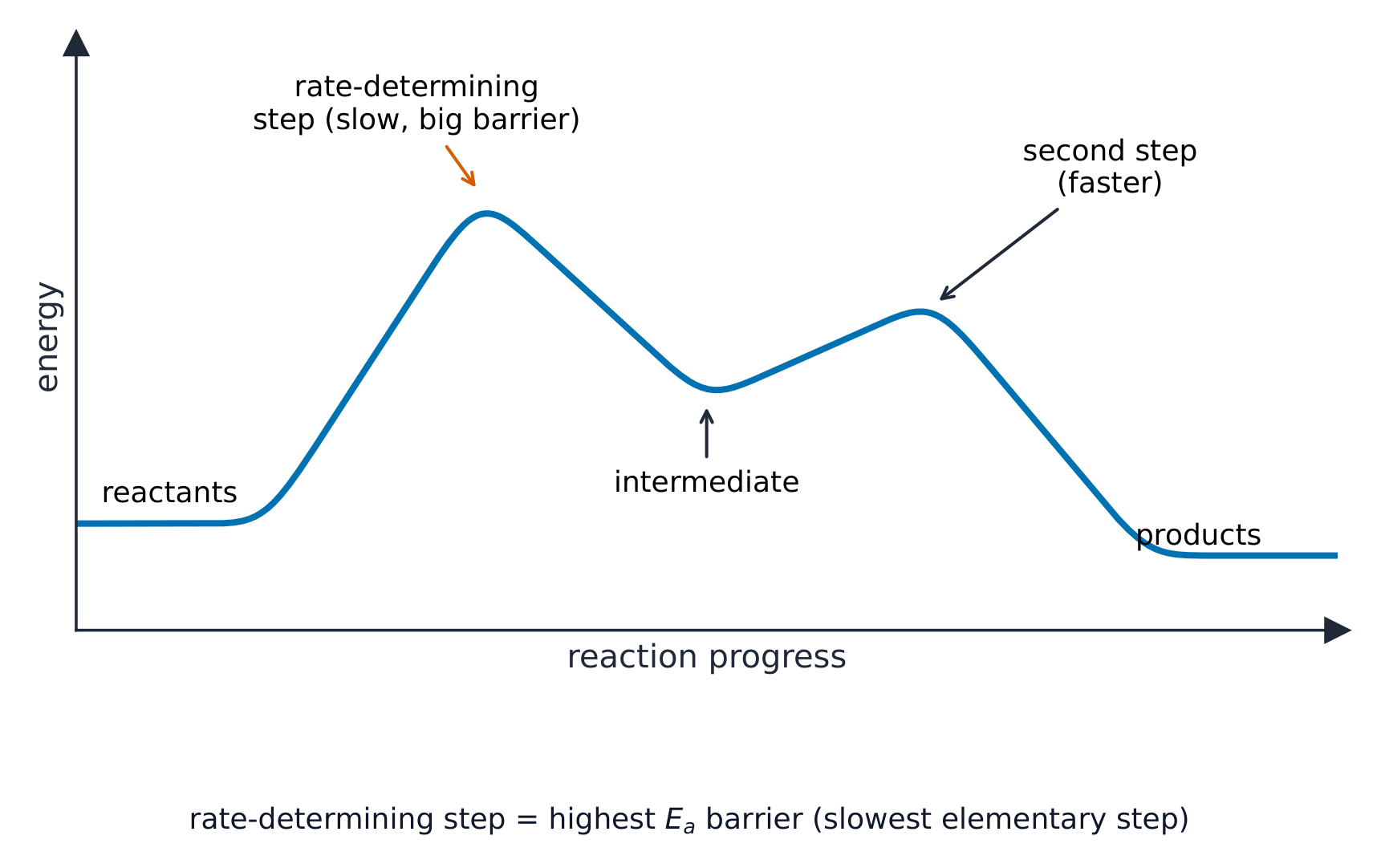
决速步骤是一个多步反应中最慢的那一步
The rate-determining step is: · 速率决定步骤是:
The slowest step is the bottleneck, so it determines the overall rate. · 最慢的步骤是瓶颈,所以它决定总速率。
Which species appear in the rate equation? · 哪些物种出现在速率方程中?
Species after the RDS do not affect the rate, so they are not in the rate equation. · RDS 之后的物种不影响速率,所以它们不在速率方程中。
An intermediate is a species that is: · 一个中间体是这样一个物种,它:
Intermediates appear during the mechanism but cancel out of the overall equation. · 中间体在机理期间出现,但在总方程中相互抵消。
Match each mechanism idea. · 匹配每个机理概念。
Each item links the term to its correct meaning. · 每一项把术语链接到它正确的含义。
Deducing the mechanism, and temperature
- Suggest a mechanism that fits both the rate equation and the overall equation.
- From initial-rate data you find the rate equation, and from that the mechanism.
- Raising the temperature increases the rate constant $k$ (more molecules pass the activation energy 活化能), so the rate rises.
推断机理,以及温度
- 提出一个既符合速率方程又符合总方程的机理。
- 从初始速率数据你找到速率方程,从那找到机理。
- 升高温度增加速率常数 $k$(更多分子通过活化能),所以速率上升。
Raising the temperature increases the rate because: · 升高温度增加速率,因为:
A higher temperature raises k, so the rate increases. · 一个更高的温度提高 k,所以速率增加。
Linking mechanism to rate
- Only species in the rate-determining step (and earlier) appear in the rate equation.
- A proposed mechanism must agree with the experimental rate equation.
把机理与速率联系起来
- 只有速率决定步骤(及更早)中的物种出现在速率方程中。
- 一个提出的机理必须与实验速率方程一致。
You've got it
- the rate-determining step is the slowest step; it controls the rate
- only species up to and including the RDS appear in the rate equation
- an intermediate is made then used up (not in the overall equation)
- higher temperature raises k and so the rate
你掌握了
- 速率决定步骤是最慢的步骤;它控制速率
- 只有直到并包括 RDS 的物种出现在速率方程中
- 一个中间体被制造然后被用掉(不在总方程中)
- 更高的温度提高 k,从而提高速率