- analyse an infrared spectrum of a simple molecule to identify functional groups (see the Data section for the functional groups required)
分析技术
A-Level 化学 · 第 22 主题
 8:45
8:45
Analytical techniques (AS)
You have just made a new compound. It is a clear liquid in a flask, with no label, and you cannot see a single molecule. How do you prove what it is? You ask…
英文讲解 · 内嵌中英文字幕
22.1
红外光谱

大纲
来源:剑桥国际大纲
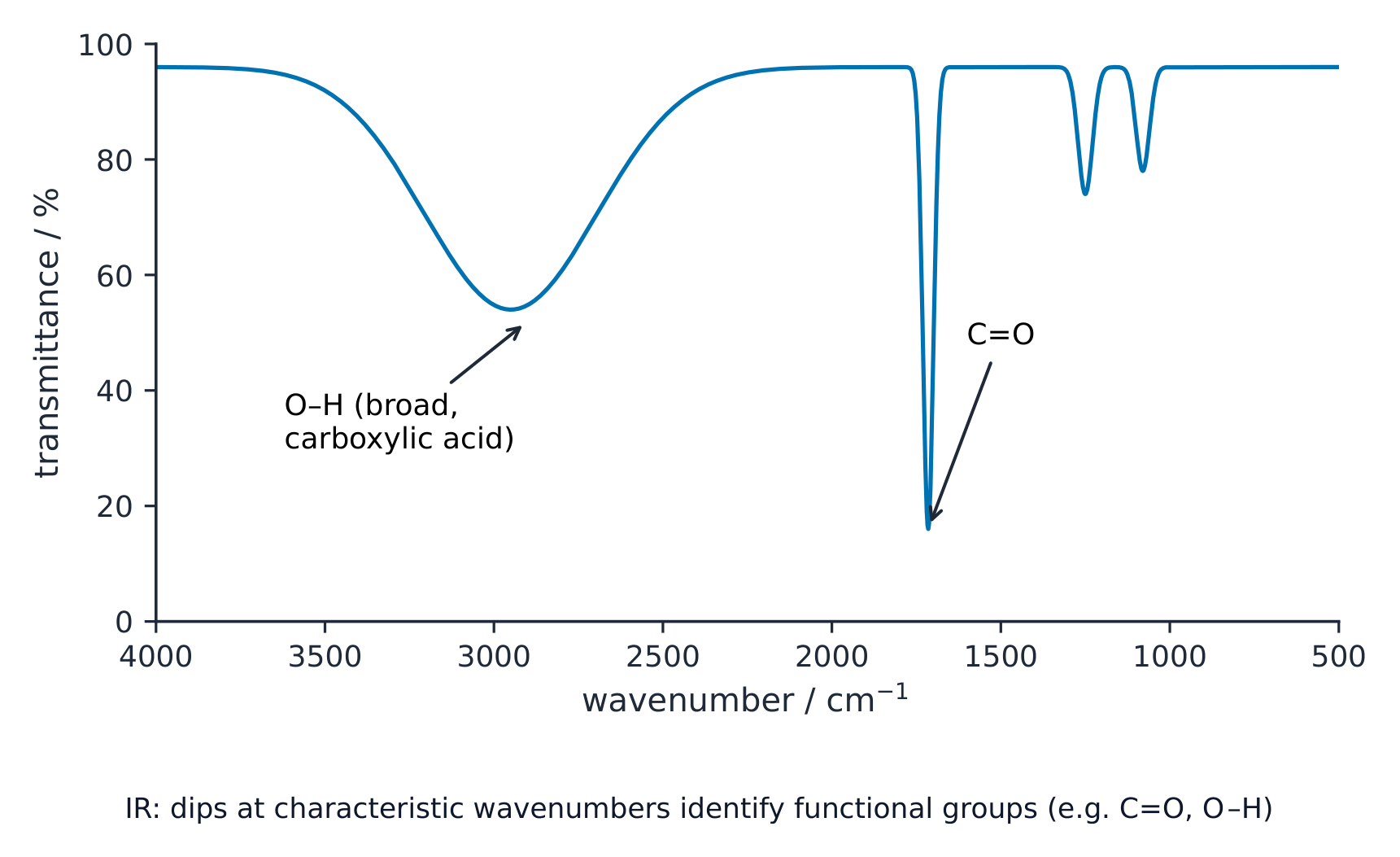
红外光谱(infrared spectroscopy)帮助你找出一个分子中的官能团(functional group)。每种键在它自己的一段频率范围内吸收红外辐射。键显示强吸收(absorption)的地方,谱有一个凹陷。
位置以波数(wavenumber,以 $\text{cm}^{-1}$ 计)测量。会给你一个数据表,所以你不用背这些数字。你只需把凹陷与键匹配:
- 在 $3200$–$3650\ \text{cm}^{-1}$ 附近的一个宽凹陷 → 一个醇中的 O–H 键。
- 在 $1700\ \text{cm}^{-1}$ 附近的一个凹陷 → 一个 C=O 键(醛、酮、酸或酯)。
- 一个宽的 $2500$–$3000\ \text{cm}^{-1}$ 凹陷连同一个 C=O 凹陷 → 一个羧酸。
这对检查一个反应有用。例如,如果丙烯已被变成丙-2-醇,C=C 凹陷应当消失,一个 O–H 凹陷应当出现。
探索
IR spectroscopy lab
Match an absorption to the bond or functional group it reveals.
词汇表
训练
| 英文 | 中文 | 拼音 |
|---|---|---|
| infrared spectroscopy/ˌɪnfrəˈred spekˈtrɒskəpi/ | 红外光谱 | hóng wài guāng pǔ |
| functional group/ˈfʌŋkʃənl ɡruːp/ | 官能团 | guān néng tuán |
| absorption/əbˈsɔːpʃn/ | 吸收 | xī shōu |
| wavenumber/ˈweɪvnʌmbə/ | 波数 | bō shù |
22.2
质谱

大纲
- analyse mass spectra in terms of $m/e$ values and isotopic abundances (knowledge of the working of the mass spectrometer is not required)
- calculate the relative atomic mass of an element given the relative abundances of its isotopes, or its mass spectrum
- deduce the molecular mass of an organic molecule from the molecular ion peak in a mass spectrum
- suggest the identity of molecules formed by simple fragmentation in a given mass spectrum
- deduce the number of carbon atoms, $n$, in a compound using the $[M + 1]^+$ peak and the formula $$n = \frac{100 \times \text{abundance of } [M + 1]^+ \text{ ion}}{1.1 \times \text{abundance of } M^+ \text{ ion}}$$
- deduce the presence of bromine and chlorine atoms in a compound using the $[M + 2]^+$ peak
来源:剑桥国际大纲
在质谱(mass spectrometry)中,一个分子被变成离子并按它的质荷比(mass-to-charge ratio,$m/e$)分类。谱是不同 $m/e$ 值处的一组峰。
从同位素求相对原子质量
一个元素的同位素(isotope)混合物给出几个峰。从同位素丰度(isotopic abundance,每种同位素有多常见)你可以求出相对原子质量(relative atomic mass)——一个加权平均:
$$A_r = \frac{\sum (\text{isotope mass} \times \text{abundance})}{\sum \text{abundance}}$$
例如,氯是 75% 的 $^{35}\text{Cl}$ 和 25% 的 $^{37}\text{Cl}$,给出 $A_r = \dfrac{35 \times 75 + 37 \times 25}{100} = 35.5$。
分子离子和碎裂
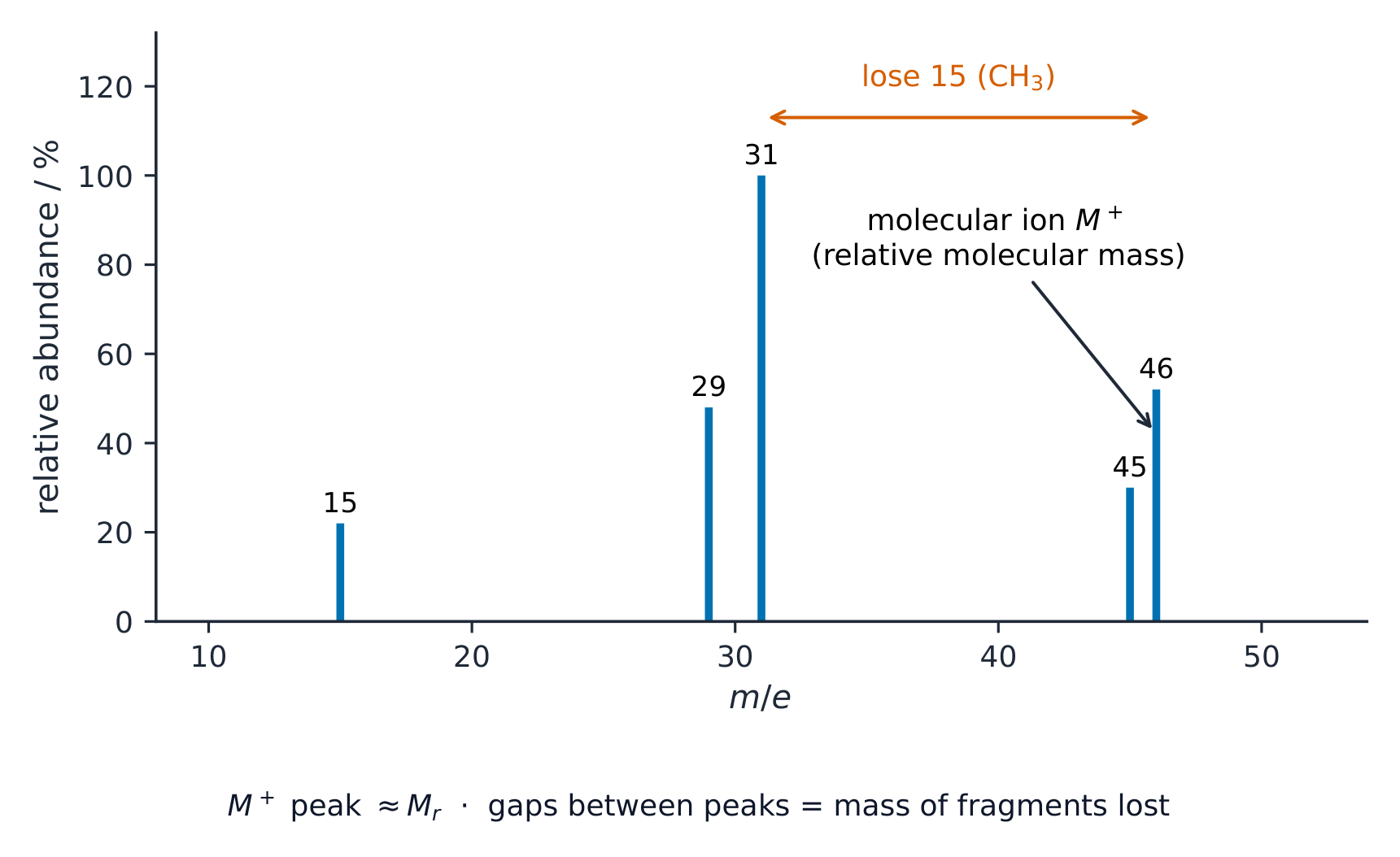
最高 $m/e$ 处的峰(分子离子(molecular ion)峰,或分子离子峰(molecular ion peak),$M^+$)给出整个分子的相对分子质量。
分子也碎裂成较小的片——这是碎裂(fragmentation)。两个峰之间的间隔告诉你丢失的片的质量,所以你可以推测每个碎片(fragment)。例如,丢失 15 意味着一个 $\text{CH}_3$ 基团丢失了,丢失 29 意味着 $\text{CHO}$ 或 $\text{C}_2\text{H}_5$。
[M + 1] 峰和 [M + 2] 峰
- 一个小的 [M + 1] 峰来自 $^{13}\text{C}$ 同位素。碳原子的数目 $n$ 是:
$$n = \frac{100 \times \text{abundance of } [M + 1]^+}{1.1 \times \text{abundance of } M^+}$$
- 一个 [M + 2] 峰显示氯或溴。一个氯给出一个约为 $M^+$ 高度三分之一的 $[M + 2]$ 峰(来自 $^{37}\text{Cl}$);一个溴给出一个与 $M^+$ 相同高度的 $[M + 2]$ 峰(来自 $^{81}\text{Br}$)。
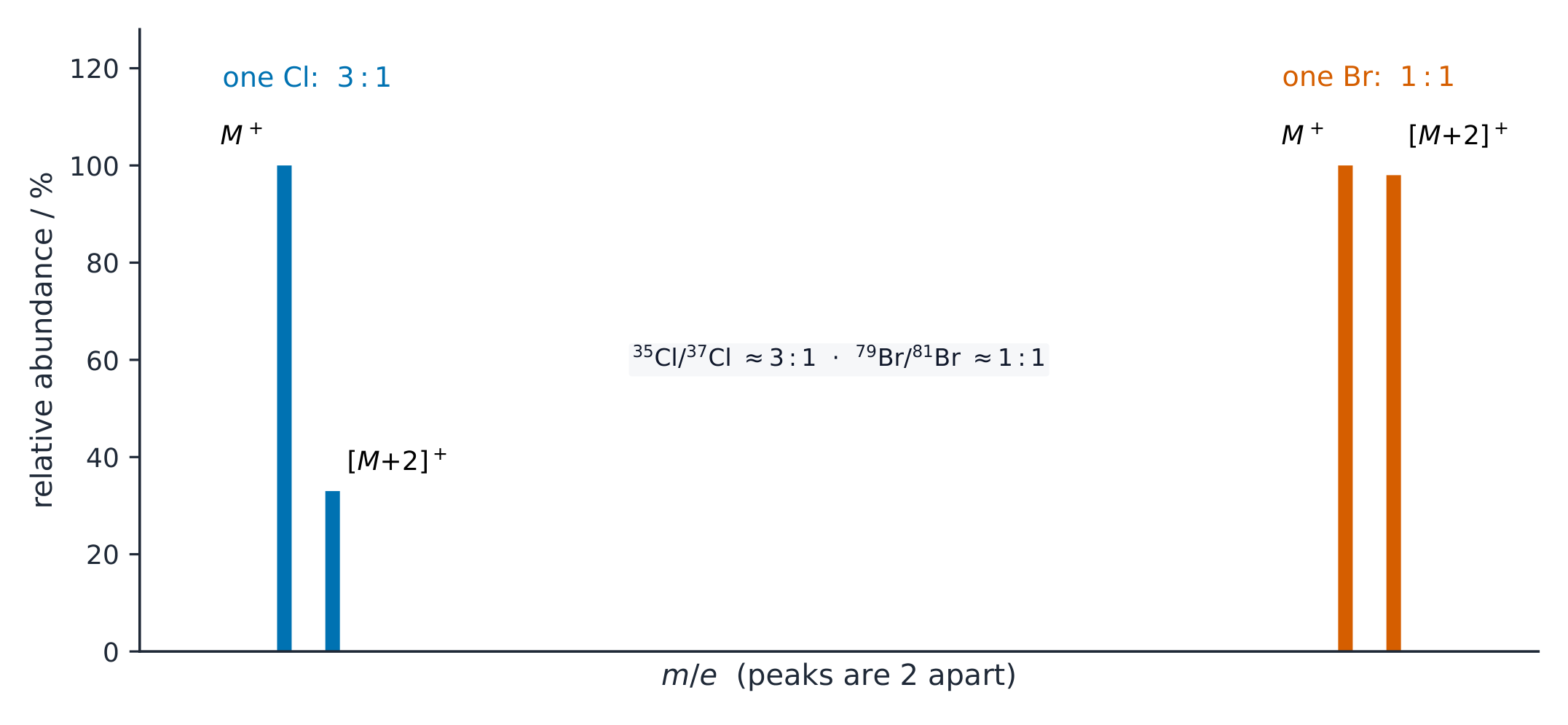
例题。 某化合物的分子离子峰在 $m/e = 108$,并在 $m/e = 110$ 处有一个高度几乎相等的峰。它的红外光谱在 $3300\ \text{cm}^{-1}$ 附近没有宽吸收峰。推断它是什么。相隔两个质量单位、高度大致相等的两个峰,是一个溴原子的 $1:1$ 特征(来自 $^{79}\text{Br}$ 和 $^{81}\text{Br}$);若是一个氯,则会给出 $3:1$ 的比例。从分子离子中减去溴:$108 - 79 = 29$,这符合一个 $\text{C}_2\text{H}_5$ 碎片。$3300\ \text{cm}^{-1}$ 附近没有宽峰,排除了 $\text{O-H}$,所以没有醇基。该化合物是溴乙烷 $\text{C}_2\text{H}_5\text{Br}$。要读 $[M+2]$ 的比例,而不只是注意到有这个峰:$1:1$ 表示溴,$3:1$ 表示氯。
探索
Mass spectrometry route
Follow a molecule through ionisation, separation and detection.
词汇表
训练
| 英文 | 中文 | 拼音 |
|---|---|---|
| mass spectrometry/mæs spekˈtrɒmətri/ | 质谱 | zhì pǔ |
| mass-to-charge ratio/mæs tə tʃɑːdʒ ˈreɪʃɪəʊ/ | 质荷比 | zhì hé bǐ |
| isotope/ˈaɪsətəʊp/ | 同位素 | tóng wèi sù |
| isotopic abundance/ˌaɪsəˈtɒpɪk əˈbʌndəns/ | 同位素丰度 | tóng wèi sù fēng dù |
| relative atomic mass/ˈrelətɪv əˈtɒmɪk mæs/ | 相对原子质量 | xiāng duì yuán zi zhì liàng |
| molecular ion/məˈlekjʊlə ˈaɪɒn/ | 分子离子 | fèn zǐ lí zi |
| molecular ion peak/məˈlekjʊlə ˈaɪɒn piːk/ | 分子离子峰 | fèn zǐ lí zi fēng |
| fragmentation/ˌfræɡmənˈteɪʃn/ | 碎裂 | suì liè |
| fragment/ˈfræɡmənt/ | 碎片 | suì piàn |
22.2
考试技巧
- 在红外光谱上引用波数和键(O-H 宽 $\sim 3200-3600$,C=O $\sim 1700$);用数据手册。
- 最高 $m/z$ 处的峰是分子离子 $\text{M}^+$,给出 $M_r$。
- 解释碎裂:峰之间的间隔是丢失的碎片(丢失 15 = $\text{CH}_3$,29 = $\text{C}_2\text{H}_5$ 或 CHO)。
- 学常见的同位素模式(Cl 给出约 3:1 的 M 和 M+2;M+1 来自 $^{13}\text{C}$)。
本主题的互动课程
逐步学习,并即时检测练习。