- recall the reactions (reagents and conditions) by which halogenoalkanes can be produced: (a) the free-radical substitution of alkanes by $\text{Cl}_2$ or $\text{Br}_2$ in the presence of ultraviolet light, as exemplified by the reactions of ethane (b) electrophilic addition of an alkene with a halogen, $\text{X}_2$, or hydrogen halide, $\text{HX(g)}$, at room temperature (c) substitution of an alcohol, e.g. by reaction with $\text{HX(g)}$; or with $\text{KCl}$ and concentrated $\text{H}_2\text{SO}_4$ or concentrated $\text{H}_3\text{PO}_4$; or with $\text{PCl}_3$ and heat; or with $\text{PCl}_5$; or with $\text{SOCl}_2$
- classify halogenoalkanes into primary, secondary and tertiary
- describe the following nucleophilic substitution reactions: (a) the reaction with $\text{NaOH(aq)}$ and heat to produce an alcohol (b) the reaction with $\text{KCN}$ in ethanol and heat to produce a nitrile (c) the reaction with $\text{NH}_3$ in ethanol heated under pressure to produce an amine (d) the reaction with aqueous silver nitrate in ethanol as a method of identifying the halogen present as exemplified by bromoethane
- describe the elimination reaction with $\text{NaOH}$ in ethanol and heat to produce an alkene as exemplified by bromoethane
- describe the $\text{S}_\text{N}1$ and $\text{S}_\text{N}2$ mechanisms of nucleophilic substitution in halogenoalkanes including the inductive effects of alkyl groups
- recall that primary halogenoalkanes tend to react via the $\text{S}_\text{N}2$ mechanism; tertiary halogenoalkanes via the $\text{S}_\text{N}1$ mechanism; and secondary halogenoalkanes by a mixture of the two, depending on structure
- describe and explain the different reactivities of halogenoalkanes (with particular reference to the relative strengths of the C–X bonds as exemplified by the reactions of halogenoalkanes with aqueous silver nitrates)
卤素化合物
A-Level 化学 · 第 15 主题
 7:31
7:31
Halogen compounds
Press the button on a can of freezer spray, and your skin goes numb with cold. Inside is a halogenoalkane: an alkane with a halogen atom in place of one…
英文讲解 · 内嵌中英文字幕
15.1
卤代烷

大纲
来源:剑桥国际大纲
一个卤代烷(halogenoalkane)是一个用一个或多个卤素原子代替氢的烷烃(一个 C–X 键,其中 X 是一个卤素)。
制备卤代烷
- 一个烷烃在紫外线下与 $\text{Cl}_2$ 或 $\text{Br}_2$ 的自由基取代(free-radical substitution)。
- 一个烯烃与一个卤素 $\text{X}_2$ 或一个卤化氢 $\text{HX}$ 的亲电加成(electrophilic addition)。
- 一个醇(alcohol)的取代,例如用 $\text{HX}$、用 $\text{PCl}_5$、用 $\text{PCl}_3$ 加热,或用 $\text{SOCl}_2$。
三类
一个卤代烷是伯(primary)、仲(secondary)或叔(tertiary),取决于有多少碳原子与持有卤素的那个碳相连(一个、两个或三个)。

词汇表
训练
| 英文 | 中文 | 拼音 |
|---|---|---|
| halogenoalkane/ˈheɪləʊdʒnəʊlkeɪn/ | 卤代烷 | lǔ dài wán |
| free-radical substitution/friː ˈrædɪkl ˌsʌbstɪˈtjuːʃn/ | 自由基取代 | zì yóu jī qǔ dài |
| electrophilic addition/ɪˌlektrəʊˈfɪlɪk əˈdɪʃn/ | 亲电加成 | qīn diàn jiā chéng |
| alcohol/ˈælkəhɒl/ | 醇 | chún |
| primary/ˈpraɪməri/ | 伯 | bó |
| secondary/ˈsekəndəri/ | 仲 | zhòng |
| tertiary/ˈtɜːʃjəri/ | 叔 | shū |
15.1
亲核取代

C–X 键是极性的,所以碳略带正电。当一个亲核试剂(nucleophile,一个带孤对电子的物种)进攻那个碳并取代卤素时,发生一个亲核取代(nucleophilic substitution)。
| 试剂和条件 | 产物 |
|---|---|
| $\text{NaOH(aq)}$,加热 | 一个醇 |
| 乙醇中的 $\text{KCN}$,加热 | 一个腈(nitrile,给链加一个碳) |
| 乙醇中的 $\text{NH}_3$,加压加热 | 一个胺(amine) |
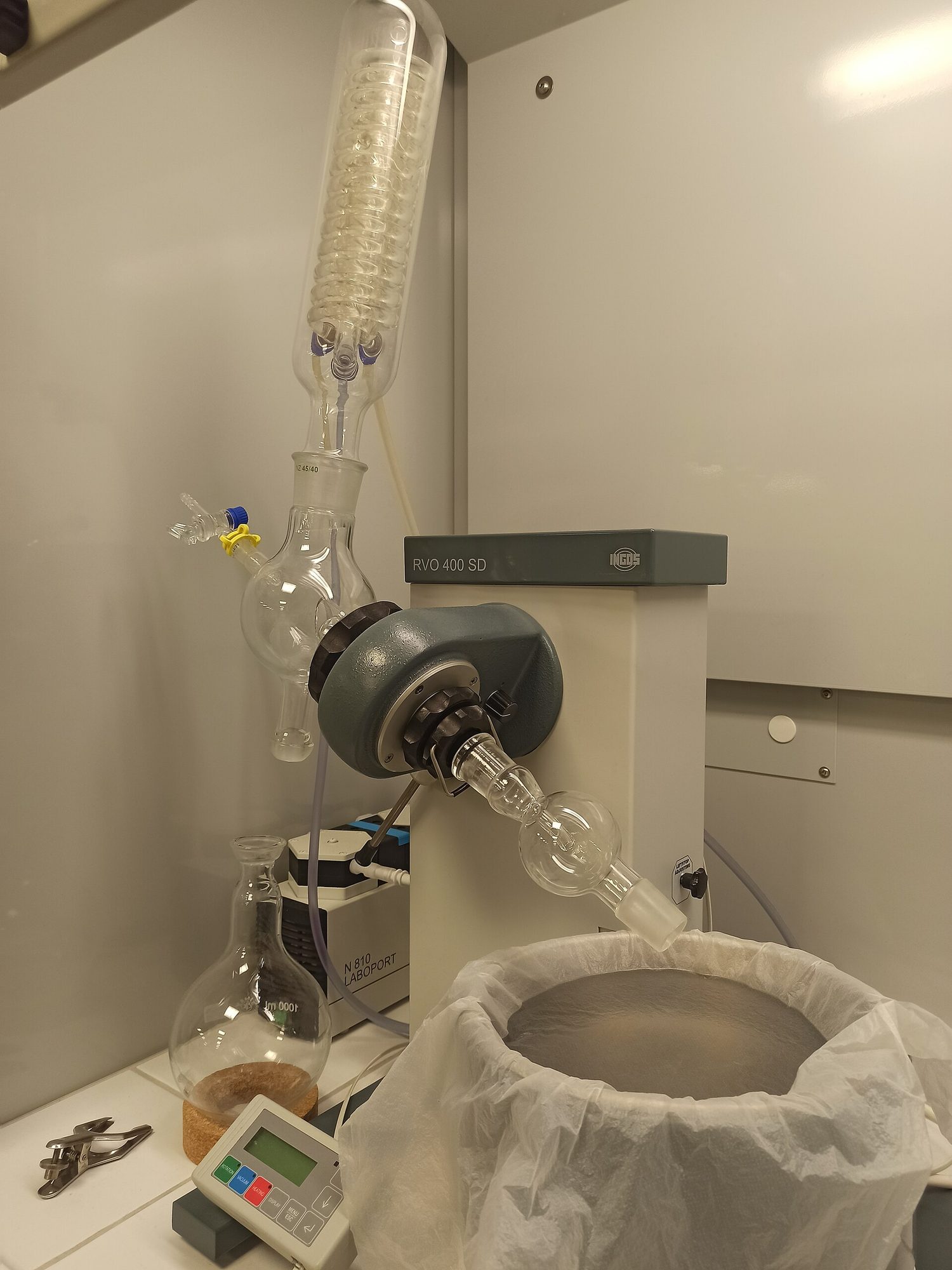
要辨认卤素,把卤代烷与乙醇中的硝酸银(silver nitrate)一起加热。一个卤化银沉淀(precipitate)形成,它的颜色显示存在哪种卤素(白色 $\text{AgCl}$、乳白色 $\text{AgBr}$、黄色 $\text{AgI}$)。
探索
Nucleophilic substitution
A nucleophile swaps in for the leaving group on a halogenoalkane.
词汇表
训练
| 英文 | 中文 | 拼音 |
|---|---|---|
| nucleophilic substitution/ˌnjuːklɪəˈfɪlɪk ˌsʌbstɪˈtjuːʃn/ | 亲核取代 | qīn hé qǔ dài |
| nucleophile/ˈnjuːklɪɒfaɪl/ | 亲核试剂 | qīn hé shì jì |
| nitrile/ˈnaɪtraɪl/ | 腈 | jīng |
| amine/ˈæmaɪn/ | 胺 | àn |
| silver nitrate/ˈsɪlvə ˈnaɪtreɪt/ | 硝酸银 | xiāo suān yín |
| precipitate/prɪˈsɪpɪteɪt/ | 沉淀 | chén diàn |
15.1
消除反应

同一个卤代烷可以改为发生消去(elimination)形成一个烯烃(alkene)。条件决定哪个反应占上风:
- 水中的 $\text{NaOH}$ → 亲核取代 → 一个醇。
- 乙醇中的 $\text{NaOH}$,加热 → 消去 → 一个烯烃。
$$\text{C}_2\text{H}_5\text{Br} + \text{NaOH} \rightarrow \text{C}_2\text{H}_4 + \text{NaBr} + \text{H}_2\text{O}$$
词汇表
训练
| 英文 | 中文 | 拼音 |
|---|---|---|
| elimination/ɪˌlɪmɪˈneɪʃn/ | 消去 | xiāo qù |
| alkene/ˈælkiːn/ | 烯烃 | xī tīng |
15.1
$S_\text{N}$1 与 $S_\text{N}$2 机理

亲核取代可以走两条路线:
- S$_\text{N}$2:一步。亲核试剂进攻的同时卤素离开,经过一个拥挤的过渡态(transition state),那里两者都半成键。速率取决于卤代烷和亲核试剂两者。
- S$_\text{N}$1:两步。首先 C–X 键断裂给出一个碳正离子(carbocation);然后亲核试剂进攻它。速率只取决于卤代烷。
烷基把电子推向带正电的碳(诱导效应(inductive effect)),所以它们稳定碳正离子。这就是为什么:
- 伯卤代烷大多通过 S$_\text{N}$2 反应。
- 叔卤代烷大多通过 S$_\text{N}$1 反应(它们的碳正离子被很好地稳定)。
- 仲卤代烷用两者的混合。
探索
The SN2 mechanism, step by step
Step through nucleophilic substitution. The nucleophile attacks from behind as the halide leaves — all in one smooth step, flipping the molecule inside-out.
词汇表
训练
| 英文 | 中文 | 拼音 |
|---|---|---|
| transition state/trænˈsɪʃn steɪt/ | 过渡态 | guò dù tài |
| carbocation/ˌkɑːbəˈkeɪʃn/ | 碳正离子 | tàn zhèng lí zi |
| inductive effect/ɪnˈdʌktɪv ɪˈfekt/ | 诱导效应 | yòu dǎo xiào yìng |
15.1
不同的反应活性
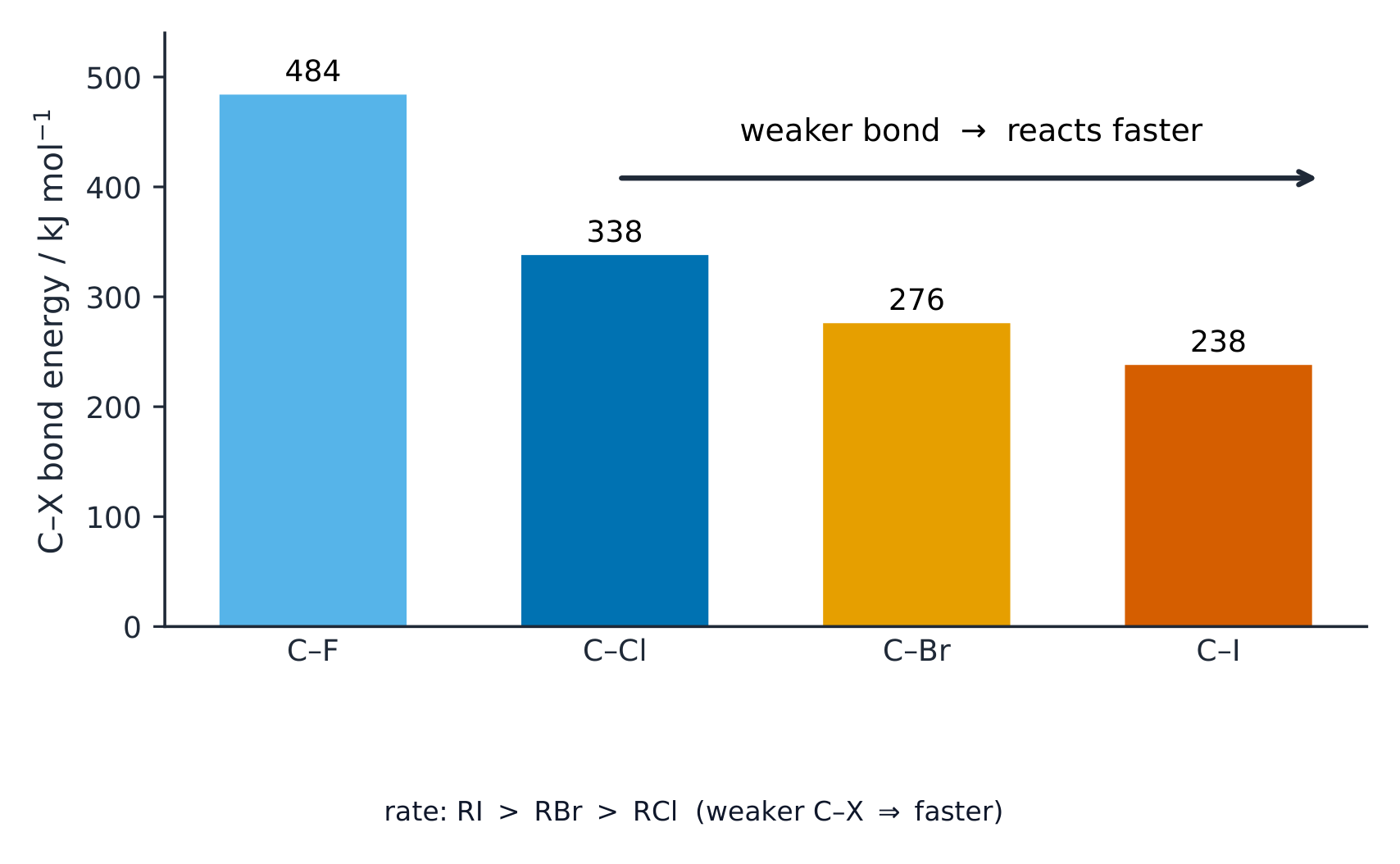
一个卤代烷反应有多快取决于 C–X 键的强度,由它的键能(bond energy)衡量。C–I 键最弱,所以碘代烷反应最快;C–Cl 键是三者中最强的,所以氯代烷反应最慢。所以用硝酸银检验时,一个碘代烷最先给出它的沉淀——它更高的反应活性(reactivity)来自更弱的 C–X 键。
例题。 预测 1-溴丁烷和 2-溴-2-甲基丙烷水解时的机理。先给卤代烷分类。1-溴丁烷是伯卤代烷:连着 $\text{Br}$ 的碳几乎没有被遮挡,所以亲核试剂可以从它的背面进攻,机理是 $\text{S}_\text{N}2$ - 一步完成,速率同时取决于卤代烷和亲核试剂。2-溴-2-甲基丙烷是叔卤代烷:三个庞大的甲基挡住了这种进攻,但它们同时也稳定了 $\text{Br}$ 离去后生成的碳正离子,所以它走 $\text{S}_\text{N}1$ - 两步完成,速率只取决于卤代烷。要根据类别来判断(伯 → $\text{S}_\text{N}2$,叔 → $\text{S}_\text{N}1$),并注意叔卤代烷虽然更拥挤,水解却更快。
词汇表
训练
| 英文 | 中文 | 拼音 |
|---|---|---|
| bond energy/bɒnd ˈenədʒi/ | 键能 | jiàn néng |
| reactivity/rɪəkˈtɪvɪti/ | 反应活性 | fǎn yìng huó xìng |
15.1
考试技巧
- 画亲核取代时,从亲核试剂的孤对电子向 $\delta+$ 碳画一个弯箭头,并从 $\text{C-X}$ 键画一个。
- 使机理与类别匹配:$S_\text{N}1$(叔,碳正离子,两步)对 $S_\text{N}2$(伯,一步,过渡态)。
- 反应活性由键焓决定:$\text{C-I}$ 最弱,所以碘代烷反应最快(不是电负性)。
- 消去(热的乙醇 KOH)对取代(温热的水合 KOH)——条件决定产物;陈述它们。
本主题的互动课程
逐步学习,并即时检测练习。