IGCSE Economics (0455) has six topics: the basic economic problem, the allocation of resources, microeconomic decision-makers, government and the macroeconomy, economic development, and international trade. There are two papers — one multiple-choice, one structured.
The structured paper decides grades, and diagrams decide the structured paper. A demand-and-supply answer written in prose will not score what the same answer scores with a labelled diagram and a stated direction of shift.
Learn to draw each diagram from a blank page — both axes labelled, the shift arrowed. In the exam you are drawing, not recognising. The higher-mark parts ask you to evaluate, which means saying when your answer would not hold.
understand the economic problem: finite (scarce) resources and unlimited wants
distinguish economic goods (scarce, have an opportunity cost) and free goods
understand that the economic problem forces consumers, workers, producers and governments to make choices
Tiếng Việt
hiểu vấn đề kinh tế: tài nguyên hữu hạn (khan hiếm) và nhu cầu vô hạn
phân biệt hàng hóa kinh tế (khan hiếm, có chi phí cơ hội) và hàng hóa miễn phí
hiểu rằng vấn đề kinh tế buộc người tiêu dùng, lao động, nhà sản xuất và chính phủ phải đưa ra lựa chọn
Source: Cambridge International syllabus · Nguồn: Chương trình Cambridge International
Economics is about how people use resources 资源 to meet their needs and wants. The main idea is simple. People want a lot, but there are not enough resources to make everything. This is the economic problem 经济问题.
Two facts cause the economic problem:
Resources are finite 有限的. There is only a limited amount of them.
People's wants 欲望 are unlimited. People always want more and better things.
Because wants are unlimited but resources are limited, resources are scarce 稀缺. We call this problem scarcity 稀缺性. Scarcity is the root of all economics.
The economic problem: scarcity forces choice, and every choice has an opportunity cost
Goods, services, and choices
We use resources to make goods 物品 (things you can touch, like food and phones) and services 服务 (jobs done for you, like a haircut or a bus ride).
Because resources are scarce, we cannot have everything. So everyone must make choices. Scarcity forces four groups to choose:
consumers 消费者 — people who buy and use goods and services. They choose what to buy.
workers 工人 — they choose which job to do.
producers 生产者, also called firms 企业 — they make goods and services. They choose what to produce.
governments 政府 — they choose what to provide and how to spend public money.
Economic goods and free goods
Most things are economic goods 经济物品. They are scarce, so making or using one means giving something else up. Economic goods have an opportunity cost 机会成本 (explained below).
A few things are free goods 免费物品. They are not scarce — there is enough for everyone and they cost nothing to use. Examples are the air you breathe and sunlight. A free good has no opportunity cost.
Be careful: a "free" sample or a "free" gift is not a free good. Resources were used to make it, so it is still an economic good.
Explore · Khám phá
Scarcity and choice · Sự khan hiếm và lựa chọn
Limited resources mean producing more of one good costs some of the other — the opportunity cost, shown by the frontier. · Nguồn lực hạn chế có nghĩa là sản xuất thêm một hàng hóa sẽ tốn kém một phần hàng hóa khác — chi phí cơ hội, được thể hiện bởi đường biên.
define the four factors of production: land, labour, capital and enterprise, with examples
state the reward to each factor (rent, wages, interest, profit)
explain the mobility of the factors of production and the causes of changes in their quantity and quality
Tiếng Việt
định nghĩa bốn yếu tố sản xuất: đất đai, lao động, vốn và doanh nghiệp, kèm theo ví dụ
nêu phần thưởng cho mỗi yếu tố (tiền thuê, tiền lương, lãi suất, lợi nhuận)
giải thích sự di chuyển của các yếu tố sản xuất và nguyên nhân thay đổi về số lượng và chất lượng của chúng
Source: Cambridge International syllabus · Nguồn: Chương trình Cambridge International
To make goods and services, firms use four types of resource. We call them the factors of production 生产要素.
The four factors of production and the reward each one earns
The four factors
Factor
What it is
Example
land 土地
natural resources
fields, water, oil, forests
labour 劳动
human work
a teacher, a builder, a nurse
capital 资本
man-made things used to produce
machines, tools, factories
enterprise 企业家才能
organising the other three and taking risks
a person who starts a business
The person who provides enterprise is the entrepreneur 企业家. They bring the other factors together and risk their own money to start and run a business.
Land — natural resources such as farmland — is one of the four factors of production
The reward to each factor
Each factor earns a reward 报酬 — the income it gets for being used:
Factor
Reward
land
rent 地租
labour
wages 工资
capital
interest 利息
enterprise
profit 利润
Mobility, quantity and quality
The mobility 流动性 of a factor means how easily it can move to a different use or place. A worker with many skills can change jobs easily, so labour is mobile. A worker with only one skill, or a factory that cannot be moved, is less mobile.
The quantity and quality of factors can change:
Quantity can rise or fall. The amount of labour grows if the birth rate rises or people move into the country to work. Land can be lost to the sea or gained by draining it.
Quality can rise. Training and education make labour better. New technology makes capital better. Higher quality means each factor can produce more.
Explore · Khám phá
Factors of production lab · Nhlab Yếu tố sản xuất
Sort real resources by the factor of production they represent. · Sắp xếp tài nguyên thực tế theo yếu tố sản xuất mà chúng đại diện.
define opportunity cost as the next best alternative given up when a choice is made
explain how opportunity cost influences decisions made by consumers, workers, producers and governments
Tiếng Việt
định nghĩa chi phí cơ hội là phương án tốt nhất bị bỏ qua khi đưa ra một lựa chọn
giải thích cách chi phí cơ hội ảnh hưởng đến quyết định của người tiêu dùng, lao động, nhà sản xuất và chính phủ
Source: Cambridge International syllabus · Nguồn: Chương trình Cambridge International
The PPF and opportunity costConsumers choosing what to buy at a busy market — scarcity forces everyone to make choicesChoosing one thing means giving up the next best alternative
When you choose one thing, you give up the next best choice. That is the real cost of your decision.
Opportunity cost is the next best alternative 替代选择 you give up when you make a choice.
It affects every decision-maker:
A consumer who buys a game gives up the book they could have bought instead.
A worker who takes one job gives up the pay of the next job they could have done.
A producer who makes more cars uses factors that could have made trucks.
A government that builds a hospital gives up the school it could have built with the same money.
Opportunity cost matters because resources are scarce. Every choice has a cost, even when no money changes hands.
Explore · Khám phá
Opportunity cost on the frontier · Chi phí cơ hội trên đường biên
Moving along the frontier, gaining more of one good always means giving up some of the other — that sacrifice is the opportunity cost. · Di chuyển dọc theo đường biên, tăng sản lượng một hàng hóa luôn đồng nghĩa với việc hy sinh một phần hàng hóa khác — sự hy sinh đó là chi phí cơ hội.
draw and interpret a PPC showing the maximum combinations of two goods that can be produced
explain points on, inside and outside the curve and movements along the curve (opportunity cost)
explain causes of shifts in the PPC (changes in the quantity/quality of resources, economic growth or decline)
Tiếng Việt
vẽ và diễn giải PPC cho thấy các tổ hợp tối đa của hai loại hàng hóa có thể sản xuất
giải thích các điểm nằm trên, bên trong và bên ngoài đường cong cũng như sự di chuyển dọc theo đường cong (chi phí cơ hội)
giải thích nguyên nhân dịch chuyển của PPC (thay đổi về số lượng/Chất lượng tài nguyên, tăng trưởng hoặc suy thoái kinh tế)
Source: Cambridge International syllabus · Nguồn: Chương trình Cambridge International
A production possibility curve 生产可能性曲线 (PPC) shows the largest amounts of two goods a country can make when it uses all its resources fully.
Imagine an economy that makes only two types of good, one on each axis:
capital goods — used to make other goods, like machines.
consumer goods — used up by people, like food and clothes.
The PPC is the line joining every point where the economy uses all its resources to make the most it can.
Reading the diagram
Picture the two goods on the two axes. The PPC is a curve that bends from one axis down to the other (it usually bows outward, away from the corner):
A point on the curve: all resources are used fully. The economy makes the most it can.
A point inside the curve: resources are wasted or not all used — for example, there is unemployment 失业. The economy could make more.
A point outside the curve: this is impossible now. There are not enough resources to reach it.
A point on the curve uses all resources; inside the curve some are wasted (e.g. unemployment); outside is not possible with today's resources.
Movements along the curve
If the economy already uses all its resources (a point on the curve), making more of one good means making less of the other. You must move factors from one good to the other. This is a trade-off 取舍.
The amount of the second good you give up is the opportunity cost of the extra first good. This is why the PPC is a clear picture of opportunity cost.
Worked example. An economy on its PPC makes 40 machines and 60 tonnes of food. To make 50 machines it must cut food to 45 tonnes. Give the opportunity cost of the extra machines. Then say what a point of 30 machines and 40 tonnes of food would tell you. The economy is already on the curve, so more of one good must mean less of the other: the 10 extra machines cost 60 − 45 = 15 tonnes of food. That lost food is the opportunity cost, so quote it in tonnes of food - never in money. The second point lies inside the curve, which means resources are idle or wasted, most likely through unemployment; from there the economy could make more of both goods, so moving out to the curve costs nothing at all. Opportunity cost only bites once you are on the curve.
Shifts of the curve
The whole curve can move:
It shifts outward (to the right) when the country can make more of both goods. This is economic growth 经济增长. Causes: more resources (a bigger workforce, more land discovered) or better-quality resources (training, new technology).
It shifts inward (to the left) when the country can make less. This is economic decline 经济衰退. Causes: fewer or worse resources — for example a war, a natural disaster, or using up non-renewable resources 不可再生资源 (resources like oil and coal that cannot be replaced once used).
More or better resources shift the whole PPC outward (growth); a war, disaster or using up resources shifts it inward (decline).
Do not confuse the two. Moving from inside the curve to the curve (by using idle resources) is a short-term gain. Moving the whole curve outward is a long-term change.
Explore · Khám phá
The production possibility curve · Đường giới hạn khả năng sản xuất
Move along the curve: making more of one good means making less of the other — that's opportunity cost. · Di chuyển dọc theo đường cong: sản xuất nhiều hơn một mặt hàng tốt có nghĩa là sản xuất ít đi mặt hàng khác — đó chính là chi phí cơ hội.
Scarcity (unlimited wants, limited resources) forces choice, and every choice has an opportunity cost — the next best alternative you give up.
Learn the four factors of production and the reward each earns: land–rent, labour–wages, capital–interest, enterprise–profit.
On a PPC, a point on the curve uses all resources fully, inside wastes some (e.g. unemployment), and outside is impossible for now. Moving along the curve shows opportunity cost.
Moving to the curve (using idle resources) is a short-term gain; shifting the whole curve outward is long-term economic growth from more or better resources.
2
The allocation of resources · Phân bổ tài nguyên
explain how the market (price mechanism) allocates resources through the signalling, incentive and rationing functions of price
Tiếng Việt
định nghĩa kinh tế vi mô và kinh tế vĩ mô
giải thích cách thị trường (cơ chế giá) phân bổ nguồn lực thông qua các chức năng báo hiệu, khuyến khích và phân phối của giá
Source: Cambridge International syllabus · Nguồn: Chương trình Cambridge International
Economics is split into two parts:
microeconomics 微观经济学 — the study of single parts of the economy, such as one industry or one product.
macroeconomics 宏观经济学 — the study of the whole economy, like total jobs, prices, and growth.
A market 市场 is any place or system where buyers and sellers meet to trade. It does not need a building — it can be online or over the phone.
A stock exchange is a market: as buyers and sellers trade, their offers set the price of each share
When a market is free, no one is in charge of deciding what to make. Instead, the price mechanism 价格机制 (the free movement of prices) allocates 配置resources 资源 — it decides what is made, how, and for whom. Price does three jobs:
the signalling 信号 function — a price change tells buyers and sellers what is happening. A rising price signals "make more"; a falling price signals "make less".
the incentive 激励 function — a higher price gives firms 企业 a reason to produce more, because they can earn more.
the rationing 配给 function — when a product is scarce, its price rises. The high price shares out the limited amount to those willing to pay.
Explore · Khám phá
How markets allocate resources · Thị trường phân bổ nguồn lực như thế nào
Price moves to where demand meets supply. That equilibrium price signals firms what to produce and rations goods to buyers. · Giá điều chỉnh đến nơi cung khớp cầu. Mức cân bằng đó báo hiệu cho doanh nghiệp biết cần sản xuất gì và phân phối hàng hóa cho người mua.
define demand and explain the law of demand (inverse relationship with price), ceteris paribus
draw demand curves and distinguish a movement along (change in price) from a shift (change in conditions of demand)
list the conditions of demand (income, tastes, price of substitutes and complements, population, advertising)
Tiếng Việt
định nghĩa cầu và giải thích luật cầu (mối quan hệ nghịch với giá), ceteris paribus
vẽ đường cong cầu và phân biệt sự di chuyển dọc theo (thay đổi giá) và sự dịch chuyển (thay đổi điều kiện cầu)
liệt kê các điều kiện cầu (thu nhập, thị hiếu, giá của hàng hóa thay thế và bổ sung, dân số, quảng cáo)
Source: Cambridge International syllabus · Nguồn: Chương trình Cambridge International
Demand 需求 is the amount of a good 物品 that consumers 消费者 (buyers) are willing and able to buy at each price, in a period of time.
The law of demand 需求定律 says: when the price of a good rises, the quantity demanded falls; when the price falls, the quantity demanded rises. Price and quantity move in opposite directions — an inverse relationship 反向关系. This is true ceteris paribus 其他条件不变 (a Latin phrase meaning "all other things stay the same").
Movements and shifts
It helps to separate two ideas:
quantity demanded 需求量 — the amount bought at one price.
demand — the whole pattern of buying at every price.
On a demand diagram, price is on the up axis and quantity on the across axis. The demand curve 需求曲线 slopes downward from left to right: high price, low quantity; low price, high quantity.
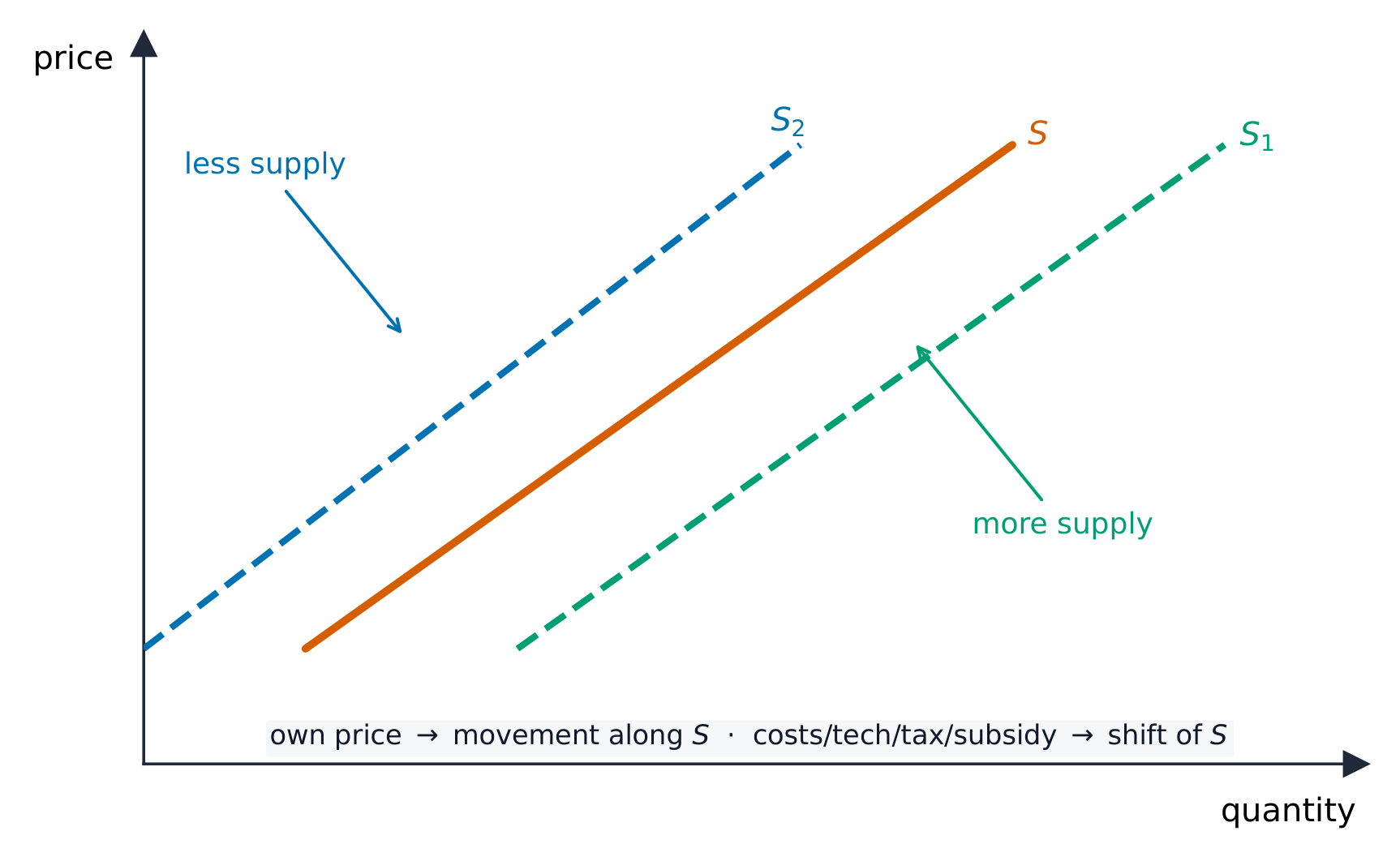
A change in the good's own price causes a movement along the demand curve. You slide to a new point on the same line.
A change in any other condition causes a shift 移动 of the whole curve. A rightward shift means more is demanded at every price; a leftward shift means less.
Conditions of demand
These are the things (other than the good's own price) that shift the demand curve:
income 收入 — more income usually means more demand.
tastes 偏好 — if a good becomes popular, demand rises.
price of substitutes 替代品 — goods used instead of each other (tea and coffee). If coffee gets dearer, demand for tea rises.
price of complements 互补品 — goods used together (cars and fuel). If cars get dearer, demand for fuel falls.
population 人口 — more people means more demand.
advertising 广告 — good adverts raise demand.
The demand curve slopes down. A change in income, tastes, population or related prices shifts the whole curve; a change in the good's own price is a movement along it.
Explore · Khám phá
Demand & supply · Cung & Cầu
Demand slopes down — cheaper means more wanted. · Nhu cầu có độ dốc âm — giá rẻ hơn thì được mong muốn nhiều hơn.
define supply and explain the law of supply (direct relationship with price)
draw supply curves and distinguish a movement along from a shift
list the conditions of supply (costs of production, technology, taxes/subsidies, weather, number of firms)
Tiếng Việt
định nghĩa cung và giải thích luật cung (mối quan hệ thuận với giá)
vẽ đường cong cung và phân biệt sự di chuyển dọc theo và sự dịch chuyển
liệt kê các điều kiện cung (chi phí sản xuất, công nghệ, thuế/trợ giá, thời tiết, số lượng doanh nghiệp)
Source: Cambridge International syllabus · Nguồn: Chương trình Cambridge International
Supply shifts right: P falls, Q rises
Supply 供给 is the amount of a good that firms are willing and able to sell at each price, in a period of time.
The law of supply 供给定律 says: when the price rises, the quantity supplied rises too. Price and quantity move the same way — a direct relationship 正向关系. Firms supply more at a high price because they can earn more.
Movements and shifts
quantity supplied 供给量 — the amount offered at one price.
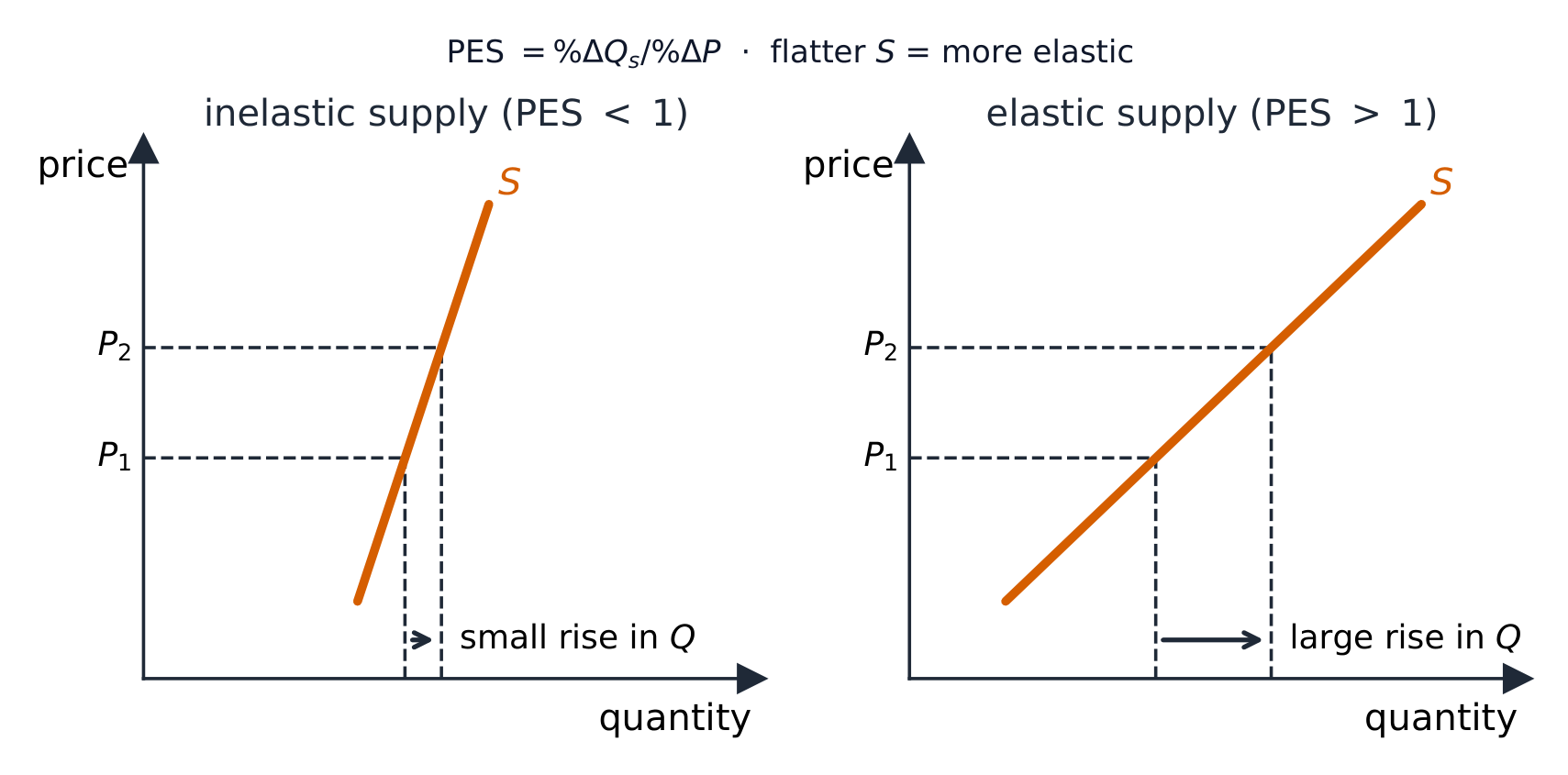
The supply curve 供给曲线 slopes upward from left to right.
A change in the good's own price → a movement along the curve.
A change in any other condition → a shift of the whole curve.
Conditions of supply
costs of production 生产成本 — if costs rise, firms supply less (curve shifts left).
technology 技术 — better technology lowers costs, so supply rises.
taxes and subsidies — a tax 税收 on a good raises firms' costs (supply falls); a subsidy 补贴 (money from the government) lowers costs (supply rises).
weather — important for farm goods.
number of firms — more firms means more supply.
The supply curve slopes up. Lower costs, better technology or a subsidy shift it right; higher costs or a tax shift it left.
Explore · Khám phá
Demand & supply · Cung & Cầu
Supply slopes up — dearer means more made. · Cung có độ dốc dương — đắt hơn thì sản xuất nhiều hơn.
explain how shifts in demand and supply cause changes in equilibrium price and quantity
explain the consequences of disequilibrium (excess demand/shortage, excess supply/surplus)
Tiếng Việt
giải thích cách sự dịch chuyển của cầu và cung gây ra thay đổi trong giá và sản lượng cân bằng
giải thích hậu quả của mất cân bằng (cầu vượt cung/ngắn hụt, cung vượt cầu/thừa)
Source: Cambridge International syllabus · Nguồn: Chương trình Cambridge International
When a curve shifts, the crossing point moves, so price and quantity change:
Demand rises (shifts right): price rises and quantity rises.
Demand falls (shifts left): price falls and quantity falls.
Supply rises (shifts right): price falls and quantity rises.
Supply falls (shifts left): price rises and quantity falls.
Disequilibrium
If the price is not at equilibrium, the market is in disequilibrium 非均衡:
If price is below equilibrium, buyers want more than firms supply. This is excess demand 超额需求, also called a shortage 短缺. Buyers compete, so the price is pushed up until equilibrium returns.
If price is above equilibrium, firms supply more than buyers want. This is excess supply 超额供给, also called a surplus 过剩. Sellers cut the price until equilibrium returns.
Above the equilibrium price there is excess supply; below it there is excess demand (a shortage). Either way the price is pushed back to equilibrium.
Explore · Khám phá
Demand & supply · Cung & Cầu
A shift in demand or supply moves the equilibrium. · Sự dịch chuyển của cầu hoặc cung sẽ làm thay đổi điểm cân bằng.
define and calculate PED (% change in quantity demanded ÷ % change in price)
interpret values (elastic, inelastic, unit) and the determinants of PED
explain the relationship between PED and total revenue and the usefulness of PED to firms and government
Tiếng Việt
định nghĩa và tính PED (% thay đổi lượng cầu ÷ % thay đổi giá)
giải thích các giá trị (co giãn, không co giãn, đơn vị) và các yếu tố quyết định PED
giải thích mối quan hệ giữa PED và doanh thu tổng cùng với tính hữu ích của PED đối với doanh nghiệp và chính phủ
Source: Cambridge International syllabus · Nguồn: Chương trình Cambridge International
Elastic vs inelastic demand
Price elasticity of demand 需求价格弹性 measures how much the quantity demanded changes when the price changes.
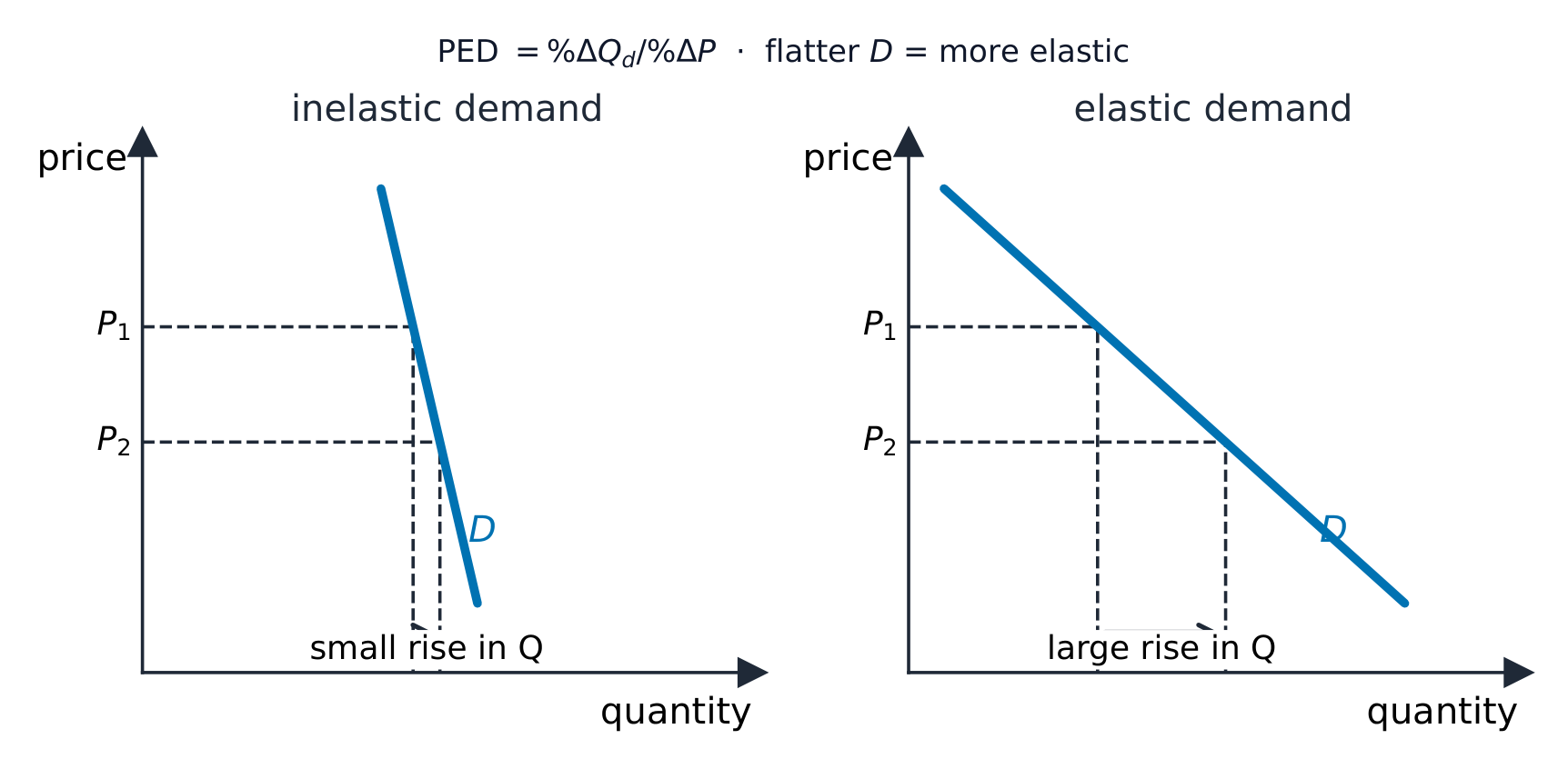
PED = (% change in quantity demanded) ÷ (% change in price)
(We usually ignore the minus sign and read the size of the number.) The determinants 决定因素 (the things that decide PED) include whether the good has close substitutes, whether it is a need or a luxury, and what share of income it takes.
Worked example. When the price of a good rises by 20%, the quantity demanded falls by 10%. Find the PED.
PED = (% change in quantity demanded) ÷ (% change in price) = 10 ÷ 20 = 0.5.
Because 0.5 is less than 1, demand is inelastic — the quantity changed by a smaller percentage than the price.
Reading the value
PED greater than 1: demand is elastic 富有弹性. Quantity changes by a large %. (Goods with many substitutes, like one brand of crisps.)
PED less than 1: demand is inelastic 缺乏弹性. Quantity changes by a small %. (Needs with few substitutes, like petrol or salt.)
PED equal to 1: unit elastic 单位弹性. Quantity changes by the same % as price.
When demand is inelastic (steep) a price change barely changes quantity; when it is elastic (shallow) the same change moves quantity a lot.
PED and total revenue
Total revenue 总收益 is the money a firm gets from sales: price × quantity sold. (To the buyer, the same money is total expenditure 总支出.) PED tells a firm what happens to revenue if it changes its price:
If demand is inelastic, raising the price raises total revenue (quantity falls only a little).
If demand is elastic, raising the price lowers total revenue (quantity falls a lot).
This is useful. A firm sets prices knowing how buyers will react. A government taxes inelastic goods (like cigarettes) because people keep buying them, so the tax raises a lot of money.
Worked example. A bus company sells 1,000 tickets a day at £2 each. It raises the price by 10% to £2.20, and daily sales fall by 5% to 950. Find the PED and what happens to total revenue.
PED = 5 ÷ 10 = 0.5, so demand is inelastic (less than 1).
old revenue = £2 × 1,000 = £2,000.
new revenue = £2.20 × 950 = £2,090.
Total revenue rose by £90. Because demand is inelastic, the price rose by a bigger percentage than the quantity fell, so raising the price raised revenue.
The same price rise raises revenue when demand is inelastic, but lowers it when demand is elastic
Explore · Khám phá
Elasticity & total revenue · Độ co giãn & doanh thu tổng
PED is the % change in quantity over the % change in price; whether it is above or below 1 decides how total revenue moves. · PED là % thay đổi của lượng chia cho % thay đổi của giá; giá trị lớn hay nhỏ hơn 1 sẽ quyết định cách doanh thu tổng biến động.
Explore · Khám phá
Demand & supply · Cung & Cầu
Elasticity of demand is the steepness of the curve. · Độ co giãn của cầu chính là độ dốc của đường cong.
explain how a market economy allocates resources through the price mechanism
explain the advantages and disadvantages of the market economic system
Tiếng Việt
giải thích cách một nền kinh tế thị trường phân bổ nguồn lực thông qua cơ chế giá
giải thích những ưu điểm và nhược điểm của hệ thống kinh tế thị trường
Source: Cambridge International syllabus · Nguồn: Chương trình Cambridge International
In a market economy 市场经济, the price mechanism makes all the choices. There is no government planning. (The opposite is a planned economy 计划经济, where the government makes the choices.)
Advantages of the market system:
Prices guide resources to where they are wanted, without anyone planning.
Firms compete, so they cut costs and create new and better goods.
Consumers have wide choice.
Disadvantages:
Some useful goods are not made because they earn no profit.
The strong (rich firms and people) do well; the weak may be left with nothing.
Markets can fail (see below).
Explore · Khám phá
How a market allocates · Cách một thị trường phân bổ
In a market system, price moves to where demand meets supply — that price signal decides what gets made. Shift the curves and watch it settle. · Trong hệ thống thị trường, giá cả điều chỉnh đến điểm cân bằng nơi cung gặp cầu — tín hiệu giá này quyết định những gì sẽ được sản xuất. Dịch chuyển đường cong và quan sát sự ổn định mới.
define market failure as the inefficient allocation of resources
explain the causes: external costs and external benefits (social vs private costs/benefits), merit and demerit goods, public goods and the abuse of monopoly power
Tiếng Việt
định nghĩa thất bại thị trường là sự phân bổ nguồn lực không hiệu quả
giải thích các nguyên nhân: chi phí bên ngoài và lợi ích bên ngoài (chi phí/lợi ích xã hội so với tư nhân), hàng hóa có lợi và hàng hóa có hại, hàng hóa công cộng và sự lạm dụng quyền độc quyền
Source: Cambridge International syllabus · Nguồn: Chương trình Cambridge International
Market failure 市场失灵 happens when the price mechanism leads to an inefficient 低效率 use of resources — resources are not shared out in the best way for society. The main causes:
External costs and benefits
Pollution from a power station is an external cost — it falls on third parties, not just the producer
When you produce or consume something, the cost or benefit to you is not always the cost or benefit to everyone.
a private cost 私人成本 is the cost to the person doing the activity.
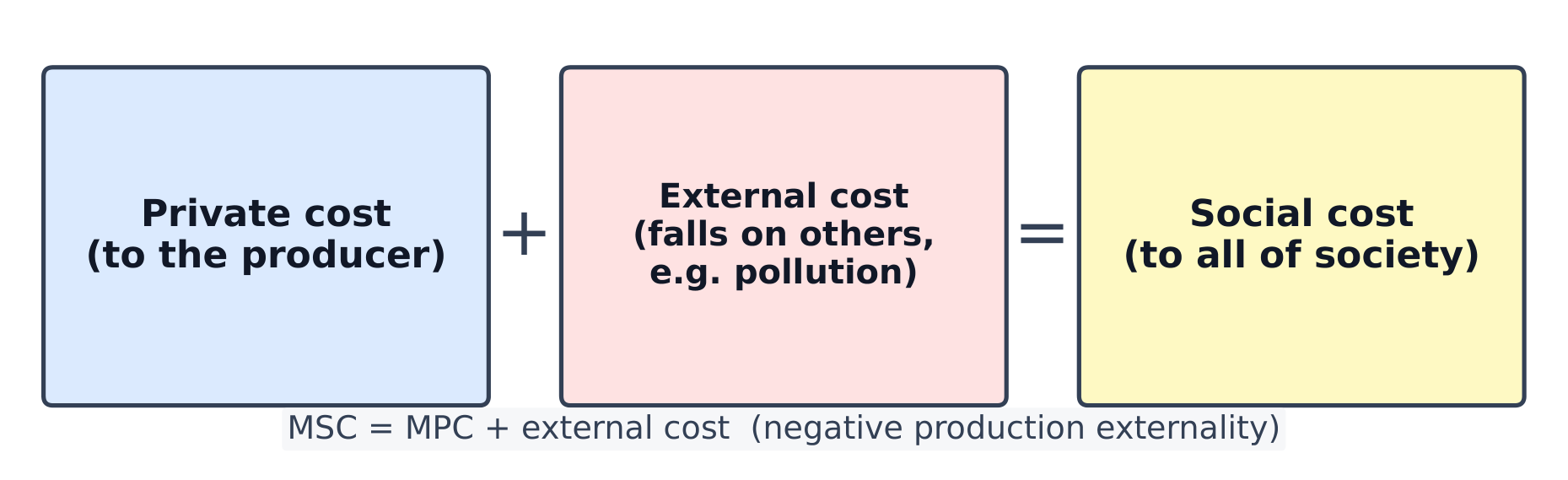
an external cost 外部成本 is a cost paid by other people — for example, smoke from a factory harms nearby families.
the social cost 社会成本 is the private cost plus the external cost (the cost to the whole of society).
In the same way:
a private benefit 私人效益 is the benefit to the person doing the activity.
an external benefit 外部效益 is a benefit that others get for free — for example, your neighbour's tidy garden is nice for you too.
the social benefit 社会效益 is the private benefit plus the external benefit.
Markets fail because firms and consumers only think about their private costs and benefits, not the external ones.
An external cost (e.g. pollution) falls on third parties, so the social cost is greater than the producer's private cost
Merit, demerit and public goods
merit goods 有益物品 are better for you than you realise, so the market makes too few (education, healthcare).
demerit goods 有害物品 are worse for you than you realise, so the market makes too many (cigarettes, alcohol).
public goods 公共物品 are things everyone can use and no one can be stopped from using, like street lights or national defence. The market makes none, because firms cannot charge for them.
A private good is rival and excludable (firms supply it); a public good is non-rival and non-excludable (the government must supply it)Merit and demerit goods are mis-judged because of information failure
Abuse of monopoly power
A monopoly 垄断 is a single firm that controls a market. With no competition, it can charge high prices and make poor-quality goods. This is another market failure.
Explore · Khám phá
Demand & supply · Cung & Cầu
Market failure: the free-market crossing isn't always best for society. · Thất bại thị trường: giao thông tự do không phải lúc nào cũng mang lại lợi ích tối đa cho xã hội.
explain the features of a mixed economy (private sector and public sector)
explain methods of government intervention to address market failure: maximum and minimum prices, indirect taxes, subsidies, regulation and direct provision
evaluate the effects of intervention
Tiếng Việt
giải thích các đặc điểm của nền kinh tế hỗn hợp (phần tư nhân và phần công)
giải thích các phương thức can thiệp của chính phủ để khắc phục thất bại thị trường: giá tối đa và tối thiểu, thuế gián tiếp, trợ giá, quy định và cung cấp trực tiếp
đánh giá tác động của sự can thiệp
Source: Cambridge International syllabus · Nguồn: Chương trình Cambridge International
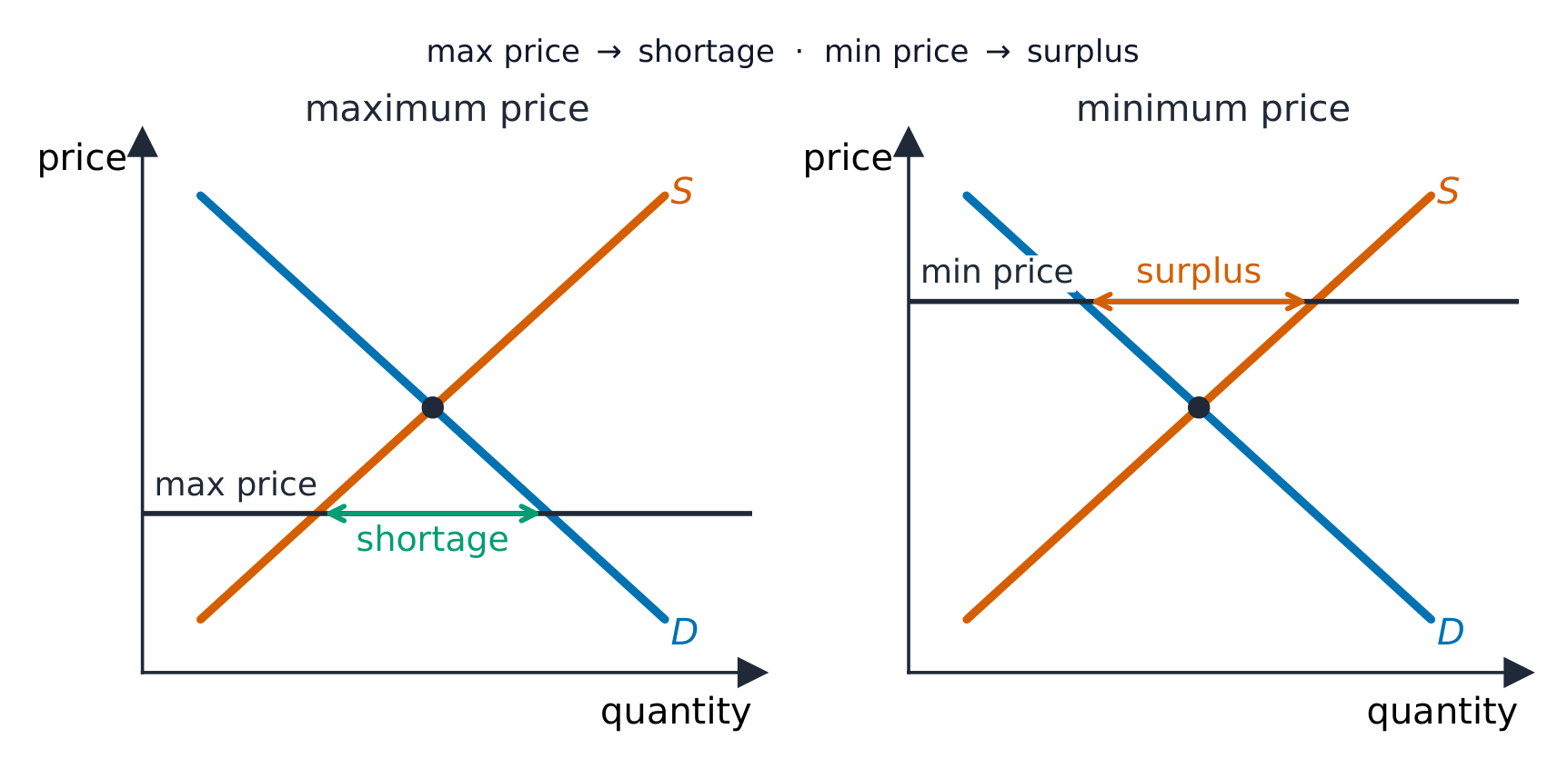
A maximum price creates a shortage
A mixed economy 混合经济 has both:
a private sector 私营部门 — firms owned by people, guided by the price mechanism.
a public sector 公共部门 — activity run by the government.
Most real economies are mixed; China's, for example, is a socialist market economy. The government steps in to correct market failure. This is government intervention 干预. The main methods:
Method
What it does
maximum price 最高价格
a price ceiling, set below equilibrium, to keep a good (like rent) cheap — but it causes a shortage
minimum price 最低价格
a price floor, set above equilibrium, to keep a price up (like a fair wage) — but it causes a surplus
indirect tax 间接税
a tax on a good (added to its price) to cut demand for demerit goods
subsidy
money paid to firms to cut the price and raise output of merit goods
regulation 监管
rules and laws, like banning smoking in public
direct provision 直接提供
the government makes and gives out goods itself, like state schools
A maximum price set below equilibrium causes a shortage; a minimum price set above equilibrium causes a surplus.
Judging intervention
Intervention can fix market failure, but it has costs. Taxes and rules cost money to collect and check. Governments can get things wrong too (this is called government failure). So you should always weigh the good effects against the bad ones before deciding.
Explore · Khám phá
Economics case lab · Phòng thí nghiệm tình huống Kinh tế học
Classify real examples by the economic idea they show. · Phân loại các ví dụ thực tế theo ý tưởng kinh tế mà chúng minh họa.
A change in a good's own price is a movement along the curve; a change in anything else (income, tastes, related prices) shifts the whole curve.
Equilibrium is where demand meets supply. Below it there is excess demand (a shortage, so price rises); above it there is excess supply (a surplus, so price falls).
PED = %ΔQ ÷ %ΔP. Demand is inelastic if PED < 1 (raising price raises revenue) and elastic if PED > 1 (raising price lowers revenue).
Market failure (external costs, merit/demerit/public goods, monopoly) means resources are used badly; the government corrects it with taxes, subsidies, rules and direct provision.
3
Microeconomic decision-makers · Người ra quyết định kinh tế vi mô
state the functions of money (medium of exchange, store of value, unit of account, means of deferred payment) and the characteristics of money
explain the role of central banks and commercial banks
Tiếng Việt
nêu các chức năng của tiền tệ (phương tiện trao đổi, phương tiện lưu giữ giá trị, đơn vị tính toán, phương tiện thanh toán trả chậm) và đặc điểm của tiền tệ
giải thích vai trò của ngân hàng trung ương và ngân hàng thương mại
Source: Cambridge International syllabus · Nguồn: Chương trình Cambridge International
English
Long ago, people swapped goods directly. This is called barter 物物交换. Barter is hard: you must find someone who has what you want and wants what you have. Money 货币 solves this problem.
The functions of money
Money does four jobs:
a medium of exchange 交换媒介 — you swap money for goods, so you do not need barter.
a store of value 价值储藏 — you can hold money now and spend it later, because it keeps its value.
a unit of account 记账单位 — money measures and compares the value of things (this is the price).
a means of deferred payment 延期支付手段 — you can buy now and pay later.
The characteristics of money
Good money must be:
durable 耐用的 — it lasts a long time.
portable 便于携带的 — easy to carry.
divisible 可分割的 — can be split into small amounts for small payments.
limited in supply, hard to copy, and accepted by everyone.
Banks
A central bank 中央银行 is the government's bank. It issues notes, looks after the banking system, and sets interest rates 利率. There is one in each country.
commercial banks 商业银行 are the ordinary banks that people and firms 企业 use. They keep savings safe, lend money, and let people pay each other.
Tiếng Việt
Xưa kia, mọi người trao đổi hàng hóa trực tiếp. Điều này gọi là trao đổi. Trao đổi rất khó khăn: bạn phải tìm được người có đúng thứ mình muốn và cũng muốn đúng thứ mình có. Tiền tệ đã giải quyết vấn đề này.
Các chức năng của tiền tệ
Tiền tệ đảm nhận bốn vai trò:
phương tiện lưu thông — bạn đổi tiền để lấy hàng hóa, vì vậy không cần trao đổi nữa.
phương tiện lưu trữ giá trị — bạn có thể giữ tiền hiện tại và tiêu sau này, vì nó giữ được giá trị.
đơn vị tính toán — tiền đo lường và so sánh giá trị của các đồ vật (đây chính là giá cả).
phương thức thanh toán延期 — bạn có thể mua ngay và trả tiền sau.
Bốn chức năng của tiền: phương tiện lưu thông, phương tiện lưu trữ giá trị, đơn vị tính toán, và phương thức thanh toán延期Tiền — tiền giấy và xu — hoạt động như phương tiện trao đổi, cao điểm giá trị, đơn vị tính toán, và phương thức thanh toán deferred
Đặc điểm của tiền tệ
Tiền tốt phải có:
bền — tồn tại lâu dài.
di động — dễ mang theo.
chia nhỏ được — có thể chia thành các khoản nhỏ để thanh toán số tiền ít.
hạn chế về nguồn cung, khó sao chép, và được mọi người chấp nhận.
Ngân hàng
Ngân hàng trung ương là ngân hàng của chính phủ. Họ phát hành tiền, quản lý hệ thống ngân hàng, và thiết lập lãi suất. Mỗi quốc gia đều có một ngân hàng trung ương.
Ngân hàng thương mại là các ngân hàng thông thường mà người dân và doanh nghiệp sử dụng. Họ giữ tiền tiết kiệm an toàn, cho vay tiền, và cho phép mọi người chuyển tiền cho nhau.
Explore · Khám phá
Economics case lab · Phòng thí nghiệm tình huống Kinh tế học
Classify real examples by the economic idea they show. · Phân loại các ví dụ thực tế theo ý tưởng kinh tế mà chúng minh họa.
means of deferred payment/miːnz ɒv dɪˈfɜːd ˈpeɪmənt/
phương thức thanh toán hoãn lại
durable/ˈdjʊərəbl/
bền vững
portable/ˈpɔːtəbl/
di động
divisible/dɪˈvɪzɪbl/
chia hết
central bank/ˈsentrəl bæŋk/
ngân hàng trung ương
interest rate/ˈɪntrest reɪt/
lãi suất
commercial banks/kəˈmɜːʃl bæŋks/
ngân hàng thương mại
3.2
Households · Hộ gia đình
Syllabus · Chương trình
English
explain the influences on spending, saving and borrowing by households (income, interest rates, confidence)
Tiếng Việt
giải thích các yếu tố ảnh hưởng đến chi tiêu, tiết kiệm và vay vốn của hộ gia đình (thu nhập, lãi suất, niềm tin)
Source: Cambridge International syllabus · Nguồn: Chương trình Cambridge International
English
A household 家庭 is a person or group living together and making money decisions. Each household must choose how much to spend, save, and borrow.
saving 储蓄 is income that is not spent now.
borrowing 借贷 is spending money you do not have yet, and paying it back later (usually with an extra charge).
Three main things change these choices:
income 收入 — with more income, people spend and save more.
interest rates — a higher interest rate makes saving more rewarding and borrowing dearer. So saving rises and borrowing falls.
confidence 信心 — if people feel sure about their jobs and the future, they spend and borrow more. If they are worried, they save more.
Tiếng Việt
Một hộ gia đình là một cá nhân hoặc nhóm người sống chung và đưa ra các quyết định tài chính. Mỗi hộ gia đình phải lựa chọn cách chi tiêu, tiết kiệm và vay nợ như thế nào.
Một hộ gia đình có thể tiêu dùng, tiết kiệm hoặc trả thuế từ thu nhập của mình
tiết kiệm là phần thu nhập không được chi tiêu ngay lúc đó.
vay nợ là chi tiêu số tiền bạn chưa có, và hoàn trả lại sau (thường kèm theo khoản phí bổ sung).
Ba yếu tố chính thay đổi những lựa chọn này:
thu nhập — với thu nhập cao hơn, mọi người chi tiêu và tiết kiệm nhiều hơn.
lãi suất — lãi suất cao hơn khiến việc tiết kiệm trở nên hấp dẫn hơn và vay nợ đắt đỏ hơn. Do đó, tiết kiệm tăng và vay nợ giảm.
tâm lý — nếu mọi người cảm thấy an tâm về công việc và tương lai, họ chi tiêu và vay nợ nhiều hơn. Nếu họ lo lắng, họ sẽ tiết kiệm nhiều hơn.
Explore · Khám phá
Economics case lab · Phòng thí nghiệm tình huống Kinh tế học
Classify real examples by the economic idea they show. · Phân loại các ví dụ thực tế theo ý tưởng kinh tế mà chúng minh họa.
explain the factors that determine an individual's choice of occupation (wage and non-wage factors)
explain the reasons for differences in earnings (skills, qualifications, danger, trade unions, discrimination)
explain division of labour/specialisation and its advantages and disadvantages
Tiếng Việt
giải thích các nhân tố quyết định sự lựa chọn nghề nghiệp cá nhân (lương và phi lương)
giải thích nguyên nhân chênh lệch thu nhập (kỹ năng, trình độ, nguy hiểm, công đoàn, phân biệt đối xử)
giải thích sự phân công lao động/chuyên môn hóa và những ưu điểm cũng như nhược điểm của nó
Source: Cambridge International syllabus · Nguồn: Chương trình Cambridge International
English
Choosing a job
When a worker chooses an occupation 职业 (a type of job), two kinds of factor matter:
wage factors — the pay. The wage 工资 is the money you earn. Higher pay attracts more workers.
non-wage factors — everything else: working hours, holidays, how safe or pleasant the job is, whether you enjoy the work, distance from home, and the chance to move up to a higher job.
Why workers earn different amounts
Workers are not all paid the same. The reasons include:
skill 技能 and qualifications 资格 — workers who are hard to replace, or who studied for years, earn more.
danger — risky or dirty jobs may pay more to attract workers.
trade unions 工会 — a trade union is a group of workers who join together to bargain for better pay and conditions. Strong unions can raise pay.
discrimination 歧视 — unfair treatment because of gender, race, or age can cause unfair pay gaps.
Division of labour
Division of labour 劳动分工 (also called specialisation 专业化) means splitting a job into small tasks, with each worker doing one task again and again.
Advantages: workers get faster and better at their one task; less time is wasted moving between tasks; this raises output.
Disadvantages: doing one task is boring, so workers may make mistakes or leave; if one worker is absent, the whole line can stop; each worker learns only one skill.
Tiếng Việt
Lựa chọn nghề nghiệp
Khi một người lao động lựa chọn nghề nghiệp (một loại công việc), hai loại yếu tố ảnh hưởng đến quyết định này:
yếu tố tiền lương — mức lương. Lương là số tiền bạn kiếm được. Mức lương cao thu hút nhiều người lao động hơn.
yếu tố phi tiền lương — tất cả những yếu tố khác: giờ làm việc, ngày nghỉ, độ an toàn hay sự thoải mái của công việc, liệu bạn có thích công việc đó hay không, khoảng cách từ nhà, và cơ hội thăng tiến lên vị trí cao hơn.
Tại sao người lao động có mức thu nhập khác nhau
Người lao động không được trả lương đồng đều. Các nguyên nhân bao gồm:
Lương phụ thuộc vào kỹ năng, độ khó của công việc và nhu cầu
kỹ năng và chứng chỉ — những người lao động khó thay thế, hoặc đã học tập trong nhiều năm, thường có lương cao hơn.
nguy hiểm — những công việc rủi ro hoặc bẩn thỉu có thể trả lương cao hơn để thu hút người lao động.
trade unions — một công đoàn là tập hợp các lao động liên kết với nhau để đàm phán về mức lương và điều kiện làm việc tốt hơn. Các công đoàn mạnh có thể nâng cao mức lương.
discrimination — sự đối xử không công bằng vì giới tính, chủng tộc hoặc độ tuổi có thể dẫn đến khoảng cách lương không công bằng.
Division of labour
Division of labour (còn gọi là specialisation) nghĩa là chia nhỏ công việc thành các nhiệm vụ riêng lẻ, trong đó mỗi người lao động thực hiện lặp lại một nhiệm vụ duy nhất.
Advantages: người lao động trở nên nhanh nhẹn và giỏi hơn trong nhiệm vụ của mình; ít thời gian bị lãng phí khi di chuyển giữa các nhiệm vụ; điều này làm tăng sản lượng.
Disadvantages: làm một nhiệm vụ đơn điệu gây nhàm chán, khiến người lao động dễ mắc sai lầm hoặc nghỉ việc; nếu một người vắng mặt, toàn bộ dây chuyền có thể ngừng hoạt động; mỗi người chỉ học được một kỹ năng.
Division of labour: việc chia nhỏ công việc thành các nhiệm vụ lặp lại giúp tăng sản lượng trên mỗi lao động
Explore · Khám phá
Economics case lab · Phòng thí nghiệm tình huống Kinh tế học
Classify real examples by the economic idea they show. · Phân loại các ví dụ thực tế theo ý tưởng kinh tế mà chúng minh họa.
classify firms by size and explain why some firms remain small and why/how firms grow (mergers: horizontal, vertical, conglomerate)
explain the causes of business failure
Tiếng Việt
phân loại doanh nghiệp theo quy mô và giải thích tại sao một số doanh nghiệp vẫn nhỏ và làm thế nào/doanh nghiệp phát triển (sáp nhập: ngang hàng, dọc, tập đoàn đa ngành)
giải thích nguyên nhân thất bại kinh doanh
Source: Cambridge International syllabus · Nguồn: Chương trình Cambridge International
English
Economies of scale: average cost falls
The size of firms
Firms come in many sizes, from one person to huge companies. We can measure size by the number of workers, the amount of capital 资本 used, or the output.
Some firms stay small because: the market 市场 is small; the product is personal (like a hairdresser); the owner wants to stay in control; or there is little money to grow.
How firms grow
Firms grow by selling more, or by joining with other firms. When two firms join, it is a merger 合并 (or takeover). There are three types:
horizontal merger 横向合并 — two firms at the same stage of the same industry join (two car makers).
vertical merger 纵向合并 — two firms at different stages of the same industry join (a car maker and a tyre maker). "Backward" is towards the supplier; "forward" is towards the seller.
conglomerate merger 混合合并 — two firms in different industries join (a car maker and a food company).
Business failure
Firms can suffer business failure 企业倒闭 (they close down) for many reasons: costs too high, too few sales, poor management, too many rivals, not enough cash, or a fall in demand 需求.
Tiếng Việt
Lợi thế quy mô: chi phí bình quân giảm
The size of firms
Các doanh nghiệp có nhiều quy mô khác nhau, từ một cá nhân đến những tập đoàn khổng lồ. Chúng ta có thể đo lường quy mô bằng số lượng lao động, lượng capital sử dụng, hoặc sản lượng.
Một số doanh nghiệp vẫn giữ quy mô nhỏ vì: market còn hạn chế; sản phẩm mang tính cá nhân (như thợ cắt tóc); chủ sở hữu muốn kiểm soát; hoặc thiếu vốn để mở rộng.
How firms grow
Doanh nghiệp phát triển bằng cách bán hàng nhiều hơn, hoặc bằng cách sáp nhập với các doanh nghiệp khác. Khi hai doanh nghiệp hợp nhất, đó là một merger (hoặc takeover). Có ba loại:
horizontal merger — hai doanh nghiệp ở cùng giai đoạn của một ngành joins (hai nhà sản xuất ô tô).
vertical merger — hai doanh nghiệp ở các giai đoạn khác nhau của cùng một ngành joins (một nhà sản xuất ô tô và một nhà sản xuất lốp xe). "Backward" hướng về phía nhà cung cấp; "forward" hướng về phía người bán.
conglomerate merger — hai doanh nghiệp trong các ngành khác nhau joins (một nhà sản xuất ô tô và một công ty thực phẩm).
Ba loại integration: horizontal (cùng giai đoạn), vertical (các giai đoạn khác nhau của một ngành), và conglomerate (các ngành khác nhau)
Business failure
Doanh nghiệp có thể gặp business failure (đóng cửa) do nhiều nguyên nhân: chi phí quá cao, doanh thu thấp, quản lý kém, quá nhiều đối thủ cạnh tranh, thiếu tiền mặt, hoặc giảm demand.
distinguish labour-intensive and capital-intensive production and explain productivity
explain demand for and supply of factors of production and economies and diseconomies of scale
Tiếng Việt
phân biệt sản xuất-intensive lao động và capital-intensive và giải thích năng suất
giải thích nhu cầu và cung các nhân tố sản xuất cùng lợi ích và bất lợi về quy mô
Source: Cambridge International syllabus · Nguồn: Chương trình Cambridge International
English
Labour-intensive and capital-intensive
labour-intensive 劳动密集型 production uses a lot of labour 劳动 (many workers) and little machinery — for example, hand-made crafts.
capital-intensive 资本密集型 production uses a lot of capital (machines) and few workers — for example, a modern car factory.
Productivity
Productivity 生产率 means output per worker (or per machine) in a set time. Higher productivity means each worker makes more, so the cost of each unit falls. Training, better machines, and good management all raise productivity.
Demand for and supply of factors
Firms buy factors of production 生产要素 (land 土地, labour, capital, and enterprise 企业家才能). The price and amount of each factor are set by its own demand and supply, just like any market. For example, if many firms want skilled workers, the wage for those workers rises.
Economies and diseconomies of scale
As a firm grows and makes more, the cost of each unit can change:
economies of scale 规模经济 — as output rises, the average cost of each unit falls. Reasons: buying materials in bulk is cheaper, big machines work more efficiently, and large firms borrow money cheaply.
diseconomies of scale 规模不经济 — if a firm grows too big, the average cost of each unit starts to rise. Reasons: a huge firm is hard to manage, messages travel slowly, and workers may feel less important.
These can be internal (caused by the firm's own size) or external (caused by the whole industry growing).
Tiếng Việt
Labour-intensive and capital-intensive
labour-intensive sản xuất phụ thuộc nhiều vào labour (nhiều lao động) và ít máy móc — ví dụ, đồ thủ công mỹ nghệ.
capital-intensive sản xuất phụ thuộc nhiều vào capital (máy móc) và ít lao động — ví dụ, nhà máy ô tô hiện đại.
Dây chuyền lắp ráp ô tô là vốn-intensive (nhiều máy móc, ít công nhân) và sử dụng sự phân công lao động — mỗi công nhân lặp lại một nhiệm vụ
Năng suất lao động
Productivity nghĩa là sản lượng trên mỗi lao động (hoặc mỗi máy) trong một khoảng thời gian xác định. Năng suất cao hơn có nghĩa là mỗi lao động tạo ra nhiều hơn, do đó chi phí cho mỗi đơn vị giảm xuống. Đào tạo, máy móc tốt hơn và quản lý hiệu quả đều làm tăng năng suất.
Demand for and supply of factors
Doanh nghiệp mua factors of production (land, labour, capital, và enterprise). Giá cả và số lượng của mỗi yếu tố được xác định bởi cung cầu riêng của nó, giống như bất kỳ thị trường nào. Ví dụ, nếu nhiều doanh nghiệp tìm kiếm lao động có tay nghề cao, tiền lương của họ sẽ tăng.
Lợi thế và bất lợi về quy mô
Khi doanh nghiệp phát triển và sản xuất nhiều hơn, chi phí trung bình của mỗi đơn vị có thể thay đổi:
economies of scale — khi sản lượng tăng, chi phí trung bình của mỗi đơn vị giảm. Nguyên nhân: mua nguyên liệu theo lô lớn rẻ hơn, máy móc lớn hoạt động hiệu quả hơn, và các tập đoàn vay tiền với lãi suất thấp.
diseconomies of scale — nếu doanh nghiệp phát triển quá lớn, chi phí trung bình của mỗi đơn vị bắt đầu tăng. Nguyên nhân: một tập đoàn quá lớn khó quản lý, thông tin truyền đạt chậm chạp, và lao động có thể cảm thấy ít quan trọng.
Chi phí trung bình giảm khi doanh nghiệp phát triển (economies of scale), đạt đến mức thấp nhất, sau đó tăng lên nếu phát triển quá lớn (diseconomies of scale).
Những yếu tố này có thể là internal (do quy mô nội tại của doanh nghiệp) hoặc external (do sự phát triển của toàn bộ ngành).
Explore · Khám phá
Factors of production lab · Nhlab Yếu tố sản xuất
Sort real resources by the factor of production they represent. · Sắp xếp tài nguyên thực tế theo yếu tố sản xuất mà chúng đại diện.
define and calculate fixed, variable, total and average costs
define and calculate total and average revenue
explain the objectives of firms (profit, survival, growth, social objectives)
Tiếng Việt
định nghĩa và tính toán chi phí cố định, biến đổi, tổng cộng và bình quân
định nghĩa và tính toán doanh thu tổng và bình quân
giải thích các mục tiêu của doanh nghiệp (lợi nhuận, tồn tại, tăng trưởng, mục tiêu xã hội)
Source: Cambridge International syllabus · Nguồn: Chương trình Cambridge International
English
Costs
A cost 成本 is money a firm spends to produce. Costs split into:
fixed costs 固定成本 — costs that do not change with output, such as rent and insurance. You pay them even if you make nothing.
variable costs 可变成本 — costs that change with output, such as materials and power. More output means more variable cost.
total cost 总成本 — fixed cost plus variable cost.
average cost 平均成本 — the cost of each unit: total cost divided by the number of units made.
Revenue
Revenue 收益 is the money a firm gets from selling its goods.
total revenue 总收益 — the price multiplied by the quantity sold.
average revenue 平均收益 — total revenue divided by the quantity sold (this is the same as the price).
Profit and other objectives
Profit 利润 is what is left after costs:
profit = total revenue − total cost
Worked example. A firm has fixed costs of £2,000 and variable costs of £3 per unit. It makes 500 units and sells them at £10 each. Find its total cost, total revenue, profit and average cost.
variable cost = 3 × 500 = £1,500, so total cost = 2,000 + 1,500 = £3,500.
total revenue = 10 × 500 = £5,000.
profit = 5,000 - 3,500 = £1,500.
average cost = total cost ÷ units = 3,500 ÷ 500 = £7 per unit.
The firm makes a profit because the price (£10) is above the average cost (£7).
Most firms want as much profit as possible. But firms can have other objectives 目标:
survival 生存 — a new firm first just wants to stay open.
growth 增长 — getting bigger, to gain economies of scale and market power.
social objectives — some firms aim to help people or protect the environment, not only to earn profit.
Tiếng Việt
Chi phí
Một cost là khoản tiền mà doanh nghiệp bỏ ra để sản xuất. Chi phí phân thành:
fixed costs — chi phí không thay đổi theo sản lượng, chẳng hạn như tiền thuê và bảo hiểm. Bạn phải trả chúng ngay cả khi không sản xuất gì.
variable costs — chi phí thay đổi theo sản lượng, chẳng hạn như nguyên vật liệu và điện năng. Sản lượng càng nhiều thì chi phí biến đổi càng cao.
total cost — fixed cost cộng với variable cost.
average cost — chi phí của mỗi đơn vị: total cost chia cho số lượng đơn vị đã sản xuất.
Fixed cost giữ nguyên khi sản lượng tăng; variable cost tăng; total cost là tổng của fixed và variable, nên khoảng cách giữa total và variable chính là fixed cost.
Thu nhập
Revenue là khoản tiền mà doanh nghiệp nhận được từ việc bán hàng hóa.
total revenue — giá nhân với số lượng bán ra.
average revenue — total revenue chia cho số lượng bán ra (điều này cũng chính là giá).
Profit and other objectives
Profit là phần còn lại sau khi trừ đi chi phí:
profit = total revenue − total cost
Worked example. Một doanh nghiệp có fixed costs là £2,000 và variable costs là £3 cho mỗi đơn vị. Họ sản xuất 500 đơn vị và bán hết với giá £10 mỗi đơn vị. Tính total cost, total revenue, profit và average cost.
variable cost = 3 × 500 = £1,500, do đó total cost = 2,000 + 1,500 = £3,500.
total revenue = 10 × 500 = £5,000.
profit = 5,000 - 3,500 = £1,500.
average cost = total cost ÷ units = 3,500 ÷ 500 = £7 cho mỗi đơn vị.
Doanh nghiệp tạo ra lợi nhuận vì giá (£10) nằm trên chi phí bình quân (£7).
Hầu hết các doanh nghiệp muốn đạt được nhiều lợi nhuận nhất có thể. Tuy nhiên, các doanh nghiệp có thể theo đuổi các mục tiêu khác:
tồn tại — một doanh nghiệp mới ban đầu chỉ muốn duy trì hoạt động.
phát triển — mở rộng quy mô để hưởng lợi từ lợi thế quy mô và sức mạnh thị trường.
mục tiêu xã hội — một số doanh nghiệp hướng đến việc giúp đỡ con người hoặc bảo vệ môi trường, không chỉ đơn thuần là kiếm lời.
Explore · Khám phá
A firm's cost curves · Đường cong chi phí của doanh nghiệp
Change output and see how average cost falls then rises — and where marginal cost crosses it. · Thay đổi sản lượng và xem chi phí bình quân giảm rồi tăng — và điểm mà chi phí biên cắt qua nó.
describe the characteristics of competitive markets and monopoly
explain the advantages and disadvantages of competition for consumers and firms
Tiếng Việt
mô tả đặc điểm của thị trường cạnh tranh và độc quyền
giải thích những ưu điểm và nhược điểm của cạnh tranh đối với người tiêu dùng và doanh nghiệp
Source: Cambridge International syllabus · Nguồn: Chương trình Cambridge International
English
Markets differ by how many firms there are and how hard it is for new firms to join.
Competitive markets
A competitive market has many firms selling similar goods, and it is easy for new firms to enter. This is strong competition 竞争. In such a market:
firms must keep prices low and quality high, or buyers go elsewhere.
firms work hard to cut costs and make new products.
This is good for consumers: low prices, wide choice, and good quality.
Monopoly
A monopoly 垄断 is a market with only one firm, or one firm that controls most of it. New firms find it hard to enter because of barriers to entry 进入壁垒 — for example, very high start-up costs, or the one firm controlling key supplies.
In a monopoly:
the firm can charge high prices, because buyers have no other choice.
there is little pressure to improve quality or cut costs.
but a large monopoly may gain economies of scale, and may use its profit to pay for research.
Competition versus monopoly
Consumers
Firms
competition
lower prices, more choice, better quality
lower profit; must work hard to survive
monopoly
higher prices, less choice
higher profit and an easy life, but may grow lazy
Tiếng Việt
Các thị trường khác nhau dựa vào số lượng doanh nghiệp tham gia và mức độ khó khăn mà các doanh nghiệp mới gặp phải khi gia nhập.
Thị trường dao động từ độc quyền (một người bán) đến cạnh tranh hoàn hảo (nhiều người)
Thị trường cạnh tranh
Một thị trường cạnh tranh có nhiều doanh nghiệp bán các mặt hàng tương tự, và rất dễ dàng cho các doanh nghiệp mới gia nhập. Đây là sự cạnh tranh gay gắt. Trong thị trường như vậy:
các doanh nghiệp phải giữ giá thấp và chất lượng cao, nếu không khách hàng sẽ tìm đến nơi khác.
các doanh nghiệp nỗ lực cắt giảm chi phí và phát triển sản phẩm mới.
Điều này có lợi cho người tiêu dùng: giá cả hợp lý, sự lựa chọn đa dạng và chất lượng tốt.
Trong thị trường cạnh tranh, nhiều doanh nghiệp bán hàng hóa tương tự, vì vậy mỗi bên phải giữ giá thấp và chất lượng cao để thu hút khách hàng
Độc quyền
Độc quyền là thị trường chỉ có một doanh nghiệp, hoặc một doanh nghiệp kiểm soát phần lớn thị trường đó. Các doanh nghiệp mới gặp khó khăn trong việc gia nhập do rào cản gia nhập — ví dụ, chi phí khởi đầu rất cao, hoặc một doanh nghiệp kiểm soát các nguồn cung cấp then chốt.
Trong một thị trường độc quyền:
doanh nghiệp có thể định giá cao, vì người mua không còn lựa chọn nào khác.
áp lực để cải thiện chất lượng hoặc giảm chi phí là rất ít.
nhưng một công ty độc quyền lớn có thể đạt được lợi thế về quy mô, và có thể sử dụng lợi nhuận để tài trợ cho nghiên cứu.
Cạnh tranh versus độc quyền
Người tiêu dùng
Doanh nghiệp
cạnh tranh
giá thấp hơn, nhiều lựa chọn hơn, chất lượng tốt hơn
lợi nhuận thấp hơn; phải nỗ lực làm việc để tồn tại
độc quyền
giá cao hơn, ít lựa chọn hơn
lợi nhuận cao và cuộc sống dễ dàng, nhưng có thể trở nên lười biếng
Explore · Khám phá
Economics case lab · Phòng thí nghiệm tình huống Kinh tế học
Classify real examples by the economic idea they show. · Phân loại các ví dụ thực tế theo ý tưởng kinh tế mà chúng minh họa.
Money's four functions: a medium of exchange, a store of value, a unit of account, and a means of deferred payment.
Key formulas: profit = total revenue − total cost; total revenue = price × quantity; average cost = total cost ÷ number of units.
Fixed costs do not change with output (rent, insurance); variable costs do (materials, power). Total cost = fixed + variable.
Economies of scale make average cost fall as a firm grows; growing too big brings diseconomies of scale (average cost rises).
Know the merger types: horizontal (same stage of the same industry), vertical (different stages of one industry), conglomerate (different industries).
Tiếng Việt
Bốn chức năng của tiền: một phương tiện thanh toán, một kho lưu trữ giá trị, một đơn vị tính toán, và một phương thức thanh toán延期 (trả chậm).
Công thức quan trọng: lợi nhuận = tổng doanh thu − tổng chi phí; tổng doanh thu = giá × số lượng; chi phí bình quân = tổng chi phí ÷ số đơn vị.
Chi phí cố định không thay đổi theo sản lượng (thuê mặt bằng, bảo hiểm); chi phí biến đổi thì có (nguyên vật liệu, điện năng). Tổng chi phí = cố định + biến đổi.
Lợi thế về quy mô giúp chi phí bình quân giảm khi doanh nghiệp mở rộng; nhưng phát triển quá lớn sẽ dẫn đến bất lợi thế về quy mô (chi phí bình quân tăng).
Phân biệt các loại sáp nhập: ngang hàng (cùng giai đoạn trong cùng ngành), dọc (khác giai đoạn trong một ngành), hỗn hợp (các ngành khác nhau).
4
Government and the macroeconomy · Chính phủ và kinh tế vĩ mô
Government macroeconomic aims · Mục tiêu vĩ mô của chính phủ
Syllabus · Chương trình
English
state the macroeconomic aims of government (economic growth, full employment/low unemployment, price stability, balance of payments stability, redistribution of income)
explain why aims may conflict
Tiếng Việt
nêu các mục tiêu vĩ mô của chính phủ (tăng trưởng kinh tế, việc làm đầy đủ/thấp, ổn định giá cả, cân bằng thanh toán, tái phân phối thu nhập)
giải thích tại sao các mục tiêu có thể xung đột
Source: Cambridge International syllabus · Nguồn: Chương trình Cambridge International
English
Governments try to manage the whole economy — the macroeconomy 宏观经济. They have five main aims:
economic growth 经济增长 — the economy makes more goods and services each year.
full employment 充分就业 — almost everyone who wants a job has one, so unemployment 失业 is low.
price stability 价格稳定 — prices rise only slowly, so inflation 通货膨胀 is low.
balance of payments 国际收支 stability — the money flowing in and out of the country (from trade) is roughly even.
redistribution of income 收入再分配 — sharing income more fairly, so the gap between rich and poor is not too wide.
These aims can conflict 冲突 (work against each other). For example, fast growth can pull prices up, causing inflation. Cutting unemployment can do the same. So a government must balance its aims.
Tiếng Việt
Chính phủ cố gắng quản lý toàn bộ nền kinh tế — nền kinh tế vĩ mô. Họ có năm mục tiêu chính:
Năm mục tiêu chính: tăng trưởng, tỷ lệ thất nghiệp thấp, ổn định giá cả, cân đối thanh toán, thu nhập công bằng
tăng trưởng kinh tế — nền sản xuất ra nhiều hàng hóa và dịch vụ hơn mỗi năm.
lao động toàn phần — hầu hết mọi người muốn làm việc đều có việc làm, do đó tỷ lệ thất nghiệp ở mức thấp.
ổn định giá cả — giá chỉ tăng chậm, do đó lạm phát ở mức thấp.
cân đối thanh toán ổn định — dòng tiền流入 và流出 khỏi đất nước (từ thương mại) xấp xỉ bằng nhau.
phân phối lại thu nhập — chia sẻ thu nhập công bằng hơn, sao cho khoảng cách giữa người giàu và người nghèo không quá rộng.
Những mục tiêu này có thể xung đột (đi ngược lại nhau). Ví dụ, tăng trưởng nhanh có thể đẩy giá lên, gây ra lạm phát. Giảm tỷ lệ thất nghiệp cũng có thể dẫn đến hậu quả tương tự. Do đó, chính phủ cần cân bằng các mục tiêu của mình.
Ba bộ công cụ chính sách của chính phủ để quản lý vĩ mô
Explore · Khám phá
Managing aggregate demand · Quản lý cầu tổng hợp
Government policy moves aggregate demand against aggregate supply to steer output and the price level. · Chính sách chính phủ di chuyển cầu tổng hợp ngược chiều cung tổng hợp để điều tiết sản lượng và mức giá.
4.2
Fiscal policy · Chính sách tài khóa
Syllabus · Chương trình
English
define fiscal policy (government spending and taxation) and the government budget (surplus, deficit, balance)
distinguish direct and indirect taxes and progressive, regressive and proportional taxes
explain the effects of fiscal policy on government macroeconomic aims
Tiếng Việt
định nghĩa chính sách tài khóa (chi tiêu chính phủ và thuế) và ngân sách nhà nước (thừa, deficit, cân bằng)
phân biệt thuế trực tiếp và gián tiếp cùng thuế lũy tiến, lũy nghịch và tỷ lệ
giải thích tác động của chính sách tài khóa lên các mục tiêu vĩ mô của chính phủ
Source: Cambridge International syllabus · Nguồn: Chương trình Cambridge International
English
Fiscal policy 财政政策 means the government changing two things to manage the economy:
government spending 政府支出 — money the government spends, for example on schools, hospitals, and roads.
taxation 税收 — money the government takes from people and firms.
The government budget 预算 sets spending against tax. There are three outcomes:
a budget deficit 预算赤字 — spending is more than the tax raised, so the government must borrow.
a budget surplus 预算盈余 — the tax raised is more than spending.
a balanced budget — the two are equal.
Types of tax
Taxes are grouped in two ways. By what is taxed:
a direct tax 直接税 is paid straight to the government from income 收入 or profit 利润 (income tax, corporation tax).
an indirect tax 间接税 is added to the price of goods and paid when you spend (a sales tax).
By how the rate changes with income:
a progressive tax 累进税 takes a bigger % from higher incomes. This helps redistribute income.
a regressive tax 累退税 takes a smaller % from higher incomes, so it hits the poor harder.
a proportional tax 比例税 takes the same % from everyone.
What fiscal policy does
To boost the economy (raise growth and jobs), the government can spend more or cut taxes. This raises total demand 需求 — but if demand grows too fast, it can cause inflation.
To slow the economy (fight inflation), the government can spend less or raise taxes. This lowers demand, but can raise unemployment.
Tiếng Việt
Chính sách tài khóa có nghĩa là chính phủ thay đổi hai yếu tố để điều tiết nền kinh tế:
chi tiêu chính phủ — số tiền mà chính phủ chi trả, ví dụ như cho trường học, bệnh viện và đường xá.
thuế — số tiền mà chính phủ thu từ người dân và doanh nghiệp.
Ngân sách nhà nước so sánh chi tiêu với thuế thu được. Có ba kết quả có thể xảy ra:
thiếu hụt ngân sách — chi tiêu lớn hơn thuế thu được, nên chính phủ phải vay nợ.
dư thừa ngân sách — thuế thu được lớn hơn chi tiêu.
ngân sách cân bằng — hai mức này bằng nhau.
Các loại thuế
Thuế được phân loại theo hai cách. Theo đối tượng bị đánh thuế:
thuế trực tiếp được thanh toán trực tiếp cho chính phủ từ lương thực hoặc lợi nhuận (thuế thu nhập, thuế doanh nghiệp).
thuế gián tiếp được thêm vào giá hàng hóa và được thanh toán khi bạn mua sắm (thuế bán lẻ).
Theo cách thay đổi thuế suất theo thu nhập:
thuế lũy tiến lấy một tỷ lệ phần trăm lớn hơn từ những khoản thu nhập cao. Điều này giúp tái phân phối thu nhập.
thuế lũy nghịch lấy một tỷ lệ phần trăm nhỏ hơn từ những khoản thu nhập cao, do đó ảnh hưởng nặng nề hơn đến người nghèo.
thuế tỷ lệ lấy cùng một tỷ lệ phần trăm từ tất cả mọi người.
Dưới chế độ thuế lũy tiến, thuế suất bình quân tăng theo thu nhập; dưới thuế lũy nghịch, nó giảm; dưới thuế tỷ lệ, nó giữ nguyên.
Chính sách tài khóa làm gì
Để thúc đẩy kinh tế (tăng trưởng và việc làm), chính phủ có thể tăng chi tiêu hoặc cắt giảm thuế. Điều này làm tăng nhu cầu tổng thể — nhưng nếu nhu cầu tăng quá nhanh, nó có thể gây ra lạm phát.
Để làm chậm kinh tế (kiểm soát lạm phát), chính phủ có thể giảm chi tiêu hoặc tăng thuế. Điều này làm giảm nhu cầu, nhưng có thể dẫn đến tỷ lệ thất nghiệp tăng cao.
Explore · Khám phá
Fiscal policy shifts AD · Chính sách tài khóa dịch chuyển AD
Spending more or taxing less shifts aggregate demand right — raising output, but also the price level. · Chi tiêu nhiều hơn hoặc giảm thuế sẽ dịch chuyển cầu tổng hợp sang phải — tăng sản lượng, nhưng cũng làm tăng mức giá.
4.3
Monetary policy · Chính sách tiền tệ
Syllabus · Chương trình
English
define monetary policy (interest rates, money supply) and the role of the central bank
explain the effects of changes in interest rates on the economy
Tiếng Việt
định nghĩa chính sách tiền tệ (lãi suất, cung tiền) và vai trò của ngân hàng trung ương
giải thích tác động của thay đổi lãi suất lên nền kinh tế
Source: Cambridge International syllabus · Nguồn: Chương trình Cambridge International
English
Monetary policy 货币政策 is the central bank 中央银行 changing interest rates 利率 (and the money supply 货币供给) to manage the economy. The interest rate is the cost of borrowing and the reward for saving.
Lower interest rates: borrowing is cheaper, so people and firms spend and invest 投资 more. Demand rises, giving more growth and jobs — but maybe more inflation.
Higher interest rates: borrowing is dearer, so spending falls. Demand falls, giving less inflation — but maybe more unemployment.
Tiếng Việt
Chính sách tiền tệ là việc ngân hàng trung ương thay đổi lãi suất (và mức cung tiền) để quản lý nền kinh tế. Lãi suất là chi phí vay vốn và phần thưởng cho việc tiết kiệm.
Lãi suất thấp hơn: việc vay trở nên rẻ hơn, do đó người dân và doanh nghiệp chi tiêu và đầu tư nhiều hơn. Nhu cầu tăng, mang lại tăng trưởng và việc làm hơn — nhưng có thể dẫn đến lạm phát cao hơn.
Lãi suất cao hơn: việc vay đắt đỏ hơn, nên chi tiêu giảm. Nhu cầu giảm, giúp giảm lạm phát — nhưng có thể làm tăng tỷ lệ thất nghiệp.
Ngân hàng trung ương thực thi chính sách tiền tệ: họ thiết lập lãi suất để điều chỉnh nhu cầu, lạm phát và tăng trưởng
Explore · Khám phá
Monetary policy shifts AD · Chính sách tiền tệ dịch chuyển AD
Lower interest rates encourage borrowing and spending, shifting aggregate demand right. · Lãi suất thấp khuyến khích vay mượn và chi tiêu, dịch chuyển cầu tổng hợp sang phải.
define supply-side policy (education and training, privatisation, deregulation, incentives)
explain the effects of supply-side policy on government macroeconomic aims
Tiếng Việt
định nghĩa chính sách phía cung (giáo dục và đào tạo, tư nhân hóa, nới lỏng quy định, khuyến khích)
giải thích tác động của chính sách phía cung lên các mục tiêu vĩ mô của chính phủ
Source: Cambridge International syllabus · Nguồn: Chương trình Cambridge International
English
Supply-side policy 供给侧政策 tries to raise the amount the economy can produce. It improves the quantity and quality of the factors of production 生产要素. Methods include:
education and training — better skills raise productivity 生产率.
privatisation 私有化 — selling state-owned firms to private owners, who may run them better.
deregulation 放松管制 — removing rules that hold firms back.
incentives 激励 — lower taxes on income and profit, so people work harder and firms invest more.
Supply-side policy can raise growth and jobs and lower inflation at the same time. Its weakness is that it works slowly.
Tiếng Việt
Chính sách phía cung cố gắng nâng cao lượng mà nền kinh tế có thể sản xuất. Nó cải thiện số lượng và chất lượng của các yếu tố sản xuất. Các phương pháp bao gồm:
giáo dục và đào tạo — kỹ năng tốt hơn làm tăng tăng năng suất.
thành tư nhân hóa — bán các doanh nghiệp do nhà nước sở hữu cho các chủ sở hữu tư nhân, những người có thể vận hành hiệu quả hơn.
giảm bớt quy định — loại bỏ các quy tắc kìm hãm sự phát triển của doanh nghiệp.
kích thích — giảm thuế thu nhập và lợi nhuận, để mọi người làm việc chăm chỉ hơn và doanh nghiệp đầu tư nhiều hơn.
Chính sách phía cung có thể nâng cao tăng trưởng và việc làm cùng lúc với việc giảm lạm phát. Điểm yếu của nó là hoạt động khá chậm.
Explore · Khám phá
Economics case lab · Phòng thí nghiệm tình huống Kinh tế học
Classify real examples by the economic idea they show. · Phân loại các ví dụ thực tế theo ý tưởng kinh tế mà chúng minh họa.
4.5
Economic growth · Tăng trưởng kinh tế
Syllabus · Chương trình
English
define economic growth as an increase in real GDP; define GDP and real GDP
describe the business cycle (boom, recession, slump, recovery)
explain the causes, consequences (costs and benefits) of economic growth and recession
Tiếng Việt
định nghĩa tăng trưởng kinh tế là sự gia tăng GDP thực; định nghĩa GDP và GDP thực
mô tả chu kỳ kinh doanh (bùng nổ, suy thoái, khủng hoảng, phục hồi)
giải thích nguyên nhân, hệ quả (chi phí và lợi ích) của tăng trưởng kinh tế và suy thoái
Source: Cambridge International syllabus · Nguồn: Chương trình Cambridge International
English
Economic growth is a rise in real GDP.
GDP (gross domestic product 国内生产总值) is the total value of all goods and services a country produces in a year. Real 实际 GDP is GDP after the effect of rising prices is removed, so it shows the true change in output.
Worked example. A country's real GDP was £500 billion last year and £515 billion this year. Find the rate of economic growth.
economic growth = (515 - 500) ÷ 500 × 100 = 3%.
Because this uses real GDP (with the effect of rising prices taken out), the 3% is a true rise in output, not just higher prices. If prices had risen but output had not, real GDP — and so growth — would be zero.
The business cycle
Real GDP does not rise smoothly. It moves through a business cycle 经济周期 with four stages:
boom 繁荣 — fast growth; output and jobs are high, but prices rise quickly.
recession 衰退 — output falls and jobs are lost. (A recession is often defined as falling real GDP for six months.)
slump 萧条 — the bottom of the cycle; very low output and high unemployment.
recovery 复苏 — output starts to rise again.
Causes and effects
Growth comes from more or better factors of production: investment in new machines, a bigger or more skilled workforce, and new technology.
Good effects: higher incomes, more jobs, better living standards 生活水平, and more tax for the government to spend.
Bad effects: prices may rise (inflation); the gap between rich and poor may grow; and there may be more pollution and use of scarce resources.
A recession brings the opposite: lower incomes, more unemployment, and business failures.
Tiếng Việt
Tăng trưởng kinh tế là sự gia tăng của GDP thực.
GDP (tổng nội sản quốc gia) là tổng giá trị tất cả hàng hóa và dịch vụ một quốc gia sản xuất trong một năm. GDP thực là GDP sau khi đã loại bỏ tác động của mức giá tăng, do đó nó phản ánh sự thay đổi thực sự trong sản lượng.
Ví dụ minh họa. GDP thực của một quốc gia là £500 tỷ vào năm ngoái và £515 tỷ vào năm nay. Tìm tốc độ tăng trưởng kinh tế.
tăng trưởng kinh tế = (515 - 500) ÷ 500 × 100 = 3%.
Vì sử dụng GDP thực (đã loại bỏ tác động của mức giá tăng), con số 3% này là sự gia tăng thực sự về sản lượng, không chỉ đơn thuần là giá cả tăng. Nếu chỉ có giá tăng mà sản lượng không đổi, GDP thực — và do đó tăng trưởng — sẽ bằng không.
Đầu tư vào cơ sở hạ tầng mới và vốn, được thấy qua đường chân trời Pudong của Thượng Hải, thúc đẩy tăng trưởng kinh tế
Chu kỳ kinh doanh
GDP thực không tăng trưởng đều đặn. Nó biến động theo chu kỳ kinh doanh với bốn giai đoạn:
sự bùng nổ — tăng trưởng nhanh; sản lượng và việc làm ở mức cao, nhưng giá tăng nhanh chóng.
sự suy thoái — sản lượng giảm và mất việc làm. (Sự suy thoái thường được định nghĩa là GDP thực giảm trong sáu tháng.)
sự suy sụp — đáy của chu kỳ; sản lượng rất thấp và tỷ lệ thất nghiệp cao.
sự phục hồi — sản lượng bắt đầu tăng trở lại.
GDP thực biến động qua các giai đoạn bùng nổ, suy thoái, suy sụp và phục hồi xung quanh xu hướng tăng của nó.
Nguyên nhân và hệ quả
Tăng trưởng đến từ nhiều hoặc tốt hơn các yếu tố sản xuất: đầu tư vào máy móc mới, lực lao động lớn hơn hoặc có trình độ hơn, và công nghệ mới.
Hệ quả tích cực: thu nhập cao hơn, nhiều việc làm hơn, chất lượng sống tốt hơn, và nhiều thuế hơn cho chính phủ chi tiêu.
Hệ quả tiêu cực: giá có thể tăng (lạm phát); khoảng cách giữa giàu và nghèo có thể mở rộng; và có thể có ô nhiễm và sử dụng tài nguyên khan hiếm nhiều hơn.
Sự suy thoái mang lại những hệ quả ngược lại: thu nhập giảm, thất nghiệp tăng, và phá sản doanh nghiệp.
Explore · Khám phá
Economic growth · Tăng trưởng kinh tế
Growth shifts the whole frontier outward — the economy can now produce more of both goods. · Tăng trưởng dịch chuyển toàn bộ biên giới ra ngoài — nền kinh tế giờ đây có thể sản xuất nhiều hơn cả hai loại hàng hóa.
Employment and unemployment · Việc làm và thất nghiệp
Syllabus · Chương trình
English
define and measure unemployment (claimant count, labour force survey)
explain the types of unemployment (frictional, structural, cyclical/demand-deficient) and their causes
explain the consequences of unemployment and the patterns/changes in employment
Tiếng Việt
định nghĩa và đo lường thất nghiệp (đếm người nhận trợ cấp, khảo sát lực lượng lao động)
giải thích các loại hình thất nghiệp (mềm, cấu trúc, chu kỳ/cung thiếu cầu) và nguyên nhân của chúng
giải thích hệ quả của thất nghiệp và các xu hướng/thay đổi trong việc làm
Source: Cambridge International syllabus · Nguồn: Chương trình Cambridge International
English
Measuring unemployment
Unemployment is people who can work and want to work, but cannot find a job. There are two ways to measure it:
the claimant count 失业救济申领人数 — it counts people who claim unemployment benefit 失业救济金. It misses those who want work but cannot claim.
the labour force survey 劳动力调查 — a survey that counts people who are not working but are looking for work and are ready to start.
The labour force 劳动力 is everyone who is working plus everyone who is unemployed (and looking for work).
Worked example. A country has 24 million people in work and 2 million people who are unemployed and looking for work. Find the labour force and the unemployment rate.
labour force = 24 + 2 = 26 million.
unemployment rate = 2 ÷ 26 × 100 = 7.7%.
People who are not looking for work (for example retired people or full-time students) are counted in neither figure, so a fall in the rate is good news only if it means more people found jobs, not that they stopped looking.
Types of unemployment
frictional unemployment 摩擦性失业 — short-term unemployment between jobs (a worker who just left one job and is looking for the next).
structural unemployment 结构性失业 — a whole industry shrinks and workers' skills are no longer wanted (for example, coal miners after the mines close).
cyclical unemployment 周期性失业 — caused by a recession, when total demand is low so firms need fewer workers. (It is also called demand-deficient unemployment.)
Effects of unemployment
workers lose income and may lose their skills.
the country loses the output those workers could have made.
the government pays more in benefits and collects less in tax.
crime and poor health may rise.
Sectors and the changing pattern of employment
The economy has three sectors:
the primary sector 第一产业 extracts raw materials (farming, fishing, mining);
the secondary sector 第二产业 makes things (manufacturing, construction);
the tertiary sector 第三产业 provides services (banking, tourism, retail, transport).
As a country develops, jobs shift primary → secondary → tertiary. Early on most work is farming; industrialisation moves workers into factories; then deindustrialisation 去工业化 and rising incomes grow the service sector, so most jobs end up tertiary. Modern economies also see more part-time and flexible work.
Tiếng Việt
Đo lường thất nghiệp
Thất nghiệp là những người có khả năng làm việc và muốn làm việc, nhưng không tìm được việc. Có hai cách để đo lường nó:
đếm người nhận trợ cấp — đếm những người đang nhận trợ cấp thất nghiệp. Nó bỏ sót những người muốn làm việc nhưng không đủ điều kiện nhận trợ cấp.
khảo sát lực lượng lao động — một cuộc khảo sát đếm những người không làm việc nhưng đang tìm kiếm việc làm và sẵn sàng bắt đầu.
Lực lượng lao động là tất cả những người đang đi làm cộng thêm tất cả những người thất nghiệp (và đang tìm việc).
Ví dụ minh họa. Một quốc gia có 24 triệu người đi làm và 2 triệu người thất nghiệp đang tìm việc. Tính lực lượng lao động và tỷ lệ thất nghiệp.
lực lượng lao động = 24 + 2 = 26 triệu.
tỷ lệ thất nghiệp = 2 ÷ 26 × 100 = 7.7%.
Những người không tìm kiếm việc làm (ví dụ như người nghỉ hưu hoặc sinh viên toàn thời gian) không được tính vào bất kỳ con số nào, do đó tỷ lệ giảm chỉ là tin tốt nếu nó có nghĩa là nhiều người tìm được việc, chứ không phải vì họ ngừng tìm kiếm.
Các loại hình thất nghiệp
thất nghiệp ma sát — thất nghiệp ngắn hạn giữa các công việc (một người vừa rời khỏi công việc cũ và đang tìm kiếm công việc tiếp theo).
thất nghiệp cấu trúc — một ngành công nghiệp thu hẹp lại và kỹ năng của công nhân không còn được cần nữa (ví dụ: khai thác viên than sau khi các mỏ đóng cửa).
thất nghiệp chu kỳ — do suy thoái gây ra, khi tổng nhu cầu thấp nên doanh nghiệp cần ít công nhân hơn. (Nó cũng được gọi là thất nghiệp thiếu cầu.)
Thất nghiệp nghĩa là những người muốn có việc làm không thể tìm được việcBốn loại thất nghiệp: ma sát (trong khoảng thời gian giữa các công việc), cấu trúc (kỹ năng không còn phù hợp), chu kỳ (nhu cầu thấp trong suy thoái) và theo mùa
Hệ quả của thất nghiệp
công nhân mất thu nhập và có thể mất kỹ năng của mình.
quốc gia mất đi sản lượng mà những công nhân đó có thể đã tạo ra.
chính phủ chi trả nhiều hơn cho trợ cấp và thu ít thuế hơn.
tội phạm và sức khỏe kém có thể gia tăng.
Các khu vực và sự thay đổi trong mô hình việc làm
Nền kinh tế có ba khu vực:
khu vực sơ cấp khai thác nguyên liệu thô (nông nghiệp, thủy sản, khai khoáng);
khu vực thứ cấp sản xuất hàng hóa (chế tạo, xây dựng);
khu vực tertiary cung cấp dịch vụ (ngân hàng, du lịch, bán lẻ, vận tải).
Khi một quốc gia phát triển, các công việc chuyển dịch từ ngành chính → ngành phụ → ngành tertiary. Ban đầu, hầu hết lao động làm nông nghiệp; quá trình công nghiệp hóa đưa người lao động vào nhà máy; sau đó là phi công nghiệp hóa và thu nhập tăng trưởng giúp mở rộng khu vực dịch vụ, nên hầu hết các công việc cuối cùng thuộc về lĩnh vực tertiary. Các nền kinh tế hiện đại cũng chứng kiến nhiều công việc bán thời gian và linh hoạt hơn.
Hàng dài người — thất nghiệp là những người sẵn sàng và có khả năng làm việc nhưng không tìm được việc
Explore · Khám phá
Development chain lab · Phòng thí nghiệm chuỗi phát triển
Follow how policy and resources can change living standards. · Theo dõi cách chính sách và tài nguyên có thể thay đổi mức sống.
define inflation and deflation and explain how they are measured (Consumer Prices Index)
explain the causes (demand-pull and cost-push) and the consequences of inflation and deflation
Tiếng Việt
định nghĩa lạm phát và giảm phát và giải thích cách đo lường chúng (Chỉ số giá tiêu dùng)
giải thích nguyên nhân (cầu kéo và chi phí đẩy) cùng hệ quả của lạm phát và giảm phát
Source: Cambridge International syllabus · Nguồn: Chương trình Cambridge International
English
Inflation is a rise in the average level of prices over time. The opposite — falling prices — is deflation 通货紧缩.
Measuring inflation
Inflation is measured by the Consumer Prices Index 消费者价格指数 (CPI). We pick a "basket" of goods a typical family buys, give each good a weight 权重 (a bigger weight for things people spend more on), and track how the price of the whole basket changes each year.
Worked example. A country's Consumer Prices Index (CPI) was 100 last year and 104 this year. Find the rate of inflation.
inflation rate = (104 - 100) ÷ 100 × 100 = 4%.
Prices rose by 4% on average. If next year the index reaches 107, the inflation rate is (107 - 104) ÷ 104 × 100 = 2.9%. Prices are still rising, but more slowly — a smaller inflation rate is not the same as deflation, because for deflation the index itself would have to fall.
Causes
demand-pull 需求拉动 inflation — total demand grows faster than the economy can supply, so prices are pulled up.
cost-push 成本推动 inflation — firms' costs rise (wages, materials), so they raise prices to cover them.
Effects of inflation
money loses purchasing power 购买力 — each unit of money buys less.
savings become worth less.
firms must keep changing prices on labels and lists, which costs time and money.
the country's goods become dearer than other countries' goods, which hurts exports.
Deflation
Falling prices sound good, but deflation can be harmful. People put off buying, hoping for lower prices later. So demand falls, firms cut output, and unemployment rises.
Tiếng Việt
Lạm phát là sự gia tăng mức giá trung bình theo thời gian. Ngược lại — giảm giá — được gọi là suy giảm giá (deflation).
Đo lường lạm phát
Lạm phát được đo bằng Chỉ số Giá Tiêu dùng (CPI). Chúng ta chọn một "giỏ hàng" gồm các mặt hàng mà một hộ gia đình điển hình mua sắm, gán cho mỗi mặt hàng một trọng số (trọng số lớn hơn cho những thứ mà mọi người chi tiêu nhiều hơn), và theo dõi sự thay đổi giá cả của toàn bộ giỏ hàng mỗi năm.
Ví dụ minh họa. Chỉ số Giá Tiêu dùng (CPI) của một quốc gia là 100 vào năm ngoái và 104 trong năm nay. Tìm tỷ lệ lạm phát.
Tỷ lệ lạm phát = (104 - 100) ÷ 100 × 100 = 4%.
Giá đã tăng trung bình 4%. Nếu năm tới chỉ số đạt 107, tỷ lệ lạm phát là (107 - 104) ÷ 104 × 100 = 2.9%. Giá vẫn đang tăng nhưng chậm hơn — tỷ lệ lạm phát nhỏ hơn không có nghĩa là suy giảm giá, vì để xảy ra suy giảm giá thì bản thân chỉ số phải giảm xuống.
Nguyên nhân
Lạm phát do đẩy cầu — tổng nhu cầu tăng nhanh hơn khả năng cung ứng của nền kinh tế, kéo giá lên cao.
Lạm phát do đẩy chi phí — chi phí của doanh nghiệp tăng (lương, nguyên vật liệu), buộc họ phải nâng giá để bù đắp.
Hai nguyên nhân của lạm phát: đẩy cầu (cầu vượt mức) và đẩy chi phí (chi phí tăng)
Tác động của lạm phát
Tiền mất đi sức mua — mỗi đơn vị tiền tệ mua được ít hàng hóa hơn.
Tiền tiết kiệm trở nên kém giá trị hơn.
Doanh nghiệp phải liên tục thay đổi giá trên nhãn mác và danh mục, tốn thời gian và tiền bạc.
Hàng hóa trong nước đắt hơn hàng hóa nước ngoài, gây ảnh hưởng xấu đến xuất khẩu.
Suy giảm giá (Deflation)
Giảm giá nghe có vẻ tốt, nhưng suy giảm giá có thể gây hại. Người dân trì hoãn mua sắm, hy vọng giá sẽ rẻ hơn sau này. Do đó, nhu cầu giảm, doanh nghiệp cắt giảm sản xuất và tỷ lệ thất nghiệp tăng.
Explore · Khám phá
Demand-pull inflation · Lạm phát kéo theo cầu
When aggregate demand rises faster than supply, the price level is pulled up — that is inflation. Push demand and watch prices climb. · Khi tổng cầu tăng nhanh hơn cung, mức giá chung bị kéo lên — đó là lạm phát. Kéo cầu mạnh và hãy xem giá leo dốc.
redistribution of income/ˌriːˌdɪstrɪˈbjuːʃn ɒv ˈɪŋkʌm/
phân phối lại thu nhập
conflict/ˈkɒnflɪkt/
xung đột
Fiscal policy/ˈfɪskl ˈpɒlɪsi/
Chính sách tài khóa
government spending/ˈɡʌvənmənt ˈspendɪŋ/
chi tiêu chính phủ
taxation/tækˈseɪʃn/
thuế
budget/ˈbʌdʒɪt/
ngân sách
budget deficit/ˈbʌdʒɪt ˈdefɪsɪt/
thiếu hụt ngân sách
budget surplus/ˈbʌdʒɪt ˈsɜːpləs/
thặng dư ngân sách
direct tax/daɪˈrekt tæks/
thuế trực tiếp
income/ˈɪŋkʌm/
thu nhập
profit/ˈprɒfɪt/
lợi nhuận
indirect tax/ɪndaɪˈrekt tæks/
thuế gián tiếp
progressive tax/prəˈɡresɪv tæks/
thuế прогрессивная (tiện nghi)
regressive tax/rɪˈɡresɪv tæks/
thuế lũy nghịch
proportional tax/prəˈpɔːʃənl tæks/
thuế tỷ lệ
demand/dɪˈmænd/
cầu
Monetary policy/ˈmʌnɪtəri ˈpɒlɪsi/
Chính sách tiền tệ
deflation/diːˈfleɪʃn/
deflation
Consumer Prices Index/kənˈsuːmə ˈpraɪsɪz ˈɪndeks/
Chỉ số Giá Tiêu dùng
weight/weɪt/
trọng lực
demand-pull/dɪˈmænd pʊl/
kéo theo nhu cầu
cost-push/kɒst pʊʃ/
đẩy theo chi phí
purchasing power/ˈpɜːtʃɪsɪŋ ˈpaʊə/
sức mua
interest rate/ˈɪntrest reɪt/
lãi suất
4.7
Exam tips · Mẹo làm bài thi
English
Learn the government's five aims (growth, low unemployment, low inflation, balance of payments, fair incomes) — they can conflict, e.g. fast growth can pull up inflation.
Fiscal policy = government spending and taxes; monetary policy = the central bank changing interest rates; supply-side policy = raising what the economy can produce.
Key rates: unemployment rate = unemployed ÷ labour force × 100; inflation rate = change in CPI ÷ old CPI × 100; growth = change in real GDP ÷ old real GDP × 100.
Deflation (falling prices) can be harmful, because people delay buying, so demand and jobs fall.
Tiếng Việt
Học năm mục tiêu của chính phủ (tăng trưởng, tỷ lệ thất nghiệp thấp, lạm phát thấp, cân bằng thanh toán, thu nhập công bằng) — chúng có thể xung đột, ví dụ: tăng trưởng nhanh có thể kéo lạm phát lên cao.
Chính sách tài khóa = chi tiêu và thuế của chính phủ; Chính sách tiền tệ = ngân hàng trung ương thay đổi lãi suất; Chính sách bên cung = nâng cao khả năng sản xuất thực tế của nền kinh tế.
Các tỷ lệ quan trọng: Tỷ lệ thất nghiệp = Số người thất nghiệp ÷ Lực lượng lao động × 100; Tỷ lệ lạm phát = Sự thay đổi CPI ÷ CPI cũ × 100; Tăng trưởng = Sự thay đổi GDP thực tế ÷ GDP thực tế cũ × 100.
Suy giảm giá (giá giảm) có thể gây hại, vì người dân trì hoãn mua sắm, dẫn đến nhu cầu và việc làm giảm.
explain the indicators of living standards (real GDP per head, Human Development Index — HDI)
compare living standards and income distribution within and between countries and the limitations of comparisons
Tiếng Việt
giải thích các chỉ báo mức sống (GDP thực đầu người, Chỉ số Phát triển Con người — HDI)
so sánh mức sống và phân phối thu nhập trong và giữa các quốc gia cùng những hạn chế của việc so sánh
Source: Cambridge International syllabus · Nguồn: Chương trình Cambridge International
English
"Living standards" means how well people live — their income, health, education, and quality of life.
Indicators of living standards
An indicator 指标 is a number we use to measure something. Two indicators of living standards 生活水平 are common.
Real GDP per head is the main one. GDP (gross domestic product 国内生产总值) is the total value of goods and services a country makes in a year. Real 实际 means after rising prices are taken out. Per head 人均 means divided by the number of people. So real GDP per head shows the average output — and roughly the average income 收入 — of each person. Higher real GDP per head usually means higher living standards.
Worked example. A country produces real GDP of £600 billion and has a population of 50 million people. Find its real GDP per head.
real GDP per head = 600 billion ÷ 50 million = £12,000 per person.
This is only an average. It does not show how the income is shared: the same £12,000 average could hide most people being much poorer while a few are very rich. That is why HDI, below, adds health and education.
The Human Development Index 人类发展指数 (HDI) is a wider measure. It combines three things: income per head, education (years of schooling), and health (measured by life expectancy 预期寿命 — how long people are expected to live). HDI gives a fuller picture than GDP alone.
Limits of the comparison
Comparing living standards is not simple:
GDP per head is an average. It hides the income distribution 收入分配 — a country can have a high average but a few rich people and many poor people.
it leaves out unpaid work, and work in the hidden economy.
it does not measure pollution, free time, or safety.
prices and money differ between countries, so the same income buys different amounts.
This is why HDI, which adds health and education, is often a better guide.
Tiếng Việt
"Mức sống" đề cập đến chất lượng cuộc sống của con người — bao gồm thu nhập, sức khỏe, giáo dục và chất lượng cuộc sống nói chung.
Các chỉ báo mức sống
Một chỉ báo là con số dùng để đo lường một yếu tố nào đó. Có hai chỉ báo phổ biến về mức sống.
GDP bình quân đầu người là chỉ báo chính. GDP (Tổng sản phẩm quốc nội) là tổng giá trị hàng hóa và dịch vụ mà một quốc gia tạo ra trong một năm. Thực tế (Real) nghĩa là đã trừ đi tác động của giá cả tăng. Bình quân đầu người (Per head) nghĩa là chia cho số dân. Vì vậy, GDP thực tế bình quân đầu người phản ánh sản lượng trung bình — và xấp xỉ mức thu nhập trung bình — của mỗi cá nhân. GDP thực tế bình quân đầu người cao thường tương ứng với mức sống cao hơn.
Ví dụ minh họa. Một quốc gia có GDP thực tế là 600 tỷ bảng Anh và dân số 50 triệu người. Tính GDP thực tế bình quân đầu người.
GDP bình quân đầu người = 600 tỷ ÷ 50 triệu = £12,000 mỗi người.
Đây chỉ là một số trung bình. Nó không cho thấy cách thức phân chia thu nhập: cùng mức trung bình £12,000 đó có thể che giấu thực tế rằng phần lớn dân cư nghèo hơn nhiều trong khi một số ít lại vô cùng giàu có. Đó là lý do tại sao Chỉ số Phát triển con người (HDI) ở dưới đây, lại bổ sung thêm các yếu tố sức khỏe và giáo dục.
Chỉ số Phát triển Con người (HDI) là thước đo toàn diện hơn. Nó kết hợp ba yếu tố: thu nhập bình quân, giáo dục (số năm đi học) và sức khỏe (đo lường bằng tuổi thọ — độ tuổi mà người dân dự kiến sẽ sống). HDI cung cấp bức tranh đầy đủ hơn so với GDP đơn thuần.
HDI kết hợp thu nhập (GNI bình quân), giáo dục (số năm đi học) và sức khỏe (tuổi thọ) thành một chỉ số nằm trong khoảng từ 0 đến 1
Giới hạn của việc so sánh
Việc so sánh mức sống không hề đơn giản:
GDP bình quân là một con số trung bình. Nó che lấp phân bố thu nhập — một quốc gia có thể có mức trung bình cao nhưng lại có một số ít người giàu và đa số người nghèo.
Nó bỏ qua các công việc không trả lương và hoạt động trong nền kinh tế ngầm.
Nó không đo lường ô nhiễm, thời gian rảnh rỗi hoặc an toàn.
Giá cả và tiền tệ khác nhau giữa các quốc gia, nên cùng một mức thu nhập có thể mua được số lượng hàng hóa khác nhau.
Đó là lý do HDI, vốn bổ sung thêm sức khỏe và giáo dục, thường là thước đo tốt hơn.
Explore · Khám phá
Economics case lab · Phòng thí nghiệm tình huống Kinh tế học
Classify real examples by the economic idea they show. · Phân loại các ví dụ thực tế theo ý tưởng kinh tế mà chúng minh họa.
Human Development Index/ˈhjuːmən dɪˈveləpmənt ˈɪndeks/
Chỉ số Phát triển Con người (HDI)
life expectancy/laɪf ekˈspektənsi/
tuổi thọ
income distribution/ˈɪŋkʌm ˌdɪstrɪˈbjuːʃn/
phân bổ thu nhập
5.2
Poverty · Nghèo đói
Syllabus · Chương trình
English
distinguish absolute and relative poverty and explain the causes of poverty
explain policies to alleviate poverty and redistribute income
Tiếng Việt
phân biệt nghèo tuyệt đối và tương đối và giải thích nguyên nhân của nghèo đói
giải thích các chính sách nhằm giảm nghèo và tái phân phối thu nhập
Source: Cambridge International syllabus · Nguồn: Chương trình Cambridge International
English
Poverty 贫困 is when people cannot afford a basic standard of living. There are two types:
absolute poverty 绝对贫困 — people cannot afford even the basics: enough food, clean water, shelter, and clothing.
relative poverty 相对贫困 — people are poor compared with others in the same country. They can afford the basics but much less than most people around them.
Causes of poverty
low income, low wages 工资, or no job (unemployment).
poor education and poor health, which make it hard to get good work.
old age, or having many children to support.
Policies to reduce poverty
economic growth 经济增长 — a growing economy creates jobs and income.
redistribute 再分配 income — use progressive taxes on the rich to pay for help for the poor.
a minimum wage 最低工资 — a legal lowest wage, so low-paid workers earn more.
state benefits 福利 — money paid by the government to the poor, old, or unemployed.
better state education and healthcare, so the poor can improve their lives.
Tiếng Việt
Nghèo đói là tình trạng con người không đủ khả năng chi trả cho một chuẩn mực sống tối thiểu. Có hai loại:
Nghèo absolut — người dân không đủ khả năng mua các nhu yếu phẩm cơ bản: đủ thức ăn, nước sạch, chỗ ở và quần áo.
Nghèo tương đối — người dân nghèo so với những người khác trong cùng một quốc gia. Họ có thể đáp ứng nhu yếu phẩm nhưng mức sống thấp hơn nhiều so với phần đông xung quanh.
Hai loại nghèo: nghèo absolut (không đủ mua nhu cầu cơ bản) và nghèo tương đối (nghèo hơn so với những người khác trong cùng quốc gia)Nghèo absolut: tại các khu định cư tự phát, nhiều người thiếu các nhu cầu cơ bản như nhà ở an toàn, nguồn nước sạch và vệ sinh
Nguyên nhân của nghèo đói
Thu nhập thấp, lương thấp hoặc không có việc làm (thất nghiệp).
Giáo dục kém và sức khỏe kém, khiến việc tìm kiếm công việc tốt trở nên khó khăn.
Tuổi già hoặc phải nuôi dưỡng nhiều con cái.
Chính sách nhằm giảm nghèo
tăng trưởng kinh tế — nền kinh tế phát triển tạo ra việc làm và thu nhập.
phân phối lại thu nhập — sử dụng thuế lũy tiến đối với người giàu để tài trợ cho sự hỗ trợ dành cho người nghèo.
mức lương tối thiểu — mức lương thấp nhất theo luật định, giúp những người có lương thấp kiếm được nhiều tiền hơn.
trợ cấp nhà nước — tiền do chính phủ chi trả cho người nghèo, người già hoặc người thất nghiệp.
giáo dục và chăm sóc sức khỏe của nhà nước tốt hơn, để người nghèo có thể cải thiện cuộc sống của họ.
Explore · Khám phá
Economics case lab · Phòng thí nghiệm tình huống Kinh tế học
Classify real examples by the economic idea they show. · Phân loại các ví dụ thực tế theo ý tưởng kinh tế mà chúng minh họa.
explain the factors affecting population growth (birth rate, death rate, net migration) and the structure of a population (population pyramids)
explain the effects of changes in the size and structure of population (e.g. ageing population) on an economy
Tiếng Việt
giải thích các nhân tố ảnh hưởng đến tăng dân số (tỷ suất sinh, tỷ suất tử, di cư ròng) và cấu trúc dân số (biểu đồ hình tháp dân số)
giải thích tác động của thay đổi quy mô và cấu trúc dân số (ví dụ: già hóa dân số) lên nền kinh tế
Source: Cambridge International syllabus · Nguồn: Chương trình Cambridge International
English
A country's population 人口 is the number of people living in it. Three things change its size.
the birth rate 出生率 — the number of births each year for every 1000 people.
the death rate 死亡率 — the number of deaths each year for every 1000 people.
migration 移民 — people moving between countries. immigration 迁入 is people moving in; emigration 迁出 is people moving out. Net migration 净移民 is immigration minus emigration.
The population grows when births plus immigration are more than deaths plus emigration.
Worked example. In one year a country has 800,000 births, 500,000 deaths, 300,000 immigrants and 100,000 emigrants. Find the net migration and the total change in population.
net migration = immigration - emigration = 300,000 - 100,000 = 200,000 (a net gain).
total change = natural change + net migration = 300,000 + 200,000 = 500,000.
So the population grew by 500,000 people that year.
Population structure
The population structure 人口结构 is how the population is split by age and sex. We often draw it as a population pyramid 人口金字塔 — a chart with age groups stacked up, males on one side and females on the other.
An ageing population
In many richer countries the ageing population 人口老龄化 is a big change: people live longer and have fewer children, so the share of old people rises. Effects:
fewer workers compared with the number of retired people, so each worker must support more people.
the government spends more on pensions and healthcare.
it may need higher taxes, or workers from other countries, to fill the gap.
Tiếng Việt
Dân số của một quốc gia là số người sinh sống trong nước đó. Có ba yếu tố làm thay đổi quy mô dân số.
tỷ lệ sinh — số ca sinh mỗi năm trên 1000 người.
tỷ lệ tử — số ca tử mỗi năm trên 1000 người.
di cư — người di chuyển giữa các quốc gia. Nhập cư là người di chuyển vào; xuất cư là người di chuyển ra. Di cư ròng là nhập cư trừ đi xuất cư.
Dân số tăng khi tổng số ca sinh cộng với nhập cư lớn hơn tổng số ca tử cộng với xuất cư.
Ví dụ minh họa. Trong một năm, một quốc gia có 800,000 ca sinh, 500,000 ca tử, 300,000 người nhập cư và 100,000 người xuất cư. Hãy tính dòng di cư ròng và sự thay đổi tổng thể của dân số.
Dòng di cư ròng = Nhập cư - Xuất cư = 300,000 - 100,000 = 200,000 (dư dương).
Biến động tự nhiên = Ca sinh - Ca tử = 800,000 - 500,000 = 300,000.
Thay đổi tổng thể = Biến động tự nhiên + Dòng di cư ròng = 300,000 + 200,000 = 500,000.
Như vậy, dân số đã tăng thêm 500,000 người trong năm đó.
Dân số một quốc gia tăng khi tổng số sinh và nhập cư lớn hơn tổng số tử và xuất cư
Cấu trúc dân số
Cấu trúc dân số là cách phân chia dân số theo độ tuổi và giới tính. Chúng ta thường vẽ nó dưới dạng pyramid dân số — một biểu đồ với các nhóm độ tuổi xếp chồng lên nhau, nam giới ở một bên và nữ giới ở bên kia.
Một nước đang phát triển có hình pyramid rộng ở đáy và trẻ trung; một nước phát triển có hình cột hơn với phần đỉnh rộng hơn (dân số già).
Dân số già
Ở nhiều nước giàu hơn, dân số già là một sự thay đổi lớn: người dân sống lâu hơn và có ít con cái hơn, nên tỷ trọng người già tăng lên. Các hệ quả:
ít lao động hơn so với số người về hưu, nên mỗi công nhân phải nuôi dưỡng nhiều người hơn.
chính phủ chi tiêu nhiều hơn cho lương hưu và chăm sóc sức khỏe.
có thể cần tăng thuế hoặc huy động lao động từ các nước khác để bù đắp khoảng trống.
Các hệ quả chính của dân số già
Explore · Khám phá
Development chain lab · Phòng thí nghiệm chuỗi phát triển
Follow how policy and resources can change living standards. · Theo dõi cách chính sách và tài nguyên có thể thay đổi mức sống.
Differences in economic development between countries · Sự khác biệt về phát triển kinh tế giữa các quốc gia
Syllabus · Chương trình
English
explain the differences in economic development between countries (income, productivity, population, resources, education, health, debt, trade)
explain how these differences affect living standards and the relationship between developed and developing economies
Tiếng Việt
giải thích sự khác biệt về phát triển kinh tế giữa các quốc gia (thu nhập, năng suất, dân số, tài nguyên, giáo dục, sức khỏe, nợ, thương mại)
giải thích sự khác biệt này ảnh hưởng như thế nào đến mức sống và mối quan hệ giữa nền kinh tế phát triển và đang phát triển
Source: Cambridge International syllabus · Nguồn: Chương trình Cambridge International
English
Economic development 经济发展 means a rise in people's well-being, not just more output. We often split the world into developed countries 发达国家 (rich, like Japan or Germany) and developing countries 发展中国家 (poorer, with lower incomes).
Why countries differ
income — developed countries have much higher income per head.
productivity 生产率 — developed countries use more capital and skill, so each worker produces more. In many developing countries, farmers do subsistence farming 自给农业 (growing food just for their own family), which produces little to sell.
population — developing countries often have higher birth rates and younger populations.
resources, education, and health — better schools, hospitals, and use of resources all raise development.
debt 债务 — many developing countries owe large amounts of money, and paying it back leaves less for schools and hospitals.
trade 贸易 — developed countries trade more, and often sell higher-value goods.
How developed and developing countries are linked
The two groups depend on each other. Developing countries sell raw materials and cheap goods to developed countries, and buy machines and skills from them. Trade, aid, and investment from richer countries can help poorer countries develop — but developing countries can also become too dependent on them.
Tiếng Việt
Phát triển kinh tế nghĩa là sự gia tăng phúc lợi của người dân, không chỉ đơn thuần là tăng sản lượng. Chúng ta thường chia thế giới thành các nước phát triển (giàu có, như Nhật Bản hay Đức) và các nước đang phát triển (nghèo hơn, với mức thu nhập thấp hơn).
Nền kinh tế phát triển: thu nhập cao hỗ trợ thành phố hiện đại với văn phòng, tài chính và dịch vụ
Tại sao các quốc gia lại khác nhau
thu nhập — các nước phát triển có mức thu nhập bình quân đầu người cao hơn rất nhiều.
sản suất — các nước phát triển sử dụng nhiều vốn và kỹ năng hơn, nên mỗi công nhân tạo ra nhiều giá trị hơn. Ở nhiều nước đang phát triển, nông dân thực hiện nông nghiệp tự cấp tự túc (trồng lương thực chỉ để dùng cho gia đình), tạo ra rất ít hàng hóa để bán.
dân số — các nước đang phát triển thường có tỷ lệ sinh cao hơn và dân số trẻ hơn.
tài nguyên, giáo dục và sức khỏe — trường học tốt hơn, bệnh viện tốt hơn và việc sử dụng hiệu quả tài nguyên đều nâng cao mức độ phát triển.
nợ nần — nhiều nước đang phát triển nợ một khoản tiền lớn, và việc trả nợ khiến ít nguồn lực hơn dành cho trường học và bệnh viện.
thương mại — các nước phát triển thương mại nhiều hơn, và thường bán các mặt hàng có giá trị cao hơn.
Cách các nước phát triển và đang phát triển liên kết với nhau
Hai nhóm này phụ thuộc lẫn nhau. Các nước đang phát triển bán nguyên liệu thô và hàng hóa giá rẻ cho các nước phát triển, và mua máy móc cùng kỹ thuật từ họ. Thương mại, viện trợ và đầu tư từ các nước giàu có thể giúp các nước nghèo phát triển — nhưng các nước đang phát triển cũng có thể trở nên quá phụ thuộc vào chúng.
Explore · Khám phá
Development chain lab · Phòng thí nghiệm chuỗi phát triển
Follow how policy and resources can change living standards. · Theo dõi cách chính sách và tài nguyên có thể thay đổi mức sống.
5.4
Exam tips · Mẹo làm bài thi
English
Real GDP per head = GDP ÷ population, but it is an average that hides how income is shared. HDI adds health and education for a fuller picture.
A population grows when births + immigration is greater than deaths + emigration. Net migration = immigration − emigration.
An ageing population means fewer workers for each retired person, so more government spending on pensions and healthcare.
Distinguish absolute poverty (cannot afford basic needs like food and shelter) from relative poverty (poor compared with others in the same country).
Tiếng Việt
GDP bình quân đầu người thực tế = GDP ÷ dân số, nhưng đây là giá trị trung bình che giấu cách thức phân chia thu nhập. HDI bổ sung yếu tố sức khỏe và giáo dục để có bức tranh đầy đủ hơn.
Dân số tăng khi tổng số ca sinh + nhập cư lớn hơn tổng số ca tử + xuất cư. Di cư ròng = nhập cư − xuất cư.
Dân số già nghĩa là có ít lao động hơn cho mỗi người về hưu, dẫn đến chi tiêu nhiều hơn của chính phủ cho lương hưu và chăm sóc sức khỏe.
Phân biệt nghèo tuyệt đối (không đủ khả năng chi trả nhu cầu cơ bản như ăn mặc và chỗ ở) với nghèo tương đối (nghèo kém so với những người khác trong cùng một quốc gia).
6
International trade and globalisation · Thương mại quốc tế và toàn cầu hóa
explain specialisation at national level and the benefits and disadvantages of free international trade
explain the role of free trade in raising living standards
Tiếng Việt
giải thích chuyên môn hóa ở cấp quốc gia và những lợi ích cũng như nhược điểm của thương mại quốc tế tự do
giải thích vai trò của thương mại tự do trong việc nâng cao mức sống
Source: Cambridge International syllabus · Nguồn: Chương trình Cambridge International
Countries trade 贸易 with each other: they sell some goods and buy others. Just as one worker can focus on one task, a whole country can focus on making the goods it is best at. This is specialisation 专业化 at a national level.
Each country makes what it is best at, then tradesExports are sold abroad; imports are bought from abroadA container port: countries specialise and trade huge volumes of goods by sea
When a country specialises, it sells the goods it makes well (exports 出口) and buys the goods other countries make well (imports 进口).
Free trade
Free trade 自由贸易 means trade between countries with no barriers — no taxes or limits on imports. Its benefits:
countries can buy some goods more cheaply from abroad than by making them at home.
consumers get a wider choice of goods.
firms can sell to bigger markets, so they gain economies of scale.
more competition makes domestic 国内的 firms (firms in your own country) work harder and improve.
All of this can raise living standards 生活水平: lower prices and more goods for everyone.
Free trade also has disadvantages:
domestic firms may not be able to compete 竞争 with cheaper foreign goods, so they close. This causes job losses.
a country can become too dependent 依赖 on other countries for important goods.
new, small industries may never grow if they face strong foreign rivals from the start.
Explore · Khám phá
Specialisation and trade · Chuyên môn hóa và thương mại
By specialising where its opportunity cost is lowest and trading, a country can consume beyond its own frontier. · Bằng cách chuyên môn hóa ở nơi chi phí cơ hội thấp nhất và tham gia thương mại, một quốc gia có thể tiêu dùng vượt ra ngoài biên giới sản xuất của chính mình.
define globalisation and explain the role and impact of multinational companies (benefits and drawbacks to host countries)
describe methods of trade protection (tariffs, quotas, subsidies, embargoes) and the reasons for and consequences of protection
Tiếng Việt
định nghĩa toàn cầu hóa và giải thích vai trò và tác động của các công ty đa quốc gia (lợi ích và nhược điểm cho nước chủ nhà)
mô tả các phương thức bảo hộ thương mại (thuế quan, định額, trợ giá, cấm vận) và nguyên nhân cũng như hệ quả của việc bảo hộ
Source: Cambridge International syllabus · Nguồn: Chương trình Cambridge International
Globalisation 全球化 is the way the world's economies are becoming more and more joined together — through trade, travel, the internet, and firms working across borders.
Multinational companies
A multinational company 跨国公司 (MNC) is a firm that produces in more than one country — for example, a car maker with factories in several countries. The country an MNC sets up in is the host country 东道国.
Benefits to the host country: new jobs, investment, new skills and technology, and more tax.
Drawbacks: profits may flow back to the MNC's home country; local firms may be pushed out; and some MNCs pay low wages or pollute (for example, by sending waste to poorer countries).
Trade protection
Trade protection 贸易保护 is a government putting up barriers to limit imports and protect its own firms. The main methods:
a tariff 关税 — a tax on imports, which makes them dearer.
a quota 配额 — a limit on the amount of a good that can be imported.
a subsidy 补贴 — money paid to domestic firms so they can sell more cheaply than foreign rivals.
an embargo 禁运 — a total ban on trade in a good, or with a country.
The four main methods of trade protection
Reasons for protection: to protect jobs; to protect an infant industry 幼稚产业 (a new industry too small to compete yet); to stop dumping 倾销 (foreign firms selling below cost to destroy local rivals); and to raise government revenue from tariffs.
But protection has costs. Prices rise and choice falls for consumers; protected firms stay weak and lazy; and other countries may hit back with their own barriers — a trade war.
A tariff raises the price from the world price to "world price + tariff": domestic supply rises, demand falls, imports shrink, and the shaded box is the government's tariff revenue
Explore · Khám phá
Trade restrictions in the market · Hạn chế thương mại trong thị trường
A tariff raises the price of imports, shifting effective supply and protecting home producers at consumers' expense. · Thuế quan làm tăng giá hàng nhập khẩu, dịch chuyển cung hiệu quả và bảo vệ nhà sản xuất nội địa với chi phí là người tiêu dùng.
define the exchange rate and explain how it is determined by demand and supply of currency (floating system)
explain the causes and consequences of changes in the exchange rate (appreciation and depreciation) for the economy
Tiếng Việt
định nghĩa tỷ giá hối đoái và giải thích cách xác định nó bởi cung và cầu tiền tệ (hệ thống nổi)
giải thích nguyên nhân và hệ quả của thay đổi tỷ giá hối đoái (tăng giá và giảm giá) đối với nền kinh tế
Source: Cambridge International syllabus · Nguồn: Chương trình Cambridge International
Exchange rates: appreciation
The exchange rate 汇率 is the price of one currency 货币 in terms of another — for example, £1 = 1.30 US dollars.
How the rate is set
In a floating exchange rate 浮动汇率 system, the rate is set by the demand 需求 for and supply 供给 of the currency, just like any market.
if more people want a currency — to buy that country's exports, or to invest there — demand for it rises, so its price (the exchange rate) rises.
for example, if a country's interest rates rise, foreigners want to save money there, so demand for its currency rises and the rate goes up.
The exchange rate is set where demand for the currency meets supply. If demand falls ($D \to D_1$), the rate falls — a depreciation.
Appreciation and depreciation
appreciation 升值 — the currency rises in value (it buys more foreign money).
depreciation 贬值 — the currency falls in value.
A change in the rate changes the price of exports and imports:
if a currency appreciates (rises), its exports become dearer for foreigners and its imports become cheaper. So exports fall and imports rise.
if a currency depreciates (falls), its exports become cheaper for foreigners and its imports become dearer. So exports rise and imports fall.
How a change in the exchange rate affects exports and imports
Worked example. The exchange rate is £1 = 1.30 US dollars. (a) A UK firm sells a machine for £2,000 — what is its price to a US buyer? (b) A US laptop costs 650 dollars — what does it cost a UK buyer?
To change pounds into dollars you multiply by the rate; to change dollars into pounds you divide. Now suppose the pound appreciates to £1 = 1.50 dollars. The same £2,000 machine then costs a US buyer 2,000 × 1.50 = 3,000 dollars — dearer than before, which is why a stronger pound makes a country's exports harder to sell abroad.
Explore · Khám phá
The foreign-exchange market · Thị trường ngoại hối
A currency is bought and sold like any good. More demand for it raises its exchange rate — it appreciates. · Một loại tiền tệ được mua và bán giống như bất kỳ hàng hóa nào. Nhu cầu lớn hơn đối với nó làm tăng tỷ giá — nó tăng giá.
describe the structure of the current account (trade in goods, trade in services, primary income, secondary income)
explain the causes and consequences of, and policies to correct, a current account deficit or surplus
Tiếng Việt
mô tả cấu trúc tài khoản thường xuyên (thương mại hàng hóa, thương mại dịch vụ, thu nhập nguyên thủy, thu nhập chuyển giao)
giải thích nguyên nhân, hệ quả của và các chính sách để điều chỉnh thặng dư hay deficits tài khoản thường xuyên
Source: Cambridge International syllabus · Nguồn: Chương trình Cambridge International
The balance of payments 国际收支 is a record of all the money flowing into and out of a country. Its main part is the current account 经常账户, which has four sections:
Exports above imports is a surplus; below is a deficit
trade in goods 货物贸易 — exports and imports of physical goods (cars, food, oil).
trade in services 服务贸易 — exports and imports of services (tourism, banking, shipping).
primary income 初次收入 — wages, interest, and profit earned from abroad.
secondary income 二次收入 — money sent with nothing given in return, such as aid and gifts.
Cargo ships carry goods between countries — the trade-in-goods part of the current account
Deficit and surplus
a current account deficit 逆差 — more money flows out than in (the country buys more from abroad than it sells).
a current account surplus 顺差 — more money flows in than out.
Correcting a deficit
A country with a large deficit must borrow money or sell assets to pay for it. To correct a deficit, a government can:
cut total demand, so people buy fewer imports.
let the currency depreciate, to make exports cheaper and imports dearer.
use trade protection (tariffs and quotas) to cut imports.
use supply-side policy to improve the competitiveness 竞争力 of its firms, so exports rise.
Explore · Khám phá
Current account flow · Luồng tài khoản hiện hành
Track exports, imports and income flows into the current account. · Theo dõi dòng xuất khẩu, nhập khẩu và thu nhập vào tài khoản hiện hành.
To convert currency: pounds → dollars, multiply by the rate; dollars → pounds, divide by the rate.
When a currency appreciates, its exports become dearer and its imports cheaper (so exports fall, imports rise); a depreciation does the opposite.
Trade protection (tariffs, quotas, subsidies, embargoes) can protect jobs and infant industries, but it raises prices, cuts choice, and can start a trade war.
A current account deficit means more money flows out than in. It can be reduced by cutting demand, letting the currency depreciate, or improving competitiveness.
Pick one and the site follows you — notes, papers, videos and practice all open on it. · Chọn một môn và trang sẽ điều hướng theo — ghi chú, tài liệu, video và bài tập đều mở ở đó.
Type to search notes, lessons, code, vocabulary and past-paper questions across every subject. · Nhập để tìm ghi chú, bài học, mã, từ vựng và câu hỏi đề thi cũ trên mọi môn học.