Chạm vào vật nóng, tay bạn đã di chuyển trước khi cảm thấy đau. Đó là một trong hai hệ thống điều khiển của bạn — hệ thống nhanh, được tạo thành từ các dây thần kinh. Hệ thống còn lại…
English narration · English + 中文 subtitles burned in · Giọng đọc tiếng Anh · phụ đề tiếng Anh + 中文 được ghi trực tiếp
14.1
The nervous system
Syllabus · Chương trình
English
Core
Supplement
1 State that electrical impulses travel along neurones
2 Describe the mammalian nervous system in terms of: (a) the central nervous system (CNS) consisting of the brain and the spinal cord (b) the peripheral nervous system (PNS) consisting of the nerves outside of the brain and spinal cord
3 Describe the role of the nervous system as coordination and regulation of body functions
4 Identify in diagrams and images sensory, relay and motor neurones
5 Describe a simple reflex arc in terms of: receptor, sensory neurone, relay neurone, motor neurone and effector
6 Describe a reflex action as a means of automatically and rapidly integrating and coordinating stimuli with the responses of effectors (muscles and glands)
7 Describe a synapse as a junction between two neurones
8 Describe the structure of a synapse, including the presence of vesicles containing neurotransmitter molecules, the synaptic gap and receptor proteins
9 Describe the events at a synapse as: (a) an impulse stimulates the release of neurotransmitter molecules from vesicles into the synaptic gap (b) the neurotransmitter molecules diffuse across the gap (c) neurotransmitter molecules bind with receptor proteins on the next neurone (d) an impulse is then stimulated in the next neurone
10 State that synapses ensure that impulses travel in one direction only
Tiếng Việt
Cốt lõi
Bổ sung
1 Nêu rằng xung điện truyền dọc theo neuron
2 Mô tả hệ thần kinh thú có vú dưới góc độ: (a) hệ thần kinh trung ương (CNS) gồm não và tủy sống (b) hệ thần kinh ngoại biên (PNS) gồm các dây thần kinh nằm ngoài não và tủy sống
3 Mô tả vai trò của hệ thần kinh là điều hòa và điều chỉnh các chức năng cơ thể
4 Xác định trên sơ đồ và hình ảnh neuron cảm giác, liên lạc và vận động
5 Mô tả cung phản xạ đơn giản dưới góc độ: thụ thể, neuron cảm giác, neuron liên lạc, neuron vận động và cơ quan đáp ứng
6 Mô tả phản xạ là một phương thức tự động và nhanh chóng tích hợp và điều hòa kích thích với phản ứng của cơ quan đáp ứng (cơ và tuyến)
7 Mô tả synapse là điểm nối giữa hai neuron
8 Mô tả cấu trúc của synapse, bao gồm sự hiện diện của các túi chứa phân tử chất dẫn truyền thần kinh, khe synapse và protein thụ thể
9 Mô tả các sự kiện xảy ra tại synapse như: (a) xung kích thích giải phóng các phân tử chất dẫn truyền thần kinh từ túi vào khe synapse (b) các phân tử chất dẫn truyền thần khuếch tán qua khe (c) các phân tử chất dẫn truyền thần kinh liên kết với protein thụ thể trên neuron tiếp theo (d) sau đó một xung được kích hoạt trong neuron tiếp theo
10 Nêu rằng synapse đảm bảo xung chỉ truyền theo một hướng duy nhất
Source: Cambridge International syllabus · Nguồn: Chương trình Cambridge International
English
The reflex arc
Your body must coordinate 协调 all its parts and react to changes. The nervous system 神经系统 does this using fast electrical impulses 电脉冲 that travel along neurones 神经元 (nerve cells). It has two parts:
the central nervous system 中枢神经系统 (CNS) — the brain 大脑 and the spinal cord 脊髓.
the peripheral nervous system 周围神经系统 (PNS) — all the nerves outside the brain and spinal cord.
The nervous system coordinates and regulates 调节 the body's functions.
Tiếng Việt
Cung phản xạNão phối hợp cơ thể thông qua hệ thần kinh.
Cơ thể bạn cần phối hợp tất cả các bộ phận và phản ứng với những thay đổi. Hệ thần kinh thực hiện điều này bằng cách sử dụng các xung điện nhanh truyền dọc theo tần số (tế bào thần kinh). Nó có hai phần:
hệ thần kinh trung ương (CNS) — não và tủy sống.
hệ thần kinh ngoại biên (PNS) — tất cả các dây thần kinh nằm ngoài não và tủy sống.
Hệ thần kinh phối hợp và điều hòa các chức năng của cơ thể.
Neurones and the reflex arc · Tế bào thần kinh và cung phản xạ
English
There are three kinds of neurone:
sensory neurones 感觉神经元 — carry impulses from receptors to the CNS.
relay neurones 中间神经元 — pass impulses on inside the CNS.
motor neurones 运动神经元 — carry impulses from the CNS to effectors.
A reflex 反射 action is a fast, automatic response 反应 to a stimulus 刺激 (a change). It follows a fixed path, the reflex arc 反射弧:
receptor 感受器 → sensory neurone → relay neurone → motor neurone → effector 效应器 (a muscle 肌肉 or gland 腺体)
Tiếng Việt
Tế bào thần kinh (tế bào thần kinh) vận chuyển xung điện khắp cơ thể.
Có ba loại tế bào thần kinh:
tế bào thần kinh cảm giác — dẫn truyền xung từ thụ thể đến CNS.
tế bào thần kinh liên lạc — truyền tiếp xung bên trong CNS.
tế bào thần kinh vận động — dẫn truyền xung từ CNS đến cơ quan tác động.
Hành vi phản xạ là một phản ứng tự động, nhanh chóng đối với tác nhân kích thích (một sự thay đổi). Nó tuân theo một đường dẫn cố định, gọi là cung phản xạ:
thụ thể → tế bào thần kinh cảm giác → tế bào thần kinh liên lạc → tế bào thần kinh vận động → cơ quan tác động (một cơ hoặc tuyến)
Trong cung phản xạ, xung truyền từ thụ thể → cảm giác → liên lạc → vận động → cơ quan tác động
Explore · Khám phá
The reflex arc · Cung phản xạ
A reflex is a fast, automatic response — the signal takes a short cut through the spinal cord. · Phản xạ là phản ứng nhanh, tự động — tín hiệu đi tắt qua tủy sống.
14.1
Synapses (Supplement) · Synapse (Bổ sung)
English
A synapse 突触 is a junction (a tiny gap) between two neurones. At the end of one neurone are vesicles 囊泡 holding neurotransmitter 神经递质 molecules. Across the synaptic gap 突触间隙, the next neurone has receptor proteins 受体蛋白.
Events at a synapse:
an impulse arrives and makes the vesicles release neurotransmitter into the synaptic gap.
the neurotransmitter molecules diffuse 扩散 across the gap.
they bind to the receptor proteins on the next neurone.
this starts a new impulse in the next neurone.
Synapses make impulses travel in one direction only.
Tiếng Việt
Một synap là điểm nối (một khe hở nhỏ) giữa hai neurone. Ở đầu cuối của một neurone có các túi contentin chứa các phân tử chất dẫn truyền thần kinh. Across the khe synap, neurone tiếp theo có các protein thụ thể.
Các sự kiện tại synapse:
một xung đến và khiến các bong bóng giải phóng neurotransmitter vào khe synapse.
các phân tử neurotransmitter khuếch tán qua khe hở.
chúng liên kết với các protein thụ thể trên tế bào thần kinh kế tiếp.
điều này bắt đầu một xung thần kinh mới trong neurone tiếp theo.
Synapse đảm bảo xung chỉ di chuyển theo một hướng duy nhất.
Tại synapse, neurotransmitter khuếch tán qua khe, nên xung chỉ đi theo một chiều
Explore · Khám phá
Across the synapse · Vượt qua synapse
Neurons don't touch — the impulse crosses the tiny gap using a chemical messenger. · Các tế bào thần kinh không chạm nhau — xung vượt qua khe hở nhỏ bằng cách sử dụng chất dẫn truyền hóa học.
Sense organs and the eye · Các cơ quan cảm giác và mắt
Syllabus · Chương trình
English
Core
Supplement
1 Describe sense organs as groups of receptor cells responding to specific stimuli: light, sound, touch, temperature and chemicals
2 Identify in diagrams and images the structures of the eye, limited to: cornea, iris, pupil, lens, retina, optic nerve and blind spot
3 Describe the function of each part of the eye, limited to: (a) cornea – refracts light (b) iris – controls how much light enters the pupil (c) lens – focuses light on to the retina (d) retina – contains light receptors, some sensitive to light of different colours (e) optic nerve – carries impulses to the brain
4 Explain the pupil reflex, limited to changes in light intensity and pupil diameter
5 Explain the pupil reflex in terms of the antagonistic action of circular and radial muscles in the iris
6 Explain accommodation to view near and distant objects in terms of the contraction and relaxation of the ciliary muscles, tension in the suspensory ligaments, shape of the lens and refraction of light
7 Describe the distribution of rods and cones in the retina of a human
8 Outline the function of rods and cones, limited to: (a) greater sensitivity of rods for night vision (b) three different kinds of cones, absorbing light of different colours, for colour vision
9 Identify in diagrams and images the position of the fovea and state its function
Tiếng Việt
Cốt lõi
Bổ sung
1 Mô tả cơ quan cảm giác là nhóm các tế bào thụ thể phản ứng với các kích thích cụ thể: ánh sáng, âm thanh, chạm, nhiệt độ và hóa chất
2 Xác định trên sơ đồ và hình ảnh cấu trúc của mắt, giới hạn ở: giác mạc, mống mắt, đồng tử, thủy tinh thể, võng mạc, dây thần kinh thị và điểm mù
3 Mô tả chức năng của mỗi bộ phận của mắt, giới hạn ở: (a) giác mạc – khúc xạ ánh sáng (b) mống mắt – kiểm soát lượng ánh sáng đi vào đồng tử (c) thủy tinh thể – hội tụ ánh sáng lên võng mạc (d) võng mạc – chứa các thụ thể ánh sáng, một số nhạy cảm với ánh sáng màu khác nhau (e) dây thần kinh thị – mang xung đến não
4 Giải thích phản xạ đồng tử, giới hạn ở thay đổi cường độ ánh sáng và đường kính đồng tử
5 Giải thích phản xạ đồng tử dưới góc độ tác động đối kháng của cơ tròn và cơ放射状 (radial) trong mống mắt
6 Giải thích điều tiết để nhìn vật gần và xa dưới góc độ co giãn cơ vòng, sức căng của dây chằng treo, hình dạng thủy tinh thể và sự khúc xạ ánh sáng
7 Mô tả sự phân bố của tế bào que và tế bào nón trong võng mạc người
8 Trình bày chức năng của tế bào que và tế bào nón, giới hạn ở: (a) độ nhạy cảm cao hơn của tế bào que cho tầm nhìn ban đêm (b) ba loại tế bào nón khác nhau, hấp thụ ánh sáng màu khác nhau, cho tầm nhìn màu sắc
9 Xác định trên sơ đồ và hình ảnh vị trí của hố trung tâm và nêu chức năng của nó
Source: Cambridge International syllabus · Nguồn: Chương trình Cambridge International
English
Sense organs 感觉器官 are groups of receptor cells that respond to one kind of stimulus — light, sound, touch, temperature or chemicals. The eye responds to light.
Parts of the eye
Part
Function
cornea 角膜
refracts 折射 (bends) the light as it enters
iris 虹膜
controls how much light enters the pupil 瞳孔
lens 晶状体
focuses the light onto the retina
retina 视网膜
contains light receptors, some sensitive to different colours
optic nerve 视神经
carries the impulses to the brain
blind spot 盲点
where the optic nerve leaves the eye; it has no receptors
The pupil reflex
In bright light the pupil gets smaller, to protect the retina. In dim light it gets wider, to let more light in. (Supplement) This is done by two sets of antagonistic 拮抗 muscles in the iris: the circular muscles 环肌 and the radial muscles 辐射肌. In bright light the circular muscles contract and the pupil narrows; in dim light the radial muscles contract and the pupil widens.
Accommodation (Supplement)
Accommodation 视觉调节 is changing the shape of the lens to focus on near or far objects, using the ciliary muscles 睫状肌 and the suspensory ligaments 悬韧带:
near object: the ciliary muscles contract, the ligaments slacken, and the lens becomes fatter — more refraction.
far object: the ciliary muscles relax, the ligaments pull tight, and the lens becomes thinner — less refraction.
Rods and cones (Supplement)
The retina has two kinds of light receptor:
rods 视杆细胞 — very sensitive, good for vision 视觉 in dim light (night vision); they do not detect colour.
cones 视锥细胞 — three kinds, each absorbing a different colour, giving colour vision; they work best in bright light.
Cones are packed most densely at the fovea 中央凹, the part of the retina that gives the sharpest image.
Tiếng Việt
Cơ quan cảm giác là tập hợp các tế bào thụ thể đáp ứng với một loại tác nhân kích thích cụ thể — ánh sáng, âm thanh, chạm, nhiệt độ hoặc hóa chất. Mắt đáp ứng với ánh sáng.
Các bộ phận của mắt
Phần
Chức năng
cornea
khúc xạ (uốn cong) ánh sáng khi đi vào
iris
kiểm soát lượng ánh sáng đi vào pupil
lens
hội tụ ánh sáng lên võng mạc
võng mạc
chứa các thụ thể ánh sáng, một số nhạy cảm với các màu sắc khác nhau
dây thần kinh thị giác
dẫn truyền xung đến não
điểm mù
nơi dây thần kinh thị giác rời khỏi mắt; không có thụ thể
Ánh sáng được tiêu cự bởi giác mạc và thủy tinh thể lên võng mạc; xung thần kinh đi ra qua dây thần kinh thị giácMặt trước của mắt thật: pupil đen là lỗ thông cho ánh sáng đi vào, và iris có màu bao quanh nó kiểm soát mức độ mở rộng của pupil
Phản xạ pupil
Trong ánh sáng mạnh, pupil trở nên nhỏ lại, để bảo vệ võng mạc. Trong ánh sáng yếu, nó trở nên rộng hơn, để nhiều ánh sáng đi vào hơn. (Bổ sung) Điều này được thực hiện bởi hai nhóm cơ đối kháng trong iris: cơ vòng và cơ bán kính. Trong ánh sáng mạnh, cơ vòng co lại và pupil thu hẹp; trong ánh sáng yếu, cơ bán kính co lại và pupil mở rộng.
Điều tiết (Bổ sung)
Điều tiết là thay đổi hình dạng của lens để hội tụ vào vật gần hoặc xa, sử dụng cơ ciliary và dây chằng Suspensory:
vật gần: cơ ciliary co lại, dây chằng nới lỏng, và lens trở nên dày hơn — khúc xạ nhiều hơn.
vật xa: cơ ciliary giãn nở, dây chằng kéo căng, và lens trở nên mỏng hơn — khúc xạ ít hơn.
Tảo ti và nón (Bổ sung)
Võng mạc có hai loại thụ thể ánh sáng:
tảo ti — rất nhạy cảm, tốt cho tầm nhìn trong ánh sáng yếu (tầm nhìn ban đêm); chúng không nhận diện màu sắc.
nón — ba loại, mỗi loại hấp thụ một màu khác nhau, tạo ra tầm nhìn màu; chúng hoạt động tốt nhất trong ánh sáng mạnh.
Nón được đóng gói dày đặc nhất tại fovea, phần của võng mạc tạo ra hình ảnh sắc nét nhất.
Explore · Khám phá
Explore the eye · Khám phá mắt
Tap each part to follow light through the eye — from the cornea and lens that focus it to the retina that detects it. · Nhấn vào từng bộ phận để theo dõi ánh sáng đi qua mắt — từ giác mạc và thủy tinh thể hội tụ nó đến võng膜 (retina) phát hiện nó.
Explore · Khám phá
Accommodation — focusing the eye · Điều tiết — lấy nét cho mắt
The eye changes the shape of its lens to focus on near or far objects. · Mắt thay đổi hình dạng của thể thủy tinh để lấy nét các vật gần hoặc xa.
1 Describe a hormone as a chemical substance, produced by a gland and carried by the blood, which alters the activity of one or more specific target organs
2 Identify in diagrams and images specific endocrine glands and state the hormones they secrete, limited to: (a) adrenal glands and adrenaline (b) pancreas and insulin (c) testes and testosterone (d) ovaries and oestrogen
5 State that glucagon is secreted by the pancreas
3 Describe adrenaline as the hormone secreted in ‘fight or flight’ situations and its effects, limited to: (a) increased breathing rate (b) increased heart rate (c) increased pupil diameter
6 Describe the role of adrenaline in the control of metabolic activity, limited to: (a) increasing the blood glucose concentration (b) increasing heart rate
4 Compare nervous and hormonal control, limited to speed of action and duration of effect
Tiếng Việt
Cốt lõi
Bổ sung
1 Mô tả hormone là một chất hóa học do tuyến tiết ra và được vận chuyển bởi máu, làm thay đổi hoạt động của một hoặc nhiều cơ quan đích cụ thể
2 Xác định trên sơ đồ và hình ảnh các tuyến nội tiết cụ thể và nêu hormone mà chúng tiết ra, giới hạn ở: (a) tuyến thượng thận và adrenaline (b) tuyến tuỵ và insulin (c) tinh hoàn và testosterone (d) buồng trứng và estrogen
5 Nêu rằng glucagon được tiết bởi tuyến tuỵ
3 Mô tả adrenaline là hormone được tiết ra trong tình huống 'chiến đấu hay bỏ chạy' và các tác động của nó, giới hạn ở: (a) tăng nhịp thở (b) tăng nhịp tim (c) tăng đường kính đồng tử
6 Mô tả vai trò của adrenaline trong việc điều khiển hoạt động trao đổi chất, giới hạn ở: (a) tăng nồng độ glucose trong máu (b) tăng nhịp tim
4 So sánh sự kiểm soát thần kinh và nội tiết, giới hạn ở tốc độ tác động và thời gian duy trì hiệu ứng
Source: Cambridge International syllabus · Nguồn: Chương trình Cambridge International
English
A hormone 激素 is a chemical, made by a gland and carried in the blood, that changes the activity of one or more target organs 靶器官. Hormones are made by endocrine glands 内分泌腺, which release them straight into the blood.
Gland
Hormone
Main effect
adrenal glands 肾上腺
adrenaline 肾上腺素
prepares the body for action
pancreas 胰腺
insulin 胰岛素 (and glucagon 胰高血糖素)
control blood glucose 葡萄糖
testes 睾丸
testosterone 睾酮
male development
ovaries 卵巢
oestrogen 雌激素
female development
Adrenaline is released in 'fight or flight' situations, such as fear or danger. It increases the breathing rate, the heart rate 心率, the blood glucose concentration 浓度 and the pupil diameter, getting the body ready to act.
Tiếng Việt
Hormone là một chất hóa học, được sản xuất bởi một tuyến và vận chuyển trong máu, làm thay đổi hoạt động của một hoặc nhiều tê cơ quan đích. Hormones được sản xuất bởi tuyến nội tiết, giải phóng chúng trực tiếp vào máu.
Tuyến
Hormone
Tác dụng chính
tuyến thượng thận
adrenaline
chuẩn bị cho cơ thể hành động
tuyến tụy
insulin (và glucagon)
kiểm soát glucose trong máu
tinh hoàn
testosterone
phát triển nam tính
bầu dục
oestrogen
phát triển nữ tính
Adrenaline được giải phóng trong các tình huống 'chiến đấu hoặc bỏ chạy', chẳng hạn như sợ hãi hoặc nguy hiểm. Nó làm tăng nhịp thở, nhịp tim, nồng độ glucose trong máu và đường kính pupil, chuẩn bị cho cơ thể sẵn sàng hành động.
Adrenaline chuẩn bị cho cơ thể hành động bằng cách tác động lên nhiều tê cơ quan đích
Explore · Khám phá
How hormones work · Cách hormone hoạt động
Hormones are chemical messengers carried in the blood — slower than nerves, but longer-lasting. · Hormone là chất truyền tin hóa học được vận chuyển trong máu — chậm hơn thần kinh, nhưng tác dụng lâu dài hơn.
Nervous control vs hormonal control · Kiểm soát thần kinh so với kiểm soát hormone
English
Nervous control
Hormonal control
speed
very fast
slower
duration 持续时间
short-lived
longer-lasting
how it travels
electrical impulses along neurones
chemicals in the blood
Tiếng Việt
Điều khiển thần kinh
Điều khiển nội tiết
Tốc độ
rất nhanh
chậm hơn
thời gian
ngắn
kéo dài hơn
cách truyền dẫn
xung điện dọc theo neuron
hóa chất trong máu
Điều khiển thần kinh nhanh nhưng ngắn; điều khiển nội tiết chậm hơn nhưng kéo dài hơn
14.4
Homeostasis · Duy trì cân bằng nội môi
Syllabus · Chương trình
English
Core
Supplement
1 Describe homeostasis as the maintenance of a constant internal environment
3 Explain the concept of homeostatic control by negative feedback with reference to a set point
2 State that insulin decreases blood glucose concentration
4 Describe the control of blood glucose concentration by the liver and the roles of insulin and glucagon
5 Outline the treatment of Type 1 diabetes
6 Identify in diagrams and images of the skin: hairs, hair erector muscles, sweat glands, receptors, sensory neurones, blood vessels and fatty tissue
7 Describe the maintenance of a constant internal body temperature in mammals in terms of: insulation, sweating, shivering and the role of the brain
8 Describe the maintenance of a constant internal body temperature in mammals in terms of vasodilation and vasoconstriction of arterioles supplying skin surface capillaries
Tiếng Việt
Cốt lõi
Bổ sung
1 Mô tả sự cân bằng nội môi là việc duy trì môi trường bên trong ổn định
3 Giải thích khái niệm điều khiển cân bằng nội môi bằng phản hồi âm liên quan đến điểm đặt
2 Nêu rằng insulin làm giảm nồng độ glucose trong máu
4 Mô tả cơ chế điều hòa nồng độ glucose trong máu bởi gan và vai trò của insulin và glucagon
5 Trình bày phương pháp điều trị bệnh đái tháo đường loại 1
6 Nhận diện trên sơ đồ và hình ảnh da: lông, cơ co lông, tuyến mồ hôi, thụ thể, neuron cảm giác, mạch máu và mô mỡ
7 Mô tả cơ chế duy trì nhiệt độ cơ thể ổn định ở động vật có vú theo các aspect: cách nhiệt, tiết mồ hôi, run rẩy và vai trò của não bộ
8 Mô tả cơ chế duy trì nhiệt độ cơ thể ổn định ở động vật có vú dựa trên giãn và co mạch tiểu动脉 cung cấp mao mạch bề mặt da
Source: Cambridge International syllabus · Nguồn: Chương trình Cambridge International
English
Negative feedback: blood glucose
Homeostasis 稳态 is keeping a constant internal environment 环境 inside the body — for example a steady temperature and a steady blood glucose level.
(Supplement) Homeostasis works by negative feedback 负反馈: when a value moves away from its set point 设定点, the body acts to bring it back. The change itself triggers the correction.
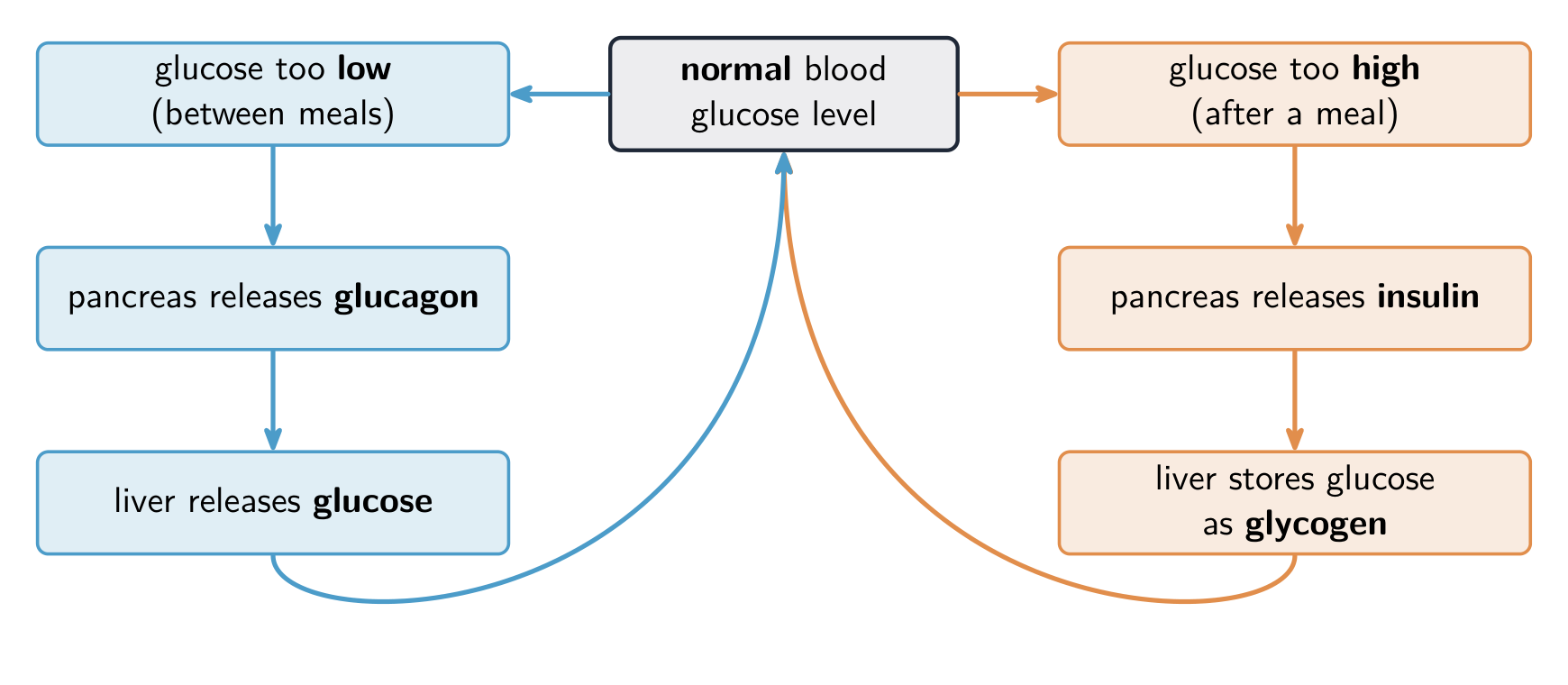
Controlling blood glucose
The liver 肝脏 and the pancreas keep blood glucose steady:
insulin lowers blood glucose after a meal — the liver stores the glucose as glycogen 糖原.
(Supplement) glucagon raises blood glucose between meals — the liver releases glucose.
In Type 1 diabetes 糖尿病 the pancreas cannot make insulin, so blood glucose rises too high. It is treated with insulin injections and a carefully planned diet.
Worked example. Blood glucose rises sharply after a meal, then falls back to normal over the next two hours. Name the organs and the hormone involved, and say what they do. The pancreas detects the rise and releases insulin. Insulin makes the liver take glucose out of the blood and store it as glycogen, so the level falls back to normal. Between meals the opposite loop runs: the pancreas releases glucagon and the liver releases glucose again. Keep the two words apart - insulin is the hormone, glycogen is the store. Swapping them is the classic error.
Controlling body temperature (Supplement)
The brain detects the body temperature 温度 and keeps it steady. The skin helps:
Structure
Role
sweat glands 汗腺
make sweat; as it evaporates it cools the skin (sweating 出汗)
hair erector muscles 立毛肌
raise the hairs to trap a layer of air
blood vessels 血管
change how much blood flows near the skin surface
fatty tissue 脂肪组织
gives insulation 隔热 to reduce heat loss
When you are too hot: you sweat, and the arterioles 小动脉 widen (vasodilation 血管舒张) so more blood flows to the skin capillaries 毛细血管 and loses heat.
When you are too cold: you shiver 颤抖 (the muscles make heat), and the arterioles narrow (vasoconstriction 血管收缩) so less blood reaches the surface, keeping heat in.
Tiếng Việt
Phản hồi âm: glucose máu
Duy trì cân bằng nội môi là giữ cho môi trường bên trong cơ thể ổn định — ví dụ như nhiệt độ ổn định và nồng độ glucose trong máu ổn định.
(Bổ sung) Duy trì cân bằng nội môi hoạt động thông qua phản hồi âm: khi một giá trị lệch khỏi điểm đặt, cơ thể sẽ hành động để đưa nó trở lại. Chính sự thay đổi này kích hoạt quá trình sửa chữa.
Kiểm soát nồng độ glucose trong máu
Gan và tuyến tụy giữ cho nồng độ glucose trong máu ổn định:
insulin làm giảm nồng độ glucose sau bữa ăn — gan lưu trữ glucose dưới dạng glycogen.
(Bổ sung) glucagon làm tăng nồng độ glucose giữa các bữa ăn — gan giải phóng glucose.
Insulin hạ glucose máu và glucagon tăng nó, giữ mức gần bình thường
Trong bệnh tiểu đường loại 1, tuyến tụy không thể sản xuất insulin, khiến nồng độ glucose trong máu tăng quá cao. Bệnh được điều trị bằng tiêm insulin và chế độ ăn uống được lập kế hoạch cẩn thận.
Ví dụ minh họa. Nồng độ glucose trong máu tăng mạnh sau bữa ăn, sau đó giảm về bình thường trong hai giờ tiếp theo. Hãy nêu tên các cơ quan và hormone liên quan, cùng với chức năng của chúng. Tuyến tụy phát hiện sự gia tăng và tiết insulin. Insulin giúp gan lấy glucose ra khỏi máu và lưu trữ nó dưới dạng glycogen, do đó mức độ giảm về bình thường. Giữa các bữa ăn, mạch ngược lại xảy ra: tuyến tụy tiết glucagon và gan lại giải phóng glucose. Phân biệt rõ hai từ - insulin là hormone, glycogen là chất dự trữ. Việc hoán vị chúng là lỗi điển hình.
Kiểm soát nhiệt độ cơ thể (Bổ sung)
Não phát hiện nhiệt độ cơ thể và giữ cho nó ổn định. Da đóng vai trò hỗ trợ:
Cấu trúc
Vai trò
tế bào mồ hôi
tạo mồ hôi; khi bay hơi, nó làm mát da (tiết mồ hôi)
cơ co lông
nâng lông lên để giữ lớp khí
mạch máu
thay đổi lượng máu chảy gần bề mặt da
mỡ
cung cấp sự cách nhiệt để giảm thất thoát nhiệt
Khi bạn quá nóng: bạn tiết mồ hôi, và các arteriole giãn nở (giãn mạch) để nhiều máu chảy đến mao mạch da và mất nhiệt.
Khi bạn quá lạnh: bạn run rẩy (cơ bắp tạo nhiệt), và các arteriole co thắt (co mạch) để ít máu hơn tới bề mặt, giữ nhiệt bên trong.
Phản hồi âm: sự thay đổi lệch khỏi khoảng 37 °C kích hoạt phản ứng đảo ngược lại, đưa cơ thể về trạng thái bình thường.
Explore · Khám phá
Negative feedback · Phản hồi âm
Push body temperature away from its set point and watch negative feedback bring it back to normal. · Đẩy nhiệt độ cơ thể lệch khỏi điểm đặt và quan sát phản hồi âm đưa nó trở về mức bình thường.
1 Describe gravitropism as a response in which parts of a plant grow towards or away from gravity
4 Explain phototropism and gravitropism of a shoot as examples of the chemical control of plant growth
2 Describe phototropism as a response in which parts of a plant grow towards or away from the direction of the light source
5 Explain the role of auxin in controlling shoot growth, limited to: (a) auxin is made in the shoot tip (b) auxin diffuses through the plant from the shoot tip (c) auxin is unequally distributed in response to light and gravity (d) auxin stimulates cell elongation
3 Investigate and describe gravitropism and phototropism in shoots and roots
Tiếng Việt
Cốt lõi
Bổ sung
1 Mô tả hướng đất là phản ứng mà các bộ phận của cây mọc về phía hoặc tránh xa trọng lực
4 Giải thích hướng sáng và hướng đất của thân là ví dụ về sự điều khiển sinh trưởng của thực vật bằng hóa chất
2 Mô tả hướng sáng là phản ứng mà các bộ phận của cây mọc về phía hoặc tránh xa nguồn sáng
5 Giải thích vai trò của auxin trong việc điều khiển sự phát triển của thân, giới hạn ở: (a) auxin được tạo ra ở ngọn thân (b) auxin khuếch tán qua thực vật từ ngọn thân (c) auxin phân bố không đều do ảnh hưởng của ánh sáng và trọng lực (d) auxin kích thích sự kéo dài tế bào
3 Điều tra và mô tả hiện tượng hướng đất và hướng sáng ở thân và rễ
Source: Cambridge International syllabus · Nguồn: Chương trình Cambridge International
English
A tropism 向性 is a plant's growth response to a direction:
gravitropism 向地性 — growth in response to gravity 重力 (roots grow down, shoots grow up).
phototropism 向光性 — growth in response to the direction of light (shoots grow towards the light).
(Supplement) These responses are controlled by a chemical called auxin 生长素:
auxin is made in the shoot 嫩枝 tip.
it diffuses down through the plant.
light or gravity makes the auxin spread unequally to one side.
auxin makes cells elongate 伸长 (grow longer). The side with more auxin grows faster, so the shoot bends.
Tiếng Việt
Hướng tính là phản ứng sinh trưởng của thực vật theo một hướng cụ thể:
hướng trọng lực — sinh trưởng đáp ứng với trọng lực (rễ mọc xuống, thân mọc lên).
hướng sáng — sinh trưởng đáp ứng với hướng của ánh sáng (thân mọc về phía ánh sáng).
(Bổ sung) Các phản ứng này được kiểm soát bởi một chất hóa học gọi là auxin:
auxin được tạo ra ở đầu thân.
nó khuếch tán xuống dọc theo cây.
ánh sáng hoặc trọng lực khiến auxin phân bố không đều sang một bên.
auxin khiến tế bào kéo dài (dài ra). Bên có nhiều auxin hơn sinh trưởng nhanh hơn, nên thân bị cong.
Auxin tích tụ ở phía tối và khiến các tế bào đó dài ra, làm thân cây bẻ cong về phía ánh sáng
Explore · Khám phá
Phototropism — bending to light · Hướng tính về ánh sáng — uốn cong về phía ánh sáng
A shoot grows towards light because a hormone makes one side grow faster than the other. · Cành cây mọc về phía ánh sáng vì hormone khiến một bên mọc nhanh hơn bên kia.
Pick one and the site follows you — notes, papers, videos and practice all open on it. · Chọn một môn và trang sẽ điều hướng theo — ghi chú, tài liệu, video và bài tập đều mở ở đó.
Type to search notes, lessons, code, vocabulary and past-paper questions across every subject. · Nhập để tìm ghi chú, bài học, mã, từ vựng và câu hỏi đề thi cũ trên mọi môn học.