Homeostasis and blood glucose
Introduced| English | Meaning |
|---|---|
| homeostasis/ˌhəʊmiːəˈstɑːsiz/ | Maintaining a relatively stable internal environment despite external or internal changes. |
| internal environment/ɪnˈtɜːnl enˈvaɪrənmənt/ | internal environment |
| negative feedback/ˈneɡətɪv ˈfiːdbæk/ | A control process in which a change triggers responses that oppose that change. |
| set point/set pɔɪnt/ | A reference level that a regulatory system acts to maintain. |
| glucagon/ˈɡluːkæɡən/ | A hormone from pancreatic alpha cells that helps raise blood glucose concentration. |
| diabetes/ˌdaɪəˈbiːtiːz/ | A disorder of blood-glucose regulation involving inadequate insulin production or response, resulting in persistently elevated blood glucose. |
Keeping things steady
- Your body works best when its internal conditions stay within a narrow range.
- Keeping them steady is homeostasis 稳态 — and controlling blood glucose is a perfect example.
Homeostasis is the maintenance of:
Difficulty 1/5 · 100 coins + a small bonus on first completion today
Homeostasis keeps internal conditions steady.
What homeostasis is
- Homeostasis is the maintenance of a constant internal environment 内环境.
- It controls temperature, water, and blood glucose levels.
Homeostasis & blood glucose
insulin ↓ · glucagon ↑
Blood glucose is held near a set point by insulin and glucagon — negative feedback.
Negative feedback brings a level back towards its set point when it strays.
Difficulty 1/5 · 100 coins + a small bonus on first completion today
A rise triggers a lowering response, and vice versa.
Negative feedback 负反馈
- The body uses negative feedback: if a level rises, a response lowers it (and vice versa).
- This keeps the level oscillating gently around a set point 设定点.
When blood glucose is too high, the pancreas releases:
Difficulty 1/5 · 100 coins + a small bonus on first completion today
Insulin lowers blood glucose by storing it.
When blood glucose is too low, the liver is told to release glucose by:
Difficulty 1/5 · 100 coins + a small bonus on first completion today
Glucagon raises blood glucose.
A failure to produce enough insulin causes type 1 ______.
Difficulty 1/5 · 100 coins + a small bonus on first completion today
Type 1 diabetes is treated with insulin injections.
Controlling blood glucose
- After eating, glucose rises → the pancreas releases insulin → glucose stored in the liver → level falls.
- When glucose falls → the pancreas releases glucagon 胰高血糖素 → liver releases glucose → level rises.
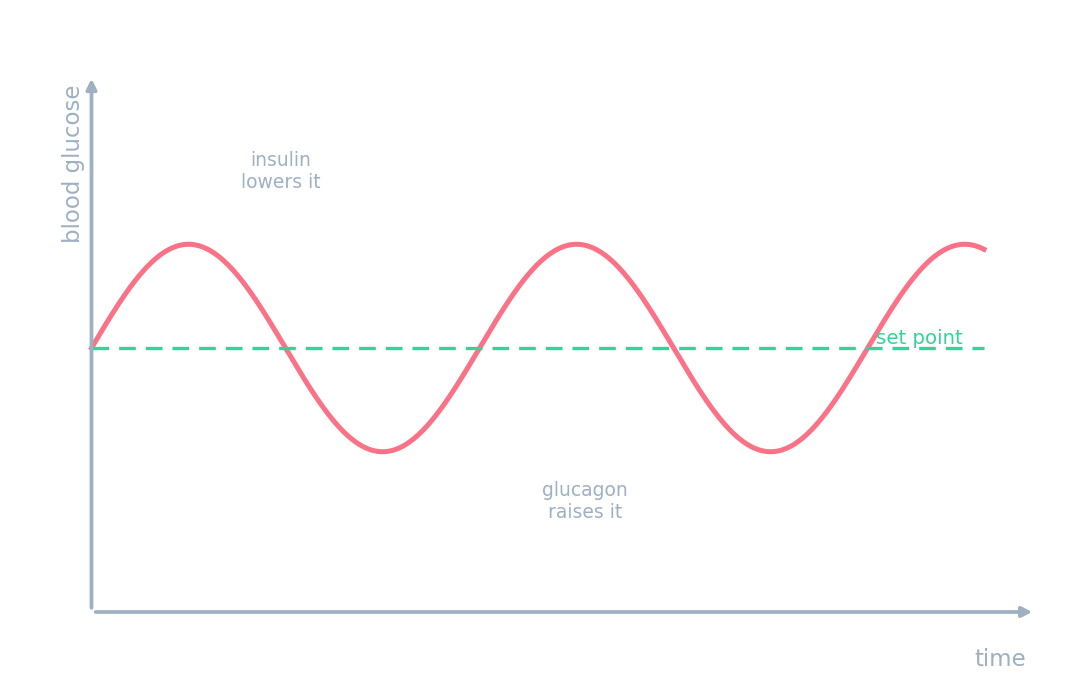
Insulin lowers blood glucose and glucagon raises it, holding the level near a set point.
In type 1 diabetes 糖尿病, the pancreas can't make enough insulin. Without insulin, blood glucose rises dangerously high after eating. It is treated with insulin injections to do the job the pancreas can't.
You've got it
- homeostasis keeps the internal environment constant, using negative feedback
- insulin lowers blood glucose (stores it); glucagon raises it (releases it)
- failure to make insulin causes type 1 diabetes