| Learning Objective | Essential Knowledge |
|---|---|
12.1.A |
|
12.1.B |
|
12.1.C |
|
Magnetic Fields and Electromagnetism · Từ trường và điện từ
AP Physics C: Electricity and Magnetism · AP Vật lý C: Điện từ · Topic 12 · Chủ đề 12
 12:45
12:45
Từ trường và điện từ
Hãy nhìn về phía bắc vào một đêm đông quang đãng, ở độ vĩ đủ xa về phía bắc, bầu trời sẽ phát ra ánh sáng màu xanh lá. Những ánh sáng đó được kích hoạt bởi một từ trường. Mặt Trời phóng ra các hạt mang điện…
English narration · English + 中文 subtitles burned in · Giọng đọc tiếng Anh · phụ đề tiếng Anh + 中文 được ghi trực tiếp
12.1
Magnetic Fields · Từ Trường
Syllabus · Chương trình
Source: College Board AP Course and Exam Description · Nguồn: Mô tả Khóa học và Bài thi College Board AP
English
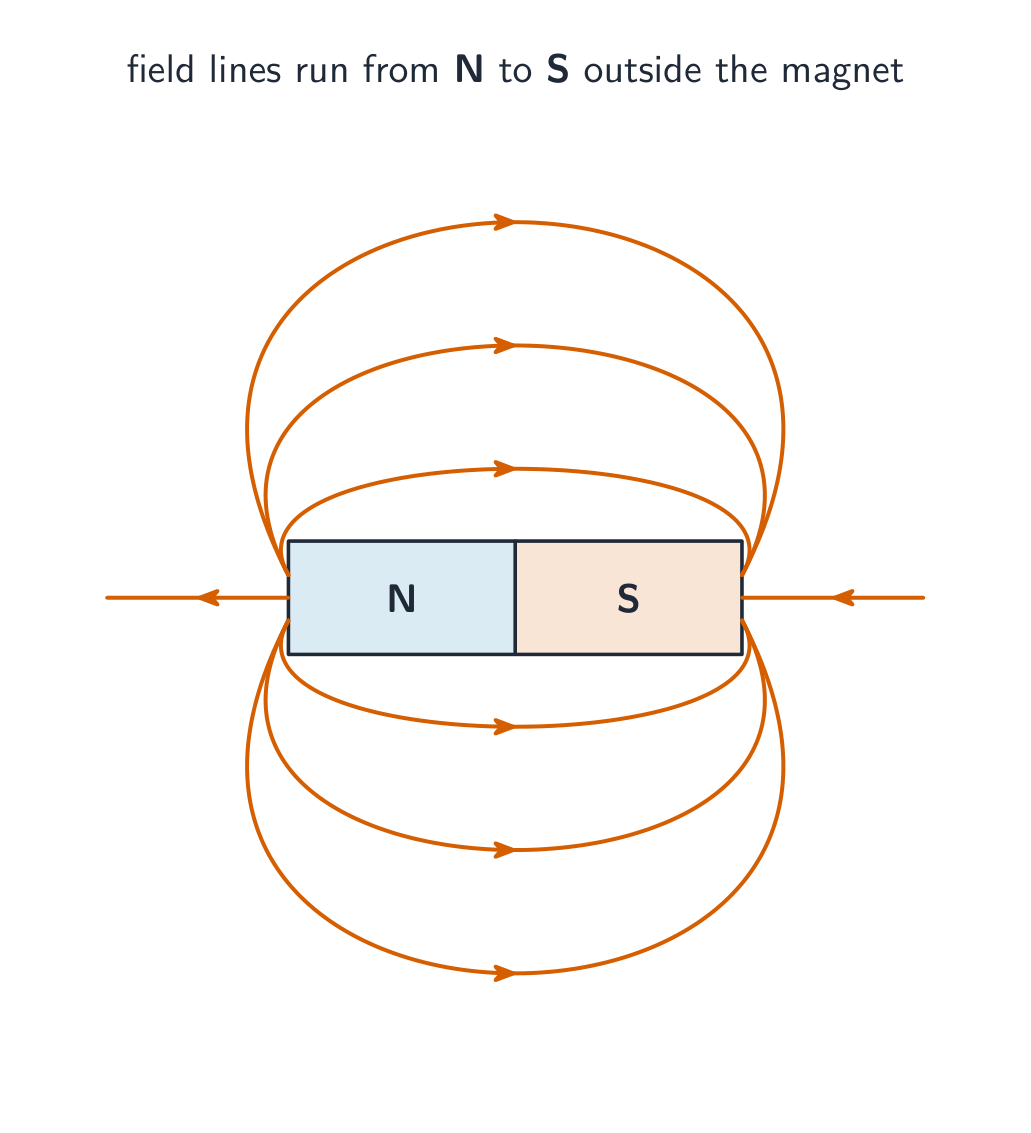
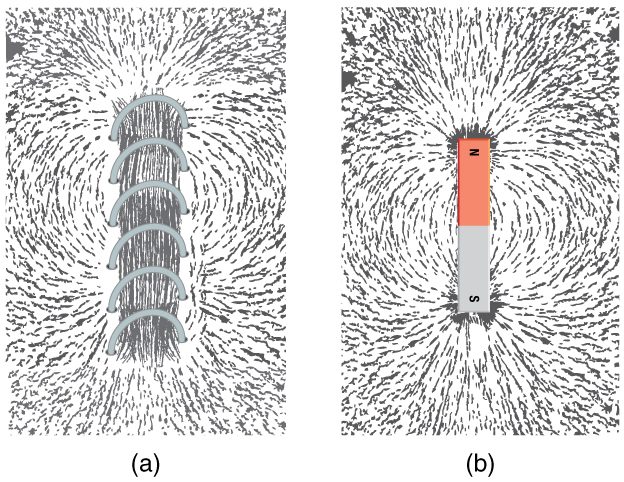
A magnetic field 磁场 $\vec{B}$ is a vector field 矢量场 that surrounds magnets, moving charges, and currents; it determines the magnetic force on any moving charge placed in it. Magnetic field lines 磁感线 must form closed loops: they leave the north pole, return to the south pole, and continue through the magnet. Denser lines mean a stronger field.
Closed loops are the content of Gauss's law for magnetism, the second of Maxwell's equations 麦克斯韦方程组:
$$\oint \vec{B}\cdot d\vec{A}=0.$$
The net magnetic flux through any closed surface is zero – as many field lines leave as enter. That is exactly the statement that isolated magnetic monopoles 磁单极子 do not exist. Every source of magnetism is a magnetic dipole 磁偶极子 (a north–south pair), made by circulating charge – in materials, the motion of electrons. Break a bar magnet in half and you get two smaller dipoles, never a lone pole. Like poles repel, opposite poles attract, and a free dipole – a compass 指南针 – rotates to line up with the local field. Earth's own field is approximately a dipole, which is why a compass works. Dipole fields weaken with distance.
How a material responds to an external field depends on how its internal dipoles behave:
- Ferromagnetic 铁磁性 (iron, nickel, cobalt): an external field aligns whole magnetic domains 磁畴, and the alignment survives after the field is removed – a permanent magnet.
- Paramagnetic 顺磁性 (aluminum, titanium): dipoles align weakly with the field but relax when it is removed.
- Diamagnetic 抗磁性 (all materials): the electronic structure produces a usually weak alignment opposite to the field.
The strength of a material's response is its magnetic permeability 磁导率. Free space has the constant value $\mu_0$ (the vacuum permeability); the permeability of matter differs from $\mu_0$ and is not even constant – it varies with temperature, orientation, and field strength.
Tiếng Việt
Trường từ $\vec{B}$ là một trường vectơ bao quanh nam châm, các điện tích chuyển động và dòng điện; nó xác định lực từ tác dụng lên bất kỳ điện tích chuyển động nào đặt trong đó. Đường sức từ phải tạo thành vòng khép kín: chúng đi ra từ cực Bắc, quay về cực Nam, và tiếp tục đi qua bên trong nam châm. Đường sức càng dày thì trường càng mạnh.
Vòng khép kín là nội dung của định luật Gauss cho từ tính, phương trình thứ hai trong các phương trình Maxwell:
$$\oint \vec{B}\cdot d\vec{A}=0.$$
Từ thông tổng hợp qua bất kỳ mặt đóng nào cũng bằng không – số đường sức đi ra bằng số đường sức đi vào. Điều đó có nghĩa chính xác là các đơn cực từ đơn lẻ không tồn tại. Mọi nguồn từ đều là nam châm đôi (cặp Bắc–Nam), được tạo bởi dòng điện tích tuần hoàn – trong vật liệu, do chuyển động của electron. Nếu phá một nam châm thanh làm đôi, bạn sẽ thu được hai nam châm đôi nhỏ hơn, chứ không bao giờ là một đơn cực riêng lẻ. Cùng cực đẩy nhau, khác cực hút nhau, và một nam châm đôi tự do – một la bàn – sẽ quay để căn chỉnh theo trường cục bộ. Trường của Trái Đất xấp xỉ là một nam châm đôi, đó là lý do la bàn hoạt động. Trường nam châm đôi yếu dần theo khoảng cách.
Cách một vật liệu phản ứng với trường bên ngoài phụ thuộc vào hành vi của các nam châm đôi bên trong nó:
- Sắt từ (sắt, niken, coban): một trường bên ngoài căn chỉnh toàn bộ các vùng từ hóa, và sự căn chỉnh này duy trì sau khi bỏ trường – tạo thành nam châm vĩnh cửu.
- Thuận từ (nhôm, titan): các nam châm đôi căn chỉnh yếu với trường nhưng giãn nở khi bỏ trường đi.
- Nghịch từ (tất cả vật liệu): cấu trúc điện tử tạo ra sự căn chỉnh thường yếu ngược chiều với trường.
Cường độ phản ứng của vật liệu là độ từ thẩm. Không gian tự do có giá trị hằng số $\mu_0$ (độ từ thẩm chân không); độ từ thẩm của vật chất khác với $\mu_0$ và thậm chí không phải hằng số – nó thay đổi theo nhiệt độ, hướng và cường độ trường.

Explore · Khám phá
See a magnet's field lines · Quan sát các đường sức từ của nam châm
Magnetic field lines run from north to south outside a magnet; where they crowd together the field is strongest. · Các đường từ trường chạy từ cực Bắc sang Nam bên ngoài nam châm; nơi chúng dày đặc thì từ trường mạnh nhất.
12.2
Magnetism and Moving Charges · Từ Tính và Điện Tích Chuyển Động
Syllabus · Chương trình
English
Learning Objective 12.2.A: Describe the magnetic field produced by moving charged objects.
- 12.2.A.1 A single moving charged object produces a magnetic field.
- 12.2.A.1.i The magnetic field at a particular point produced by a moving charged object depends on the object's velocity and the distance between the point and the object.
- 12.2.A.1.ii At a point in space, the direction of the magnetic field produced by a moving charged object is perpendicular to both the velocity of the object and the position vector from the object to that point in space and can be determined using the right-hand rule.
- 12.2.A.1.iii The magnitude of the magnetic field is a maximum when the velocity vector and the position vector from the object to that point in space are perpendicular.
Learning Objective 12.2.B: Describe the force exerted on moving charged objects by a magnetic field.
- 12.2.B.1 A magnetic field will exert a force on a charged object moving within that field, with magnitude and direction that depend on the cross-product of the charge's velocity and the magnetic field.
- Equation: $\vec{F}_B = q\left(\vec{v} \times \vec{B}\right)$
- 12.2.B.2 In a region containing both a magnetic field and an electric field, a moving charged object will experience independent forces from each field.
- 12.2.B.3 The Hall effect describes the potential difference created in a conductor by an external magnetic field that has a component perpendicular to the direction of charges moving in the conductor.
Tiếng Việt
Mục tiêu học tập 12.2.A: Mô tả từ trường sinh ra bởi các vật mang điện chuyển động.
- 12.2.A.1 Một vật mang điện đơn lẻ khi chuyển động sẽ sinh ra từ trường.
- 12.2.A.1.i Từ trường tại một điểm cụ thể sinh ra bởi vật mang điện chuyển động phụ thuộc vào vận tốc của vật và khoảng cách giữa điểm đó và vật.
- 12.2.A.1.ii Tại một điểm trong không gian, phương của từ trường sinh ra bởi vật mang điện chuyển động vuông góc với cả vận tốc của vật và vectơ vị trí từ vật đến điểm đó trong không gian; có thể xác định bằng quy tắc bàn tay phải.
- 12.2.A.1.iii Độ lớn của từ trường đạt cực đại khi vectơ vận tốc và vectơ vị trí từ vật đến điểm đó trong không gian vuông góc với nhau.
Mục tiêu học tập 12.2.B: Mô tả lực tác dụng lên các vật mang điện chuyển động bởi từ trường.
- 12.2.B.1 Một từ trường sẽ tác dụng lực lên một vật mang điện chuyển động trong từ trường đó, với độ lớn và phương phụ thuộc vào tích có hướng giữa vận tốc của điện tích và từ trường.
- Phương trình: $\vec{F}_B = q\left(\vec{v} \times \vec{B}\right)$
- 12.2.B.2 Trong vùng chứa cả từ trường và điện trường, một vật mang điện chuyển động sẽ chịu tác dụng của các lực độc lập từ mỗi trường.
- 12.2.B.3 Hiệu ứng Hall mô tả hiệu điện thế sinh ra trong một vật dẫn khi có từ trường ngoài có thành phần vuông góc với phương chuyển động của các điện tích trong vật dẫn.
Source: College Board AP Course and Exam Description · Nguồn: Mô tả Khóa học và Bài thi College Board AP
English
A moving charge does two things: it creates a magnetic field, and it feels a force in an external one. The field it creates at a point is perpendicular 垂直 to both its velocity and the position vector from charge to point (right-hand rule again), and is largest where those two are perpendicular – zero directly ahead of or behind the motion.
The force on a charge moving in a field $\vec{B}$ is the cross product
$$\vec{F}_B=q\,\vec{v}\times\vec{B},\qquad F=qvB\sin\theta,$$
perpendicular to both $\vec{v}$ and $\vec{B}$ – point the fingers of your right hand along $\vec{v}$, curl toward $\vec{B}$, and the thumb gives the force on a positive charge (reverse it for negative). Because $\vec{F}_B\perp\vec{v}$, the magnetic force does no work on the charge: it changes direction, never speed.
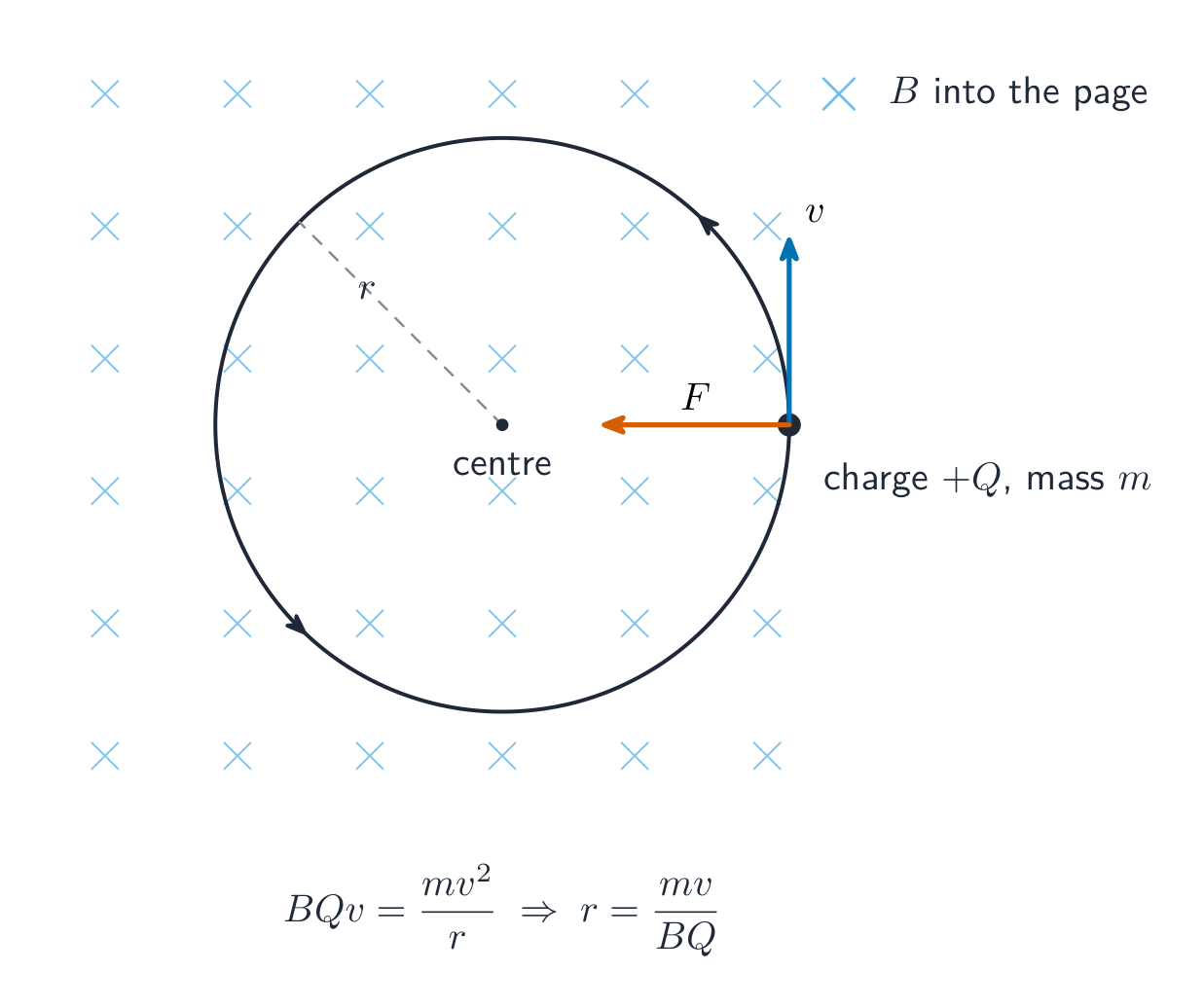
A charge moving perpendicular to a uniform field therefore travels in a circle, the magnetic force supplying the centripetal force 向心力:
$$qvB=\frac{mv^2}{r}\quad\Rightarrow\quad r=\frac{mv}{qB},\qquad T=\frac{2\pi m}{qB}.$$
Notice the period $T$ does not depend on the speed – faster particles ride larger circles in the same time.
Worked example. A proton ($q=1.6\times10^{-19}\ \text{C}$, $m=1.67\times10^{-27}\ \text{kg}$) enters a $0.50\ \text{T}$ field at $2.0\times10^{5}\ \text{m/s}$, perpendicular to it. The magnetic force $F=qvB=1.6\times10^{-14}\ \text{N}$ bends it into a circle of radius $r=\dfrac{mv}{qB}=\dfrac{1.67\times10^{-27}(2.0\times10^{5})}{1.6\times10^{-19}(0.50)}=4.2\times10^{-3}\ \text{m}$.
In a region with both an electric and a magnetic field, the two forces act independently and add as vectors. Balancing them makes a velocity selector 速度选择器: with $\vec{E}$ and $\vec{B}$ crossed, only charges with $qE=qvB$, i.e. $v=E/B$, pass straight through. The Hall effect 霍尔效应 is the same physics inside a conductor: a field with a component perpendicular to the current pushes the moving carriers sideways, charge builds up on one face, and a measurable potential difference appears across the conductor – its sign reveals whether the carriers are positive or negative.
Tiếng Việt
Một điện tích chuyển động thực hiện hai việc: nó tạo ra một trường từ, và nó cảm thấy một lực trong trường bên ngoài. Trường mà nó tạo ra tại một điểm là vuông góc với cả vận tốc và vectơ vị trí từ điện tích đến điểm đó (lại áp dụng quy tắc bàn tay phải), và đạt cực đại nơi hai vectơ này vuông góc – bằng không ngay phía trước hoặc phía sau hướng chuyển động.
Lực tác dụng lên một điện tích chuyển động trong trường $\vec{B}$ là tích có hướng
$$\vec{F}_B=q\,\vec{v}\times\vec{B},\qquad F=qvB\sin\theta,$$
vuông góc với cả $\vec{v}$ và $\vec{B}$ – chỉ các ngón tay phải dọc theo $\vec{v}$, cuộn về phía $\vec{B}$, và ngón cái sẽ chỉ ra lực tác dụng lên điện tích dương (đảo ngược cho điện tích âm). Vì $\vec{F}_B\perp\vec{v}$, lực từ không thực hiện công lên điện tích: nó chỉ thay đổi hướng, không thay đổi tốc độ.
Một điện tích chuyển động vuông góc với trường đều do đó di chuyển theo quỹ đạo tròn, lực từ cung cấp lực hướng tâm:
$$qvB=\frac{mv^2}{r}\quad\Rightarrow\quad r=\frac{mv}{qB},\qquad T=\frac{2\pi m}{qB}.$$
Lưu ý chu kỳ $T$ không phụ thuộc vào tốc độ – các hạt nhanh hơn di chuyển trên đường tròn lớn hơn nhưng mất cùng một khoảng thời gian.
Ví dụ minh họa. Một proton ($q=1.6\times10^{-19}\ \text{C}$, $m=1.67\times10^{-27}\ \text{kg}$) đi vào $0.50\ \text{T}$ field ở $2.0\times10^{5}\ \text{m/s}$, vuông góc với nó. Lực từ $F=qvB=1.6\times10^{-14}\ \text{N}$ bẻ cong quỹ đạo thành một đường tròn có bán kính $r=\dfrac{mv}{qB}=\dfrac{1.67\times10^{-27}(2.0\times10^{5})}{1.6\times10^{-19}(0.50)}=4.2\times10^{-3}\ \text{m}$.
Trong vùng có cả điện trường và từ trường, hai lực này tác động độc lập và cộng lại như các vectơ. Cân bằng chúng tạo thành bộ chọn lọc vận tốc: với $\vec{E}$ và $\vec{B}$ vuông góc, chỉ những điện tích có $qE=qvB$, tức là $v=E/B$, mới đi thẳng qua. Hiệu ứng Hall là cùng vật lý đó xảy ra bên trong vật dẫn: một trường có thành phần vuông góc với dòng điện đẩy các hạt tải điện lệch sang ngang, điện tích tích tụ trên một mặt, và xuất hiện hiệu điện thế đo được across vật dẫn – dấu của hiệu điện thế này tiết lộ xem hạt tải điện là dương hay âm.
Explore · Khám phá
Force on a moving charge · Lực tác dụng lên điện tích chuyển động
A charge moving through a magnetic field feels a force $F=qvB$ at right angles to both its velocity and the field — the basis of the motor effect. Reverse either and the force flips. · Điện tích chuyển động trong từ trường chịu một lực $F=qvB$ vuông góc với cả vận tốc lẫn từ trường — đây là cơ sở của hiệu ứng động cơ. Đảo ngược bất kỳ đại lượng nào thì lực đảo chiều.
12.3
Magnetic Fields of Current-Carrying Wires · Từ trường của dây dẫn có dòng điện
Syllabus · Chương trình
English
Learning Objective 12.3.A: Describe the magnetic field produced by a current-carrying wire.
- 12.3.A.1 The Biot-Savart law defines the magnitude and direction of a magnetic field created by an electrical current.
- Equation: $d\vec{B} = \dfrac{\mu_0}{4\pi} \dfrac{I(d\vec{\ell} \times \hat{r})}{r^2}$
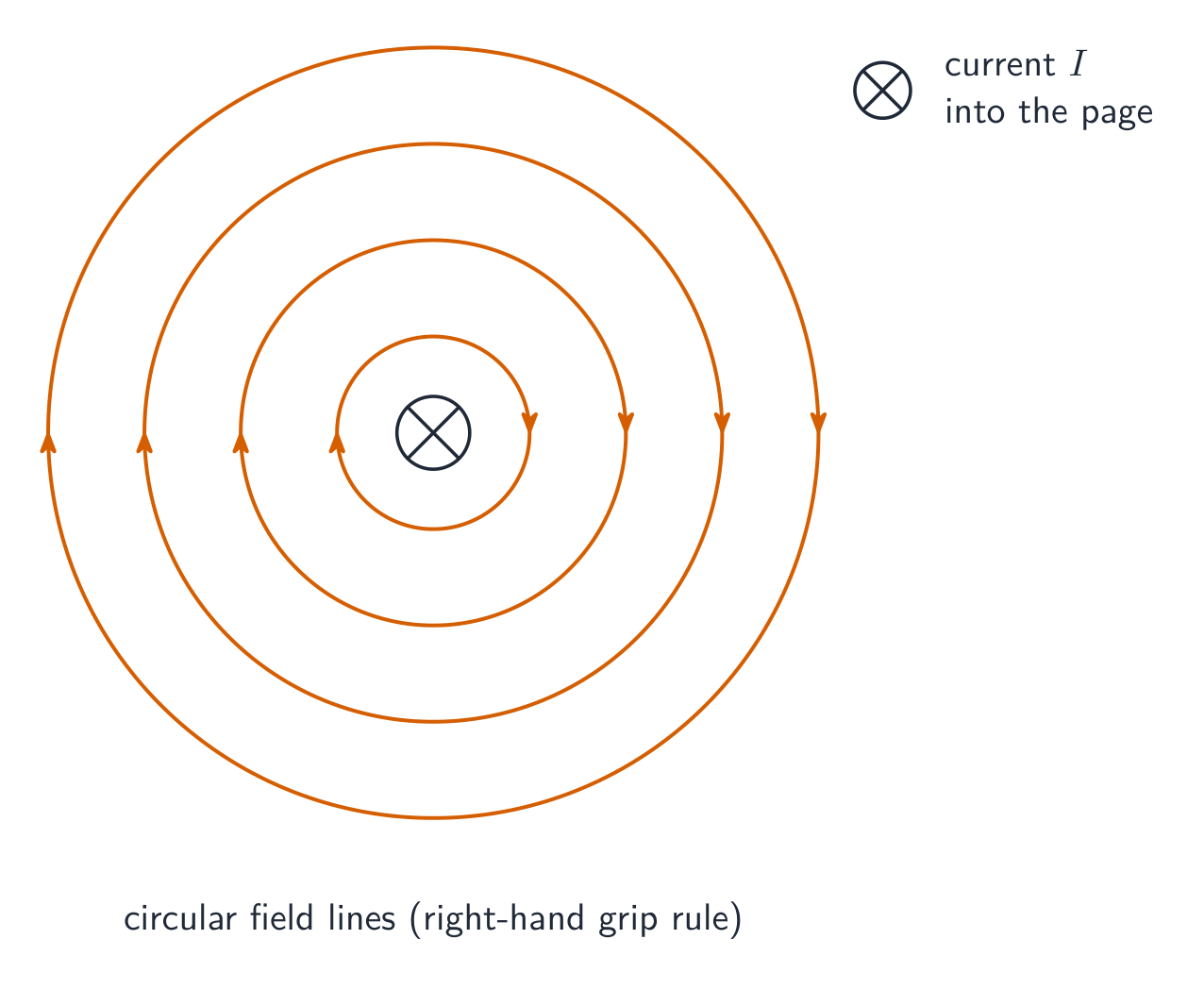
- 12.3.A.2 The magnetic field vectors around a small segment of a current-carrying wire are tangent to concentric circles centered on that wire. The field has no component toward, away from, or parallel to the segment of the current-carrying wire.
- 12.3.A.3 The Biot-Savart law can be used to derive the magnitudes and directions of magnetic fields around segments of current-carrying wires, for example at the center of a circular loop of wire.
- Equation: $B_{\text{center of loop}} = \dfrac{\mu_0 I}{2R}$
Learning Objective 12.3.B: Describe the force exerted on current-carrying wires by a magnetic field.
- 12.3.B.1 A magnetic field will exert a force on a current-carrying wire.
- Equation: $\vec{F}_B = \int I\left(d\vec{\ell} \times \vec{B}\right)$
Boundary statement: AP Physics C: Electricity & Magnetism only expects students to perform quantitative analysis of certain cases of current-carrying conductors using the Biot-Savart law, such as at a location along the perpendicular bisector of a straight conductor, at a location along the central axis of a circular loop, or at the center of a segment of a circular loop.
Tiếng Việt
Mục tiêu học tập 12.3.A: Mô tả từ trường sinh ra bởi dây dẫn mang điện.
- 12.3.A.1 Định luật Biot-Savart xác định độ lớn và phương của từ trường do dòng điện tạo ra.
- Phương trình: $d\vec{B} = \dfrac{\mu_0}{4\pi} \dfrac{I(d\vec{\ell} \times \hat{r})}{r^2}$
- 12.3.A.2 Các vectơ từ trường xung quanh một đoạn nhỏ của dây dẫn mang dòng điện tiếp xúc với các đường tròn đồng tâm tâm tại dây dẫn đó. Từ trường không có thành phần hướng vào, ra xa hay song song với đoạn dây dẫn mang dòng điện.
- 12.3.A.3 Định luật Biot-Savart có thể được sử dụng để suy diễn độ lớn và phương của từ trường xung quanh các đoạn dây dẫn mang dòng điện, ví dụ như tại tâm của một vòng tròn dây dẫn.
- Phương trình: $B_{\text{center of loop}} = \dfrac{\mu_0 I}{2R}$
Mục tiêu học tập 12.3.B: Mô tả lực tác dụng lên các dây dẫn mang dòng điện bởi từ trường.
- 12.3.B.1 Một từ trường sẽ tác dụng lực lên một dây dẫn mang dòng điện.
- Phương trình: $\vec{F}_B = \int I\left(d\vec{\ell} \times \vec{B}\right)$
Tuyên bố giới hạn: AP Physics C: Điện & Từ chỉ yêu cầu học sinh thực hiện phân tích định lượng cho một số trường hợp cụ thể của vật dẫn mang dòng điện bằng định luật Biot-Savart, chẳng hạn như tại vị trí trên đường trung trực của một dây dẫn thẳng, tại vị trí trên trục trung tâm của một vòng tròn, hoặc tại tâm của một đoạn vòng tròn.
Source: College Board AP Course and Exam Description · Nguồn: Mô tả Khóa học và Bài thi College Board AP
English
A current is a stream of moving charges, so it creates a magnetic field. The Biot–Savart law 毕奥-萨伐尔定律 adds up the field of each current element:
$$d\vec{B}=\frac{\mu_0}{4\pi}\frac{I\,d\vec{l}\times\hat{r}}{r^2}.$$
Around any straight segment the field vectors are tangent 相切 to concentric circles 同心圆 centred on the wire – no component toward, away from, or along the wire. Curl your right hand around the wire with the thumb along the current: your fingers give the field direction.
The Biot–Savart integrals AP expects: a long straight wire ($B=\dfrac{\mu_0 I}{2\pi r}$, or a point on the perpendicular bisector of a finite wire), and the centre of a circular loop,
$$B_{\text{centre of loop}}=\frac{\mu_0 I}{2R},$$
where every element $d\vec{l}$ is perpendicular to $\hat{r}$ and equally distant $R$ – say that in an FRQ derivation. An arc that is a fraction of a full circle contributes that same fraction of $\mu_0 I/2R$ at its centre.
A field also pushes on a current-carrying wire, element by element:
$$\vec{F}_B=\int I\,d\vec{l}\times\vec{B}\qquad(\vec{F}=I\vec{L}\times\vec{B}\ \text{for a straight wire in a uniform field}).$$
Worked example. Two long parallel wires a distance $d=0.10\ \text{m}$ apart each carry $5.0\ \text{A}$ in the same direction. Wire 1's field at wire 2 is $B=\dfrac{\mu_0 I}{2\pi d}=1.0\times10^{-5}\ \text{T}$, so wire 2 feels $\dfrac{F}{L}=I B=5.0\times10^{-5}\ \text{N/m}$, pulled toward wire 1. Same-direction currents attract; opposite currents repel.
Tiếng Việt
Dòng điện là dòng các điện tích chuyển động, nên nó tạo ra từ trường. Định luật Biot–Savart cộng gộp trường của mỗi phần tử dòng điện:
$$d\vec{B}=\frac{\mu_0}{4\pi}\frac{I\,d\vec{l}\times\hat{r}}{r^2}.$$
Xung quanh bất kỳ đoạn thẳng nào, các vectơ trường là tiếp tuyến với các vòng tròn đồng tâm tâm tại dây dẫn – không có thành phần hướng vào, ra hoặc dọc theo dây. Cuộn bàn tay phải quanh dây dẫn với ngón cái dọc theo chiều dòng điện: các ngón tay sẽ chỉ ra hướng của trường.
Các tích phân Biot–Savart mà đề AP yêu cầu: một dây dẫn thẳng dài ($B=\dfrac{\mu_0 I}{2\pi r}$, hoặc một điểm trên đường trung trực của dây hữu hạn), và tâm của vòng tròn,
$$B_{\text{centre of loop}}=\frac{\mu_0 I}{2R},$$
nơi mỗi phần tử $d\vec{l}$ vuông góc với $\hat{r}$ và cách đều $R$ – hãy nói rõ điều này trong bài giải FRQ. Một cung tròn chiếm một phân số của vòng tròn đầy đủ sẽ đóng góp đúng phân số đó của $\mu_0 I/2R$ tại tâm của nó.
Trường từ cũng tác dụng lực lên dây dẫn có dòng điện, từng phần tử một:
$$\vec{F}_B=\int I\,d\vec{l}\times\vec{B}\qquad(\vec{F}=I\vec{L}\times\vec{B}\ \text{for a straight wire in a uniform field}).$$
Ví dụ minh họa. Hai dây dẫn song song dài cách nhau $d=0.10\ \text{m}$, mỗi dây mang $5.0\ \text{A}$ theo cùng chiều. Trường từ của dây 1 tại dây 2 là $B=\dfrac{\mu_0 I}{2\pi d}=1.0\times10^{-5}\ \text{T}$, do đó dây 2 cảm thấy $\dfrac{F}{L}=I B=5.0\times10^{-5}\ \text{N/m}$, bị kéo về phía dây 1. Dòng điện cùng chiều thì hút nhau; dòng điện ngược chiều thì đẩy nhau.
Vocabulary · Từ vựng
Train · Luyện tập
| English | Tiếng Việt |
|---|---|
| magnetic field/mæɡˈnetɪk fiːld/ | từ trường |
| vector field/ˈvektə fiːld/ | Trường vector |
| magnetic field lines/mæɡˈnetɪk fiːld laɪnz/ | Đường sức từ |
| Maxwell's equations/ˈmækswelz ɪˈkweɪʒnz/ | Phương trình Maxwell |
| magnetic monopoles/mæɡˈnetɪk ˈmɒnəʊpəʊlz/ | Đơn cực từ |
| magnetic dipole/mæɡˈnetɪk ˈdaɪpəʊl/ | Hai cực từ |
| compass/ˈkʌmpəs/ | la bàn |
| Ferromagnetic/ˌferəməɡˈnetɪk/ | Sắt từ |
| magnetic domains/mæɡˈnetɪk dəˈmeɪnz/ | Miền từ |
| Paramagnetic/ˌpærəməɡˈnetɪk/ | Từ tính |
| Diamagnetic/ˌdaɪəməɡˈnetɪk/ | Chống từ |
| magnetic permeability/mæɡˈnetɪk ˌpɜːməˈbɪlɪti/ | Độ từ thẩm |
| perpendicular/ˌpɜːpənˈdɪkjʊlə/ | vuông góc |
| centripetal force/senˈtrɪpɪtl fɔːs/ | lực lượng hướng tâm |
| velocity selector/vəˈlɒsɪti sɪˈlektə/ | bộ chọn vận tốc |
| Hall effect/hɔːl ɪˈfekt/ | hiệu ứng Hall |
| Biot–Savart law/ˈbɪɒt ˈsævɑːt lɔː/ | định定律 Biot–Savart |
| tangent/ˈtændʒənt/ | tiếp tuyến |
| concentric circles/kənˈsentrɪk ˈsɜːklz/ | Vòng tròn đồng tâm |
| Ampère's law/ˈæmpeəz lɔː/ | Định luật Ampère |
| Amperian loop/æmˈpɪərɪən luːp/ | vòng Amperian |
| current density/ˈkʌrənt ˈdensɪti/ | Mật độ dòng điện |
| solenoid/ˈsəʊlənɔɪd/ | solenoid |
12.4
Ampère's Law · Định luật Ampère
Syllabus · Chương trình
English
Learning Objective 12.4.A: Use Ampère's law to describe the magnetic field created by a moving charge carrier.
- 12.4.A.1 Ampère's law relates the magnitude of the magnetic field to the current enclosed by a closed imaginary path called an Amperian loop.
- Equation: $\oint \vec{B} \cdot d\vec{\ell} = \mu_0 I_{\text{enc}}$
- 12.4.A.1.i Ampère's law can be used to determine the magnetic field near a long, straight current-carrying wire.
- Equation: $B_{\text{wire}} = \dfrac{\mu_0}{2\pi} \dfrac{I}{r}$
- 12.4.A.1.ii Unless otherwise stated, all solenoids are assumed to be very long, with uniform magnetic fields inside the solenoids and negligible magnetic fields outside the solenoids.
- 12.4.A.1.iii Ampère's law can be used to determine the magnetic field inside of a long solenoid.
- Equation: $B_{\text{sol}} = \mu_0 n I$
- 12.4.A.2 An Amperian loop is a closed path around a current-carrying conductor.
- 12.4.A.3 The principle of superposition can be used to determine the net magnetic field at a point in space created by various combinations of current-carrying conductors, or conducting loops, segments, or cylinders.
- 12.4.A.4 Maxwell's equations are the collection of equations that fully describe electromagnetism. Maxwell's fourth equation is Ampère's law with Maxwell's addition; it states that magnetic fields can be generated by electric current (Ampère's law) and that a changing electric field creates a magnetic field, similar to the way a moving charge creates a magnetic field (Maxwell's addition).
- Equation: $\oint \vec{B} \cdot d\vec{\ell} = \mu_0 I + \mu_0 \varepsilon_0 \dfrac{d\Phi_E}{dt}$
Boundary statement: AP Physics C: Electricity & Magnetism only expects quantitative application of Ampère's law limited to situations involving symmetrical magnetic fields. Long straight wires, long solenoids carrying currents, as well as conductive slabs or cylindrical conductors carrying a current density, are the types of shapes to which Ampère's law will be applied on the AP Physics C: Electricity & Magnetism Exam.
Boundary statement: AP Physics C: Electricity & Magnetism does not expect students to use Maxwell's fourth equation with a changing electric field. However, students should understand that a changing electric field generates a magnetic field.
Tiếng Việt
Mục tiêu học tập 12.4.A: Sử dụng định luật Ampère để mô tả từ trường do một hạt tải điện chuyển động tạo ra.
- 12.4.A.1 Định luật Ampere liên hệ độ lớn của từ trường với dòng điện bị bao quanh bởi một đường kín giả tưởng gọi là vòng Ampe.
- Phương trình: $\oint \vec{B} \cdot d\vec{\ell} = \mu_0 I_{\text{enc}}$
- 12.4.A.1.i Định luật Ampère có thể được sử dụng để xác định từ trường gần một dây dẫn dài, thẳng mang dòng điện.
- Phương trình: $B_{\text{wire}} = \dfrac{\mu_0}{2\pi} \dfrac{I}{r}$
- 12.4.A.1.ii Trừ khi có quy định khác, tất cả các cuộn dây solenoid đều được giả định là rất dài, với từ trường đều bên trong và từ trường bên ngoài có thể bỏ qua.
- 12.4.A.1.iii Định luật Ampère có thể được sử dụng để xác định từ trường bên trong một cuộn dây solenoid dài.
- Phương trình: $B_{\text{sol}} = \mu_0 n I$
- 12.4.A.2 Vòng Ampe là một đường kín bao quanh một dây dẫn mang dòng điện.
- 12.4.A.3 Nguyên lý chồng chập có thể được sử dụng để xác định từ trường tổng hợp tại một điểm trong không gian tạo ra bởi sự kết hợp của nhiều vật dẫn mang dòng điện, hoặc các vòng dẫn, đoạn dẫn, hoặc trụ dẫn.
- 12.4.A.4 Các phương trình Maxwell là tập hợp các phương trình mô tả đầy đủ về điện từ học. Phương trình thứ tư của Maxwell là định luật Ampère với bổ sung của Maxwell; nó phát biểu rằng từ trường có thể được tạo ra bởi dòng điện (định luật Ampère) và rằng một điện trường biến thiên tạo ra từ trường, tương tự như cách một điện tích chuyển động tạo ra từ trường (bổ sung của Maxwell).
- Phương trình: $\oint \vec{B} \cdot d\vec{\ell} = \mu_0 I + \mu_0 \varepsilon_0 \dfrac{d\Phi_E}{dt}$
Tuyên bố giới hạn: AP Physics C: Điện & Từ chỉ yêu cầu áp dụng định lượng định luật Ampère giới hạn trong các tình huống có từ trường đối xứng. Dây dẫn thẳng dài, cuộn dây solenoid dài mang dòng điện, cũng như các tấm dẫn hoặc trụ dẫn mang mật độ dòng điện là các loại hình dạng mà định luật Ampère sẽ được áp dụng trong kỳ thi AP Physics C: Điện & Từ.
Tuyên bố giới hạn: AP Physics C: Điện & Từ không yêu cầu học sinh sử dụng phương trình thứ tư của Maxwell với điện trường biến thiên. Tuy nhiên, học sinh cần hiểu rằng một điện trường biến thiên sinh ra từ trường.
Source: College Board AP Course and Exam Description · Nguồn: Mô tả Khóa học và Bài thi College Board AP
English
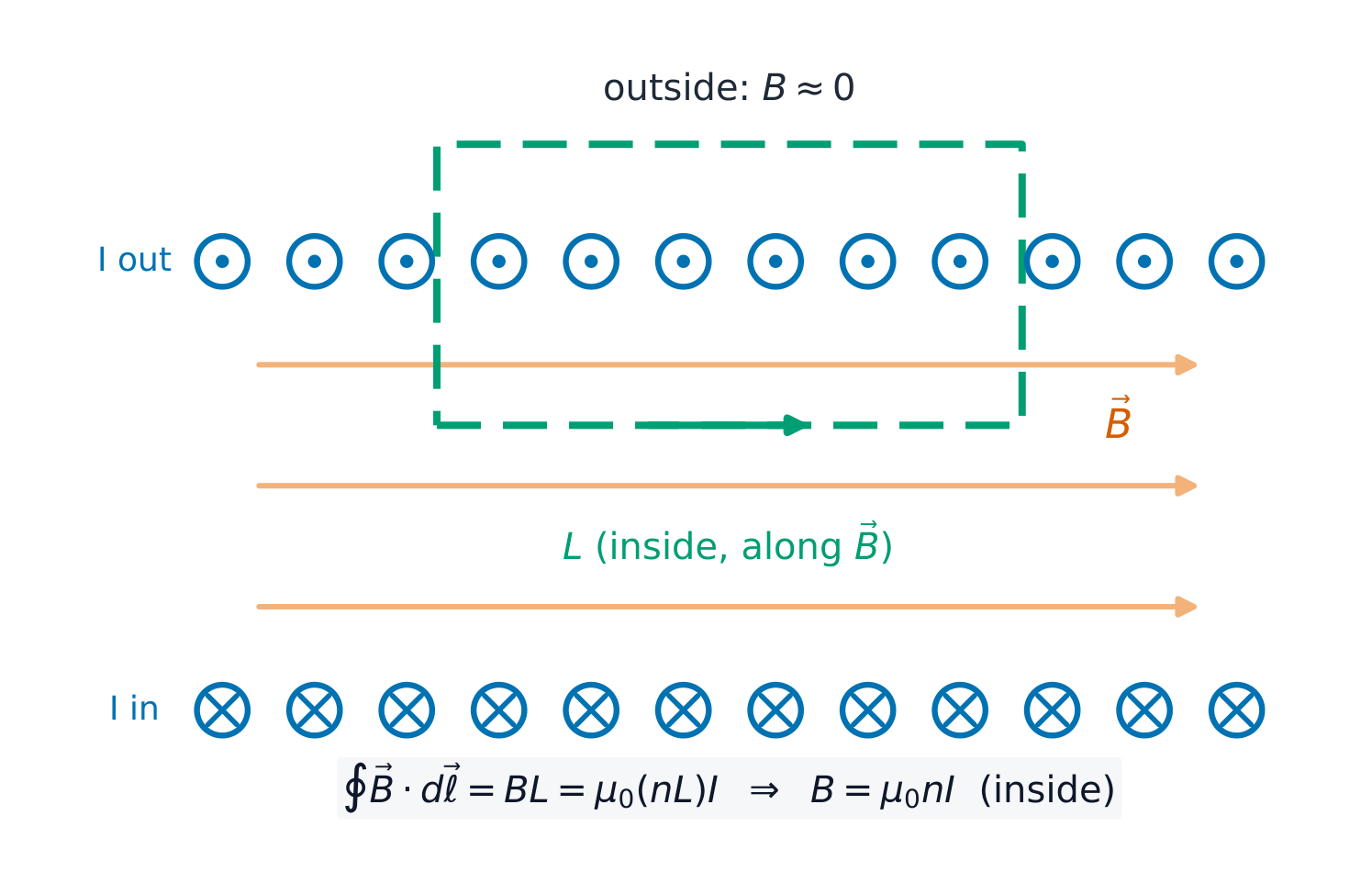
For symmetric current distributions, Ampère's law 安培定律 finds the field far faster than Biot–Savart:
$$\oint \vec{B}\cdot d\vec{l}=\mu_0 I_{\text{enc}}.$$
Choose an Amperian loop 安培环路 that matches the symmetry, so that $B$ is constant along the loop (and parallel to it) and comes out of the integral. AP applies it to long straight wires, long solenoids, and conductors carrying a current density 电流密度 (slabs and cylinders); combinations are handled by superposition 叠加.
Worked example. Find the field $0.10\ \text{m}$ from a long wire carrying $5.0\ \text{A}$. A circular loop of radius $r$ shares the field's symmetry, so $B(2\pi r)=\mu_0 I$ and
$$B=\frac{\mu_0 I}{2\pi r}=\frac{(4\pi\times10^{-7})(5.0)}{2\pi(0.10)}=1.0\times10^{-5}\ \text{T}.$$
A long solenoid 螺线管 (assumed: uniform field inside, negligible field outside) is the other classic. Take a rectangular loop with one side of length $L$ inside, parallel to the axis: only that side contributes to the integral, so $BL=\mu_0 (nL) I$ and
$$B_{\text{sol}}=\mu_0 n I,$$
with $n$ the turns per metre.
Worked example (cylinder). A solid cylindrical conductor of radius $R$ carries current $I$ spread uniformly over its cross-section. Inside ($r
Exam skill. Every Ampère's-law answer earns its marks in the setup: name the loop, state why $B$ is constant and parallel to it (symmetry), and count $I_{\text{enc}}$ carefully before you solve. Maxwell's fourth equation adds one more idea you should know qualitatively: a changing electric field also creates a magnetic field – but AP will not ask you to compute with that term.
Tiếng Việt
Đối với các phân bố dòng điện đối xứng, định luật Ampère tìm ra trường từ nhanh hơn nhiều so với Biot–Savart:
$$\oint \vec{B}\cdot d\vec{l}=\mu_0 I_{\text{enc}}.$$
Chọn một vòng Amperian phù hợp với tính đối xứng, sao cho $B$ là hằng số dọc theo vòng (và song song với nó) và có thể đưa ra ngoài dấu tích phân. AP áp dụng điều này cho các dây dẫn thẳng dài, cuộn dây solenoid dài và vật dẫn mang mật độ dòng điện (tấm phẳng và trụ); các trường hợp tổ hợp được xử lý bằng nguyên lý superposition.
Ví dụ minh họa. Tìm từ trường $0.10\ \text{m}$ tạo bởi một dây dẫn dài mang $5.0\ \text{A}$. Một vòng tròn bán kính $r$ chia sẻ tính đối xứng của từ trường, do đó $B(2\pi r)=\mu_0 I$ và
$$B=\frac{\mu_0 I}{2\pi r}=\frac{(4\pi\times10^{-7})(5.0)}{2\pi(0.10)}=1.0\times10^{-5}\ \text{T}.$$
Một cuộn dây solenoid dài (giả sử: từ trường đều bên trong, từ trường bên ngoài bỏ qua) là trường hợp cổ điển khác. Lấy một vòng chữ nhật có một cạnh dài $L$ nằm bên trong, song song với trục: chỉ cạnh đó đóng góp vào tích phân, nên $BL=\mu_0 (nL) I$ và
$$B_{\text{sol}}=\mu_0 n I,$$
với $n$ là số vòng quay trên mét.
Ví dụ minh họa (trụ). Một vật dẫn dạng trụ đặc bán kính $R$ mang dòng điện $I$ phân bố đều trên tiết diện. Bên trong ($r
Kỹ năng làm bài thi. Mọi câu trả lời định luật Ampère đều kiếm được điểm ở phần thiết lập: đặt tên vòng Ampe, nêu lý do vì sao $B$ là hằng số và song song với nó (do đối xứng), và đếm $I_{\text{enc}}$ cẩn thận trước khi giải. Phương trình thứ tư của Maxwell bổ sung thêm một ý tưởng bạn cần nắm vững về mặt định tính: một điện trường biến thiên cũng tạo ra từ trường – nhưng đề AP sẽ không yêu cầu bạn tính toán với số hạng đó.
Vocabulary · Từ vựng
Train · Luyện tập
| English | Tiếng Việt |
|---|---|
| superposition/ˌsuːpəpəˈzɪʃn/ | sự chồng chập |
12.4
Exam tips · Mẹo làm bài thi
English
- The magnetic force $\vec F=q\vec v\times\vec B$ is perpendicular to velocity — use the right-hand rule and note it does no work.
- A charge in a uniform field moves in a circle with $r=\tfrac{mv}{qB}$.
- Find the field of currents with Biot–Savart $d\vec B=\tfrac{\mu_0}{4\pi}\tfrac{I\,d\vec l\times\hat r}{r^2}$ or Ampère's law $\oint \vec B\cdot d\vec l=\mu_0 I_{enc}$ when there is symmetry.
- Force on a wire is $\vec F=I\vec L\times\vec B$; keep the cross-product direction straight.
- Distinguish the force on a charge from the field the current creates.
Tiếng Việt
- Lực từ $\vec F=q\vec v\times\vec B$ vuông góc với vận tốc – hãy dùng quy tắc bàn tay phải và lưu ý rằng lực này không thực hiện công.
- Điện tích chuyển động trong từ trường đều theo quỹ đạo tròn với $r=\tfrac{mv}{qB}$.
- Tìm từ trường của dòng điện bằng Biot–Savart $d\vec B=\tfrac{\mu_0}{4\pi}\tfrac{I\,d\vec l\times\hat r}{r^2}$ hoặc định luật Ampère $\oint \vec B\cdot d\vec l=\mu_0 I_{enc}$ khi có tính đối xứng.
- Lực tác dụng lên dây dẫn là $\vec F=I\vec L\times\vec B$; hãy giữ đúng hướng của tích có hướng.
- Phân biệt lực tác dụng lên điện tích và từ trường mà dòng điện tạo ra.
Interactive lessons on this topic · Bài học tương tác về chủ đề này
Work through it step by step, with instant-check exercises. · Làm theo từng bước, kèm theo bài tập kiểm tra ngay lập tức.