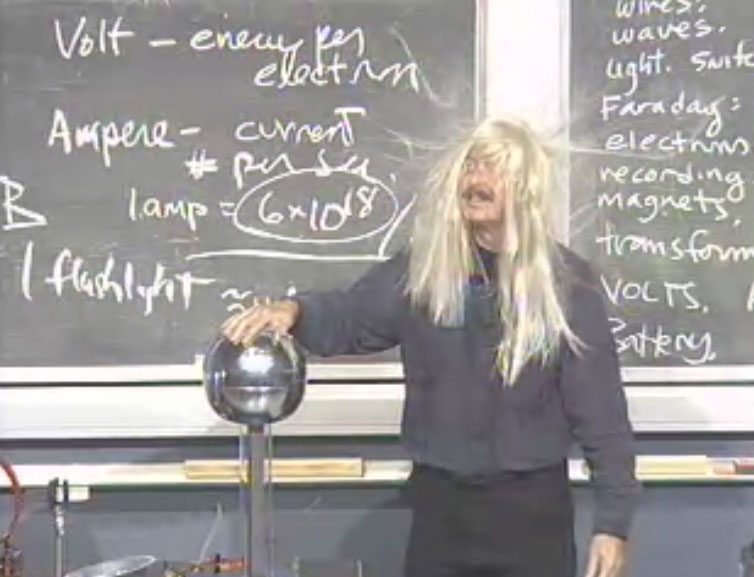
Learning Objective 10.1.A: Describe the electric force that results from the interactions between charged objects or systems.
- 10.1.A.1 Charge is a fundamental property of all matter.
- 10.1.A.1.i Charge is described as positive or negative.
- 10.1.A.1.ii The magnitude of the charge of a single electron or proton, the elementary charge $e$, can be considered to be the smallest indivisible amount of charge.
- 10.1.A.1.iii The charge of an electron is $-e$, the charge of a proton is $+e$, and a neutron has no electric charge.
- 10.1.A.1.iv A point charge is a model in which the physical size of a charged object or system is negligible in the context of the situation being analyzed.
- 10.1.A.2 Coulomb's law describes the electrostatic force between two charged objects as directly proportional to the magnitude of each of the charges and inversely proportional to the square of the distance between the objects.
- Equation: $\left|\vec{F}_E\right| = \dfrac{1}{4\pi\varepsilon_0}\dfrac{\left|q_1 q_2\right|}{r^2} = k\dfrac{\left|q_1 q_2\right|}{r^2}$
- 10.1.A.3 The direction of the electrostatic force depends on the signs of the charges of the interacting objects and is parallel to the line of separation between the objects.
- 10.1.A.3.i Two objects with charges of the same sign exert repulsive forces on each other.
- 10.1.A.3.ii Two objects with charges of opposite signs exert attractive forces on each other.
- 10.1.A.4 Electric forces are responsible for some of the macroscopic properties of objects in everyday experiences. However, the large number of particle interactions that occur make it more convenient to treat everyday forces in terms of nonfundamental forces called contact forces, such as normal force, friction, and tension.
Learning Objective 10.1.B: Describe the electric and gravitational forces that result from interactions between charged objects with mass.
- 10.1.B.1 Electrostatic forces can be attractive or repulsive, while gravitational forces are always attractive.
- 10.1.B.2 For any two objects that have mass and electric charge, the magnitude of the gravitational force is usually much smaller than the magnitude of the electrostatic force.
- 10.1.B.3 Gravitational forces dominate at larger scales even though they are weaker than electrostatic forces, because systems at large scales tend to be electrically neutral.
Learning Objective 10.1.C: Describe the electric permittivity of a material or medium.
- 10.1.C.1 Electric permittivity is a measurement of the degree to which a material or medium is polarized in the presence of an electric field.
- 10.1.C.2 Electric polarization can be modeled as the induced rearrangement of electrons by an external electric field, resulting in a separation of positive and negative charges within a material or medium.
- 10.1.C.3 Free space has a constant value of electric permittivity, $\varepsilon_0$, that appears in physical relationships.
- 10.1.C.4 The permittivity of matter has a value different from that of free space that arises from the matter's composition and arrangement.
- 10.1.C.4.i In a given material, electric permittivity is determined by the ease with which electrons can change configurations within the material.
- 10.1.C.4.ii Conductors are made from electrically conducting materials in which charge carriers move easily; insulators are made from electrically nonconducting materials in which charge carriers cannot move easily.
Boundary statement: AP Physics 2 only expects students to make calculations of the electric force between four or fewer interacting charged objects or systems. The analysis of the resulting electric force from more charges is allowed in situations of high symmetry.
Mục tiêu học tập 10.1.A: Mô tả lực điện phát sinh từ các tương tác giữa các vật hoặc hệ mang điện.
- 10.1.A.1 Điện tích là một tính chất cơ bản của mọi vật chất.
- 10.1.A.1.i Điện tích được mô tả là dương hoặc âm.
- 10.1.A.1.ii Độ lớn điện tích của một electron hay proton đơn lẻ, điện tích nguyên tố $e$, có thể được xem là lượng điện tích nhỏ nhất không thể chia nhỏ được.
- 10.1.A.1.iii Điện tích của electron là $-e$, điện tích của proton là $+e$, và neutron không mang điện tích.
- 10.1.A.1.iv Điện tích điểm là một mô hình trong đó kích thước vật lý của một vật hoặc hệ mang điện là không đáng kể trong bối cảnh tình huống đang được phân tích.
- 10.1.A.2 Định luật Coulomb mô tả lực tĩnh điện giữa hai vật mang điện trực tiếp tỉ lệ thuận với độ lớn của mỗi điện tích và inversly tỉ lệ nghịch với bình phương khoảng cách giữa các vật.
- Phương trình: $\left|\vec{F}_E\right| = \dfrac{1}{4\pi\varepsilon_0}\dfrac{\left|q_1 q_2\right|}{r^2} = k\dfrac{\left|q_1 q_2\right|}{r^2}$
- 10.1.A.3 Hướng của lực tĩnh điện phụ thuộc vào dấu của các điện tích các vật tương tác và song song với đường nối giữa các vật.
- 10.1.A.3.i Hai vật mang điện cùng dấu sẽ tác dụng lên nhau các lực đẩy.
- 10.1.A.3.ii Hai vật mang điện trái dấu sẽ tác dụng lên nhau các lực hút.
- 10.1.A.4 Các lực điện chịu trách nhiệm cho một số tính chất vĩ mô của các vật trong trải nghiệm hàng ngày. Tuy nhiên, số lượng lớn các tương tác hạt xảy ra khiến việc xử lý các lực hàng ngày dưới dạng các lực phi cơ bản gọi là lực tiếp xúc, như lực pháp tuyến, lực ma sát và lực căng dây, trở nên thuận tiện hơn.
Mục tiêu học tập 10.1.B: Mô tả các lực điện và lực hấp dẫn phát sinh từ tương tác giữa các vật mang điện có khối lượng.
- 10.1.B.1 Các lực tĩnh điện có thể là lực hút hoặc lực đẩy, trong khi các lực hấp dẫn luôn là lực hút.
- 10.1.B.2 Đối với bất kỳ hai vật thể nào có khối lượng và điện tích, độ lớn của lực hấp dẫn thường nhỏ hơn nhiều so với độ lớn của lực tĩnh điện.
- 10.1.B.3 Lực hấp dẫn chiếm ưu thế ở quy mô lớn mặc dù nó yếu hơn lực tĩnh điện, vì các hệ ở quy mô lớn thường trung hòa về mặt điện.
Mục tiêu học tập 10.1.C: Mô tả hằng số điện môi của một vật liệu hay môi trường.
- 10.1.C.1 Hằng số điện môi là đại lượng đo lường mức độ mà một vật liệu hay môi trường bị phân cực trong sự hiện diện của một điện trường.
- 10.1.C.2 Sự phân cực điện có thể được mô hình hóa như sự sắp xếp lại electron do điện trường bên ngoài gây ra, dẫn đến sự tách biệt giữa các điện tích dương và âm bên trong vật liệu hay môi trường.
- 10.1.C.3 Không gian tự do có một giá trị không đổi của hằng số điện môi, $\varepsilon_0$, xuất hiện trong các mối liên hệ vật lý.
- 10.1.C.4 Hằng số điện môi của vật chất có giá trị khác với không gian tự do phát sinh từ thành phần và cấu trúc của vật chất đó.
- 10.1.C.4.i Trong một vật liệu nhất định, hằng số điện môi được xác định bởi mức độ dễ dàng mà các electron có thể thay đổi cấu hình bên trong vật liệu.
- 10.1.C.4.ii Chất dẫn điện được làm từ các vật liệu dẫn điện nơi các hạt tải điện di chuyển dễ dàng; chất cách điện được làm từ các vật liệu không dẫn điện nơi các hạt tải điện không thể di chuyển dễ dàng.
Tuyên bố giới hạn: AP Physics 2 chỉ yêu cầu học sinh thực hiện tính toán lực điện giữa bốn hoặc ít hơn các vật thể hoặc hệ thống mang điện tương tác. Phân tích lực điện thu được từ nhiều điện tích hơn được phép trong các tình huống có tính đối xứng cao.