Skip to content · ⁨ข้ามไปยังเนื้อหา⁩
Subjects · ⁨รายวิชา⁩
  • 1 Narrative tenses · ⁨กาลอดีตในการเล่าเรื่อง⁩
    1.1

    Past Simple vs Past Continuous

    English

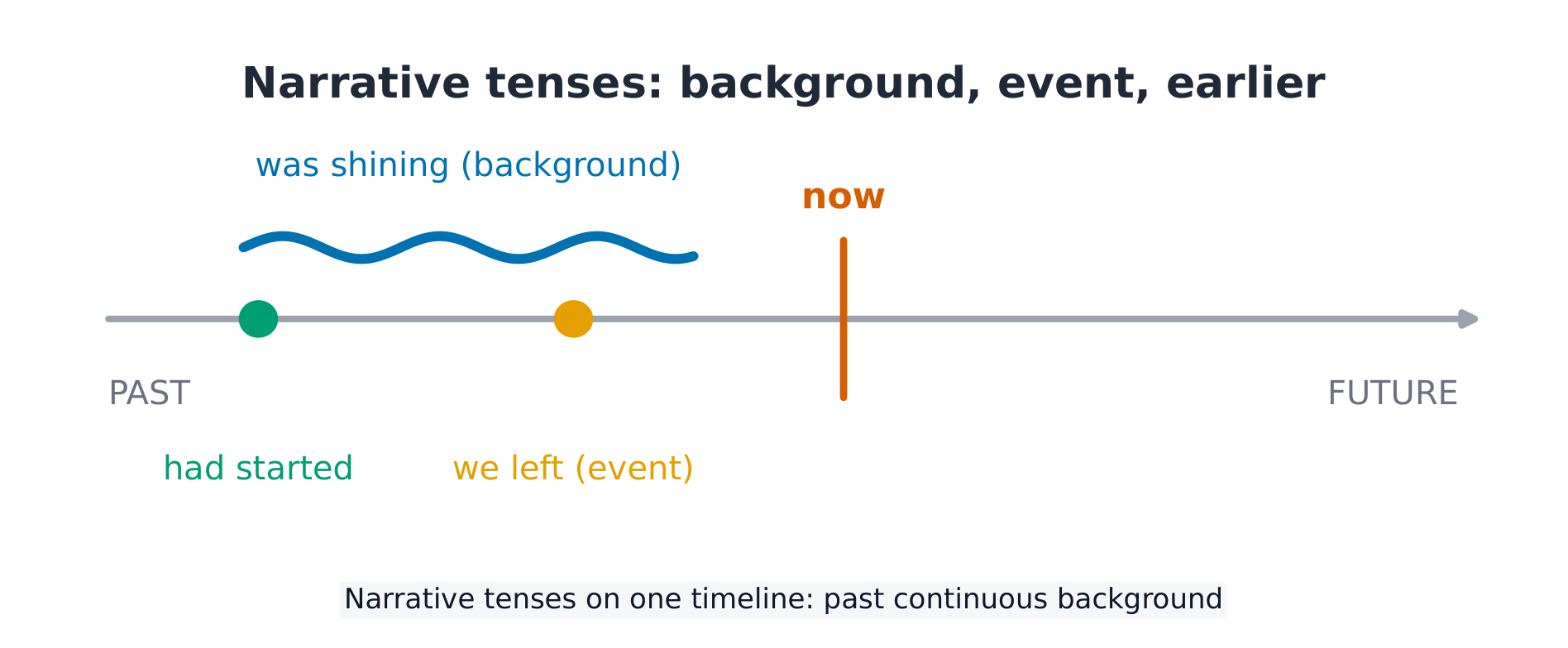
    When telling stories, English uses a set of narrative tenses in combination. The most basic two are:

    • Simple Past: The main actions that advance the plot (one after another).
    • Past Continuous: Setting the background, describing what was happening at that time.

    (冠词)The 太阳sun (过去进行)was 照耀shining 当...时when 我们we 出发left.

    We set off while the sun was shining brightly. (Background + main action)

    她She (过去进行)was 做饭cooking 当...时when (冠词)the 电话phone 响了rang.

    Her phone rang while she was cooking.

    Note A long background action uses the past continuous (was cooking); a short action interrupting it uses the simple past (rang).
    ไทย
    Tenses for storytelling: Background, Events, Earlier actions

    讲故事时,英语用一组叙事时态 (narrative tenses) 配合使用。最基础的两个是:

    • Past Simple: การกระทำหลักที่ขับเคลื่อนเรื่องราว(เป็นขั้นตอนๆ) *
    • Past Continuous: สร้างฉากหลัง อธิบายสิ่งที่กำลังเกิดขึ้น当时

    (冠词)The 太阳sun (过去进行)was 照耀shining 当...时when 我们we 出发left.

    เราออกเดินทางแล้ว แสงอาทิตย์ก็ส่องสว่าง (ฉากหลัง + การกระทำหลัก)

    她She (过去进行)was 做饭cooking 当...时when (冠词)the 电话phone 响了rang.

    เธอทำอาหารแล้ว โทรศัพท์ดัง

    注意 长的背景动作用过去进行时(was cooking);打断它的短动作用一般过去时(rang)。

    1.2

    Past Perfect用于更早的过去

    English

    To indicate an action that occurred before another past action, use the past perfect (had + past participle).

    当...时When 我们we 到达arrived (冠词), the 电影film (过去完成)had 已经already 开始started.

    By the time we arrived, the film had already started. (Started first, arrived later)

    Combination in Narrative:

    • Earliest → Past Perfect (had started).
    • Later → Simple Past (arrived).
    • Background → Past Continuous (was raining).

    Note These three tenses combined clearly convey the timeline of a story.

    ไทย

    当需要表示一个动作发生在另一个过去动作之前,用过去完成时 (had + 过去分词)。

    当...时When 我们we 到达arrived (冠词), the 电影film (过去完成)had 已经already 开始started.

    เราไปถึงแล้ว หนังก็เริ่มแล้ว (เริ่มก่อน มาทีหลัง)

    การใช้ร่วมกันในบทบรรยาย:

    • 最早 → 过去完成时(had started)。
    • 之后 → 一般过去时(arrived)。
    • 背景 → 过去进行时(was raining)。

    ข้อควรระวัง เมื่อใช้ทั้งสาม tense นี้รวมกัน จะช่วยให้เรื่องราวมีความชัดเจนในระดับเวลา

    1.3

    Past Perfect Continuous

    English

    The past perfect continuous (had been + V-ing) emphasizes an action that continued up until a specific point in the past.

    她She (过去)was 累tired 因为because 她she (过去完成)had (进行)been 工作working 一整天all day.

    She was tired because she had been working all day.

    Difference from Past Perfect:

    • Past Perfect Continuous: Emphasizes the continuous process / duration (had been working — kept doing it).
    • Past Perfect: Emphasizes completion / result (had finished — got it done).

    Note Stative verbs (know, be) do not take the continuous form: use had known, not ~~had been knowing~~.

    Common Errors

    • ❌ ~~When the phone rang, she cooked dinner.~~ (Meaning: "was cooking") → ✓ …she was cooking dinner. — Using simple past implies she started cooking after the phone rang.
    • ❌ ~~While I walked home, I was meeting a friend.~~ → ✓ While I was walking home, I met a friend. — Long background actions use continuous tense; short actions use simple past. Do not reverse this.
    • ❌ ~~She had finished the report, then she had sent it.~~ → ✓ She finished the report, then sent it. — When narrating in chronological order, simple past is sufficient; past perfect is only used to look back at an earlier event.
    • ❌ ~~It was the first time I saw snow.~~ → ✓ It was the first time I had seen snow. — "First time" in past narration requires past perfect.
    ไทย

    过去完成进行时 (had been + V-ing) 强调在某个过去时间点之前一直持续的动作。

    她She (过去)was 累tired 因为because 她she (过去完成)had (进行)been 工作working 一整天all day.

    เธอเหนื่อยมาก เพราะเธอทำงานมาทั้งวัน

    ความแตกต่างจาก Past Perfect:

    • 过去完成进行时:强调持续的过程 / 时长(had been working — 一直在干)。
    • 过去完成时:强调完成 / 结果(had finished — 干完了)。

    注意 状态动词(know、be)不用进行时:用 had known,不用 ~~had been knowing~~。

    ข้อผิดพลาดที่พบบ่อย

    • ❌ ~~When the phone rang, she cooked dinner.~~(想说"正在做饭")→ ✓ …she was cooking dinner. — 用一般过去时,意思会变成"电话响了之后她才开始做饭"。
    • ❌ ~~While I walked home, I was meeting a friend.~~ → ✓ While I was walking home, I met a friend. — 长的背景动作用进行时,短动作用过去时,别颠倒。
    • ❌ ~~She had finished the report, then she had sent it.~~ → ✓ She finished the report, then sent it. — เมื่อเล่าเหตุการณ์ตามลำดับเวลา ใช้ simple past ก็เพียงพอ; past perfect ใช้เฉพาะเมื่อ "ย้อนกลับไปเสริมเรื่องที่เกิดขึ้นก่อนหน้า" เท่านั้น
    • ❌ ~~It was the first time I saw snow.~~ → ✓ It was the first time I had seen snow. — ในบทบรรยายแบบ过去 (past narrative) คำว่า "ครั้งแรก" ต้องใช้ past perfect
  • 2 Future continuous and perfect · ⁨future continuous และ future perfect⁩
    2.1

    将来进行时 (will be + V-ing)

    English

    Future Continuous indicates an action that will be in progress at a specific moment in the future.

    Structure: will be + 动词-ing

    这个时候This time 明天tomorrow 我, I 将will (进行)be 飞flying 去to 巴黎Paris.

    At this time tomorrow, I will be flying to Paris.

    不要Don't 打电话call 在at 八点eight 我们; we 将will (进行)be 吃having 晚饭dinner.

    Don't call at eight; we'll be having dinner then.

    Note: It is also frequently used to politely ask about someone's plans: Will you be using the car tonight?

    ไทย
    Future Continuous vs Future Perfect

    将来进行时 (future continuous)表示ในช่วงเวลาที่ระบุในอนาคต某时刻กำลังทำอยู่ของงาน

    结构: will be + 动词-ing

    这个时候This time 明天tomorrow 我, I 将will (进行)be 飞flying 去to 巴黎Paris.

    ตอนนี้พรุ่งนี้ ฉันจะกำลังเดินทาง飞往巴黎 (อยู่ระหว่างทางไปปารีส)

    不要Don't 打电话call 在at 八点eight 我们; we 将will (进行)be 吃having 晚饭dinner.

    อย่าโทรหาฉันช่วงแปด โมง เดี๋ยวเรากำลังกินข้าวเย็นกัน

    注意 ยังมักใช้เพื่อถามอย่างสุภาพเกี่ยวกับการวางแผนของผู้อื่น: Will you be using the car tonight?(คุณจะ用车Tonight吗?)

    2.2

    将来完成时 (will have + 过去分词)

    English

    Future Perfect indicates an action that will be completed before a specific moment in the future.

    Structure: will have + 过去分词, often used with by + future time.

    到...时By 明年next year 我, I 将will (完成)have 完成finished 我的my 学业studies.

    By next year, I will have graduated.

    他们They 将will (完成)have 离开left 在...之前by ...时候the time 你you 到达arrive.

    They will have left by the time you arrive.

    Note: Common collocation by + time point (e.g., by 2030, by then, by the time…), meaning "by that time."

    Common Errors

    • ❌ ~~By 2030, I will finish my degree.~~ → ✓ By 2030, I will have finished my degree. — "by + future time" is a strong signal for future perfect.
    • ❌ ~~This time tomorrow I will fly to Paris.~~ → ✓ …I will be flying to Paris. — "Action in progress at a future moment" uses will be + -ing; will fly merely states a decision.
    • ❌ ~~I will have finish it by Friday.~~ → ✓ I will have finished it. — Past participle follows will have.
    • ❌ ~~When you will arrive, I will have cooked dinner.~~ → ✓ When you arrive, I will have cooked dinner. — Time clauses still take simple present; no exceptions even with advanced main clauses.
    ไทย

    将来完成时 (future perfect)表示ในช่วงเวลา某前之前已经完成的งาน

    结构: will have + 过去分词,常和 by + 将来时间 连用。

    到...时By 明年next year 我, I 将will (完成)have 完成finished 我的my 学业studies.

    ถึงปีหน้า ฉันจะเรียนจบแล้ว

    他们They 将will (完成)have 离开left 在...之前by ...时候the time 你you 到达arrive.

    ตอนที่เธอมาถึง พวกเขาเดินไปแล้ว

    注意常见搭配 by + 时间点(by 2030、by then、by the time …),表示"到那时为止"。

    ข้อผิดพลาดที่พบบ่อย

    • ❌ ~~By 2030, I will finish my degree.~~ → ✓ By 2030, I will have finished my degree. — by + 将来时间是future perfect的强信号。
    • ❌ ~~This time tomorrow I will fly to Paris.~~ → ✓ …I will be flying to Paris. — "未来某刻正在进行"用will be + -ing;will fly只是陈述决定。
    • ❌ ~~I will have finish it by Friday.~~ → ✓ I will have finished it. — will have后面是过去分词。
    • ❌ ~~When you will arrive, I will have cooked dinner.~~ → ✓ When you arrive, I will have cooked dinner. — 时间从句照旧用一般现在时,再高级的主句也不例外。
  • 3 Third and mixed conditionals · ⁨conditional แบบที่สามและแบบผสม⁩
    3.1

    Third Conditional

    English

    Third Conditional discusses the past—an unreal assumption and its hypothetical result.

    Structure: If + 过去完成时, would have + 过去分词

    如果If 我I (过去完成)had 学习studied 我, I 会would (完成)have 通过passed.

    If I had studied, I would have passed. (But I didn't study, and I didn't pass)

    Note: It expresses a hypothesis contrary to past facts; often conveys regret or blame. Abbreviations: I'd have, would've.

    ไทย
    Third and Mixed Conditionals

    第三条件句 (third conditional)谈论过去——一个没有发生的假设,以及它本会带来的结果。

    结构: If + 过去完成时, would have + 过去分词

    如果If 我I (过去完成)had 学习studied 我, I 会would (完成)have 通过passed.

    ถ้าฉันเรียนเมื่อคืน ฉันก็ผ่านแล้ว (แต่ไม่ได้อ่านหนังสือ และก็ไม่ผ่านจริง)

    注意它表示与过去事实相反的假设;常含遗憾或责备。缩写:I'd have、would've。

    3.2

    Mixed Conditionals

    English

    Mixed Conditional mixes different times. The most common type is: Past cause → Present result.

    Structure: If + 过去完成时, would + 动词原形

    如果If 我I (过去完成)had 存saved 钱money 我, I 会would (是)be 富有rich 现在now.

    If I had saved money, I would be rich now. (Past cause, present result)

    Note: Use would + base verb in the main clause (referring to present), not would have (which refers to the past).

    ไทย

    混合条件句 (mixed conditional)把不同的时间混在一起。最常见的是:过去的原因 → 现在的结果。

    结构: If + 过去完成时, would + 动词原形

    如果If 我I (过去完成)had 存saved 钱money 我, I 会would (是)be 富有rich 现在now.

    ถ้าฉันออมเงินเมื่อก่อน ตอนนี้ฉันคงรวยแล้ว (สาเหตุในอดีต ผลลัพธ์ในปัจจุบัน)

    注意主句用 would + 动词原形(指现在),不是 would have(那指过去)。

    3.3

    สรุป Conditionals

    English

    Comparing all four conditionals together:

    • Zero Conditional: If + present, present. (Universal truths)
    • First Conditional: If + present, will + base verb. (Real future)
    • Second Conditional: If + past, would + base verb. (Unreal present)
    • Third Conditional: If + past perfect, would have + past participle. (Unreal past)

    如果If 我I 是were 你you 我, I 会would 道歉apologize.

    If I were you, I would apologize. (Second conditional)

    Note: Identify the tense of the if-clause: present / past / past perfect determines the conditional type.

    Common Errors

    • ❌ ~~If I would have known, I would have come.~~ → ✓ If I had known, I would have come. — Never use would in the if-clause; this is the most frequent error in spoken English (especially influenced by American TV dramas).
    • ❌ ~~If I had studied, I would pass the exam yesterday.~~ → ✓ …I would have passed the exam. — Past results require would have + past participle.
    • Mixed conditionals are not "random mixing": Only logical combinations like past cause → present result (If I had saved money, I would be rich now) work correctly.
    • Decoding abbreviations: I'd followed by have + past participle → I'd = I would; I'd followed directly by a past participle → I'd = I had. I'd have helped (would) vs. I'd finished (had).
    ไทย

    เปรียบเทียบ Conditionals ทั้งสี่แบบ:

    • 零条件:If + 现在, 现在。(普遍真理)
    • 第一条件:If + 现在, will + 原形。(真实将来)
    • 第二条件:If + 过去, would + 原形。(现在不真实)
    • 第三条件:If + 过去完成, would have + 过去分词。(过去不真实)

    如果If 我I 是were 你you 我, I 会would 道歉apologize.

    ฉันเป็นคุณ ผมจะขอโทษ (Second Conditional)

    注意关键看 if 从句的时态:现在 / 过去 / 过去完成,决定了是哪一类条件句。

    ข้อผิดพลาดที่พบบ่อย

    • ❌ ~~If I would have known, I would have come.~~ → ✓ If I had known, I would have come. — if 从句里永远没有 would;这是口语里(尤其受美剧影响)最高频的错误。
    • ❌ ~~If I had studied, I would pass the exam yesterday.~~ → ✓ …I would have passed the exam. — 过去的结果要用 would have + 过去分词。
    • 混合条件句不是"随意混搭":只有过去的原因 → 现在的结果(If I had saved money, I would be rich now)这类才成立,前后要讲得通。
    • 解码缩写 I'd:后面跟 have + 过去分词 → I'd = I would;后面直接跟过去分词 → I'd = I had。I'd have helped(would)vs I'd finished(had)。
  • 4 wish and if only · ⁨wish และ if only⁩
    4.1

    wish + 过去时(对现在的遗憾)

    English

    wish expresses a desire or regret. For dissatisfaction with the present, use past simple (subjunctive) after wish.

    Structure: wish + 一般过去时

    我I 但愿wish 我I 有had 更多more 时间time.

    I wish I had more time. (But I don't)

    她She 但愿wishes 她she 住lived 在by (冠词)the 海边sea.

    She wishes she lived by the sea. (But she doesn't)

    Note: Like the second conditional, the verb be is commonly were: I wish I were taller.

    ไทย
    wish / if only

    wish用来表达愿望或遗憾。对现在情况不满意时,wish后面用一般过去时(虚拟)。

    结构: wish + 一般过去时

    我I 但愿wish 我I 有had 更多more 时间time.

    หวังว่าผมจะมีเวลามากกว่านี้ (แต่ไม่มีจริงๆ)

    她She 但愿wishes 她she 住lived 在by (冠词)the 海边sea.

    เธออยาก住在海边 (แต่ไม่ได้อยู่จริงๆ)

    注意和第二条件句一样,be动词常用 were: I wish I were taller.(但愿我更高些。)

    4.2

    wish + 过去完成时 / would

    English

    Two advanced usages:

    • Regret about the past: wish + 过去完成时 (should have… but didn't).
    • Dissatisfaction with others' behavior / desire for change: wish + 主语 + would.

    我I 但愿wish 我I (过去完成)had 学习studied 更努力harder.

    I wish I had studied harder. (Regret about the past)

    我I 但愿wish 你you 会would 听listen.

    I wish you could listen. (Dissatisfaction with others' behavior)

    Note: if only functions like wish but with stronger emphasis: If only I had known!

    Common Errors

    • ❌ ~~I wish I have more time.~~ → ✓ I wish I had more time. — Tense must "step back" after wish.
    • ❌ ~~I wish I studied harder last year.~~ → ✓ I wish I had studied harder last year. — Regrets about the past require past perfect.
    • ❌ ~~I wish I would be taller.~~ → ✓ I wish I were taller. — wish + would applies only to dissatisfaction with others' behavior, never oneself.
    • ❌ ~~I wish you will pass the exam.~~ → ✓ I hope you pass the exam. — Wishes for real possibilities use hope; wish + clause expresses "unreality" (except fixed phrases like I wish you good luck).
    ไทย

    สองการใช้งานขั้นสูง:

    • ความ regret ต่ออดีต:wish + 过去完成时(ควรทำ...แต่ไม่ได้ทำ)
    • ความไม่พอใจต่อพฤติกรรมของผู้อื่น / ความต้องการให้เปลี่ยนแปลง: wish + 主语 + would。

    我I 但愿wish 我I (过去完成)had 学习studied 更努力harder.

    หวังว่าเมื่อวานฉันจะตั้งใจอ่านหนังสือมากกว่านี้ (ความ regret ต่ออดีต)

    我I 但愿wish 你you 会would 听listen.

    หวังว่าคุณจะได้ฟังดูบ้าง (ความไม่พอใจต่อพฤติกรรมคนอื่น)

    注意 if only 和 wish用法相同,但语气更强: If only I had known!(我要是早知道就好了!)

    ข้อผิดพลาดที่พบบ่อย

    • ❌ ~~I wish I have more time.~~ → ✓ I wish I had more time. — wish后面时态必须"后退一步"。
    • ❌ ~~I wish I studied harder last year.~~ → ✓ I wish I had studied harder last year. — 对过去的遗憾要退到过去完成时。
    • ❌ ~~I wish I would be taller.~~ → ✓ I wish I were taller. — wish + would只能对别人的行为表达不满,不能用于自己身上。
    • ~~I wish you will pass the exam.~~ → ✓ I hope you pass the exam. — 真实可能发生的祝愿用 hope;wish + 从句表示"与事实相反"(固定祝福语 I wish you good luck 除外)。
  • 5 Advanced passive
    5.1

    Passive Voice在各时态中

    English

    The passive voice can be used in any tense—simply change the form of be, which is always followed by a past participle.

    Tense Passive Structure
    Present Simple am / is / are + past participle
    Past Simple was / were + past participle
    Present Perfect has / have been + past participle
    Future will be + past participle
    Modal can / must be + past participle

    (冠词)The 桥bridge (完成)has (被动)been 修理repaired.

    This bridge has already been repaired. (Present Perfect Passive)

    (冠词)The 工作work 将will (被动)be 完成done 很快soon.

    The work will soon be completed. (Future Passive)

    Note: Regardless of the tense, the core of the passive structure is always be (changing) + past participle (unchanged).

    ไทย
    Passive in Various Tenses

    被动语态 (the passive)可以用在任何时态——只要改变 be的形式,后面始终跟过去分词。

    Tense Passive Structure
    一般现在 am / is / are + 过去分词
    一般过去 was / were + 过去分词
    现在完成 has / have been + 过去分词
    将来 will be + 过去分词
    情态 can / must be + 过去分词

    (冠词)The 桥bridge (完成)has (被动)been 修理repaired.

    สะพานแห่งนี้ถูกซ่อมแซมเสร็จแล้ว (Present Perfect Passive)

    (冠词)The 工作work 将will (被动)be 完成done 很快soon.

    งานนี้จะถูกทำให้เสร็จเร็วๆ (Future Passive)

    注意不论时态,被动的核心都是 be(变化)+ 过去分词(不变)。

    5.2

    被动转述 (it is said that…)

    English

    When reporting general opinions or rumors without specifying who said it, we often use the passive reporting structure:

    • It is said / believed / thought that + clause.
    • Subject + is said / believed to + infinitive / base verb.

    (形式主语)It (被动)is 说said (连词)that 他he 是is 非常very 富有rich.

    He is said to be very rich.

    他He (被动)is 说said (不定式)to 是be 非常very 富有rich.

    It is said that he is very rich. (Same meaning, subject moved forward)

    Note: Such structures are common in news and formal writing, allowing for objective reporting of unverified information.

    Common Errors

    • ❌ ~~The bridge has repaired.~~ → ✓ The bridge has been repaired. — In the perfect passive, been is easily omitted; without been, it means "the bridge repaired something else".
    • ❌ ~~The problem must be solve.~~ → ✓ The problem must be solved. — Modal passive = modal verb + be + past participle.
    • ❌ ~~He is said that he is rich.~~ → ✓ It is said that he is rich. / He is said to be rich. — The two "said" structures cannot be combined.
    • Additional: There is also a continuous passive — am / is / are being + past participle: The road is being repaired. (The road is currently being repaired.)
    ไทย

    เมื่อต้องการถ่ายทอดความคิดเห็น / ข่าวลือ โดยไม่ระบุแหล่งที่มา มักใช้โครงสร้าง Reported Passive:

    • It is said / believed / thought that + 句子。
    • 主语 + is said / believed to + 动词原形 / 不定式。

    (形式主语)It (被动)is 说said (连词)that 他he 是is 非常very 富有rich.

    เขา被认为很富有。

    他He (被动)is 说said (不定式)to 是be 非常very 富有rich.

    据说他很有钱。(同义,主语提前)

    ข้อควรระวัง โครงสร้างเหล่านี้พบบ่อยในข่าวและการเขียนทางการ ช่วยถ่ายทอดข้อมูลที่ยังไม่ได้รับการยืนยันอย่างมีนัยยะ

    ข้อผิดพลาดที่พบบ่อย

    • ❌ ~~The bridge has repaired.~~ → ✓ The bridge has been repaired. — 完成时被动最容易丢 been;没有 been就成了"桥修理了(别的东西)"。
    • ❌ ~~The problem must be solve.~~ → ✓ The problem must be solved. — 情态被动 = 情态动词 + be + 过去分词。
    • ❌ ~~He is said that he is rich.~~ → ✓ It is said that he is rich. / He is said to be rich. — 两种"据说"结构不能拼在一起。
    • 补充:进行时也有被动 — am / is / are being + 过去分词: The road is being repaired.(路正在被修。)
  • 6 Reported questions and commands
    6.1

    Indirect Questions

    English

    When reporting a question, the word order changes back to statement word order (subject + verb), and the question mark is removed.

    • Yes/No questions → introduced by if / whether.
    • Wh- questions → introduced by the original question word (what, where…).

    她She 问asked 哪里where 我I 住lived.

    She asked me where I lived. (Original: "Where do you live?")

    他He 问asked 是否if 我I (过去)was 忙busy.

    He asked me if I was busy. (Original: "Are you busy?")

    Note: In indirect questions, auxiliary verbs do / does / did are not used, and there is no inversion: ~~where did I live~~ ✗ → where I lived ✓.

    ไทย
    间接疑问句与命令

    เมื่อถ่ายทอดคำถาม ต้องกลับไปที่ประโยคบอกเล่า (Subject + Verb) และลบเครื่องหมายคำถามออก

    • Yes/No 问句 → 用 if / whether引导。
    • 特殊疑问句 → 用原来的疑问词(what、where…)引导。

    她She 问asked 哪里where 我I 住lived.

    เธอถามฉันว่าฉันอยู่ไหน (คำพูดเดิม: "Where do you live?")

    他He 问asked 是否if 我I (过去)was 忙busy.

    เขาถามฉันว่าฉันยุ่งไหม (คำพูดเดิม: "Are you busy?")

    ข้อควรระวัง ในประโยค indirect question ไม่ใช้助动词 do / does / did และ ไม่มีการกลับลำดับคำ: ~~where did I live~~ ✗ → where I lived ✓

    6.2

    Indirect Commands & Requests

    English

    When reporting a command, request, or suggestion, use tell / ask / advise + someone + (not) to + base verb.

    她She 叫told 我me (不定式)to 等wait.

    She told me to wait a moment. (Original: "Wait.")

    他He 请asked 我me 不要not to (是)be 迟到late.

    He asked me not to be late. (Original: "Please don't be late.")

    Note: Negative commands use not to: asked me not to go (asked me not to go).

    Common Errors

    • ❌ ~~He asked me am I busy.~~ → ✓ He asked me if I was busy. — You cannot simply insert the original sentence; it must become if + statement word order.
    • ❌ ~~She said me to wait.~~ → ✓ She told me to wait. — For reporting commands, use tell / ask / advise + person + to do; say cannot take this construction.
    • ❌ ~~He told me don't be late.~~ → ✓ He told me not to be late. — Negative commands become not to; don't cannot be inserted directly into reported speech.
    • ❌ ~~She suggested me to go home.~~ → ✓ She suggested that I (should) go home. / She suggested going home. — suggest cannot be followed by "person + to do".
    ไทย

    เมื่อแปลงเป็นคำสั่ง คำขอ หรือคำแนะนำ ให้ใช้ tell / ask / advise + บุคคล + (not) to + กริยาต้นแบบ

    她She 叫told 我me (不定式)to 等wait.

    เธอสั่งให้รอสักครู่ (คำพูดเดิม: "Wait.")

    他He 请asked 我me 不要not to (是)be 迟到late.

    เขาร้องขอให้ฉันอย่ามาสาย (คำพูดเดิม: "Please don't be late.")

    ข้อควรระวัง คำสั่งเชิงลบใช้ not to: asked me not to go (ขอไม่ให้ไป)

    ข้อผิดพลาดที่พบบ่อย

    • ❌ ~~He asked me am I busy.~~ → ✓ He asked me if I was busy. — ไม่สามารถนำคำพูดเดิมใส่เข้าไปโดยตรง ต้องเปลี่ยนเป็น if + ลำดับคำบอกเล่า
    • ❌ ~~She said me to wait.~~ → ✓ She told me to wait. — การแปลงคำสั่งใช้ tell / ask / advise + คน + to do; say ไม่สามารถใช้รูปแบบนี้ได้
    • ❌ ~~He told me don't be late.~~ → ✓ He told me not to be late. — คำสั่งเชิงลบเปลี่ยนเป็น not to, don't ไม่สามารถนำไปวางในประโยคreported speech โดยตรงได้
    • ❌ ~~She suggested me to go home.~~ → ✓ She suggested that I (should) go home. / She suggested going home. — suggest ตามด้วย "คน + to do" ไม่ได้
  • 7 Past modals · ⁨Modal verbs ในอดีต⁩
    7.1

    must have / can't have(การคาดเดา)

    English

    When speculating about the past, use modal verb + have + past participle. When you are certain:

    • must have + past participle: Must have been… (in the past).
    • can't have + past participle: Cannot have been… (in the past).

    他He 一定must (完成)have 忘记forgotten.

    He must have forgotten. (A definite positive speculation about the past)

    她She 不可能can't (完成)have 看见seen 我们us.

    She can't have seen us.

    Note: Negative speculation uses can't have, not mustn't have.

    ไทย
    Past Modals: Speculation/Regret/Possibility

    เมื่อกล่าวถึงการคาดเดาเกี่ยวกับอดีต ให้ใช้情态动词 + have + 过去分词。เมื่อมั่นใจมาก:

    • must have + 过去分词: ต้อง肯定是(ในอดีต)……
    • can't have + 过去分词: เป็นไปไม่ได้ว่า(ในอดีต)จะเป็น……

    他He 一定must (完成)have 忘记forgotten.

    เขาคงลืมแน่ (การคาดเดา certainty ในอดีต)

    她She 不可能can't (完成)have 看见seen 我们us.

    เธอน่าจะไม่เห็นเราแล้ว

    ข้อควรระวัง การคาดเดาเชิงลบใช้ can't have, ไม่ใช่ mustn't have

    7.2

    should have(ความเสียใจ, การตำหนิ)

    English

    should have + past participle indicates "should have done but didn’t

    我I 本该should (完成)have 学习studied 更努力harder.

    I should have studied harder. (Regret)

    你You 本不该shouldn't (完成)have 说said 那that.

    You shouldn't have said that. (Criticism)

    Note: It refers to something not done (or done) in the past that is now regretted.

    ไทย

    should have + 过去分词 หมายความว่า"ควรทำแต่ไม่ได้ทำ"— มักมีความรู้สึกเสียใจหรือตำหนิ

    我I 本该should (完成)have 学习studied 更努力harder.

    ฉันควรรigorously study more. (ความ regret)

    你You 本不该shouldn't (完成)have 说said 那that.

    คุณไม่ควรพูด那句话那句话นั้น (การติชม)

    ข้อควรระวัง มันหมายถึงสิ่งที่ไม่ได้ทำ (หรือทำ) ในอดีต แต่ปัจจุบันรู้สึกเสียใจ

    7.3

    could have / might have(ความเป็นไปได้)

    English

    could have / might have + past participle indicates something that was possible in the past (but not certain).

    他们They 可能might (完成)have 错过missed (冠词)the 火车train.

    They may have missed the train.

    (它)It 本可能could (完成)have 是been 更糟worse.

    Things could have been worse.

    Note: could have can also mean "could have done but didn't": I could have helped, but I didn't. (I could have helped, but I didn't.)

    Common Errors

    • ❌ ~~He must forgot.~~ → ✓ He must have forgotten. — Speculation about the past requires "modal + have + past participle"; there is no form like "must forgot".
    • ❌ ~~I should have went.~~ / Mishearing as oral speech ~~should of gone~~ → ✓ I should have gone. — After have comes the past participle; connected speech sounds like "of," but it must be written as "have."
    • ❌ ~~I could help you yesterday, but I was busy.~~ → ✓ I could have helped you yesterday… — "Could have done" expresses "could have but didn't"; could + base verb only expresses general ability in the past.
    • ❌ ~~You should had called.~~ → ✓ You should have called. — After a modal verb always comes the base form "have," never "had."
    ไทย

    could have / might have + 过去分词 หมายความว่าในอดีตมี**ความเป็นไปได้(แต่ไม่แน่นอน)**ที่จะเกิดขึ้น

    他们They 可能might (完成)have 错过missed (冠词)the 火车train.

    พวกเขาอาจพลาดรถไฟไป

    (它)It 本可能could (完成)have 是been 更糟worse.

    สถานการณ์น่าจะเลวร้ายกว่านี้

    ข้อควรระวัง could have ยังหมายถึง"ทำได้แต่ไม่ได้ทำ": I could have helped, but I didn't.(ฉันช่วยได้แต่ไม่ได้ช่วย)

    ข้อผิดพลาดที่พบบ่อย

    • ❌ ~~He must forgot.~~ → ✓ He must have forgotten. — การคาดเดาเกี่ยวกับอดีตต้องเป็น"情态动词 + have + 过去分词", ไม่มีรูปแบบ must forgot แบบนี้
    • ❌ ~~I should have went.~~ / 听音误写 ~~should of gone~~ → ✓ I should have gone. — have后面是过去分词;口语连读听着像 of,写出来必须是 have。
    • ❌ ~~I could help you yesterday, but I was busy.~~ → ✓ I could have helped you yesterday… — "本可以却没做"用 could have done;could + 原形只表示过去的一般能力。
    • ❌ ~~You should had called.~~ → ✓ You should have called. — หลังกริยาศัพท์คือ have รูปแบบต้นเสมอ ไม่ใช่ had
  • 8 Relative clauses (defining and non-defining) · ⁨ประโยคขยาย (ประเภทกำหนดและประเภทไม่กำหนด)⁩
    8.1

    ข้อจำกัด vs ไม่จำกัด

    English

    Relative clauses are divided into two types, distinguished by whether the information is essential:

    • Restrictive (defining): Provides essential information, identifying "which one," with no comma.
    • Non-restrictive (non-defining): Provides extra information; removing it does not affect identification, so it is set off by commas.

    (冠词)The 男人man (关系代词)who 打电话called 是is 我的my 老板boss.

    The man who called is my boss. (Restrictive: identifies which man)

    我的My 老板boss (关系代词), who 是is 非常very 友善kind 打电话, called 我me.

    My boss called me, and he is a very nice person. (Non-restrictive: supplementary information)

    Note: A comma signals a non-restrictive clause, indicating the information is an aside.

    ไทย
    限制性 vs 非限制性定语从句

    Relative Clauses แบ่งเป็นสองประเภท ขึ้นอยู่กับว่าข้อมูลนั้นจำเป็นหรือไม่:

    • 限制性 (defining): ให้ข้อมูลจำเป็น บอกว่า"是哪一個", ไม่มี逗号
    • 非限制性 (non-defining): ให้ข้อมูลเพิ่มเติม ลบออกก็ไม่กระทบการระบุ, ใช้逗号 คั่น

    (冠词)The 男人man (关系代词)who 打电话called 是is 我的my 老板boss.

    ผู้ชายที่โทรหาฉันคือหัวหน้าของฉัน (Restrictive: ชี้ชัดว่าเป็นผู้ชายคนไหน)

    我的My 老板boss (关系代词), who 是is 非常very 友善kind 打电话, called 我me.

    หัวหน้าฉันโทรหาฉัน เขาเป็นคนดีมาก (Non-restrictive: ข้อมูลเสริม)

    ข้อควรระวัง เมื่อเห็นเครื่องหมายจุลภาค ก็รู้ทันทีว่าเป็น Non-restrictive ข้อมูลภายในเป็นเพียง"โดยสรุป"

    8.2

    คomma และ which

    English

    There are also differences in the choice of relative pronouns between the two types of clauses:

    • Restrictive: Use who / that for people, which / that for things; may be omitted when functioning as an object.
    • Non-restrictive: Use who for people, which for things; that cannot be used, and it cannot be omitted.

    这This 书book (关系代词), which 我I 读read 去年last year 是, is 优秀excellent.

    *I read this book last year, which was excellent. (Non-restrictive, use which)

    Note: that is never used in non-restrictive clauses: ~~My boss, that is kind, …~~ ✗ → My boss, who is kind, … ✓.

    Common Errors

    • ❌ ~~My mother who lives in Beijing is a teacher.~~ → ✓ My mother**, who** lives in Beijing**,** is a teacher. — Unique people or things (mother, Beijing, sun) can only take non-restrictive clauses; omitting commas implies "you have several mothers".
    • ❌ ~~He failed the exam, it made his parents angry.~~ → ✓ …the exam**, which** made his parents angry. — A comma cannot directly join two sentences; a comma plus which refers to the entire preceding situation.
    • ❌ ~~My boss, I met yesterday, is kind.~~ → ✓ My boss, who(m) I met yesterday, is kind. — The relative pronoun in a non-restrictive clause cannot be omitted.
    • Commas must appear in pairs: When a clause is inserted mid-sentence, it requires commas on both sides: My boss, who is kind, called me.
    ไทย

    ทั้งสองประเภทมีความแตกต่างในการเลือกRelative Pronoun ด้วย:

    • 限制性: คนใช้ who / that, สิ่งใช้ which / that; ทำ宾语的时可省略
    • 非限制性: คนใช้ who, สิ่งใช้ which; 不能用 that, 不能省略

    这This 书book (关系代词), which 我I 读read 去年last year 是, is 优秀excellent.

    หนังสือเล่มนี้ฉันเคยอ่าน去年แล้ว ดีมาก (非限制性, 用 which)

    ข้อควรระวัง ใน non-defining clause ห้ามใช้ that: ~~My boss, that is kind, …~~ ✗ → My boss, who is kind, … ✓

    ข้อผิดพลาดที่พบบ่อย

    • ❌ ~~My mother who lives in Beijing is a teacher.~~ → ✓ My mother**, who** lives in Beijing**,** is a teacher. — บุคคล/สิ่งของที่เป็นเอกลักษณ์ (แม่, ปักกิ่ง, ดวงอาทิตย์) ใช้ได้เฉพาะ non-defining clause; ไม่มีcomma เท่ากับสื่อว่า"คุณมีแม่หลายคน"
    • ❌ ~~He failed the exam, it made his parents angry.~~ → ✓ …the exam**, which** made his parents angry. — comma เชื่อมสองประโยคไม่ได้; comma + which ชี้ถึงทั้งเหตุการณ์ข้างหน้า
    • ❌ ~~My boss, I met yesterday, is kind.~~ → ✓ My boss, who(m) I met yesterday, is kind. — Relationship pronoun ของ non-defining clause 不能省略
    • Comma ต้อง成对: เมื่อ clause คั่นกลาง ต้องมีหน้าและหลัง:My boss, who is kind, called me.
  • 9 The causative · ⁨โครงสร้างการทำให้ (Causative)⁩
    9.1

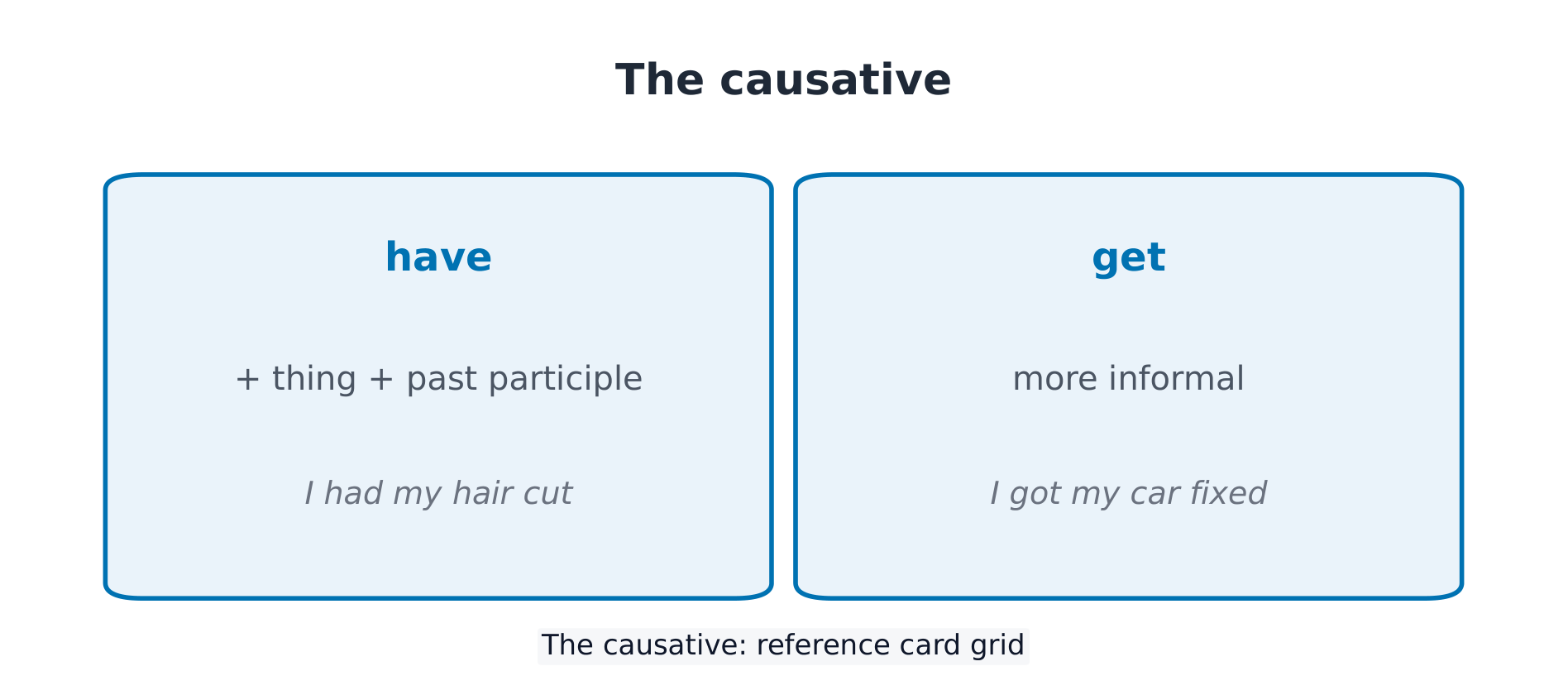
    have something done

    English

    The causative structure expresses having someone else do something for you, rather than doing it yourself.

    Structure: have + 宾语 + 过去分词

    我I (使役)had 我的my 头发hair 剪cut 昨天yesterday.

    I got my hair cut yesterday. (Not by myself)

    我们We (be)are (使役)having 我们的our 房子house 粉刷painted.

    We are getting the house painted. (By someone else)

    Note: Pay attention to word order: have + object + past participle. I had my car repaired. (I sent it to be fixed) differs from I repaired my car. (I did it myself).

    ไทย
    使役结构:have/get something done

    使役结构 (the causative) หมายถึง"ให้คนอื่นทำแทนเรา", ไม่ใช่ทำเอง

    结构: have + 宾语 + 过去分词

    我I (使役)had 我的my 头发hair 剪cut 昨天yesterday.

    ฉันตัดผมเมื่อวาน (ไม่ใช่ตัดเอง)

    我们We (be)are (使役)having 我们的our 房子house 粉刷painted.

    เรากำลังทาสีบ้าน (จ้างคนทำ)

    ข้อควรระวัง ข้อควรระวังเรื่องลำดับคำ: have +之物+过去分词。I had my car repaired.(ฉันนำรถไปซ่อม) และ I repaired my car.(ฉันซ่อมเอง) มีความหมายต่างกัน

    9.2

    get something done

    English

    get + object + past participle functions similarly to have, but is more informal.

    我I 需要need to (使役)get 我的my 手机phone 修理fixed.

    *I need to get my phone repaired.

    她She (使役)got 她的her 照片photo 拍taken.

    She got a photo taken. (By someone else)

    Note: In causative structures, have and get are largely interchangeable; get carries a more casual, conversational tone.

    Common Errors

    • ❌ ~~I cut my hair yesterday.~~ (Actually at the salon) → ✓ I had my hair cut yesterday. — Using the active voice implies you cut it yourself with scissors.
    • ❌ Incorrect word order: ~~I had cut my hair~~ is the past perfect tense ("I had already cut it before then"), not causative; the causative form is have + object + past participle: I had my hair cut.
    • ❌ ~~I had my hair cutted.~~ → ✓ …cut. — The past participle in the causative structure must also be correct: cut–cut–cut remains unchanged.
    • To ask someone to do it: have + person + base form, get + person + to do: I'll have John fix it. / I'll get John to fix it.
    ไทย

    get +宾格+过去分词 用法与 have几乎相同,但更口语化。

    我I 需要need to (使役)get 我的my 手机phone 修理fixed.

    ฉันต้องนำโทรศัพท์ไปซ่อม

    她She (使役)got 她的her 照片photo 拍taken.

    เธอถ่ายรูปมา (จ้างคนถ่าย)

    ข้อควรระวัง have และ get ใน使役โครงสร้างส่วนใหญ่สลับกันได้; get มีน้ำเสียง casual informal มากขึ้น

    ข้อผิดพลาดที่พบบ่อย

    • ❌ ~~I cut my hair yesterday.~~(实际上是理发店剪的)→ ✓ I had my hair cut yesterday. — บอกเป็น active verb แปลว่าตัดเองด้วยกรรไกร
    • ❌ 语序错误:~~I had cut my hair~~ 是过去完成时("在此之前我已剪过"),不是使役;使役结构为 had + 宾格 + 过去分词:I had my hair cut。
    • ❌ ~~I had my hair cutted.~~ → ✓ …cut. — 使役中的过去分词也需正确使用:cut–cut–cut 形式不变。
    • 请某人做:have + 人 + 原形,get + 人 + to do:I'll have John fix it. / I'll get John to fix it.
  • 10 Contrast linkers · ⁨คำเชื่อมแสดงการเปรียบเทียบ⁩
    10.1

    although, though, even though

    English

    These conjunctions express contrast / concession ("although...but..."). They are followed by a complete sentence (subject + verb).

    • although / though: Although. even though: Stronger tone, meaning "even if / despite the fact that".

    虽然Although (天气it)it (过去)was 下雨raining 我们, we 去went 外出out.

    *Although it was raining, we still went out.

    他He 通过passed 尽管, even though 他he 没有hadn't 学习studied.

    *Even though he didn't study, he still passed.

    Note: though can also appear at the end of a sentence to mean "however" (informal): It's expensive. I like it, though.

    ไทย
    对比连接词:although/despite/however

    คำเชื่อมเหล่านี้แสดงถึงความขัดแย้ง / การยอมแพ้("แม้...แต่...") ตามด้วยประโยคสมบูรณ์ (Subject + Verb)

    • although / though: แม้/แม้ว่า。even though: น้ำหนักแรงกว่า, "ถึงอย่าง"

    虽然Although (天气it)it (过去)was 下雨raining 我们, we 去went 外出out.

    แม้ฝนจะตก เราก็ยังออกไปข้างนอก

    他He 通过passed 尽管, even though 他he 没有hadn't 学习studied.

    แม้เขาไม่เรียน เขาก็สอบผ่าน

    ข้อควรระวัง though ยังอยู่ในท้ายประโยค, หมายถึง"แต่/อย่างไรก็ตาม" (informal): It's expensive. I like it, though.

    10.2

    despite, in spite of

    English

    despite and in spite of have the same meaning as although, but they are followed by nouns / gerunds, not complete sentences.

    尽管Despite (冠词)the 雨rain 我们, we 去went 外出out.

    *Despite the rain, we still went out.

    尽管In spite of 是being 累tired 她, she 继续kept 工作working.

    *Despite being very tired, she continued working.

    Note: Key distinction: although + sentence; despite / in spite of + noun / -ing. ~~despite it was raining~~ ✗ → despite the rain ✓.

    ไทย

    despite และ in spite of ความหมายเท่ากับ although แต่ตามด้วยนาม / gerund, ไม่ใช่ประโยคเต็ม

    尽管Despite (冠词)the 雨rain 我们, we 去went 外出out.

    แม้ฝนจะตก เราก็ยังออกไปข้างนอก

    尽管In spite of 是being 累tired 她, she 继续kept 工作working.

    แม้她会很累 She was tired, she continued working.

    ข้อควรระวัง จุดต่างสำคัญ: although + ประโยค; despite / in spite of + นาม / -ing: ~~despite it was raining~~ ✗ → despite the rain ✓

    10.3

    อย่างไรก็ตาม / แต่ทว่า

    English

    however and nevertheless are conjunctive adverbs that connect two sentences, usually placed at the beginning of a sentence followed by a comma.

    (它)It (过去)was 贵expensive 然而. However 我们, we 买bought 它it.

    *It was expensive. However, we still bought it.

    Note: However typically forms its own sentence separated by a comma; do not use it to directly join two clauses like but.

    Common Errors

    • ❌ ~~Although it was raining, but we went out.~~ → ✓ Keep only one: Although it was raining, we went out. / It was raining, but we went out. — Chinese "although...but..." appears in pairs, but English allows only one.
    • ❌ ~~Despite of the rain…~~ → ✓ despite the rain / in spite of the rain — despite never takes of; in spite always takes of; do not mix them.
    • ❌ ~~Even he studied hard, he failed.~~ → ✓ Even though he studied hard… — even alone is not a conjunction; use even though / even if.
    • ❌ ~~It was expensive, however we bought it.~~ → ✓ It was expensive. However, we bought it. (Or using a semicolon: …expensive**; however,** we…) — However cannot join two clauses with just a comma like but.
    ไทย

    however และ nevertheless เป็น คำเชื่อมแบบวิเศษณ์ ใช้เชื่อมประโยคสองประโยค โดยมักวางไว้ที่ ต้นประโยคและตามด้วยลูกน้ำ

    (它)It (过去)was 贵expensive 然而. However 我们, we 买bought 它it.

    *มันแพงมาก แต่เราก็ซื้อ把它买了

    ข้อควรระวัง however มักใช้แยกเป็นประโยคหรือมีลูกน้ำคั่น; อย่าใช้มันเชื่อมพยางค์สองส่วนโดยตรงเหมือน but

    ข้อผิดพลาดที่พบบ่อย

    • ❌ ~~Although it was raining, but we went out.~~ → ✓ ทิ้งเพียงอย่างใดอย่างหนึ่ง: Although it was raining, we went out. / It was raining, but we went out. — ในภาษาจีนใช้ "ถึงแม้...แต่..." คู่กัน แต่ในภาษาอังกฤษเลือกใช้ได้แค่ด้านเดียวเท่านั้น
    • ❌ ~~Despite of the rain…~~ → ✓ despite the rain / in spite of the rain — despite ไม่เคยนำหน้า by of; in spite ต้องมี of เสมอ; อย่าผสมผสานทั้งสองรูปแบบเข้าด้วยกัน
    • ❌ ~~Even he studied hard, he failed.~~ → ✓ Even though he studied hard… — even เองไม่ใช่คำเชื่อม ต้องใช้ even though หรือ even if เท่านั้น
    • ❌ ~~It was expensive, however we bought it.~~ → ✓ It was expensive. However, we bought it. (หรือใช้เครื่องหมายกึ่งจุดต่อ: …expensive**; however,** we…) — however ไม่สามารถเชื่อมพยางค์สองส่วนด้วยลูกน้ำได้เหมือน but
  • 11 Articles (advanced) · ⁨คำนำหน้าคำนาม (ระดับสูง)⁩
    11.1

    ความหมายทั่วไป vs ความหมายเฉพาะเจาะจง

    English

    At B2 level, the difficulty with articles lies in distinguishing generic reference from specific reference:

    • Generic reference (whole categories): Plural / uncountable nouns, no the.
    • Specific reference (particular ones): Use the.

    老虎Tigers 是are 危险dangerous.

    *Tigers are dangerous. (Refers to tigers in general, no the)

    (特指)The 老虎tigers 在at (冠词)the 动物园zoo 是are 困倦sleepy.

    *The tigers in the zoo are sleepy. (Specific, use the)

    Note: Abstract nouns are also used without the for generic reference: Love is important. (Love is important.) But the love of a mother uses the when referring specifically.

    ไทย
    เลือก Article:a/an · the · Zero article

    ถึงระดับ B2 จุดยากของ冠icles คือการแยกแยะระหว่าง泛指 (General) และ特指 (Specific):

    • ความหมายทั่วไป (กลุ่มสิ่งของทั้งหมด): คำนามพหูพจน์ / คำนามนับไม่ได้ ไม่ใส่ the
    • ความหมายเฉพาะเจาะจง (สิ่งของ那几个ที่ชัดเจน): ใส่ the

    老虎Tigers 是are 危险dangerous.

    เสือมีความอันตราย (หมายถึงเสือทุกตัว ไม่ใส่ the)

    (特指)The 老虎tigers 在at (冠词)the 动物园zoo 是are 困倦sleepy.

    เสือในสวนสัตว์ตัวนั้นๆ นอนหลับ (เฉพาะเจาะจง ใส่ the)

    ข้อควรระวัง คำนามนามธรรมที่ใช้ในความหมายทั่วไปก็ไม่ต้องใส่ the เช่น Love is important. (ความรักสำคัญ) แต่ถ้าเป็น the love of a mother (ความรักของแม่) ซึ่งเป็นความหมายเฉพาะเจาะจง ก็ต้องใส่ the

    11.2

    Collocations

    English

    In many collocations, article usage is fixed and must be memorized as a whole:

    • No article: go to bed / school / work, by car / bus, at home, have breakfast.
    • Use the: in the morning, play the piano, the same, listen to the radio.

    我I 去go (介词)to 上班work 乘by 公交bus.

    *I go to work by bus. (Neither go to work nor by bus takes an article)

    Note: These collocations lack much logical reasoning; memorizing them as fixed phrases is most effective.

    Common Errors

    • ❌ ~~the China / the Japan~~ → ✓ China / Japan; but ✓ the US, the UK, the Netherlands, the Philippines — Only countries with plural forms or "organizational" names take the.
    • ❌ ~~Most of people agree.~~ → ✓ Most people agree. / Most of the people in this room agree. — most goes directly before a noun; most of must be followed by the / my / these etc.
    • Distinguish (British English): be in hospital (admitted as a patient) vs. go to the hospital (go to the building, e.g., to visit someone). The same applies to in prison / at school.
    • the + adjective refers to a class of people: The rich should help the poor.
    ไทย

    在许多搭配里冠词用法是固定的,要整体记:

    • ไม่ใส่冠词: go to bed / school / work, by car / bus, at home, have breakfast
    • ใส่ the: in the morning, play the piano, the same, listen to the radio

    我I 去go (介词)to 上班work 乘by 公交bus.

    ฉันไปทำงานโดยรถเมล์ (go to work และ by bus ไม่ต้องใส่冠词)

    注意 这些搭配没有太多道理,当作固定短语背下来最有效。

    ข้อผิดพลาดที่พบบ่อย

    • ❌ ~~the China / the Japan~~ → ✓ China / Japan; แต่ ✓ the US, the UK, the Netherlands, the Philippines — ประเทศที่มีรูปพหูพจน์หรือชื่อประเทศที่เป็น "รูปแบบองค์กร" จึงใช้ the
    • ❌ ~~Most of people agree.~~ → ✓ Most people agree. / Most of the people in this room agree. — most วางตรงหน้าคำนามได้เลย; ส่วน most of ต้องมี the / my / these ฯลฯ ตามหลังเสมอ
    • แยกแยะ (สไตล์อังกฤษ): be in hospital (นอนโรงพยาบาล ในฐานะผู้ป่วย) vs go to the hospital (ไปที่ตึกโรงพยาบาล เช่น ไปเยี่ยม) เช่นเดียวกับ in prison / at school
    • the + adjective หมายถึงกลุ่มคน: The rich should help the poor. (คนรวยควรช่วยคนจน)
  • 12 Emphasis · ⁨จุดเด่น⁩
    12.1

    so และ such ในการเน้นย้ำ

    English

    so and such are used to intensify meaning ('so...that' or 'such...that'), often followed by that to introduce a result.

    • so + adjective / adverb (+ that …).
    • such + (a/an) + adjective + noun (+ that …).

    (它)It (过去)was 如此so 冷cold 以至于that (冠词)the 湖lake 结冰froze.

    It is so cold that the lake has frozen over.

    (它)It (过去)was 如此such 一个a 好good 电影film 以至于that 我I 哭了cried.

    That movie was so good that I cried.

    Note: Follow so with an adjective (so cold); follow such with a noun phrase (such a good film).

    ไทย
    เน้นย้ำ:so / such / do

    so และ such ใช้เพื่อเสริม语气 (เช่น "ยิ่ง...ยิ่ง...", "จนกระทั่ง") โดยมักตามด้วย that เพื่อแสดงผลลัพธ์

    • so + adjective / adverb (+ that …)
    • such + (a/an) + adjective + noun (+ that …)

    (它)It (过去)was 如此so 冷cold 以至于that (冠词)the 湖lake 结冰froze.

    天太冷了,湖都结冰了。

    (它)It (过去)was 如此such 一个a 好good 电影film 以至于that 我I 哭了cried.

    那电影太好了,我都哭了。

    ข้อควรระวัง so ตามด้วย adjective (so cold); such ตามด้วย noun phrase (such a good film)

    12.2

    so do I, neither do I

    English

    To express "Me too" or "Me neither," English uses a short inverted structure where the auxiliary verb must match the previous sentence:

    • Affirmative agreement: So + auxiliary verb + subject (So do I / So am I / So can I).
    • Negative agreement: Neither + auxiliary verb + subject (Neither do I / Neither am I).

    "I like tea." — 也So (助动词)do 我I.

    "I like tea." — "Me too."

    "I can't swim." — 也不Neither (助动词)can 我I.

    "I can't swim." — "Neither can I."

    Note: The auxiliary verb must match the tense/verb of the previous sentence: if the previous sentence uses are → So are they; if it uses don't → Neither do I.

    Common Errors

    • ❌ "I love this song." — ~~So am I.~~ → ✓ So do I. — The agreeing auxiliary must match the previous sentence: main verbs → do / does / did; be → am / is; can → can.
    • ❌ "I don't like it." — ~~Me too.~~ → ✓ Me neither. / Neither do I. — Do not use too for negative agreements.
    • ❌ "I can't swim." — ~~So can't I.~~ → ✓ Neither can I. — Negative inversion begins with neither / nor, never so + negative.
    • To emphasize "really," avoid using very + verb: ❌ ~~I very like it.~~ → ✓ I do like it. / I really like it. — Placing the auxiliary do before the verb creates emphasis.
    ไทย

    表示“我也是 / 我也不是”,英语用倒装的简短结构,助动词要和前句呼应:

    • ยืนยันเชิงบวก: So + auxiliary verb + subject (So do I / So am I / So can I)
    • ยืนยันเชิงลบ: Neither + auxiliary verb + subject (Neither do I / Neither am I)

    "I like tea." — 也So (助动词)do 我I.

    “我喜欢茶。”“我也是。”

    "I can't swim." — 也不Neither (助动词)can 我I.

    “我不会游泳。”“我也不会。”

    ข้อควรระวัง auxiliary verb ต้องตรงกับ tense / verb ของประโยคก่อน: ประโยคแรก are → So are they; ประโยคแรก don't → Neither do I

    ข้อผิดพลาดที่พบบ่อย

    • ❌ "I love this song." — ~~So am I.~~ → ✓ So do I. — auxiliary verb ที่ยืนยันต้องสอดคล้องกับประโยคก่อน: Verb ปกติ → do / does / did; be → am / is; can → can
    • ❌ "I don't like it." — ~~Me too.~~ → ✓ Me neither. / Neither do I. — การยืนยันประโยคลบไม่สามารถใช้ too ได้
    • ❌ "I can't swim." — ~~So can't I.~~ → ✓ Neither can I. — การกลับคำเชิงลบต้องใช้ neither / nor นำหน้า ไม่พูดว่า so + ประโยคลบ
    • เน้นคำว่า "จริงๆ" อย่าใช้ very + verb: ❌ ~~I very like it.~~ → ✓ I do like it. / I really like it. — การวาง do หน้า verb คือการเน้นย้ำ

Log in or create account · ⁨เข้าสู่ระบบหรือสร้างบัญชี⁩

IGCSE, A-Level & AP