Source: Cambridge International syllabus · แหล่งที่มา: หลักสูตร Cambridge International
English
Stock control: the sawtooth chart
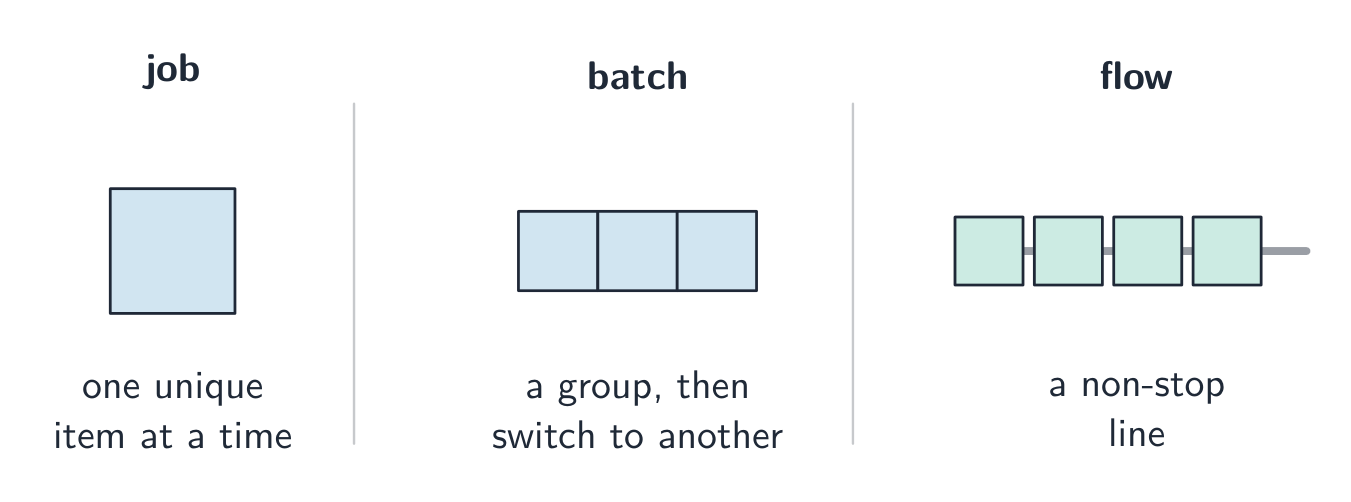
Production 生产 means turning materials and labour 劳动力 into finished goods and services 服务. There are three main methods.
Method
What it is
Good for
Drawback
job production 单件生产
making one item at a time, to order
special, one-off items: a wedding cake, a ship
slow and costly per item
batch production 批量生产
making a group of the same item, then switching to another group
bakeries, clothes in different sizes
machines stand idle while switching
flow production 流水线生产
making goods non-stop on a moving line
mass-made goods: cars, drinks
costly to set up; work can be boring
Productivity
Productivity 生产率 measures how much each worker or machine produces in a set time. Higher productivity lowers the cost per item. A business can raise productivity by:
training workers,
using better machines and technology 技术,
improving motivation 激励,
organising the work better.
Lean production and just-in-time
Lean production 精益生产 means cutting all waste — wasted time, materials, space and effort — while keeping quality.
One key method is just-in-time 准时制 (JIT). With JIT, materials arrive just as they are needed, and finished goods are sold quickly, so the business holds very little inventory 库存 (its stock of materials and goods). This saves storage cost, but one late delivery can stop production. Good management of inventory keeps enough stock to meet demand, but not so much that money is tied up or goods go out of date.
Technology in production
Technology has changed production. Automation 自动化 (machines and robots doing tasks), computer design and online ordering all make production faster, cheaper and more exact. But machines cost a lot to buy and can replace workers' jobs.
A business picks job, batch or flow production to suit its product and order size. · ธุรกิจเลือกการผลิตแบบ job, batch หรือ flow เพื่อให้เหมาะสมกับผลิตภัณฑ์และขนาดคำสั่งซื้อ
Worked example. A factory has fixed costs of £8,000 and variable costs of £2 per unit, and makes 1,000 units. Find the total cost and the average cost per unit.
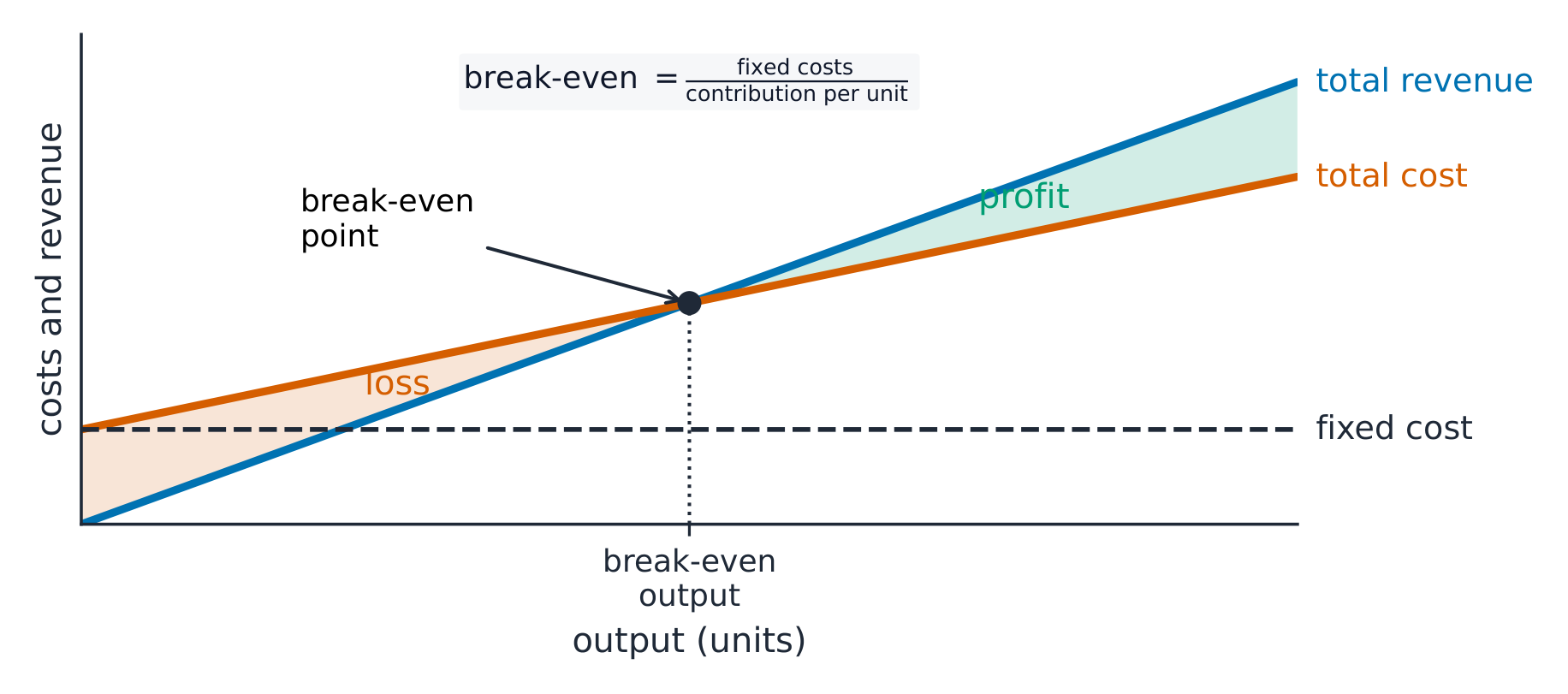
The break-even 盈亏平衡 point is the level of output where total revenue exactly equals total cost: the business makes no profit and no loss. Below it the business makes a loss; above it, a profit.
Each item sold gives an amount towards covering the fixed costs. This amount is the selling price minus the variable cost of one item (sometimes called the contribution 贡献 per unit).
$$\text{break-even output} = \frac{\text{fixed costs}}{\text{selling price per unit} - \text{variable cost per unit}}$$
A break-even chart 盈亏平衡图 plots total cost and total revenue against output. The two lines cross at the break-even point 盈亏平衡点.
The margin of safety 安全边际 is how far the actual output is above the break-even output.
$$\text{margin of safety} = \text{actual output} - \text{break-even output}$$
Worked example. A product sells for £15 with a variable cost of £5 per unit, and the firm's fixed costs are £8,000. Find the break-even output, and the margin of safety if the firm actually makes 1,200 units.
The contribution per unit is $\text{\pounds} 15 - \text{\pounds} 5 = \text{\pounds} 10$, so
A large margin of safety is safer, because sales can fall a long way before the business makes a loss.
Limits of break-even analysis. It assumes that all output is sold, and that the selling price and the costs stay the same at every level of output. In real life these often change, so break-even is only a guide.
ไทย
ประโยชน์จากขนาด economy of scale: ค่าเฉลี่ยลดลงการวิเคราะห์จุดคุ้มทุน สร้างทีละบรรทัด
Source: Cambridge International syllabus · แหล่งที่มา: หลักสูตร Cambridge International
English
Locating a business
Where a business sits affects its costs and its sales. A manufacturing 制造业 business (one that makes goods) looks at:
nearness to raw materials 原材料, because heavy or bulky materials cost a lot to move,
nearness to customers and the market 市场,
the cost and size of the land,
a supply of suitable labour,
good transport links,
government grants offered in some areas.
A service business (one that sells services, such as a shop or a hair salon) looks more at being close to customers, passing foot traffic, nearby shops, and the rent.
Locating in another country
A business may produce or sell abroad in order to reach new customers and bigger markets, pay lower wages or rent, get nearer to raw materials, or avoid tariffs 关税 (taxes on imports) by making goods inside the country. But it must then deal with different laws, languages and customs, and follow the legal controls 法律管制 of both countries.
Match the production methods: job (one-off items to order), batch (a group, then switch to another), flow (non-stop mass production on a line).
Learn the formulas: total cost = fixed + variable; average cost = total cost ÷ output; total revenue = price × quantity; profit = total revenue − total cost.
Break-even output = fixed costs ÷ (selling price − variable cost per unit). How far actual output is above break-even is the margin of safety.
Break-even analysis assumes everything made is sold at one fixed price and cost, so it is only a guide.
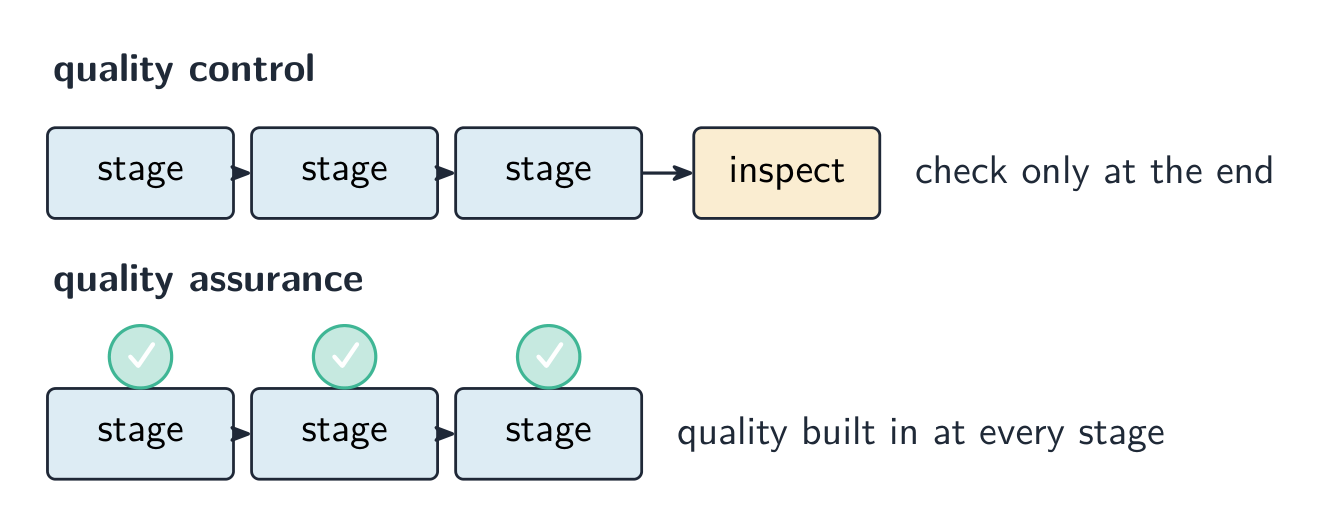
Quality control checks finished goods at the end; quality assurance builds quality in at every stage.
Pick one and the site follows you — notes, papers, videos and practice all open on it. · เลือกหนึ่งตัว และเว็บจะติดตามคุณ — หมายเหตุ, ใบงาน, วิดีโอ และการฝึกฝนจะเปิดอยู่ที่นั้น
Type to search notes, lessons, code, vocabulary and past-paper questions across every subject. · พิมพ์เพื่อค้นหาบันทึก, บทเรียน, โค้ด, คำศัพท์ และคำถามข้อสอบเก่าในทุกวิชา