Costs, scale of production and break-even
Introduced| English | Meaning |
|---|---|
| total cost/ˈtəʊtl kɒst/ | The sum of all costs of producing a given level of output, including fixed and variable costs. |
| fixed costs/fɪkst kɒsts/ | Costs that do not change with output over the relevant period and production range. |
| variable costs/ˈveərɪəbl kɒsts/ | Costs that change as the level of output changes. |
| economies of scale/ɪˈkɒnəmiz ɒv skeɪl/ | Falls in average production cost as the scale of output increases. |
| average cost/ˈævrɪdʒ kɒst/ | Total production cost divided by the quantity produced. |
| contribution/ˌkɒntrɪˈbjuːʃn/ | Sales revenue minus variable costs, available to cover fixed costs and then provide profit. |
| break-even output/breɪk ˈiːvən ˈaʊtpʊt/ | break-even output |
| margin of safety/ˈmɑːdʒɪn ɒv ˈseɪfti/ | The amount by which actual or forecast sales exceed break-even sales. |
Costs, scale and the break-even point
- Before a business can price its product or judge profit, it must understand its costs.
- A key tool is the break-even point — the sales level where the business stops making a loss.
Which is a fixed cost?
Difficulty 1/5 · 100 coins + a small bonus on first completion today
Rent does not change with output — a fixed cost.
Fixed, variable and total costs 总成本
- Fixed costs 固定成本 don't change with output: rent, salaries.
- Variable costs 可变成本 rise with output: materials, power.
- Total cost = fixed + variable. Larger scale can bring economies of scale 规模经济 (lower average cost 平均成本).

Fixed, variable and total cost as output rises
Break-even
Break-even is where total revenue crosses total cost.
Selling price is 12 and variable cost per unit is 8. What is the contribution per unit?
Difficulty 2/5 · 140 coins + a small bonus on first completion today
Contribution = 12 − 8 = 4.
Fixed costs are 1,600 and contribution per unit is 4. What is the break-even output (units)?
Difficulty 2/5 · 140 coins + a small bonus on first completion today
Break-even = 1,600 ÷ 4 = 400 units.
At the break-even point, the business makes:
Difficulty 1/5 · 100 coins + a small bonus on first completion today
Revenue exactly equals total cost.
Contribution 贡献 and break-even
- Contribution per unit = selling price − variable cost per unit.
- Break-even output 盈亏平衡产量 = fixed costs ÷ contribution per unit. At this point, revenue = total cost.
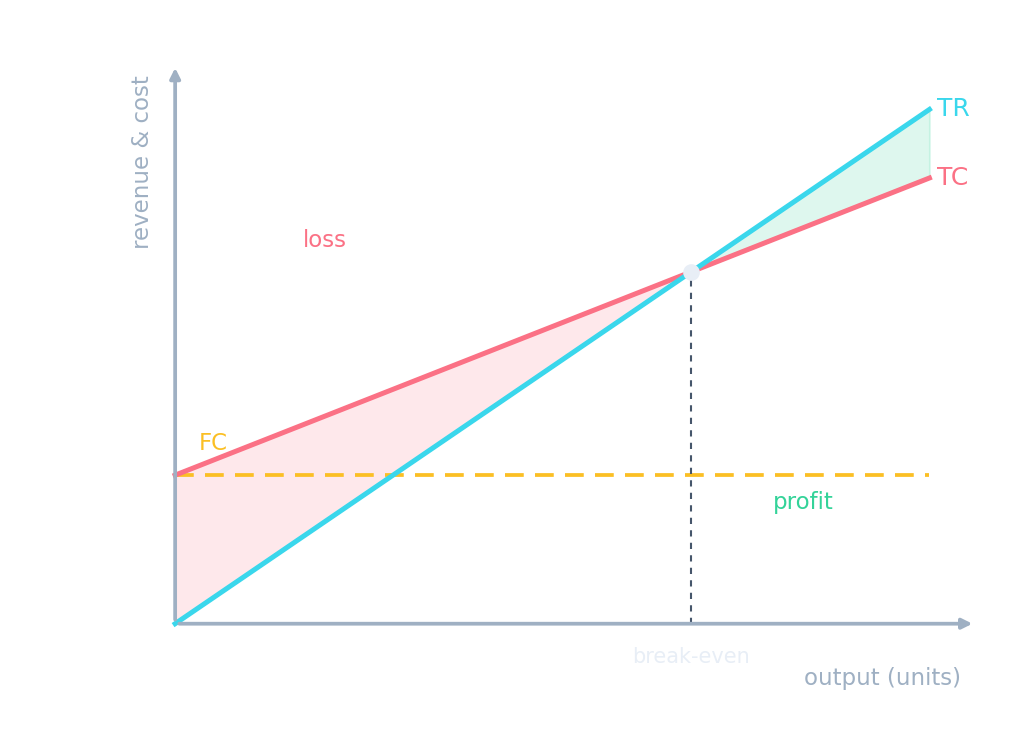
Below break-even the business makes a loss; above it, a profit.
Actual output minus break-even output is the margin of ______.
Difficulty 1/5 · 100 coins + a small bonus on first completion today
It shows how far sales can fall before a loss.
Margin of safety 安全边际
- Margin of safety = actual output − break-even output.
- It shows how far sales can fall before the business makes a loss.
Worked example. Price 10, variable cost 6 → contribution = 4. Fixed costs 2,000 → break-even = 2,000 ÷ 4 = 500 units. Selling 700 gives a margin of safety of 200 units.
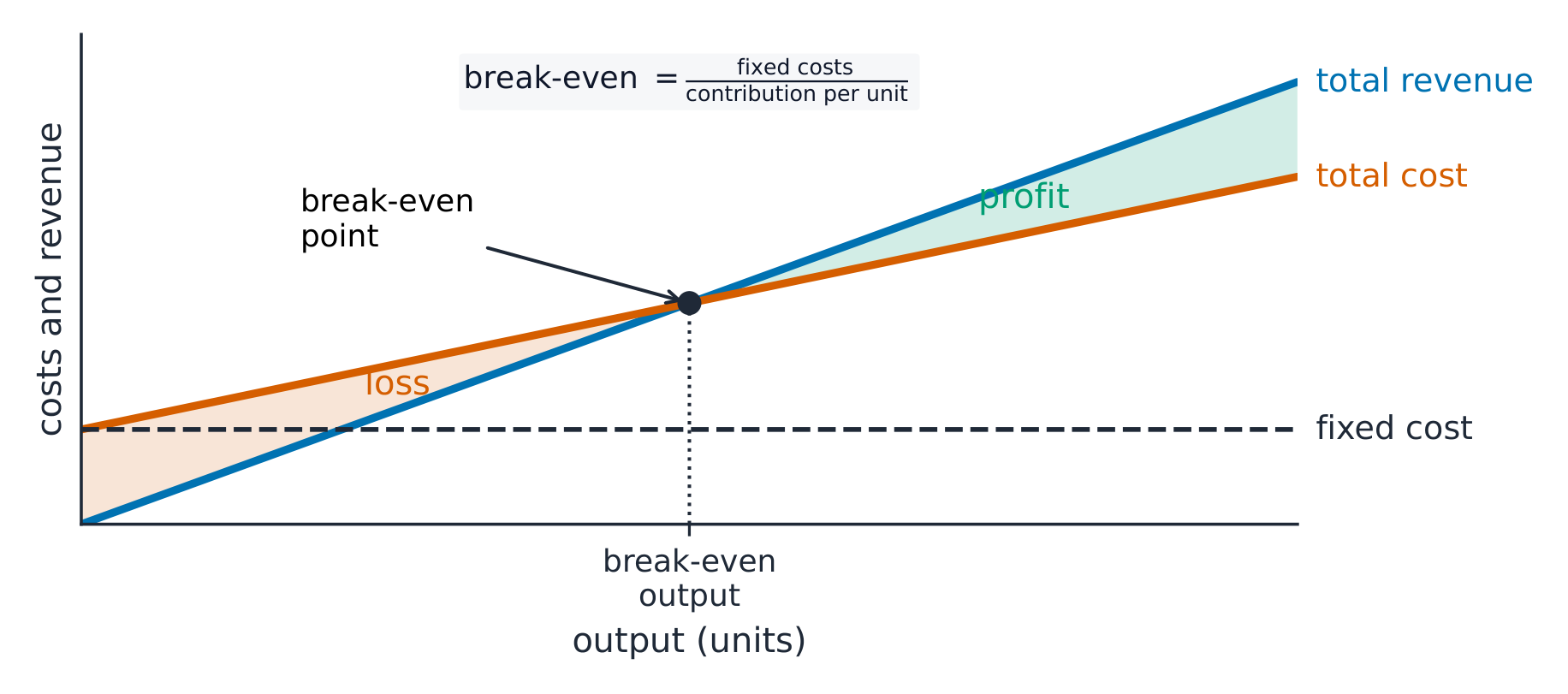
The break-even point is where total revenue equals total cost
You've got it
- total cost = fixed + variable; larger scale can lower average cost
- contribution = price − variable cost per unit; break-even = fixed costs ÷ contribution
- margin of safety = actual − break-even output