Achieving quality production
Introduced| English | Meaning |
|---|---|
| reputation/ˌrepjuːˈteɪʃn/ | The beliefs or opinions others hold about a person or organisation based on its conduct or performance. |
| quality/ˈkwɒlɪti/ | The extent to which a product, service or outcome meets stated requirements or users' needs. |
| quality control/ˈkwɒlɪti kənˈtrəʊl/ | Checking products or processes against standards to identify defects or unacceptable variation. |
| quality assurance/ˈkwɒlɪti əˈʃʊərəns/ | Planned procedures designed to prevent defects and ensure that products or services meet required standards. |
| inspecting/ɪnˈspektɪŋ/ | Examining a product or process to check whether it meets specified requirements. |
| loyalty/ˈlɔɪəlti/ | A continuing commitment or preference, such as a customer's repeated choice of a particular business or brand. |
| quality marks/ˈkwɒlɪti mɑːks/ | quality marks |
Getting it right every time
- One faulty product can lose a customer for life and harm a business's reputation 声誉.
- Quality 质量 means meeting the standard customers expect — consistently.
Quality methods lab
Compare quality approaches by when they prevent or find faults.
Quality control mainly involves:
Difficulty 1/5 · 100 coins + a small bonus on first completion today
QC inspects the end product.
Quality assurance focuses on:
Difficulty 1/5 · 100 coins + a small bonus on first completion today
QA designs quality in so faults do not occur.
Building quality into every stage of production is quality ______.
Difficulty 1/5 · 100 coins + a small bonus on first completion today
Assurance prevents faults; control inspects for them.
Quality control 质量控制 vs quality assurance 质量保证
- Quality control (QC): inspecting 检验 finished products to catch faults at the end.
- Quality assurance (QA): building quality into every stage so faults don't happen.
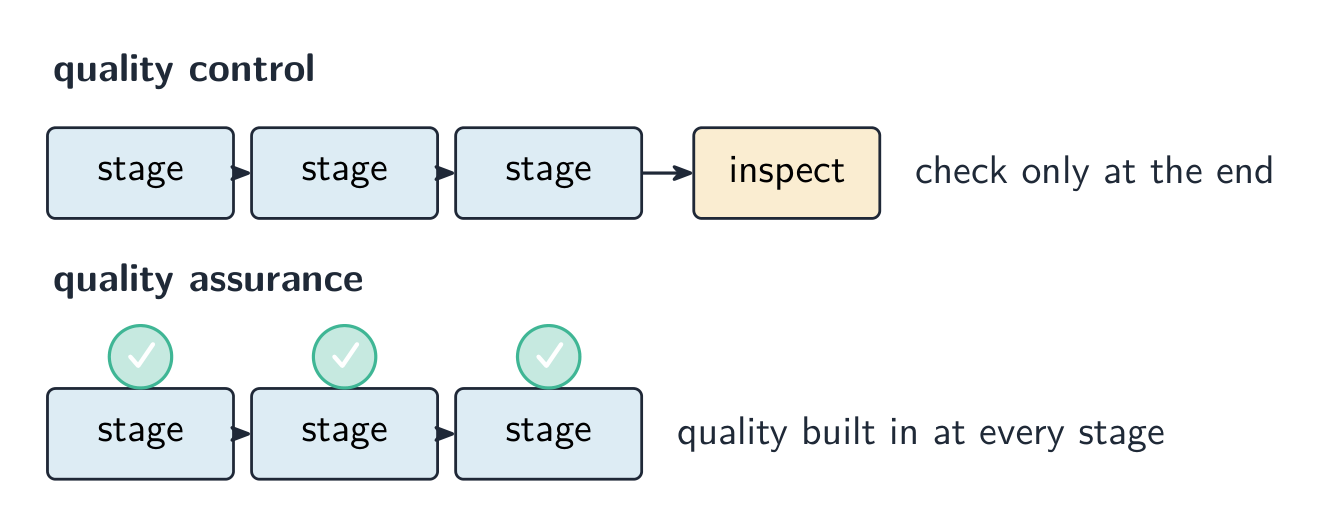
Quality control checks at the end; quality assurance builds quality into every stage
Why does quality matter to a business? (Select all that apply.)
Difficulty 2/5 · 140 coins + a small bonus on first completion today
Quality builds reputation and loyalty and cuts waste; it does not raise material costs.
Why quality matters
- High quality builds reputation, customer loyalty 忠诚度, and lets a firm charge more.
- Poor quality causes returns, complaints, lost customers and wasted materials.
Worked example. A bakery that checks ingredients, ovens and packaging at every step (QA) wastes less than one that only inspects finished loaves at the end (QC) — because faults are caught before more are made.
Preventing faults (assurance) is usually cheaper than inspecting them out at the end (control).
Difficulty 1/5 · 100 coins + a small bonus on first completion today
Prevention avoids making defective output.
Quality and small vs large firms
- Small firms rely on personal care and reputation.
- Large firms use systems and standards (e.g. quality marks 质量标志) to keep quality consistent across many sites.
Quality control catches faults; quality assurance prevents them. QC inspects at the end, when waste is already made. QA builds quality in from the start — usually cheaper.
You've got it
- quality control inspects finished output; quality assurance builds quality into every stage
- good quality builds reputation and loyalty; poor quality causes waste and lost customers
- prevention (assurance) is usually cheaper than inspection (control)
Write from 16 faults found at the end
- Inspectors check 200 finished units and find 16 faults.
- Finding faults after they exist is quality control. Quality assurance tries to stop them being made.
Inspectors check 200 finished units and find 16 faults. Is this quality control or quality assurance, and why does the difference matter?
Quality control inspects output. Quality assurance builds the checks into the way the product is made.
What is the inspection that finds the 16 finished faults?
Difficulty 1/5 · 100 coins + a small bonus on first completion today
The faults are already in the finished units, so the inspection is quality control. Other options — Quality assurance (because inspection prevents every fault); Neither (because 16 faults means quality does not apply).