Production of goods and services
Introduced| English | Meaning |
|---|---|
| production/prəˈdʌkʃn/ | The process of combining resources to create goods or provide services. |
| inputs/ˈɪnpʊts/ | Resources or values used by a process to produce outputs. |
| outputs/ˈaʊtpʊts/ | The goods, services or other results produced by an activity or production process. |
| productivity/ˌprɒdəkˈtɪvɪti/ | Output produced per unit of input over a given period. |
| job production/dʒɒb prəˈdʌkʃn/ | Making a single product or completing a specific order to a customer's requirements. |
| batch production/bætʃ prəˈdʌkʃn/ | Making a set of identical products together before changing to another set. |
| flow production/fləʊ prəˈdʌkʃn/ | Continuous production in which products pass through a sequence of standardised stages. |
| lean production/liːn prəˈdʌkʃn/ | An approach to production that reduces waste while maintaining value for the customer. |
| waste/weɪst/ | The unnecessary or inefficient use of resources, time or effort. |
| just-in-time/dʒʌst ɪn taɪm/ | A production and inventory approach in which supplies arrive close to when they are needed, reducing stock held. |
Making the product
- Turning raw materials into finished goods (or delivering a service) is production 生产 — the heart of operations.
- How a business produces affects its cost, quality and speed.
6 workers produce 300 units a day. What is productivity (units per worker)?
Difficulty 2/5 · 140 coins + a small bonus on first completion today
300 ÷ 6 = 50 units per worker.
Inputs 投入 to outputs 产出
- Production turns inputs (materials, labour, machines) into outputs (goods or services).
- Productivity 生产率 = output per worker — a key measure of efficiency.
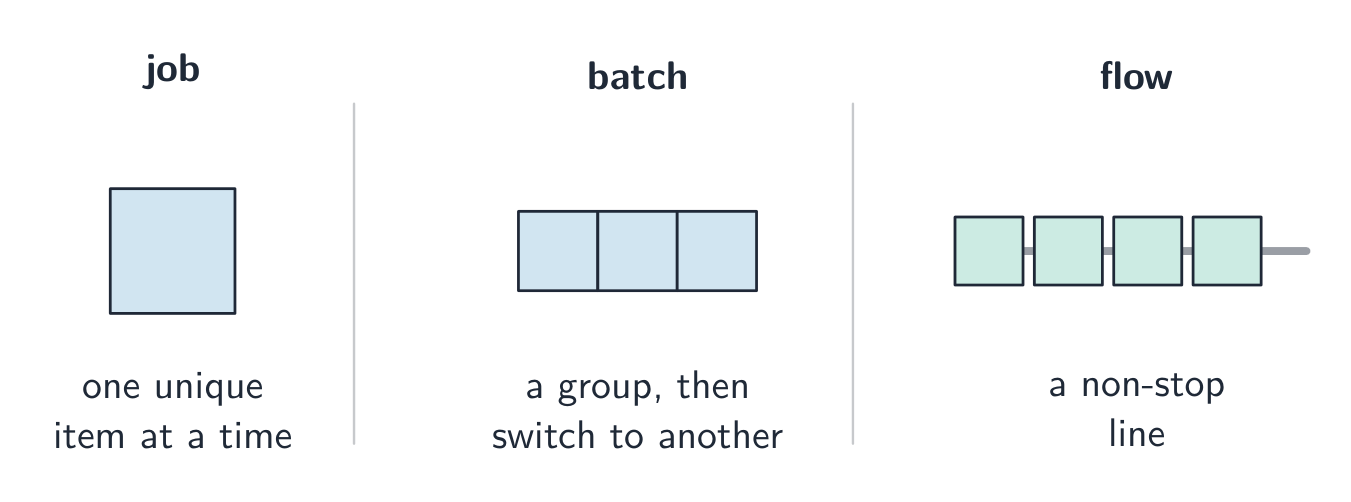
The three methods of production
Methods of production
A business picks job, batch or flow production to suit its product and order size.
Making a single, unique product to order is:
Difficulty 1/5 · 100 coins + a small bonus on first completion today
Job production makes one bespoke item at a time.
Continuous mass production on an assembly line is:
Difficulty 1/5 · 100 coins + a small bonus on first completion today
Flow production runs continuously at low unit cost.
Methods of production
- Job production 单件生产: one unique item at a time (a wedding cake). High quality, high cost.
- Batch production 批量生产: groups of identical items in stages (loaves of bread).
- Flow production 流水线生产: continuous mass production on a line (bottled drinks). Low unit cost.
Worked example. 5 workers make 200 units a day → productivity = 200 ÷ 5 = 40 units per worker. A new machine lifts output to 300 with the same 5 workers → productivity rises to 60.

A car assembly line: making many identical products on a moving line
Just-in-time production aims to hold as little stock as possible.
Difficulty 1/5 · 100 coins + a small bonus on first completion today
JIT brings materials in only as needed, cutting storage costs.
Production that aims to cut all forms of waste is called ______ production.
Difficulty 1/5 · 100 coins + a small bonus on first completion today
Lean production minimises waste while keeping quality.
Lean production 精益生产
- Lean production cuts waste 浪费 of all kinds (time, materials, stock) while keeping quality.
- Just-in-time 准时制 (JIT) keeps almost no stock; materials arrive as needed.
You've got it
- production turns inputs into outputs; productivity = output per worker
- methods: job (one-off), batch (groups), flow (continuous mass)
- lean production cuts waste; JIT holds almost no stock