- explain why businesses need finance (start-up capital, expansion, working capital, cash-flow problems)
- distinguish short-term and long-term finance and internal and external sources of finance
- describe sources of finance (retained profit, sale of assets, owners' savings, bank loan/overdraft, share issue, debentures, leasing, hire purchase, trade credit, microfinance, crowdfunding, government grants)
- explain the factors that influence the choice of source of finance
Financial information and decisions
IGCSE Business Studies · Topic 5
 12:52
12:52
Financial information and decisions
This business was doing well. Every month it made a profit — the products sold, the customers were happy. But watch the money in the bank. Suppliers wanted…
English narration · English + 中文 subtitles burned in
5.1
Why businesses need finance

Syllabus
Source: Cambridge International syllabus

Finance 资金 means the money a business needs. A business needs finance to:
- start up — start-up capital 启动资金 to buy equipment and stock before it earns anything,
- grow — money for expansion 扩张, such as new shops or machines,
- run day to day — working capital 营运资金 to pay wages and suppliers while waiting for customers to pay,
- survive a cash-flow 现金流 problem, when more money is going out than is coming in.
Sources of finance
Finance can be short-term 短期 (paid back within a year) or long-term 长期 (over several years). It can come from inside the business (internal) or from outside (external).
| Source | Internal / external | Notes |
|---|---|---|
| retained profit 留存利润 | internal | profit kept in the business, not paid out |
| sale of assets 资产 | internal | selling things the business no longer needs |
| owners' savings | internal | the owners' own money |
| bank loan 贷款 | external | borrowed money, repaid with interest 利息 over time |
| bank overdraft 透支 | external | the bank lets the account go below zero, for short-term needs |
| issuing new shares 股份 | external | only for limited companies; raises money but shares out control |
| debentures 债券 | external | long-term loans to a company that pay interest |
| leasing 租赁 | external | renting equipment instead of buying it |
| hire purchase 分期付款 | external | buy now and pay in monthly parts |
| trade credit 贸易信贷 | external | pay suppliers later, for example after 30 days |
| microfinance 小额信贷 | external | small loans for tiny businesses in poorer areas |
| crowdfunding 众筹 | external | many people each give a small amount, often online |
| government grants 补助金 | external | money from the government that need not be repaid |

Choosing a source
The best source depends on how much money is needed and for how long, the cost (interest and fees), the size and legal type of the business (only companies can sell shares), and how much risk and control the owners will accept.
Explore
Sources of finance lab
Choose the best type of finance by time, risk and ownership.
Vocabulary
Train
| English |
|---|
| finance/ˈfaɪnæns/ |
| start-up capital/stɑːt ʌp ˈkæpɪtl/ |
| expansion/ekˈspænʃn/ |
| working capital/ˈwɜːkɪŋ ˈkæpɪtl/ |
| cash-flow/kæʃ fləʊ/ |
| short-term/ʃɔːt tɜːm/ |
| long-term/lɒŋ tɜːm/ |
| retained profit/rɪˈteɪnd ˈprɒfɪt/ |
| assets/ˈæsets/ |
| loan/ləʊn/ |
| interest/ˈɪntrest/ |
| overdraft/ˈəʊvədræft/ |
| shares/ʃeəz/ |
| debentures/deˈbentʃəz/ |
| leasing/ˈliːsɪŋ/ |
| hire purchase/ˈhaɪə ˈpɜːtʃɪs/ |
| trade credit/treɪd ˈkredɪt/ |
| microfinance/ˌmaɪkrəʊfaɪˈnæns/ |
| crowdfunding/ˈkraʊdfʌndɪŋ/ |
| grants/ɡrænts/ |
5.2
Cash flow and working capital

Syllabus
- explain the importance of cash and the difference between cash and profit
- construct, complete and interpret a cash-flow forecast (inflows, outflows, net cash flow, opening/closing balance)
- explain working capital and how a business can overcome cash-flow problems
Source: Cambridge International syllabus
Cash is not the same as profit
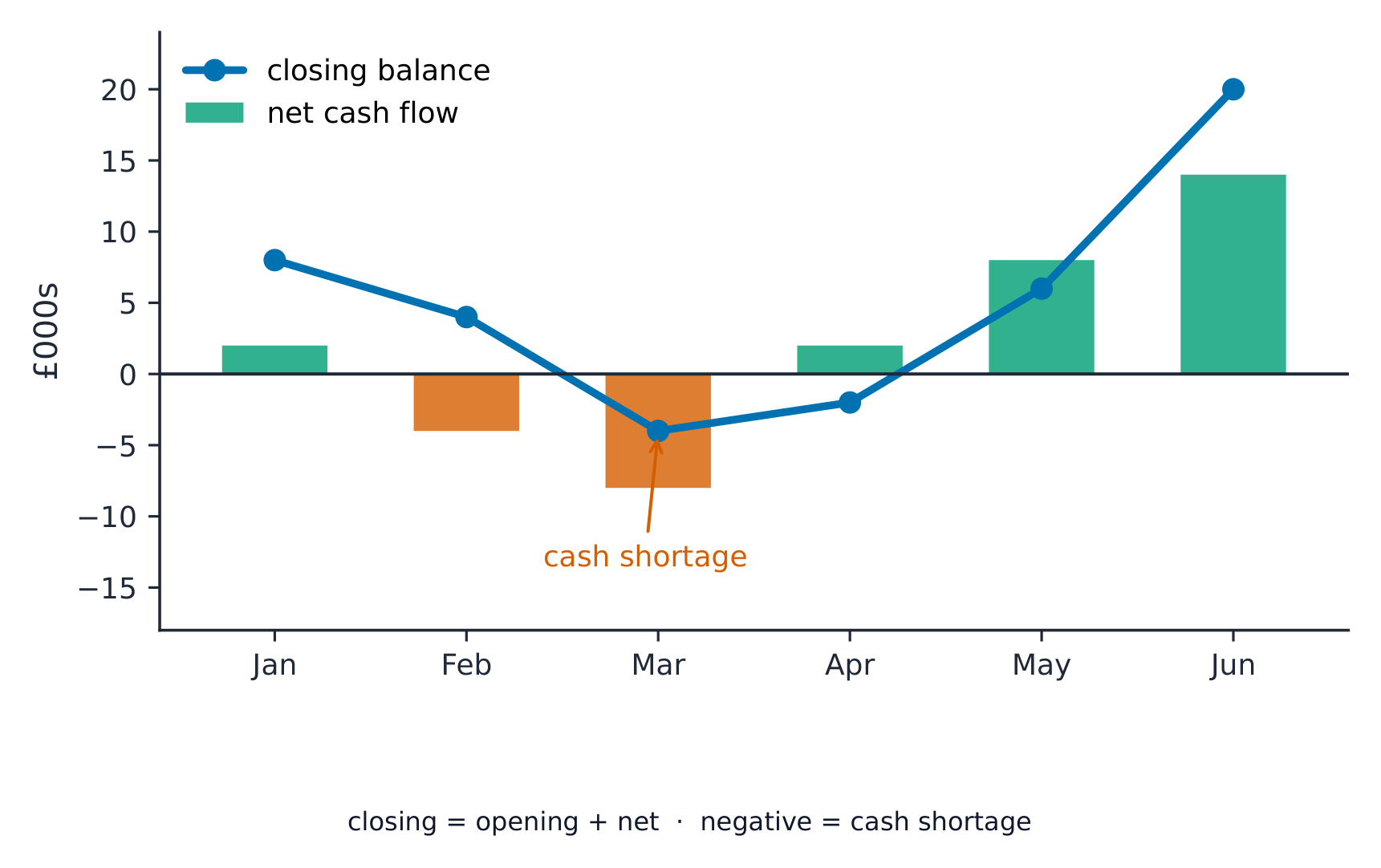
Cash 现金 is the money a business can use right now. Profit 利润 is revenue 收入 minus costs over a period. A business can be making a profit yet still run out of cash — for example, if customers have not paid yet. Running out of cash can force even a profitable business to close.
The cash-flow forecast
A cash-flow forecast 现金流预测 predicts the money coming in and going out each month. It uses:
- inflows 流入 — money coming in (sales, loans),
- outflows 流出 — money going out (wages, rent, materials),
- net cash flow 净现金流 — inflows minus outflows,
- opening balance 期初余额 — the cash held at the start of the month,
- closing balance 期末余额 — the cash held at the end of the month.
$$\text{net cash flow} = \text{inflows} - \text{outflows}$$
$$\text{closing balance} = \text{opening balance} + \text{net cash flow}$$
Worked example. A shop expects inflows of £12,000 and outflows of £9,000 next month, and starts the month with £2,000 in the bank. Find the net cash flow and the closing balance.
$$\text{net cash flow} = \text{\pounds} 12\,000 - \text{\pounds} 9\,000 = \text{\pounds} 3\,000$$
$$\text{closing balance} = \text{\pounds} 2\,000 + \text{\pounds} 3\,000 = \text{\pounds} 5\,000$$
Working capital
Working capital is the money available for day-to-day running. It is the current assets 流动资产 (cash and things soon turned into cash) minus the current liabilities 流动负债 (debts due within a year).
$$\text{working capital} = \text{current assets} - \text{current liabilities}$$
To overcome cash-flow problems, a business can arrange an overdraft, delay paying suppliers, ask customers to pay sooner, sell spare assets, or cut spending.

Explore
Cash-flow forecasting
A forecast of cash in and out each month warns a business of a cash shortage before it strikes.
Explore
Cash-flow forecast lab
Drag the monthly cash in, cash out and the one-off oven purchase — does the bakery stay out of the red all six months?
Vocabulary
Train
| English |
|---|
| cash/kæʃ/ |
| profit/ˈprɒfɪt/ |
| revenue/ˈrevənjuː/ |
| cash-flow forecast/kæʃ fləʊ ˈfɔːkæst/ |
| inflows/ˈɪnfləʊz/ |
| outflows/aʊtˈfləʊz/ |
| net cash flow/net kæʃ fləʊ/ |
| opening balance/ˈəʊpənɪŋ ˈbæləns/ |
| closing balance/ˈkləʊzɪŋ ˈbæləns/ |
| current assets/ˈkʌrənt ˈæsets/ |
| current liabilities/ˈkʌrənt ˌlaɪəˈbɪlɪtiz/ |
5.3
Income statement
Syllabus
- identify the main features of an income statement: revenue, cost of sales, gross profit, expenses and profit for the year
- explain how income statements are used by stakeholders
Source: Cambridge International syllabus
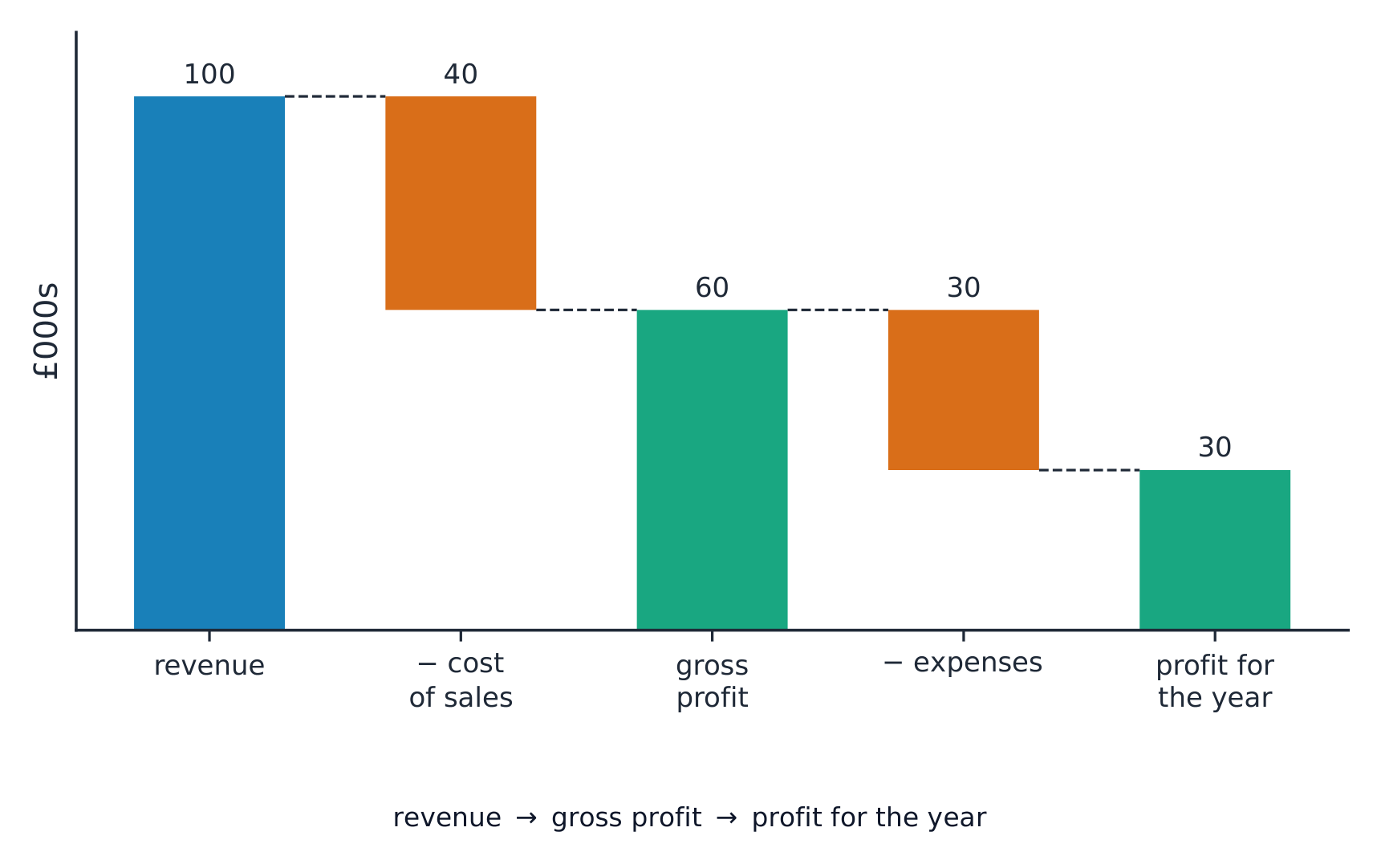
An income statement 损益表 shows how much profit a business made over a period, usually a year.
| Line | Meaning |
|---|---|
| revenue | money from sales |
| cost of sales 销售成本 | the cost of making or buying the goods that were sold |
| gross profit 毛利润 | revenue minus cost of sales |
| expenses 费用 | other running costs: rent, wages, advertising |
| profit for the year 年度利润 | gross profit minus expenses |
$$\text{gross profit} = \text{revenue} - \text{cost of sales}$$
$$\text{profit for the year} = \text{gross profit} - \text{expenses}$$
Worked example. A business has revenue of £200,000, cost of sales of £120,000 and expenses of £50,000. Find its gross profit and its profit for the year.
$$\text{gross profit} = \text{\pounds} 200\,000 - \text{\pounds} 120\,000 = \text{\pounds} 80\,000$$
$$\text{profit for the year} = \text{\pounds} 80\,000 - \text{\pounds} 50\,000 = \text{\pounds} 30\,000$$
Income statements are used by stakeholders 利益相关者: owners check the profit, lenders check whether their loans are safe, and managers look for problems.
Explore
Financial statements flow
See how business events become the statements users read.
Vocabulary
Train
| English |
|---|
| income statement/ˈɪŋkʌm ˈsteɪtmənt/ |
| cost of sales/kɒst ɒv seɪlz/ |
| gross profit/ɡrəʊs ˈprɒfɪt/ |
| expenses/ekˈspensɪz/ |
| profit for the year/ˈprɒfɪt fəðə jɪə/ |
| stakeholders/ˈsteɪkhəʊldəz/ |
5.4
Statement of financial position

Syllabus
- identify the main classifications in a statement of financial position: non-current and current assets, current and non-current liabilities, and owners' equity/capital
- explain how the statement of financial position is used
Source: Cambridge International syllabus
A statement of financial position 财务状况表 (also called a balance sheet) shows what a business owns and what it owes (its liabilities 负债) on one day.
- non-current assets 非流动资产 — things kept for the long term: buildings, machines.
- current assets — short-term items: inventory 库存, money owed by customers, and cash.
- current liabilities — debts due within a year: an overdraft, money owed to suppliers.
- non-current liabilities 非流动负债 — debts due after more than a year: a long-term loan.
- owners' equity 所有者权益 — the money the owners put in, plus profit kept in the business.
It is used to check what the business is worth, how much it owes, and whether it can pay its debts.

Explore
Financial statements flow
See how business events become the statements users read.
Vocabulary
Train
| English |
|---|
| statement of financial position/ˈsteɪtmənt ɒv faɪˈnænʃl pəˈzɪʃn/ |
| liabilities/ˌlaɪəˈbɪlɪtiz/ |
| non-current assets/nɒn ˈkʌrənt ˈæsets/ |
| inventory/ˈɪnvəntri/ |
| non-current liabilities/nɒn ˈkʌrənt ˌlaɪəˈbɪlɪtiz/ |
| owners' equity/ˈəʊnəz ˈekwɪti/ |
5.5
Analysis of accounts

Syllabus
- calculate and interpret profitability ratios: gross profit margin, profit margin and return on capital employed (ROCE)
- calculate and interpret liquidity ratios: current ratio and acid test (quick) ratio
- explain how internal and external users use account analysis to make decisions
Source: Cambridge International syllabus
You can judge a business by working out ratios 比率 from its accounts. A ratio compares two figures.
Profitability ratios
Profitability 盈利能力 ratios show how good a business is at making profit.
$$\text{gross profit margin} = \frac{\text{gross profit}}{\text{revenue}} \times 100\%$$
$$\text{profit margin} = \frac{\text{profit for the year}}{\text{revenue}} \times 100\%$$
$$\text{ROCE} = \frac{\text{profit}}{\text{capital employed}} \times 100\%$$
- gross profit margin 毛利率 — gross profit as a percentage of revenue.
- profit margin 利润率 — profit for the year as a percentage of revenue.
- return on capital employed 资本回报率 (ROCE) — profit as a percentage of the capital employed 所用资本 (money invested). It shows how well the investment is used.
A higher percentage is better for all three.
Worked example. The same business (revenue £200,000, gross profit £80,000, profit for the year £30,000) has capital employed of £150,000. Find its three profitability ratios.
$$\text{gross profit margin} = \frac{80\,000}{200\,000} \times 100\% = 40\%$$
$$\text{profit margin} = \frac{30\,000}{200\,000} \times 100\% = 15\%$$
$$\text{ROCE} = \frac{30\,000}{150\,000} \times 100\% = 20\%$$
Liquidity ratios
Liquidity 流动性 ratios show whether a business can pay its short-term debts.
$$\text{current ratio} = \frac{\text{current assets}}{\text{current liabilities}}$$
$$\text{acid test ratio} = \frac{\text{current assets} - \text{inventory}}{\text{current liabilities}}$$
- the current ratio 流动比率 compares current assets with current liabilities. Around 1.5 to 2 is healthy.
- the acid test ratio 速动比率 is stricter: it leaves out inventory, because inventory is not yet sold.
Worked example. A business has current assets of £40,000 (including £10,000 of inventory) and current liabilities of £20,000. Find its current ratio and acid test ratio.
$$\text{current ratio} = \frac{40\,000}{20\,000} = 2.0$$
$$\text{acid test ratio} = \frac{40\,000 - 10\,000}{20\,000} = 1.5$$
Who uses account analysis
- internal users (owners and managers) use it to control the business and to plan.
- external users (banks, suppliers, the government and investors) use it to decide whether to lend, supply or invest.
Explore
Accounts ratio diagnosis
Classify ratios by the question they answer about a business.
Vocabulary
Train
| English |
|---|
| ratios/ˈreɪʃɪəʊz/ |
| profitability/ˌprɒfɪtəˈbɪlɪti/ |
| gross profit margin/ɡrəʊs ˈprɒfɪt ˈmɑːdʒɪn/ |
| profit margin/ˈprɒfɪt ˈmɑːdʒɪn/ |
| return on capital employed/rɪˈtɜːn ɒn ˈkæpɪtl emˈplɔɪd/ |
| capital employed/ˈkæpɪtl emˈplɔɪd/ |
| liquidity/lɪˈkwɪdɪti/ |
| current ratio/ˈkʌrənt ˈreɪʃɪəʊ/ |
| acid test ratio/ˈæsɪd test ˈreɪʃɪəʊ/ |
5.5
Exam tips
- Cash is not profit: a profitable business can still run out of cash if customers pay late. Watch the closing balance on a cash-flow forecast.
- Separate internal sources (retained profit, sale of assets, owners' savings) from external ones (bank loan, overdraft, shares, leasing, trade credit).
- Key formulas: net cash flow = inflows − outflows; closing balance = opening balance + net cash flow; working capital = current assets − current liabilities.
- Profitability ratios (gross margin, profit margin, ROCE) — higher is better. Liquidity: the current ratio (healthy ≈ 1.5–2) and the stricter acid test (which leaves out inventory).
- Only limited companies can raise money by issuing shares; a sole trader or partnership cannot.
Interactive lessons on this topic
Work through it step by step, with instant-check exercises.