Skip to content · ⁨ข้ามไปยังเนื้อหา⁩

Human nutrition · ⁨โภชนาการมนุษย์⁩

IGCSE Biology · ⁨Biology IGCSE⁩ · Topic 7 · ⁨หัวข้อ 7⁩

Video lesson for this topic · ⁨บทเรียนวิดีโอสำหรับหัวข้อนี้⁩ Open the video page · ⁨เปิดหน้าวิดีโอ⁩
15:52

โภชนาการในมนุษย์

อาหารบนจานของคุณประกอบด้วยโมเลกุลที่ใหญ่เกินกว่าจะเข้าสู่กระแสเลือดได้ ร่างกายจึงแยกมันออก—โดยเริ่มจากการบดมันออกก่อน แล้วค่อยตัดโมเลกุล…

English narration · English + 中文 subtitles burned in · ⁨การบรรยายภาษาอังกฤษ · คำบรรยายภาษาอังกฤษ + 中文 ลอยตัวบนภาพ⁩

7.1

A balanced diet · ⁨อาหารครบถ้วน⁩

Syllabus · ⁨หลักสูตร⁩
English
Core Supplement
1 Describe what is meant by a balanced diet
2 State the principal dietary sources and describe the importance of: (a) carbohydrates (b) fats and oils (c) proteins (d) vitamins, limited to C and D (e) mineral ions, limited to calcium and iron (f) fibre (roughage) (g) water
3 State the causes of scurvy and rickets
ไทย
แก่น เพิ่มเติม
1 อธิบายความหมายของอาหารครบถ้วน
2 ระบุแหล่งอาหารหลักและอธิบายความสำคัญของ: (a) carbohydrates (b) fats และ oils (c) proteins (d) vitamins โดยจำกัดเฉพาะ C และ D (e) mineral ions โดยจำกัดเฉพาะ calcium และ iron (f) fibre (roughage) (g) น้ำ
3 State the causes of scurvy and rickets

Source: Cambridge International syllabus · ⁨แหล่งที่มา: หลักสูตร Cambridge International⁩

English

A balanced diet 均衡饮食 gives you all the substances you need, in the right amounts. There are seven parts.

Part of diet Good sources Why you need it
carbohydrates 碳水化合物 rice, bread, potatoes the main source of energy 能量
fats 脂肪 and oils butter, oil, nuts an energy store; help keep you warm
proteins 蛋白质 meat, fish, eggs, beans growth and repair of cells
vitamin 维生素 C fresh fruit, vegetables keeps skin and gums healthy
vitamin D sunlight, oily fish, eggs helps the body take in calcium 钙
mineral ions 矿物质离子 — calcium milk, cheese strong bones and teeth
mineral ions — iron 铁 red meat, leafy greens needed to make haemoglobin 血红蛋白, the red pigment in red blood cells that carries oxygen
fibre 膳食纤维 (roughage) vegetables, whole grains keeps food moving through the gut
water drinks and food needed for all reactions; most of the body is water

Two diseases come from missing a vitamin:

  • too little vitamin C → scurvy 坏血病 (bleeding gums, slow healing).
  • too little vitamin D → rickets 佝偻病 (soft, bent bones), because the body cannot take in enough calcium.

Worked example. A child eats almost no fresh fruit or vegetables. Their gums bleed and small cuts heal slowly. Which part of the diet is missing, and why does that explain the symptoms? Fresh fruit and vegetables are the main source of vitamin C, and too little vitamin C causes scurvy - whose signs are exactly bleeding gums and slow healing. So the missing part is vitamin C. Name the substance and the disease separately: an answer that says only "a vitamin deficiency" does not earn the mark.

ไทย
ผลไม้สดและผักหลากหลายชนิด
อาหารครบถ้วนประกอบด้วยผลไม้และผักเพียงพอ

อาหารครบถ้วน ให้สารที่คุณต้องการทั้งหมด ในปริมาณที่เหมาะสม มีเจ็ดส่วน

เจ็ดส่วนของอาหารครบถ้วน พร้อมหน้าที่ของแต่ละส่วน: คาร์โบไฮเดรตเพื่อพลังงาน ไขมันเพื่อเก็บพลังงาน โปรตีนเพื่อการเจริญเติบโตและการซ่อมแซม วิตามิน ไอออนแร่ธาตุ ใยอาหาร และน้ำ
เจ็ดส่วนของอาหารครบถ้วนและหน้าที่ของแต่ละส่วน
ส่วนของอาหาร แหล่งที่ดี เหตุผลที่ต้องใช้
คาร์โบไฮเดรต ข้าว ขนมปัง มันฝรั่ง แหล่ง พลังงาน หลัก
ไขมัน และน้ำมัน เนย น้ำมัน ถั่ว การเก็บพลังงาน; ช่วยรักษาความอบอุ่น
โปรตีน เนื้อสัตว์ ปลา ไข่ ถั่ว การเจริญเติบโตและการซ่อมแซมเซลล์
วิตามิน C ผลไม้สด ผัก รักษาผิวและเหงือกให้สุขภาพดี
วิตามิน D แสงแดด ปลาที่มีไขมัน ไข่ ช่วยร่างกายดูดซึม แคลเซียม
ไอออนแร่ธาตุ — แคลเซียม นม ชีส กระดูกและฟันที่แข็งแรง
ไอออนแร่ธาตุ — เหล็ก เนื้อแดง ผักใบเขียว จำเป็นในการสร้าง ฮีโมโกลบิน สีย้อมสีแดงในเม็ดเลือดแดงที่ขนส่งออกซิเจน
ใยอาหาร (roughage) ผัก ธัญ-full-grain ทำให้อาหารเคลื่อนที่ผ่านลำไส้
น้ำ เครื่องดื่มและอาหาร จำเป็นสำหรับปฏิกิริยาทั้งหมด; ร่างกายส่วนใหญ่คือน้ำ

โรคสองชนิดเกิดจากการขาดวิตามิน:

  • วิตามิน C น้อยเกินไป → โรคเลือดออก gums (scurvy) (เหงือกเลือดออก หายช้า).
  • วิตามิน D น้อยเกินไป → โรคกระดูกอ่อน (rickets) (กระดูกอ่อนและโค้ง), เพราะร่างกายไม่สามารถดูดซึมแคลเซียมได้เพียงพอ

例题。一个儿童几乎不吃新鲜水果或蔬菜。他们的牙龈出血且小伤口愈合缓慢。饮食中缺少哪一部分,为什么这能解释症状?新鲜水果和蔬菜是维生素C的主要来源,缺乏维生素C会导致坏血病——其症状正是牙龈出血和愈合缓慢。因此,缺失的部分是维生素C。请分别命名物质和疾病:仅回答“维生素缺乏”无法得分。

Explore · ⁨สำรวจ⁩

Balanced diet lab · ⁨ห้องปฏิบัติการอาหารสมดุล⁩

Match dietary needs to the nutrient that solves the problem. · ⁨จับคู่ความต้องการทางอาหารกับสารอาหารที่แก้ปัญหา⁩

Vocabulary · ⁨คำศัพท์⁩ Train · ⁨ฝึกฝน⁩
English ไทย
balanced diet/ˈbælənst ˈdaɪət/ อาหารที่สมดุล
carbohydrates/ˌkɑːbəʊˈhaɪdreɪts/ คาร์โบไฮเดรต
energy/ˈenədʒi/ พลังงาน
scurvy/ˈskɜːvi/ โรคเลือดออกตามเหงือก
rickets/ˈrɪkɪts/ โรคกระดูกอ่อน
gums/ɡʌmz/ เหงือก
muscle/ˈmʌsl/ กล้ามเนื้อ
bile/baɪl/ น้ำดี
7.2

The digestive system · ⁨ระบบย่อยอาหาร⁩

Syllabus · ⁨หลักสูตร⁩
English
Core Supplement
1 Identify in diagrams and images the main organs of the digestive system, limited to: (a) alimentary canal: mouth, oesophagus, stomach, small intestine (duodenum and ileum) and large intestine (colon, rectum, anus) (b) associated organs: salivary glands, pancreas, liver and gall bladder
2 Describe the functions of the organs of the digestive system listed in 7.2.1, in relation to: (a) ingestion – the taking of substances, e.g. food and drink, into the body (b) digestion – the breakdown of food (c) absorption – the movement of nutrients from the intestines into the blood (d) assimilation – uptake and use of nutrients by cells (e) egestion – the removal of undigested food from the body as faeces
ไทย
แก่น เพิ่มเติม
1 ระบุในแผนภาพและภาพอวัยวะหลักของระบบย่อยอาหาร ได้แก่: (a) ท่ออาหาร: ปาก, กระเพาะอาหาร, ลำไส้เล็ก (ดิวโอดENUM และไลีเอม) และลำไส้ใหญ่ (Colon, Rectum, Anus) (b) อวัยวะที่เกี่ยวข้อง: น้ำลาย, pankreas, ตับ และถุงน้ำดี
2 อธิบายหน้าที่ของอวัยวะในระบบย่อยอาหารที่กล่าวถึงใน 7.2.1 เกี่ยวกับ: (a) การกิน – การนำสาร เช่น อาหารและเครื่องดื่ม เข้าสู่ร่างกาย (b) การย่อย – การสลายอาหาร (c) การดูดซึม – การเคลื่อนย้ายสารอาหารจากลำไส้เข้าสู่เลือด (d) การ asimilación – การดูดซึมและใช้สารอาหารโดยเซลล์ (e) การขับถ่าย – การกำจัดอาหารที่ยังไม่ย่อยออกจากร่างกายเป็นอุจจาระ

Source: Cambridge International syllabus · ⁨แหล่งที่มา: หลักสูตร Cambridge International⁩

English

The digestive system 消化系统 breaks food down. Food passes along one long tube, the alimentary canal 消化道:

mouth → oesophagus 食道 → stomach 胃 → small intestine 小肠 (the duodenum 十二指肠 then the ileum 回肠) → large intestine 大肠 (the colon 结肠, rectum 直肠 and anus 肛门).

Some organs help with digestion but food does not pass through them: the salivary glands 唾液腺 in the mouth, the pancreas 胰腺, the liver 肝脏 and the gall bladder 胆囊.

Five things happen to food, in order:

Process What it means
ingestion 摄入 taking food and drink into the body through the mouth
digestion 消化 breaking food down into small molecules
absorption 吸收 nutrients 营养物质 move from the intestine into the blood
assimilation 同化 cells take in and use the nutrients
egestion 排遗 undigested food leaves the body as faeces 粪便
ไทย

ระบบย่อยอาหาร ทำการย่อยอาหาร อาหารเคลื่อนที่ไปตามท่อยาวหนึ่ง ซึ่งเรียกว่า ทางเดินอาหาร:

ปาก → หลอดอาหาร → กระเพาะอาหาร → ลำไส้เล็ก (ซึ่งประกอบด้วย ลำไส้สิบสองนิ้ว แล้วตามด้วย ลำไส้ใหญ่) → ลำไส้ใหญ่ (ลำไส้ใหญ่ส่วนต้น, ลำไส้ตรง และ รูทวาร).

บางอวัยวะช่วยในการย่อยอาหารแต่อาหารไม่ได้ไหลผ่านอวัยวะเหล่านี้: ต่อมน้ำลาย ในปาก, ตับอ่อน, ตับ และ ถุงน้ำดี.

แผนภาพแสดงระบบย่อยอาหาร: ปาก, หลอดอาหาร, กระเพาะอาหาร, ลำไส้เล็ก, ลำไส้ใหญ่ และรูทวาร ตามเส้นทางของอาหาร โดยมีต่อมน้ำลาย, ตับ, ถุงน้ำดี และตับอ่อนหลั่งน้ำย่อย
ทางเดินอาหารที่อาหารผ่าน性以及อวัยวะที่หลั่งน้ำย่อย

มี 5 สิ่งที่เกิดขึ้นกับอาหารตามลำดับ:

กระบวนการ ความหมาย
การรับอาหาร (ingestion) การนำอาหารและเครื่องดื่มเข้าสู่ร่างกายทางปาก
การย่อย (digestion) การย่อยอาหารให้แตกตัวเป็นโมเลกุลขนาดเล็ก
การดูดซึม (absorption) สารอาหาร เคลื่อนย้ายจากลำไส้เข้าสู่กระแสเลือด
การสร้างเนื้อเยื่อ (assimilation) เซลล์ดูดซับและใช้สารอาหาร
การขับถ่าย (egestion) อาหารที่ยังย่อยไม่หมดถูกขับออกจากร่างกายในรูปของ อุจจาระ
Explore · ⁨สำรวจ⁩

Through the digestive system · ⁨ผ่านระบบย่อยอาหาร⁩

Food travels along the gut; each part does a different job to break it down and absorb it. · ⁨อาหารเคลื่อนที่ไปตามลำไส้; แต่ละส่วนทำหน้าที่ต่างกันในการย่อยและดูดซึม⁩

Vocabulary · ⁨คำศัพท์⁩ Train · ⁨ฝึกฝน⁩
English ไทย
digestive system/daɪˈdʒestɪv ˈsɪstəm/ ระบบย่อยอาหาร
alimentary canal/əlaɪˈmentəri kəˈnæl/ ระบบทางเดินอาหาร
oesophagus/ɪˈsɒfəɡəs/ หลอดอาหาร
stomach/ˈstʌmək/ กระเพาะอาหาร
small intestine/smɔːl ɪnˈtestɪn/ ลำไส้เล็ก
duodenum/ˈdjuːəʊdnəm/ ลำไส้เล็กส่วนต้น
ileum/ɪˈliːəm/ ลำไส้เล็กส่วนปลาย
large intestine/lɑːdʒ ɪnˈtestɪn/ ลำไส้ใหญ่
colon/ˈkəʊlən/ ลำไส้ใหญ่
rectum/ˈrektəm/ ลำไส้ตรง
anus/ˈeɪnʌs/ ทวารหนัก
salivary glands/ˈsælɪvəri ɡlændz/ ต่อมลายน้ำ
pancreas/ˈpæŋkrɪəs/ ตับอ่อน
liver/ˈlɪvə/ ตับ
gall bladder/ɡɔːl ˈblædə/ ถุงน้ำดี
ingestion/ɪnˈdʒestʃn/ การกิน
digestion/daɪˈdʒestʃn/ การย่อยอาหาร
nutrients/ˈnjuːtrɪənts/ สารอาหาร (nutrients)
absorption/əbˈsɔːpʃn/ การดูดซับ
assimilation/əˌsɪmɪˈleɪʃn/ การ InputStreamReader (Assimilation)
egestion/ɪˈdʒestʃn/ การขับออก
faeces/ˈfiːsiːz/ อุจจาระ
surface area/ˈsɜːfɪs ˈeərɪə/ พื้นที่ผิว
7.3

Physical digestion · ⁨การย่อยแบบกายภาพ⁩

Syllabus · ⁨หลักสูตร⁩
English
Core Supplement
1 Describe physical digestion as the breakdown of food into smaller pieces without chemical change to the food molecules
2 State that physical digestion increases the surface area of food for the action of enzymes in chemical digestion
3 Identify in diagrams and images the types of human teeth: incisors, canines, premolars and molars
4 Describe the structure of human teeth, limited to: enamel, dentine, pulp, nerves, blood vessels and cement, and understand that teeth are embedded in bone and the gums
5 Describe the functions of the types of human teeth in physical digestion of food
6 Describe the function of the stomach in physical digestion
7 Outline the role of bile in emulsifying fats and oils to increase the surface area for chemical digestion
ไทย
แก่น เพิ่มเติม
1 อธิบายการย่อยทางกายภาพเป็นการสลายอาหารให้เป็นชิ้นเล็กๆ โดยไม่มีการเปลี่ยนแปลงทางเคมีของโมเลกุลอาหาร
2 ระบุว่า การย่อยทางกายภาพช่วยเพิ่มพื้นที่ผิวของอาหารเพื่อให้เกิดปฏิกิริยากับเอนไซม์ในการย่อยทางเคมี
3 ระบุในแผนภาพและรูปภาพประเภทของฟันมนุษย์ ได้แก่ ฟันตัด ฟันเขี้ยว ฟันกรามหน้า และฟันกรามหลัง
4 อธิบายโครงสร้างของฟันมนุษย์ โดยจำกัดอยู่ที่: เอนาเมล, เดนติน, พัลพ, เส้นประสาท, หลอดเลือด และซีเมนต์ และเข้าใจว่าฟันฝังอยู่ในกระดูกและเหงือก
5 อธิบายหน้าที่ของประเภทต่างๆ ของฟันมนุษย์ในการย่อยทางกายภาพของอาหาร
6 อธิบายหน้าที่ของกระเพาะอาหารในการย่อยทางกายภาพ
7 สรุปบทบาทของน้ำดีในการทำให้ไขมันและน้ำมันกระจายตัวเป็นเม็ดเล็ก เพื่อเพิ่มพื้นที่ผิวสำหรับการย่อยทางเคมี

Source: Cambridge International syllabus · ⁨แหล่งที่มา: หลักสูตร Cambridge International⁩

English

Physical digestion breaks food into smaller pieces without changing the food molecules. This gives a larger surface area 表面积 for the enzymes 酶 to act on later.

Teeth

You have four kinds of teeth 牙齿:

Tooth Job
incisors 门齿 sharp front teeth for biting and cutting
canines 犬齿 pointed teeth for tearing
premolars 前臼齿 flat teeth for chewing and grinding
molars 臼齿 flat back teeth for chewing and grinding

A tooth is built from these parts:

Part Description
enamel 牙釉质 hard white outer layer; the hardest material in the body
dentine 牙本质 softer, bone-like layer under the enamel
pulp 牙髓 soft centre with nerves 神经 and blood vessels 血管
cement 牙骨质 fixes the root into the jaw

Teeth are set into the bone of the jaw and held firm by the gums 牙龈.

The stomach

The wall of the stomach is made of muscle 肌肉 that squeezes and mixes the food, breaking it into smaller pieces.

Bile (Supplement)

Bile 胆汁 is made in the liver and stored in the gall bladder. It emulsifies 乳化 fats and oils — it breaks large drops of fat into many tiny droplets. This gives a much larger surface area for the enzyme lipase 脂肪酶 to digest the fat. Bile itself contains no enzymes.

ไทย

การย่อยแบบกายภาพทำให้อาหารแตกตัวเป็นชิ้นเล็กๆ โดยไม่เปลี่ยน โครงสร้างโมเลกุลของอาหาร สิ่งนี้เพิ่ม พื้นที่ผิว ที่มากขึ้นเพื่อให้ เอนไซม์ สามารถทำงานได้ต่อไปในอนาคต

ฟัน

คุณมีฟัน 4 ประเภท:

ฟัน หน้าที่
ฟันหน้า (incisors) ฟันแหลมด้านหน้าสำหรับกัดและตัด
ฟันกราม (canines) ฟันแหลมสำหรับฉีกขาด
ฟันกรามน้อย (premolars) ฟันแบนสำหรับเคี้ยวและบด
ฟันกราม (molars) ฟันแบนด้านหลังสำหรับเคี้ยวและบด
โมเดล 3 มิติของขากรรไกรล่างที่มีฟันสีแตกต่างกันตามประเภท: ฟันกรามและฟันกรามน้อยแบนอยู่ด้านหลัง, ฟันกรามแหลม, และฟันหน้ารูปเสี้ยนไม้อยู่ด้านหน้า
ประเภทของฟันทั้งสี่: ฟันหน้าและฟันกรามอยู่ด้านหน้า, ฟันกรามน้อยและฟันกรามอยู่ด้านหลัง

ฟันประกอบด้วยส่วนต่างๆ ดังนี้:

ส่วน คำอธิบาย
เคลือบฟัน (enamel) ชั้นนอกสีขาวแข็ง; วัสดุที่แข็งที่สุดในร่างกาย
ดentin (dentine) ชั้นที่นุ่มกว่า คล้ายกระดูก อยู่ใต้เคลือบฟัน
โพรงฟัน (pulp) ส่วนกลางที่นุ่ม มี เส้นประสาท และ หลอดเลือด
** cementum (cement)** ยึดรากฟันเข้ากับขากรรไกร

ฝังฟันอยู่ในกระดูกขากรรไกรและยึดติดแน่นโดย เหงือก

ฟันตัดขวาง: ท้องฟันปกคลุมด้วยเคลือบเหนือ dentin และมี pulp นุ่มอยู่ภายใน รวมถึงรากฟันที่หุ้มด้วย cementum ฝังอยู่ในกระดูกขากรรไกรและมีเหงือกโอบล้อม
ฟันตัดขวาง: เคลือบฟันแข็งทับบน dentin,โพรงฟันนุ่ม, และรากฟันฝังในขากรรไกร

กระเพาะอาหาร

ผนังกระเพาะอาหารประกอบด้วย กล้ามเนื้อ ที่หดตัวและผสมอาหาร使其แตกตัวเป็นชิ้นเล็กๆ

น้ำดี (ข้อมูลเสริม)

น้ำดี ถูกผลิตในตับและเก็บไว้ในถุงน้ำดี มัน ทำให้น้ำมันและไขมันเป็นอิมัลชัน (emulsifies) — โดยทำให้หยดไขมันขนาดใหญ่แตกตัวเป็นหยดเล็กๆจำนวนมาก สิ่งนี้เพิ่มพื้นที่ผิวอย่างมากให้กับเอนไซม์ lipase ในการย่อยไขมัน น้ำดีเองไม่มีเอนไซม์

Explore · ⁨สำรวจ⁩

Physical (mechanical) digestion · ⁨การย่อยอาหารแบบกลไก (กายภาพ)⁩

Physical digestion breaks food into smaller pieces WITHOUT changing it chemically — it just increases the surface area for enzymes. · ⁨การย่อยอาหารแบบกลไกทำให้อาหารแตกเป็นชิ้นเล็กๆ โดยไม่มีการเปลี่ยนแปลงทางเคมี — เพียงแต่เพิ่มพื้นที่ผิวเพื่อให้อาหารถูกย่อยด้วยเอนไซม์ได้ง่ายขึ้น⁩

Vocabulary · ⁨คำศัพท์⁩ Train · ⁨ฝึกฝน⁩
English ไทย
teeth/tiːθ/ ฟัน
incisors/ɪnˈsaɪzəz/ ฟันหน้า
canines/ˈkeɪnaɪnz/ ฟันกราม
premolars/priːˈməʊləz/ ฟันกรามบด
molars/ˈməʊləz/ ฟัน磨
enamel/ɪˈnæml/ เคลือบฟัน
dentine/ˈdentiːn/ ดentin
pulp/pʌlp/ isel
nerves/nɜːvz/ เส้นประสาท
blood vessels/blʌd ˈveslz/ หลอดเลือด
cement/sɪˈment/ ปูนซีเมนต์
emulsifies/ɪˈmʌlsɪfaɪz/ ทำให้เป็นอิมัลชัน
lipase/ˈlɪpeɪs/ ไลเปส
insoluble/ɪnˈsɒljuːbl/ ไม่ละลาย
soluble/ˈsɒljuːbl/ ละลายได้
7.4

Chemical digestion · ⁨การย่อยแบบเคมี⁩

Syllabus · ⁨หลักสูตร⁩
English
Core Supplement
1 Describe chemical digestion as the breakdown of large insoluble molecules into small soluble molecules
2 State the role of chemical digestion in producing small soluble molecules that can be absorbed
3 Describe the functions of enzymes as follows: (a) amylase breaks down starch to simple reducing sugars (b) proteases break down protein to amino acids (c) lipase breaks down fats and oils to fatty acids and glycerol 6 Describe the digestion of starch in the digestive system: (a) amylase breaks down starch to maltose (b) maltase breaks down maltose to glucose on the membranes of the epithelium lining the small intestine
4 State where, in the digestive system, amylase, protease and lipase are secreted and where they act 7 Describe the digestion of protein by proteases in the digestive system: (a) pepsin breaks down protein in the acidic conditions of the stomach (b) trypsin breaks down protein in the alkaline conditions of the small intestine
5 Describe the functions of hydrochloric acid in gastric juice, limited to killing harmful microorganisms in food and providing an acidic pH for optimum enzyme activity 8 Explain that bile is an alkaline mixture that neutralises the acidic mixture of food and gastric juices entering the duodenum from the stomach, to provide a suitable pH for enzyme action
ไทย
แก่น เพิ่มเติม
1 อธิบายการย่อยทางเคมีเป็นการสลายโมเลกุลใหญ่ที่ไม่ละลายน้ำให้เป็นโมเลกุลเล็กที่ละลายน้ำได้
2 ระบุว่า การย่อยทางเคมีมีบทบาทในการสร้างโมเลกุลเล็กที่ละลายน้ำได้ซึ่งสามารถดูดซึมได้
3 อธิบายหน้าที่ของเอนไซม์ ดังนี้: (ก) แอมิลเลสสลายแป้งให้เป็นน้ำตาลลด简单的 (ข) โปรตีเอสสลายโปรตีนเป็นกรดอะมิโน (ค).trainaseสลายไขมันและน้ำมันเป็นกรดไขมันและกลีเซอรอล 6 อธิบายการย่อยแป้งในระบบย่อยอาหาร: (ก) แอมิลเลสสลายแป้งเป็นมาลโทส (ข) มาลเทสสลายมาลโทสเป็นกลูโคสบนเยื่อบุผิวที่บุ内壁ของลำไส้เล็ก
4 ระบุว่า ในระบบย่อยอาหาร แอมิลเลส โปรตีเอส และ.trainaseถูกหลั่งออกมาจากตำแหน่งใด และทำงานที่ตำแหน่งใด 7 อธิบายการย่อยโปรตีนโดยโปรตีเอสในระบบย่อยอาหาร: (ก) เพปซินสลายโปรตีนในสภาวะกรดของกระเพาะอาหาร (ข) ทริปซินสลายโปรตีนในสภาวะเบสของลำไส้เล็ก
5 อธิบายหน้าที่ของกรดไฮโดรคลอริกในน้ำย่อยกระเพาะ โดยจำกัดอยู่ที่การฆ่าจุลินทรีย์ที่เป็นอันตรายในอาหารและการให้ค่า pH ที่เป็นกรดเพื่อให้เกิดการทำงานสูงสุดของเอนไซม์ 8 อธิบายว่าน้ำดีเป็นสารผสมที่มีฤทธิ์เบส ซึ่งไปทำปฏิกิริยาเป็นกลางกับสารผสมที่เป็นกรดจากอาหารและน้ำย่อยกระเพาะอาหารที่เข้าสู่ลำไส้ส่วนต้นจากกระเพาะอาหาร เพื่อให้เกิดค่า pH ที่เหมาะสมสำหรับการทำงานของเอนไซม์

Source: Cambridge International syllabus · ⁨แหล่งที่มา: หลักสูตร Cambridge International⁩

English

Chemical digestion breaks large insoluble 不溶性 molecules into small soluble 可溶性 molecules. Only small soluble molecules can be absorbed into the blood. Enzymes carry out this work.

Enzyme Breaks down Into Made in
amylase 淀粉酶 starch 淀粉 reducing sugars 还原糖 salivary glands, pancreas
protease 蛋白酶 protein amino acids 氨基酸 stomach, pancreas
lipase fats and oils fatty acids 脂肪酸 and glycerol 甘油 pancreas

Acid in the stomach

The stomach makes hydrochloric acid 盐酸, which is part of the gastric juice 胃液. This acid:

  • kills harmful microorganisms 微生物 in the food, and
  • gives an acidic 酸性 pH, the best pH for the stomach's protease to work.

Digesting starch and protein (Supplement)

Starch is digested in two steps:

  • amylase breaks starch into maltose 麦芽糖.
  • maltase 麦芽糖酶, on the membranes of the epithelium 上皮 lining the small intestine, breaks maltose into glucose 葡萄糖.

Protein is digested by two proteases:

  • pepsin 胃蛋白酶 breaks protein down in the acidic stomach.
  • trypsin 胰蛋白酶 breaks protein down in the alkaline 碱性 small intestine.

Bile is alkaline. It neutralises 中和 the acidic food and gastric juice as they enter the duodenum, giving a suitable pH for the enzymes there.

ไทย

การย่อยแบบเคมีทำให้โมเลกุล ไม่ละลายน้ำ ขนาดใหญ่แตกตัวเป็นโมเลกุล ละลายน้ำ ขนาดเล็ก โมเลกุลขนาดเล็กที่ละลายน้ำได้เท่านั้นที่จะสามารถดูดซึมเข้าสู่กระแสเลือดได้ เอนไซม์ทำหน้าที่ในการย่อยนี้

เอนไซม์ ย่อย เป็น ผลิตใน
แอมิลาส (amylase) แป้ง น้ำตาลลด ต่อมน้ำลาย, ตับอ่อน
โปรเทส (protease) โปรตีน กรดอะมิโน กระเพาะอาหาร, ตับอ่อน
lipase ไขมันและน้ำมัน กรดไขมัน และ กลีเซอรอล ตับอ่อน
สามแถวแสดงเอนไซม์正在 breaking large molecules into small ones: amylase turns starch into simple sugars, protease turns protein into amino acids, lipase turns fats into fatty acids and glycerol
เอนไซม์ย่อยอาหารทำให้โมเลกุลไม่ละลายน้ำขนาดใหญ่แตกตัวเป็นโมเลกุลละลายน้ำขนาดเล็ก

กรดในกระเพาะอาหาร

กระเพาะอาหารผลิต กรดไฮโดรคลอริก, ซึ่งเป็นส่วนหนึ่งของ น้ำย่อยกระเพาะ กรดนี้:

  • ฆ่า จุลินทรีย์ ที่อันตรายในอาหาร, และ
  • สร้างสภาพ กรด, ซึ่งเป็นค่า pH ที่ดีที่สุดสำหรับการทำงานของโปรเทสในกระเพาะอาหาร

การย่อยแป้งและโปรตีน (ข้อมูลเสริม)

แป้งถูกย่อยในสองขั้นตอน:

  • แอมิลาสย่อยแป้งให้เป็น แมลโทส
  • มาลเทส, บนเมมเบรนของ เยื่อบุ (epithelium) ที่บุลำไส้เล็ก, ย่อยแมลโทสให้เป็น กลูโคส

โปรตีนถูกย่อยโดยโปรเทสสองชนิด:

  • เปปซิน ย่อยโปรตีนในกระเพาะอาหารที่เป็นกรด
  • ไตรปซิน ย่อยโปรตีนในลำไส้เล็กที่เป็น ด่าง

น้ำดีมีฤทธิ์เป็นด่าง มัน utralizes อาหารและน้ำย่อยที่เป็นกรดเมื่อเข้าสู่ลำไส้สิบสองนิ้ว เพื่อสร้างค่า pHที่เหมาะสมสำหรับเอนไซม์ในที่นั้น

Explore · ⁨สำรวจ⁩

How fast a digestive enzyme works · ⁨ความเร็วที่เอนไซม์ในระบบย่อยอาหารทำงาน⁩

Add more substrate and the reaction rate climbs, then levels off as every enzyme is busy — the same way amylase, protease and lipase break down food. · ⁨เมื่อเพิ่มสารตั้งต้น อัตราการเกิดปฏิกิริยาจะเพิ่มขึ้นจน plateau เมื่อเอนไซม์ทุกตัวถูกใช้งานหมด — เหมือนกับวิธีที่แอมิลเลส โปรเตเอส และลิเปสย่อยสลายอาหาร⁩

Vocabulary · ⁨คำศัพท์⁩ Train · ⁨ฝึกฝน⁩
English ไทย
fats/fæts/ ไขมัน
proteins/ˈprəʊtiːnz/ โปรตีน
vitamin/ˈvɪtəmɪn/ วิตามิน
calcium/ˈkælsɪəm/ แคลเซียม
mineral ions/ˈmɪnərəl ˈaɪɒnz/ ไอออนแร่ธาตุ
iron/ˈaɪən/ เหล็ก
haemoglobin/ˌhiːməˈɡləʊbɪn/ ฮีโมโกลบิน
fibre/ˈfaɪbə/ ไฟเบอร์
enzymes/ˈenzaɪmz/ เอนไซม์
amylase/ˈæmɪleɪz/ amylase
starch/stɑːtʃ/ แป้งข้าวโพด
reducing sugars/rɪˈdjuːsɪŋ ˈʃʊɡəz/ น้ำตาลลด
protease/ˈprəʊteɪs/ โปรเตอาส
amino acids/əˈmiːnəʊ ˈæsɪdz/ กรดอะมิโน
fatty acids/ˈfæti ˈæsɪdz/ กรดไขมัน
glycerol/ˈɡlɪsərɒl/ กลีเซอโรล
hydrochloric acid/ˌhaɪdrəˈklɔːrɪk ˈæsɪd/ กรดไฮโดรคลอรีก
gastric juice/ˈɡæstrɪk dʒuːs/ น้ำย่อยกระเพาะอาหาร
microorganisms/ˌmaɪkrəʊˈɔːɡənɪzəmz/ จุลินทรีย์
acidic/əˈsɪdɪk/ เป็นกรด
maltose/ˈmɒltəʊs/ มอลโทส
maltase/ˈmɒlteɪs/ มาลเทส
epithelium/ˌepɪˈθiːlɪəm/ เยื่อบุ
glucose/ˈɡluːkəʊs/ กลูโคส
pepsin/ˈpepsɪn/ เปปซิน
trypsin/ˈtrɪpsɪn/ ไตรปซิน
alkaline/ˈælkəlaɪn/ อัลคาไล
neutralises/ˈnjuːtrəlaɪzɪz/ เป็นกลาง
7.5

Absorption · ⁨การดูดซึม⁩

Syllabus · ⁨หลักสูตร⁩
English
Core Supplement
1 State that the small intestine is the region where nutrients are absorbed
3 Explain the significance of villi and microvilli in increasing the internal surface area of the small intestine
4 Describe the structure of a villus
5 Describe the roles of capillaries and lacteals in villi
2 State that most water is absorbed from the small intestine but that some is also absorbed from the colon
ไทย
แก่น เพิ่มเติม
1 ระบุว่า ลำไส้เล็กเป็นบริเวณที่สารอาหารถูกดูดซึม
3 อธิบายความสำคัญของวิลลัสและไมโครวิลลัสในการเพิ่มพื้นที่ภายในของลำไส้เล็ก
4 อธิบายโครงสร้างของวิลลัส
5 อธิบายบทบาทของหลอดเลือดฝอยและแลคทีอัลในวิลลัส
2 ระบุว่า น้ำส่วนใหญ่ถูกดูดซึมจากลำไส้เล็ก แต่บางส่วนก็ถูกดูดซึมจากลำไส้ใหญ่ด้วย

Source: Cambridge International syllabus · ⁨แหล่งที่มา: หลักสูตร Cambridge International⁩

English

Digested nutrients are absorbed into the blood in the small intestine. Most water is absorbed here too; the colon absorbs the rest, leaving solid faeces.

Villi (Supplement)

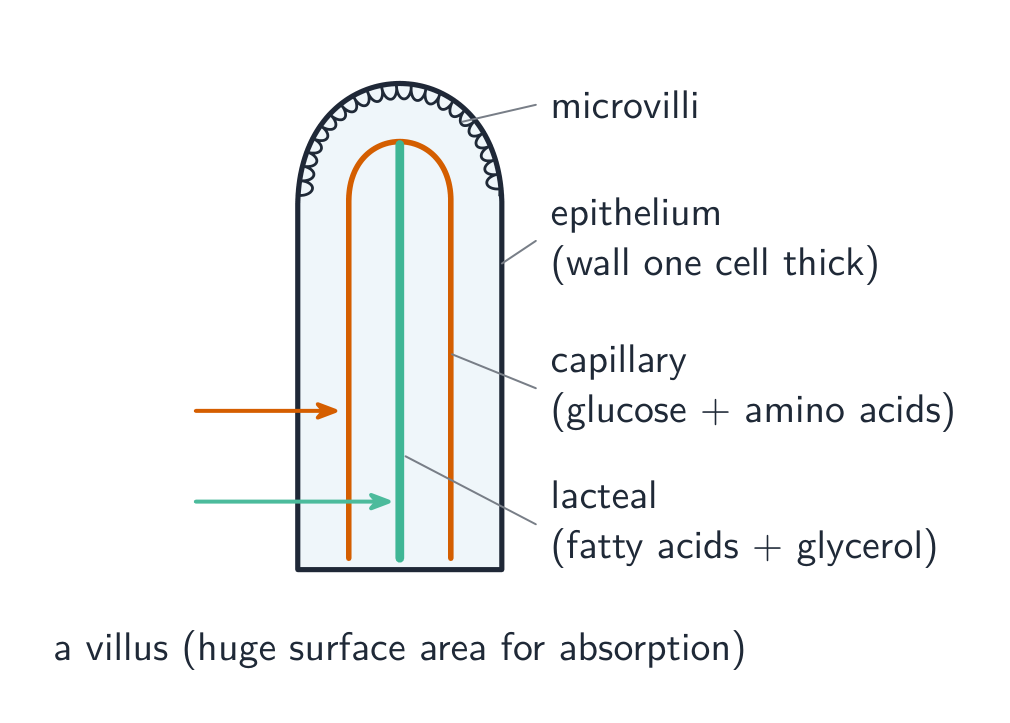
The inside of the small intestine is covered with millions of tiny finger-shaped villi 绒毛. Each villus is itself covered in much smaller microvilli 微绒毛. Together these give a huge surface area, so absorption is fast.

A single villus has:

  • a wall just one cell thick, so molecules have only a short distance to travel.
  • a network of capillaries 毛细血管 that carry away absorbed glucose and amino acids.
  • a lacteal 乳糜管 in the centre that carries away absorbed fatty acids and glycerol.
ไทย

สารอาหารที่ถูกย่อยจะถูกดูดซึมเข้าสู่กระแสเลือดในลำไส้เล็ก น้ำส่วนใหญ่ก็ถูกดูดซึมที่นี่เช่นกัน ลำไส้ใหญ่จะดูดซึมส่วนที่เหลือ เหลือเพียงอุจจาระแข็ง

รอยย้อย (villi) (ข้อมูลเสริม)

ภายในลำไส้เล็กปกคลุมไปด้วย **รอยย้อย (villi)**形似手指的小突起数量达数百万个。每个绒毛本身又覆盖着更小的 微绒毛。两者结合提供了巨大的表面积,因此吸收速度很快。

ขนตาดวงเดียวที่มีคำอธิบายลักษณะที่ปรับให้เหมาะกับการทำงาน: ไมโครวิลลัสเพื่อเพิ่มพื้นที่ผิวมากขึ้น, ผนังบางเพียงเซลล์เดียว, การไหลเวียนเลือดที่อุดมสมบูรณ์เพื่อนำสารอาหารออกไป, และท่อไขมัน (lacteal) ที่ดูดซึมไขมัน
ขนตาถูกปรับให้เหมาะสำหรับการดูดซึมอย่างรวดเร็ว: มีไมโครวิลลัส, ผนังบาง, การไหลเวียนเลือดที่อุดมสมบูรณ์ และท่อไขมัน

ขนตาดวงเดียวมี:

  • ผนังบางเพียงชั้นเซลล์เดียว ทำให้โมเลกุลต้องเดินทางระยะทางสั้น
  • 运输吸收的葡萄糖和氨基酸的毛细血管网络。
  • ท่อไขมัน (lacteal) ตรงกลางซึ่งนำกรดไขมันและกลีเซอรอลที่ถูกดูดซึมออกไป
单个绒毛:指状突起,具有单层细胞薄的壁,表面有微绒毛,吸收葡萄糖和氨基酸的毛细血管网,以及吸收脂肪酸和甘油的中性乳糜管
ขนตามีผนังบาง, Translucent capillary network และท่อไขมัน เพื่อการดูดซึมอย่างรวดเร็ว
Explore · ⁨สำรวจ⁩

Absorption at the villi · ⁨การดูดซึมที่ขน小肠⁩

The small intestine is lined with millions of villi that give a huge surface area for absorbing digested food. · ⁨ลำไส้เล็กบุด้วยขน小肠นับล้านซึ่งให้พื้นที่ผิวขนาดใหญ่สำหรับการดูดซึมอาหารที่ถูกย่อยแล้ว⁩

Vocabulary · ⁨คำศัพท์⁩ Train · ⁨ฝึกฝน⁩
English ไทย
villi/ˈvɪlaɪ/ ขนตามลำไส้
microvilli/ˈmaɪkrəʊvɪlaɪ/ ไมโครวิลไล
capillaries/ˈkæpɪləriz/ หลอดเลือดฝอย
lacteal/ˈlæktɪəl/ ลำเลียงไขมัน
7.5

Exam tips · ⁨ข้อแนะนำสำหรับการสอบ⁩

English
  • A balanced diet has the right amount of each part. Learn one source and one use for each.
  • Vitamin C ↔ scurvy; vitamin D ↔ rickets.
  • The five processes in order: ingestion → digestion → absorption → assimilation → egestion. Egestion (faeces) is not excretion.
  • Physical digestion makes pieces smaller (more surface area); chemical digestion uses enzymes to make molecules smaller and soluble.
  • amylase → sugars, protease → amino acids, lipase → fatty acids + glycerol. Stomach acid kills microorganisms and sets a low pH.
  • Villi and microvilli give a large surface area, and a thin wall gives a short distance — both make absorption faster.
ไทย
  • อาหารที่สมดุลต้องมีปริมาณที่เหมาะสมของแต่ละส่วน เรียนรู้แหล่งที่มาและการใช้ประโยชน์หนึ่งอย่างสำหรับแต่ละส่วน
  • วิตามินซี ↔ โรค اسکอร์เวีย; วิตามินดี ↔ โรคrachitis
  • กระบวนการทั้งห้าตามลำดับ: การกิน → การย่อย → การดูดซึม → การสังเคราะห์ขึ้นใหม่ → การขับถ่ายของเสีย การขับถ่ายของเสีย (อุจจาระ) ไม่ใช่ การขับถ่าย (excretion)
  • การย่อยทางกายภาพทำให้ชิ้นส่วนเล็กลง (เพิ่มพื้นที่ผิว); การย่อยทางเคมีใช้เอนไซม์ทำให้โมเลกุลเล็กลงและละลายน้ำได้
  • amylase → น้ำตาล, protease → กรดอะมิโน, lipase → กรดไขมัน + กลีเซอรอล. กรดในกระเพาะฆ่าจุลินทรีย์และสร้างค่า pH ต่ำ
  • ขนตาและไมโครวิลลัสให้พื้นที่ผิวยิ่งใหญ่, และผนังบางให้ระยะทางสั้น — ทั้งสองสิ่งทำให้การดูดซึมเร็วขึ้น

Interactive lessons on this topic · ⁨บทเรียนเชิงโต้ตอบสำหรับหัวข้อนี้⁩

Work through it step by step, with instant-check exercises. · ⁨ทำทีละขั้นตอน พร้อมแบบฝึกหัดตรวจสอบผลทันที⁩

Past Papers · ⁨ข้อสอบย้อนหลัง⁩

More topics in IGCSE Biology · ⁨Biology IGCSE⁩ · ⁨หัวข้อเพิ่มเติมใน IGCSE Biology · ⁨Biology IGCSE⁩⁩

Log in or create account · ⁨เข้าสู่ระบบหรือสร้างบัญชี⁩

IGCSE, A-Level & AP