Skip to content · ⁨ข้ามไปยังเนื้อหา⁩

Coordination and response · ⁨การประสานงานและการตอบสนอง⁩

IGCSE Biology · ⁨Biology IGCSE⁩ · Topic 14 · ⁨หัวข้อ 14⁩

Video lesson for this topic · ⁨บทเรียนวิดีโอสำหรับหัวข้อนี้⁩ Open the video page · ⁨เปิดหน้าวิดีโอ⁩
18:13

การประสานงานและการตอบสนอง

สัมผัสของร้อนมือคุณกำลังเคลื่อนที่ก่อนที่คุณจะรู้สึกเจ็บ นั่นคือระบบควบคุมของคุณหนึ่ง — ระบบเร็วที่ทำจากเส้นประสาท อีก…

English narration · English + 中文 subtitles burned in · ⁨การบรรยายภาษาอังกฤษ · คำบรรยายภาษาอังกฤษ + 中文 ลอยตัวบนภาพ⁩

14.1

The nervous system · ⁨ระบบประสาท⁩

Syllabus · ⁨หลักสูตร⁩
English
Core Supplement
1 State that electrical impulses travel along neurones
2 Describe the mammalian nervous system in terms of: (a) the central nervous system (CNS) consisting of the brain and the spinal cord (b) the peripheral nervous system (PNS) consisting of the nerves outside of the brain and spinal cord
3 Describe the role of the nervous system as coordination and regulation of body functions
4 Identify in diagrams and images sensory, relay and motor neurones
5 Describe a simple reflex arc in terms of: receptor, sensory neurone, relay neurone, motor neurone and effector
6 Describe a reflex action as a means of automatically and rapidly integrating and coordinating stimuli with the responses of effectors (muscles and glands)
7 Describe a synapse as a junction between two neurones 8 Describe the structure of a synapse, including the presence of vesicles containing neurotransmitter molecules, the synaptic gap and receptor proteins
9 Describe the events at a synapse as: (a) an impulse stimulates the release of neurotransmitter molecules from vesicles into the synaptic gap (b) the neurotransmitter molecules diffuse across the gap (c) neurotransmitter molecules bind with receptor proteins on the next neurone (d) an impulse is then stimulated in the next neurone
10 State that synapses ensure that impulses travel in one direction only
ไทย
แก่น เพิ่มเติม
1 ระบุว่า สัญญาณไฟฟ้าเดินทางไปตามประสาทเซลล์ (neurones)
2 อธิบายระบบประสาทของสัตว์เลี้ยงลูกด้วยนมโดยแบ่งเป็น: (ก) ระบบประสาทส่วนกลาง (CNS) ซึ่งประกอบด้วยสมองและไขสันหลัง (ข) ระบบประสาทส่วนปลาย (PNS) ซึ่งประกอบด้วยเส้นประสาทนอกสมองและไขสันหลัง
3 อธิบายบทบาทของระบบประสาทในฐานะการประสานงานและการควบคุมการทำงานของร่างกาย
4 ชี้ตำแหน่งประสาทเซลล์รับความรู้สึก ประสาทเชื่อมโยง และประสาทสั่งการในแผนภาพและรูปภาพ
5 อธิบายวงจรรับรู้พื้นฐาน (reflex arc) โดย提及: ตัวรับสัญญาณ, ประสาทเซลล์รับความรู้สึก, ประสาทเชื่อมโยง, ประสาทสั่งการ และอวัยวะทำงาน
6 อธิบายการตอบสนองแบบสะท้อน (reflex action) ว่าเป็น Means of automatically and rapidly integrating and coordinating stimuli with the responses of effectors (muscles and glands)
7 อธิบาย synapse ว่าเป็นจุดเชื่อมต่อระหว่างสองประสาทเซลล์ 8 อธิบายโครงสร้างของ synapse รวมถึง presence of vesicles containing neurotransmitter molecules, the synaptic gap and receptor proteins
9 อธิบายเหตุการณ์ที่เกิดขึ้นที่ synapse โดย提及: (ก) สัญญาณกระตุ้นให้ release of neurotransmitter molecules from vesicles into the synaptic gap (ข) neurotransmitter molecules diffusing across the gap (ค) neurotransmitter molecules binding with receptor proteins on the next neurone (ง) an impulse is then stimulated in the next neurone
10 ระบุว่า synapse ทำให้สัญญาณเดินทางได้ทางเดียวเท่านั้น

Source: Cambridge International syllabus · ⁨แหล่งที่มา: หลักสูตร Cambridge International⁩

English
The reflex arc

Your body must coordinate 协调 all its parts and react to changes. The nervous system 神经系统 does this using fast electrical impulses 电脉冲 that travel along neurones 神经元 (nerve cells). It has two parts:

  • the central nervous system 中枢神经系统 (CNS) — the brain 大脑 and the spinal cord 脊髓.
  • the peripheral nervous system 周围神经系统 (PNS) — all the nerves outside the brain and spinal cord.

The nervous system coordinates and regulates 调节 the body's functions.

ไทย
Reflex arc
ภาพสแกนสมองมนุษย์
สมองประสานงานกับร่างกายผ่านระบบประสาท

ร่างกายของคุณต้อง ประสานงาน ส่วนต่างๆ ทั้งหมดและตอบสนองต่อการเปลี่ยนแปลง ระบบประสาท ทำสิ่งนี้โดยใช้ สัญญาณไฟฟ้า ที่รวดเร็วซึ่งเดินทางตาม เซลล์ประสาท (เซลล์เส้นประสาท) มีสองส่วน:

  • ระบบประสาทส่วนกลาง (CNS) — สมอง และ ไขสันหลัง
  • ระบบประสาทส่วนปลาย (PNS) — เส้นประสาททั้งหมดนอกเหนือจากสมองและไขสันหลัง

ระบบประสาททำหน้าที่ประสานงานและ ควบคุม การทำงานของร่างกาย

Vocabulary · ⁨คำศัพท์⁩ Train · ⁨ฝึกฝน⁩
English ไทย
brain/breɪn/ สมอง
spinal cord/ˈspaɪnl kɔːd/ ไขสันหลัง
peripheral nervous system/pəˈrɪfərəl ˈnɜːvəs ˈsɪstəm/ ระบบประสาทส่วนปลาย
regulates/ˈreɡjʊleɪts/ ปรับสมดุล
sensory neurones/ˈsensəri ˈnjuːrəʊnz/ เซลล์ประสาทรับความรู้สึก
relay neurones/ˈriːleɪ ˈnjuːrəʊnz/ เซลล์ประสาทกลาง
motor neurones/ˈməʊtə ˈnjuːrəʊnz/ เซลล์ประสาทสั่งการ
reflex/ˈriːfleks/ reflex
response/rɪˈspɒns/ การตอบสนอง
stimulus/ˈstɪmjʊləs/ สิ่งเร้า
reflex arc/ˈriːfleks ɑːk/ วงจอปฏิกิริยาสะท้อน
14.1

Neurones and the reflex arc · ⁨เซลล์ประสาทและวงจบทนทาน⁩

English

There are three kinds of neurone:

  • sensory neurones 感觉神经元 — carry impulses from receptors to the CNS.
  • relay neurones 中间神经元 — pass impulses on inside the CNS.
  • motor neurones 运动神经元 — carry impulses from the CNS to effectors.

A reflex 反射 action is a fast, automatic response 反应 to a stimulus 刺激 (a change). It follows a fixed path, the reflex arc 反射弧:

receptor 感受器 → sensory neurone → relay neurone → motor neurone → effector 效应器 (a muscle 肌肉 or gland 腺体)

ไทย
ภาพจุลทรรศน์ของเซลล์ประสาท
เซลล์ประสาท (เซลล์เส้นประสาท) นำส่งสัญญาณไฟฟ้าไปทั่วร่างกาย

มีเซลล์ประสาทสามชนิด:

  • เซลล์ประสาทรับความรู้สึก — นำส่งสัญญาณจากตัวรับไปสู่ CNS
  • เซลล์ประสาทเชื่อมโยง — ส่งต่อสัญญาณภายใน CNS
  • เซลล์ประสาทสั่งการ — นำส่งสัญญาณจาก CNS ไปยังอวัยวะเป้าหมาย

การกระทำแบบทนทานเป็น การตอบสนอง ที่รวดเร็วและเป็นอัตโนมัติต่อ สิ่งกระตุ้น (การเปลี่ยนแปลง) มันเดินไปตามเส้นทางที่กำหนดไว้ล่วงหน้า ซึ่งเรียกว่า วงจบทนทาน:

ตัวรับ → เซลล์ประสาทรับความรู้สึก → เซลล์ประสาทเชื่อมโยง → เซลล์ประสาทสั่งการ → อวัยวะเป้าหมาย (กล้ามเนื้อ หรือ ต่อม)

วงจรการตอบสนองอัตโนมัติ: กระตุ้น由 skin上的 receptor ตรวจจับ; impulse travels along a sensory neurone ไปยัง relay neurone ในไขสันหลัง; แล้ว travels along a motor neurone ไปยัง effector muscle
ในวงจบทนทาน สัญญาณจะผ่านจากตัวรับ → รับความรู้สึก → เชื่อมโยง → สั่งการ → อวัยวะเป้าหมาย
Explore · ⁨สำรวจ⁩

The reflex arc · ⁨วงจรการตอบสนองแบบสะท้อนกลับ⁩

A reflex is a fast, automatic response — the signal takes a short cut through the spinal cord. · ⁨การตอบสนองแบบสะท้อนกลับคือการตอบสนองที่รวดเร็วและเป็นอัตโนมัติ — สัญญาณจะตัดผ่านไขสันหลัง⁩

Vocabulary · ⁨คำศัพท์⁩ Train · ⁨ฝึกฝน⁩
English ไทย
receptor/rɪˈseptə/ ตัวรับ (receptor)
effector/ɪˈfektə/ อวัยวะตอบสนอง
muscle/ˈmʌsl/ กล้ามเนื้อ
gland/ɡlænd/ ต่อม
14.1

Synapses (Supplement) · ⁨ซินแนปส์ (ส่วนเสริม)⁩

English

A synapse 突触 is a junction (a tiny gap) between two neurones. At the end of one neurone are vesicles 囊泡 holding neurotransmitter 神经递质 molecules. Across the synaptic gap 突触间隙, the next neurone has receptor proteins 受体蛋白.

Events at a synapse:

  1. an impulse arrives and makes the vesicles release neurotransmitter into the synaptic gap.
  2. the neurotransmitter molecules diffuse 扩散 across the gap.
  3. they bind to the receptor proteins on the next neurone.
  4. this starts a new impulse in the next neurone.

Synapses make impulses travel in one direction only.

ไทย

ซินแนปส์ คือจุดเชื่อมต่อ (ช่องว่างเล็กๆ) ระหว่างเซลล์ประสาทสองเซลล์ ที่ปลายหนึ่งของเซลล์ประสาทจะมี เวสิเคิล ที่บรรจุโมเลกุล สารสื่อประสาท ข้าม ช่องว่างซินแนปส์ เซลล์ประสาทถัดไปจะมี โปรตีนตัวรับ

เหตุการณ์ที่ซินแนปส์:

  1. สัญญาณมาถึงและทำให้เวสิเคิลปล่อยสารสื่อประสาทเข้าสู่ช่องว่างซินแนปส์
  2. โมเลกุลสารสื่อประสาท แพร่ ผ่านช่องว่าง
  3. พวกมันจะจับกับโปรตีนรีเซปเตอร์บนนิวรอนถัดไป
  4. สิ่งนี้จะเริ่มสัญญาณใหม่ในนิวรอนถัดไป

ซินแนปส์ทำให้สัญญาณเดินทางได้เพียง ทิศทางเดียวเท่านั้น

ซินแนปส์: วезิกูลในนิวรอนแรกปล่อยสารสื่อประสาทเข้าสู่ช่องว่าง ซึ่งสารนั้นจะแพร่ข้ามไปยังโปรตีนรีเซปเตอร์บนนิวรอนถัดไป ทำให้กระแสไฟฟ้าสามารถเดินทางได้ทางเดียวเท่านั้น
ที่ซินาปส์神经递质diffuses across the gap, so impulses travel one way only
Explore · ⁨สำรวจ⁩

Across the synapse · ⁨ข้ามซินาปส์⁩

Neurons don't touch — the impulse crosses the tiny gap using a chemical messenger. · ⁨เซลล์ประสาทไม่สัมผัสกัน — สัญญาณข้ามช่องว่างเล็กๆ โดยใช้สารสื่อเคมี⁩

Vocabulary · ⁨คำศัพท์⁩ Train · ⁨ฝึกฝน⁩
English ไทย
synapse/ˈsɪnæps/ ซินาปส์ (synapse)
vesicles/ˈvesɪklz/ vesicles
diffuse/dɪˈfjuːz/ แพร่กระจาย
sense organs/sens ˈɔːɡənz/ อวัยวะรับความรู้สึก
14.2

Sense organs and the eye · ⁨อวัยวะรับรู้และดวงตา⁩

Syllabus · ⁨หลักสูตร⁩
English
Core Supplement
1 Describe sense organs as groups of receptor cells responding to specific stimuli: light, sound, touch, temperature and chemicals
2 Identify in diagrams and images the structures of the eye, limited to: cornea, iris, pupil, lens, retina, optic nerve and blind spot
3 Describe the function of each part of the eye, limited to: (a) cornea – refracts light (b) iris – controls how much light enters the pupil (c) lens – focuses light on to the retina (d) retina – contains light receptors, some sensitive to light of different colours (e) optic nerve – carries impulses to the brain
4 Explain the pupil reflex, limited to changes in light intensity and pupil diameter 5 Explain the pupil reflex in terms of the antagonistic action of circular and radial muscles in the iris
6 Explain accommodation to view near and distant objects in terms of the contraction and relaxation of the ciliary muscles, tension in the suspensory ligaments, shape of the lens and refraction of light
7 Describe the distribution of rods and cones in the retina of a human
8 Outline the function of rods and cones, limited to: (a) greater sensitivity of rods for night vision (b) three different kinds of cones, absorbing light of different colours, for colour vision
9 Identify in diagrams and images the position of the fovea and state its function
ไทย
แก่น เพิ่มเติม
1 อธิบายอวัยวะรับความรู้สึกว่าเป็นกลุ่มของเซลล์รับสัญญาณที่ตอบสนองต่อสิ่งเร้าเฉพาะ: แสง เสียง สัมผัส อุณหภูมิ และสารเคมี
2 ชี้ตำแหน่งโครงสร้างของตาในแผนภาพและรูปภาพ โดยจำกัดไว้เฉพาะ: cornea, iris, pupil, lens, retina, optic nerve และ blind spot
3 อธิบายหน้าที่ของแต่ละส่วนของตา โดยจำกัดไว้เฉพาะ: (ก) cornea – bend light (ข) iris – control how much light enters the pupil (ค) lens – focus light onto the retina (ง) retina – contain light receptors, some sensitive to light of different colours (จ) optic nerve – carry impulses to the brain
4 อธิบายการตอบสนองของรูม่านตา (pupil reflex) โดยจำกัดไว้เฉพาะการเปลี่ยนแปลงของความเข้มแสงและขนาดของรูม่านตา 5 อธิบายการตอบสนองของรูม่านตาโดย提及การกระทำตรงข้ามกันของ circular และ radial muscles ใน iris
6 อธิบายการปรับโฟกัส (accommodation) เพื่อมองวัตถุใกล้และไกล โดย提及การหดและคลายตัวของ ciliary muscles, tension in the suspensory ligaments, shape of the lens และ refraction of light
7 อธิบายการกระจายตัวของ rods และ cones ใน retina ของมนุษย์
8 สรุปหน้าที่ของ rods และ cones โดยจำกัดไว้เฉพาะ: (ก) ความไวสูงของ rods สำหรับ seeing at night (ข) rod and cones, absorbing light of different colours, for colour vision
9 ชี้ตำแหน่ง fovea ในแผนภาพและรูปภาพและระบุหน้าที่ของมัน

Source: Cambridge International syllabus · ⁨แหล่งที่มา: หลักสูตร Cambridge International⁩

English

Sense organs 感觉器官 are groups of receptor cells that respond to one kind of stimulus — light, sound, touch, temperature or chemicals. The eye responds to light.

Parts of the eye

Part Function
cornea 角膜 refracts 折射 (bends) the light as it enters
iris 虹膜 controls how much light enters the pupil 瞳孔
lens 晶状体 focuses the light onto the retina
retina 视网膜 contains light receptors, some sensitive to different colours
optic nerve 视神经 carries the impulses to the brain
blind spot 盲点 where the optic nerve leaves the eye; it has no receptors

The pupil reflex

In bright light the pupil gets smaller, to protect the retina. In dim light it gets wider, to let more light in. (Supplement) This is done by two sets of antagonistic 拮抗 muscles in the iris: the circular muscles 环肌 and the radial muscles 辐射肌. In bright light the circular muscles contract and the pupil narrows; in dim light the radial muscles contract and the pupil widens.

Accommodation (Supplement)

Accommodation 视觉调节 is changing the shape of the lens to focus on near or far objects, using the ciliary muscles 睫状肌 and the suspensory ligaments 悬韧带:

  • near object: the ciliary muscles contract, the ligaments slacken, and the lens becomes fatter — more refraction.
  • far object: the ciliary muscles relax, the ligaments pull tight, and the lens becomes thinner — less refraction.

Rods and cones (Supplement)

The retina has two kinds of light receptor:

  • rods 视杆细胞 — very sensitive, good for vision 视觉 in dim light (night vision); they do not detect colour.
  • cones 视锥细胞 — three kinds, each absorbing a different colour, giving colour vision; they work best in bright light.

Cones are packed most densely at the fovea 中央凹, the part of the retina that gives the sharpest image.

ไทย

อวัยวะรับรู้ เป็นกลุ่มของเซลล์ตัวรับที่ตอบสนองต่อสิ่งกระตุ้นชนิดหนึ่ง — แสง เสียง สัมผัส อุณหภูมิ หรือสารเคมี ดวงตาตอบสนองต่อแสง

ส่วนประกอบของดวงตา

ส่วนประกอบ หน้าที่
** قرنตา** หักเห (งอ) แสงเมื่อเข้าสู่ตา
** ม่านตา** ควบคุมปริมาณแสงที่เข้าสู่ รูม่านตา
** เลนส์** มุ่งเน้นแสง onto retina
** เรตินา** มีตัวรับแสง บางส่วนไวต่อสีต่างกัน
เส้นประสาทตา นำส่งสัญญาณไปยังสมอง
จุดบอด 的地方ที่เส้นประสาทตาออกจากตา; ไม่มีตัวรับ
ตาแบบตัดขวาง: แสงเข้าผ่านกระจกตา ผ่านรูม่านตา (ช่องว่างในม่านตา) แล้วเลนส์จะโฟกัสภาพลงบนจอประสาทตาด้านหลัง และสัญญาณจะออกตามเส้นประสาทตา
แสงถูกโฟกัสโดยกระจกตาและเลนส์ onto the retina; impulses leave by the optic nerve
ภาพถ่ายมาโครของตามนุษย์จริง แสดงรูม่านตาสีดำ ลวดลายสีของม่านตา และ巩膜สีขาว
ด้านหน้าของดวงตาจริง: รูม่านตาสีดำคือรูที่แสงเข้า และม่านตาที่มีสีรอบๆ ควบคุมความกว้างของรูม่านตา

การสะท้อนของรูม่านตา

ในแสงสว่างรูม่านตาจะ เล็กลง เพื่อปกป้องเรตินา ในแสงน้อยมันจะ ขยายใหญ่ขึ้น เพื่อให้แสงเข้ามากขึ้น (ส่วนเสริม) สิ่งนี้ทำโดยกล้ามเนื้อคู่ ตรงกันข้าม สองชุดในม่านตา: กล้ามเนื้อวงกลม และ กล้ามเนื้อรัศมี ในแสงสว่างกล้ามเนื้อวงกลมหดตัวและรูม่านตาแคบลง; ในแสงน้อยกล้ามเนื้อรัศมีหดตัวและรูม่านตาขยายใหญ่ขึ้น

การปรับโฟกัส (ส่วนเสริม)

การปรับโฟกัส คือการเปลี่ยนรูปร่างของเลนส์เพื่อโฟกัสวัตถุใกล้หรือไกล โดยใช้ กล้ามเนื้อซีลียารี และ สายยึด:

  • วัตถุใกล้: กล้ามเนื้อซีลียารีหดตัว สายยืดหย่อน และเลนส์หนาขึ้น — หักเหมากขึ้น
  • วัตถุไกล: กล้ามเนื้อซีลียารีคลายตัว สายดึงตึง และเลนส์บางลง — หักเหลดลง

รอดและกราด (ส่วนเสริม)

เรตินามีตัวรับแสงสองชนิด:

  • รอด — มีความไวสูง เหมาะสำหรับการ มองเห็น ในแสงน้อย (การมองเห็นกลางคืน); ไม่ตรวจจับสี
  • กราด — สามชนิด ดูดซับสีต่างกัน ให้การมองเห็นสี; ทำงานได้ดีที่สุดในแสงสว่าง

กราดอัดแน่นที่สุดที่ ฟิวเวอา ซึ่งเป็นส่วนหนึ่งของเรตินาที่ให้ภาพที่คมชัดที่สุด

Explore · ⁨สำรวจ⁩

Explore the eye · ⁨สำรวจโครงสร้างตา⁩

Tap each part to follow light through the eye — from the cornea and lens that focus it to the retina that detects it. · ⁨แตะแต่ละส่วนเพื่อดูเส้นทางแสงผ่านตา — จากกระจกตาและเลนส์ที่โฟกัสภาพไปยังจอประสาทตาที่ตรวจจับภาพ⁩

Explore · ⁨สำรวจ⁩

Accommodation — focusing the eye · ⁨การปรับโฟกัส — การโฟกัสของตา⁩

The eye changes the shape of its lens to focus on near or far objects. · ⁨ตาเปลี่ยนรูปร่างของเลนส์เพื่อโฟกัสวัตถุใกล้หรือไกล⁩

Vocabulary · ⁨คำศัพท์⁩ Train · ⁨ฝึกฝน⁩
English ไทย
retina/ˈretɪnə/ retina
optic nerve/ˈɒptɪk nɜːv/ optic nerve
blind spot/blaɪnd spɒt/ จุดบอด
antagonistic/ænˈtæɡənɪstɪk/ ทำงานตรงข้ามกัน
circular muscles/ˈsɜːkjʊlə ˈmʌslz/ กล้ามเนื้อวงกลม
radial muscles/ˈreɪdɪəl ˈmʌslz/ กล้ามเนื้อรัศมี
14.3

Hormones · ⁨ฮอร์โมน⁩

Syllabus · ⁨หลักสูตร⁩
English
Core Supplement
1 Describe a hormone as a chemical substance, produced by a gland and carried by the blood, which alters the activity of one or more specific target organs
2 Identify in diagrams and images specific endocrine glands and state the hormones they secrete, limited to: (a) adrenal glands and adrenaline (b) pancreas and insulin (c) testes and testosterone (d) ovaries and oestrogen 5 State that glucagon is secreted by the pancreas
3 Describe adrenaline as the hormone secreted in ‘fight or flight’ situations and its effects, limited to: (a) increased breathing rate (b) increased heart rate (c) increased pupil diameter 6 Describe the role of adrenaline in the control of metabolic activity, limited to: (a) increasing the blood glucose concentration (b) increasing heart rate
4 Compare nervous and hormonal control, limited to speed of action and duration of effect
ไทย
แก่น เพิ่มเติม
1 อธิบายฮอร์โมนว่าเป็นสารเคมีที่ถูกผลิตโดยต่อมและลำเลียงโดยเลือด ซึ่งเปลี่ยน activity ของ one or more specific target organs
2 ชี้ตำแหน่งต่อม endocrine เฉพาะเจาะจงในแผนภาพและรูปภาพและระบุ hormones ที่ they secrete โดยจำกัดไว้เฉพาะ: (ก) adrenal glands และ adrenaline (ข) pancreas และ insulin (ค) testes และ testosterone (ง) ovaries และ oestrogen 5 ระบุว่า glucagon ถูก分泌โดย pancreas
3 อธิบายอะดรีนาลีนในฐานะฮอร์โมนที่ถูกหลั่งในสถานการณ์ ‘สู้หรือหนี’ และผลที่เกิดขึ้น โดยจำกัดเฉพาะ: (ก) อัตราการหายใจเพิ่มขึ้น (ข) อัตราการเต้นของหัวใจเพิ่มขึ้น (ค) เส้นผ่านศูนย์กลางของรูม่านตาขยายใหญ่ขึ้น 6 อธิบายบทบาทของอะดรีนาลีนในการควบคุมกิจกรรมทางเมแทบอลิซึม โดยจำกัดเฉพาะ: (ก) การเพิ่มระดับกลูโคสในเลือด (ข) การเพิ่มอัตราการเต้นของหัวใจ
4 เปรียบเทียบการควบคุมด้วยระบบประสาทและการควบคุมด้วยฮอร์โมน โดยจำกัดเฉพาะความเร็วในการกระทำและระยะเวลาของผลลัพธ์

Source: Cambridge International syllabus · ⁨แหล่งที่มา: หลักสูตร Cambridge International⁩

English

A hormone 激素 is a chemical, made by a gland and carried in the blood, that changes the activity of one or more target organs 靶器官. Hormones are made by endocrine glands 内分泌腺, which release them straight into the blood.

Gland Hormone Main effect
adrenal glands 肾上腺 adrenaline 肾上腺素 prepares the body for action
pancreas 胰腺 insulin 胰岛素 (and glucagon 胰高血糖素) control blood glucose 葡萄糖
testes 睾丸 testosterone 睾酮 male development
ovaries 卵巢 oestrogen 雌激素 female development

Adrenaline is released in 'fight or flight' situations, such as fear or danger. It increases the breathing rate, the heart rate 心率, the blood glucose concentration 浓度 and the pupil diameter, getting the body ready to act.

ไทย

ฮอร์โมน เป็นสารเคมีผลิตโดยต่อมและพาไปในเลือดที่เปลี่ยนกิจกรรมของ อวัยวะเป้าหมาย หนึ่งหรือหลายชนิด ฮอร์โมนผลิตโดย ต่อมเอนโดครีน ซึ่งปล่อยมัน直接进入血液

ต่อม ฮอร์โมน ผลหลัก
ต่อม suprarenal อะดรีนาลีน เตรียมร่างกายสำหรับการกระทำ
ตับอ่อน อินซูลิน (และ กลูคาگون) ควบคุม กลูโคส ในเลือด
อัณฑะ เทสโทสเตอโรน การพัฒนาเพศชาย
รังไข่ เอสโตรเจน การพัฒนาเพศหญิง

อะดรีนาลีนถูกปล่อยในสถานการณ์ 'สู้หรือหนี' เช่น ความกลัวหรืออันตราย เพิ่มอัตราการหายใจ อัตราการเต้นของหัวใจ ความเข้มข้นของกลูโคสในเลือดและเส้นผ่านศูนย์กลางของรูม่านตา เตรียมร่างกายให้พร้อมที่จะกระทำ

ต่อมหมวกไตหลั่งอะดรีนาลีนเข้าสู่เลือด ซึ่งมีผลต่ออวัยวะเป้าหมายหลายชนิด: หัวใจเต้นเร็วขึ้น การหายใจลึกขึ้น และตับปล่อยกลูโคส เพื่อเตรียมพร้อมให้ร่างกายทำงาน
อะดรีนาลีนเตรียมร่างกายสำหรับการกระทำโดย作用于หลายอวัยวะเป้าหมาย
Explore · ⁨สำรวจ⁩

How hormones work · ⁨วิธีที่ฮอร์โมนทำงาน⁩

Hormones are chemical messengers carried in the blood — slower than nerves, but longer-lasting. · ⁨ฮอร์โมนคือสารสื่อเคมีที่ขนส่งในเลือด — ช้ากว่าเส้นประสาท แต่ติดทนนานกว่า⁩

Vocabulary · ⁨คำศัพท์⁩ Train · ⁨ฝึกฝน⁩
English ไทย
adrenaline/əˈdrenəlɪn/ อะดรีนาลีน
pancreas/ˈpæŋkrɪəs/ ตับอ่อน
14.3

Nervous control vs hormonal control · ⁨การควบคุมด้วยระบบประสาท vs การควบคุมด้วยฮอร์โมน⁩

English
Nervous control Hormonal control
speed very fast slower
duration 持续时间 short-lived longer-lasting
how it travels electrical impulses along neurones chemicals in the blood
ไทย
การควบคุมด้วยระบบประสาท การควบคุมด้วยฮอร์โมน
ความเร็ว เร็วมาก ช้ากว่า
ระยะเวลา สั้นๆ ยาวนานกว่า
วิธีการส่งสัญญาณ สัญญาณไฟฟ้าตามเส้นประสาท สารเคมีในเลือด
การควบคุมด้วยระบบประสาทส่งสัญญาณเป็น脉冲ไฟฟ้าตามเส้นประสาท รวดเร็วและสั้นๆ; การควบคุมด้วยฮอร์โมนส่งสัญญาณเป็นสารเคมีในเลือด ช้ากว่าและยาวนานกว่า
การควบคุมด้วยระบบประสาทรวดเร็วแต่สั้น; การควบคุมด้วยฮอร์โมนช้าแต่ยาวนาน
14.4

Homeostasis · ⁨Homeostasis (สมดุลภายในร่างกาย)⁩

Syllabus · ⁨หลักสูตร⁩
English
Core Supplement
1 Describe homeostasis as the maintenance of a constant internal environment 3 Explain the concept of homeostatic control by negative feedback with reference to a set point
2 State that insulin decreases blood glucose concentration 4 Describe the control of blood glucose concentration by the liver and the roles of insulin and glucagon
5 Outline the treatment of Type 1 diabetes
6 Identify in diagrams and images of the skin: hairs, hair erector muscles, sweat glands, receptors, sensory neurones, blood vessels and fatty tissue
7 Describe the maintenance of a constant internal body temperature in mammals in terms of: insulation, sweating, shivering and the role of the brain
8 Describe the maintenance of a constant internal body temperature in mammals in terms of vasodilation and vasoconstriction of arterioles supplying skin surface capillaries
ไทย
แก่น เพิ่มเติม
1 อธิบาย homeostasis ว่าเป็นการรักษาสภาพแวดล้อมภายในให้คงที่ 3 อธิบายแนวคิดของการควบคุม homeostasis ผ่านกลไกปฏิกิริยาลบ (negative feedback) พร้อมยกตัวอย่างค่าเป้าหมาย (set point)
2 ระบุว่าอินซูลินช่วยลดระดับกลูโคสในเลือดลง 4 อธิบายการควบคุมระดับกลูโคสในเลือดโดยตับ และบทบาทของอินซูลินกับกลูคาโกน
5 สรุปแนวทางการรักษาโรคเบาหวานชนิดที่ 1
6 ชี้ระบุในแผนภาพและรูปภาพของผิวหนัง ได้แก่: ขน, กล้ามเนื้อยกขน, ต่อมเหงื่อ, ตัวรับความรู้สึก, เซลล์ประสาทรับความรู้สึก, หลอดเลือด และเนื้อเยื่อไขมัน
7 อธิบายการรักษาอุณหภูมิภายในร่างกายให้คงที่ในสัตว์เลี้ยงลูกด้วยนม ในแง่ของ: การกันความร้อน, การออกเหงื่อ, การสั่นรุ่ม และบทบาทของสมอง
8 อธิบายการรักษาอุณหภูมิภายในร่างกายให้คงที่ในสัตว์เลี้ยงลูกด้วยนม ในแง่ของการขยายหลอดเลือด (vasodilation) และการหดตัวของหลอดเลือด (vasoconstriction) ของหลอดเลือดฝอยที่ผิวหน้า

Source: Cambridge International syllabus · ⁨แหล่งที่มา: หลักสูตร Cambridge International⁩

English
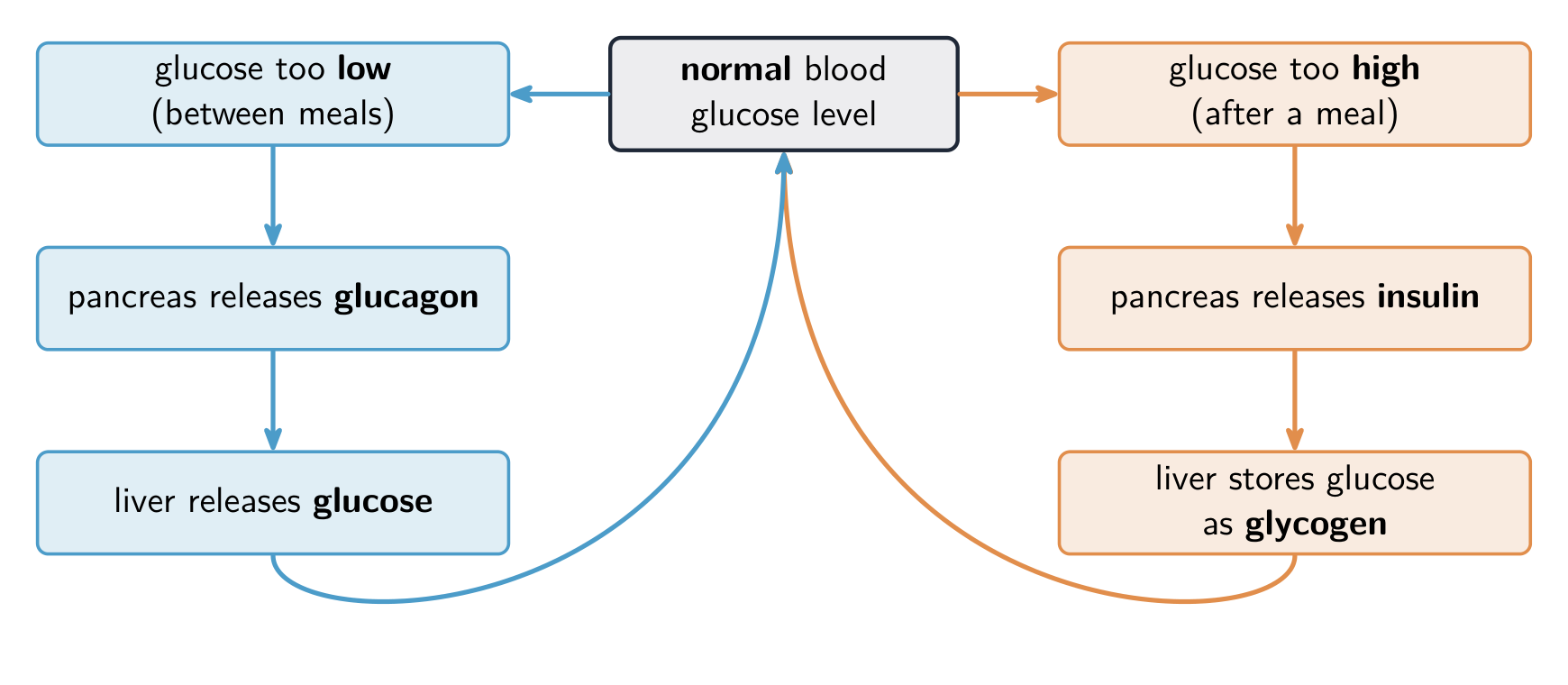
Negative feedback: blood glucose

Homeostasis 稳态 is keeping a constant internal environment 环境 inside the body — for example a steady temperature and a steady blood glucose level.

(Supplement) Homeostasis works by negative feedback 负反馈: when a value moves away from its set point 设定点, the body acts to bring it back. The change itself triggers the correction.

Controlling blood glucose

The liver 肝脏 and the pancreas keep blood glucose steady:

  • insulin lowers blood glucose after a meal — the liver stores the glucose as glycogen 糖原.
  • (Supplement) glucagon raises blood glucose between meals — the liver releases glucose.

In Type 1 diabetes 糖尿病 the pancreas cannot make insulin, so blood glucose rises too high. It is treated with insulin injections and a carefully planned diet.

Worked example. Blood glucose rises sharply after a meal, then falls back to normal over the next two hours. Name the organs and the hormone involved, and say what they do. The pancreas detects the rise and releases insulin. Insulin makes the liver take glucose out of the blood and store it as glycogen, so the level falls back to normal. Between meals the opposite loop runs: the pancreas releases glucagon and the liver releases glucose again. Keep the two words apart - insulin is the hormone, glycogen is the store. Swapping them is the classic error.

Controlling body temperature (Supplement)

The brain detects the body temperature 温度 and keeps it steady. The skin helps:

Structure Role
sweat glands 汗腺 make sweat; as it evaporates it cools the skin (sweating 出汗)
hair erector muscles 立毛肌 raise the hairs to trap a layer of air
blood vessels 血管 change how much blood flows near the skin surface
fatty tissue 脂肪组织 gives insulation 隔热 to reduce heat loss

When you are too hot: you sweat, and the arterioles 小动脉 widen (vasodilation 血管舒张) so more blood flows to the skin capillaries 毛细血管 and loses heat.

When you are too cold: you shiver 颤抖 (the muscles make heat), and the arterioles narrow (vasoconstriction 血管收缩) so less blood reaches the surface, keeping heat in.

ไทย
ปฏิกิริยาย้อนกลับเชิงลบ: กลูโคสในเลือด

Homeostasis คือการรักษาสภาพแวดล้อมภายในร่างกายให้คงที่ — เช่น อุณหภูมิที่เสถียรและระดับน้ำตาลในเลือดที่คงที่

(ส่วนเสริม) Homeostasis ทำงานผ่านกลไก negative feedback: เมื่อค่าใดค่าหนึ่งเบี่ยงเบนออกจาก จุดตั้งต้น (set point) ร่างกายจะตอบสนองเพื่อคืนค่ากลับสู่ปกติ การเปลี่ยนแปลงนั้นเองที่เป็นตัวกระตุ้นให้เกิดการแก้ไข

การควบคุมระดับน้ำตาลในเลือด

ตับและ** pankreas (ต่อมพânciaเอส )** ช่วยรักษาความเสถียรของระดับน้ำตาลในเลือด:

  • อินซูลิน ลดระดับน้ำตาลในเลือดหลังมื้ออาหาร — ตับจะเก็บกักน้ำตาลในรูปแบบของ ไกลโคเจน
  • (ส่วนเสริม) กลูคาگون เพิ่มระดับน้ำตาลในเลือดระหว่างมื้ออาหาร — ตับจะปล่อยน้ำตาลออกมา
วงจรป้อนกลับ: ถ้าระดับน้ำตาลในเลือดสูงเกินไป pankreas จะหลั่งอินซูลินและตับจะเก็บน้ำตาลเป็นไกลโคเจน; ถ้าต่ำเกินไป pankreas จะหลั่งกลูคาگونและตับจะปล่อยน้ำตาล; ทั้งสองกรณีจะคืนค่าสู่ปกติ
อินซูลินลดกลูโคสในเลือดและกลูคาгонเพิ่มระดับ使其接近正常水平

ในโรค เบาหวานชนิดที่ 1 pankreas ไม่สามารถสร้างอินซูลินได้ ทำให้ระดับน้ำตาลในเลือดสูงเกินปกติ รักษาด้วยการฉีดอินซูลินและการจัดอาหารอย่างพิถีพิถัน

ตัวอย่างแบบฝึกหัด. ระดับน้ำตาลในเลือดเพิ่มขึ้นอย่างรวดเร็วหลังมื้ออาหาร แล้วค่อยๆ กลับสู่ปกติภายในเวลาสองชั่วโมงถัดมา ระบุอวัยวะและฮอร์โมนที่เกี่ยวข้อง และอธิบายหน้าที่它们在它们。 Pankreas ตรวจจับการเพิ่มขึ้นและหลั่ง อินซูลิน。 อินซูลินทำให้ ตับ ดึงน้ำตาลออกจากเลือดและเก็บเป็น ไกลโคเจน ดังนั้นระดับจึงลดลงกลับมาสู่ปกติ ระหว่างมื้ออาหารจะมีวงจรตรงกันข้าม: Pankreas หลั่งกลูคาگونและตับจะปล่อยน้ำตาลอีกครั้ง ระวังแยกคำสองคำนี้ให้ชัด - อินซูลินคือ hormone (ฮอร์โมน), ไกลโคเจนคือ store (แหล่งเก็บ) การสลับกันคือข้อผิดพลาดที่พบบ่อยที่สุด

การควบคุมอุณหภูมิร่างกาย (ส่วนเสริม)

สมองตรวจจับ อุณหภูมิ ของร่างกายและรักษาให้อยู่ในระดับคงที่ ผิวหนังช่วยในการ调控:

โครงสร้าง หน้าที่
ต่อมเหงื่อ ผลิตเหงื่อ; เมื่อเหงื่อระเหยจะทำให้ผิวเย็น (การ.selting)
กล้ามเนื้อยกขน ยกขนขึ้นเพื่อกักเก็บชั้นอากาศ
หลอดเลือด เปลี่ยนปริมาณเลือดที่ไหลใกล้พื้นผิวผิวหนัง
เนื้อเยื่อไขมัน ให้ ฉนวนกันความร้อน เพื่อลดการสูญเสียความร้อน

เมื่อคุณ ร้อนเกินไป: คุณ.selting และ arterioles ขยายตัว (vasodilation) เพื่อให้เลือดไหลเข้าสู่ capillaries ของผิวหนังมากขึ้นและสูญเสียความร้อน

เมื่อคุณ หนาวเกินไป: คุณ shivering (กล้ามเนื้อสร้างความร้อน) และ arterioles หดตัว (vasoconstriction) เพื่อให้เลือด reaching surfaces น้อยลง รักษาความร้อนไว้ในร่างกาย

ร้อนเกินไปนำไปสู่.selting และ vasodilation เพื่อสูญเสียความร้อน; หนาวเกินไปนำไปสู่.shivering และ vasoconstriction เพื่อรักษาความร้อน; ทั้งสองกรณีจะคืนร่างกายสู่ประมาณ 37 องศา
Negative feedback: การเปลี่ยนแปลงเบี่ยงเบนจากประมาณ 37 °C จะกระตุ้นการตอบสนองที่จะย้อนกลับการเปลี่ยนแปลงนั้น คืนร่างกายสู่สถานะปกติ
Explore · ⁨สำรวจ⁩

Negative feedback · ⁨ฟีดแบ็กเชิงลบ⁩

Push body temperature away from its set point and watch negative feedback bring it back to normal. · ⁨ดันอุณหภูมิตกลงนอกจุดที่ตั้งไว้และดู ปฏิกิริยาตอบกลับเชิงลบ นำมันกลับมาปกติ⁩

Vocabulary · ⁨คำศัพท์⁩ Train · ⁨ฝึกฝน⁩
English ไทย
hormone/ˈhɔːməʊn/ ฮอร์โมน
target organs/ˈtɑːɡɪt ˈɔːɡənz/ อวัยวะเป้าหมาย
endocrine glands/ˈendəʊkraɪn ɡlændz/ ต่อมไร้ท่อ
adrenal glands/əˈdriːnl ɡlændz/ ต่อมหมวกไต
homeostasis/ˌhəʊmiːəˈstɑːsiz/ homeostasis
environment/enˈvaɪrənmənt/ สิ่งแวดล้อม
negative feedback/ˈneɡətɪv ˈfiːdbæk/ ฟีดแบ็กลบ
set point/set pɔɪnt/ จุดกำหนด
liver/ˈlɪvə/ ตับ
glycogen/ˈɡlaɪkədʒn/ ไกลโคเจน
diabetes/ˌdaɪəˈbiːtiːz/ เบาหวาน
temperature/ˈtemprɪtʃə/ อุณหภูมิ
sweat glands/swet ɡlændz/ ต่อมเหงื่อ
sweating/ˈswetɪŋ/ การหลั่งเหงื่อ
hair erector muscles/heə ɪˈrektə ˈmʌslz/ กล้ามเนื้อยกขน
blood vessels/blʌd ˈveslz/ หลอดเลือด
fatty tissue/ˈfæti ˈtɪʃuː/ เนื้อเยื่อไขมัน
insulation/ˌɪnsjuːˈleɪʃn/ ฉนวนกันความร้อน (insulation)
arterioles/ɑːˈtɪəriəʊlz/ arterioles
vasodilation/ˌvæsədɪˈleɪʃn/ การขยายหลอดเลือด
capillaries/ˈkæpɪləriz/ หลอดเลือดฝอย
shiver/ˈʃɪvə/ สั่น寒战
vasoconstriction/ˌvæsəkənˈstrɪkʃn/ การหดหลอดเลือด
Watch lesson · ⁨ดูบทเรียน⁩
14.5

Tropisms · ⁨Tropisms (การเคลื่อนที่หรือการเติบโตตามทิศทาง)⁩

Syllabus · ⁨หลักสูตร⁩
English
Core Supplement
1 Describe gravitropism as a response in which parts of a plant grow towards or away from gravity 4 Explain phototropism and gravitropism of a shoot as examples of the chemical control of plant growth
2 Describe phototropism as a response in which parts of a plant grow towards or away from the direction of the light source 5 Explain the role of auxin in controlling shoot growth, limited to: (a) auxin is made in the shoot tip (b) auxin diffuses through the plant from the shoot tip (c) auxin is unequally distributed in response to light and gravity (d) auxin stimulates cell elongation
3 Investigate and describe gravitropism and phototropism in shoots and roots
ไทย
แก่น เพิ่มเติม
1 อธิบาย gravitropism ว่าเป็นการตอบสนองที่ส่วนต่างๆ ของพืชเจริญเติบโตเข้าหาหรือถอยห่างจากแรงโน้มถ่วง 4 อธิบาย phototropism และ gravitropism ของลำต้นเป็นตัวอย่างของการควบคุมการเจริญเติบโตของพืชด้วยสารเคมี
2 อธิบาย phototropism ว่าเป็นการตอบสนองที่ส่วนต่างๆ ของพืชเจริญเติบโตเข้าหาหรือถอยห่างจากแหล่งกำเนิดแสง 5 อธิบายบทบาทของออกซินในการควบคุมการเจริญเติบโตของลำต้น โดยจำกัดเฉพาะ: (ก) ออกซินผลิตที่ปลายลำต้น (ข) ออกซินแพร่กระจายผ่านพืชจากปลายลำต้น (ค) ออกซินมีการกระจายตัวไม่เท่ากันตามการตอบสนองต่อแสงและแรงโน้มถ่วง (ง) ออกซินกระตุ้นการยืดตัวของเซลล์
3 ตรวจสอบและอธิบาย gravitropism และ phototropism ในลำต้นและราก

Source: Cambridge International syllabus · ⁨แหล่งที่มา: หลักสูตร Cambridge International⁩

English

A tropism 向性 is a plant's growth response to a direction:

  • gravitropism 向地性 — growth in response to gravity 重力 (roots grow down, shoots grow up).
  • phototropism 向光性 — growth in response to the direction of light (shoots grow towards the light).

(Supplement) These responses are controlled by a chemical called auxin 生长素:

  • auxin is made in the shoot 嫩枝 tip.
  • it diffuses down through the plant.
  • light or gravity makes the auxin spread unequally to one side.
  • auxin makes cells elongate 伸长 (grow longer). The side with more auxin grows faster, so the shoot bends.
ไทย

Tropism คือการตอบสนองต่อการเติบโตของพืชที่มีทิศทาง:

  • gravitropism — การเติบโตตอบสนองต่อ แรงโน้มถ่วง (รากงอกลงไป กิ่งก้านงอขึ้นไป)
  • phototropism — การเติบโตตอบสนองต่อทิศทางของแสง (กิ่งก้านงอเข้าหาแสง)

(ส่วนเสริม) การตอบสนองเหล่านี้ถูกควบคุมโดยสารเคมีที่เรียกว่า auxin:

  • auxin ถูกสร้างที่ปลาย shoot
  • มันแพร่กระจายลงไปตามพืช
  • แสงหรือแรงโน้มถ่วงทำให้ auxin กระจายไม่เท่ากันไปยังด้านหนึ่ง
  • auxin ทำให้เซลล์ elongate (ยืดยาวขึ้น) ด้านที่มี auxin มากกว่าจะเจริญเติบโตเร็วกว่า ทำให้ shoot弯曲 towards the light
Shoot ที่ได้รับแสงจากด้านเดียว: auxin จากปลายสะสมอยู่ที่ด้านร่มเงา ซึ่งเซลล์ยืดยาวกว่า ทำให้shoot bending towards the light
Auxin รวมตัวอยู่ที่ด้านมืดและทำให้เซลล์เหล่านั้นยาวขึ้น ทำให้ยอดงอเข้าหาแสง
Explore · ⁨สำรวจ⁩

Phototropism — bending to light · ⁨โฟโตโทรพิซึม — การงอเข้าหาแสง⁩

A shoot grows towards light because a hormone makes one side grow faster than the other. · ⁨ยอดพืชเจริญเติบโตเข้าหาแสงเนื่องจากฮอร์โมนทำให้ด้านหนึ่งเจริญเร็วกว่าอีกด้านหนึ่ง⁩

Vocabulary · ⁨คำศัพท์⁩ Train · ⁨ฝึกฝน⁩
English ไทย
tropism/ˈtrəʊpɪzəm/ โทรพิซึม
gravitropism/ˈɡrævɪtrəʊpɪzəm/ การเคลื่อนที่ตามแรงโน้มถ่วง
gravity/ˈɡrævɪti/ แรงโน้มถ่วง
phototropism/ˌfəʊtəʊˈtrəʊpɪzəm/ การเคลื่อนที่เข้าหาแสง
auxin/ˈɔːksɪn/ auxin
shoot/ʃuːt/ shoot
elongate/ˈiːlɒŋɡeɪt/ ยืดออก
14.5

Exam tips · ⁨ข้อแนะนำสำหรับการสอบ⁩

English
  • Nervous system: CNS (brain + spinal cord) and PNS (the nerves). Impulses travel along neurones.
  • Learn the reflex arc in order: receptor → sensory → relay → motor → effector.
  • At a synapse, neurotransmitter diffuses across the gap — this makes impulses go one way only.
  • Eye: cornea and lens refract light; the lens changes shape (accommodation); rods for dim light, cones for colour.
  • Hormones are slower but longer-lasting than nerves. Insulin lowers blood glucose; glucagon raises it.
  • Too hot → sweating and vasodilation; too cold → shivering and vasoconstriction.
  • Auxin from the shoot tip controls phototropism and gravitropism by making cells elongate.
ไทย
  • ระบบประสาท: CNS (สมอง +ไขสันหลัง) และ PNS (เส้นประสาท) impulse travels along neurones.
  • จำลำดับ reflex arc ได้: receptor → sensory → relay → motor → effector.
  • ที่ synapse, neurotransmitter แพร่ข้ามช่องว่าง — สิ่งนี้ทำให้ impulse ไปทางเดียวเท่านั้น
  • ตา: cornea และ lens bend light; lens เปลี่ยนรูป (accommodation); rods สำหรับแสงน้อย, cones สำหรับสี
  • Hormones ช้าแต่ยาวนานกว่า nerves. Insulin ลดน้ำตาลในเลือด; glucagon เพิ่มมัน
  • ร้อนเกินไป →.selting และ vasodilation; หนาวเกินไป → .shivering และ vasoconstriction.
  • Auxin จากปลาย shoot ควบคุม phototropism และ gravitropism โดยทำให้เซลล์ elongate
Vocabulary · ⁨คำศัพท์⁩ Train · ⁨ฝึกฝน⁩
English ไทย
coordinate/kəʊˈɔːdɪnət/ coordinate
nervous system/ˈnɜːvəs ˈsɪstəm/ ระบบประสาท
electrical impulses/ɪˈlektrɪkl ˈɪmpʌlsɪz/ สัญญาณไฟฟ้า
neurones/ˈnjuːrəʊnz/ เซลล์ประสาท
central nervous system/ˈsentrəl ˈnɜːvəs ˈsɪstəm/ central nervous system
neurotransmitter/ˈnjuːrətrænsmɪtə/ สารสื่อประสาท
synaptic gap/sɪˈnæptɪk ɡæp/ ช่องว่าง synapse
receptor proteins/rɪˈseptə ˈprəʊtiːnz/ โปรตีนตัวรับ
cornea/ˈkɔːnɪə/ กระจกตา
refracts/rɪˈfrækts/ หักเห
iris/ˈaɪrɪs/ iris
pupil/ˈpjuːpl/ รูม่านตา
lens/lenz/ lens
accommodation/əˌkɒməˈdeɪʃn/ accommodation
ciliary muscles/ˈsɪlɪəri ˈmʌslz/ กล้ามเนื้อรอบลูกตา
suspensory ligaments/səˈspensəri ˈlɪɡəmənts/ ligament ค้าง
rods/rɒdz/ เซลล์รับแสงแบบแท่ง
vision/ˈvɪʒn/ vision
cones/kəʊnz/ กรวยรับแสง
fovea/ˈfəʊvɪə/ จุดกึ่งกลางจอ
insulin/ˈɪnsjuːlɪn/ อินซูลิน
glucagon/ˈɡluːkæɡən/ กลูคาอน
glucose/ˈɡluːkəʊs/ กลูโคส
testes/ˈtestiːz/ 睾丸
testosterone/teˈstɒstərəʊn/ เทสโทสเตอโรน
ovaries/ˈəʊvəriz/ 卵巢
oestrogen/ˈiːstrədʒn/ เอสโตรเจน
heart rate/hɑːt reɪt/ อัตราการเต้นของหัวใจ
concentration/ˌkɒnsənˈtreɪʃn/ ความเข้มข้น
duration/djʊəˈreɪʃn/ ระยะเวลา

Interactive lessons on this topic · ⁨บทเรียนเชิงโต้ตอบสำหรับหัวข้อนี้⁩

Work through it step by step, with instant-check exercises. · ⁨ทำทีละขั้นตอน พร้อมแบบฝึกหัดตรวจสอบผลทันที⁩

Past Papers · ⁨ข้อสอบย้อนหลัง⁩

More topics in IGCSE Biology · ⁨Biology IGCSE⁩ · ⁨หัวข้อเพิ่มเติมใน IGCSE Biology · ⁨Biology IGCSE⁩⁩

Log in or create account · ⁨เข้าสู่ระบบหรือสร้างบัญชี⁩

IGCSE, A-Level & AP