Skip to content · ⁨ข้ามไปยังเนื้อหา⁩

Functions Involving Parameters, Vectors, and Matrices · ⁨ฟังก์ชันที่เกี่ยวข้องกับพารามิเตอร์ เวกเตอร์ และเมทริกซ์⁩

AP Precalculus · Topic 4 · ⁨หัวข้อ 4⁩

Video lesson for this topic · ⁨บทเรียนวิดีโอสำหรับหัวข้อนี้⁩ Open the video page · ⁨เปิดหน้าวิดีโอ⁩
8:04

ฟังก์ชันที่เกี่ยวข้องกับพารามิเตอร์ เวกเตอร์ และเมทริกซ์

ดูรถไฟเหาะนี้ ในทุกช่วงเวลา รถมีสองข้อเท็จจริง: มันอยู่ที่ไหน และมันไปทางไหน สมการหนึ่งไม่สามารถถือทั้งสองไว้ได้ ดาวยิ่ง的运行着... ¿

English narration · English + 中文 subtitles burned in · ⁨การบรรยายภาษาอังกฤษ · คำบรรยายภาษาอังกฤษ + 中文 ลอยตัวบนภาพ⁩

4.1

Parametric Functions · ⁨ฟังก์ชันพารามิเตอร์⁩

Syllabus · ⁨หลักสูตร⁩
English

Learning Objective 4.1.A: Construct a graph or table of values for a parametric function represented analytically.

  • 4.1.A.1 A parametric function in $\mathbb{R}^2$, the set of all ordered pairs of two real numbers, consists of a set of two parametric equations in which two dependent variables, $x$ and $y$, are dependent on a single independent variable, $t$, called the parameter.
  • 4.1.A.2 Because variables $x$ and $y$ are dependent on the independent variable, $t$, the coordinates $(x_i,\, y_i)$ at time $t_i$ can be written as functions of $t$ and can be expressed as the single parametric function $f(t) = (x(t),\, y(t))$, where in this case $x$ and $y$ are names of two functions.
  • 4.1.A.3 A numerical table of values can be generated for the parametric function $f(t) = (x(t),\, y(t))$ by evaluating $x_i$ and $y_i$ at several values of $t_i$ within the domain.
  • 4.1.A.4 A graph of a parametric function can be sketched by connecting several points from the numerical table of values in order of increasing value of $t$.
  • 4.1.A.5 The domain of the parametric function $f$ is often restricted, which results in start and end points on the graph of $f$.
ไทย

วัตถุประสงค์การเรียนรู้ 4.1.A: สร้างกราฟหรือตารางค่าสำหรับฟังก์ชันพารามิเตอร์ที่แสดงด้วยแบบจำลองเชิงวิเคราะห์

  • 4.1.A.1 ฟังก์ชันพารามิเตอร์ใน $\mathbb{R}^2$ ซึ่งเป็นเซตของคู่orderedทั้งหมดของจำนวนจริงสองจำนวน ประกอบด้วยชุดของสมการพารามิเตอร์สองสมการ โดยตัวแปรตามสองตัว คือ $x$ และ $y$ ขึ้นอยู่กับตัวแปรอิสระตัวเดียว ซึ่งเรียกว่า $t$ หรือ พารามิเตอร์
  • 4.1.A.2 เนื่องจากตัวแปร $x$ และ $y$ ขึ้นอยู่กับตัวแปรอิสระ $t$ พิกัด $(x_i,\, y_i)$ ที่เวลา $t_i$ สามารถเขียนเป็นฟังก์ชันของ $t$ ได้ และแสดงเป็นฟังก์ชันพารามิเตอร์เดี่ยว $f(t) = (x(t),\, y(t))$ โดยในกรณีนี้ $x$ และ $y$ เป็นชื่อของฟังก์ชันสองฟังก์ชัน
  • 4.1.A.3 ตารางค่าเชิงตัวเลขสามารถสร้างได้สำหรับฟังก์ชันพารามิเตอร์ $f(t) = (x(t),\, y(t))$ โดยการคำนวณค่า $x_i$ และ $y_i$ ที่ค่าต่างๆ ของ $t_i$ ภายในโดเมน
  • 4.1.A.4 กราฟของฟังก์ชันพารามิเตอร์สามารถวาดโดยเชื่อมจุดต่างๆ จากตารางค่าเชิงตัวเลขตามลำดับของค่า $t$ ที่เพิ่มขึ้น
  • 4.1.A.5 โดเมนของฟังก์ชันพารามิเตอร์ $f$ มักจะถูกจำกัด ซึ่งส่งผลให้เกิดจุดเริ่มต้นและจุดสิ้นสุดบนกราฟของ $f$
Source: College Board AP Course and Exam Description · ⁨แหล่งที่มา: คำอธิบายหลักสูตรและข้อสอบ College Board AP⁩

English

Unit 4 is part of the course but is not assessed on the AP Precalculus Exam (which covers only Units 1–3); it builds tools used in later courses.

A parametric function 参数函数 describes a curve by giving both coordinates as functions of a third variable, the parameter 参数 $t$: $\big(x(t),\,y(t)\big)$. As $t$ runs through its domain, the point traces a path – and, unlike $y=f(x)$, the path may loop or cross itself.

ไทย
A roller coaster: vectors and parametric motion describe path and velocity together

Unit 4 เป็นส่วนหนึ่งของหลักสูตรแต่ไม่ถูกทดสอบในการสอบ AP Precalculus (ซึ่งครอบคลุมเฉพาะ Unit 1–3); มันสร้างเครื่องมือที่ใช้ในรายวิชาถัดไป

ฟังก์ชัน พารามิเตอร์ (parametric function) อธิบายเส้นโค้งโดยการกำหนดทั้งสองพิกัดเป็นฟังก์ชันของตัวแปรที่สาม ซึ่งเรียกว่า พารามิเตอร์ $t$: $\big(x(t),\,y(t)\big)$. เมื่อ $t$ ทำงานผ่านโดเมนของมัน จุดนี้จะวาดเส้นทาง – และต่างจาก $y=f(x)$, เส้นทางอาจวนหรือตัดกันเองได้

Vocabulary · ⁨คำศัพท์⁩ Train · ⁨ฝึกฝน⁩
English ไทย
parametric function/ˌpærəˈmetrɪk ˈfʌŋkʃn/ ฟังก์ชันพารามิเตอร์
parameter/pəˈræmɪtə/ พารามิเตอร์
vector/ˈvektə/ เวกเตอร์
magnitude/ˈmæɡnɪtjuːd/ ขนาด
vector-valued function/ˈvektə ˈvæljuːd ˈfʌŋkʃn/ ฟังก์ชันที่มีค่าเป็นเวกเตอร์
4.2

Parametric Functions and Planar Motion · ⁨ฟังก์ชันพารามิเตอร์และการเคลื่อนที่แบบระนาบ⁩

Syllabus · ⁨หลักสูตร⁩
English

Learning Objective 4.2.A: Identify key characteristics of a parametric planar motion function that are related to position.

  • 4.2.A.1 A parametric function given by $f(t) = (x(t),\, y(t))$ can be used to model particle motion in the plane. The graph of this function indicates the position of a particle at time $t$.
  • 4.2.A.2 The horizontal and vertical extrema of a particle's motion can be determined by identifying the maximum and minimum values of the functions $x(t)$ and $y(t)$, respectively.
  • 4.2.A.3 The real zeros of the function $x(t)$ correspond to $y$-intercepts, and the real zeros of $y(t)$ correspond to $x$-intercepts.
ไทย

จุดประสงค์การเรียนรู้ 4.2.A: ระบุลักษณะสำคัญของฟังก์ชันการเคลื่อนที่บนระนาบแบบพารามิเตอร์ที่เกี่ยวข้องกับตำแหน่ง

  • 4.2.A.1 ฟังก์ชันพารามิเตอร์ที่กำหนดโดย $f(t) = (x(t),\, y(t))$ สามารถใช้จำลองการเคลื่อนที่ของอนุภาคบนระนาบ กราฟของฟังก์ชันนี้แสดงตำแหน่งของอนุภาคที่เวลา $t$
  • 4.2.A.2 จุดสูงสุดและจุดต่ำสุดในแนวราบและแนวตั้งของการเคลื่อนที่ของอนุภาคสามารถกำหนดได้โดยการระบุค่าสูงสุดและค่าต่ำสุดของฟังก์ชัน $x(t)$ และ $y(t)$ ตามลำดับ
  • 4.2.A.3 รากจริงของฟังก์ชัน $x(t)$ สอดคล้องกับจุดตัดแกน $y$, และรากจริงของ $y(t)$ สอดคล้องกับจุดตัดแกน $x$

Source: College Board AP Course and Exam Description · ⁨แหล่งที่มา: คำอธิบายหลักสูตรและข้อสอบ College Board AP⁩

English

Reading $t$ as time, a parametric function models motion in the plane. $x(t)$ and $y(t)$ give the horizontal and vertical position; the point's direction of travel is the order in which the curve is drawn as $t$ increases (mark it with arrows).

ไทย

เมื่ออ่าน $t$ ว่า เวลา ฟังก์ชันแบบพารามิเตอร์จะจำลองการเคลื่อนที่ในระนาบ $x(t)$ และ $y(t)$ ให้ตำแหน่งแนวนอนและแนวตั้ง; ทิศทาง การเคลื่อนที่ของจุดคือลำดับในการวาดเส้นโค้งเมื่อ $t$ เพิ่มขึ้น (ระบุด้วยลูกศร)

4.3

Parametric Functions and Rates of Change · ⁨ฟังก์ชันแบบพารามิเตอร์และอัตราการเปลี่ยนแปลง⁩

Syllabus · ⁨หลักสูตร⁩
English

Learning Objective 4.3.A: Identify key characteristics of a parametric planar motion function that are related to direction and rate of change.

  • 4.3.A.1 As the parameter increases, the direction of planar motion of a particle can be analyzed in terms of $x$ and $y$ independently. If $x(t)$ is increasing or decreasing, the direction of motion is to the right or left, respectively. If $y(t)$ is increasing or decreasing, the direction of motion is up or down, respectively.
  • 4.3.A.2 At any given point in the plane, the direction of planar motion may be different for different values of $t$.
  • 4.3.A.3 The same curve in the plane can be parametrized in different ways and can be traversed in different directions with different parametric functions.
  • 4.3.A.4 Over a given interval $[t_1,\, t_2]$ within the domain, the average rate of change can be computed for $x(t)$ and $y(t)$ independently. The ratio of the average rate of change of $y$ to the average rate of change of $x$ gives the slope of the graph between the points on the curve corresponding to $t_1$ and $t_2$, so long as the average rate of change of $x(t) \neq 0$.
ไทย

จุดประสงค์การเรียนรู้ 4.3.A: ระบุลักษณะสำคัญของฟังก์ชันการเคลื่อนที่บนระนาบแบบพารามิเตอร์ที่เกี่ยวข้องกับทิศทางและอัตราการเปลี่ยนแปลง

  • 4.3.A.1 เมื่อพารามิเตอร์เพิ่มขึ้น ทิศทางการเคลื่อนที่บนระนาบของอนุภาคสามารถวิเคราะห์ได้ในtermsของ $x$ และ $y$ แยกกัน หาก $x(t)$ เพิ่มขึ้นหรือลดลง ทิศทางการเคลื่อนที่จะไปทางขวาหรือซ้ายตามลำดับ หาก $y(t)$ เพิ่มขึ้นหรือลดลง ทิศทางการเคลื่อนที่จะขึ้นไปหรือลงตามลำดับ
  • 4.3.A.2 ที่จุดใดก็ตามบนระนาบ ทิศทางการเคลื่อนที่บนระนาบอาจแตกต่างกันสำหรับค่าต่างๆ ของ $t$
  • 4.3.A.3 เส้นโค้งเดียวกันบนระนาบสามารถพารามิเตอร์化ได้หลายวิธีและสามารถเดินทางผ่านได้ด้วยทิศทางและฟังก์ชันพารามิเตอร์ที่แตกต่างกัน
  • 4.3.A.4 ในช่วง给定 $[t_1,\, t_2]$ ภายในโดเมน อัตราการเปลี่ยนแปลงเฉลี่ยสามารถคำนวณได้สำหรับ $x(t)$ และ $y(t)$ แยกกัน อัตราส่วนของการเปลี่ยนแปลงเฉลี่ยของ $y$ ต่ออัตราการเปลี่ยนแปลงเฉลี่ยของ $x$ จะให้ความชันของกราฟระหว่างจุดบนเส้นโค้งที่สอดคล้องกับ $t_1$ และ $t_2$ ตราบใดที่อัตราการเปลี่ยนแปลงเฉลี่ยของ $x(t) \neq 0$

Source: College Board AP Course and Exam Description · ⁨แหล่งที่มา: คำอธิบายหลักสูตรและข้อสอบ College Board AP⁩

English

Over an interval of $t$, the average rate of change of $x$ is $\dfrac{\Delta x}{\Delta t}$ and of $y$ is $\dfrac{\Delta y}{\Delta t}$. Their signs tell you which way the point moves (right/left, up/down); together they describe the motion's speed and direction along the path.

ไทย

ในช่วง $t$ อัตราการเปลี่ยนแปลงเฉลี่ยของ $x$ คือ $\dfrac{\Delta x}{\Delta t}$ และของ $y$ คือ $\dfrac{\Delta y}{\Delta t}$. สัญญาณบวก/ลบบอกทิศทางการเคลื่อนที่ของจุด (ขวา/ซ้าย, ขึ้น/ลง); เมื่อรวมกันจะอธิบายความเร็วและทิศทางของการเคลื่อนที่ตามเส้นทาง

4.4

Parametrically Defined Circles and Lines · ⁨วงกลมและเส้นตรงที่นิยามแบบพารามิเตอร์⁩

Syllabus · ⁨หลักสูตร⁩
English

Learning Objective 4.4.A: Express motion around a circle or along a line segment parametrically.

  • 4.4.A.1 A complete counterclockwise revolution around the unit circle that starts and ends at $(1,\, 0)$ and is centered at the origin can be modeled by $(x(t),\, y(t)) = (\cos t,\, \sin t)$ with domain $0 \leq t \leq 2\pi$.
  • 4.4.A.2 Transformations of the parametric function $(x(t),\, y(t)) = (\cos t,\, \sin t)$ can model any circular path traversed in the plane.
  • 4.4.A.3 A linear path along the line segment from the point $(x_1,\, y_1)$ to the point $(x_2,\, y_2)$ can be parametrized many ways, including using an initial position $(x_1,\, y_1)$ and rates of change for $x$ with respect to $t$ and $y$ with respect to $t$.
ไทย

จุดประสงค์การเรียนรู้ 4.4.A: แสดงการเคลื่อนที่รอบวงกลมหรือตามส่วนเส้นตรงในรูปแบบพารามิเตอร์

  • 4.4.A.1 การหมุนรอบวงกลมหน่วยเต็มรอบทวนเข็มนาฬิกาซึ่งเริ่มต้นและสิ้นสุดที่ $(1,\, 0)$ และมีจุดศูนย์กลางอยู่ที่จุดกำเนิด สามารถจำลองได้โดย $(x(t),\, y(t)) = (\cos t,\, \sin t)$ dengan domain $0 \leq t \leq 2\pi$
  • 4.4.A.2 การแปลงของฟังก์ชันพารามิเตอร์ $(x(t),\, y(t)) = (\cos t,\, \sin t)$ สามารถจำลองเส้นทางวงกลมใดๆ ที่เดินทางบนระนาบ
  • 4.4.A.3 เส้นทางเชิงเส้นตามส่วนเส้นตรงจากจุด $(x_1,\, y_1)$ ไปยังจุด $(x_2,\, y_2)$ สามารถพารามิเตอร์化ได้หลายวิธี รวมถึงการใช้ตำแหน่งเริ่มต้น $(x_1,\, y_1)$ และอัตราการเปลี่ยนแปลงสำหรับ $x$ เทียบกับ $t$ และ $y$ เทียบกับ $t$

Source: College Board AP Course and Exam Description · ⁨แหล่งที่มา: คำอธิบายหลักสูตรและข้อสอบ College Board AP⁩

English

A circle of radius $R$ centered at $(h,k)$ is $x=h+R\cos t,\ y=k+R\sin t$. A line through $(x_0,y_0)$ with direction $(a,b)$ is $x=x_0+at,\ y=y_0+bt$. Adjusting the coefficients changes the start point, speed, and direction of tracing.

ไทย

วงกลม รังสี $R$ ศูนย์กลางที่ $(h,k)$ คือ $x=h+R\cos t,\ y=k+R\sin t$. เส้นตรง ผ่าน $(x_0,y_0)$ ที่มีทิศทาง $(a,b)$ คือ $x=x_0+at,\ y=y_0+bt$. การปรับสัมประสิทธิ์จะเปลี่ยนจุดเริ่มต้น ความเร็ว และทิศทางในการวาดเส้น

4.5

Implicitly Defined Functions · ⁨ฟังก์ชันที่นิยามแบบนัยยะ⁩

Syllabus · ⁨หลักสูตร⁩
English

Learning Objective 4.5.A: Construct a graph of an equation involving two variables.

  • 4.5.A.1 An equation involving two variables can implicitly describe one or more functions.
  • 4.5.A.2 An equation involving two variables can be graphed by finding solutions to the equation.
  • 4.5.A.3 Solving for one of the variables in an equation involving two variables can define a function whose graph is part or all of the graph of the equation.

Learning Objective 4.5.B: Determine how the two quantities related in an implicitly defined function vary together.

  • 4.5.B.1 For ordered pairs on the graph of an implicitly defined function that are close together, if the ratio of the change in the two variables is positive, then the two variables simultaneously increase or both decrease; conversely, if the ratio is negative, then as one variable increases, the other decreases.
  • 4.5.B.2 The rate of change of $x$ with respect to $y$ or of $y$ with respect to $x$ can be zero, indicating vertical or horizontal intervals, respectively.
ไทย

วัตถุประสงค์การเรียนรู้ 4.5.A: สร้างกราฟของสมการที่มีตัวแปรสองตัว

  • 4.5.A.1 สมการที่มีตัวแปรสองตัวสามารถอธิบายฟังก์ชันหนึ่งหรือมากกว่าแบบโดยนัยได้
  • 4.5.A.2 สมการที่มีตัวแปรสองตัวสามารถสร้างกราฟได้โดยการหาผลเฉลยของสมการนั้น
  • 4.5.A.3 การแก้สมการเพื่อหาค่าของตัวแปรตัวหนึ่งในสมการที่มีตัวแปรสองตัว สามารถกำหนดฟังก์ชัน whose graph เป็นส่วนหนึ่งของหรือทั้งหมดของกราฟของสมการนั้นได้

วัตถุประสงค์การเรียนรู้ 4.5.B: วิเคราะห์ความสัมพันธ์ระหว่างปริมาณสองตัวในฟังก์ชันที่นิยามโดยนัยว่าเปลี่ยนแปลงร่วมกันอย่างไร

  • 4.5.B.1 สำหรับคู่ลำดับบนกราฟของฟังก์ชันที่นิยามโดยนัยซึ่งอยู่ใกล้กัน หากอัตราส่วนของการเปลี่ยนแปลงของตัวแปรทั้งสองเป็นบวก แสดงว่าตัวแปรทั้งสองจะเพิ่มขึ้นพร้อมกันหรือลดลงพร้อมกัน ในทางกลับกัน หากอัตราส่วนเป็นลบ เมื่อตัวแปรหนึ่งเพิ่มขึ้น อีกตัวแปรจะลดลง
  • 4.5.B.2 อัตราการเปลี่ยนแปลงของ $x$ เทียบกับ $y$ หรือของ $y$ เทียบกับ $x$ อาจเป็นศูนย์ ซึ่งบ่งบอกถึงช่วงแนวตั้งหรือแนวนอนตามลำดับ

Source: College Board AP Course and Exam Description · ⁨แหล่งที่มา: คำอธิบายหลักสูตรและข้อสอบ College Board AP⁩

English

An implicit 隐式 equation relates $x$ and $y$ without solving for either, such as $x^2+y^2=25$. Its graph may fail the vertical-line test (not a function), so it is often split into pieces or described parametrically.

ไทย

สมการแบบ implicit เชื่อมโยง $x$ และ $y$ โดยไม่ต้องแก้หาค่าใดค่าหนึ่ง เช่น $x^2+y^2=25$. กราฟอาจล้มเหลวในการทดสอบเส้นตั้ง (ไม่ใช่ฟังก์ชัน) ดังนั้นจึงมักแบ่งออกเป็นชิ้นหรืออธิบายด้วยพารามิเตอร์

Vocabulary · ⁨คำศัพท์⁩ Train · ⁨ฝึกฝน⁩
English ไทย
implicit/ɪmˈplɪsɪt/ สมการนัยยะ
4.6

Conic Sections · ⁨รูปทรงกรวยตัดกึ่ง⁩

Syllabus · ⁨หลักสูตร⁩
English

Learning Objective 4.6.A: Represent conic sections with horizontal or vertical symmetry analytically.

  • 4.6.A.1 A parabola with vertex $(h,\, k)$ can, if $a \neq 0$, be represented analytically as $x - h = a(y - k)^2$ if it opens left or right, or as $y - k = a(x - h)^2$ if it opens up or down.
  • 4.6.A.2 An ellipse centered at $(h,\, k)$ with horizontal radius $a$ and vertical radius $b$ can be represented analytically as $\dfrac{(x - h)^2}{a^2} + \dfrac{(y - k)^2}{b^2} = 1$. A circle is a special case of an ellipse where $a = b$.
  • 4.6.A.3 A hyperbola centered at $(h,\, k)$ with vertical and horizonal lines of symmetry can be represented algebraically as $\dfrac{(x - h)^2}{a^2} - \dfrac{(y - k)^2}{b^2} = 1$ for a hyperbola opening left and right, or as $\dfrac{(y - k)^2}{b^2} - \dfrac{(x - h)^2}{a^2} = 1$ for a hyperbola opening up and down. The asymptotes are $y - k = \pm \dfrac{b}{a}(x - h)$.
ไทย

วัตถุประสงค์การเรียนรู้ 4.6.A: แสดงวงกรรมาศที่มีสมมาตรแนวตั้งหรือแนวนอนในรูปแบบเชิงวิเคราะห์

  • 4.6.A.1 พาราโบลาที่มีจุดยอด $(h,\, k)$ สามารถ, ถ้า $a \neq 0$, แสดงด้วยสมการวิเคราะห์ได้เป็น $x - h = a(y - k)^2$ ถ้าเปิดไปทางซ้ายหรือขวา, หรือเป็น $y - k = a(x - h)^2$ ถ้าเปิดขึ้นหรือลง
  • 4.6.A.2 เอลลิปส์ที่มีจุดศูนย์กลางอยู่ที่ $(h,\, k)$ มีรัศมีแนวนอน $a$ และรัศมีแนวตั้ง $b$ สามารถแสดงรูปแบบเชิงวิเคราะห์เป็น $\dfrac{(x - h)^2}{a^2} + \dfrac{(y - k)^2}{b^2} = 1$ วงกลมเป็นกรณีพิเศษของเอลลิปส์เมื่อ $a = b$
  • 4.6.A.3 ไฮเพอร์โบล่าที่มีจุดศูนย์กลางอยู่ที่ $(h,\, k)$ และมีเส้นสมมาตรแนวตั้งและแนวนอน สามารถแสดงรูปแบบเชิงพีชคณิตเป็น $\dfrac{(x - h)^2}{a^2} - \dfrac{(y - k)^2}{b^2} = 1$ สำหรับไฮเพอร์โบล่าที่เปิดไปทางซ้ายหรือขวา หรือเป็น $\dfrac{(y - k)^2}{b^2} - \dfrac{(x - h)^2}{a^2} = 1$ สำหรับไฮเพอร์โบล่าที่Opens up and down เส้นประสิทธิ์คือ $y - k = \pm \dfrac{b}{a}(x - h)$

Source: College Board AP Course and Exam Description · ⁨แหล่งที่มา: คำอธิบายหลักสูตรและข้อสอบ College Board AP⁩

English
Conic sections: one cone, four curves

Conic sections 圆锥曲线 – circles, ellipses, parabolas, and hyperbolas – are the curves from slicing a cone, each given by a quadratic equation in $x$ and $y$. Their standard forms reveal centers, vertices, axes, and asymptotes.

ไทย
段หน้าตัดกรวย:กรวยหนึ่ง สี่เส้นโค้ง

Conic sections – circles, ellipses, parabolas, และ hyperbolas – คือเส้นโค้งจากการตัดกรวย แต่ละชนิดกำหนดโดยสมการกำลังสองใน $x$ และ $y$. รูปแบบมาตรฐานของพวกมันเผยให้เห็นศูนย์กลาง จุดยอด แกน และเส้นประ

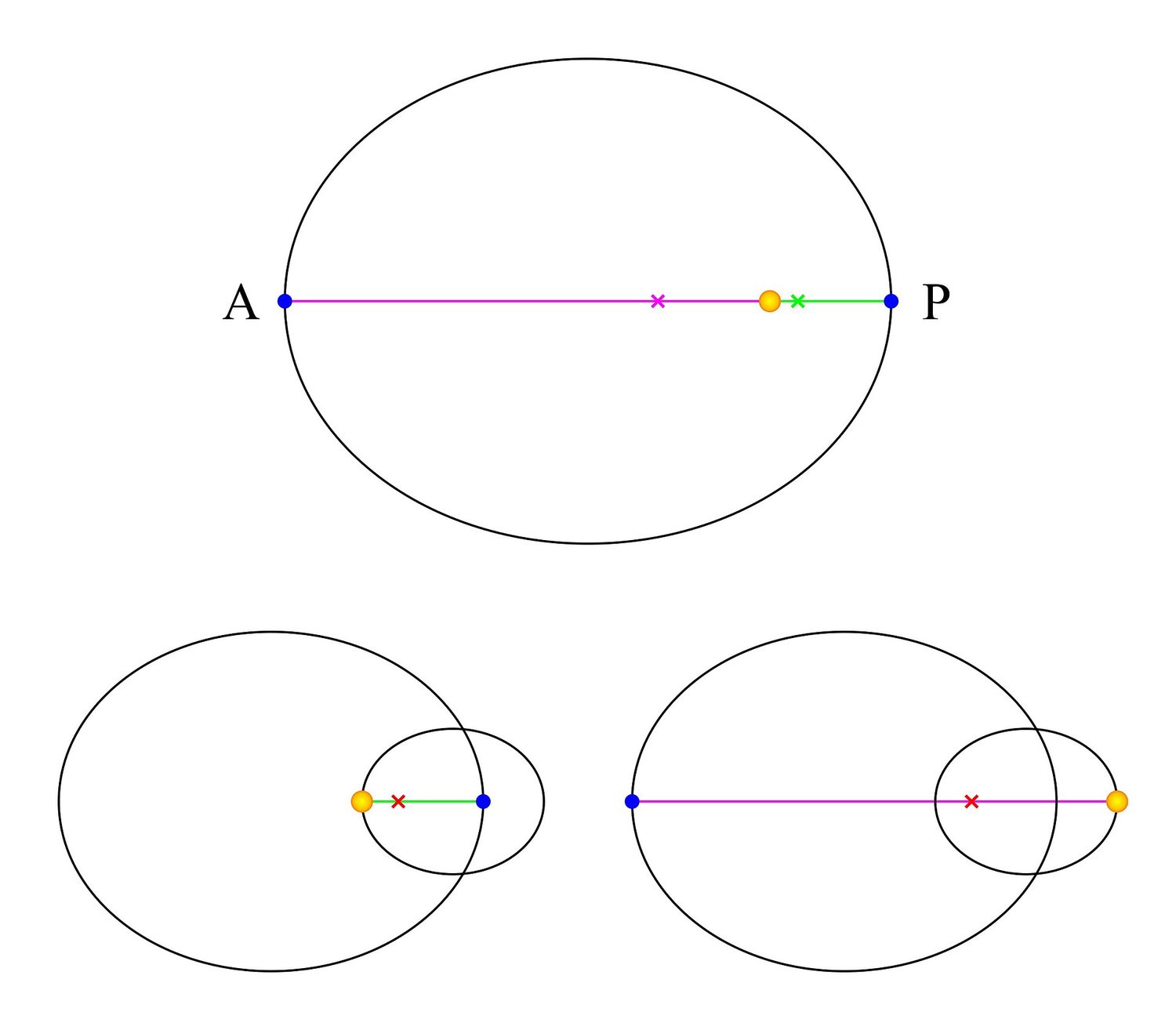
Elliptical orbits: conic sections describe closed paths with two foci — a key parametric model
วงโคจรแบบเอลลิปส์:段หน้าตัดกรวยอธิบายเส้นทางปิดที่มีโฟกัสสองจุด – โมเดลพารามิเตอร์ที่สำคัญ
Vocabulary · ⁨คำศัพท์⁩ Train · ⁨ฝึกฝน⁩
English ไทย
Conic sections/ˈkɒnɪk ˈsekʃnz/ วงกรรณิย Conic sections
4.7

Parametrizing Implicit Curves · ⁨การทำพารามิเตอร์ของเส้นโค้งแบบนัยยะ⁩

Syllabus · ⁨หลักสูตร⁩
English

Learning Objective 4.7.A: Represent a curve in the plane parametrically.

  • 4.7.A.1 A parametrization $(x(t),\, y(t))$ for an implicitly defined function will, when $x(t)$ and $y(t)$ are substituted for $x$ and $y$, respectively, satisfy the corresponding equation for every value of $t$ in the domain.
  • 4.7.A.2 If $f$ is a function of $x$, then $y = f(x)$ can be parametrized as $(x(t),\, y(t)) = (t, f(t))$. If $f$ is invertible, its inverse can be parametrized as $(x(t),\, y(t)) = (f(t),\, t)$ for an appropriate interval of $t$.

Learning Objective 4.7.B: Represent conic sections parametrically.

  • 4.7.B.1 A parabola can be parametrized in the same way that any equation that can be solved for $x$ or $y$ can be parametrized. Equations that can be solved for $x$ can be parametrized as $(x(t),\, y(t)) = (f(t),\, t)$ by solving for $x$ and replacing $y$ with $t$. Equations that can be solved for $y$ can be parametrized as $(x(t),\, y(t)) = (t, f(t))$ by solving for $y$ and replacing $x$ with $t$.
  • 4.7.B.2 An ellipse can be parametrized using the trigonometric functions $x(t) = h + a\cos t$ and $y(t) = k + b\sin t$ for $0 \leq t \leq 2\pi$.
  • 4.7.B.3 A hyperbola can be parametrized using trigonometric functions. For a hyperbola that opens left and right, the functions are $x(t) = h + a\sec t$ and $y(t) = k + b\tan t$ for $0 \leq t \leq 2\pi$. For a hyperbola that opens up and down, the functions are $x(t) = h + a\tan t$ and $y(t) = k + b\sec t$ for $0 \leq t \leq 2\pi$.
ไทย

วัตถุประสงค์การเรียนรู้ 4.7.A: แสดงโค้งในระนาบในรูปแบบพารามิเตอร์

  • 4.7.A.1 การกำหนดพารามิเตอร์ $(x(t),\, y(t))$ สำหรับฟังก์ชันที่ถูกกำหนดโดยนัยจะ, เมื่อ $x(t)$ และ $y(t)$ ถูกแทนที่ให้กับ $x$ และ $y$ ตามลำดับ, จะสอดคล้องกับสมการที่เกี่ยวข้องสำหรับทุกค่าของ $t$ ในโดเมน
  • 4.7.A.2 หาก $f$ เป็นฟังก์ชันของ $x$ แล้ว $y = f(x)$ สามารถพารามิเตอร์เป็น $(x(t),\, y(t)) = (t, f(t))$ ได้ หาก $f$ กลับค่าได้ inverse ของมันสามารถพารามิเตอร์เป็น $(x(t),\, y(t)) = (f(t),\, t)$ สำหรับช่วงที่เหมาะสมของ $t$

วัตถุประสงค์การเรียนรู้ 4.7.B: แสดงวงกรรมาศในรูปแบบพารามิเตอร์

  • 4.7.B.1 พาราโบลาสามารถพารามิเตอร์ได้ในวิธีเดียวกันกับสมการใด ๆ ที่สามารถแก้หาค่า $x$ หรือ $y$ ได้ สมการที่แก้หาค่า $x$ ได้สามารถพารามิเตอร์เป็น $(x(t),\, y(t)) = (f(t),\, t)$ โดยการแก้หาค่า $x$ และแทนที่ $y$ ด้วย $t$ สมการที่แก้หาค่า $y$ ได้สามารถพารามิเตอร์เป็น $(x(t),\, y(t)) = (t, f(t))$ โดยการแก้หาค่า $y$ และแทนที่ $x$ ด้วย $t$
  • 4.7.B.2 เอลลิปส์สามารถพารามิเตอร์โดยใช้ฟังก์ชันตรีโกณมิติ $x(t) = h + a\cos t$ และ $y(t) = k + b\sin t$ สำหรับ $0 \leq t \leq 2\pi$
  • 4.7.B.3 ไฮเพอร์โบล่าสามารถพารามิเตอร์โดยใช้ฟังก์ชันตรีโกณมิติ สำหรับไฮเพอร์โบล่าที่เปิดไปทางซ้ายหรือขวา ฟังก์ชันคือ $x(t) = h + a\sec t$ และ $y(t) = k + b\tan t$ สำหรับ $0 \leq t \leq 2\pi$ สำหรับไฮเพอร์โบล่าที่Opens up and down ฟังก์ชันคือ $x(t) = h + a\tan t$ และ $y(t) = k + b\sec t$ สำหรับ $0 \leq t \leq 2\pi$

Source: College Board AP Course and Exam Description · ⁨แหล่งที่มา: คำอธิบายหลักสูตรและข้อสอบ College Board AP⁩

English

Many implicit curves can be parametrized – rewritten as $\big(x(t),y(t)\big)$ – which makes them easier to graph and to treat as motion. The circle above is the basic example; ellipses use $x=h+A\cos t,\ y=k+B\sin t$.

ไทย

เส้นโค้งแบบนัยยะจำนวนมากสามารถ ทำพารามิเตอร์ได้ – เขียนใหม่เป็น $\big(x(t),y(t)\big)$ – ซึ่งทำให้กราฟและนำไปใช้กับการเคลื่อนที่ง่ายขึ้น วงกลมข้างต้นเป็นตัวอย่างพื้นฐาน; เอลลิปส์ใช้ $x=h+A\cos t,\ y=k+B\sin t$.

4.8

Vectors · ⁨เวกเตอร์⁩

Syllabus · ⁨หลักสูตร⁩
English

Learning Objective 4.8.A: Identify characteristics of a vector.

  • 4.8.A.1 A vector is a directed line segment. When a vector is placed in the plane, the point at the beginning of the line segment is called the tail, and the point at the end of the line segment is called the head. The length of the line segment is the magnitude of the vector.
  • 4.8.A.2 A vector $\overrightarrow{P_1 P_2}$ with two components can be plotted in the $xy$-plane from $P_1 = (x_1, y_1)$ to $P_2 = (x_2, y_2)$. The vector is identified by $a$ and $b$, where $a = x_2 - x_1$ and $b = y_2 - y_1$. The vector can be expressed as $\langle a,\, b \rangle$. A zero vector $\langle 0,\, 0 \rangle$ is the trivial case when $P_1 = P_2$.
  • 4.8.A.3 The direction of the vector is parallel to the line segment from the origin to the point with coordinates $(a,\, b)$. The magnitude of the vector is the square root of the sum of the squares of the components.
  • 4.8.A.4 For a vector represented geometrically in the plane, the components of the vector can be found using trigonometry.

Learning Objective 4.8.B: Determine sums and products involving vectors.

  • 4.8.B.1 The multiplication of a constant and a vector results in a new vector whose components are found by multiplying the constant by each of the components of the original vector. The new vector is parallel to the original vector.
  • 4.8.B.2 The sum of two vectors in $\mathbb{R}^2$ is a new vector whose components are found by adding the corresponding components of the original vectors. The new vector can be represented graphically as a vector whose tail corresponds to the tail of the first vector and whose head corresponds to the head of the second vector when the second vector's tail is located at the first vector's head.
  • 4.8.B.3 The dot product of two vectors is the sum of the products of their corresponding components. That is, $\langle a_1,\, b_1 \rangle \cdot \langle a_2,\, b_2 \rangle = a_1 a_2 + b_1 b_2$.

Learning Objective 4.8.C: Determine a unit vector for a given vector.

  • 4.8.C.1 A unit vector is a vector of magnitude $1$. A unit vector in the same direction as a given nonzero vector can be found by scalar multiplying the vector by the reciprocal of its magnitude.
  • 4.8.C.2 The vector $\langle a,\, b \rangle$ can be expressed as $a\vec{i} + b\vec{j}$ in $\mathbb{R}^2$, where $\vec{i}$ and $\vec{j}$ are unit vectors in the $x$ and $y$ directions, respectively. That is, $\vec{i} = \langle 1,\, 0 \rangle$ and $\vec{j} = \langle 0,\, 1 \rangle$.

Learning Objective 4.8.D: Determine angle measures between vectors and magnitudes of vectors involved in vector addition.

  • 4.8.D.1 The dot product is geometrically equivalent to the product of the magnitudes of the two vectors and the cosine of the angle between them. Therefore, if the dot product of two nonzero vectors is zero, then the vectors are perpendicular.
  • 4.8.D.2 The Law of Sines and Law of Cosines can be used to determine side lengths and angle measures of triangles formed by vector addition.
ไทย

วัตถุประสงค์การเรียนรู้ 4.8.A: ระบุคุณลักษณะของเวกเตอร์

  • 4.8.A.1 เวกเตอร์คือเส้นตรงที่มีทิศทาง เมื่อวางเวกเตอร์ในระนาบ จุดเริ่มต้นของเส้นตรงเรียกว่า หาง (tail) และจุดปลายของเส้นตรงเรียกว่า หัว (head) ความยาวของเส้นตรงคือ ขนาด (magnitude) ของเวกเตอร์
  • 4.8.A.2 เวกเตอร์ $\overrightarrow{P_1 P_2}$ ที่มีองค์ประกอบสองตัวสามารถวาดในระนาบ $xy$ จาก $P_1 = (x_1, y_1)$ ไปยัง $P_2 = (x_2, y_2)$ เวกเตอร์นี้ถูกจำแนกโดย $a$ และ $b$ โดยที่ $a = x_2 - x_1$ และ $b = y_2 - y_1$ เวกเตอร์สามารถเขียนในรูป $\langle a,\, b \rangle$ เวกเตอร์ศูนย์ $\langle 0,\, 0 \rangle$ เป็นกรณีพื้นฐานเมื่อ $P_1 = P_2$
  • 4.8.A.3 ทิศทาง ของเวกเตอร์ขนานกับเส้นตรงจากจุดกำเนิดไปยังจุดที่มีพิกัด $(a,\, b)$ ขนาดของเวกเตอร์คือรากที่สองของผลรวมกำลังสองขององค์ประกอบ
  • 4.8.A.4 สำหรับเวกเตอร์ที่แสดงด้วยเรขาคณิตในระนาบ องค์ประกอบของเวกเตอร์สามารถหาได้โดยใช้ตรีโกณมิติ

วัตถุประสงค์การเรียนรู้ 4.8.B: หาคำตอบสำหรับการบวกและคูณที่เกี่ยวข้องกับเวกเตอร์

  • 4.8.B.1 การคูณคงที่กับเวกเตอร์จะได้เวกเตอร์ใหม่whose components หาได้โดยการคูณคงที่นั้นกับแต่ละองค์ประกอบของเวกเตอร์เดิม เวกเตอร์ใหม่นี้ขนานกับเวกเตอร์เดิม
  • 4.8.B.2 ผลบวกของเวกเตอร์สองตัวใน $\mathbb{R}^2$ คือเวกเตอร์ใหม่ที่องค์ประกอบหาได้จากการบวกองค์ประกอบที่ตรงกับตำแหน่งของเวกเตอร์เดิม เวกเตอร์ใหม่สามารถแสดงด้วยกราฟเป็นเวกเตอร์whose tail ตรงกับ tail ของเวกเตอร์แรก และwhose head ตรงกับ head ของเวกเตอร์ที่สอง เมื่อ tail ของเวกเตอร์ที่สองวางอยู่ที่ head ของเวกเตอร์แรก
  • 4.8.B.3 Dot product ของเวกเตอร์สองตัวคือผลรวมของผลคูณขององค์ประกอบที่ตรงกับตำแหน่งกัน นั่นคือ $\langle a_1,\, b_1 \rangle \cdot \langle a_2,\, b_2 \rangle = a_1 a_2 + b_1 b_2$

วัตถุประสงค์การเรียนรู้ 4.8.C: หาเวกเตอร์หน่วยสำหรับเวกเตอร์ที่กำหนดให้

  • 4.8.C.1 เวกเตอร์หน่วย คือเวกเตอร์whose magnitude เท่ากับ $1$ เวกเตอร์หน่วยในทิศทางเดียวกับเวกเตอร์ที่ไม่เป็นศูนย์ที่กำหนดให้สามารถหาได้โดยการคูณสเกลาร์เวกเตอร์นั้นด้วยส่วนกลับของขนาดของมัน
  • 4.8.C.2 เวกเตอร์ $\langle a,\, b \rangle$ สามารถเขียนในรูป $a\vec{i} + b\vec{j}$ ใน $\mathbb{R}^2$ โดยที่ $\vec{i}$ และ $\vec{j}$ เป็นเวกเตอร์หน่วยในทิศทาง $x$ และ $y$ ตามลำดับ นั่นคือ $\vec{i} = \langle 1,\, 0 \rangle$ และ $\vec{j} = \langle 0,\, 1 \rangle$

วัตถุประสงค์การเรียนรู้ 4.8.D: หาค่ามุมระหว่างเวกเตอร์และขนาดของเวกเตอร์ที่เกี่ยวข้องในการบวกเวกเตอร์

  • 4.8.D.1 ผลคูณเชิงสเกลาร์มีนัยทางเรขาคณิตเทียบเท่ากับผลคูณของขนาดของเวกเตอร์ทั้งสองและโคไซน์ของมุมระหว่างเวกเตอร์ทั้งสอง ดังนั้น หากผลคูณเชิงสเกลาร์ของเวกเตอร์สองตัวที่ไม่เป็นศูนย์เป็นศูนย์ แสดงว่าเวกเตอร์ทั้งสองตั้งฉากกัน
  • 4.8.D.2 กฎของซายน์และกฎของไคosgines สามารถใช้เพื่อหาความยาวด้านและขนาดมุมของสามเหลี่ยมที่เกิดจากการบวกเวกเตอร์

Source: College Board AP Course and Exam Description · ⁨แหล่งที่มา: คำอธิบายหลักสูตรและข้อสอบ College Board AP⁩

English
Resolving a vector into components

A vector 向量 has both magnitude 大小 (length) and direction. Write it by components $\langle a,b\rangle$. Add vectors component-by-component; scale by multiplying each component; the magnitude is $\sqrt{a^2+b^2}$. Vectors model displacements, velocities, and forces.

ไทย
การแยกเวกเตอร์ออกเป็นองค์ประกอบ

เวกเตอร์ มีทั้ง ขนาด (ความยาว) และ ทิศทาง เขียนโดยองค์ประกอบ $\langle a,b\rangle$. บวกเวกเตอร์ทีละองค์ประกอบ; สเกลด้วยวิธีคูณแต่ละองค์ประกอบ; ขนาดคือ $\sqrt{a^2+b^2}$. เวกเตอร์ใช้จำลองการกระจัด, ความเร็ว และแรง.

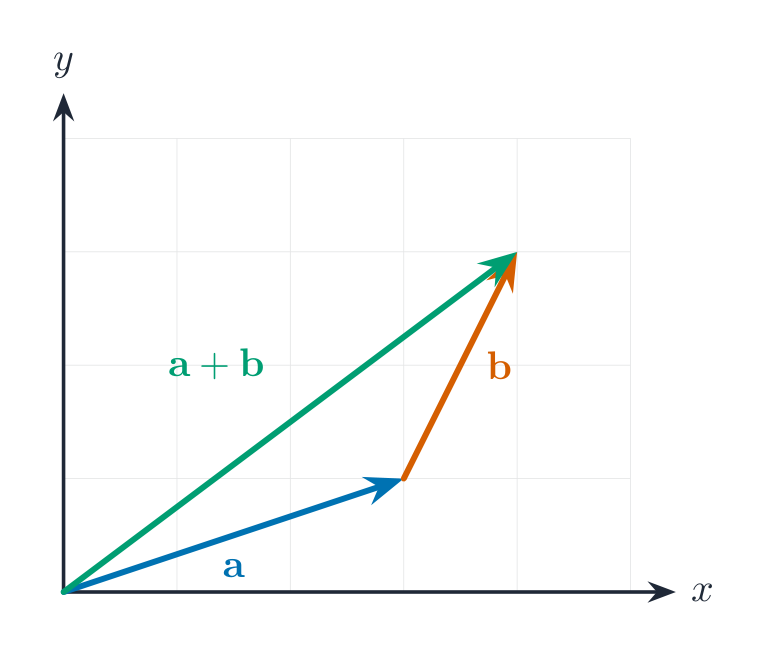
การบวกเวกเตอร์โดยใช้กฎสามเหลี่ยม
Explore · ⁨สำรวจ⁩

Add two vectors tip to tail · ⁨บวกเวกเตอร์สองตัวปลายติดหัว⁩

A vector has magnitude and direction. Adding two vectors places them tip to tail; the resultant runs from the first tail to the last tip. Drag each to see the sum. · ⁨เวกเตอร์ มีขนาดและทิศทาง การบวกเวกเตอร์สองตัววางปลายติดฐาน; เวกเตอร์ผลรวมลากจากฐานแรกถึงปลายสุดท้าย ลากแต่ละตัวเพื่อดูผลรวม⁩

4.9

Vector-Valued Functions · ⁨ฟังก์ชันที่มีค่าเป็นเวกเตอร์⁩

Syllabus · ⁨หลักสูตร⁩
English

Learning Objective 4.9.A: Represent planar motion in terms of vector-valued functions.

  • 4.9.A.1 The position of a particle moving in a plane that is given by the parametric function $f(t) = (x(t),\, y(t))$ may be expressed as a vector-valued function, $p(t) = x(t)\vec{i} + y(t)\vec{j}$ or $p(t) = \langle x(t),\, y(t) \rangle$. The magnitude of the position vector at time $t$ gives the distance of the particle from the origin.
  • 4.9.A.2 The vector-valued function $v(t) = \langle x(t),\, y(t) \rangle$ can be used to express the velocity of a particle moving in a plane at different times, $t$. At time $t$, the sign of $x(t)$ indicates if the particle is moving right or left, and the sign of $y(t)$ indicates if the particle is moving up or down. The magnitude of the velocity vector at time $t$ gives the speed of the particle.
ไทย

จุดประสงค์การเรียนรู้ 4.9.A: แสดงการเคลื่อนที่ในระนาบด้วยฟังก์ชันที่มีค่าเป็นเวกเตอร์

  • 4.9.A.1 ตำแหน่งของอนุภาคที่เคลื่อนที่ในระนาบซึ่งกำหนดโดยฟังก์ชัน $f(t) = (x(t),\, y(t))$ สามารถเขียนในรูป ฟังก์ชันที่มีค่าเป็นเวกเตอร์ ได้คือ $p(t) = x(t)\vec{i} + y(t)\vec{j}$ หรือ $p(t) = \langle x(t),\, y(t) \rangle$ ขนาดของเวกเตอร์ตำแหน่งที่เวลา $t$ จะให้ระยะห่างของอนุภาคจากจุดกำเนิด
  • 4.9.A.2 ฟังก์ชันค่าเวกเตอร์ $v(t) = \langle x(t),\, y(t) \rangle$ สามารถใช้เพื่อแสดงความเร็วของอนุภาคที่เคลื่อนที่ในระนาบในเวลาต่างๆ, $t$. ในช่วงเวลา $t$, สัญญาณของ $x(t)$ บ่งชี้ว่าอนุภาคเคลื่อนที่ไปทางขวาหรือซ้าย, และสัญญาณของ $y(t)$ บ่งชี้ว่าเคลื่อนที่ขึ้นหรือลง. ขนาดของเวกเตอร์ความเร็วในช่วงเวลา $t$ ให้ค่าความเร็วของอนุภาค

Source: College Board AP Course and Exam Description · ⁨แหล่งที่มา: คำอธิบายหลักสูตรและข้อสอบ College Board AP⁩

English

A vector-valued function 向量值函数 outputs a vector for each input, e.g. $\vec{r}(t)=\langle x(t),y(t)\rangle$ – the same information as a parametric function, packaged as a moving position vector.

ไทย

ฟังก์ชันที่มีค่าเป็นเวกเตอร์ จะให้เวกเตอร์ออกมาสำหรับแต่ละอินพุต เช่น $\vec{r}(t)=\langle x(t),y(t)\rangle$ – ข้อมูลเดียวกันกับฟังก์ชันพารามิเตอร์ แต่จัดรูปแบบเป็นเวกเตอร์ตำแหน่งที่เคลื่อนที่

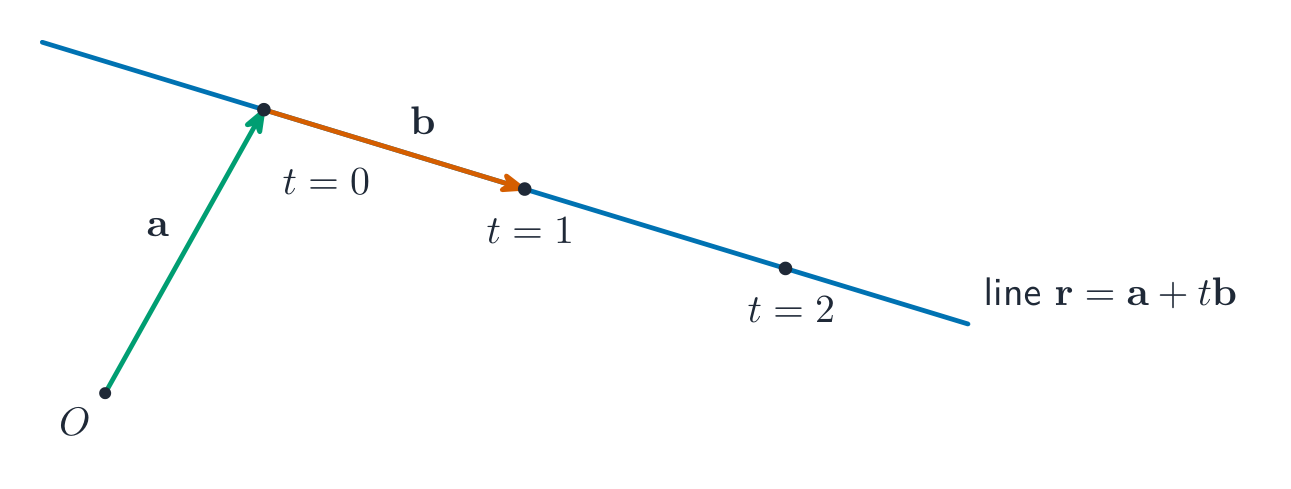
เส้นที่มีค่าเป็นเวกเตอร์: เริ่มที่ a, แล้วเลื่อนไป t หลายเท่าในทิศทาง b
4.10

Matrices · ⁨เมทริกซ์⁩

Syllabus · ⁨หลักสูตร⁩
English

Learning Objective 4.10.A: Determine the product of two matrices.

  • 4.10.A.1 An $n \times m$ matrix is an array consisting of $n$ rows and $m$ columns.
  • 4.10.A.2 Two matrices can be multiplied if the number of columns in the first matrix equals the number of rows in the second matrix. The product of the matrices is a new matrix in which the component in the $i$th row and $j$th column is the dot product of the $i$th row of the first matrix and the $j$th column of the second matrix.
ไทย

วัตถุประสงค์การเรียนรู้ 4.10.A: หาผลคูณของเมทริกซ์สองตัว

  • 4.10.A.1 เมทริกซ์ $n \times m$ คือชุดข้อมูลที่มี $n$ แถวและ $m$ คอลัมน์
  • 4.10.A.2 เมทริกซ์สองตัวสามารถคูณกันได้หากจำนวนคอลัมน์ของเมทริกซ์แรกเท่ากับจำนวนแถวของเมทริกซ์ที่สอง ผลคูณของเมทริกซ์จะเป็นเมทริกซ์ใหม่ซึ่งองค์ประกอบในแถวที่ $i$ และคอลัมน์ที่ $j$ เป็นผลคูณสเกลาร์ของแถวที่ $i$ ของเมทริกซ์แรกและคอลัมน์ที่ $j$ ของเมทริกซ์ที่สอง

Source: College Board AP Course and Exam Description · ⁨แหล่งที่มา: คำอธิบายหลักสูตรและข้อสอบ College Board AP⁩

English

A matrix 矩阵 is a rectangular array of numbers. Add matrices of the same size entry-by-entry; multiply a matrix by a compatible one by combining rows with columns. Matrices store and transform data compactly.

ไทย

เมทริกซ์ คือตารางจำนวนรูปสี่เหลี่ยมผืนผ้า บวกเมทริกซ์ที่มีขนาดเท่ากันทีละช่อง; คูณเมทริกซ์กับเมทริกซ์ที่เข้ากันได้โดยการนำแถวไปคูณกับหลัก เมทริกซ์เก็บและแปลงข้อมูลได้อย่างกะทัดรัด

4.11

The Inverse and Determinant of a Matrix · ⁨อินเวอร์สและดีเทอร์มิแนนต์ของเมทริกซ์⁩

Syllabus · ⁨หลักสูตร⁩
English

Learning Objective 4.11.A: Determine the inverse of a $2 \times 2$ matrix.

  • 4.11.A.1 The identity matrix, $I$, is a square matrix consisting of $1$s on the diagonal from the top left to bottom right and $0$s everywhere else.
  • 4.11.A.2 Multiplying a square matrix by its corresponding identity matrix results in the original square matrix.
  • 4.11.A.3 The product of a square matrix and its inverse, when it exists, is the identity matrix of the same size.
  • 4.11.A.4 The inverse of a $2 \times 2$ matrix, when it exists, can be calculated with or without technology.

Learning Objective 4.11.B: Apply the value of the determinant to invertibility and vectors.

  • 4.11.B.1 The determinant of the matrix $A = \begin{bmatrix} a & b \\ c & d \end{bmatrix}$ is $ad - bc$. The determinant can be calculated with or without technology and is denoted $\det(A)$.
  • 4.11.B.2 If a $2 \times 2$ matrix consists of two column or row vectors from $\mathbb{R}^2$, then the nonzero absolute value of the determinant of the matrix is the area of the parallelogram spanned by the vectors represented in the columns or rows of the matrix. If the determinant equals $0$, then the vectors are parallel.
  • 4.11.B.3 The square matrix $A$ has an inverse if and only if $\det(A) \neq 0$.
ไทย

วัตถุประสงค์การเรียนรู้ 4.11.A: หาฟังก์ชันกลับด้านของเมทริกซ์ $2 \times 2$

  • 4.11.A.1 เมทริกซ์เอกลักษณ์, $I$, เป็นเมทริกซ์สี่เหลี่ยมที่มี $1$ บนเส้นทแยงมุมจากมุมบนซ้ายไปมุมล่างขวา และมี $0$ ในตำแหน่งอื่นๆ ทั้งหมด
  • 4.11.A.2 การคูณเมทริกซ์สี่เหลี่ยมกับเมทริกซ์เอกลักษณ์ที่เกี่ยวข้องจะไดเมทริกซ์สี่เหลี่ยมเดิม
  • 4.11.A.3 ผลคูณของเมทริกซ์สี่เหลี่ยมกับฟังก์ชันกลับด้านของมัน (ถ้ามี) คือเมทริกซ์เอกลักษณ์ที่มีขนาดเท่ากัน
  • 4.11.A.4 ฟังก์ชันกลับด้านของเมทริกซ์ $2 \times 2$ (ถ้ามี) สามารถคำนวณได้ทั้งโดยใช้เครื่องมือและเทคโนโลยีหรือไม่ใช้

วัตถุประสงค์การเรียนรู้ 4.11.B: ใช้ค่าดีเทอร์มิแนนต์ในการหาฟังก์ชันกลับด้านและเวกเตอร์

  • 4.11.B.1 ดีเทอร์มิแนนต์ของเมทริกซ์ $A = \begin{bmatrix} a & b \\ c & d \end{bmatrix}$ มีค่าเท่ากับ $ad - bc$ ดีเทอร์มิแนนต์สามารถคำนวณได้ทั้งโดยใช้เครื่องมือและเทคโนโลยีและไม่ระบุสัญลักษณ์ด้วย $\det(A)$
  • 4.11.B.2 หากเมทริกซ์ $2 \times 2$ ประกอบด้วยเวกเตอร์คอลัมน์หรือแถวสองตัวจาก $\mathbb{R}^2$ แล้วค่าสัมบูรณ์ที่ไม่เป็นศูนย์ของดีเทอร์มิแนนต์ของเมทริกซ์คือพื้นที่ของรูปสี่เหลี่ยมขนานที่ถูกสร้างโดยเวกเตอร์ที่แสดงในคอลัมน์หรือแถวของเมทริกซ์ หากดีเทอร์มิแนนต์เท่ากับ $0$ แล้วเวกเตอร์ทั้งสองขนานกัน
  • 4.11.B.3 เมทริกซ์สี่เหลี่ยม $A$ จะมีฟังก์ชันกลับด้านก็ต่อเมื่อ $\det(A) \neq 0$ เท่านั้น

Source: College Board AP Course and Exam Description · ⁨แหล่งที่มา: คำอธิบายหลักสูตรและข้อสอบ College Board AP⁩

English

The determinant 行列式 of a $2\times 2$ matrix $\begin{bmatrix} a & b \\ c & d\end{bmatrix}$ is $ad-bc$. A matrix has an inverse 逆矩阵 exactly when its determinant is nonzero; the inverse undoes the matrix, and it solves matrix equations (like a reciprocal for numbers).

Worked example. For $A=\begin{bmatrix}3 & 1\\ 2 & 4\end{bmatrix}$, the determinant is $ad-bc=(3)(4)-(1)(2)=10$. Since it is nonzero, $A$ is invertible, and $A^{-1}=\dfrac{1}{10}\begin{bmatrix}4 & -1\\ -2 & 3\end{bmatrix}$ (swap the diagonal, negate the off-diagonal, divide by the determinant).

ไทย

ดีเทอร์มิแนนต์ ของเมทริกซ์ $2\times 2$ $\begin{bmatrix} a & b \\ c & d\end{bmatrix}$ คือ $ad-bc$. เมทริกซ์จะมี อินเวอร์ส ก็ต่อเมื่อดีเทอร์มิแนนต์ไม่เท่ากับศูนย์; อินเวอร์สจะ undo การกระทำของเมทริกซ์ และแก้สมการเมทริกซ์ (เหมือนเศษส่วนกลับของตัวเลข)

ตัวอย่างวิธีทำ. สำหรับ $A=\begin{bmatrix}3 & 1\\ 2 & 4\end{bmatrix}$, ดีเทอร์มิแนนต์คือ $ad-bc=(3)(4)-(1)(2)=10$. เนื่องจากไม่เท่ากับศูนย์, $A$ จึงมีอินเวอร์สได้, และ $A^{-1}=\dfrac{1}{10}\begin{bmatrix}4 & -1\\ -2 & 3\end{bmatrix}$ (สลับ.diag, เปลี่ยนเครื่องหมาย off-diag, หารด้วยดีเทอร์มิแนนต์).

Vocabulary · ⁨คำศัพท์⁩ Train · ⁨ฝึกฝน⁩
English ไทย
matrix/ˈmeɪtrɪks/ เมทริกซ์
determinant/dɪˈtɜːmɪnənt/ ดีเทอร์มิแนนต์
inverse/ɪnˈvɜːs/ ผกผัน
linear transformation/ˈlɪnɪə trænsfɔːˈmeɪʃn/ การแปลงเชิงเส้น
4.12

Linear Transformations and Matrices · ⁨การแปลงเชิงเส้นและเมทริกซ์⁩

Syllabus · ⁨หลักสูตร⁩
English

Learning Objective 4.12.A: Determine the output vectors of a linear transformation using a $2 \times 2$ matrix.

  • 4.12.A.1 A linear transformation is a function that maps an input vector to an output vector such that each component of the output vector is the sum of constant multiples of the input vector components.
  • 4.12.A.2 A linear transformation will map the zero vector to the zero vector.
  • 4.12.A.3 A single vector in $\mathbb{R}^2$ can be expressed as a $2 \times 1$ matrix. A set of $n$ vectors in $\mathbb{R}^2$ can be expressed as a $2 \times n$ matrix.
  • 4.12.A.4 For a linear transformation, $L$, from $\mathbb{R}^2$ to $\mathbb{R}^2$, there is a unique $2 \times 2$ matrix, $A$, such that $L(\vec{v}) = A\vec{v}$ for vectors in $\mathbb{R}^2$. Conversely, for a given $2 \times 2$ matrix, $A$, the function $L(\vec{v}) = A\vec{v}$ is a linear transformation from $\mathbb{R}^2$ to $\mathbb{R}^2$.
  • 4.12.A.5 Multiplication of a $2 \times 2$ transformation matrix, $A$, and a $2 \times n$ matrix of $n$ input vectors gives a $2 \times n$ matrix of the $n$ output vectors for the linear transformation $L(\vec{v}) = A\vec{v}$.
ไทย

วัตถุประสงค์การเรียนรู้ 4.12.A: หาเวกเตอร์เอาต์พุตของการแปลงเชิงเส้นโดยใช้เมทริกซ์ $2 \times 2$

  • 4.12.A.1 การแปลงเชิงเส้น คือฟังก์ชันที่ส่งเวกเตอร์อินพุตไปยังเวกเตอร์เอาต์พุต โดยที่แต่ละองค์ประกอบของเวกเตอร์เอาต์พุตเป็นผลรวมของค่าคงที่คูณด้วยองค์ประกอบของเวกเตอร์อินพุต
  • 4.12.A.2 การแปลงเชิงเส้นจะส่งเวกเตอร์ศูนย์ไปยังเวกเตอร์ศูนย์
  • 4.12.A.3 เวกเตอร์หนึ่งตัวใน $\mathbb{R}^2$ สามารถเขียนเป็นเมทริกซ์ $2 \times 1$ ชุดของ $n$ เวกเตอร์ใน $\mathbb{R}^2$ สามารถเขียนเป็นเมทริกซ์ $2 \times n$
  • 4.12.A.4 สำหรับฟังก์ชันเชิงเส้น $L$ จาก $\mathbb{R}^2$ ไปยัง $\mathbb{R}^2$ จะมีเมทริกซ์ $2 \times 2$ ที่ไม่ซ้ำกัน ⟨ $A$ ⟩ ซึ่งทำให้ $L(\vec{v}) = A\vec{v}$ สำหรับเวกเตอร์ใน $\mathbb{R}^2$ ในทางกลับกัน สำหรับเมทริกซ์ $2 \times 2$ ที่กำหนดให้ ⟨ $A$ ⟩ ฟังก์ชัน $L(\vec{v}) = A\vec{v}$ เป็นฟังก์ชันเชิงเส้นจาก $\mathbb{R}^2$ ไปยัง $\mathbb{R}^2$
  • 4.12.A.5 การคูณเมทริกซ์การแปลง $2 \times 2$, $A$, และเมทริกซ์ $2 \times n$ ของเวกเตอร์อินพุต $n$ จะได้เมทริกซ์ $2 \times n$ ของเวกเตอร์เอาต์พุต $n$ สำหรับการแปลงเชิงเส้น $L(\vec{v}) = A\vec{v}$

Source: College Board AP Course and Exam Description · ⁨แหล่งที่มา: คำอธิบายหลักสูตรและข้อสอบ College Board AP⁩

English
A matrix transforms the plane

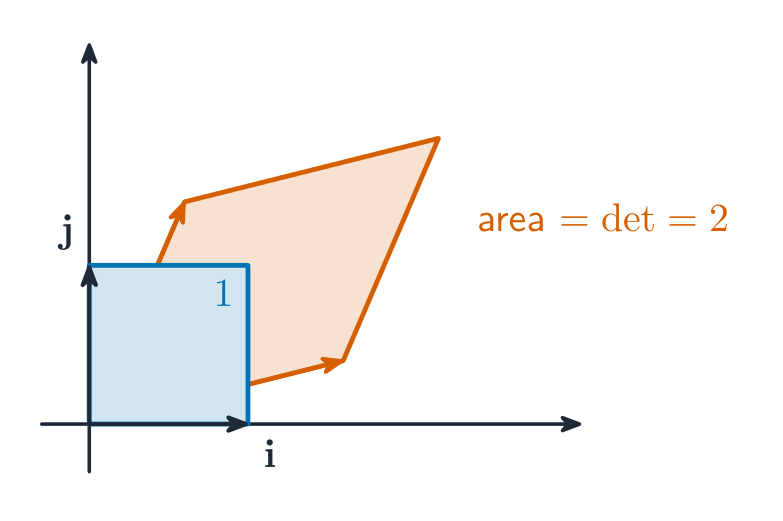
A $2\times 2$ matrix acts as a linear transformation 线性变换 of the plane – rotating, reflecting, stretching, or shearing points – by multiplying each position vector. The determinant measures how the transformation scales area (and its sign tells whether orientation flips).

Worked example. The matrix $\begin{bmatrix}2 & 0\\ 0 & 3\end{bmatrix}$ stretches the plane by $2$ horizontally and $3$ vertically, sending the vector $\begin{bmatrix}1\\1\end{bmatrix}$ to $\begin{bmatrix}2\\3\end{bmatrix}$. Its determinant $2\times3=6$ means every area is multiplied by $6$, so the unit square becomes a $2\times3$ rectangle.

ไทย
เมทริกซ์แปลงระนาบ

เมทริกซ์ $2\times 2$ ทำหน้าที่เป็น การแปลงเชิงเส้น ของระนาบ – หมุน, สะท้อน, ยืด หรือบิดจุด – โดยการคูณเวกเตอร์ตำแหน่งแต่ละตัว. ดีเทอร์มิแนนต์วัดการขยายพื้นที่ของการแปลง (และเครื่องหมายบอก whether Orientation ถูกพลิก)

ตัวอย่างวิธีทำ. เมทริกซ์ $\begin{bmatrix}2 & 0\\ 0 & 3\end{bmatrix}$ ขยายระนาบ $2$ ในแนวนอนและ $3$ ในแนวตั้ง, ส่งเวกเตอร์ $\begin{bmatrix}1\\1\end{bmatrix}$ ไปยัง $\begin{bmatrix}2\\3\end{bmatrix}$. ดีเทอร์มิแนนต์ $2\times3=6$ ของมันหมายความว่าทุกพื้นที่ถูกคูณด้วย $6$, ดังนั้นสี่เหลี่ยมจัตุรัสหน่วยจึงกลายเป็นสี่เหลี่ยมผืนผ้า $2\times3$

เมทริกซ์ 2x2映射 subsquare เป็น parallelogram; ดีเทอร์มิแนนต์คือ scale พื้นที่
Explore · ⁨สำรวจ⁩

Transform the plane with a matrix · ⁨แปลงระนาบด้วยเมทริกซ์⁩

A $2\times2$ matrix maps every point to a new one, so it stretches, rotates or shears the whole grid. Change the entries and watch the unit square transform. · ⁨$2\times2$ เมทริกซ์映射ทุกจุดไปยังจุดใหม่ ดังนั้นจึงยืด หมุน หรือบิดตารางทั้งหมด เปลี่ยนค่าเข้าและดูการเปลี่ยนแปลงของสี่เหลี่ยมหน่วย⁩

4.13

Matrices as Functions · ⁨เมทริกซ์ในฐานะฟังก์ชัน⁩

Syllabus · ⁨หลักสูตร⁩
English

Learning Objective 4.13.A: Determine the association between a linear transformation and a matrix.

  • 4.13.A.1 The linear transformation mapping $\langle x,\, y \rangle$ to $\langle a_{11} x + a_{12} y,\, a_{21} x + a_{22} y \rangle$ is associated with the matrix $\begin{bmatrix} a_{11} & a_{12} \\ a_{21} & a_{22} \end{bmatrix}$.
  • 4.13.A.2 The mapping of the unit vectors in a linear transformation provides valuable information for determining the associated matrix.
  • 4.13.A.3 The matrix $\begin{bmatrix} \cos\theta & -\sin\theta \\ \sin\theta & \cos\theta \end{bmatrix}$ is associated with a linear transformation of vectors that rotates every vector an angle $\theta$ counterclockwise about the origin.
  • 4.13.A.4 The absolute value of the determinant of a $2 \times 2$ transformation matrix gives the magnitude of the dilation of regions in $\mathbb{R}^2$ under the transformation.

Learning Objective 4.13.B: Determine the composition of two linear transformations.

  • 4.13.B.1 The composition of two linear transformations is a linear transformation.
  • 4.13.B.2 The matrix associated with the composition of two linear transformations is the product of the matrices associated with each linear transformation.

Learning Objective 4.13.C: Determine the inverse of a linear transformation.

  • 4.13.C.1 Two linear transformations are inverses if their composition maps any vector to itself.
  • 4.13.C.2 If a linear transformation, $L$, is given by $L(\vec{v}) = A\vec{v}$, then its inverse transformation is given by $L^{-1}(\vec{v}) = A^{-1}\vec{v}$, where $A^{-1}$ is the inverse of the matrix $A$.
ไทย

จุดประสงค์การเรียนรู้ 4.13.A: หาความสัมพันธ์ระหว่างการแปลงเชิงเส้นกับเมทริกซ์

  • 4.13.A.1 การแปลงเชิงเส้นที่映射 $\langle x,\, y \rangle$ ไปยัง $\langle a_{11} x + a_{12} y,\, a_{21} x + a_{22} y \rangle$ มีความสัมพันธ์กับเมทริกซ์ $\begin{bmatrix} a_{11} & a_{12} \\ a_{21} & a_{22} \end{bmatrix}$
  • 4.13.A.2 การ映射ของเวกเตอร์หน่วยในการแปลงเชิงเส้นให้ข้อมูลที่มีค่าสำหรับการหาเมทริกซ์ที่เกี่ยวข้อง
  • 4.13.A.3 เมทริกซ์ $\begin{bmatrix} \cos\theta & -\sin\theta \\ \sin\theta & \cos\theta \end{bmatrix}$ มีความสัมพันธ์กับการแปลงเชิงเส้นของเวกเตอร์ที่หมุนทุกเวกเตอร์เป็นมุม $\theta$ ทวนเข็มนาฬิกาโดยรอบจุดกำเนิด
  • 4.13.A.4 ค่าสัมบูรณ์ของดีเทอร์มิแนนต์ของเมทริกซ์การแปลง $2 \times 2$ ให้ขนาดของการขยาย (dilation) ของพื้นที่ใน $\mathbb{R}^2$ ภายใต้การแปลงนั้น

จุดประสงค์การเรียนรู้ 4.13.B: หาองค์ประกอบ (composition) ของการแปลงเชิงเส้นสองครั้ง

  • 4.13.B.1 องค์ประกอบของการแปลงเชิงเส้นสองครั้งเป็นการแปลงเชิงเส้น
  • 4.13.B.2 เมทริกซ์ที่เกี่ยวข้องกับการองค์ประกอบของการแปลงเชิงเส้นสองครั้งคือผลคูณของเมทริกซ์ที่เกี่ยวข้องกับการแปลงเชิงเส้นแต่ละครั้ง

จุดประสงค์การเรียนรู้ 4.13.C: หาการแปลงเชิงเส้นผกผัน (inverse)

  • 4.13.C.1 การแปลงเชิงเส้นสองครั้งจะ salingเป็นผกผันหากองค์ประกอบ将它们mapping任何向量到其自身
  • 4.13.C.2 หากการแปลงเชิงเส้น $L$ กำหนดโดย $L(\vec{v}) = A\vec{v}$ แล้ว การแปลงเชิงเส้นผกผันของมันกำหนดโดย $L^{-1}(\vec{v}) = A^{-1}\vec{v}$ โดยที่ $A^{-1}$ คือเมทริกซ์ผกผันของเมทริกซ์ $A$

Source: College Board AP Course and Exam Description · ⁨แหล่งที่มา: คำอธิบายหลักสูตรและข้อสอบ College Board AP⁩

English

Because a matrix maps input vectors to output vectors, it is a function on the plane. Composing transformations corresponds to multiplying their matrices, and the inverse matrix reverses the mapping.

ไทย

เนื่องจากเมทริกซ์映射 input vectors เป็น output vectors, มัน เป็น ฟังก์ชันบนระนาบ. การ compose การแปลงสอดคล้องกับการคูณเมทริกซ์, และเมทริกซ์อินเวอร์สจะ reverse การ映射

4.14

Matrices Modeling Contexts · ⁨เมทริกซ์สำหรับการจำลองสถานการณ์⁩

Syllabus · ⁨หลักสูตร⁩
English

Learning Objective 4.14.A: Construct a model of a scenario involving transitions between two states using matrices.

  • 4.14.A.1 A contextual scenario can indicate the rate of transitions between states as percent changes. A matrix can be constructed based on these rates to model how states change over discrete intervals.

Learning Objective 4.14.B: Apply matrix models to predict future and past states for $n$ transition steps.

  • 4.14.B.1 The product of a matrix that models transitions between states and a corresponding state vector can predict future states.
  • 4.14.B.2 Repeated multiplication of a matrix that models the transitions between states and corresponding resultant state vectors can predict the steady state, a distribution between states that does not change from one step to the next.
  • 4.14.B.3 The product of the inverse of a matrix that models transitions between states and a corresponding state vector can predict past states.
ไทย

จุดประสงค์การเรียนรู้ 4.14.A: สร้างโมเดลของสถานการณ์ที่เกี่ยวข้องกับการเปลี่ยนผ่านระหว่างสองสถานะโดยใช้เมทริกซ์

  • 4.14.A.1 สถานการณ์จริงสามารถระบุอัตราการเปลี่ยนผ่านระหว่างสถานะเป็นการเปลี่ยนแปลงเป็นเปอร์เซ็นต์ เมทริกซ์สามารถสร้างขึ้นจากอัตราเหล่านี้เพื่อจำลองการเปลี่ยนแปลงของสถานะในช่วงเวลาที่ไม่ต่อเนื่อง

จุดประสงค์การเรียนรู้ 4.14.B: ใช้โมเดลเมทริกซ์เพื่อทำนายสถานะในอนาคตและอดีตสำหรับ $n$ ขั้นตอนการเปลี่ยนผ่าน

  • 4.14.B.1 ผลคูณของเมทริกซ์ที่จำลองการเปลี่ยนผ่านระหว่างสถานะกับเวกเตอร์สถานะที่เกี่ยวข้องสามารถทำนายสถานะในอนาคตได้
  • 4.14.B.2 การคูณเมทริกซ์ที่จำลองการเปลี่ยนผ่านระหว่างสถานะกับเวกเตอร์สถานะผลลัพธ์ที่เกี่ยวข้องซ้ำๆ สามารถทำนายสถานะคงตัว (steady state) ซึ่งเป็นสัดส่วนระหว่างสถานะที่ไม่เปลี่ยนแปลงจากขั้นตอนหนึ่งไปยังอีกขั้นตอนหนึ่ง
  • 4.14.B.3 ผลคูณของเมทริกซ์ผกผันที่จำลองการเปลี่ยนผ่านระหว่างสถานะกับเวกเตอร์สถานะที่เกี่ยวข้องสามารถทำนายสถานะในอดีตได้

Source: College Board AP Course and Exam Description · ⁨แหล่งที่มา: คำอธิบายหลักสูตรและข้อสอบ College Board AP⁩

English

Matrices model systems that step forward in stages – for example, populations moving between states each year. Repeated multiplication by a transition matrix advances the model one step at a time, so matrix powers predict long-run behavior.

ไทย

เมทริกซ์ใช้จำลองระบบที่เปลี่ยนแปลงเป็นขั้นๆ – เช่น การเคลื่อนย้ายของประชากรระหว่างสถานะแต่ละปี การคูณซ้ำด้วย เมทริกซ์การเปลี่ยนผ่าน จะทำให้แบบจำลองก้าวไปข้างหน้าทีละขั้นตอน ดังนั้นกำลังของเมทริกซ์จึง可以用来预测长期行为。

4.14

Exam tips · ⁨ข้อแนะนำสำหรับการสอบ⁩

English
  • A parametric function gives $x(t)$ and $y(t)$ separately — track the direction of motion as $t$ increases.
  • A vector has magnitude and direction; add component-by-component and find magnitude with $\sqrt{a^2+b^2}$.
  • The determinant of a $2\times2$ matrix is $ad-bc$ (mind the minus sign); it scales area under the transformation.
  • A $2\times2$ matrix transforms the plane (rotate, reflect, stretch); an inverse exists only when the determinant is non-zero.
  • Note this unit is not tested on the AP Precalculus Exam (Units 1–3 only), but it underpins later courses.
ไทย
  • ฟังก์ชันแบบพารามิเตอร์ให้ $x(t)$ และ $y(t)$ แยกกัน — ติดตามทิศทางการเคลื่อนที่เมื่อ $t$ เพิ่มขึ้น
  • เวกเตอร์มีขนาดและทิศทาง; บวกรายองค์ประกอบแล้วหาค่าขนาดโดยใช้ $\sqrt{a^2+b^2}$
  • ดترمินแนนต์ของเมทริกซ์ $2\times2$ มีค่าเท่ากับ $ad-bc$ (ระวังเครื่องหมายลบ); ใช้ปรับขนาดพื้นที่ภายใต้การแปลง
  • เมทริกซ์ $2\times2$ ทำการแปลงระนาบ (หมุน, สะท้อน, ขยาย); จะมีอินเวอร์สก็ต่อเมื่อดترمินแนนต์ไม่เท่ากับศูนย์เท่านั้น
  • หมายเหตุว่าหน่วยนี้ไม่ออกสอบใน AP Precalculus Exam (เฉพาะหน่วย 1–3 เท่านั้น) แต่เป็นพื้นฐานสำคัญสำหรับวิชาที่เรียนต่อ

Interactive lessons on this topic · ⁨บทเรียนเชิงโต้ตอบสำหรับหัวข้อนี้⁩

Work through it step by step, with instant-check exercises. · ⁨ทำทีละขั้นตอน พร้อมแบบฝึกหัดตรวจสอบผลทันที⁩

Past Papers · ⁨ข้อสอบย้อนหลัง⁩

More topics in AP Precalculus · ⁨หัวข้อเพิ่มเติมใน AP Precalculus⁩

Log in or create account · ⁨เข้าสู่ระบบหรือสร้างบัญชี⁩

IGCSE, A-Level & AP