Skip to content

Trigonometric and Polar Functions

AP Precalculus · Topic 3

Train
3.1

Periodic Phenomena

Syllabus
Learning ObjectiveEssential Knowledge

3.1.A
Construct graphs of periodic relationships based on verbal representations.

  • 3.1.A.1 A periodic relationship can be identified between two aspects of a context if, as the input values increase, the output values demonstrate a repeating pattern over successive equal-length intervals.
  • 3.1.A.2 The graph of a periodic relationship can be constructed from the graph of a single cycle of the relationship.

3.1.B
Describe key characteristics of a periodic function based on a verbal representation.

  • 3.1.B.1 The period of the function is the smallest positive value $k$ such that $f(x + k) = f(x)$ for all $x$ in the domain. Consequently, the behavior of a periodic function is completely determined by any interval of width $k$.
  • 3.1.B.2 The period can be estimated by investigating successive equal-length output values and finding where the pattern begins to repeat.
  • 3.1.B.3 Periodic functions take on characteristics of other functions, such as intervals of increase and decrease, different concavities, and various rates of change. However, with periodic functions, all characteristics found in one period of the function will be in every period of the function.

Source: College Board AP Course and Exam Description

A relationship is periodic 周期性 if its output pattern repeats at regular input steps. The period 周期 is the smallest positive $k$ with $f(x+k)=f(x)$ for all $x$. You can build the whole graph by copying a single cycle 周期段, and estimate the period by finding how far apart the pattern repeats. Within each cycle a periodic function still has intervals of increase/decrease and maxima/minima.
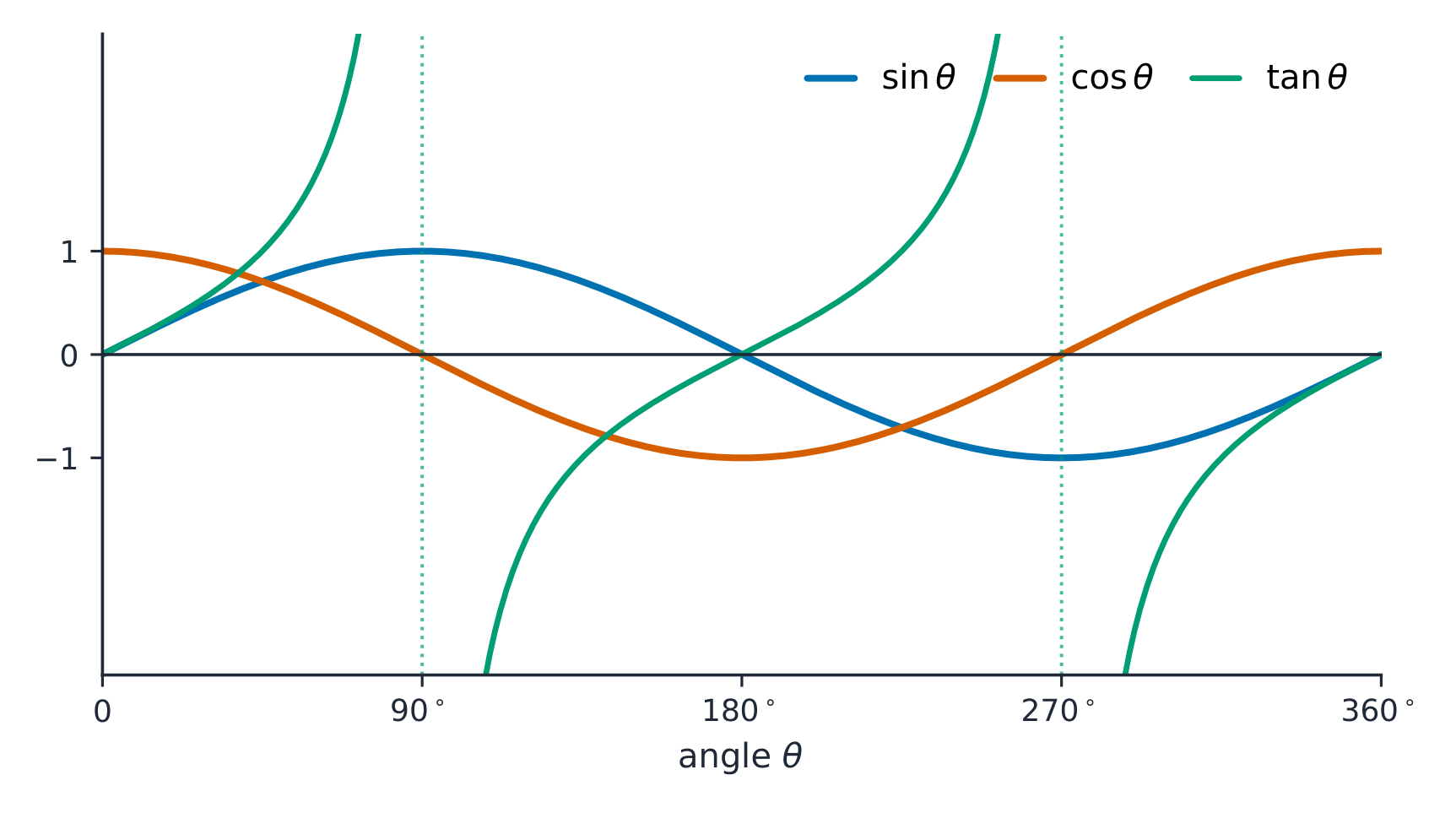

sin and cos wave between -1 and 1; tan breaks at 90 and 270 degrees sin and cos wave between -1 and 1; tan breaks at 90 and 270 degrees

The Vienna Giant Ferris Wheel against a blue sky As a Ferris wheel turns steadily, your height rises and falls over and over — a real sine wave in time

Vocabulary Train
English Chinese Pinyin
periodic 周期性 zhōu qī xìng
period 周期 zhōu qī
cycle 周期段 zhōu qī duàn
3.2

Sine, Cosine, and Tangent

Syllabus
Learning ObjectiveEssential Knowledge

3.2.A
Determine the sine, cosine, and tangent of an angle using the unit circle.

  • 3.2.A.1 In the coordinate plane, an angle is in standard position when the vertex coincides with the origin and one ray coincides with the positive $x$-axis. The other ray is called the terminal ray. Positive and negative angle measures indicate rotations from the positive $x$-axis in the counterclockwise and clockwise direction, respectively. Angles in standard position that share a terminal ray differ by an integer number of revolutions.
  • 3.2.A.2 The radian measure of an angle in standard position is the ratio of the length of the arc of a circle centered at the origin subtended by the angle to the radius of that same circle. For a unit circle, which has radius $1$, the radian measure is the same as the length of the subtended arc.
  • 3.2.A.3 Given an angle in standard position and a circle centered at the origin, there is a point, $P$, where the terminal ray intersects the circle. The sine of the angle is the ratio of the vertical displacement of $P$ from the $x$-axis to the distance between the origin and point $P$. Therefore, for a unit circle, the sine of the angle is the $y$-coordinate of point $P$.
  • 3.2.A.4 Given an angle in standard position and a circle centered at the origin, there is a point, $P$, where the terminal ray intersects the circle. The cosine of the angle is the ratio of the horizontal displacement of $P$ from the $y$-axis to the distance between the origin and point $P$. Therefore, for a unit circle, the cosine of the angle is the $x$-coordinate of point $P$.
  • 3.2.A.5 Given an angle in standard position, the tangent of the angle is the slope, if it exists, of the terminal ray. Because the slope of the terminal ray is the ratio of the vertical displacement to the horizontal displacement over any interval, the tangent of the angle is the ratio of the $y$-coordinate to the $x$-coordinate of the point at which the terminal ray intersects the unit circle; alternately, it is the ratio of the angle's sine to its cosine.

Source: College Board AP Course and Exam Description

An angle is in standard position 标准位置 when its vertex is at the origin and its initial ray lies on the positive $x$-axis. Its radian 弧度 measure is the arc length on a unit circle. For the point $P$ where the terminal ray meets a circle of radius $r$:

$$\cos\theta = \frac{x}{r},\qquad \sin\theta = \frac{y}{r},\qquad \tan\theta = \frac{y}{x}\ (\text{the slope of the terminal ray}).$$

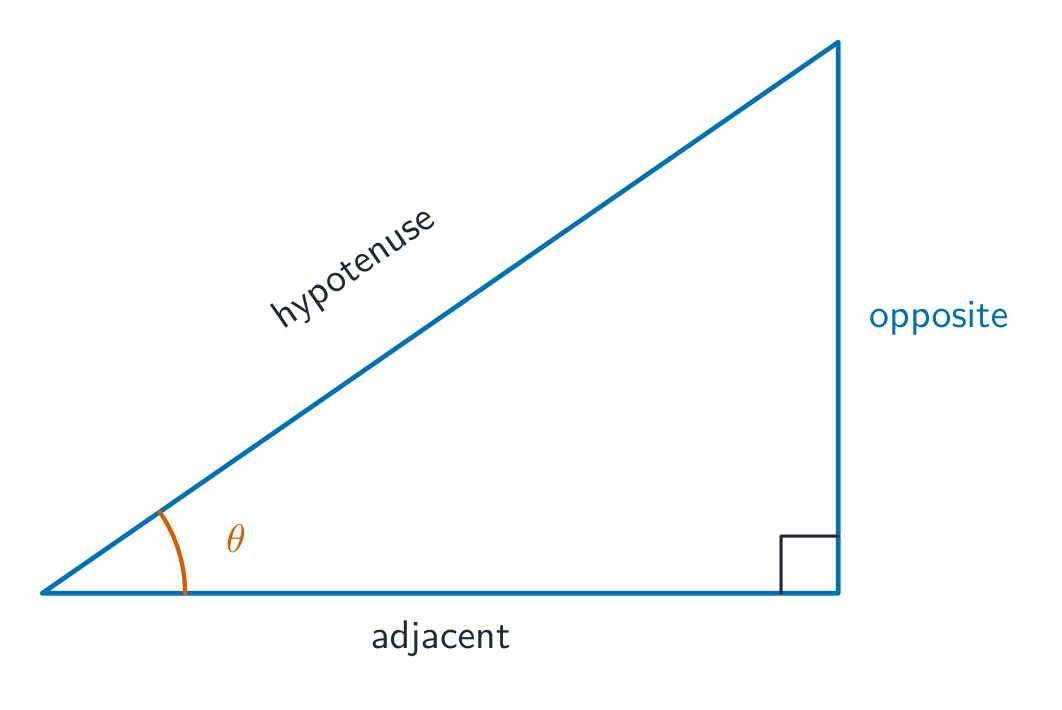
Naming the sides of a right triangle from the angle Naming the sides of a right triangle from the angle

Explore

Read sine and cosine off the unit circle

On the unit circle a point at angle $\theta$ has coordinates $(\cos\theta,\ \sin\theta)$. Spin the angle to watch sine and cosine trace out as the height and width.

Vocabulary Train
English Chinese Pinyin
standard position 标准位置 biāo zhǔn wèi zhì
radian 弧度 hú dù
3.3

Sine and Cosine Function Values

Syllabus
Learning ObjectiveEssential Knowledge

3.3.A
Determine coordinates of points on a circle centered at the origin.

  • 3.3.A.1 Given an angle of measure $\theta$ in standard position and a circle with radius $r$ centered at the origin, there is a point, $P$, where the terminal ray intersects the circle. The coordinates of point $P$ are $(r\cos\theta, r\sin\theta)$.
  • 3.3.A.2 The geometry of isosceles right and equilateral triangles, while attending to the signs of the values based on the quadrant of the angle, can be used to find exact values for the cosine and sine of angles that are multiples of $\dfrac{\pi}{4}$ and $\dfrac{\pi}{6}$ radians and whose terminal rays do not lie on an axis.

Source: College Board AP Course and Exam Description

On a circle of radius $r$, $x=r\cos\theta$ and $y=r\sin\theta$. Exact values at the special angles ($0,\tfrac{\pi}{6},\tfrac{\pi}{4},\tfrac{\pi}{3},\tfrac{\pi}{2},\dots$) come from isosceles right and equilateral triangle 等边三角形 geometry, with signs set by the quadrant 象限 of the angle.

Vocabulary Train
English Chinese Pinyin
equilateral triangle 等边三角形 děng biān sān jiǎo xíng
quadrant 象限 xiàng xiàn
3.4

Sine and Cosine Function Graphs

Syllabus
Learning ObjectiveEssential Knowledge

3.4.A
Construct representations of the sine and cosine functions using the unit circle.

  • 3.4.A.1 Given an angle of measure $\theta$ in standard position and a unit circle centered at the origin, there is a point, $P$, where the terminal ray intersects the circle. The sine function, $f(\theta) = \sin\theta$, gives the $y$-coordinate, or vertical displacement from the $x$-axis, of point $P$. The domain of the sine function is all real numbers.
  • 3.4.A.2 As the input values, or angle measures, of the sine function increase, the output values oscillate between $-1$ and $1$, taking every value in between and tracking the vertical distance of points on the unit circle from the $x$-axis.
  • 3.4.A.3 Given an angle of measure $\theta$ in standard position and a unit circle centered at the origin, there is a point, $P$, where the terminal ray intersects the circle. The cosine function, $f(\theta) = \cos\theta$, gives the $x$-coordinate, or horizontal displacement from the $y$-axis, of point $P$. The domain of the cosine function is all real numbers.
  • 3.4.A.4 As the input values, or angle measures, of the cosine function increase, the output values oscillate between $-1$ and $1$, taking every value in between and tracking the horizontal distance of points on the unit circle from the $y$-axis.

Source: College Board AP Course and Exam Description

The unit circle draws the sine curve

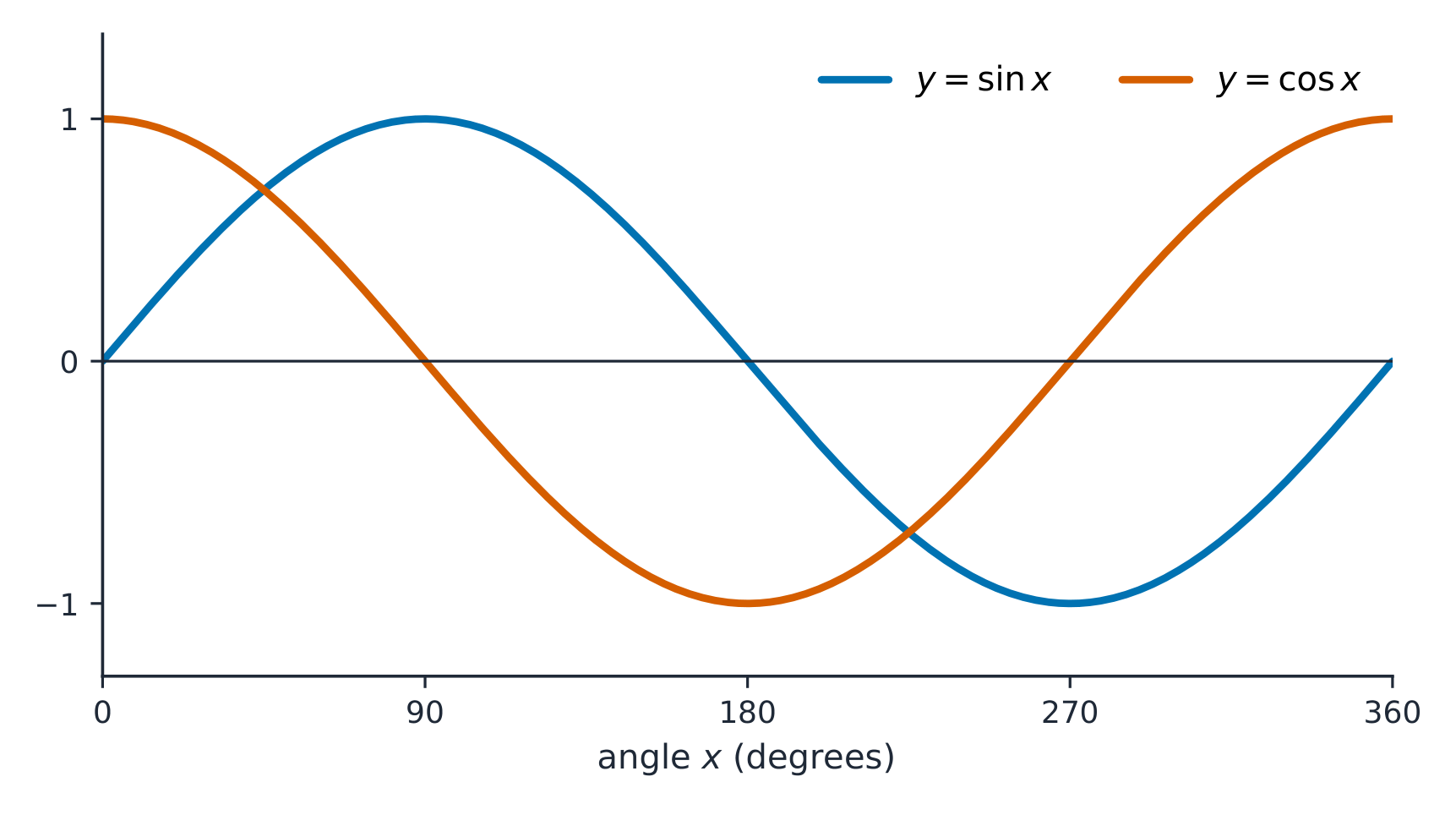
On the unit circle 单位圆 ($r=1$), $\sin\theta$ is the $y$-coordinate and $\cos\theta$ is the $x$-coordinate. As $\theta$ increases, both oscillate 振荡 smoothly between $-1$ and $1$ with period $2\pi$. Sine starts at $0$ (rising); cosine starts at $1$. They are the same wave shifted by $\tfrac{\pi}{2}$.

y = sin x and y = cos x are smooth waves between -1 and 1 y = sin x and y = cos x are smooth waves between -1 and 1

Explore

Graph a sine wave

Unrolling the circle gives the wave $y=\sin x$: it repeats every $2\pi$ (its period) and swings between $-1$ and $1$ (its amplitude).

Vocabulary Train
English Chinese Pinyin
unit circle 单位圆 dān wèi yuán
oscillate 振荡 zhèn dàng
Exercise sheet
3.5

Sinusoidal Functions

Syllabus
Learning ObjectiveEssential Knowledge

3.5.A
Identify key characteristics of the sine and cosine functions.

  • 3.5.A.1 A sinusoidal function is any function that involves additive and multiplicative transformations of $f(\theta) = \sin\theta$. The sine and cosine functions are both sinusoidal functions, with $\cos\theta = \sin\left(\theta + \dfrac{\pi}{2}\right)$.
  • 3.5.A.2 The period and frequency of a sinusoidal function are reciprocals. The period of $f(\theta) = \sin\theta$ and $g(\theta) = \cos\theta$ is $2\pi$, and the frequency is $\dfrac{1}{2\pi}$.
  • 3.5.A.3 The amplitude of a sinusoidal function is half the difference between its maximum and minimum values. The amplitude of $f(\theta) = \sin\theta$ and $g(\theta) = \cos\theta$ is $1$.
  • 3.5.A.4 The midline of the graph of a sinusoidal function is determined by the average, or arithmetic mean, of the maximum and minimum values of the function. The midline of the graphs of $y = \sin\theta$ and $y = \cos\theta$ is $y = 0$.
  • 3.5.A.5 As input values increase, the graphs of sinusoidal functions oscillate between concave down and concave up.
  • 3.5.A.6 The graph of $y = \sin\theta$ has rotational symmetry about the origin and is therefore an odd function. The graph of $y = \cos\theta$ has reflective symmetry over the $y$-axis and is therefore an even function.

Source: College Board AP Course and Exam Description

A sinusoidal function 正弦型函数 is any transformation of sine (or cosine). Its key features:

  • Period and frequency 频率 are reciprocals; $\sin\theta$ has period $2\pi$.
  • Amplitude 振幅 = half the distance between the maximum and minimum output.
  • Midline 中线 $y=d$ = the average of the maximum and minimum (the horizontal center line).

The graph alternates concave up and concave down each half-cycle.

Worked example. For $f(\theta)=3\sin(2\theta)+1$: the amplitude is $3$, the period is $\dfrac{2\pi}{2}=\pi$, and the midline is $y=1$. So the maximum output is $1+3=4$ and the minimum is $1-3=-2$.

Vocabulary Train
English Chinese Pinyin
sinusoidal function 正弦型函数 zhèng xián xíng hán shù
frequency 频率 pín lǜ
Amplitude 振幅 zhèn fú
Midline 中线 zhōng xiàn
3.6

Sinusoidal Function Transformations

Syllabus
Learning ObjectiveEssential Knowledge

3.6.A
Identify the amplitude, vertical shift, period, and phase shift of a sinusoidal function.

  • 3.6.A.1 Functions that can be written in the form $f(\theta) = a\sin(b(\theta + c)) + d$ or $g(\theta) = a\cos(b(\theta + c)) + d$, where $a, b, c,$ and $d$ are real numbers and $a \neq 0$, are sinusoidal functions and are transformations of the sine and cosine functions. Additive and multiplicative transformations are the same for both sine and cosine because the cosine function is a phase shift of the sine function by $-\dfrac{\pi}{2}$ units.
  • 3.6.A.2 The graph of the additive transformation $g(\theta) = \sin\theta + d$ of the sine function $f(\theta) = \sin\theta$ is a vertical translation of the graph of $f$, including its midline, by $d$ units. The same transformation of the cosine function yields the same result.
  • 3.6.A.3 The graph of the additive transformation $g(\theta) = \sin(\theta + c)$ of the sine function $f(\theta) = \sin\theta$ is a horizontal translation, or phase shift, of the graph of $f$ by $-c$ units. The same transformation of the cosine function yields the same result.
  • 3.6.A.4 The graph of the multiplicative transformation $g(\theta) = a\sin\theta$ of the sine function $f(\theta) = \sin\theta$ is a vertical dilation of the graph of $f$ and differs in amplitude by a factor of $|a|$. The same transformation of the cosine function yields the same result.
  • 3.6.A.5 The graph of the multiplicative transformation $g(\theta) = \sin(b\theta)$ of the sine function $f(\theta) = \sin\theta$ is a horizontal dilation of the graph of $f$ and differs in period by a factor of $\left|\dfrac{1}{b}\right|$. The same transformation of the cosine function yields the same result.
  • 3.6.A.6 The graph of $y = f(\theta) = a\sin(b(\theta + c)) + d$ has an amplitude of $|a|$ units, a period of $\left|\dfrac{1}{b}\right|2\pi$ units, a midline vertical shift of $d$ units from $y = 0$, and a phase shift of $-c$ units. The same transformations of the cosine function yield the same results.

Source: College Board AP Course and Exam Description

Amplitude, period & phase of a sinusoid

The general sinusoid is

$$f(\theta)=a\sin\big(b(\theta+c)\big)+d \quad\text{or}\quad a\cos\big(b(\theta+c)\big)+d,$$
where $|a|$ is the amplitude, $\dfrac{2\pi}{|b|}$ is the period, $c$ is the horizontal phase shift 相移, and $d$ is the vertical shift (midline). A negative $a$ reflects the wave.

Explore

Stretch and shift a sinusoid

In $y=a\sin(bx+c)+d$: $a$ sets the amplitude, $b$ the period, $c$ a horizontal phase shift, and $d$ a vertical shift. Change each and watch the wave respond.

Vocabulary Train
English Chinese Pinyin
phase shift 相移 xiāng yí
3.7

Sinusoidal Function Context and Data Modeling

Syllabus
Learning ObjectiveEssential Knowledge

3.7.A
Construct sinusoidal function models of periodic phenomena.

  • 3.7.A.1 The smallest interval of input values over which the maximum or minimum output values start to repeat, that is, the input-value interval between consecutive maxima or consecutive minima, can be used to determine or estimate the period and frequency for a sinusoidal function model.
  • 3.7.A.2 The maximum and minimum output values can be used to determine or estimate the amplitude and vertical shift for a sinusoidal function model.
  • 3.7.A.3 An actual pair of input-output values can be compared to pairs of input-output values produced by a sinusoidal function model to determine or estimate a phase shift for the model.
  • 3.7.A.4 Sinusoidal function models can be constructed for a data set with technology by estimating key values or using sinusoidal regressions.
  • 3.7.A.5 Sinusoidal functions that model a data set are frequently only useful over their contextual domain and can be used to predict values of the dependent variable from values of the independent variable.

Source: College Board AP Course and Exam Description

To model periodic data (tides, daylight, temperature): read the period from where the pattern repeats, get the amplitude and midline from the max and min, and set the phase shift so a peak lands at the right input. Technology fits a sinusoidal regression. Such a model is only trustworthy over its contextual domain.

3.8

The Tangent Function

Syllabus
Learning ObjectiveEssential Knowledge

3.8.A
Construct representations of the tangent function using the unit circle.

  • 3.8.A.1 Given an angle of measure $\theta$ in standard position and a unit circle centered at the origin, there is a point, $P$, where the terminal ray intersects the circle. The tangent function, $f(\theta) = \tan\theta$, gives the slope of the terminal ray.
  • 3.8.A.2 Because the slope of the terminal ray is the ratio of the change in the $y$-values to the change in the $x$-values between any two points on the ray, the tangent function is also the ratio of the sine function to the cosine function. Therefore, $\tan\theta = \dfrac{\sin\theta}{\cos\theta}$, where $\cos\theta \neq 0$.

3.8.B
Describe key characteristics of the tangent function.

  • 3.8.B.1 Because the slope values of the terminal ray repeat every one-half revolution of the circle, the tangent function has a period of $\pi$.
  • 3.8.B.2 The tangent function demonstrates periodic asymptotic behavior at input values $\theta = \dfrac{\pi}{2} + k\pi$, for integer values of $k$, because $\cos\theta = 0$ at those values.
  • 3.8.B.3 The tangent function increases and its graph changes from concave down to concave up between consecutive asymptotes.

Source: College Board AP Course and Exam Description

$\tan\theta=\dfrac{\sin\theta}{\cos\theta}$ is the slope of the terminal ray. Its slope values repeat every half-revolution, so its period is $\pi$. It has vertical asymptotes where $\cos\theta=0$ (at $\theta=\tfrac{\pi}{2}+k\pi$), and it is always increasing between consecutive asymptotes, switching concavity at each zero.

3.9

Inverse Trigonometric Functions

Syllabus
Learning ObjectiveEssential Knowledge

3.9.A
Construct analytical and graphical representations of the inverse of the sine, cosine, and tangent functions over a restricted domain.

  • 3.9.A.1 For inverse trigonometric functions, the input and output values are switched from their corresponding trigonometric functions, so the output value of an inverse trigonometric function is often interpreted as an angle measure and the input is a value in the range of the corresponding trigonometric function.
  • 3.9.A.2 The inverse trigonometric functions are called arcsine, arccosine, and arctangent (also represented as $\sin^{-1}x, \cos^{-1}x,$ and $\tan^{-1}x$). Because the corresponding trigonometric functions are periodic, they are only invertible if they have restricted domains.
  • 3.9.A.3 In order to define their respective inverse functions, the domain of the sine function is restricted to $\left[-\dfrac{\pi}{2}, \dfrac{\pi}{2}\right]$, the cosine function to $[0, \pi]$, and the tangent function to $\left(-\dfrac{\pi}{2}, \dfrac{\pi}{2}\right)$.

Source: College Board AP Course and Exam Description

The inverse trigonometric functions 反三角函数arcsine 反正弦, arccosine, arctangent – reverse the trig functions, so they take a ratio and return an angle. Because sine, cosine, and tangent repeat, their domains must be restricted (e.g. sine to $[-\tfrac{\pi}{2},\tfrac{\pi}{2}]$) before an inverse can exist.

Vocabulary Train
English Chinese Pinyin
inverse trigonometric functions 反三角函数 fǎn sān jiǎo hán shù
arcsine 反正弦 fǎn zhèng xián
3.10

Trigonometric Equations and Inequalities

Syllabus
Learning ObjectiveEssential Knowledge

3.10.A
Solve equations and inequalities involving trigonometric functions.

  • 3.10.A.1 Inverse trigonometric functions are useful in solving equations and inequalities involving trigonometric functions, but solutions may need to be modified due to domain restrictions.
  • 3.10.A.2 Because trigonometric functions are periodic, there are often infinitely many solutions to trigonometric equations.
  • 3.10.A.3 In trigonometric equations and inequalities arising from a contextual scenario, there is often a domain restriction that can be implied from the context, which limits the number of solutions.

Source: College Board AP Course and Exam Description

Use inverse trig functions to solve trig equations. Because the functions are periodic, there are usually infinitely many solutions – write the general solution by adding multiples of the period, then keep those in the required (often contextual) domain.

Worked example. Solve $2\sin\theta=1$ on $[0,2\pi)$. Then $\sin\theta=\tfrac12$, and on the unit circle sine is positive in the first and second quadrants, so $\theta=\dfrac{\pi}{6}$ or $\dfrac{5\pi}{6}$. Over all reals you would add $2\pi k$ to each.

3.11

The Secant, Cosecant, and Cotangent Functions
Syllabus
Learning ObjectiveEssential Knowledge

3.11.A
Identify key characteristics of functions that involve quotients of the sine and cosine functions.

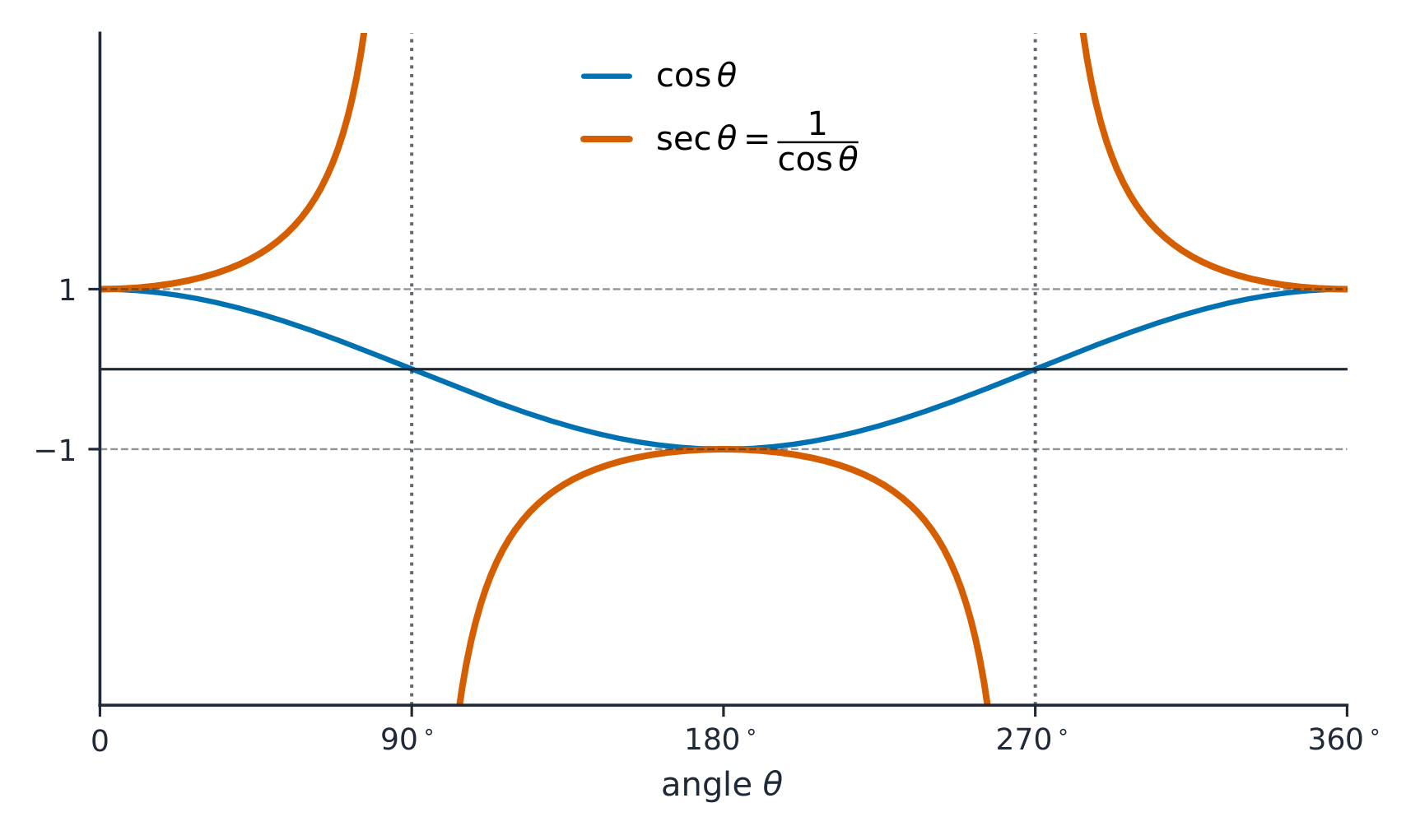
  • 3.11.A.1 The secant function, $f(\theta) = \sec\theta$, is the reciprocal of the cosine function, where $\cos\theta \neq 0$.
  • 3.11.A.2 The cosecant function, $f(\theta) = \csc\theta$, is the reciprocal of the sine function, where $\sin\theta \neq 0$.
  • 3.11.A.3 The graphs of the secant and cosecant functions have vertical asymptotes where cosine and sine are zero, respectively, and have a range of $(-\infty, -1] \cup [1, \infty)$.
  • 3.11.A.4 The cotangent function, $f(\theta) = \cot\theta$, is the reciprocal of the tangent function, where $\tan\theta \neq 0$. Equivalently, $\cot\theta = \dfrac{\cos\theta}{\sin\theta}$, where $\sin\theta \neq 0$.
  • 3.11.A.5 The graph of the cotangent function has vertical asymptotes for domain values where $\tan\theta = 0$ and is decreasing between consecutive asymptotes.

Source: College Board AP Course and Exam Description

These are the reciprocals 倒数 of the main three:

$$\sec\theta=\frac{1}{\cos\theta},\qquad \csc\theta=\frac{1}{\sin\theta},\qquad \cot\theta=\frac{1}{\tan\theta}.$$
Secant and cosecant have vertical asymptotes where cosine and sine are zero; cotangent has them where tangent is zero (where sine is zero).

sec is the reciprocal of cos, with asymptotes where cos is zero sec is the reciprocal of cos, with asymptotes where cos is zero

Vocabulary Train
English Chinese Pinyin
reciprocals 倒数 dào shǔ
3.12

Equivalent Representations of Trigonometric Functions

Syllabus
Learning ObjectiveEssential Knowledge

3.12.A
Rewrite trigonometric expressions in equivalent forms with the Pythagorean identity.

  • 3.12.A.1 The Pythagorean Theorem can be applied to right triangles with points on the unit circle at coordinates $(\cos\theta, \sin\theta)$, resulting in the Pythagorean identity: $\sin^2\theta + \cos^2\theta = 1$.
  • 3.12.A.2 The Pythagorean identity can be algebraically manipulated into other forms involving trigonometric functions, such as $\tan^2\theta = \sec^2\theta - 1$, and can be used to establish other trigonometric relationships, such as $\arcsin x = \arccos\left(\sqrt{1 - x^2}\right)$, with appropriate domain restrictions.

3.12.B
Rewrite trigonometric expressions in equivalent forms with sine and cosine sum identities.

  • 3.12.B.1 The sum identity for sine is $\sin(\alpha + \beta) = \sin\alpha\cos\beta + \cos\alpha\sin\beta$.
  • 3.12.B.2 The sum identity for cosine is $\cos(\alpha + \beta) = \cos\alpha\cos\beta - \sin\alpha\sin\beta$.
  • 3.12.B.3 The sum identities for sine and cosine can also be used as difference and double-angle identities.
  • 3.12.B.4 Properties of trigonometric functions, known trigonometric identities, and other algebraic properties can be used to verify additional trigonometric identities.

3.12.C
Solve equations using equivalent analytic representations of trigonometric functions.

  • 3.12.C.1 A specific equivalent form involving trigonometric expressions can make information more accessible.
  • 3.12.C.2 Equivalent trigonometric forms may be useful in solving trigonometric equations and inequalities.

Source: College Board AP Course and Exam Description

The Pythagorean identity 毕达哥拉斯恒等式 comes from $x^2+y^2=1$ on the unit circle:

$$\sin^2\theta+\cos^2\theta=1,$$
which rearranges into forms with $\sec$ and $\tan$. The sum identities 和角公式:
$$\sin(\alpha+\beta)=\sin\alpha\cos\beta+\cos\alpha\sin\beta,\qquad \cos(\alpha+\beta)=\cos\alpha\cos\beta-\sin\alpha\sin\beta,$$
also give the difference and double-angle 二倍角 identities (set $\beta=\alpha$).

Vocabulary Train
English Chinese Pinyin
Pythagorean identity 毕达哥拉斯恒等式 bì dá gē lā sī héng děng shì
sum identities 和角公式 hé jiǎo gōng shì
double-angle 二倍角 èr bèi jiǎo
3.13

Trigonometry and Polar Coordinates
Syllabus
Learning ObjectiveEssential Knowledge

3.13.A
Determine the location of a point in the plane using both rectangular and polar coordinates.

  • 3.13.A.1 The polar coordinate system is based on a grid of circles centered at the origin and on lines through the origin. Polar coordinates are defined as an ordered pair, $(r, \theta)$, such that $|r|$ represents the radius of the circle on which the point lies, and $\theta$ represents the measure of an angle in standard position whose terminal ray includes the point. In the polar coordinate system, the same point can be represented many ways.
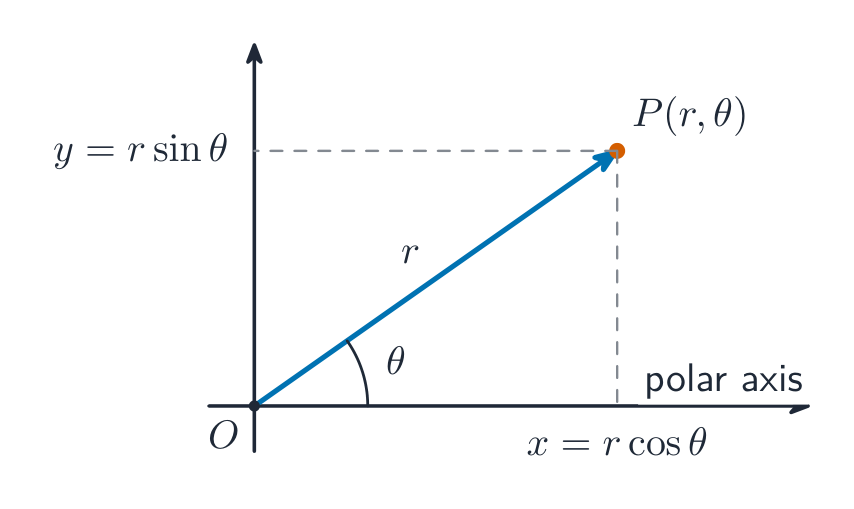
  • 3.13.A.2 The coordinates of a point in the polar coordinate system, $(r, \theta)$, can be converted to coordinates in the rectangular coordinate system, $(x, y)$, using $x = r\cos\theta$ and $y = r\sin\theta$.
  • 3.13.A.3 The coordinates of a point in the rectangular coordinate system, $(x, y)$, can be converted to coordinates in the polar coordinate system, $(r, \theta)$, using $r = \sqrt{x^2 + y^2}$ and $\theta = \arctan\left(\dfrac{y}{x}\right)$ for $x > 0$ or $\theta = \arctan\left(\dfrac{y}{x}\right) + \pi$ for $x < 0$.
  • 3.13.A.4 A complex number can be understood as a point in the complex plane and can be determined by its corresponding rectangular or polar coordinates. When the complex number has the rectangular coordinates $(a, b)$, it can be expressed as $a + bi$. When the complex number has polar coordinates $(r, \theta)$, it can be expressed as $(r\cos\theta) + i(r\sin\theta)$.

Source: College Board AP Course and Exam Description

Polar coordinates 极坐标 locate a point by $(r,\theta)$ – distance $r$ from the origin at angle $\theta$. Convert with

$$x=r\cos\theta,\quad y=r\sin\theta,\qquad r=\sqrt{x^2+y^2},\quad \tan\theta=\frac{y}{x}.$$
A complex number 复数 is the point $(x,y)=x+yi$ and can likewise be written with $r$ and $\theta$.

Polar coordinates give a point by its distance r and angle theta Polar coordinates give a point by its distance r and angle theta

Vocabulary Train
English Chinese Pinyin
Polar coordinates 极坐标 jí zuò biāo
complex number 复数 fù shù
3.14

Polar Function Graphs

Syllabus
Learning ObjectiveEssential Knowledge

3.14.A
Construct graphs of polar functions.

  • 3.14.A.1 The graph of the function $r = f(\theta)$ in polar coordinates consists of input-output pairs of values where the input values are angle measures and the output values are radii.
  • 3.14.A.2 The domain of the polar function $r = f(\theta)$, given graphically, can be restricted to a desired portion of the function by selecting endpoints corresponding to the desired angle and radius.
  • 3.14.A.3 When graphing polar functions in the form of $r = f(\theta)$, changes in input values correspond to changes in angle measure from the positive $x$-axis, and changes in output values correspond to changes in distance from the origin.

Source: College Board AP Course and Exam Description

Tracing a polar curve

The graph of $r=f(\theta)$ is all points $(r,\theta)$ as $\theta$ sweeps around. Restricting the domain of $\theta$ draws only part of the curve. As $\theta$ increases, $r$ grows or shrinks, tracing spirals, circles, roses, and limaçons.

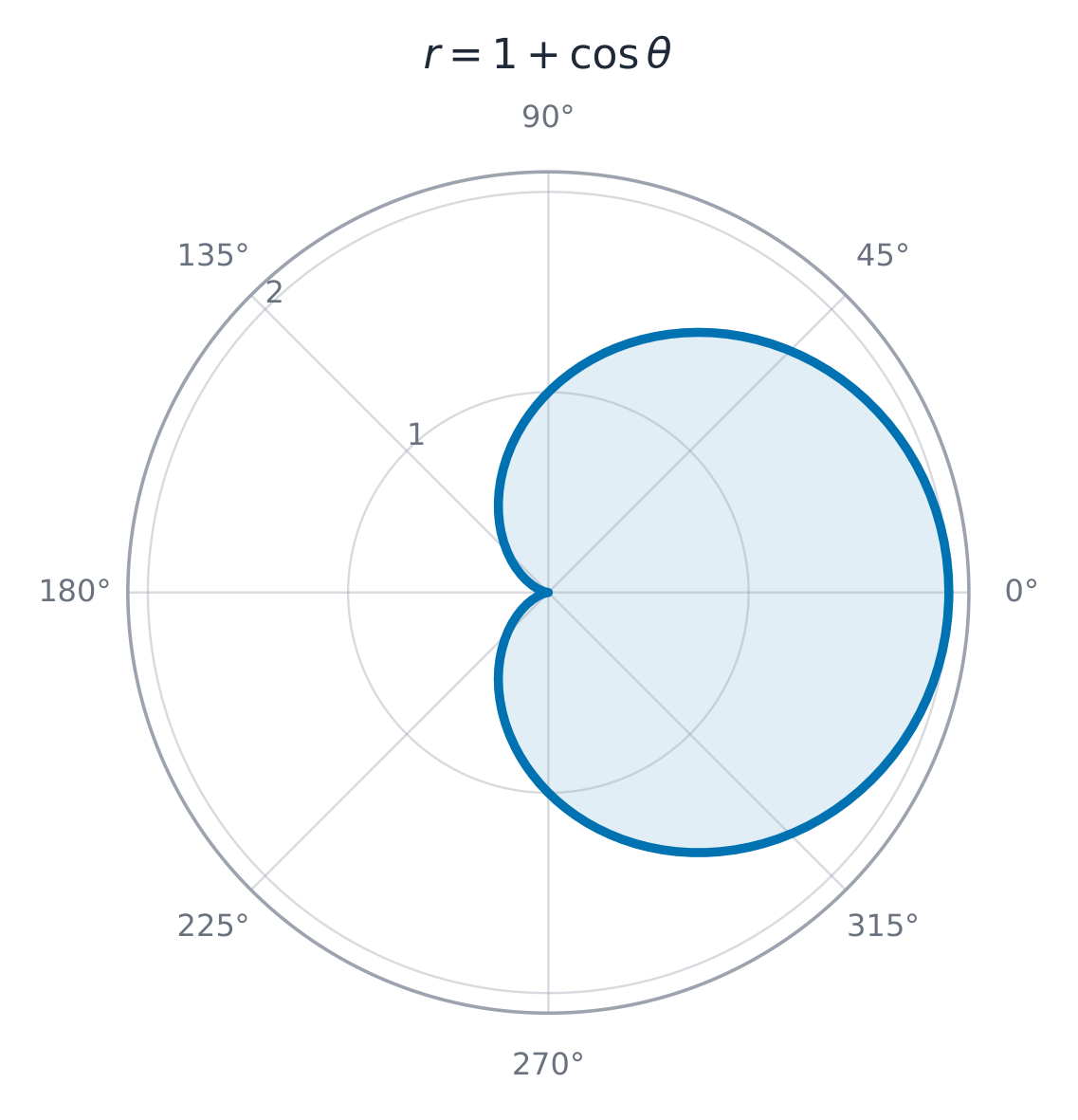
A cardioid r = 1 + cos theta, sketched directly in polar form A cardioid r = 1 + cos theta, sketched directly in polar form

Explore

Plot a curve in polar coordinates

In polar form a point is a distance $r$ at angle $\theta$. Letting $r$ depend on $\theta$ traces shapes a rule in $x,y$ can't — like this cardioid.

3.15

Rates of Change in Polar Functions

Syllabus
Learning ObjectiveEssential Knowledge

3.15.A
Describe characteristics of the graph of a polar function.

  • 3.15.A.1 If a polar function, $r = f(\theta)$, is positive and increasing or negative and decreasing, then the distance between $f(\theta)$ and the origin is increasing.
  • 3.15.A.2 If a polar function, $r = f(\theta)$, is positive and decreasing or negative and increasing, then the distance between $f(\theta)$ and the origin is decreasing.
  • 3.15.A.3 For a polar function, $r = f(\theta)$, if the function changes from increasing to decreasing or decreasing to increasing on an interval, then the function has a relative extremum on the interval corresponding to a point relatively closest to or farthest from the origin.
  • 3.15.A.4 The average rate of change of $r$ with respect to $\theta$ over an interval of $\theta$ is the ratio of the change in the radius values to the change in $\theta$ over an interval of $\theta$. Graphically, the average rate of change indicates the rate at which the radius is changing per radian.
  • 3.15.A.5 The average rate of change of $r$ with respect to $\theta$ over an interval of $\theta$ can be used to estimate values of the function within the interval.

Source: College Board AP Course and Exam Description

As $\theta$ increases, the distance from the origin $r$ changes:

  • $r$ positive and increasing (or negative and decreasing) $\Rightarrow$ moving away from the origin;
  • $r$ positive and decreasing (or negative and increasing) $\Rightarrow$ moving toward the origin.

Where $r$ switches between increasing and decreasing, the distance reaches a relative extreme. The average rate of change of $r$ with respect to $\theta$, $\dfrac{\Delta r}{\Delta \theta}$, estimates how fast the curve moves in or out over an interval.

3.15

Exam tips

  • Use radians and the unit circle: $\cos\theta$ and $\sin\theta$ are the coordinates, always between $-1$ and $1$.
  • For a sinusoid $a\sin(b(\theta+c))+d$: $|a|$ is the amplitude, $\tfrac{2\pi}{|b|}$ the period, $d$ the midline, $c$ the phase shift.
  • Model periodic data by reading period, amplitude, and midline from the max and min.
  • Inverse trig functions need a restricted domain and return an angle; trig equations have infinitely many solutions (add the period).
  • Convert polar↔rectangular with $x=r\cos\theta$, $y=r\sin\theta$.

Log in or create account

IGCSE & A-Level