Skip to content

Exponential and Logarithmic Functions

AP Precalculus · Topic 2

Train
2.1

Change in Arithmetic and Geometric Sequences
Syllabus
Learning ObjectiveEssential Knowledge

2.1.A
Express arithmetic sequences found in mathematical and contextual scenarios as functions of the whole numbers.

  • 2.1.A.1 A sequence is a function from the whole numbers to the real numbers. Consequently, the graph of a sequence consists of discrete points instead of a curve.
  • 2.1.A.2 Successive terms in an arithmetic sequence have a common difference, or constant rate of change.
  • 2.1.A.3 The general term of an arithmetic sequence with a common difference $d$ is denoted by $a_n$ and is given by $a_n = a_0 + dn$, where $a_0$ is the initial value, or by $a_n = a_k + d(n - k)$, where $a_k$ is the $k$th term of the sequence.

2.1.B
Express geometric sequences found in mathematical and contextual scenarios as functions of the whole numbers.

  • 2.1.B.1 Successive terms in a geometric sequence have a common ratio, or constant proportional change.
  • 2.1.B.2 The general term of a geometric sequence with a common ratio $r$ is denoted by $g_n$ and is given by $g_n = g_0 r^n$, where $g_0$ is the initial value, or by $g_n = g_k r^{(n-k)}$, where $g_k$ is the $k$th term of the sequence.
  • 2.1.B.3 Increasing arithmetic sequences increase equally with each step, whereas increasing geometric sequences increase by a larger amount with each successive step.

Source: College Board AP Course and Exam Description

Geometric series & convergence

A sequence 数列 is a function from the whole numbers to the real numbers, so its graph is discrete points, not a curve.

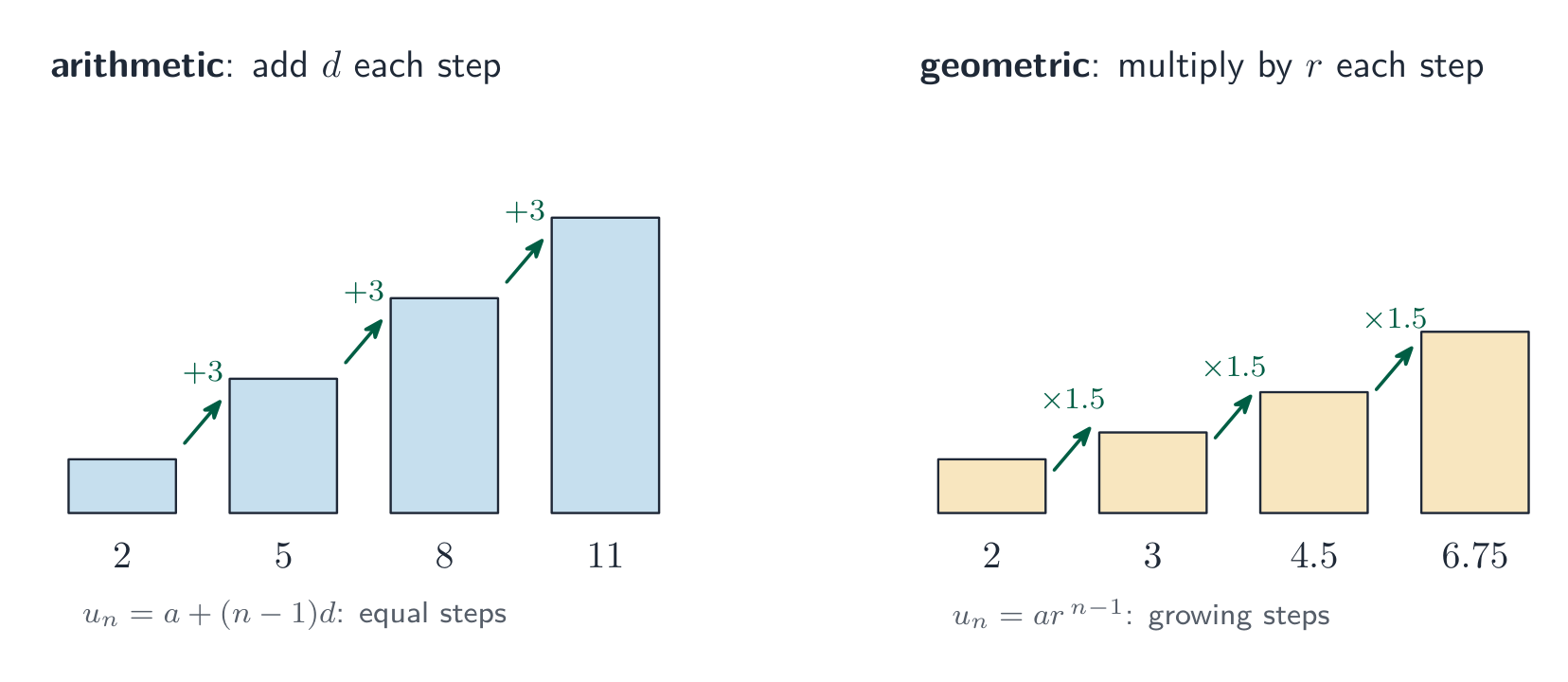
An arithmetic sequence climbs in equal steps; a geometric one multiplies by a ratio An arithmetic sequence climbs in equal steps; a geometric one multiplies by a ratio

  • An arithmetic sequence 等差数列 has a common difference 公差 $d$ (a constant rate of change): $a_n = a_0 + dn$, or from a known term, $a_n = a_k + d(n-k)$.
  • A geometric sequence 等比数列 has a common ratio 公比 $r$ (a constant proportional change): $g_n = g_0\,r^{\,n}$, or $g_n = g_k\,r^{\,(n-k)}$.

An increasing arithmetic sequence grows by the same amount each step; an increasing geometric sequence grows by a larger amount each step.

Worked example. An arithmetic sequence with $a_0=3$ and $d=5$ has $a_4=3+5(4)=23$. A geometric sequence with $g_0=2$ and $r=3$ has $g_4=2\cdot3^4=162$ – addition versus multiplication makes the geometric one pull far ahead.

Explore

Compare arithmetic and geometric growth

An arithmetic sequence adds a fixed step each term (linear); a geometric sequence multiplies by a fixed ratio (exponential). Change the ratio and watch the terms explode or decay.

Vocabulary Train
English Chinese Pinyin
sequence 数列 shù liè
arithmetic sequence 等差数列 děng chā shù liè
common difference 公差 gōng chāi
geometric sequence 等比数列 děng bǐ shù liè
common ratio 公比 gōng bǐ
2.2

Change in Linear and Exponential Functions

Syllabus
Learning ObjectiveEssential Knowledge

2.2.A
Construct functions of the real numbers that are comparable to arithmetic and geometric sequences.

  • 2.2.A.1 Linear functions of the form $f(x) = b + mx$ are similar to arithmetic sequences of the form $a_n = a_0 + dn$, as both can be expressed as an initial value ($b$ or $a_0$) plus repeated addition of a constant rate of change, the slope ($m$ or $d$).
  • 2.2.A.2 Similar to arithmetic sequences of the form $a_n = a_k + d(n - k)$, which are based on a known difference, $d$, and a $k$th term, linear functions can be expressed in the form $f(x) = y_i + m(x - x_i)$ based on a known slope, $m$, and a point, $(x_i, y_i)$.
  • 2.2.A.3 Exponential functions of the form $f(x) = ab^x$ are similar to geometric sequences of the form $g_n = g_0 r^n$, as both can be expressed as an initial value ($a$ or $g_0$) times repeated multiplication by a constant proportion ($b$ or $r$).
  • 2.2.A.4 Similar to geometric sequences of the form $g_n = g_k r^{(n-k)}$, which are based on a known ratio, $r$, and a $k$th term, exponential functions can be expressed in the form $f(x) = y_i r^{(x - x_i)}$ based on a known ratio, $r$, and a point, $(x_i, y_i)$.
  • 2.2.A.5 Sequences and their corresponding functions may have different domains.

Source: College Board AP Course and Exam Description

Sequences have continuous cousins:

  • Linear functions $f(x)=b+mx$ mirror arithmetic sequences – an initial value plus repeated addition of the slope $m$. Point form: $f(x)=y_i+m(x-x_i)$.
  • Exponential functions $f(x)=ab^x$ mirror geometric sequences – an initial value times repeated multiplication by the base $b$. Point form: $f(x)=y_i\,r^{\,(x-x_i)}$.

The difference: linear = repeated addition, exponential = repeated multiplication. (A sequence and its function may have different domains.)

2.3

Exponential Functions
Syllabus
Learning ObjectiveEssential Knowledge

2.3.A
Identify key characteristics of exponential functions.

  • 2.3.A.1 The general form of an exponential function is $f(x) = ab^x$, with the initial value $a$, where $a \neq 0$, and the base $b$, where $b > 0$, and $b \neq 1$. When $a > 0$ and $b > 1$, the exponential function is said to demonstrate exponential growth. When $a > 0$ and $0 < b < 1$, the exponential function is said to demonstrate exponential decay.
  • 2.3.A.2 When the natural numbers are input values in an exponential function, the input value specifies the number of factors of the base to be applied to the function's initial value. The domain of an exponential function is all real numbers.
  • 2.3.A.3 Because the output values of exponential functions in general form are proportional over equal-length input-value intervals, exponential functions are always increasing or always decreasing, and their graphs are always concave up or always concave down. Consequently, exponential functions do not have extrema except on a closed interval, and their graphs do not have points of inflection.
  • 2.3.A.4 If the values of the additive transformation function $g(x) = f(x) + k$ of any function $f$ are proportional over equal-length input-value intervals, then $f$ is exponential.

Source: College Board AP Course and Exam Description

The general exponential function 指数函数 is $f(x)=ab^x$ with initial value 初始值 $a\neq 0$ and base 底数 $b>0,\ b\neq 1$. Domain: all real numbers.

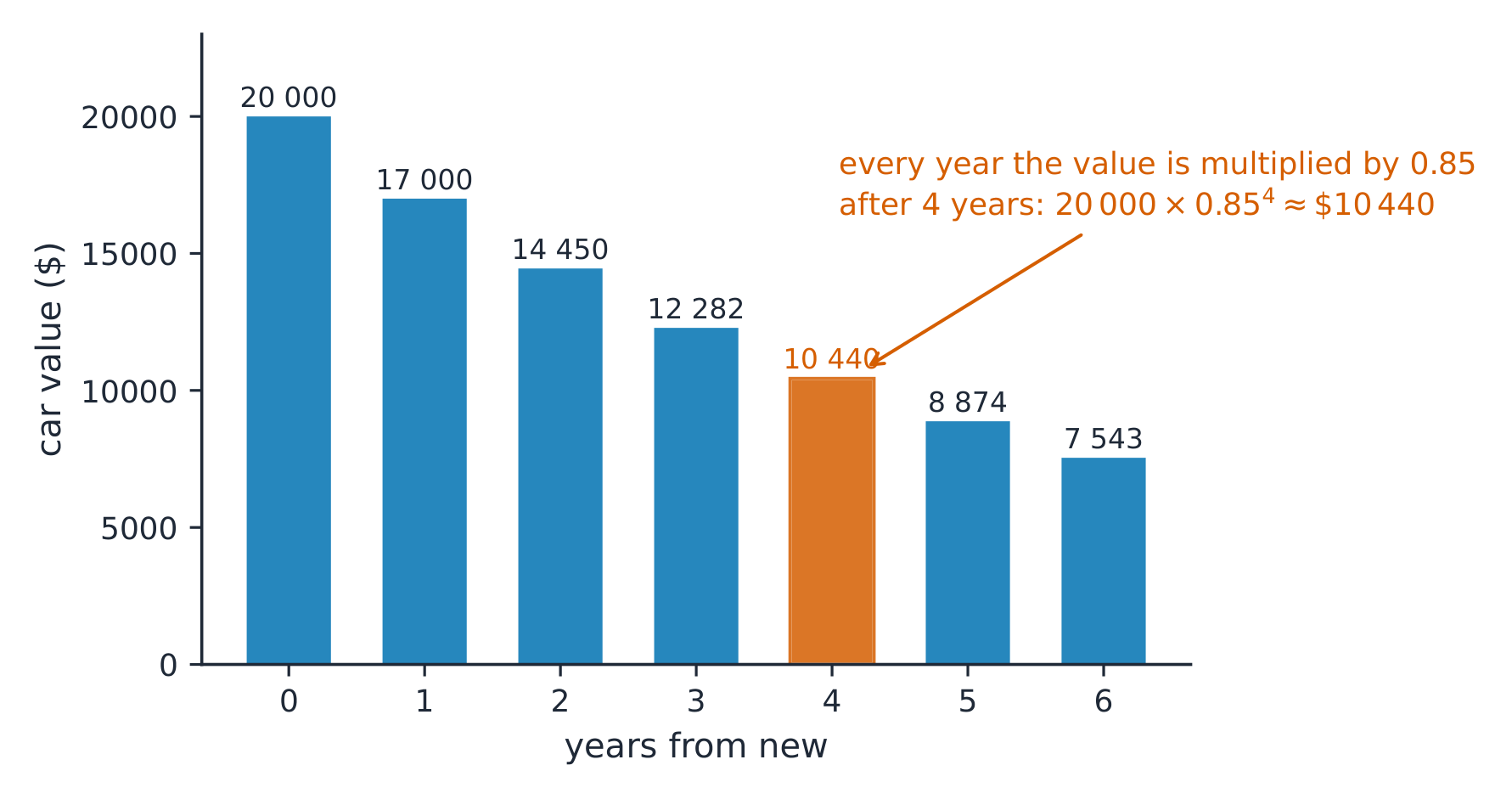
Exponential decay: a fixed percentage is lost each period Exponential decay: a fixed percentage is lost each period

  • $a>0,\ b>1$ gives exponential growth 指数增长; $a>0,\ 0 gives exponential decay 指数衰减.
  • Outputs are proportional over equal-length input intervals. So an exponential is always increasing or always decreasing, and always concave up or always concave down – it has no extrema (except on a closed interval) and no points of inflection.
Explore

Explore an exponential curve

y = a·e^(bx) + c

An exponential function changes by a constant factor over equal steps, so it rises (or decays) ever faster. The constant $c$ sets the horizontal asymptote it hugs.

Vocabulary Train
English Chinese Pinyin
exponential function 指数函数 zhǐ shù hán shù
initial value 初始值 chū shǐ zhí
base 底数 dǐ shù
exponential growth 指数增长 zhǐ shù zēng zhǎng
exponential decay 指数衰减 zhǐ shù shuāi jiǎn
2.4

Exponential Function Manipulation

Syllabus
Learning ObjectiveEssential Knowledge

2.4.A
Rewrite exponential expressions in equivalent forms.

  • 2.4.A.1 The product property for exponents states that $b^m b^n = b^{(m+n)}$. Graphically, this property implies that every horizontal translation of an exponential function, $f(x) = b^{(x+k)}$, is equivalent to a vertical dilation, $f(x) = b^{(x+k)} = b^x b^k = ab^x$, where $a = b^k$.
  • 2.4.A.2 The power property for exponents states that $\left(b^m\right)^n = b^{(mn)}$. Graphically, this property implies that every horizontal dilation of an exponential function, $f(x) = b^{(cx)}$, is equivalent to a change of the base of an exponential function, $f(x) = \left(b^c\right)^x$, where $b^c$ is a constant and $c \neq 0$.
  • 2.4.A.3 The negative exponent property states that $b^{-n} = \dfrac{1}{b^n}$.
  • 2.4.A.4 The value of an exponential expression involving an exponential unit fraction, such as $b^{(1/k)}$ where $k$ is a natural number, is the $k$th root of $b$, when it exists.

Source: College Board AP Course and Exam Description

The exponent rules reshape exponential expressions and connect to graph transformations:

  • Product: $b^m b^n = b^{m+n}$. A horizontal shift $b^{x+k}$ equals a vertical stretch $ab^x$ with $a=b^k$.
  • Power: $(b^m)^n = b^{mn}$. A horizontal stretch $b^{cx}$ equals a base change $(b^c)^x$.
  • Negative exponent: $b^{-n}=\dfrac{1}{b^n}$.
  • Unit-fraction exponent: $b^{1/k}=\sqrt[k]{b}$ (the $k$th root 方根).
Vocabulary Train
English Chinese Pinyin
root 方根 fāng gēn
2.5

Exponential Function Context and Data Modeling

Syllabus
Learning ObjectiveEssential Knowledge

2.5.A
Construct a model for situations involving proportional output values over equal-length input-value intervals.

  • 2.5.A.1 Exponential functions model growth patterns where successive output values over equal-length input-value intervals are proportional. When the input values are whole numbers, exponential functions model situations of repeated multiplication of a constant to an initial value.
  • 2.5.A.2 A constant may need to be added to the dependent variable values of a data set to reveal a proportional growth pattern.
  • 2.5.A.3 An exponential function model can be constructed from an appropriate ratio and initial value or from two input-output pairs. The initial value and the base can be found by solving a system of equations resulting from the two input-output pairs.
  • 2.5.A.4 Exponential function models can be constructed by applying transformations to $f(x) = ab^x$ based on characteristics of a contextual scenario or data set.
  • 2.5.A.5 Exponential function models can be constructed for a data set with technology using exponential regressions.
  • 2.5.A.6 The natural base $e$, which is approximately $2.718$, is often used as the base in exponential functions that model contextual scenarios.

Source: College Board AP Course and Exam Description

Exponentials model quantities that grow by a constant proportion over equal intervals (repeated multiplication).

  • Build a model from a ratio and an initial value, or from two points (solve the system for $a$ and $b$).
  • Sometimes a constant must be added to the data to reveal the proportional pattern.
  • Use exponential regression 指数回归 on technology to fit a data set.
  • The natural base 自然底数 $e\approx 2.718$ is the standard base for real-world models.
Vocabulary Train
English Chinese Pinyin
exponential regression 指数回归 zhǐ shù huí guī
natural base 自然底数 zì rán dǐ shù
2.6

Competing Function Model Validation

Syllabus
Learning ObjectiveEssential Knowledge

2.6.A
Construct linear, quadratic, and exponential models based on a data set.

  • 2.6.A.1 Two variables in a data set that demonstrate a slightly changing rate of change can be modeled by linear, quadratic, and exponential function models.
  • 2.6.A.2 Models can be compared based on contextual clues and applicability to determine which model is most appropriate.

2.6.B
Validate a model constructed from a data set.

  • 2.6.B.1 A model is justified as appropriate for a data set if the graph of the residuals of a regression, the residual plot, appear without pattern.
  • 2.6.B.2 The difference between the predicted and actual values is the error in the model. Depending on the data set and context, it may be more appropriate to have an underestimate or overestimate for any given interval.

Source: College Board AP Course and Exam Description

When a rate of change shifts only slightly, linear, quadratic, and exponential models may all seem to fit. Choose using context and fit quality:

  • A model is appropriate if its residual plot 残差图 shows no pattern (a residual 残差 is actual minus predicted).
  • The error is the gap between predicted and actual; context decides whether an over- or under-estimate is safer.
Vocabulary Train
English Chinese Pinyin
residual plot 残差图 cán chà tú
residual 残差 cán chà
2.7

Composition of Functions

Syllabus
Learning ObjectiveEssential Knowledge

2.7.A
Evaluate the composition of two or more functions for given values.

  • 2.7.A.1 If $f$ and $g$ are functions, the composite function $f \circ g$ maps a set of input values to a set of output values such that the output values of $g$ are used as input values of $f$. For this reason, the domain of the composite function is restricted to those input values of $g$ for which the corresponding output value is in the domain of $f$. $(f \circ g)(x)$ can also be represented as $f(g(x))$.
  • 2.7.A.2 Values for the composite function $f \circ g$ can be calculated or estimated from the graphical, numerical, analytical, or verbal representations of $f$ and $g$ by using output values from $g$ as input values for $f$.
  • 2.7.A.3 The composition of functions is not commutative; that is, $f \circ g$ and $g \circ f$ are typically different functions; therefore, $f(g(x))$ and $g(f(x))$ are typically different values.
  • 2.7.A.4 If the function $f(x) = x$ is composed with any function $g$, the resulting composite function is the same as $g$; that is, $g(f(x)) = f(g(x)) = g(x)$. The function $f(x) = x$ is called the identity function. When composing two functions, the identify function acts in the same way as $0$, the additive identity, when adding two numbers and $1$, the multiplicative identity, when multiplying two numbers.

2.7.B
Construct a representation of the composition of two or more functions.

  • 2.7.B.1 Function composition is useful for relating two quantities that are not directly related by an existing formula.
  • 2.7.B.2 When analytic representations of the functions $f$ and $g$ are available, an analytic representation of $f(g(x))$ can be constructed by substituting $g(x)$ for every instance of $x$ in $f$.
  • 2.7.B.3 A numerical or graphical representation of $f \circ g$ can often be constructed by calculating or estimating values for $(x, f(g(x)))$.

2.7.C
Rewrite a given function as a composition of two or more functions.

  • 2.7.C.1 Functions given analytically can often be decomposed into less complicated functions. When properly decomposed, the variable in one function should replace each instance of the function with which it was composed.
  • 2.7.C.2 An additive transformation of a function, $f$, that results in vertical and horizontal translations can be understood as the composition of $g(x) = x + k$ with $f$.
  • 2.7.C.3 A multiplicative transformation of a function, $f$, that results in vertical and horizontal dilations can be understood as the composition of $g(x) = kx$ with $f$.

Source: College Board AP Course and Exam Description

The composite function 复合函数 $(f\circ g)(x)=f(g(x))$ feeds $g$'s output into $f$. Its domain is the inputs of $g$ whose outputs lie in $f$'s domain.

A function as a machine; its inverse runs the machine backwards A function as a machine; its inverse runs the machine backwards

  • Composition is not commutative: $f(g(x))$ and $g(f(x))$ usually differ.
  • To build $f(g(x))$ analytically, substitute $g(x)$ for every $x$ in $f$.
  • The identity function 恒等函数 $f(x)=x$ leaves any function unchanged under composition.
  • A function can also be decomposed into simpler pieces – useful for seeing an additive shift as composing with $x+k$, or a dilation as composing with $kx$.

Vocabulary Train
English Chinese Pinyin
composite function 复合函数 fù hé hán shù
identity function 恒等函数 héng děng hán shù
2.8

Inverse Functions

Syllabus
Learning ObjectiveEssential Knowledge

2.8.A
Determine the input-output pairs of the inverse of a function.

  • 2.8.A.1 On a specified domain, a function, $f$, has an inverse function, or is invertible, if each output value of $f$ is mapped from a unique input value. The domain of a function may be restricted in many ways to make the function invertible.
  • 2.8.A.2 An inverse function can be thought of as a reverse mapping of the function. An inverse function, $f^{-1}$, maps the output values of a function, $f$, on its invertible domain to their corresponding input values; that is, if $f(a) = b$, then $f^{-1}(b) = a$. Alternately, on its invertible domain, if a function consists of input-output pairs $(a, b)$, then the inverse function consists of input-output pairs $(b, a)$.

2.8.B
Determine the inverse of a function on an invertible domain.

  • 2.8.B.1 The composition of a function, $f$, and its inverse function, $f^{-1}$, is the identity function; that is, $f\left(f^{-1}(x)\right) = f^{-1}(f(x)) = x$.
  • 2.8.B.2 On a function's invertible domain, the function's range and domain are the inverse function's domain and range, respectively. The inverse of the table of values of $y = f(x)$ can be found by reversing the input-output pairs; that is, $(a, b)$ corresponds to $(b, a)$.
  • 2.8.B.3 The inverse of the graph of the function $y = f(x)$ can be found by reversing the roles of the $x$- and $y$-axes; that is, by reflecting the graph of the function over the graph of the identity function $h(x) = x$.
  • 2.8.B.4 The inverse of the function can be found by determining the inverse operations to reverse the mapping. One method for finding the inverse of the function $f$ is reversing the roles of $x$ and $y$ in the equation $y = f(x)$, then solving for $y = f^{-1}(x)$.
  • 2.8.B.5 In addition to limiting the domain of a function to obtain an inverse function, contextual restrictions may also limit the applicability of an inverse function.

Source: College Board AP Course and Exam Description

Inverse functions are a reflection
Exponential & logarithm are inverses

A function is invertible 可逆 on a domain where each output comes from a unique input (you may restrict the domain to force this). The inverse function 反函数 $f^{-1}$ reverses the mapping: if $f(a)=b$ then $f^{-1}(b)=a$.

  • $f\big(f^{-1}(x)\big)=f^{-1}\big(f(x)\big)=x$ (composition gives the identity).
  • Domain and range swap: reverse each $(a,b)$ to $(b,a)$ in a table; reflect the graph over the line $y=x$.
  • To find a formula: swap $x$ and $y$ in $y=f(x)$, then solve for $y$. Context may further limit where the inverse applies.
Vocabulary Train
English Chinese Pinyin
invertible 可逆 kě nì
inverse function 反函数 fǎn hán shù
Exercise sheet
2.9

Logarithmic Expressions

Syllabus
Learning ObjectiveEssential Knowledge

2.9.A
Evaluate logarithmic expressions.

  • 2.9.A.1 The logarithmic expression $\log_b c$ is equal to, or represents, the value that the base $b$ must be exponentially raised to in order to obtain the value $c$. That is, $\log_b c = a$ if and only if $b^a = c$, where $a$ and $c$ are constants, $b > 0$, and $b \neq 1$. (when the base of a logarithmic expression is not specified, it is understood as the common logarithm with a base of $10$)
  • 2.9.A.2 The values of some logarithmic expressions are readily accessible through basic arithmetic while other values can be estimated through the use of technology.
  • 2.9.A.3 On a logarithmic scale, each unit represents a multiplicative change of the base of the logarithm. For example, on a standard scale, the units might be $0, \; 1, \; 2, \; \ldots$, while on a logarithmic scale, using logarithm base $10$, the units might be $10^0, \; 10^1, \; 10^2, \; \ldots$.

Source: College Board AP Course and Exam Description

The logarithm 对数 answers "what exponent?": $\log_b c = a$ means exactly $b^a = c$ (with $b>0,\ b\neq 1$). An unwritten base means the common logarithm 常用对数 (base $10$). On a logarithmic scale, each unit is a multiplicative step of the base (…, $10^0,10^1,10^2,$ …).

Vocabulary Train
English Chinese Pinyin
logarithm 对数 duì shù
common logarithm 常用对数 cháng yòng duì shù
2.10

Inverses of Exponential Functions
Syllabus
Learning ObjectiveEssential Knowledge

2.10.A
Construct representations of the inverse of an exponential function with an initial value of 1.

  • 2.10.A.1 The general form of a logarithmic function is $f(x) = a\log_b x$, with base $b$, where $b > 0$, $b \neq 1$, and $a \neq 0$.
  • 2.10.A.2 The way in which input and output values vary together have an inverse relationship in exponential and logarithmic functions. Output values of general-form exponential functions change proportionately as input values increase in equal-length intervals. However, input values of general-form logarithmic functions change proportionately as output values increase in equal-length intervals. Alternately, exponential growth is characterized by output values changing multiplicatively as input values change additively, whereas logarithmic growth is characterized by output values changing additively as input values change multiplicatively.
  • 2.10.A.3 $f(x) = \log_b x$ and $g(x) = b^x$, where $b > 0$ and $b \neq 1$, are inverse functions. That is, $g(f(x)) = f(g(x)) = x$.
  • 2.10.A.4 The graph of the logarithmic function $f(x) = \log_b x$, where $b > 0$ and $b \neq 1$, is a reflection of the graph of the exponential function $g(x) = b^x$, where $b > 0$ and $b \neq 1$, over the graph of the identity function $h(x) = x$.
  • 2.10.A.5 If $(s, \; t)$ is an ordered pair of the exponential function $g(x) = b^x$, where $b > 0$ and $b \neq 1$, then $(t, \; s)$ is an ordered pair of the logarithmic function $f(x) = \log_b x$, where $b > 0$ and $b \neq 1$.

Source: College Board AP Course and Exam Description

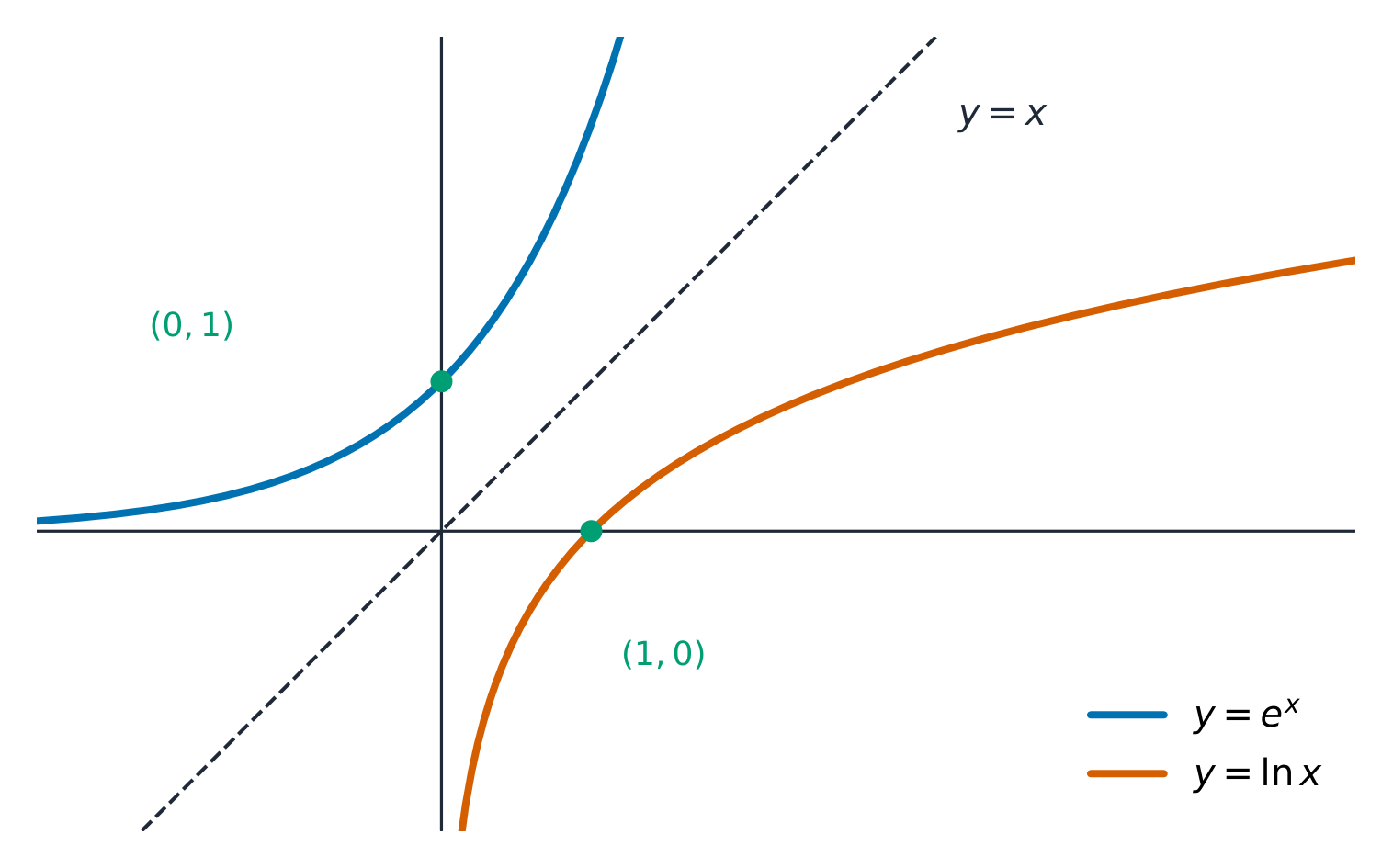
The logarithm is the inverse of the exponential: $y=b^x$ and $y=\log_b x$ undo each other, so their graphs are reflections over $y=x$. Hence $\log_b(b^x)=x$ and $b^{\log_b x}=x$. The natural logarithm 自然对数 $\ln x = \log_e x$ is the inverse of $e^x$.

e^x and ln x are reflections of each other in the line y = x e^x and ln x are reflections of each other in the line y = x

Vocabulary Train
English Chinese Pinyin
natural logarithm 自然对数 zì rán duì shù
2.11

Logarithmic Functions

Syllabus
Learning ObjectiveEssential Knowledge

2.11.A
Identify key characteristics of logarithmic functions.

  • 2.11.A.1 The domain of a logarithmic function in general form is any real number greater than zero, and its range is all real numbers.
  • 2.11.A.2 Because logarithmic functions are inverses of exponential functions, logarithmic functions are also always increasing or always decreasing, and their graphs are either always concave up or always concave down. Consequently, logarithmic functions do not have extrema except on a closed interval, and their graphs do not have points of inflection.
  • 2.11.A.3 The additive transformation function $g(x) = f(x + k)$, where $k \neq 0$, of a logarithmic function $f$ in general form does not have input values that are proportional over equal-length output-value intervals. However, if the input values of the additive transformation function, $g(x) = f(x + k)$, of any function $f$ are proportional over equal-length output value intervals, then $f$ is logarithmic.
  • 2.11.A.4 With their limited domain, logarithmic functions in general form are vertically asymptotic to $x = 0$, with an end behavior that is unbounded. That is, for a logarithmic function in general form, $\lim\limits_{x \to 0^+} a\log_b x = \pm\infty$ and $\lim\limits_{x \to \infty} a\log_b x = \pm\infty$.

Source: College Board AP Course and Exam Description

The logarithmic function 对数函数 $f(x)=\log_b x$ has domain $x>0$ and range all reals. It is always increasing (for $b>1$) or always decreasing (for $0), always concave one way, with a vertical asymptote at $x=0$ – the mirror image of the exponential's horizontal asymptote. It grows very slowly for large $x$.

Explore

Explore a logarithmic curve

y = a·ln(x − b) + c

A logarithm is the inverse of an exponential: it grows without bound but ever slower, with a vertical asymptote where its input hits zero.

Vocabulary Train
English Chinese Pinyin
logarithmic function 对数函数 duì shù hán shù
2.12

Logarithmic Function Manipulation

Syllabus
Learning ObjectiveEssential Knowledge

2.12.A
Rewrite logarithmic expressions in equivalent forms.

  • 2.12.A.1 The product property for logarithms states that $\log_b(xy) = \log_b x + \log_b y$. Graphically, this property implies that every horizontal dilation of a logarithmic function, $f(x) = \log_b(kx)$, is equivalent to a vertical translation, $f(x) = \log_b(kx) = \log_b k + \log_b x = a + \log_b x$, where $a = \log_b k$.
  • 2.12.A.2 The power property for logarithms states that $\log_b x^n = n\log_b x$. Graphically, this property implies that raising the input of a logarithmic function to a power, $f(x) = \log_b x^k$, results in a vertical dilation, $f(x) = \log_b x^k = k\log_b x$.
  • 2.12.A.3 The change of base property for logarithms states that $\log_b x = \dfrac{\log_a x}{\log_a b}$, where $a > 0$ and $a \neq 1$. This implies that all logarithmic functions are vertical dilations of each other.
  • 2.12.A.4 The function $f(x) = \ln x$ is a logarithmic function with the natural base $e$; that is, $\ln x = \log_e x$.

Source: College Board AP Course and Exam Description

The log properties reverse the exponent rules:

$$\log_b(xy)=\log_b x+\log_b y,\quad \log_b\!\frac{x}{y}=\log_b x-\log_b y,\quad \log_b(x^n)=n\log_b x.$$
The change-of-base 换底 formula lets you compute any log with technology: $\log_b x = \dfrac{\log x}{\log b}=\dfrac{\ln x}{\ln b}$.

Vocabulary Train
English Chinese Pinyin
change-of-base 换底 huàn dǐ
2.13

Exponential and Logarithmic Equations and Inequalities

Syllabus
Learning ObjectiveEssential Knowledge

2.13.A
Solve exponential and logarithmic equations and inequalities.

  • 2.13.A.1 Properties of exponents, properties of logarithms, and the inverse relationship between exponential and logarithmic functions can be used to solve equations and inequalities involving exponents and logarithms.
  • 2.13.A.2 When solving exponential and logarithmic equations found through analytical or graphical methods, the results should be examined for extraneous solutions precluded by the mathematical or contextual limitations.
  • 2.13.A.3 Logarithms can be used to rewrite expressions involving exponential functions in different ways that may reveal helpful information. Specifically, $b^x = c^{(\log_c b)(x)}$.

2.13.B
Construct the inverse function for exponential and logarithmic functions.

  • 2.13.B.1 The function $f(x) = ab^{(x-h)} + k$ is a combination of additive transformations of an exponential function in general form. The inverse of $y = f(x)$ can be found by determining the inverse operations to reverse the mapping.
  • 2.13.B.2 The function $f(x) = a\log_b(x - h) + k$ is a combination of additive transformations of a logarithmic function in general form. The inverse of $y = f(x)$ can be found by determining the inverse operations to reverse the mapping.

Source: College Board AP Course and Exam Description

To solve, use the fact that exponentials and logs are inverses:

  • Isolate the exponential, then take a log of both sides (bring the exponent down with the power property).
  • Isolate the log, then exponentiate both sides.
  • Always check for extraneous solutions – the argument of a log must stay positive.

Worked example. Solve $2\cdot3^x=54$. Divide by $2$: $3^x=27=3^3$, so $x=3$. When the sides are not tidy powers, take logs instead: $5^x=20$ gives $x=\dfrac{\ln 20}{\ln 5}\approx1.86$.

2.14

Logarithmic Function Context and Data Modeling

Syllabus
Learning ObjectiveEssential Knowledge

2.14.A
Construct a logarithmic function model.

  • 2.14.A.1 Logarithmic functions are inverses of exponential functions and can be used to model situations involving proportional growth, or repeated multiplication, where the input values change proportionally over equal-length output-value intervals. Alternately, if the output value is a whole number, it indicates how many times the initial value has been multiplied by the proportion.
  • 2.14.A.2 A logarithmic function model can be constructed from an appropriate proportion and a real zero or from two input-output pairs.
  • 2.14.A.3 Logarithmic function models can be constructed by applying transformations to $f(x) = a\log_b x$ based on characteristics of a context or data set.
  • 2.14.A.4 Logarithmic function models can be constructed for a data set with technology using logarithmic regressions.
  • 2.14.A.5 The natural logarithm function is often useful in modeling real-world phenomena.
  • 2.14.A.6 Logarithmic function models can be used to predict values for the dependent variable.

Source: College Board AP Course and Exam Description

Logarithms model quantities that change over huge multiplicative ranges (sound, acid strength, earthquakes). Build a log model from data, and use logarithmic regression for a data set. Because a log compresses large values, it turns proportional growth into a straight-line pattern – the idea behind semi-log plots.

2.15

Semi-log Plots

Syllabus
Learning ObjectiveEssential Knowledge

2.15.A
Determine if an exponential model is appropriate by examining a semi-log plot of a data set.

  • 2.15.A.1 In a semi-log plot, one of the axes is logarithmically scaled. When the $y$-axis of a semi-log plot is logarithmically scaled, data or functions that demonstrate exponential characteristics will appear linear.
  • 2.15.A.2 An advantage of semi-log plots is that a constant never needs to be added to the dependent variable values to reveal that an exponential model is appropriate.

2.15.B
Construct the linearization of exponential data.

  • 2.15.B.1 Techniques used to model linear functions can be applied to a semi-log graph.
  • 2.15.B.2 For an exponential model of the form $y = ab^x$, the corresponding linear model for the semi-log plot is $y = (\log_n b)x + \log_n a$, where $n > 0$ and $n \neq 1$. Specifically, the linear rate of change is $\log_n b$, and the initial linear value is $\log_n a$.

Source: College Board AP Course and Exam Description

A semi-log plot 半对数图 puts the output on a logarithmic axis and the input on a normal axis. On these axes, an exponential function $y=ab^x$ becomes a straight line, because $\log y = \log a + (\log b)\,x$ is linear in $x$. So: if data look linear on a semi-log plot, an exponential model fits; the line's slope gives $\log b$ and its intercept gives $\log a$.

Vocabulary Train
English Chinese Pinyin
semi-log plot 半对数图 bàn duì shù tú
2.15

Exam tips

  • Distinguish arithmetic (add a common difference) from geometric (multiply a common ratio) sequences and their linear/exponential function cousins.
  • Exponential = repeated multiplication, so it eventually outgrows any linear or polynomial model.
  • The logarithm is the inverse of the exponential ($\log_b c=a\Leftrightarrow b^a=c$); use it to solve $b^x=k$.
  • Apply the log laws (product, quotient, power) and the change-of-base formula; the argument of a log must be positive.
  • On a semi-log plot an exponential model becomes a straight line.

Log in or create account

IGCSE & A-Level