Parametric Circles and Lines
Introduced| English |
|---|
| parameter/pəˈræmɪtə/ |
| parametric equations/ˌpærəˈmetrɪk ɪˈkweɪʒnz/ |
| unit circle/ˈjuːnɪt ˈsɜːkl/ |
Drawing circles the easy way
- A circle is impossible to write as a single $y = f(x)$ — it fails the vertical-line test.
- But with a parameter, it becomes beautifully simple: an angle sweeping around.
- Lines, too, get a clean parametric form built from a starting point and a direction.
- These two shapes are the workhorses of parametric geometry.
A line, parametrically
- Start at a point $(x_0, y_0)$ and move a fixed step each unit of $t$.
- The parametric equations 参数方程 are $x = x_0 + at$ and $y = y_0 + bt$.
- Here $(a, b)$ is the direction, and $t$ is the parameter 参数 that carries you along.
- As $t$ runs over all reals, the point traces the full straight line.
A line through a point in a fixed direction can be written parametrically as…
Starting at $(x_0, y_0)$ and moving by $(a, b)$ each unit of $t$ traces a straight line.
A circle, parametrically
- A point on the unit circle 单位圆 at angle $t$ is $(\cos t, \sin t)$.
- Scale by the radius $r$: $x = r\cos t$ and $y = r\sin t$ trace a circle of radius $r$.
- As $t$ sweeps from $0$ to $2\pi$, the point travels once around, counter-clockwise.
- Shift by $(h, k)$ to centre the circle anywhere.
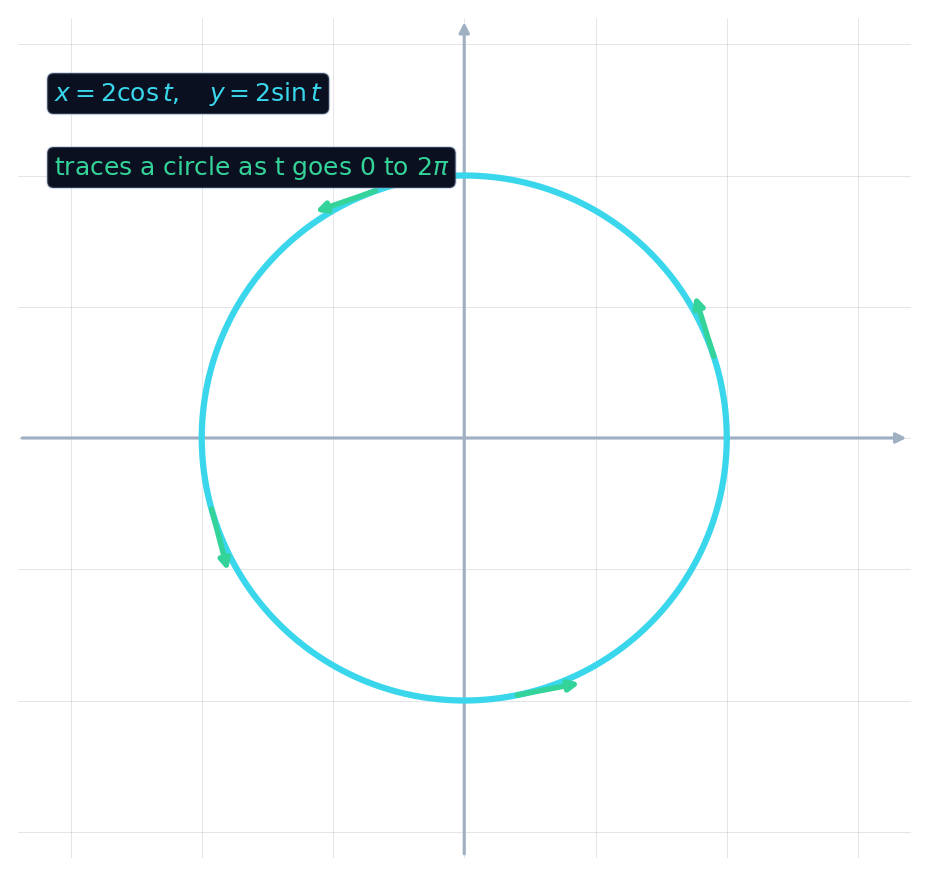
Sweep the angle to trace a circle
As the parameter (an angle) sweeps from 0 to 2 pi, the point (cos t, sin t) travels once around the circle.
Which parametric equations trace a circle of radius $r$ centred at the origin?
From the unit circle scaled by $r$: $x = r\cos t$ and $y = r\sin t$ trace the circle as $t$ goes $0$ to $2\pi$.
The parametrization $x = \cos t,\ y = \sin t$ comes directly from the ____.
A point on the unit circle at angle $t$ is $(\cos t, \sin t)$ — the natural parametrization of a circle.
Select all true statements.
A circle can be parametrized (that is the whole point). The other three are correct.
Direction and speed
- The parametrization sets not just the shape but the way it is drawn.
- $x = \cos t, y = \sin t$ goes counter-clockwise; $x = \cos t, y = -\sin t$ goes clockwise.
- Replacing $t$ with $2t$ traces the same circle twice as fast.
- So the same circle has many parametrizations, each with its own motion.
Restricting $t$ to $0 \le t \le \pi$ in $x = \cos t,\ y = \sin t$ traces only the top half of the circle.
From $t = 0$ to $\pi$, $y = \sin t \ge 0$, so only the upper semicircle is drawn.
Drawing only part
- Restricting the parameter interval draws just an arc.
- $0 \le t \le \pi$ in $(\cos t, \sin t)$ gives only the top half of the circle.
- For a line, restricting $t$ gives a segment or a ray.
- Choose the interval to draw exactly the piece you want.
The parametric form of a circle is not unique. $(\cos t, \sin t)$ and $(\sin t, \cos t)$ both trace the unit circle, but start at different points and go in different directions. Always check the starting point and direction, not just the shape.
Parametrize the circle of radius $3$ centred at $(1, -2)$.
- Start from the unit-circle form and scale by $3$: $3\cos t$, $3\sin t$.
- Shift the centre to $(1, -2)$: $x = 1 + 3\cos t$, $y = -2 + 3\sin t$.
- As $t$ goes $0$ to $2\pi$, this traces the full circle once.
A line is $x = x_0 + at,\ y = y_0 + bt$ (a point plus a direction). A circle of radius $r$ is $x = r\cos t,\ y = r\sin t$, straight from the unit circle. These parametric equations let the parameter $t$ set the shape, direction, and speed — restrict $t$ to draw only an arc or segment.