Parametric Functions and Planar Motion
Introduced| English |
|---|
| parametric function/ˌpærəˈmetrɪk ˈfʌŋkʃn/ |
| parameter/pəˈræmɪtə/ |
Where is it, right now?
- Throw a ball and it follows a graceful arc through the air.
- To describe that flight, we track its horizontal and vertical positions over time.
- Each is its own function of time — and together they give the ball's location at every moment.
- This is exactly what parametric functions were made for.
Position over time
- A parametric function 参数方程函数 models motion by giving position $(x(t), y(t))$ at each time.
- The parameter 参数 $t$ is the clock; plug in a time and read off the location.
- Horizontal motion lives in $x(t)$; vertical motion lives in $y(t)$.
- The pair traces the object's path across the plane.
When parametric functions model motion, the parameter $t$ usually represents…
In a parametric function modeling motion, $t$ is time, and $(x(t), y(t))$ is the object's position then.
Splitting the motion
- The great trick is that $x$ and $y$ can be analysed independently.
- A thrown ball moves at a steady horizontal speed while gravity curves its vertical motion.
- So $x(t)$ might be linear while $y(t)$ is a downward parabola.
- Combine them and the ball follows its familiar arc.
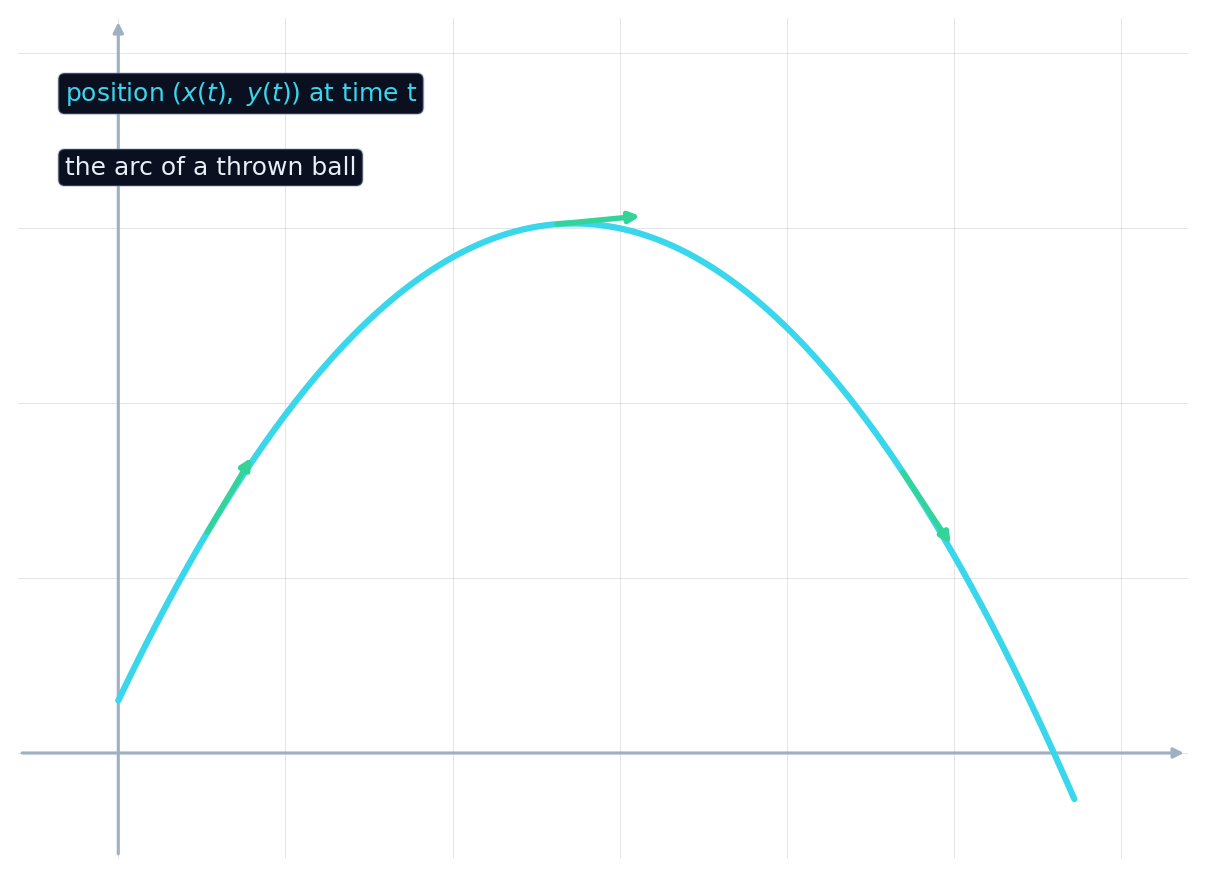
A ball has $x = 3t$ and $y = 20t - 5t^2$. What is its height $y$ at $t = 2$?
$y = 20(2) - 5(2)^2 = 40 - 20 = 20$; and $x = 3(2) = 6$, so the ball is at $(6, 20)$.
The object's starting position is found by evaluating $x$ and $y$ at $t =$ ____.
At $t = 0$ the motion begins, so $(x(0), y(0))$ is the initial position.
Select all true statements about parametric motion.
A parametric path can curve (like a thrown ball's arc), not just be a line. The other three are correct.
Reading the motion
- The starting point is at $t = 0$: evaluate $x(0)$ and $y(0)$.
- Later times give later positions along the path.
- Where the path is highest, the vertical motion has momentarily stopped rising.
- Following $t$ upward shows the direction of travel.
A path traced by a parameter
As the parameter runs, the point moves and traces out a planar curve.
The horizontal and vertical motions can be analysed separately as $x(t)$ and $y(t)$.
Splitting motion into independent $x$ and $y$ parts is the great strength of the parametric view.
Beyond position
- From the position functions you can ask how fast each coordinate is changing.
- That leads to velocity — the next lesson's rates of change.
- You can also find when the object lands (where $y = 0$ again) or how far it travels.
- Parametric motion turns geometry into a moving story.
Do not confuse the path with the motion. The picture of the arc shows the shape, but the parametrization also encodes when the ball is at each point and how fast. Two balls can share a path yet move along it very differently.
A ball has $x = 3t$ and $y = 20t - 5t^2$ (metres, seconds).
- At $t = 0$: position $(0, 0)$ — it starts at the origin.
- At $t = 2$: $x = 6$, $y = 40 - 20 = 20$ — it is $6$ m across and $20$ m high.
- It lands when $y = 0$ again: $20t - 5t^2 = 0 \Rightarrow t = 4$ s.
A parametric function models planar motion by giving position $(x(t), y(t))$ at each time, with the parameter $t$ as the clock. Horizontal and vertical motion split into $x(t)$ and $y(t)$, which can be analysed separately and recombined into the path.