Skip to content · ⁨ข้ามไปยังเนื้อหา⁩

Energy and Momentum of Rotating Systems · ⁨พลังงานและโมเมนตัมของระบบหมุน⁩

AP Physics C: Mechanics · Topic 6 · ⁨หัวข้อ 6⁩

Video lesson for this topic · ⁨บทเรียนวิดีโอสำหรับหัวข้อนี้⁩ Open the video page · ⁨เปิดหน้าวิดีโอ⁩
8:12

พลังงานและโมเมนตัมของระบบหมุน

ดูนักสเก็ตน้ำแข็งหมุน แขนกางออก เธอหมุนช้า เธอดึงแขนเข้าหาตัว — และโดยไม่ดันอะไรเลย เธอหมุนเร็วขึ้นมากไม่มีใคร...

English narration · English + 中文 subtitles burned in · ⁨การบรรยายภาษาอังกฤษ · คำบรรยายภาษาอังกฤษ + 中文 ลอยตัวบนภาพ⁩

6.1

Rotational Kinetic Energy · ⁨พลังงานจลน์จากการหมุน⁩

Syllabus · ⁨หลักสูตร⁩
English

Learning Objective 6.1.A: Describe the rotational kinetic energy of a rigid system in terms of the rotational inertia and angular velocity of that rigid system.

  • 6.1.A.1 The rotational kinetic energy of an object or rigid system is related to the rotational inertia and angular velocity of the rigid system and is given by the equation $K_{\text{rot}} = \dfrac{1}{2} I \omega^2$.
    • Equation: $K_{\text{rot}} = \dfrac{1}{2} I \omega^2$
    • 6.1.A.1.i The rotational inertia of an object about a fixed axis can be used to show that the rotational kinetic energy of that object is equivalent to its translational kinetic energy, which is its total kinetic energy.
    • 6.1.A.1.ii The total kinetic energy of a rigid system is the sum of its rotational kinetic energy due to its rotation about its center of mass and the translational kinetic energy due to the linear motion of its center of mass.
  • 6.1.A.2 A rigid system can have rotational kinetic energy while its center of mass is at rest due to the individual points within the rigid system having linear speed and, therefore, kinetic energy.
  • 6.1.A.3 Rotational kinetic energy is a scalar quantity.
ไทย

วัตถุประสงค์การเรียนรู้ 6.1.A: อธิบายพลังงานจลน์การหมุนของระบบแข็งในterms of ความเฉื่อยรอบแกนหมุนและความเร็วเชิงมุมของระบบแข็งนั้น

  • 6.1.A.1 พลังงานจลน์การหมุนของวัตถุหรือระบบแข็งมีความสัมพันธ์กับความเฉื่อยรอบแกนหมุนและความเร็วเชิงมุมของระบบแข็ง และกำหนดโดยสมการ $K_{\text{rot}} = \dfrac{1}{2} I \omega^2$
    • สมการ: $K_{\text{rot}} = \dfrac{1}{2} I \omega^2$
    • 6.1.A.1.i ความเฉื่อยรอบแกนหมุนของวัตถุรอบแกนคงที่สามารถใช้เพื่อบ่งชี้ว่าพลังงานจลน์การหมุนของวัตถุนั้นเทียบเท่าพลังงานจลน์การเคลื่อนที่ ซึ่งคือพลังงานจลน์ทั้งหมดของมัน
    • 6.1.A.1.ii พลังงานจลน์รวมของระบบแข็งคือผลรวมของพลังงานจลน์การหมุนเนื่องจากหมุนรอบศูนย์กลางมวล และพลังงานจลน์การเคลื่อนที่เนื่องจากการเคลื่อนที่เชิงตรงของศูนย์กลางมวล
  • 6.1.A.2 ระบบแข็งสามารถมีพลังงานจลน์การหมุนในขณะที่ศูนย์กลางมวลหยุดนิ่งได้ เนื่องจากจุดต่างๆ ภายในระบบแข็งมีความเร็วเชิงเส้นและดังนั้นจึงมีพลังงานจลน์
  • 6.1.A.3 พลังงานจลน์การหมุนเป็นปริมาณสเกลาร์
Source: College Board AP Course and Exam Description · ⁨แหล่งที่มา: คำอธิบายหลักสูตรและข้อสอบ College Board AP⁩

English

A spinning body has rotational kinetic energy 转动动能

$$K_{\text{rot}}=\tfrac12 I\omega^2,$$

the rotational twin of $\tfrac12mv^2$, with the rotational inertia 转动惯量 $I$ playing the role of mass. A body that both moves and spins carries both terms:

$$K=\tfrac12 mv_{\text{cm}}^2+\tfrac12 I\omega^2.$$

Worked example. A uniform cylinder ($I=\tfrac12mr^2$) rolls at speed $v$. Its kinetic energy is $K=\tfrac12mv^2+\tfrac12\big(\tfrac12mr^2\big)\big(\tfrac{v}{r}\big)^2=\tfrac34mv^2$ – one third of it is rotational. The same ball of energy bookkeeping decides every rolling problem.

ไทย

วัตถุที่กำลังหมุนมี พลังงานจลน์เชิงหมุน

$$K_{\text{rot}}=\tfrac12 I\omega^2,$$

คู่หูเชิงหมุนของ $\tfrac12mv^2$, โดยที่ โมเมนต์ความเฉื่อย $I$ ทำหน้าที่แทนมวล. วัตถุที่เคลื่อนที่และหมุนพร้อมกันจะพกพา ทั้งสอง พจน์นี้:

$$K=\tfrac12 mv_{\text{cm}}^2+\tfrac12 I\omega^2.$$

ตัวอย่างทำข้อ. ทรงกระบอกสม่ำเสมอ ($I=\tfrac12mr^2$) ม้วนด้วยความเร็ว $v$. พลังงานจลน์ของมันคือ $K=\tfrac12mv^2+\tfrac12\big(\tfrac12mr^2\big)\big(\tfrac{v}{r}\big)^2=\tfrac34mv^2$ – หนึ่งในสามเป็นพลังงานหมุน. การบัญชีพลังงานแบบเดียวกันนี้ตัดสินใจทุกปัญหาม้วน

6.2

Torque and Work · ⁨โมเมนต์แรงและงาน⁩

Syllabus · ⁨หลักสูตร⁩
English

Learning Objective 6.2.A: Describe the work done on a rigid system by a given torque or collection of torques.

  • 6.2.A.1 A torque can transfer energy into or out of an object or rigid system if the torque is exerted over an angular displacement.
  • 6.2.A.2 The amount of work done on a rigid system by a torque is related to the magnitude of that torque and the angular displacement through which the rigid system rotates during the interval in which that torque is exerted.
    • Equation: $W = \displaystyle\int_{\theta_1}^{\theta_2} \tau \, d\theta$
  • 6.2.A.3 Work done on a rigid system by a given torque can be found from the area under the curve of a graph of the torque as a function of angular position.
ไทย

จุดประสงค์การเรียนรู้ 6.2.A: อธิบายงานที่ทำต่อระบบแข็งโดยโมเมนต์แรงหรือกลุ่มโมเมนต์ที่กำหนดให้

  • 6.2.A.1 โมเมนต์แรงสามารถถ่ายโอนพลังงานเข้าสู่หรือออกจากวัตถุหรือระบบแข็งได้ หากโมเมนต์แรงนั้นกระทำต่อวัตถุในระหว่างที่มีการเลื่อนตัวเชิงมุม
  • 6.2.A.2 ปริมาณงานที่ทำต่อระบบแข็งโดยโมเมนต์แรงมีสัมพันธ์กับความใหญ่ของโมเมนต์แรงนั้นและการเลื่อนตัวเชิงมุมที่ระบบแข็งหมุนไปในช่วงเวลาที่โมเมนต์แรงนั้นถูกกระทำ
    • สมการ: $W = \displaystyle\int_{\theta_1}^{\theta_2} \tau \, d\theta$
  • 6.2.A.3 งานที่ทำต่อระบบแข็งเกร就由โมเมนต์แรงที่กำหนด สามารถหาค่าได้จากพื้นที่ใต้กราฟของโมเมนต์แรงในฐานะฟังก์ชันของตำแหน่งเชิงมุม

Source: College Board AP Course and Exam Description · ⁨แหล่งที่มา: คำอธิบายหลักสูตรและข้อสอบ College Board AP⁩

English

A torque 力矩 acting through an angular displacement 角位移 does work, and power is torque times angular velocity:

$$W=\int_{\theta_1}^{\theta_2}\tau\,d\theta,\qquad P=\tau\omega.$$

These are the rotational forms of $W=\int F\,dx$ and $P=Fv$ – the whole translational energy toolkit carries over with $F\to\tau$, $x\to\theta$, $v\to\omega$.

Worked example. A motor applies a constant $8.0\ \text{N}\cdot\text{m}$ torque to a flywheel for $5.0$ full turns: $W=\tau\,\Delta\theta=8.0(5.0)(2\pi)=250\ \text{J}$, which appears as rotational kinetic energy if friction is negligible.

ไทย

โมเมนต์แรง ที่กระทำผ่าน การเลื่อนตำแหน่งเชิงมุม ทำงาน, และกำลังคือโมเมนต์แรงคูณความเร็วเชิงมุม:

$$W=\int_{\theta_1}^{\theta_2}\tau\,d\theta,\qquad P=\tau\omega.$$

นี่คือรูปแบบการหมุนของ $W=\int F\,dx$ และ $P=Fv$ – ชุดเครื่องมือพลังงานการเคลื่อนที่ทั้งหมดถ่ายโอนได้โดย $F\to\tau$, $x\to\theta$, $v\to\omega$.

ตัวอย่างทำข้อ. มอเตอร์ใช้โมเมนต์แรงคงที่ $8.0\ \text{N}\cdot\text{m}$ กับเฟลwheel เป็นเวลา $5.0$ รอบเต็ม: $W=\tau\,\Delta\theta=8.0(5.0)(2\pi)=250\ \text{J}$, ซึ่งปรากฏเป็นพลังงานจลน์เชิงหมุนหากแรงเสียดทานมีน้อยมาก

Explore · ⁨สำรวจ⁩

Balance torques on a beam · ⁨ปรับสมดุลแรงบิดบนคาน⁩

Torque is force times perpendicular distance, $\tau=Fd$. Equal torques on each side keep the beam in rotational equilibrium. · ⁨โมเมนต์แรง คือแรงคูณระยะตั้งฉาก, $\tau=Fd$ โมเมนต์แรงเท่ากันทั้งสองข้างทำให้คานอยู่ในสมดุลหมุน⁩

6.3

Angular Momentum and Angular Impulse · ⁨โมเมนตัมเชิงมุมและแรงกระแทกเชิงมุม⁩

Syllabus · ⁨หลักสูตร⁩
English

Learning Objective 6.3.A: Describe the angular momentum of an object or rigid system.

  • 6.3.A.1 The magnitude of the angular momentum of a rigid system about a specific axis can be described with the equation $L = I\omega$.
    • Equation: $L = I\omega$
  • 6.3.A.2 The angular momentum of an object about a given point is $\vec{L} = \vec{r} \times \vec{p}$.
    • Equation: $\vec{L} = \vec{r} \times \vec{p}$
    • 6.3.A.2.i The selection of the axis about which an object is considered to rotate influences the determination of the angular momentum of that object.
    • 6.3.A.2.ii The measured angular momentum of an object traveling in a straight line depends on the distance between the reference point and the object, the mass of the object, the speed of the object, and the angle between the radial distance and the velocity of the object.

Learning Objective 6.3.B: Describe the angular impulse delivered to an object or rigid system by a torque.

  • 6.3.B.1 Angular impulse is defined as the product of the torque exerted on an object or rigid system and the time interval during which the torque is exerted.
    • Equation: $\text{angular impulse} = \displaystyle\int \tau \, dt$
  • 6.3.B.2 Angular impulse has the same direction as the torque imparting it.
  • 6.3.B.3 The angular impulse delivered to an object or rigid system by a torque can be found from the area under the curve of a graph of the torque as a function of time.

Learning Objective 6.3.C: Relate the change in angular momentum of an object or rigid system to the angular impulse given to that object or rigid system.

  • 6.3.C.1 The magnitude of the change in angular momentum can be described by comparing the magnitudes of the final and initial momenta of the object or rigid system.
    • Equation: $\Delta L = L - L_0$
  • 6.3.C.2 A rotational form of the impulse–momentum theorem relates the angular impulse delivered to an object or rigid system and the change in angular momentum of that object or rigid system.
    • 6.3.C.2.i The angular impulse exerted on an object or rigid system is equal to the change in angular momentum of that object or rigid system.
      • Equation: $\Delta L = \displaystyle\int_{t_1}^{t_2} \tau \, dt$
    • 6.3.C.2.ii The rotational form of the impulse–momentum theorem is a direct result of Newton's second law of motion for cases in which rotational inertia is constant.
      • Equation: $\tau_{\text{net}} = \dfrac{dL}{dt} = I\dfrac{d\omega}{dt} = I\alpha$
  • 6.3.C.3 The net torque exerted on an object or rigid system is equal to the slope of the graph of the angular momentum of an object as a function of time.
  • 6.3.C.4 The angular impulse delivered to an object or rigid system is equal to the area under the curve of a graph of the net external torque exerted on an object as a function of time.
ไทย

จุดประสงค์การเรียนรู้ 6.3.A: อธิบายโมเมนตัมเชิงมุมของวัตถุหรือระบบแข็ง

  • 6.3.A.1 ความใหญ่ของโมเมนตัมเชิงมุมของระบบแข็งรอบแกนเฉพาะสามารถอธิบายได้ด้วยสมการ $L = I\omega$
    • สมการ: $L = I\omega$
  • 6.3.A.2 โมเมนตัมเชิงมุมของวัตถุรอบจุดที่กำหนดคือ $\vec{L} = \vec{r} \times \vec{p}$
    • สมการ: $\vec{L} = \vec{r} \times \vec{p}$
    • 6.3.A.2.i การเลือกแกนที่วัตถุถูกพิจารณาว่าหมุนรอบนั้นมีผลต่อการกำหนดโมเมนตัมเชิงมุมของวัตถุนั้น
    • 6.3.A.2.ii โมเมนตัมเชิงมุมที่วัดได้จากวัตถุที่เคลื่อนที่เป็นเส้นตรงขึ้นอยู่กับระยะห่างระหว่างจุดอ้างอิงกับวัตถุ มวลของวัตถุ ความเร็วของวัตถุ และมุมระหว่างระยะรัศมีและความเร็วของวัตถุ

จุดประสงค์การเรียนรู้ 6.3.B: อธิบายอิมพัลส์เชิงมุมที่ถูกส่งไปยังวัตถุหรือระบบแข็งโดยโมเมนต์แรง

  • 6.3.B.1 อิมพัลส์เชิงมุมนิยามเป็นผลคูณของโมเมนต์แรงที่ทำต่อวัตถุหรือระบบแข็งกับช่วงเวลาที่ใช้ในการกระทำโมเมนต์แรงนั้น
    • สมการ: $\text{angular impulse} = \displaystyle\int \tau \, dt$
  • 6.3.B.2 แรงกระแทกเชิงมุมมีทิศทางเดียวกับโมเมนต์แรงที่ทำให้เกิดมัน
  • 6.3.B.3 อิมพัลส์เชิงมุมที่ถูกส่งไปยังวัตถุหรือระบบแข็งโดยโมเมนต์แรงสามารถหาได้จากพื้นที่ใต้กราฟของโมเมนต์แรงในฟังก์ชันของเวลา

จุดประสงค์การเรียนรู้ 6.3.C: เชื่อมโยงการเปลี่ยนแปลงโมเมนตัมเชิงมุมของวัตถุหรือระบบแข็งกับอิมพัลส์เชิงมุมที่ได้รับจากวัตถุนั้นหรือระบบนั้น

  • 6.3.C.1 ขนาดของการเปลี่ยนแปลงโมเมนตัมเชิงมุมสามารถอธิบายได้ด้วยการเปรียบเทียบขนาดของโมเมนตัมสุดท้ายและเริ่มต้นของวัตถุหรือระบบแข็งเกรจง
    • สมการ: $\Delta L = L - L_0$
  • 6.3.C.2 รูปแบบการหมุนของทฤษฎีบทอิมพัลส์-โมเมนตัมเชื่อมโยงอิมพัลส์เชิงมุมที่ถูกส่งไปยังวัตถุหรือระบบแข็งกับการเปลี่ยนแปลงโมเมนตัมเชิงมุมของวัตถุนั้นหรือระบบนั้น
    • 6.3.C.2.i อิมพัลส์เชิงมุมที่ทำต่อวัตถุหรือระบบแข็งมีค่าเท่ากับการเปลี่ยนแปลงโมเมนตัมเชิงมุมของวัตถุนั้นหรือระบบนั้น
      • สมการ: $\Delta L = \displaystyle\int_{t_1}^{t_2} \tau \, dt$
    • 6.3.C.2.ii รูปแบบการหมุนของทฤษฎีบทแรงกระแทก-โมเมนตัมเป็นผลโดยตรงจากกฎข้อที่สองของนิวตันสำหรับการเคลื่อนที่ในกรณีที่มีโมเมนต์ความเฉื่อยคงที่
      • สมการ: $\tau_{\text{net}} = \dfrac{dL}{dt} = I\dfrac{d\omega}{dt} = I\alpha$
  • 6.3.C.3 โมเมนต์แรงสุทธิที่กระทำต่อวัตถุหรือระบบแข็งเกรจงมีค่าเท่ากับความชันของกราฟโมเมนตัมเชิงมุมของวัตถุในฐานะฟังก์ชันของเวลา
  • 6.3.C.4 แรงกระแทกเชิงมุมที่ส่งไปยังวัตถุหรือระบบแข็งเกรจงมีค่าเท่ากับพื้นที่ใต้กราฟของโมเมนต์แรงภายนอกสุทธิที่กระทำต่อวัตถุในฐานะฟังก์ชันของเวลา

Source: College Board AP Course and Exam Description · ⁨แหล่งที่มา: คำอธิบายหลักสูตรและข้อสอบ College Board AP⁩

English

Angular momentum 角动量 for a particle is

$$\vec{L}=\vec{r}\times\vec{p},\qquad |L|=mvr\sin\theta,$$

so even a particle moving in a straight line has angular momentum about any point not on that line ($L=mv\,d$, with $d$ the perpendicular distance). For a rigid body spinning about a fixed axis, $L=I\omega$. Newton's second law in rotational form is

$$\vec{\tau}_{\text{net}}=\frac{d\vec{L}}{dt}\quad(=I\alpha\ \text{when }I\text{ is constant}),$$

and a net torque acting over time delivers an angular impulse 角冲量 $\int\tau\,dt=\Delta L$ – the rotational impulse–momentum theorem.

ไทย

โมเมนตัมเชิงมุม สำหรับอนุภาคคือ

$$\vec{L}=\vec{r}\times\vec{p},\qquad |L|=mvr\sin\theta,$$

ดังนั้นแม้แต่อนุภาคที่เคลื่อนที่ในเส้นตรงก็มีโมเมนตัมเชิงมุมรอบจุดใดๆ นอกเส้นนั้น ($L=mv\,d$, โดยที่ $d$ คือระยะตั้งฉาก). สำหรับวัตถุแข็งที่หมุนรอบแกนคงที่, $L=I\omega$. กฎที่สองของนิวตันในรูปแบบการหมุนคือ

$$\vec{\tau}_{\text{net}}=\frac{d\vec{L}}{dt}\quad(=I\alpha\ \text{when }I\text{ is constant}),$$

และโมเมนต์แรงสุทธิที่กระทำเป็นเวลาจะส่งมอบ ** импульเชิงมุม** $\int\tau\,dt=\Delta L$ – theorem impulse-momentum แบบการหมุน

6.4

Conservation of Angular Momentum · ⁨การอนุรักษ์โมเมนตัมเชิงมุม⁩

Syllabus · ⁨หลักสูตร⁩
English

Learning Objective 6.4.A: Describe the behavior of a system using conservation of angular momentum.

  • 6.4.A.1 The total angular momentum of a system about a rotational axis is the sum of the angular momenta of the system's constituent parts about that rotational axis.
  • 6.4.A.2 Any change to a system's angular momentum must be due to an interaction between the system and its surroundings.
    • 6.4.A.2.i The angular impulse exerted by one object or system on a second object or system is equal and opposite to the angular impulse exerted by the second object or system on the first. This is a direct result of Newton's third law.
    • 6.4.A.2.ii A system may be selected so that the total angular momentum of that system is constant.
    • 6.4.A.2.iii The angular speed of a nonrigid system may change without the angular momentum of the system changing if the system changes shape by moving mass closer to or farther from the rotational axis.
    • 6.4.A.2.iv If the total angular momentum of a system changes, that change will be equivalent to the angular impulse exerted on the system.

Learning Objective 6.4.B: Describe how the selection of a system determines whether the angular momentum of that system changes.

  • 6.4.B.1 Angular momentum is conserved in all interactions.
  • 6.4.B.2 If the net external torque exerted on a selected object or rigid system is zero, the total angular momentum of that system is constant.
  • 6.4.B.3 If the net external torque exerted on a selected object or rigid system is nonzero, angular momentum is transferred between the system and the environment.
ไทย

จุดประสงค์การเรียนรู้ 6.4.A: อธิบายพฤติกรรมของระบบโดยใช้หลักการอนุรักษ์โมเมนตัมเชิงมุม

  • 6.4.A.1 โมเมนตัมเชิงมุมรวมของระบบรอบแกนหมุนคือผลรวมของโมเมนตัมเชิงมุมของส่วนประกอบต่างๆ ของระบบรอบแกนหมุนนั้น
  • 6.4.A.2 การเปลี่ยนแปลงใดๆ ต่อโมเมนตัมเชิงมุมของระบบต้องเกิดจากการมีปฏิสัมพันธ์ระหว่างระบบกับสิ่งแวดล้อมรอบข้าง
    • 6.4.A.2.i อิมพัลส์เชิงมุมที่ทำโดยวัตถุหรือระบบหนึ่งต่อวัตถุหรือระบบอีกแห่งหนึ่งมีขนาดเท่ากันแต่มีทิศทางตรงข้ามกับอิมพัลส์เชิงมุมที่ทำโดยวัตถุหรือระบบนั้นต่อวัตถุหรือระบบแรก นี่คือผลลัพธ์โดยตรงของกฎข้อที่สามของนิวตัน
    • 6.4.A.2.ii สามารถเลือกระบบได้这样一种使得该系统的总角动量保持不变。
    • 6.4.A.2.iii The angular speed of a nonrigid system may change without the angular momentum of the system changing if the system changes shape by moving mass closer to or farther from the rotational axis.
    • 6.4.A.2.iv หากโมเมนตัมเชิงมุมรวมของระบบเปลี่ยนแปลง การเปลี่ยนแปลงนั้นจะเท่ากับอิมพัลส์เชิงมุมที่ทำต่อระบบ

จุดประสงค์การเรียนรู้ 6.4.B: อธิบายว่าการเลือกระบบมีผลอย่างไรต่อการ决定是否该系统的角动量是否改变。

  • 6.4.B.1 โมเมนตัมเชิงมุมจะถูกอนุรักษ์ในทุกการมีปฏิสัมพันธ์
  • 6.4.B.2 หากโมเมนต์แรงภายนอกสุทธิที่ทำต่อวัตถุหรือระบบแข็งที่ถูกเลือกมีค่าเป็นศูนย์ โมเมนตัมเชิงมุมรวมของระบบนั้นจะมีค่าคงที่
  • 6.4.B.3 หากโมเมนต์แรงภายนอกสุทธิที่ทำต่อวัตถุหรือระบบแข็งที่ถูกเลือกมีค่าน้อยกว่าหรือมากกว่าศูนย์ โมเมนตัมเชิงมุมจะถูกถ่ายโอนระหว่างระบบกับสภาพแวดล้อม

Source: College Board AP Course and Exam Description · ⁨แหล่งที่มา: คำอธิบายหลักสูตรและข้อสอบ College Board AP⁩

English
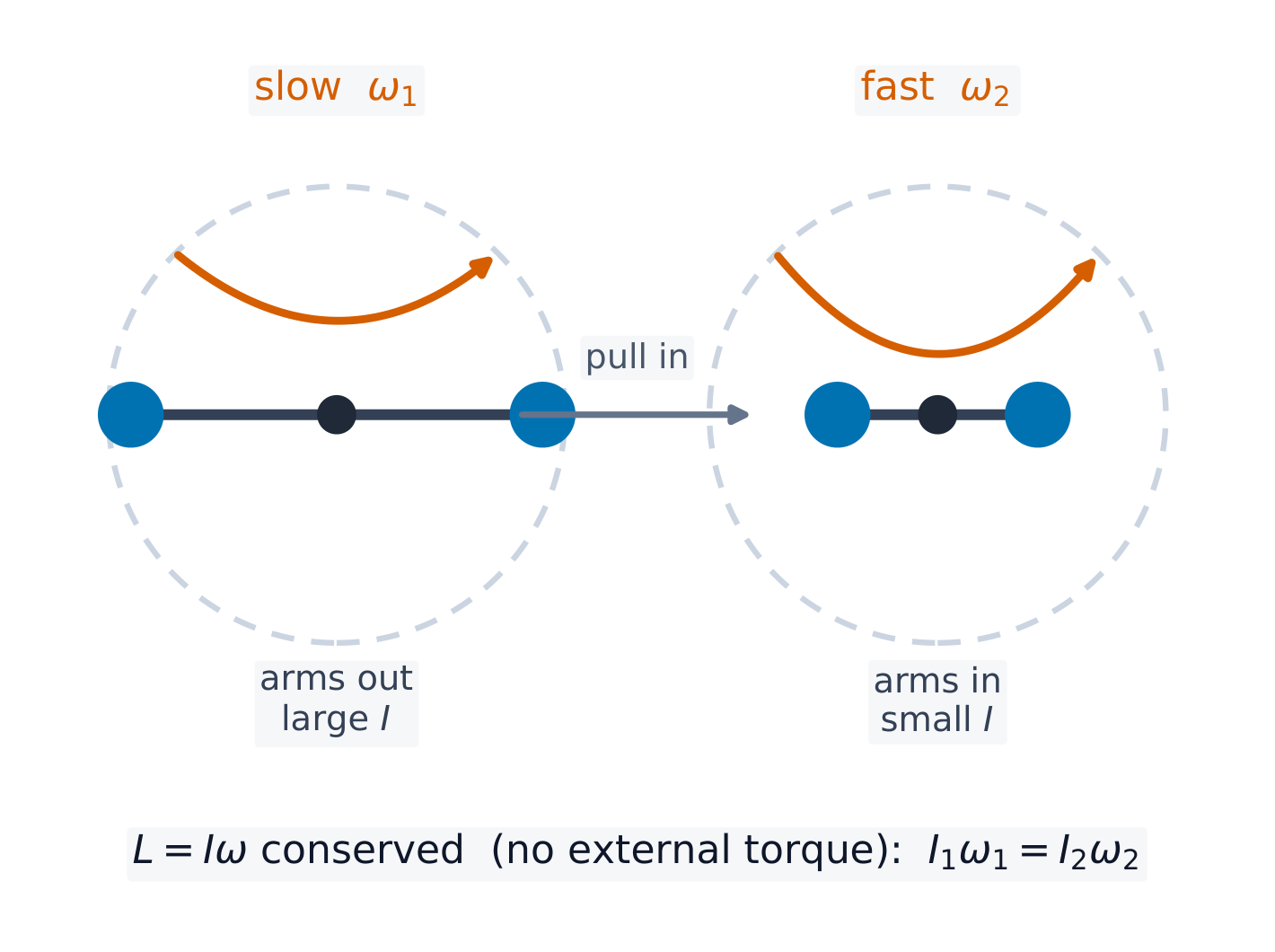
Angular momentum: pull in, spin faster

With zero net external torque, total angular momentum is conserved 守恒:

$$L_{\text{before}}=L_{\text{after}},\qquad I_1\omega_1=I_2\omega_2\ \text{(one rigid body reshaping)}.$$

If $I$ shrinks, $\omega$ grows – a spinning skater speeds up pulling her arms in. The rule survives collisions and shape changes, which is what makes it so useful: pick the axis so that every external force (gravity, the pivot force) exerts no torque about it.

Worked example. A skater spins at $2.0\ \text{rev/s}$ with $I_1=4.0\ \text{kg}\cdot\text{m}^2$. Pulling in her arms drops it to $I_2=1.6\ \text{kg}\cdot\text{m}^2$: $\omega_2=\dfrac{4.0}{1.6}(2.0)=5.0\ \text{rev/s}$. Her kinetic energy rises – the extra energy is the work her muscles do pulling her arms inward.

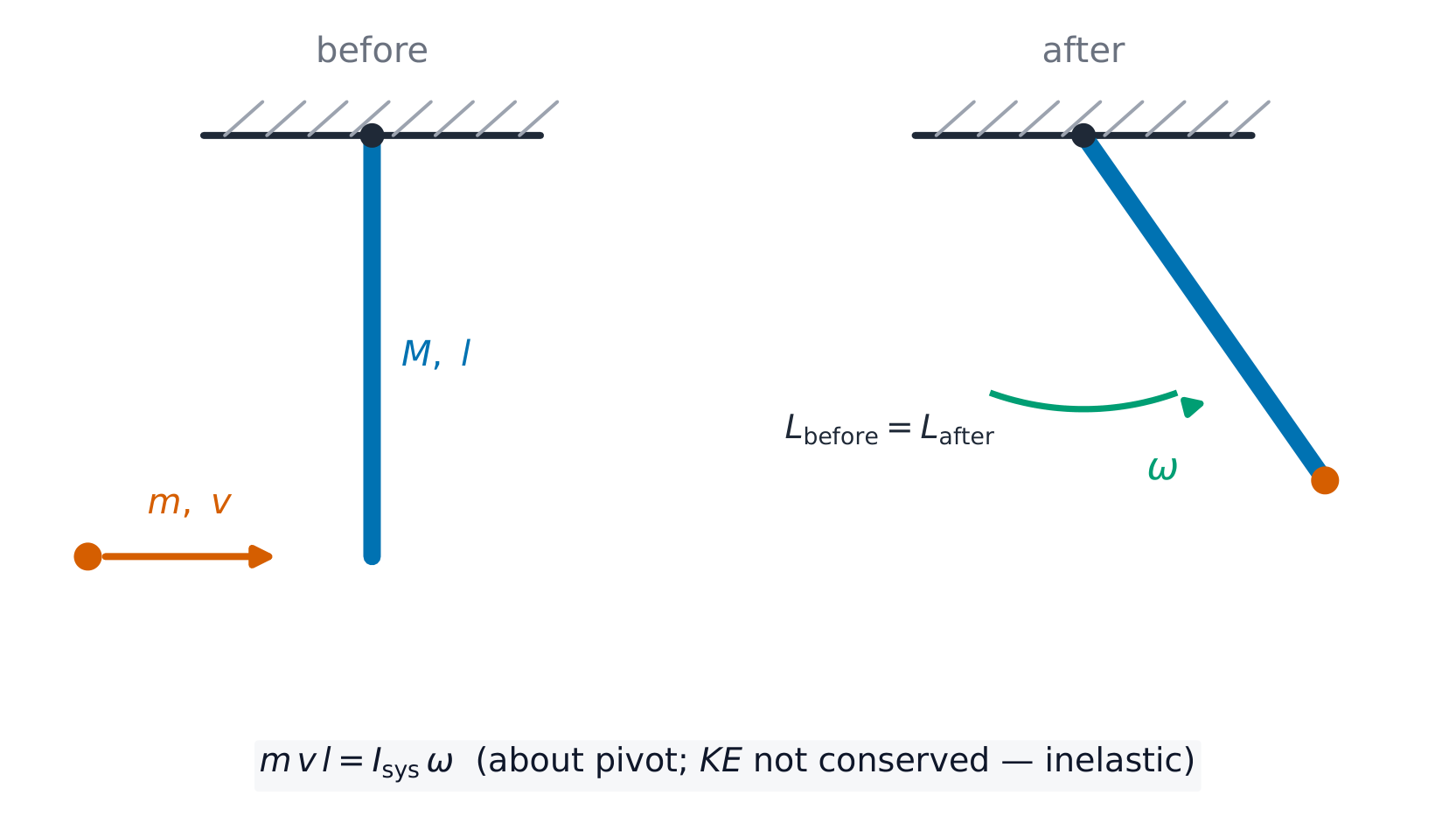
Worked example (rotational collision). A $0.020\ \text{kg}$ bullet at $300\ \text{m/s}$ strikes the tip of a uniform rod ($M=1.5\ \text{kg}$, length $l=0.60\ \text{m}$) hanging from a pivot, and embeds. About the pivot, gravity and the pivot force exert no torque during the strike, so $L$ is conserved: $L=mvl=0.020(300)(0.60)=3.6\ \text{kg}\cdot\text{m}^2/\text{s}$. Afterwards $I=\tfrac13Ml^2+ml^2=0.18+0.0072=0.187\ \text{kg}\cdot\text{m}^2$, so $\omega=\dfrac{3.6}{0.187}\approx19\ \text{rad/s}$. (Linear momentum is not conserved here – the pivot pushes on the rod – and kinetic energy certainly is not: check both before claiming them.)

ไทย
โมเมนตัมเชิงมุม: ดึงเข้า, หมุนเร็วขึ้น

ด้วย โมเมนต์แรงภายนอกสุทธิเป็นศูนย์, โมเมนตัมเชิงมุมรวม คงที่:

$$L_{\text{before}}=L_{\text{after}},\qquad I_1\omega_1=I_2\omega_2\ \text{(one rigid body reshaping)}.$$

หาก $I$ ลดลง, $\omega$ เพิ่มขึ้น – นักสเก็ตที่หมุนจะเร่งความเร็วเมื่อดึงแขนเข้า. กฎนี้ยังคงอยู่ในการชนและการเปลี่ยนรูปร่าง, ซึ่งเป็นสิ่งที่ทำให้มันมีประโยชน์: เลือกแกนที่ทุกแรงภายนอก (แรงโน้มถ่วง, แรงจากจุดหมุน) ไม่สร้างโมเมนต์รอบมัน

ตัวอย่างทำข้อ. นักสเก็ตหมุนที่ $2.0\ \text{rev/s}$ ด้วย $I_1=4.0\ \text{kg}\cdot\text{m}^2$. การดึงแขนเข้าลดเหลือ $I_2=1.6\ \text{kg}\cdot\text{m}^2$: $\omega_2=\dfrac{4.0}{1.6}(2.0)=5.0\ \text{rev/s}$. พลังงานจลน์ของเธอ เพิ่มขึ้น – พลังงานเพิ่มนี้คืองานที่กล้ามเนื้อเธอทำในการดึงแขนเข้าด้านใน

การดึงมวลเข้าใกล้แกนลด I ลง sehingga ω เพิ่มขึ้นเพื่อรักษา L = Iω ไว้
โมเมนตัมเชิงมุมรอบจุดหมุนคงที่ขณะกระสุนฝังอยู่ในแท่ง

ตัวอย่างทำข้อ (การชนแบบหมุน). กระสุน $0.020\ \text{kg}$ ที่ $300\ \text{m/s}$ ตัดปลายของแท่งสม่ำเสมอ ($M=1.5\ \text{kg}$, ยาว $l=0.60\ \text{m}$) ที่แขวนจากจุดหมุน, และฝังตัว. รอบจุดหมุน, แรงโน้มถ่วงและแรงจากจุดหมุนไม่สร้างโมเมนต์during การชน, ดังนั้น $L$ คงที่: $L=mvl=0.020(300)(0.60)=3.6\ \text{kg}\cdot\text{m}^2/\text{s}$. ต่อจากนั้น $I=\tfrac13Ml^2+ml^2=0.18+0.0072=0.187\ \text{kg}\cdot\text{m}^2$, ดังนั้น $\omega=\dfrac{3.6}{0.187}\approx19\ \text{rad/s}$. (โมเมนตัมเชิงเส้น ไม่ คงที่ที่นี่ – จุดหมุนดันแท่ง – และพลังงานจลน์แน่นอนว่าไม่: ตรวจสอบทั้งสองก่อนอ้างถึงพวกมัน)

นักสเก็ตหน้าน้ำแข็งกำลังแสดงบนน้ำแข็ง
การสเก็ตหน้า水和โมเมนตัมเชิงมุม: นักสเก็ตที่ดึงแขนเข้าขณะหมุนจะลดโมเมนต์ความเฉื่อยเชิงหมุน שלה, sehingga หมุนเร็วขึ้น
Vocabulary · ⁨คำศัพท์⁩ Train · ⁨ฝึกฝน⁩
English ไทย
rotational kinetic energy/rəʊˈteɪʃənl kɪˈnetɪk ˈenədʒi/ พลังงานจลน์เชิงหมุน
rotational inertia/rəʊˈteɪʃənl ɪˈnɜːʃə/ โมเมนต์ความเฉื่อย
torque/tɔːk/ แรงบิด
angular displacement/ˈæŋɡjʊlə dɪˈspleɪsmənt/ การกระจัดเชิงมุม
Angular momentum/ˈæŋɡjʊlə məʊˈmentəm/ โมเมนตัมเชิงมุม
angular impulse/ˈæŋɡjʊlə ˈɪmpʌls/ แรงกระแทกเชิงมุม
conserved/kənˈsɜːvd/ คงที่
6.5

Rolling · ⁨การกลิ้ง⁩

Syllabus · ⁨หลักสูตร⁩
English

Learning Objective 6.5.A: Describe the kinetic energy of a system that has translational and rotational motion.

  • 6.5.A.1 The total kinetic energy of a system is the sum of the system's translational and rotational kinetic energies.
    • Equation: $K_{\text{tot}} = K_{\text{trans}} + K_{\text{rot}}$

Learning Objective 6.5.B: Describe the motion of a system that is rolling without slipping.

  • 6.5.B.1 While rolling without slipping, the translational motion of a system's center of mass is related to the rotational motion of the system itself with the following equations:
    • Equation: $\Delta x_{\text{cm}} = r\Delta\theta$
    • Equation: $v_{\text{cm}} = r\omega$
    • Equation: $a_{\text{cm}} = r\alpha$
  • 6.5.B.2 For ideal cases, rolling without slipping implies that the frictional force does not dissipate any energy from the rolling system.

Learning Objective 6.5.C: Describe the motion of a system that is rolling while slipping.

  • 6.5.C.1 When slipping, the motion of a system's center of mass and the system's rotational motion cannot be directly related.
  • 6.5.C.2 When a rotating system is slipping relative to another surface, the point of application of the force of kinetic friction exerted on the system moves with respect to the surface, so the force of kinetic friction will dissipate energy from the system.

Boundary statement: Rolling friction is beyond the scope of AP Physics C: Mechanics.

ไทย

จุดประสงค์การเรียนรู้ 6.5.A: อธิบายพลังงานจลน์ของระบบที่มีทั้งการเคลื่อนที่แบบแปลนและการเคลื่อนที่แบบหมุน

  • 6.5.A.1 พลังงานจลน์รวมของ系统是ผลบวกของพลังงานจลน์แบบแปลนและพลังงานจลน์แบบหมุนของระบบ
    • สมการ: $K_{\text{tot}} = K_{\text{trans}} + K_{\text{rot}}$

จุดประสงค์การเรียนรู้ 6.5.B: อธิบายการเคลื่อนที่ของระบบที่กลิ้งโดยไม่ลื่นไถล

  • 6.5.B.1 ขณะกลิ้งโดยไม่ลื่น การเคลื่อนที่แบบเลื่อนของจุดศูนย์กลางมวลของระบบมีความสัมพันธ์กับการเคลื่อนที่แบบหมุนของระบบเองด้วยสมการต่อไปนี้:
    • สมการ: $\Delta x_{\text{cm}} = r\Delta\theta$
    • สมการ: $v_{\text{cm}} = r\omega$
    • สมการ: $a_{\text{cm}} = r\alpha$
  • 6.5.B.2 สำหรับกรณีในอุดมคติ การกลิ้งโดยไม่ลื่นไถลหมายถึงแรงเสียดทานไม่ทำให้พลังงานของระบบกลิ้งลดลง

วัตถุประสงค์การเรียนรู้ 6.5.C: อธิบายการเคลื่อนที่ของระบบที่กำลังกลิ้งพร้อมทั้งลื่นไถล

  • 6.5.C.1 เมื่อมีการลื่นไถล การเคลื่อนที่ของจุดศูนย์กลางมวลและระบบไม่ได้มีความสัมพันธ์โดยตรงกับการเคลื่อนที่แบบหมุนของระบบ
  • 6.5.C.2 เมื่อระบบหมุนกำลังลื่นไถลเทียบกับพื้นผิวอื่น จุดที่แรงเสียดทานจลน์กระทำต่อระบบจะเคลื่อนที่เทียบกับพื้นผิวนั้น ดังนั้นแรงเสียดทานจลน์จึงทำให้พลังงานของระบบลดลง

ข้อความขอบเขต: แรงเสียดทานจากการกลิ้งอยู่นอกเหนือขอบเขตของ AP Physics C: Mechanics

Source: College Board AP Course and Exam Description · ⁨แหล่งที่มา: คำอธิบายหลักสูตรและข้อสอบ College Board AP⁩

English
Rolling without slipping

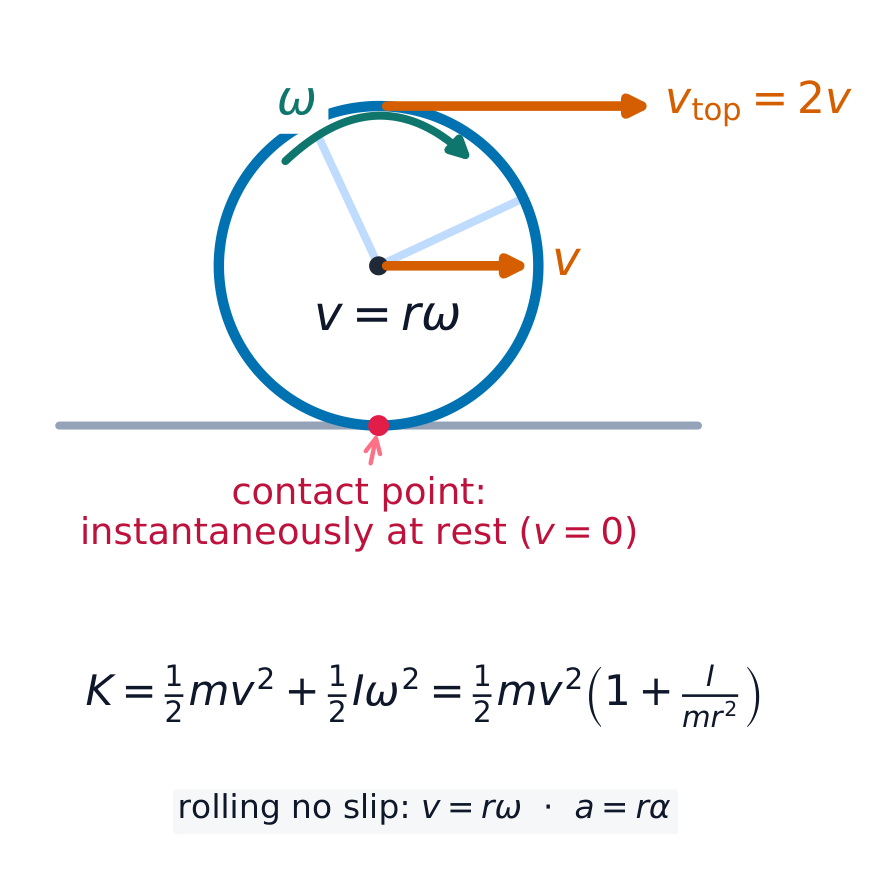
Rolling without slipping 无滑滚动 ties translation to rotation: the contact point is momentarily at rest, so

$$\Delta x_{\text{cm}}=r\,\Delta\theta,\qquad v_{\text{cm}}=r\omega,\qquad a_{\text{cm}}=r\alpha.$$

Static friction supplies the torque that keeps the spin matched to the motion, but at a point that is not sliding – so for pure rolling, friction does no work, and energy conservation is safe to use. (Rolling friction is beyond the AP course.)

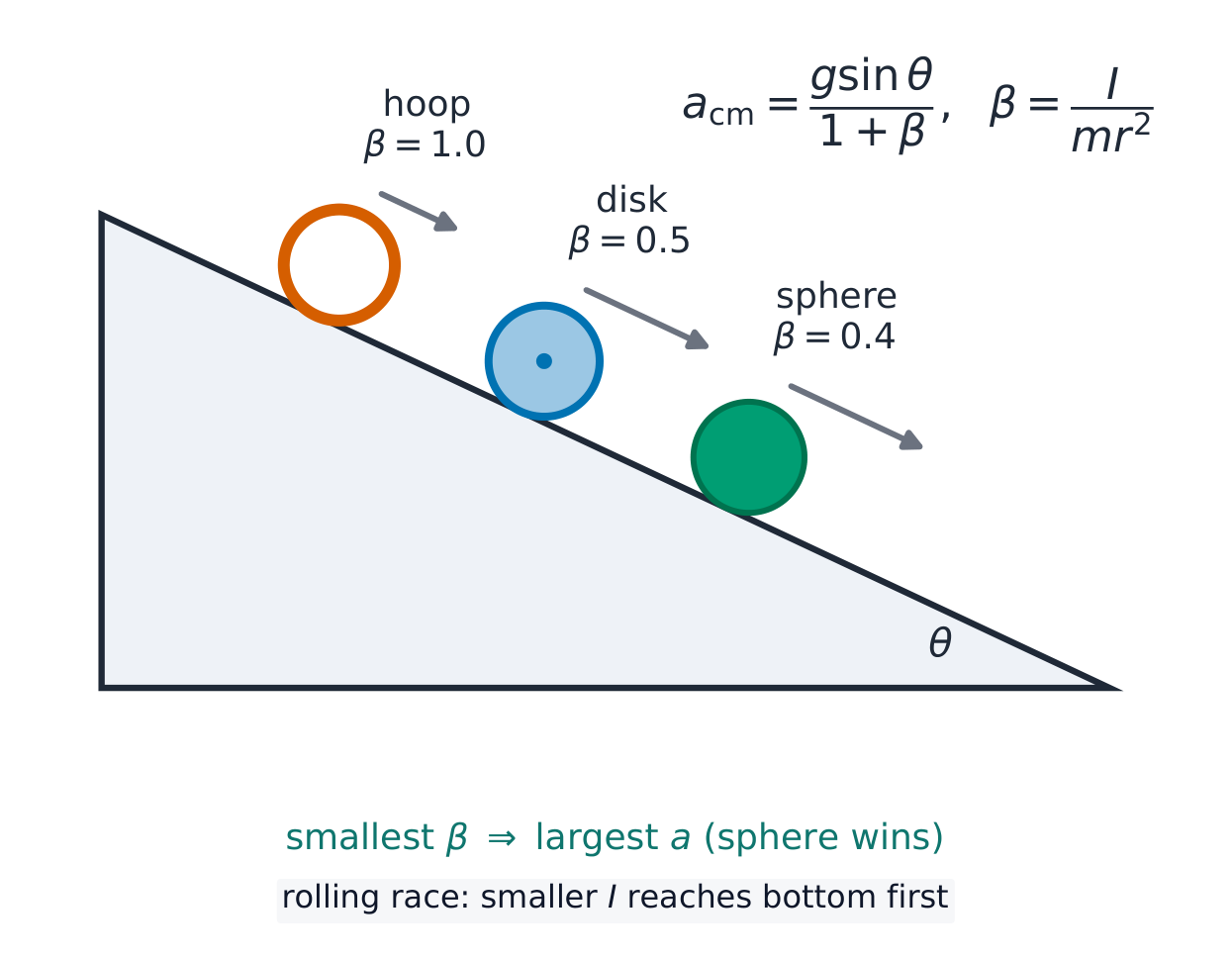
Racing shapes down an incline shows the energy split. With $I=\beta mr^2$, energy conservation gives

$$a_{\text{cm}}=\frac{g\sin\theta}{1+\beta}:$$

a sphere ($\beta=\tfrac25$) beats a disk 圆盘 ($\beta=\tfrac12$), which beats a hoop 圆环 ($\beta=1$) – mass and radius cancel completely. More of the hoop's energy is locked in rotation, so its center moves slower.

Worked example. A solid sphere rolls from rest down a $30^\circ$ incline: $a=\dfrac{g\sin30^\circ}{1+\tfrac25}=\dfrac{9.8(0.50)}{1.4}=3.5\ \text{m/s}^2$, versus $4.9\ \text{m/s}^2$ for a frictionless slider – rolling objects always lose the race against sliding ones.

ไทย
ม้วนโดยไม่ลื่น

ม้วนโดยไม่ลื่น เชื่อมต่อการเคลื่อนที่กับการหมุน: จุดสัมผัสหยุดนิ่งชั่วคราว, ดังนั้น

$$\Delta x_{\text{cm}}=r\,\Delta\theta,\qquad v_{\text{cm}}=r\omega,\qquad a_{\text{cm}}=r\alpha.$$
ในการกลิ้งโดยไม่ลื่นไถล จุดสัมผัสจะหยุดนิ่ง ดังนั้น v = rω

แรงเสียดทานสถิตจัดโมเมนต์แรงที่ทำให้การหมุนตรงกับ gerakan, แต่ที่จุดที่ไม่ลื่น所以对于การม้วนบริสุทธิ์, แรงเสียดทานไม่ ทำงาน, และการอนุรักษ์พลังงานสามารถใช้ได้อย่างปลอดภัย. (แรงเสียดทานการม้วนอยู่นอกหลักสูตร AP.)

การแข่งขันทรงต่างๆ ลงทางลาดแสดงการแบ่งพลังงาน. ด้วย $I=\beta mr^2$, การอนุรักษ์พลังงานให้

$$a_{\text{cm}}=\frac{g\sin\theta}{1+\beta}:$$

ทรง ลูกบอล ($\beta=\tfrac25$) ชนะ ดิสก์ ($\beta=\tfrac12$), ซึ่งชนะ วงแหวน ($\beta=1$) – มวลและรัศมีตัดกันหมด. ส่วนใหญ่ของพลังงานวงแหวนถูกล็อกไว้ในหมุน, ดังนั้นศูนย์กลางของมันเคลื่อนที่ช้ากว่า

การแข่งขันม้วน: รูปร่างที่มี I/mr² น้อยสุดไปถึงด้านล่างก่อน

ตัวอย่างทำข้อ. ลูกบอลทึบม้วนจากจุดหยุดนิ่งลงทางลาด $30^\circ$: $a=\dfrac{g\sin30^\circ}{1+\tfrac25}=\dfrac{9.8(0.50)}{1.4}=3.5\ \text{m/s}^2$, เทียบกับ $4.9\ \text{m/s}^2$ สำหรับตัวลื่นไร้แรงเสียดทาน – วัตถุที่ม้วนจะแพ้การแข่งขันต่อวัตถุที่ลื่นเสมอ

Vocabulary · ⁨คำศัพท์⁩ Train · ⁨ฝึกฝน⁩
English ไทย
Rolling without slipping/ˈrəʊlɪŋ wɪˈðaʊt ˈslɪpɪŋ/ การกลิ้งโดยไม่ลื่นไถล
disk/dɪsk/ ดิสก์
hoop/huːp/ ห่วงวงกลม
centripetal force/senˈtrɪpɪtl fɔːs/ แรงเข้าสู่ศูนย์กลาง
satellite/ˈsætəlaɪt/ ดาวเทียม
gravitational potential energy/ˌɡrævɪˈteɪʃənl pəˈtenʃl ˈenədʒi/ พลังงานศักย์โน้มถ่วง
total mechanical energy/ˈtəʊtl mɪˈkænɪkl ˈenədʒi/ พลังงานกลทั้งหมด
escape velocity/eˈskeɪp vəˈlɒsɪti/ ความเร็วหลุดพ้น
elliptical orbit/ɪˈlɪptɪkl ˈɔːbɪt/ วงโคจรวงรี
Kepler's second law/ˈkepləz ˈsekənd lɔː/ กฎ Kepler ที่สอง
6.6

Motion of Orbiting Satellites · ⁨การเคลื่อนที่ของดาวเทียมโคจร⁩

Syllabus · ⁨หลักสูตร⁩
English

Learning Objective 6.6.A: Describe the motions of a system consisting of two objects or systems interacting only via gravitational forces.

  • 6.6.A.1 In a system consisting only of a massive central object and an orbiting satellite with mass that is negligible in comparison to the central object's mass, the motion of the central object itself is negligible.
  • 6.6.A.2 The motion of satellites in orbits is constrained by conservation laws.
    • 6.6.A.2.i In circular orbits, the system's total mechanical energy, the system's gravitational potential energy, and the satellite's angular momentum and kinetic energy are constant.
    • 6.6.A.2.ii In elliptical orbits, the system's total mechanical energy and the satellite's angular momentum are constant, but the system's gravitational potential energy and the satellite's kinetic energy can each change.
    • 6.6.A.2.iii The gravitational potential energy of a system consisting of a satellite and a massive central object is defined to be zero when the satellite is an infinite distance from the central object.
      • Equation: $U_g = -G\dfrac{m_1 m_2}{r}$
  • 6.6.A.3 The total energy of a system consisting of a satellite orbiting a central object in a circular path can be written in terms of the gravitational potential energy of that system or the kinetic energy of the satellite.
    • Equation: $K = -\dfrac{1}{2}U$
    • Equation: $E_{total} = \dfrac{1}{2}U = -\dfrac{GMm}{2r}$
  • 6.6.A.4 The escape velocity of a satellite is the satellite's velocity such that the mechanical energy of the satellite–central-object system is equal to zero.
    • 6.6.A.4.i When the only force exerted on a satellite is gravity from a central object, a satellite that reaches escape velocity will move away from the central body until its speed reaches zero at an infinite distance from the central body.
    • 6.6.A.4.ii The escape velocity of a satellite from a central body of mass $M$ can be derived using conservation of energy laws.
      • Equation: $v_{\text{esc}} = \sqrt{\dfrac{2GM}{r}}$
ไทย

วัตถุประสงค์การเรียนรู้ 6.6.A: อธิบายการเคลื่อนที่ของระบบที่ประกอบด้วยวัตถุสอง物体หรือระบบที่มีปฏิสัมพันธ์กันเพียงผ่านแรงโน้มถ่วงเท่านั้น

  • 6.6.A.1 ในระบบที่ประกอบด้วยวัตถุกลางที่มีมวลมากและดาวเทียมโคจรที่มีมวลน้อยเมื่อเทียบกับมวลของวัตถุกลาง การเคลื่อนที่ของวัตถุกลางเองนั้นน้อยมากจนสามารถละเลยได้
  • 6.6.A.2 การเคลื่อนที่ของดาวเทียมในวงโคจรถูกกำหนดโดยกฎการอนุรักษ์
    • 6.6.A.2.i ในวงโคจรเป็นวงกลม พลังงานกลรวมของระบบ พลังงานศักย์โน้มถ่วงของระบบ และโมเมนตัมเชิงมุมกับพลังงานจลน์ของดาวเทียมจะมีค่าคงที่
    • 6.6.A.2.ii ในวงโคจรเป็นวงรี พลังงานกลรวมของระบบและโมเมนตัมเชิงมุมของดาวเทียมจะมีค่าคงที่ แต่พลังงานศักย์โน้มถ่วงของระบบและพลังงานจลน์ของดาวเทียมสามารถเปลี่ยนแปลงได้
    • 6.6.A.2.iii พลังงานศักย์โน้มถ่วงของระบบที่ประกอบด้วยดาวเทียมและวัตถุกลางที่มีมวลมากถูกกำหนดให้มีค่าเป็นศูนย์เมื่อดาวเทียมอยู่ที่ระยะห่างอนันต์จากวัตถุกลาง
      • สมการ: $U_g = -G\dfrac{m_1 m_2}{r}$
  • 6.6.A.3 พลังงานรวมของระบบที่ประกอบด้วยดาวเทียมโคจรรอบวัตถุศูนย์กลางในเส้นทางวงกลมสามารถเขียนในรูปของพลังงานศักย์โน้มถ่วงของระบบนั้นหรือพลังงานจลน์ของดาวเทียมได้
    • สมการ: $K = -\dfrac{1}{2}U$
    • สมการ: $E_{total} = \dfrac{1}{2}U = -\dfrac{GMm}{2r}$
  • 6.6.A.4 ความเร็วหลุดพ้นของดาวเทียมคือความเร็วของดาวเทียมที่ทำให้พลังงานกลของระบบดาวเทียม-วัตถุศูนย์กลางมีค่าเท่ากับศูนย์
    • 6.6.A.4.i เมื่อแรงเดียวที่ทำต่อดาวเทียมคือแรงโน้มถ่วงจากวัตถุศูนย์กลาง ดาวเทียมที่จะถึงความเร็วหลุดพ้นจะเคลื่อนที่ห่างจากวัตถุศูนย์กลางไปจนกว่าความเร็วจะลดลงเป็นศูนย์ที่ระยะอนันต์จากวัตถุศูนย์กลาง
    • 6.6.A.4.ii ความเร็วหลุดพ้นของดาวเทียมจากวัตถุศูนย์กลางที่มีมวล $M$ สามารถหาได้จากกฎการอนุรักษ์พลังงาน
      • สมการ: $v_{\text{esc}} = \sqrt{\dfrac{2GM}{r}}$

Source: College Board AP Course and Exam Description · ⁨แหล่งที่มา: คำอธิบายหลักสูตรและข้อสอบ College Board AP⁩

English
Orbital motion (Kepler's 2nd law)

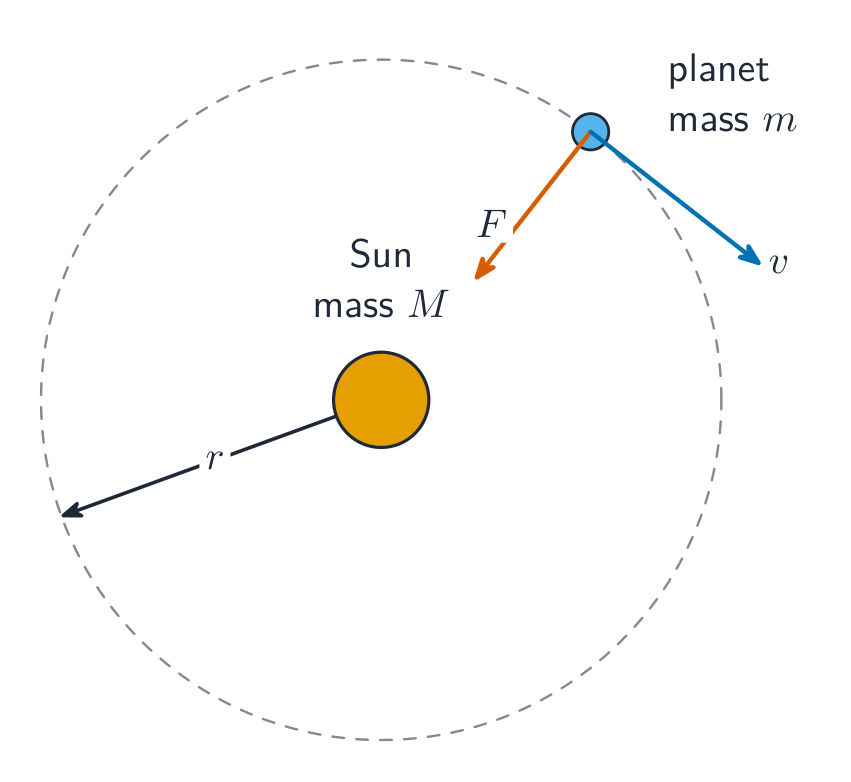
Gravity supplies the centripetal force 向心力 for a satellite 卫星 in a circular orbit:

$$\frac{GMm}{r^2}=\frac{mv^2}{r}\quad\Rightarrow\quad v=\sqrt{\frac{GM}{r}}$$

– larger orbits are slower. With gravitational potential energy 引力势能 $U_g=-\dfrac{GMm}{r}$, a circular orbit obeys $K=-\tfrac12U$, so the total mechanical energy 总机械能 is

$$E=K+U=\frac{U}{2}=-\frac{GMm}{2r},$$

negative because the satellite is bound. To escape from radius $r$, total energy must reach zero, giving the escape velocity 逃逸速度

$$v_{\text{esc}}=\sqrt{\frac{2GM}{r}}.$$

In an elliptical orbit 椭圆轨道, $E$ and $L$ are fixed: gravity points at the focus, so it exerts no torque about it. Conserved $L$ means the satellite sweeps equal areas in equal times – Kepler's second law 开普勒第二定律 – and therefore moves fastest at closest approach, slowest at the far point. Energy conservation connects speeds at the two ends.

Worked example. For a satellite at $r=7.0\times10^{6}\ \text{m}$ around Earth ($GM=4.0\times10^{14}\ \text{m}^3/\text{s}^2$): orbital speed $v=\sqrt{GM/r}=7.6\times10^{3}\ \text{m/s}$, while escaping from that radius needs $v_{\text{esc}}=\sqrt{2GM/r}=1.1\times10^{4}\ \text{m/s}$ – exactly $\sqrt2$ times the circular speed.

Exam skill. Orbit FRQs are energy-and-angular-momentum problems in disguise: write $E=\tfrac12mv^2-\dfrac{GMm}{r}$ and $L=mvr\sin\theta$ at the two points of interest and solve the pair – never assume the orbit formulae for circles apply to an ellipse.

ไทย
Orbital motion (Kepler's 2nd law)

แรงโน้มถ่วงจัด แรงแนวเข้าศูนย์กลาง สำหรับ ดาวเทียม ในวงโคจรวงกลม:

$$\frac{GMm}{r^2}=\frac{mv^2}{r}\quad\Rightarrow\quad v=\sqrt{\frac{GM}{r}}$$

– วงโคจรที่ใหญ่กว่าจะช้ากว่า. ด้วย ศักย์พลังงานโน้มถ่วง $U_g=-\dfrac{GMm}{r}$, วงโคจรวงกลมปฏิบัติตาม $K=-\tfrac12U$, ดังนั้น พลังงานกลรวม คือ

$$E=K+U=\frac{U}{2}=-\frac{GMm}{2r},$$

เป็นลบเพราะดาวเทียมถูกผูกมัด. เพื่อหลบหนีจากรัศมี $r$, พลังงานรวมต้องเป็นศูนย์, ให้ ความเร็วหลบหนี

$$v_{\text{esc}}=\sqrt{\frac{2GM}{r}}.$$
แรงโน้มถ่วงให้แรงสู่ศูนย์กลางที่ยึดดาวเทียมไว้ในวงโคจร

ใน วงโคจรวงรี, $E$ และ $L$ คงที่: แรงโน้มถ่วงชี้ไปที่โฟกัส, ดังนั้นมันไม่สร้างโมเมนต์รอบมัน. โมเมนตัมเชิงมุมคงที่ $L$ หมายความว่าดาวเทียมกวาดพื้นที่เท่ากันในเวลาที่เท่ากัน – กฎที่สองของเคปเลอร์ – และดังนั้นจึงเคลื่อนที่เร็วที่สุดที่จุดใกล้ที่สุด, ช้าที่สุดที่จุดไกลที่สุด. การอนุรักษ์พลังงานเชื่อมความเร็วที่ปลายทั้งสอง

ตัวอย่างที่คำนวณแล้ว. สำหรับดาวเทียมที่ $r=7.0\times10^{6}\ \text{m}$ รอบโลก ($GM=4.0\times10^{14}\ \text{m}^3/\text{s}^2$): ความเร็ววงโคจรคือ $v=\sqrt{GM/r}=7.6\times10^{3}\ \text{m/s}$, ในขณะที่หลบหนีออกจากรัศมีนั้นต้องใช้ $v_{\text{esc}}=\sqrt{2GM/r}=1.1\times10^{4}\ \text{m/s}$ – ซึ่งเท่ากับ $\sqrt2$ เท่าของความเร็วจักรรดิ

ทักษะการสอบ. FRQ เรื่องวงโคจรคือปัญหาเรื่องพลังงานและโมเมนตัมเชิงมุมที่ซ่อนอยู่: เขียน $E=\tfrac12mv^2-\dfrac{GMm}{r}$ และ $L=mvr\sin\theta$ ที่จุดทั้งสองที่ต้องการ แล้วแก้ระบบสมการคู่ – อย่าเพิ่งสันนิษฐานว่าสูตรวงโคจรสำหรับวงกลมใช้กับวงรีได้

Explore · ⁨สำรวจ⁩

Compare orbits at different radii · ⁨เปรียบเทียบวงโคจรที่รัศมิต่างๆ⁩

An orbiting satellite is in free fall, gravity supplying the centripetal force. A larger orbit means a slower speed and longer period (Kepler's third law). · ⁨ดาวเทียมโคจรอยู่ในการตกอิสระ โดยแรงโน้มถ่วงทำหน้าที่เป็นแรงเข้าศูนย์กลาง วงโคจรที่ใหญ่ขึ้น意味着ความเร็วช้าลงและ周期ยาวนานขึ้น (กฎที่สามของเคปเลอร์)⁩

6.6

Exam tips · ⁨ข้อแนะนำสำหรับการสอบ⁩

English
  • Compute the moment of inertia $I=\int r^2\,dm$ and shift axes with the parallel-axis theorem $I=I_{cm}+Md^2$.
  • Rotational kinetic energy is $\tfrac12 I\omega^2$; a rolling body has both translational and rotational KE.
  • Conserve angular momentum $L=I\omega$ when net external torque is zero (a spinning skater pulling in).
  • Use energy conservation for rolling-without-slipping problems ($v=r\omega$ ties the two motions).
  • Know standard $I$ values (hoop, disk, rod, sphere) and where the axis is.
ไทย
  • คำนวณ โมเมนต์ความเฉื่อย $I=\int r^2\,dm$ และเลื่อนแกนด้วย ทฤษฎีบทแกนขนาน $I=I_{cm}+Md^2$.
  • พลังงานจลน์จากการหมุนคือ $\tfrac12 I\omega^2$; วัตถุที่กลิ้งจะมีทั้งพลังงานจลน์แบบเคลื่อนที่และแบบหมุน
  • บำรุงรักษา โมเมนตัมเชิงมุม $L=I\omega$ เมื่อแรงบิดภายนอกสุทธิเป็นศูนย์ (นักสเก็ตที่หมุนแล้วดึงแขนเข้าหาตัว)
  • ใช้การอนุรักษ์พลังงานสำหรับปัญหารูปแบบกลิ้งโดยไม่ลื่นไถล ($v=r\omega$ เชื่อมโยงการเคลื่อนที่ทั้งสองเข้าด้วยกัน)
  • จำค่ามาตรฐานของ $I$ ได้ (ห่วง, ดิสก์, แท่ง, ลูกบอล) และรู้ว่าแกนอยู่ที่ไหน

Interactive lessons on this topic · ⁨บทเรียนเชิงโต้ตอบสำหรับหัวข้อนี้⁩

Work through it step by step, with instant-check exercises. · ⁨ทำทีละขั้นตอน พร้อมแบบฝึกหัดตรวจสอบผลทันที⁩

Past Papers · ⁨ข้อสอบย้อนหลัง⁩

More topics in AP Physics C: Mechanics · ⁨หัวข้อเพิ่มเติมใน AP Physics C: Mechanics⁩

Log in or create account · ⁨เข้าสู่ระบบหรือสร้างบัญชี⁩

IGCSE, A-Level & AP